ISC Class 12 Specimen Paper 2022 Electricity And Electronics Semester 1
Finished viewing? Save it for later —
Download ISC Class 12 Specimen Paper 2022 Electricity And Electronics Semester 1 (PDF · 19 pages)About ISC Class 12 Specimen Paper 2022 Electricity And Electronics Semester 1
ISC Class 12 Specimen Paper 2022 Electricity And Electronics Semester 1 is available here for free download. Published by CISCE for Class 12, this sample paper can be viewed online or downloaded as a PDF (19 pages). Candidates preparing for Class 12 can use ISC Class 12 Specimen Paper 2022 Electricity And Electronics Semester 1 to understand the exam pattern, the type of questions asked, and the overall difficulty level.
Frequently Asked Questions
How can I download ISC Class 12 Specimen Paper 2022 Electricity And Electronics Semester 1?
Open this page and click the Download button to save ISC Class 12 Specimen Paper 2022 Electricity And Electronics Semester 1 as a PDF. It is completely free on AglaSem Docs.
Is ISC Class 12 Specimen Paper 2022 Electricity And Electronics Semester 1 free to download?
Yes. ISC Class 12 Specimen Paper 2022 Electricity And Electronics Semester 1 can be viewed online and downloaded as a PDF free of cost on AglaSem Docs.
How many pages does ISC Class 12 Specimen Paper 2022 Electricity And Electronics Semester 1 have?
ISC Class 12 Specimen Paper 2022 Electricity And Electronics Semester 1 contains 19 pages, which you can read online or download together as a single PDF.
Where can I find more Class 12 study material?
You can find more Class 12 question papers, sample papers, syllabus, and answer keys on AglaSem Docs.
ISC Class 12 Specimen Paper 2022 Electricity And Electronics Semester 1 – Text
Read the full text of this sample paper below — useful to quickly search, copy and reference the content online without downloading the PDF.
📄 View text version (19 pages)
Page 1
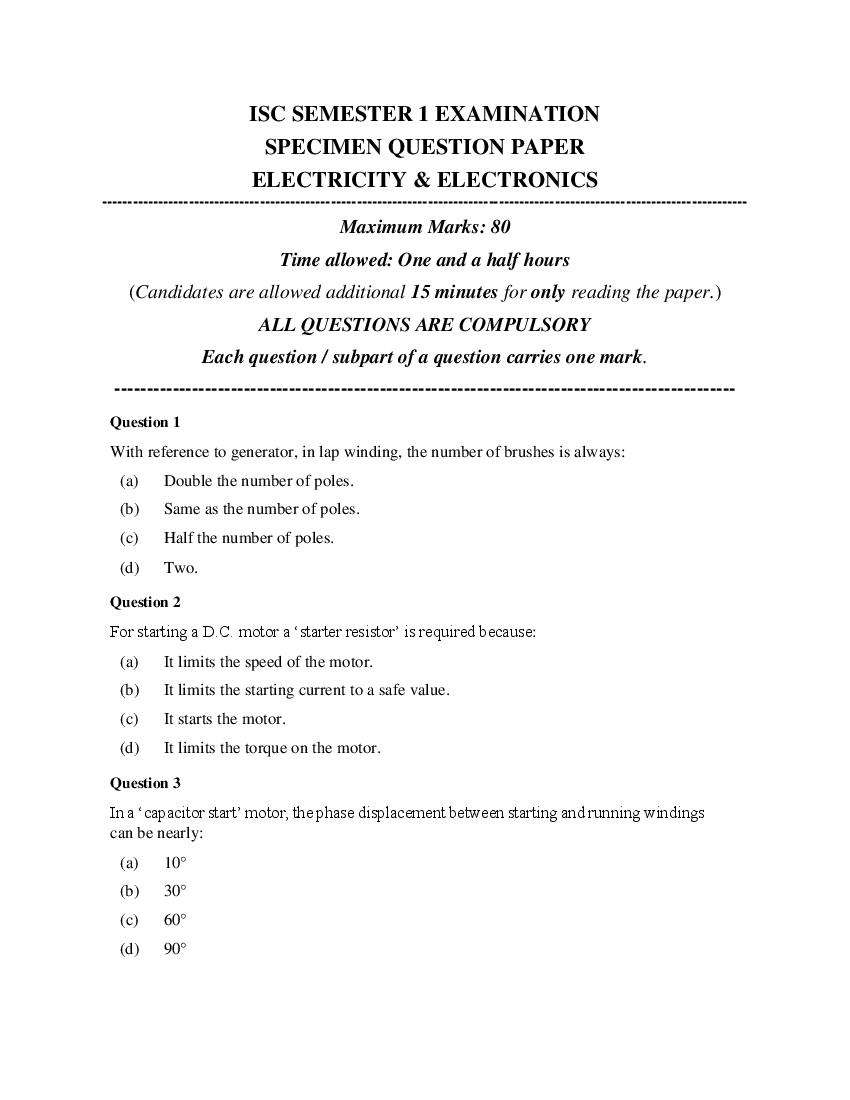
SPECIMEN QUESTION PAPER
ELECTRICITY & ELECTRONICS
-------------------------------------------------------------------------------------------------------------------------------
Maximum Marks: 80
Time allowed: One and a half hours
(Candidates are allowed additional 15 minutes for only reading the paper.)
ALL QUESTIONS ARE COMPULSORY
Each question / subpart of a question carries one mark.
------------------------------------------------------------------------------------------------
Question 1
With reference to generator, in lap winding, the number of brushes is always:
(a) Double the number of poles.
(b) Same as the number of poles.
(c) Half the number of poles.
(d) Two.
Question 2
For starting a D.C. motor a ‘starter resistor’ is required because:
(a) It limits the speed of the motor.
(b) It limits the starting current to a safe value.
(c) It starts the motor.
(d) It limits the torque on the motor.
Question 3
In a ‘capacitor start’ motor, the phase displacement between starting and running windings
can be nearly:
(a) 10°
(b) 30°
(c) 60°
(d) 90°
Page 2
Through which of the following systems can electric power be distributed?
(a) Overhead system.
(b) Underground system.
(c) Both (a) and (b).
(d) None of the above.
Question 5
Which of the following materials is not used for distribution of electrical power?
(a) Copper
(b) Aluminium
(c) Steel
(d) Tungsten
Question 6
A semiconductor diode has:
(a) One p-n junction.
(b) Two p-n junctions.
(c) Three p-n junctions.
(d) Four p-n junctions.
Question 7
If the arrow of crystal diode symbol is positive with reference to bar, then diode is
___________ biased.
(a) Forward
(b) Reverse
(c) Either forward or reverse
(d) None of the above
Question 8
When the crystal diode current is large, the bias is:
(a) Forward
(b) Inverse
(c) Poor
(d) Reverse
Page 3
If the temperature of a crystal diode increases, then leakage current:
(a) Remains the same
(b) Decreases
(c) Increases
(d) Becomes zero
Question 10
Semiconductor diode is used as:
(a) Oscillator
(b) Amplifier
(c) Rectifier
(d) Modulator
Question 11
For controlling the initial inrush of current:
(a) Reduced voltage is applied to the stator during the starting period.
(b) Reduced voltage is applied to the stator when the motor is running at rated speed.
(c) Either (a) or (b).
(d) The number of turns in the stator coil are increased.
Question 12
A crystal diode has forward resistance of the order of ___________.
(a) kΩ
(b) Ω
(c) MΩ
(d) GΩ
Question 13
If the p type of the crystal diode is connected to the positive terminal of the battery, then
this diode is:
(a) Forward biased
(b) Reverse biased
(c) Both (a) and (b)
(d) Unbiased
Page 4
The reverse current in a diode is of the order of ___________.
(a) kA
(b) mA
(c) μA
(d) A
Question 15
The forward voltage drop across a silicon diode is about:
(a) 2.5 V
(b) 3V
(c) 10 V
(d) 0.7 V
Question 16
The D.C resistance of a crystal diode is ___________ its A.C resistance.
(a) The same as
(b) More than
(c) Less than
(d) Equal to
Question 17
An ideal crystal diode is one which behaves as a perfect _________ when forward biased.
(a) conductor
(b) insulator
(c) resistance material
(d) none of the above
Question 18
The leakage current in a crystal diode is due to _________.
(a) minority carriers
(b) majority carriers
(c) junction capacitance
(d) none of the above
Page 5
If the temperature of a crystal diode increases, then leakage current __________.
(a) remains the same
(b) decreases
(c) increases
(d) becomes zero
Question 20
If the doping level of a crystal diode is increased, the breakdown voltage __________.
(a) Remains the same.
(b) Is increased.
(c) Is decreased.
(d) First increases and then gradually decreases.
Question 21
The knee voltage of a crystal diode is approximately equal to _______.
(a) applied voltage
(b) breakdown voltage
(c) forward voltage
(d) barrier potential
Question 22
When the crystal diode current is small, the bias is:
(a) forward
(b) inverse
(c) poor
(d) reverse
Question 23
A crystal diode is a _________ device.
(a) non-linear
(b) bilateral
(c) linear
(d) unilateral
Page 6
If the doping level in a crystal diode is increased, the width of depletion layer _______.
(a) Remains the same.
(b) Decreases.
(c) Increases.
(d) Initially increases and then abruptly decreases.
Question 25
The PIV rating of each diode means:
(a) Reverse voltage
(b) Forward voltage
(c) Reverse safe voltage
(d) Forward safe voltage
Question 26
If the PIV rating of a diode is exceeded:
(a) The diode conducts poorly.
(b) The diode is destroyed.
(c) The diode behaves like a resistor.
(d) The diode conducts heavily.
Question 27
Diode is made up of ____________ material.
(a) Conducting
(b) Insulating
(c) Semiconducting
(d) Electronic
Question 28
Semiconductors are classified as _________________.
(a) Intrinsic semiconductors
(b) Extrinsic semiconductors
(c) Both (a) and (b)
(d) None of the above
Page 7
Diode is a ______ device.
(a) Unidirectional
(b) Bidirectional
(c) Non-linear
(d) Both (a) and (c)
Question 30
Diode turns OFF if the applied voltage polarity is ________ the diode polarity.
(a) Similar to
(b) Matches
(c) Same as
(d) Opposite to
Question 31
A part of an electric circuit which is used to limit the amount of electric current flowing
through the circuit is known as a:
(a) Diode
(b) Thermistor
(c) Radiator
(d) Resistor
Question 32
The capacitors which use chemical reactions to store charge are called:
(a) Ceramic capacitors
(b) Fixed capacitors
(c) Parallel plate capacitors
(d) Electrolytic capacitors
Question 33
The capacitor which has a dielectric between its plates and is made of a flexible material
that can be rolled into the shape of a cylinder is called:
(a) Ceramic capacitor
(b) Fixed capacitor
(c) Parallel plate capacitor
(d) Electrolytic capacitor
Page 8
The figure 1 given below shows the symbol for:
figure 1
(a) An air core.
(b) A ferrite core.
(c) An iron core.
(d) None of the above.
Question 35
Why is the armature of a DC generator laminated?
(a) To reduce the bulk.
(b) To provide the bulk.
(c) To insulate the bulk.
(d) To reduce the eddy current loss.
Question 36
What are the field coils of a DC generator usually made up of?
(a) Mica
(b) Copper
(c) Cast iron
(d) Carbon
Question 37
A DC generator may lose a residual magnetism due to:
(a) Heating
(b) Vibrations
(c) Over excitation
(d) Any of the above
Page 9
If a D.C. motor is connected across the A.C. supply, it will:
(a) Run at anormal speed.
(b) Not run.
(c) Run at a speed lower than the rated speed.
(d) Burn due to heat produced in the field winding by eddy current.
Question 39
How can the speed of a D.C. shunt motor be increased?
(a) By increasing the resistance in armature circuit.
(b) By increasing the resistance in field circuit.
(c) By reducing the resistance in the field circuit.
(d) By reducing the resistance in the armature circuit.
Question 40
In a split-phase motor, the running winding should have:
(a) High resistance and low inductance.
(b) High resistance and High inductance.
(c) Low resistance and high inductance.
(d) Low resistance and low inductance.
Question 41
If the capacitor of a single-phase motor is short-circuited:
(a) The motor will not start.
(b) The motor will run in the same direction at a reduced speed.
(c) The motor will run in the reverse direction.
(d) None of the above.
Question 42
In a split-phase motor:
(a) Both, starting and running windings are connected through a centrifugal switch.
(b) Centrifugal switch is used to control supply voltage.
(c) The running winding is connected through a centrifugal switch.
(d) The starting winding is connected through a centrifugal switch.
Page 10
A shunt generator delivers 450 A at 230 V and the resistance of the shunt field and
armature are 50 Ω and 0.03 Ω respectively. What will be the generated e.m.f?
(a) 243.6 V
(b) 243.06 V
(c) 243 V
(d) 240 V
Question 44
400 V DC shunt motor takes 5 A at no load (Ra = 0.5 ohm, Rf = 200 ohm). What is the
difference between emf no - load and emf full - load when the DC shunt motor takes 50
A on full load?
(a) 22.5 V
(b) 22 V
(c) 25 V
(d) 23 V
Question 45
The material used for making the stator of an induction motor is:
(a) copper
(b) silicon steel
(c) iron
(d) gold
Question 46
What are the brushes of D.C. machines are made up of?
(a) carbon
(b) copper
(c) zinc
(d) Tungsten
Page 11
Inductors are ________ devices.
(a) active
(b) passive
(c) non-linear
(d) none of the above
Question 48
What happens to the speed of the D.C shunt motor if the load on it is increased?
(a) It reduces slightly.
(b) It increases slightly.
(c) Initially it increases and then decreases.
(d) Initially it decreases and then increases.
Question 49
The terminal voltage of a series generator is 150 V when the load current is 5 A. If the
load current is increased to 10 A, then what will be the terminal voltage?
(a) greater than 150 V.
(b) less than 150 V.
(c) exactly doubles.
(d) exactly halved.
Question 50
Resistors are ________ devices.
(a) polar
(b) non- polar
(c) non-linear
(d) none of the above
Question 51
DC generator uses ________ to conduct current to the external circuit.
(a) slip rings
(b) split ring
(c) both (a) and (b)
(d) brushes
Page 12
AC generator uses _______ to conduct current to the external circuit.
(a) slip rings
(b) split ring
(c) both (a) and (b)
(d) brushes
Question 53
Single phase A.C motor works when ___________ is given as input.
(a) A.C
(b) D.C
(c) both A.C and D.C
(d) none of the above
Question 54
The energy conversion in a loud speaker is:
(a) Sound energy to electrical energy.
(b) Electrical energy to sound energy.
(c) Mechanical energy to sound.
(d) Both (a) and (b).
Question 55
D.C motor converts:
(a) A.C to D.C voltage
(b) D.C to A.C voltage.
(c) mechanical energy to electrical energy
(d) electrical energy to mechanical.
Question 56
Boron is a ___________.
(a) Trivalent atom.
(b) Pentavalent atom.
(c) Tetravalent atom.
(d) Hexavalent atom.
Page 13
SI unit of inductor is:
(a) henry
(b) farad
(c) tesla
(d) weber
Question 58
Overload release coil is used as __________ in a D.C motor.
(a) Protective device.
(b) Supporting device.
(c) Heating device.
(d) Voltage stabilising device.
Question 59
Resistors are:
(a) Passive components
(b) Active components
(c) Non-linear components
(d) All of the above
Question 60
A diode has:
(a) only p-region
(b) only n-region
(c) both p-region and n-region.
(d) none of the above
Page 14
The circuit shown in figure 2 below is a simple diagram of an ‘inductor start’ motor.
figure 2
(i) The component labelled 1:
(a) Switch
(b) Two way switch
(c) Centrifugal switch
(d) None of the above
(ii) The component labelled 2:
(a) Auxiliary winding
(b) Main winding
(c) Resistor
(d) Transformer
Page 15
Figure 3 given below is a diagram of a semiconductor diode. Choose the correct option to
label markings 1 to 5.
figure 3
(i) Label 1:
(a) Positive ion
(b) Hole
(c) Boron atom
(d) None of the above
(ii) Label 2:
(a) Positive ion
(b) Negative ion
(c) arsenic atom
(d) None of the above
(iii) Label 3:
(a) Depletion region
(b) Saturated region
(c) Region with large number of charge carriers
(d) Diffusion region
(iv) Label 4:
(a) Positive ion
(b) hole
(c) indium atom
(d) none of the above
Page 16
(a) minority charge carriers
(b) majority charge carriers
(c) immobile charges
(d) germanium atom
Question 63
The graph in figure 4 given below shows that the semiconductor diode is ___________
biased.
figure 4
(a) Forward biased
(b) Reversed biased
(c) Unbiased
(d) None of the above
Question 64
Answer the following question with reference to vacuum diode.
(i) What is the terminal which is close to heater circuit called?
(a) Plate
(b) Cathode
(c) grid
(d) none of the above
(iii) In ‘space charge limited region’:
(a) Plate current increases as plate voltage increases
(b) Plate current decreases as plate voltage increases
(c) Plate current remains constant as plate voltage decreases.
(d) Plate current becomes erratic as plate voltage increases.
Page 17
Choose the correct option to replace the underlined word.
(i) The insulation colour used for ‘Live’ wire is yellow.
(a) red
(b) black
(c) orange
(d) green
(ii) Minority charge carriers in a p type semiconductor are holes.
(a) Electrons
(b) Indium atom
(c) Positive ions
(d) Negative ions
(iii) Arsenic has six electrons in their outer most orbit.
(a) Five
(b) Four
(c) Three
(d) None of the above
(iv) Forward biasing of p-n junction offers infinite resistance.
(a) 100 kilo ohm resistance
(b) Almost Zero resistance
(c) 10 kilo ohm resistance
(d) None of the above
(v) Resistor dissipate electric charge.
(a) Power
(b) Electrical energy
(c) Current
(d) Voltage
Page 18
Figure 5 given below showing the circuit diagram is a motor starter with a protective
device with parts labelled as I to V.
figure 5
Identify the parts:
(i) Labelled I
(a) starter resistor
(b) resistor for running the motor
(c) resistor in parallel to the motor
(d) all of the above
(ii) Labelled II
(a) soft iron
(b) glass
(c) wood
(d) Steel
(iii) Labelled III
(a) wooden keeper
(b) magnetic keeper
(c) rubber plank
(d) conducting rod
Page 19
(a) coil
(b) spiral spring
(c) supporting frame
(d) torsion spring
(v) Labelled V
(a) low volt release coil
(b) overload release coil
(c) supporting coil
(d) transformer.
Document Details
| Board / Org | CISCE |
| Exam | Class 12 |
| Type | Sample Paper |
| Pages | 19 |
| Language | english |
| Updated | 22 Jul 2026 |