AIBE 2027 Sample Paper English
Finished viewing? Save it for later —
Download AIBE 2027 Sample Paper English (PDF · 20 pages)About AIBE 2027 Sample Paper English
AIBE 2027 Sample Paper English is available here for free download. Published by BCI for AIBE, this sample paper can be viewed online or downloaded as a PDF (20 pages). Candidates preparing for AIBE can use AIBE 2027 Sample Paper English to understand the exam pattern, the type of questions asked, and the overall difficulty level.
Frequently Asked Questions
How can I download AIBE 2027 Sample Paper English?
Open this page and click the Download button to save AIBE 2027 Sample Paper English as a PDF. It is completely free on AglaSem Docs.
Is AIBE 2027 Sample Paper English free to download?
Yes. AIBE 2027 Sample Paper English can be viewed online and downloaded as a PDF free of cost on AglaSem Docs.
How many pages does AIBE 2027 Sample Paper English have?
AIBE 2027 Sample Paper English contains 20 pages, which you can read online or download together as a single PDF.
Where can I find more AIBE study material?
You can find more AIBE question papers, sample papers, syllabus, and answer keys on AglaSem Docs.
AIBE 2027 Sample Paper English – Text
Read the full text of this sample paper below — useful to quickly search, copy and reference the content online without downloading the PDF.
📄 View text version (20 pages)
Page 1
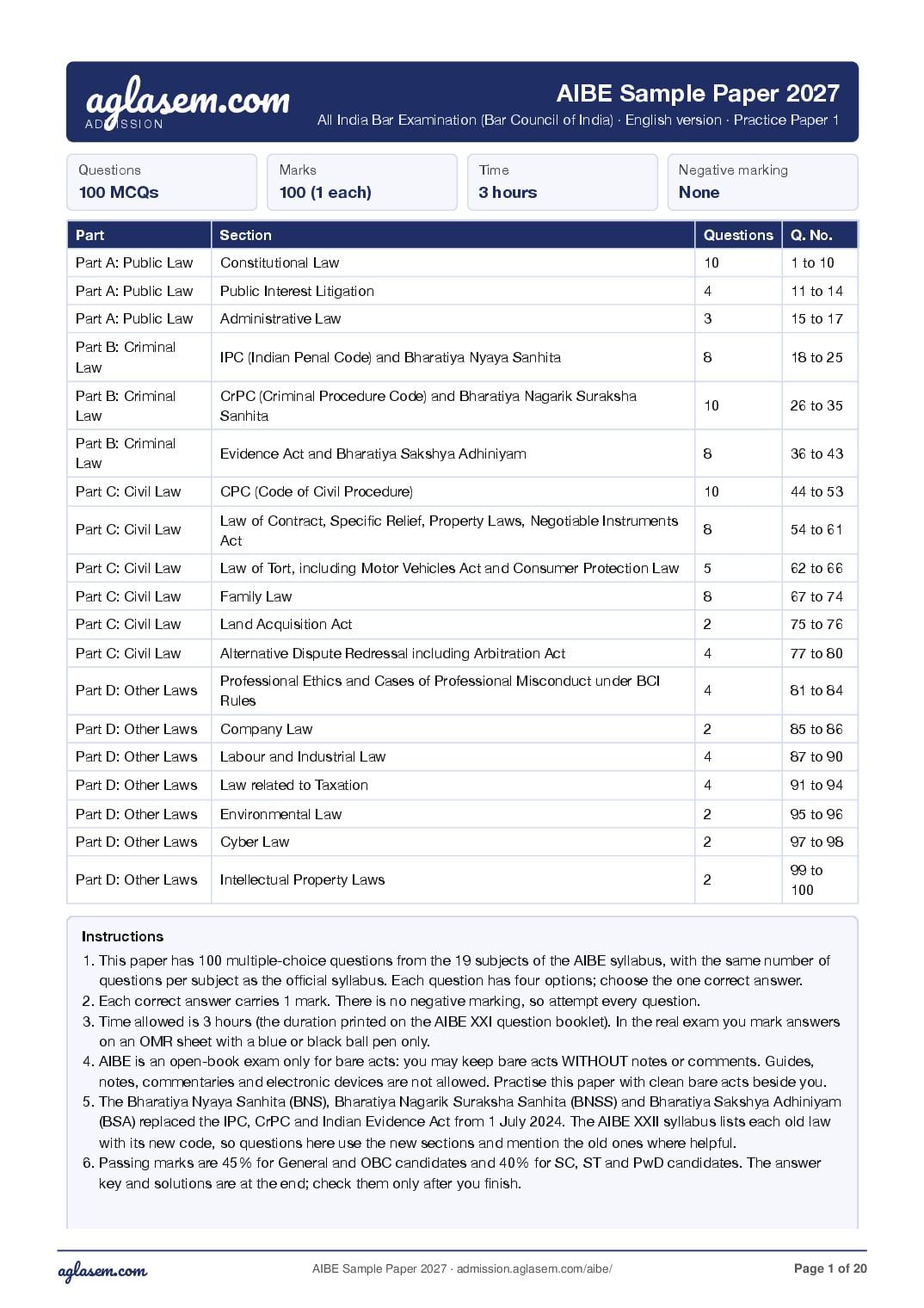
AIBE Sample Paper 2027
All India Bar Examination (Bar Council of India) · English version · Practice Paper 1
Questions Marks Time Negative marking
100 MCQs 100 (1 each) 3 hours None
Part Section Questions Q. No.
Part A: Public Law Constitutional Law 10 1 to 10
Part A: Public Law Public Interest Litigation 4 11 to 14
Part A: Public Law Administrative Law 3 15 to 17
Part B: Criminal
IPC (Indian Penal Code) and Bharatiya Nyaya Sanhita 8 18 to 25
Law
Part B: Criminal CrPC (Criminal Procedure Code) and Bharatiya Nagarik Suraksha
10 26 to 35
Law Sanhita
Part B: Criminal
Evidence Act and Bharatiya Sakshya Adhiniyam 8 36 to 43
Law
Part C: Civil Law CPC (Code of Civil Procedure) 10 44 to 53
Law of Contract, Specific Relief, Property Laws, Negotiable Instruments
Part C: Civil Law 8 54 to 61
Act
Part C: Civil Law Law of Tort, including Motor Vehicles Act and Consumer Protection Law 5 62 to 66
Part C: Civil Law Family Law 8 67 to 74
Part C: Civil Law Land Acquisition Act 2 75 to 76
Part C: Civil Law Alternative Dispute Redressal including Arbitration Act 4 77 to 80
Professional Ethics and Cases of Professional Misconduct under BCI
Part D: Other Laws 4 81 to 84
Rules
Part D: Other Laws Company Law 2 85 to 86
Part D: Other Laws Labour and Industrial Law 4 87 to 90
Part D: Other Laws Law related to Taxation 4 91 to 94
Part D: Other Laws Environmental Law 2 95 to 96
Part D: Other Laws Cyber Law 2 97 to 98
99 to
Part D: Other Laws Intellectual Property Laws 2
100
Instructions
1. This paper has 100 multiple-choice questions from the 19 subjects of the AIBE syllabus, with the same number of
questions per subject as the official syllabus. Each question has four options; choose the one correct answer.
2. Each correct answer carries 1 mark. There is no negative marking, so attempt every question.
3. Time allowed is 3 hours (the duration printed on the AIBE XXI question booklet). In the real exam you mark answers
on an OMR sheet with a blue or black ball pen only.
4. AIBE is an open-book exam only for bare acts: you may keep bare acts WITHOUT notes or comments. Guides,
notes, commentaries and electronic devices are not allowed. Practise this paper with clean bare acts beside you.
5. The Bharatiya Nyaya Sanhita (BNS), Bharatiya Nagarik Suraksha Sanhita (BNSS) and Bharatiya Sakshya Adhiniyam
(BSA) replaced the IPC, CrPC and Indian Evidence Act from 1 July 2024. The AIBE XXII syllabus lists each old law
with its new code, so questions here use the new sections and mention the old ones where helpful.
6. Passing marks are 45% for General and OBC candidates and 40% for SC, ST and PwD candidates. The answer
key and solutions are at the end; check them only after you finish.
AIBE Sample Paper 2027 · admission./aibe/ Page 1 of 20
Page 2
questions, 1 mark each, no negative marking). It is not an official BCI paper and its questions are original. AIBE is also offered in
several Indian languages; this is the English version. Law is stated as on 26 October 2026.
Part A: Public Law
Constitutional Law
1. The 'basic structure' doctrine, which limits Parliament's power to amend the Constitution under Article
368, was laid down in:
(A) Shankari Prasad v. Union of India (1951)
(B) Kesavananda Bharati v. State of Kerala (1973)
(C) Minerva Mills Ltd. v. Union of India (1980)
(D) I.C. Golaknath and Others v. State of Punjab (1967)
2. Dr. B.R. Ambedkar described one Article as 'the very soul of the Constitution and the very heart of it'.
That Article is:
(A) Article 21 (B) Article 14
(C) Article 32 (D) Article 226
3. In Maneka Gandhi v. Union of India (1978), the Supreme Court held that:
(A) the right to go abroad is not part of personal liberty
(B) Articles 14, 19 and 21 operate in separate, mutually exclusive compartments
(C) procedure under Article 21 must be just, fair and reasonable
(D) Article 21 protects a person against executive action only
4. A person holding a public office to which he is not legally entitled can be challenged through the writ of:
(A) Habeas corpus (B) Certiorari
(C) Mandamus (D) Quo warranto
5. A Constitution Amendment Bill that changes the representation of States in Parliament must, after being
passed by the special majority in each House, also be ratified by:
(A) the Legislatures of at least two-thirds of the States
(B) the Legislatures of all the States without exception
(C) no State Legislature, as Parliament's vote is enough
(D) the Legislatures of at least one-half of the States
6. The right to free and compulsory education for children of 6 to 14 years (Article 21A) was inserted by
the:
(A) Constitution (Forty-fourth Amendment) Act, 1978
(B) Constitution (Forty-second Amendment) Act, 1976
(C) Constitution (Eighty-sixth Amendment) Act, 2002
(D) Constitution (Ninety-third Amendment) Act, 2005
7. Assertion (A): The right to property is no longer a Fundamental Right in India.
Reason (R): The Constitution (Forty-fourth Amendment) Act, 1978 omitted Article 31 and inserted Article
300A, which makes it a constitutional right.
Choose the correct option.
(A) Both (A) and (R) are true, and (R) is the correct explanation of (A).
(B) (A) is false, but (R) is true.
(C) Both (A) and (R) are true, but (R) is not the correct explanation of (A).
(D) (A) is true, but (R) is false.
AIBE Sample Paper 2027 · admission./aibe/ Page 2 of 20
Page 3
contained in:
(A) Article 72 (B) Article 352
(C) Article 123 (D) Article 213
9. During a Proclamation of Emergency, the President cannot suspend the right to move a court for
enforcement of which Fundamental Rights?
(A) Articles 19 and 21 (B) Articles 20 and 21
(C) Articles 21 and 22 (D) Articles 14 and 21
10. The doctrine of eclipse, applied in Bhikaji Narain Dhakras v. State of M.P. (1955), applies to:
(A) pre-Constitution laws that are inconsistent with Fundamental Rights
(B) laws made by Parliament outside its legislative competence
(C) constitutional amendments that damage the basic structure
(D) delegated legislation that goes beyond the parent Act
Public Interest Litigation
11. The PIL in which the Supreme Court recognised the right to a speedy trial as part of Article 21 and
ordered the release of undertrials detained for very long periods is:
(A) S.P. Gupta v. Union of India
(B) Hussainara Khatoon v. Home Secretary, Bihar
(C) Olga Tellis v. Bombay Municipal Corporation
(D) Bandhua Mukti Morcha v. Union of India
12. In which case did the Supreme Court relax the rule of locus standi and hold that any member of the
public acting bona fide can seek redress for a public wrong or public injury?
(A) S.P. Gupta v. Union of India (1981)
(B) A.K. Gopalan v. State of Madras (1950)
(C) State of Madras v. V.G. Row (1952)
(D) Kharak Singh v. State of U.P. (1962)
13. 'Epistolary jurisdiction' in Public Interest Litigation refers to the court:
(A) deciding a case only on written submissions
(B) transferring a case on receiving a letter
(C) issuing its directions to officers by post
(D) treating a letter addressed to it as a writ petition
14. A Public Interest Litigation can be filed in the Supreme Court and in a High Court, respectively, under:
(A) Article 32 and Article 226 (B) Article 136 and Article 227
(C) Article 131 and Article 228 (D) Article 226 and Article 32
Administrative Law
15. The maxim 'nemo judex in causa sua' means:
(A) every decision must be supported by reasons
(B) a delegate cannot further delegate its power
(C) no person should be a judge in his own cause
(D) the other side must be heard before deciding
AIBE Sample Paper 2027 · admission./aibe/ Page 3 of 20
Page 4
line between administrative and quasi-judicial power is thin, in:
(A) Ram Jawaya Kapur v. State of Punjab (1955)
(B) A.K. Kraipak v. Union of India (1969)
(C) Union of India v. Tulsiram Patel (1985)
(D) In re Delhi Laws Act (1951)
17. The 'Wednesbury principle' is a ground for judicial review of an administrative decision on the basis of:
(A) its gross unreasonableness or irrationality
(B) the bias of the deciding authority
(C) excessive delegation of legislative power
(D) the State's vicarious liability for its servants' torts
Part B: Criminal Law
IPC (Indian Penal Code) and Bharatiya Nyaya Sanhita
18. The Bharatiya Nyaya Sanhita, 2023, which replaced the Indian Penal Code from 1 July 2024, contains:
(A) 358 sections (B) 531 sections
(C) 170 sections (D) 511 sections
19. Acts done by several persons in furtherance of a common intention (Section 34 IPC) are now covered
by which provision of the BNS?
(A) Section 61(1) (B) Section 34
(C) Section 190 (D) Section 3(5)
20. The offence of sedition (Section 124A IPC) has not been retained in the BNS. The provision that now
deals with acts against the nation is:
(A) Section 113: committing a terrorist act in or outside India
(B) Section 147: waging or attempting to wage war against the Government
(C) Section 152: endangering sovereignty, unity and integrity of India
(D) Section 197: imputations prejudicial to national integration
21. Section 4 of the BNS lists the punishments. Which of these was NOT a punishment under Section 53
IPC and has been newly added?
(A) Simple imprisonment (B) Imprisonment for life
(C) Forfeiture of property (D) Community service
22. Under Section 103(2) of the BNS, murder by a group acting in concert on the ground of race, caste or
community, sex, place of birth, language or personal belief (mob lynching) requires a group of:
(A) five or more persons (B) two or more persons
(C) ten or more persons (D) three or more persons
23. In which of these cases does the right of private defence of the body NOT extend to causing death
(Section 38 BNS, formerly Section 100 IPC)?
(A) A slap causing simple hurt, with no threat of graver harm
(B) Throwing or attempting to throw acid on the person
(C) An assault with the intention of committing rape
(D) An assault with the intention of kidnapping or abducting
24. Under Section 20 BNS (Section 82 IPC), nothing is an offence which is done by a child under the age of:
(A) twelve years (B) seven years
(C) ten years (D) sixteen years
AIBE Sample Paper 2027 · admission./aibe/ Page 4 of 20
Page 5
Under Section 303 BNS (theft), A has:
(A) committed criminal misappropriation on taking it
(B) not committed theft, as he did not act dishonestly
(C) committed theft, as the watch was moved without consent
(D) committed criminal breach of trust against B
CrPC (Criminal Procedure Code) and Bharatiya Nagarik Suraksha Sanhita
26. Under Section 173 BNSS, information about a cognizable offence may be given by electronic
communication (e-FIR). Such information is taken on record when signed by the informant within:
(A) seven days (B) 24 hours
(C) fifteen days (D) three days
27. For a cognizable offence punishable with imprisonment of three years or more but less than seven
years, Section 173(3) BNSS allows the officer in charge, with permission of an officer not below the rank
of DSP, to conduct a preliminary enquiry to see if a prima facie case exists. It must be completed within:
(A) 7 days (B) 14 days
(C) 30 days (D) 60 days
28. Maintenance of wives, children and parents, earlier provided in Section 125 CrPC, is now provided in:
(A) Section 163 BNSS (B) Section 173 BNSS
(C) Section 144 BNSS (D) Section 125 BNSS
29. The inherent powers of the High Court, earlier saved by Section 482 CrPC, are now saved by:
(A) Section 530 BNSS (B) Section 482 BNSS
(C) Section 483 BNSS (D) Section 528 BNSS
30. Where the offence is punishable with death, imprisonment for life or imprisonment for not less than ten
years, an accused becomes entitled to 'default bail' if the investigation is not completed within:
(A) 60 days (B) 120 days
(C) 180 days (D) 90 days
31. Under Section 23 BNSS, a Judicial Magistrate of the first class may pass a sentence of imprisonment
up to three years, or a fine not exceeding ____, or both, or community service.
(A) one lakh rupees (B) five thousand rupees
(C) ten thousand rupees (D) fifty thousand rupees
32. Section 176(3) BNSS provides that, from the date notified by the State Government, a forensic expert
shall visit the crime scene to collect forensic evidence (and the process shall be video-graphed) for
every offence punishable with imprisonment of:
(A) ten years or more (B) life or death only
(C) three years or more (D) seven years or more
33. Under Section 479 BNSS (earlier Section 436A CrPC), a first-time offender who has been in detention
as an undertrial for up to ____ of the maximum imprisonment for the offence shall be released on bond
by the court.
(A) two-thirds (B) one-third
(C) one-half (D) one-fourth
AIBE Sample Paper 2027 · admission./aibe/ Page 5 of 20
Page 6
Criminal Court under the BNSS?
(A) Metropolitan Magistrates
(B) Courts of Session
(C) Judicial Magistrates of the second class
(D) Executive Magistrates
35. Under Section 35(7) BNSS, no arrest shall be made without prior permission of an officer not below the
rank of DSP for an offence punishable with less than three years where the person is infirm or is above
the age of:
(A) 65 years (B) 60 years
(C) 70 years (D) 75 years
Evidence Act and Bharatiya Sakshya Adhiniyam
36. The admissibility of electronic records and the certificate requirement, earlier in Section 65B of the
Indian Evidence Act, are now in:
(A) Section 57 BSA (B) Section 63 BSA
(C) Section 65B BSA (D) Section 61 BSA
37. Under the BSA, the rule that so much of the information received from an accused in police custody as
distinctly relates to a fact discovered may be proved (Section 27 IEA) is found in:
(A) Section 22 of the Adhiniyam
(B) the proviso to Section 23(2)
(C) Section 27 of the Adhiniyam
(D) the first proviso to Section 22
38. Under Indian law (Section 26(a) BSA, formerly Section 32(1) IEA), a statement by a person about the
cause of his death is relevant:
(A) only if it was recorded by a Magistrate
(B) only if he was then under expectation of imminent death
(C) whether or not he expected death when he made it
(D) only in proceedings for murder
39. When any fact is especially within the knowledge of any person (Section 106 IEA, now Section 109
BSA), the burden of proving that fact is upon:
(A) the court, by calling a witness
(B) that person
(C) the party who first alleges it
(D) the prosecution in every case
40. Leading questions may be asked as a matter of course in:
(A) cross-examination (B) none of these stages
(C) examination-in-chief (D) re-examination
41. Section 22 BSA (formerly Section 24 IEA) makes a confession irrelevant if it appears to have been
caused by inducement, threat, promise or one more ground that the BSA has added expressly. That
ground is:
(A) coercion (B) fraud
(C) intoxication (D) mistake
AIBE Sample Paper 2027 · admission./aibe/ Page 6 of 20
Page 7
in the Schedule and signed by:
(A) a gazetted officer of the State Government
(B) the person in charge of the device and an expert
(C) a Judicial Magistrate of the first class
(D) the investigating officer of the case alone
43. A conviction based only on the uncorroborated testimony of an accomplice is:
(A) valid only in summons-case trials
(B) valid only if the accomplice was pardoned
(C) not illegal merely for that reason
(D) illegal and void in every case
Part C: Civil Law
CPC (Code of Civil Procedure)
44. The doctrine of res judicata is contained in:
(A) Section 12 CPC (B) Section 10 CPC
(C) Section 9 CPC (D) Section 11 CPC
45. Which of the following is NOT a ground for rejection of a plaint under Order VII Rule 11 CPC?
(A) The plaint does not disclose a cause of action
(B) The defendant has raised a counter-claim in his reply
(C) The relief is undervalued and not corrected within time
(D) The suit appears from the plaint to be barred by law
46. Temporary injunctions are granted under:
(A) Order XXXIX Rules 1 and 2 (B) Order XXI Rule 32
(C) Order XL Rule 1 (D) Order XXXVIII Rule 5
47. Under Section 80 CPC, a suit against the Government or a public officer (for an act in official capacity)
can be filed only after the expiry of ____ after notice in writing has been delivered.
(A) six months (B) one month
(C) two months (D) three months
48. An application by a defendant to set aside an ex parte decree passed against him is made under:
(A) Order IX Rule 9 (B) Order XLVII Rule 1
(C) Order XLI Rule 1 (D) Order IX Rule 13
49. Under Order VIII Rule 1 CPC, the written statement is to be filed within 30 days of service of summons,
and the court may for recorded reasons extend the time, but the Rule says not later than:
(A) 180 days from service of summons
(B) 90 days from service of summons
(C) 120 days from service of summons
(D) 60 days from service of summons
50. A caveat lodged under Section 148A CPC remains in force for:
(A) 90 days from lodging (B) 30 days from lodging
(C) one year from lodging (D) 60 days from lodging
AIBE Sample Paper 2027 · admission./aibe/ Page 7 of 20
Page 8
questions about religious rites or ceremonies, is:
(A) triable only by a Revenue Court
(B) maintainable only with the State's consent
(C) barred, being a purely religious question
(D) a suit of a civil nature, triable by a civil court
52. The inherent powers of a civil court to make orders necessary for the ends of justice or to prevent abuse
of its process are saved by:
(A) Section 115 CPC (B) Section 151 CPC
(C) Section 148 CPC (D) Section 152 CPC
53. A person holding money claimed by two rival claimants, who claims no interest in it except costs and is
ready to pay the rightful claimant, may file:
(A) a summary suit (B) a representative suit
(C) a suit as an indigent person (D) an interpleader suit
Law of Contract, Specific Relief, Property Laws, Negotiable Instruments Act
54. In Mohori Bibee v. Dharmodas Ghose (1903), the Privy Council held that an agreement with a minor is:
(A) absolutely void (void ab initio)
(B) valid if it is for the minor's benefit
(C) valid but unenforceable at law
(D) voidable at the option of the minor
55. Where a contract names a sum to be paid in case of breach, Section 74 of the Indian Contract Act
entitles the party complaining of the breach to:
(A) only nominal damages, as the sum is a penalty
(B) nothing unless actual loss is first proved
(C) the full sum named, whatever the actual loss
(D) reasonable compensation not exceeding the sum named
56. After the Specific Relief (Amendment) Act, 2018, specific performance of a contract:
(A) is granted only if damages are an inadequate remedy
(B) remains a purely discretionary relief of the court
(C) shall be enforced, subject to the exceptions in the Act
(D) cannot be granted for contracts about immovable property
57. Under Section 54 of the Transfer of Property Act, 1882, a sale of tangible immovable property must be
made by a registered instrument where its value is:
(A) ten thousand rupees or more (B) one thousand rupees or more
(C) five hundred rupees or more (D) one hundred rupees or more
58. The rule that a party to a pending suit about immovable property cannot transfer it so as to affect the
rights of the other party under the decree is:
(A) Section 53A: part performance
(B) Section 41: transfer by an ostensible owner
(C) Section 52: the doctrine of lis pendens
(D) Section 43: feeding the grant by estoppel
AIBE Sample Paper 2027 · admission./aibe/ Page 8 of 20
Page 9
demand for payment to the drawer within ____ of receiving information from the bank that the cheque
was returned unpaid.
(A) 45 days (B) 60 days
(C) 15 days (D) 30 days
60. The presumption under Section 139 of the Negotiable Instruments Act that the holder received the
cheque for the discharge of a debt or liability is:
(A) conclusive and cannot be rebutted at all
(B) rebuttable, on a preponderance of probabilities
(C) available only for cheques above one lakh rupees
(D) rebuttable only by proof beyond reasonable doubt
61. Where both parties to an agreement are under a mistake as to a matter of fact essential to the
agreement, the agreement is:
(A) voidable under Section 19A (B) voidable under Section 19
(C) void under Section 23 (D) void under Section 20
Law of Tort, including Motor Vehicles Act and Consumer Protection Law
62. In M.C. Mehta v. Union of India (1987, Oleum gas leak), the Supreme Court held that an enterprise
engaged in a hazardous or inherently dangerous activity is subject to:
(A) liability only on proof of negligence
(B) strict liability, with the usual exceptions
(C) liability shared equally with the State
(D) absolute liability, with no exceptions
63. A spectator at a cricket match is hit by a ball struck in the ordinary course of play. The organisers can
best rely on the defence of:
(A) res ipsa loquitur (B) volenti non fit injuria
(C) damnum sine injuria (D) novus actus interveniens
64. Under Section 69 of the Consumer Protection Act, 2019, a complaint must ordinarily be filed within:
(A) ninety days from the date of the cause of action
(B) one year from the date of the cause of action
(C) two years from the date of the cause of action
(D) three years from the date of the cause of action
65. Under Section 164 of the Motor Vehicles Act, 1988 (as amended in 2019), the owner or insurer must pay
compensation for death in a motor accident, without the claimant having to prove any wrongful act or
negligence, of:
(A) five lakh rupees (B) two lakh rupees
(C) ten lakh rupees (D) fifty thousand rupees
66. In Kasturilal Ralia Ram Jain v. State of U.P. (1965), the Supreme Court held that:
(A) sovereign immunity had been abolished by Article 300
(B) the State was not liable, as the act was a sovereign function
(C) police officers can never be personally sued for negligence
(D) the State is liable like any private employer in every case
AIBE Sample Paper 2027 · admission./aibe/ Page 9 of 20
Page 10
67. Under Section 5(iii) of the Hindu Marriage Act, 1955, the minimum ages at the time of marriage are:
(A) 21 years for the bridegroom and 18 for the bride
(B) 21 years for both the bridegroom and the bride
(C) 18 years for the bridegroom and 16 for the bride
(D) 18 years for both the bridegroom and the bride
68. For divorce by mutual consent under Section 13B of the Hindu Marriage Act, the spouses must have
been living separately for at least:
(A) two years (B) one year
(C) six months (D) three years
69. In Vineeta Sharma v. Rakesh Sharma (2020), the Supreme Court held that under the amended Section 6
of the Hindu Succession Act, a daughter:
(A) is a coparcener only if she was born after 9 September 2005
(B) is a coparcener only if her father was alive on 9 September 2005
(C) is a coparcener by birth, even if her father died before 9.9.2005
(D) gets coparcenary rights only after the death of her father
70. Under the Muslim Women (Protection of Rights on Marriage) Act, 2019, the pronouncement of talaq-e-
biddat (instant triple talaq) by a husband is:
(A) valid only if pronounced in front of two adult witnesses
(B) voidable at the option of the wife within ninety days of it
(C) void and illegal, and an offence punishable with imprisonment
(D) valid, though the husband can be made to pay a fine to the wife
71. Under the Hindu Adoptions and Maintenance Act, 1956, when a male Hindu adopts a daughter, he must
be older than the child by at least:
(A) 25 years (B) 18 years
(C) 21 years (D) 15 years
72. Under Section 5 of the Special Marriage Act, 1954, the notice of intended marriage is given to the
Marriage Officer of the district in which at least one party has resided for not less than:
(A) 30 days before the notice (B) 60 days before the notice
(C) 90 days before the notice (D) 15 days before the notice
73. In Githa Hariharan v. Reserve Bank of India (1999), the word 'after' in Section 6(a) of the Hindu Minority
and Guardianship Act (father, and after him, the mother) was read to mean:
(A) after the father remarries (B) after the death of the father
(C) in the absence of the father (D) after the father turns sixty
74. The case in which the Supreme Court held that a divorced Muslim wife who is unable to maintain
herself can claim maintenance under Section 125 CrPC is:
(A) Lily Thomas v. Union of India (2000)
(B) Sarla Mudgal v. Union of India (1995)
(C) Shayara Bano v. Union of India (2017)
(D) Mohd. Ahmed Khan v. Shah Bano Begum (1985)
AIBE Sample Paper 2027 · admission./aibe/ Page 10 of 20
Page 11
75. Under the Right to Fair Compensation and Transparency in Land Acquisition, Rehabilitation and
Resettlement Act, 2013, the solatium payable is:
(A) 30% of the market value
(B) 100% of the market value of the land
(C) 100% of the compensation amount
(D) 12% of the market value
76. Under Section 2(2) of the 2013 Act, land acquired for private companies requires the prior consent of at
least what share of the affected families?
(A) 80 per cent (B) 70 per cent
(C) 90 per cent (D) 60 per cent
Alternative Dispute Redressal including Arbitration Act
77. Under Section 8 of the Arbitration and Conciliation Act, 1996, a judicial authority must refer the parties
to arbitration if a party applies:
(A) at any time before the final hearing of the suit has begun in court
(B) only after the court has framed the issues in the suit
(C) within ninety days from the date of service of summons
(D) by the date of his first statement on the substance of the dispute
78. Under Section 29A of the 1996 Act, in an arbitration other than an international commercial arbitration,
the award must be made within:
(A) 12 months from completion of pleadings
(B) 18 months from the date of the agreement
(C) 24 months from the date of the reference
(D) 6 months from appointment of the arbitrator
79. An application to set aside an arbitral award under Section 34 of the 1996 Act must be made within:
(A) six months, with no extension at all
(B) ninety days, extendable by ninety days
(C) three months, extendable by thirty days
(D) thirty days, extendable by fifteen days
80. Under the Legal Services Authorities Act, 1987, an award of a Lok Adalat is:
(A) appealable to the District Judge within thirty days
(B) deemed a civil court decree, and no appeal lies against it
(C) only a recommendation that does not bind the parties
(D) binding only after it is confirmed by the High Court
Part D: Other Laws
Professional Ethics and Cases of Professional Misconduct under BCI Rules
81. Under Section 35 of the Advocates Act, 1961, which of the following is NOT an order that a State Bar
Council's disciplinary committee can pass against an advocate found guilty of misconduct?
(A) Reprimanding the advocate
(B) Suspending him from practice
(C) Removing his name from the roll
(D) Imposing a monetary fine on him
AIBE Sample Paper 2027 · admission./aibe/ Page 11 of 20
Page 12
(A) the Supreme Court, within sixty days
(B) the Attorney General, within forty-five days
(C) the Central Government, within ninety days
(D) the High Court, within thirty days
83. In Supreme Court Bar Association v. Union of India (1998), the Supreme Court held that:
(A) it can suspend an advocate's licence under Article 142
(B) Bar Councils have no power to punish advocates at all
(C) it cannot suspend an advocate's licence while punishing contempt
(D) only the High Court can punish an advocate for contempt
84. An advocate agrees with a client to charge a fixed fee plus 10% of whatever amount the client recovers
in the suit. Under the BCI Rules, this is:
(A) misconduct, as fee cannot depend on the result
(B) allowed, if the client agrees to it in writing
(C) allowed in money suits but not in criminal cases
(D) allowed, if the share is under one-fourth of it
Company Law
85. Under the Companies Act, 2013, the minimum number of members required to form a public company
is:
(A) seven (B) five
(C) three (D) two
86. A company covered by Section 135 of the Companies Act, 2013 must spend on Corporate Social
Responsibility in every financial year at least:
(A) 2% of its average net profits of the preceding three years
(B) 2% of its paid-up share capital at the start of that financial year
(C) 1% of its turnover of the immediately preceding year
(D) 5% of its net profit of the immediately preceding year
Labour and Industrial Law
87. The 'triple test' for deciding whether an activity is an 'industry' was laid down in:
(A) Bangalore Water Supply v. A. Rajappa (1978)
(B) Workmen of Dimakuchi Tea Estate v. Management (1958)
(C) Hussainbhai v. Alath Factory Union (1978)
(D) Excel Wear v. Union of India (1978)
88. Which of the following is NOT one of the four Labour Codes enacted by Parliament?
(A) The Code on Social Security, 2020
(B) The Code on Employment Security, 2020
(C) The Occupational Safety, Health and Working Conditions Code, 2020
(D) The Industrial Relations Code, 2020
89. Under the Payment of Gratuity Act, 1972, gratuity for an employee paid monthly is calculated at the rate
of ____ for every completed year of service.
(A) twenty-six days' wages (B) seven days' wages
(C) thirty days' wages (D) fifteen days' wages
AIBE Sample Paper 2027 · admission./aibe/ Page 12 of 20
Page 13
out of and in the course of his employment' is the basic rule of the:
(A) Trade Unions Act, 1926
(B) Employees' Compensation Act, 1923
(C) Minimum Wages Act, 1948
(D) Factories Act, 1948
Law related to Taxation
91. 'No tax shall be levied or collected except by authority of law' is provided in:
(A) Article 280 (B) Article 300
(C) Article 265 (D) Article 266
92. The Goods and Services Tax Council is constituted under:
(A) Article 246A (B) Article 280
(C) Article 269A (D) Article 279A
93. Integrated Goods and Services Tax (IGST) is levied on:
(A) intra-State supplies of goods only
(B) services supplied within a single State
(C) alcoholic liquor for human consumption
(D) inter-State supplies of goods or services
94. A tax on agricultural income can be levied by:
(A) Parliament and States jointly (B) Parliament alone
(C) State Legislatures (D) local bodies alone
Environmental Law
95. The 'polluter pays' and 'precautionary' principles were held to be part of the law of the land in:
(A) Rural Litigation and Entitlement Kendra v. State of U.P. (1985)
(B) M.C. Mehta v. Kamal Nath (1997)
(C) Vellore Citizens' Welfare Forum v. Union of India (1996)
(D) T.N. Godavarman Thirumulpad v. Union of India (1997)
96. An appeal against an award, decision or order of the National Green Tribunal lies to:
(A) the High Court, within sixty days
(B) the Supreme Court, within thirty days
(C) the Supreme Court, within ninety days
(D) the Central Government, within thirty days
Cyber Law
97. In Shreya Singhal v. Union of India (2015), the Supreme Court struck down which provision of the
Information Technology Act, 2000 as unconstitutional?
(A) Section 69A (B) Section 66A
(C) Section 67 (D) Section 66C
98. Fraudulently or dishonestly using another person's password or electronic signature is punishable under
which Section of the IT Act, 2000?
(A) Section 66F (B) Section 66D
(C) Section 66C (D) Section 66E
AIBE Sample Paper 2027 · admission./aibe/ Page 13 of 20
Page 14
99. Under the Copyright Act, 1957, copyright in a published literary work subsists during the lifetime of the
author and for:
(A) fifty years after his death
(B) sixty years after his death
(C) twenty-five years after his death
(D) seventy years after his death
100. Under Section 53 of the Patents Act, 1970, the term of every patent is:
(A) 20 years from the date of filing
(B) 10 years, renewable once for 10
(C) 14 years from the date of filing
(D) 20 years from the date of grant
AIBE Sample Paper 2027 · admission./aibe/ Page 14 of 20
Page 15
1 B 2 C 3 C 4 D 5 D 6 C 7 A 8 C 9 B 10 A
11 B 12 A 13 D 14 A 15 C 16 B 17 A 18 A 19 D 20 C
21 D 22 A 23 A 24 B 25 B 26 D 27 B 28 C 29 D 30 D
31 D 32 D 33 B 34 A 35 B 36 B 37 B 38 C 39 B 40 A
41 A 42 B 43 C 44 D 45 B 46 A 47 C 48 D 49 B 50 A
51 D 52 B 53 D 54 A 55 D 56 C 57 D 58 C 59 D 60 B
61 D 62 D 63 B 64 C 65 A 66 B 67 A 68 B 69 C 70 C
71 C 72 A 73 C 74 D 75 C 76 A 77 D 78 A 79 C 80 B
81 D 82 A 83 C 84 A 85 A 86 A 87 A 88 B 89 D 90 B
91 C 92 D 93 D 94 C 95 C 96 C 97 B 98 C 99 B 100 A
Solutions
Constitutional Law
1. (B) A 13-judge bench in Kesavananda Bharati (24 April 1973) held that Parliament can amend any part of the
Constitution but cannot destroy its basic structure. Minerva Mills later applied the doctrine; Golaknath had held that
Fundamental Rights could not be amended at all.
2. (C) In the Constituent Assembly, Dr. Ambedkar said this of Article 32, the right to move the Supreme Court for
enforcement of Fundamental Rights.
3. (C) Maneka Gandhi read Articles 14, 19 and 21 together and held that the 'procedure established by law' under
Article 21 must be right, just and fair, not arbitrary. It also held that the right to travel abroad is part of personal liberty.
4. (D) Quo warranto ('by what authority') asks the holder of a public office to show the legal authority under which he
holds it.
5. (D) Under the proviso to Article 368(2), amendments to matters such as representation of States in Parliament, the
Seventh Schedule or Article 368 itself need ratification by the Legislatures of not less than one-half of the States.
6. (C) The 86th Amendment, 2002 inserted Article 21A, substituted Article 45 and added the fundamental duty in
Article 51A(k). The 93rd Amendment inserted Article 15(5).
7. (A) The 44th Amendment deleted Article 19(1)(f) and Article 31 and added Article 300A ('No person shall be deprived
of his property save by authority of law'). So (R) explains (A).
8. (C) Article 123 gives the President the Ordinance-making power. Article 213 is the Governor's power, Article 352
deals with national emergency, and Article 72 with pardons.
9. (B) After the 44th Amendment, an order under Article 359 cannot suspend enforcement of Article 20 (protection in
respect of conviction) and Article 21 (life and personal liberty).
10. (A) Under Article 13(1), a pre-Constitution law inconsistent with Fundamental Rights is not dead but eclipsed; it
revives if the inconsistency is removed by a constitutional amendment.
Public Interest Litigation
11. (B) In Hussainara Khatoon (1979), filed on the basis of newspaper reports, the Court held that speedy trial is
implicit in Article 21 and directed the release of undertrials held for long periods.
12. (A) In S.P. Gupta (the Judges' Transfer case), Justice P.N. Bhagwati held that a public-spirited person acting bona
fide has standing to approach the court for a class of persons who cannot do so themselves.
13. (D) Courts have treated letters and postcards as writ petitions, for example the letter of a prisoner in Sunil Batra v.
Delhi Administration. This is called epistolary jurisdiction.
14. (A) The Supreme Court is approached under Article 32 (enforcement of Fundamental Rights) and a High Court
under Article 226 (writs for Fundamental Rights and for any other purpose).
AIBE Sample Paper 2027 · admission./aibe/ Page 15 of 20
Page 16
15. (C) Nemo judex in causa sua is the rule against bias. The rule 'hear the other side' is audi alteram partem.
16. (B) In A.K. Kraipak, a selection board member who was himself a candidate made the selection invalid; the Court
applied natural justice to an administrative process.
17. (A) Associated Provincial Picture Houses v. Wednesbury Corporation (1948) lets courts strike down a decision so
unreasonable that no reasonable authority could have taken it.
IPC (Indian Penal Code) and Bharatiya Nyaya Sanhita
18. (A) BNS has 358 sections. The IPC had 511 sections, BNSS has 531 and BSA has 170.
19. (D) Section 3(5) BNS reproduces Section 34 IPC. Section 61 BNS is criminal conspiracy and Section 190 deals
with common object of an unlawful assembly.
20. (C) Section 152 BNS punishes acts endangering the sovereignty, unity and integrity of India. Section 147
corresponds to Section 121 IPC, Section 113 defines a terrorist act and Section 197 corresponds to Section 153B IPC.
21. (D) Section 4(f) BNS adds community service, for example for petty theft on restoring the property (Section 303(2))
and defamation (Section 356(2)). Forfeiture of property was already in Section 53 IPC.
22. (A) Section 103(2) BNS applies when a group of five or more persons acting in concert commits murder on any of
these grounds; each member is punishable with death or imprisonment for life, and fine.
23. (A) Section 38 BNS lists the cases (fear of death or grievous hurt, rape, unnatural lust, kidnapping or abducting,
wrongful confinement in certain cases, acid attack). A simple slap causing no reasonable apprehension of graver harm
is not one of them.
24. (B) A child below seven is conclusively presumed incapable of crime (doli incapax). A child between seven and
twelve is protected only if of immature understanding (Section 21 BNS).
25. (B) Theft needs a dishonest intention when the property is moved. A person who takes property in good faith
believing it to be his own does not commit theft (illustration to the theft section).
CrPC (Criminal Procedure Code) and Bharatiya Nagarik Suraksha Sanhita
26. (D) Section 173(1)(ii) BNSS allows information by electronic communication, to be taken on record on being signed
within three days by the person giving it. The FIR can be lodged at any police station irrespective of jurisdiction (zero
FIR).
27. (B) Section 173(3) BNSS permits a preliminary enquiry within fourteen days for such offences, or the officer may
proceed with the investigation directly if a prima facie case exists.
28. (C) Section 144 BNSS corresponds to Section 125 CrPC. Section 163 BNSS is the old Section 144 CrPC (urgent
cases of nuisance), and Section 173 BNSS deals with FIRs.
29. (D) Section 528 BNSS corresponds to Section 482 CrPC. Section 482 BNSS deals with anticipatory bail, Section
483 with special powers of the High Court or Court of Session regarding bail, and Section 530 with proceedings in
electronic mode.
30. (D) Under Section 187(3) BNSS (Section 167(2) CrPC), the limit is 90 days for such offences and 60 days for other
offences; if the charge-sheet is not filed in time, the accused is entitled to bail on furnishing bail.
31. (D) BNSS raised the fine limit of a first-class Magistrate from ten thousand to fifty thousand rupees and added
community service. A second-class Magistrate can fine up to ten thousand rupees.
32. (D) Section 176(3) BNSS makes a forensic visit mandatory for offences punishable with seven years or more;
States were given up to five years to notify the date from which it applies.
33. (B) For first-time offenders BNSS reduced the period from one-half to one-third of the maximum sentence. The
benefit is not available for offences punishable with death or imprisonment for life.
34. (A) BNSS lists Courts of Session, Judicial Magistrates of the first and second class, and Executive Magistrates.
The separate category of Metropolitan Magistrates in the CrPC was dropped.
35. (B) Section 35(7) BNSS protects persons who are infirm or above sixty years of age when accused of offences
punishable with less than three years' imprisonment.
AIBE Sample Paper 2027 · admission./aibe/ Page 16 of 20
Page 17
36. (B) Section 63 BSA corresponds to Section 65B IEA. Section 61 BSA says an electronic record shall not be denied
admissibility merely because it is electronic, and Section 57 deals with primary evidence.
37. (B) BSA Section 23 merges Sections 25, 26 and 27 IEA: confessions to police (23(1)), confessions in police custody
(23(2)) and, in its proviso, the discovery rule.
38. (C) Unlike English law, Indian law admits a dying declaration whether or not the maker was under expectation of
death, and whatever the nature of the proceeding in which the cause of death is in question.
39. (B) The burden of proving a fact especially within a person's knowledge lies on that person. In criminal cases it
does not relieve the prosecution of its primary burden.
40. (A) Leading questions must not be asked in examination-in-chief or re-examination if objected to (except on
introductory or undisputed matters), but may be asked in cross-examination.
41. (A) Section 22 BSA adds 'coercion' to inducement, threat and promise as grounds that make a confession
irrelevant in a criminal proceeding.
42. (B) The BSA Schedule has Part A (to be filled by the party or person in charge of the device or relevant activities)
and Part B (to be filled by an expert).
43. (C) The law makes an accomplice a competent witness and a conviction on his uncorroborated testimony is not
illegal (Section 133 IEA, retained in the BSA), though as a rule of prudence courts look for corroboration.
CPC (Code of Civil Procedure)
44. (D) Section 11 bars a court from trying an issue directly and substantially decided in a former suit between the
same parties. Section 10 is res sub judice and Section 9 is the jurisdiction of civil courts.
45. (B) Order VII Rule 11 grounds include no cause of action, undervaluation or insufficient stamp not corrected, suit
barred by law, plaint not filed in duplicate and non-compliance with Rule 9. A counter-claim is not a ground.
46. (A) Order XXXIX Rules 1 and 2 deal with temporary injunctions. Order XXXVIII Rule 5 is attachment before
judgment, Order XL appointment of a receiver and Order XXI Rule 32 execution of a decree for injunction.
47. (C) Section 80(1) requires two months' notice. Under Section 80(2), a suit for urgent or immediate relief may be filed
without notice with the leave of the court.
48. (D) Order IX Rule 13 is for setting aside an ex parte decree. Order IX Rule 9 is restoration of a suit dismissed for the
plaintiff's default; Order XLVII is review and Order XLI is appeals from original decrees.
49. (B) The proviso caps the extension at 90 days. In Kailash v. Nanhku (2005) the Supreme Court held this directory
for ordinary suits; for commercial suits the 120-day limit is mandatory.
50. (A) Under Section 148A(5), a caveat remains in force for ninety days from the date it was lodged, unless the
application it relates to is made earlier.
51. (D) Explanation I to Section 9 CPC says a suit in which the right to property or to an office is contested is a suit of a
civil nature, even if it depends entirely on questions as to religious rites or ceremonies.
52. (B) Section 151 saves inherent powers. Section 148 is enlargement of time, Section 152 amendment of judgments
and decrees, and Section 115 revision.
53. (D) Section 88 and Order XXXV CPC provide for interpleader suits, so that rival claimants interplead among
themselves and the holder is protected.
Law of Contract, Specific Relief, Property Laws, Negotiable Instruments Act
54. (A) A minor is not competent to contract under Section 11 of the Contract Act, so an agreement with a minor is
void from the beginning.
55. (D) Section 74 allows reasonable compensation up to the amount named, whether or not actual damage is proved,
and makes no distinction between penalty and liquidated damages.
56. (C) The amended Section 10 says specific performance 'shall be enforced by the court' subject to Sections 11(2),
14 and 16. The old discretion and 'damages inadequate' test were removed.
57. (D) For tangible immovable property of the value of one hundred rupees and upwards, a sale can be made only by
a registered instrument.
AIBE Sample Paper 2027 · admission./aibe/ Page 17 of 20
Page 18
result of the suit.
59. (D) Section 138(b) requires the demand notice within thirty days; the drawer then has fifteen days to pay, failing
which the offence is complete.
60. (B) In Rangappa v. Sri Mohan (2010), the Supreme Court held that the presumption includes a legally enforceable
debt and is rebuttable; the accused need only raise a probable defence.
61. (D) Section 20 makes such an agreement void. Section 23 makes void only agreements with an unlawful object or
consideration, and Section 22 says a mistake by one party alone does not make a contract voidable. Sections 19 and
19A deal with consent obtained by coercion, fraud, misrepresentation or undue influence.
Law of Tort, including Motor Vehicles Act and Consumer Protection Law
62. (D) The Court went beyond Rylands v. Fletcher and laid down absolute liability, which admits none of the
exceptions available under strict liability.
63. (B) A spectator who chooses to watch a game accepts the ordinary risks of it, so the consent defence (volenti non
fit injuria) applies.
64. (C) The limitation is two years from the date on which the cause of action arises; delay can be condoned for
sufficient cause recorded in writing.
65. (A) Section 164 provides five lakh rupees for death and two and a half lakh rupees for grievous hurt on a no-fault
basis. Two lakh rupees is the hit-and-run compensation for death under Section 161.
66. (B) The Court held the State not liable for the negligence of police officers in keeping seized gold, as the act was in
exercise of sovereign power. Later cases such as N. Nagendra Rao (1994) narrowed this immunity.
Family Law
67. (A) Section 5(iii) requires the bridegroom to have completed 21 years and the bride 18 years.
68. (B) Section 13B(1) requires separate living for one year or more. The six-month waiting period before the second
motion was held to be directory and waivable in Amardeep Singh v. Harveen Kaur (2017).
69. (C) The Court held that the daughter's right flows from birth, so it does not depend on the father (coparcener) being
alive on the date of the 2005 amendment.
70. (C) Section 3 makes talaq-e-biddat void and illegal and Section 4 punishes the husband with imprisonment up to
three years and fine. Shayara Bano (2017) had earlier set it aside.
71. (C) Section 11(iii) requires an age gap of at least 21 years when a male adopts a female; Section 11(iv) requires the
same when a female adopts a male.
72. (A) Section 5 requires that at least one party has resided in the district for thirty days immediately before the date of
the notice.
73. (C) The Court held that 'after' means 'in the absence of' (for any reason), so the mother can act as natural guardian
even while the father is alive.
74. (D) Shah Bano (1985) upheld the claim under Section 125 CrPC (now Section 144 BNSS). Sarla Mudgal and Lily
Thomas dealt with conversion for a second marriage; Shayara Bano with triple talaq.
Land Acquisition Act
75. (C) Section 30 of the 2013 Act gives a solatium equal to 100% of the compensation amount. It is calculated on the
compensation amount, not on the bare market value. Under the old 1894 Act, solatium was 30% of market value.
76. (A) Consent of at least 80% of affected families is needed for private companies; for public-private partnership
projects, it is 70%.
Alternative Dispute Redressal including Arbitration Act
77. (D) Section 8(1) requires the application not later than the date of submitting the first statement on the substance of
the dispute, and the court refers unless it finds prima facie that no valid arbitration agreement exists.
78. (A) Section 29A(1) (as amended in 2019) sets twelve months from completion of pleadings under Section 23(4);
parties may extend it by six months by consent, and further extension needs the court.
AIBE Sample Paper 2027 · admission./aibe/ Page 18 of 20
Page 19
for sufficient cause, but not thereafter.
80. (B) Section 21 says every award of a Lok Adalat is deemed to be a decree of a civil court, is final and binding on all
parties, and no appeal lies to any court against it.
Professional Ethics and Cases of Professional Misconduct under BCI Rules
81. (D) Section 35(3) allows dismissing the complaint, reprimand, suspension for a period, or removal of the name from
the State roll. A fine is not among them.
82. (A) Section 38 of the Advocates Act provides an appeal to the Supreme Court within sixty days of the date on
which the order is communicated.
83. (C) Overruling the part of In re Vinay Chandra Mishra (1995) that suspended a licence, the Court held that
suspension or removal is for the Bar Councils under the Advocates Act; the Court can punish for contempt but not
suspend the licence in contempt proceedings.
84. (A) Rule 20 of the BCI Standards of Professional Conduct bars an advocate from stipulating a fee contingent on the
result of litigation or agreeing to share its proceeds; consent of the client does not save it.
Company Law
85. (A) Section 3(1) requires seven or more persons for a public company, two or more for a private company, and one
for a One Person Company.
86. (A) Section 135(5) requires at least two per cent of the average net profits made during the three immediately
preceding financial years.
Labour and Industrial Law
87. (A) A seven-judge bench in Bangalore Water Supply held that systematic activity, organised by co-operation
between employer and employees, for producing goods or services to satisfy human wants is an industry.
88. (B) The four Codes are the Code on Wages, 2019, the Industrial Relations Code, 2020, the Code on Social
Security, 2020 and the Occupational Safety, Health and Working Conditions Code, 2020.
89. (D) Section 4(2) of the Act provides fifteen days' wages for every completed year of service (or part exceeding six
months).
90. (B) Section 3 of the Employees' Compensation Act, 1923 (earlier the Workmen's Compensation Act) makes the
employer liable for such injuries.
Law related to Taxation
91. (C) Article 265 requires every tax to be backed by law. Article 266 deals with the Consolidated Fund, Article 280
with the Finance Commission and Article 300 with suits by and against the Government.
92. (D) Article 279A (inserted by the 101st Amendment, 2016) provides for the GST Council. Article 246A gives
Parliament and States concurrent power to make GST laws and Article 269A deals with GST on inter-State trade.
93. (D) IGST applies to supplies in the course of inter-State trade or commerce (including imports). Alcoholic liquor for
human consumption is outside GST, and intra-State supplies attract CGST and SGST.
94. (C) Taxes on agricultural income are in Entry 46 of the State List; Parliament's income-tax power (Entry 82, Union
List) expressly excludes agricultural income.
Environmental Law
95. (C) Vellore Citizens' Welfare Forum adopted both principles as part of environmental law in India. Kamal Nath is
known for the public trust doctrine.
96. (C) Section 22 of the National Green Tribunal Act, 2010 provides an appeal to the Supreme Court within ninety
days of communication of the order.
Cyber Law
97. (B) Section 66A (offensive messages through communication service) was struck down for violating Article 19(1)(a).
The Court upheld Section 69A (blocking of websites).
AIBE Sample Paper 2027 · admission./aibe/ Page 19 of 20
Page 20
violation of privacy and 66F cyber terrorism.
Intellectual Property Laws
99. (B) Section 22 provides the life of the author plus sixty years, counted from the beginning of the calendar year
following the author's death.
100. (A) The term is twenty years from the date of filing of the application, subject to payment of renewal fees.
AIBE Sample Paper 2027 · admission./aibe/ Page 20 of 20
Document Details
| Board / Org | BCI |
| Exam | AIBE |
| Type | Sample Paper |
| Pages | 20 |
| Language | english |
| Updated | 27 Oct 2026 |