CSIR NET Model Question Paper Chemical Sciences
Finished viewing? Save it for later —
Download CSIR NET Model Question Paper Chemical Sciences (PDF · 22 pages)About CSIR NET Model Question Paper Chemical Sciences
CSIR NET Model Question Paper Chemical Sciences is available here for free download. Published by NTA for CSIR National Eligibility Test, this sample paper can be viewed online or downloaded as a PDF (22 pages). Candidates preparing for CSIR National Eligibility Test can use CSIR NET Model Question Paper Chemical Sciences to understand the exam pattern, the type of questions asked, and the overall difficulty level.
Frequently Asked Questions
How can I download CSIR NET Model Question Paper Chemical Sciences?
Open this page and click the Download button to save CSIR NET Model Question Paper Chemical Sciences as a PDF. It is completely free on AglaSem Docs.
Is CSIR NET Model Question Paper Chemical Sciences free to download?
Yes. CSIR NET Model Question Paper Chemical Sciences can be viewed online and downloaded as a PDF free of cost on AglaSem Docs.
How many pages does CSIR NET Model Question Paper Chemical Sciences have?
CSIR NET Model Question Paper Chemical Sciences contains 22 pages, which you can read online or download together as a single PDF.
Where can I find more CSIR National Eligibility Test study material?
You can find more CSIR National Eligibility Test question papers, sample papers, syllabus, and answer keys on AglaSem Docs.
CSIR NET Model Question Paper Chemical Sciences – Text
Read the full text of this sample paper below — useful to quickly search, copy and reference the content online without downloading the PDF.
📄 View text version (22 pages)
Page 1
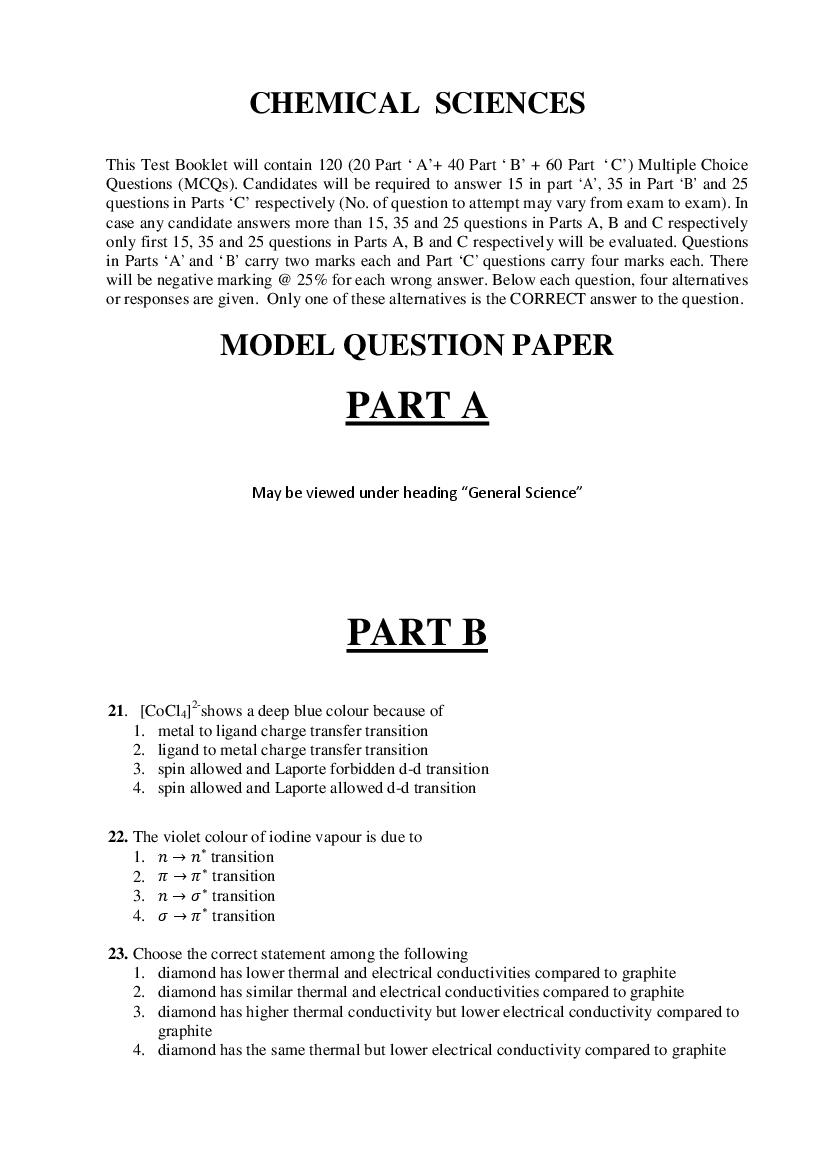
This Test Booklet will contain 120 (20 Part ‘ A’+ 40 Part ‘ B’ + 60 Part ‘ C’) Multiple Choice
Questions (MCQs). Candidates will be required to answer 15 in part ‘A’, 35 in Part ‘B’ and 25
questions in Parts ‘C’ respectively (No. of question to attempt may vary from exam to exam). In
case any candidate answers more than 15, 35 and 25 questions in Parts A, B and C respectively
only first 15, 35 and 25 questions in Parts A, B and C respectively will be evaluated. Questions
in Parts ‘A’ and ‘ B’ carry two marks each and Part ‘C’ questions carry four marks each. There
will be negative marking @ 25% for each wrong answer. Below each question, four alternatives
or responses are given. Only one of these alternatives is the CORRECT answer to the question.
MODEL QUESTION PAPER
PART A
May be viewed under heading “General Science”
PART B
21. [CoCl4]2-shows a deep blue colour because of
1. metal to ligand charge transfer transition
2. ligand to metal charge transfer transition
3. spin allowed and Laporte forbidden d-d transition
4. spin allowed and Laporte allowed d-d transition
22. The violet colour of iodine vapour is due to
1. 𝑛𝑛 → 𝑛𝑛∗ transition
2. 𝜋𝜋 → 𝜋𝜋 ∗ transition
3. 𝑛𝑛 → 𝜎𝜎 ∗ transition
4. 𝜎𝜎 → 𝜋𝜋 ∗ transition
23. Choose the correct statement among the following
1. diamond has lower thermal and electrical conductivities compared to graphite
2. diamond has similar thermal and electrical conductivities compared to graphite
3. diamond has higher thermal conductivity but lower electrical conductivity compared to
graphite
4. diamond has the same thermal but lower electrical conductivity compared to graphite
Page 2
1. B4H10
2. B5H9
3. [B6H6]2-
4. B5H11
25. Among the three types of orbital sp, d, and f,
1. both p and f orbitals have centre of symmetry
2. both p and d orbitals have centre of symmetry
3. only d orbitals have centre of symmetry
4. f orbitals alone have centre of symmetry
26. The absorbance of solution having 20% transmittance is
1. 0.301
2. 0.699
3. 1.301
4. 1.699
27. The active site of enzyme nitrogenise contains
1. Mo
2. Mn
3. Fe
4. Cu
28. Which one of the following is a free radical?
1. CO
2. CN–
3. NO
4. CS
29. Choose the 16 e– complex from the following:
1. Ni(CO)4
2. Rh(PPh3)3Cl
3. Fe(CO)5
4. (η6-C6H6)2Cr
30. The species having metal-metal bond is:
1. Mn2(CO)10
2. Al2(CH3)6
3. V2(CO)12
4. Al2(OPri)12
31. The only molecule having bridging oxygen is
1. Phosphorus trioxide
2. Phosphorus pentoxide
3. Cyclic tetraphosphate
4. Pyrophosphate
Page 3
1. 2
2. 4
3. 5
4. 6
33. Using phenolphthalein as the indicator, which of the following titration is possible:
1. acetic acid with pyridine
2. oxalic acid with sodium hydroxide
3. hydrochloric acid with aniline
4. sulphuric acid with aqueous ammonia
34. Which of the following species is ESR-active?
1. VOSO4
2. K2Cr2O7
3. KMnO4
4. [Co(NH3)6]Cl3
35. Large deviation from Trouton's rule is observed for systems which are
1. having more ordered structure
2. having more disordered structure
3. having low melting points
4. having low boiling points
36. The concentration of a reactant decreases linearly with time. What is the order of the
reaction?
[A]
t
st
1. 1 order
2. Fractional order
nd
3. 2 order
4. Zero order
37. The point group symmetry of the molecule cis–ML4X2 is
1. C4v
2. D4h
3. C2h
4. C2v
38. The number of rotational degrees of freedom of CO2 is
1. one
2. two
3. three
4. four
Page 4
value of 1 is
1. 5/2
2. 1/2
3. 1
4. 3/2
40. Which of the following transitions in the electronic spectrum of a homonuclear diatomic
molecule is forbidden
1. ∑+
𝑢𝑢 → ∑𝑔𝑔
+
2. ∑+
𝑔𝑔 → ∏𝑢𝑢
3. ∑+
𝑢𝑢 → ∏𝑔𝑔
4. ∑+𝑔𝑔 → Δ𝑢𝑢
41. The diffraction pattern of a cubic solid has an intense 110 Bragg reflection, but the 100 and
111 Bragg reflections are absent. The structure of the solid is
1. Body-centered cubic
2. Primitive cubic
3. Face-centered cubic
4. Edge-centered cubic
42. The logarithmic conductivity of a crystalline solid shows a linear variation with inverse
temperature (1/T). The band gap may be obtained from
1. slope of the plot.
2. intercept on the conductivity axis.
3. intercept on the temperature axis.
4. inverse slope
43. The molar masses of monodisperse and polydisperse polymers obey respectively the
�𝑛𝑛 = Number average molecular weight and 𝑀𝑀
conditions: (𝑀𝑀 �𝑤𝑤 = Weight average molecular
weight).
�𝑛𝑛 > 𝑀𝑀
1. 𝑀𝑀 �𝑤𝑤 and𝑀𝑀
�𝑛𝑛 < 𝑀𝑀
�𝑤𝑤
� � � �𝑤𝑤
2. 𝑀𝑀𝑛𝑛 = 𝑀𝑀𝑤𝑤 and𝑀𝑀𝑛𝑛 < 𝑀𝑀
�𝑛𝑛 < 𝑀𝑀
3. 𝑀𝑀 �𝑤𝑤 and𝑀𝑀
�𝑛𝑛 < 𝑀𝑀
�𝑤𝑤
� � � �𝑤𝑤
4. 𝑀𝑀𝑛𝑛 = 𝑀𝑀𝑤𝑤 and𝑀𝑀𝑛𝑛 = 𝑀𝑀
44. The spatial part of hydrogen molecular wave function in the simplest molecular orbital
theory is given by 𝜎𝜎𝑔𝑔2 where 𝜎𝜎𝑔𝑔 is a normalized linear combination of two hydrogen 1s
orbitals. Which of the following is true about the above wave function?
1. It contains only covalent terms.
2. It includes only a small amount of ionic terms.
3. It contains only ionic terms.
4. It over estimates the ionic terms.
45. A 2pz orbital of hydrogen atom is an eigenfunction of
1. H only.
2. H and L2 only
3. H, L2 and Lz only
4. H, L2, Lz and Lx
Page 5
1. takes infinite time for completion
2. satisfies ∆S (universe) = 0
3. satisfies ∆G = 0.
4. gives the minimum work
47. A hydrogenic 3p orbital has the following form of the radial wavefunction (αi=
constant):
1. 𝑟𝑟(𝛼𝛼1 − 𝑟𝑟)𝑒𝑒 −𝛼𝛼 2 𝑟𝑟
2. 𝑟𝑟𝑒𝑒 −𝛼𝛼 3 𝑟𝑟
3. 𝑟𝑟(𝛼𝛼4 − 𝑟𝑟)(𝛼𝛼5 − 𝑟𝑟)𝑒𝑒 −𝛼𝛼 6 𝑟𝑟
4. 𝑟𝑟 3 𝑒𝑒 −𝛼𝛼 3 𝑟𝑟
48. IUPAC name for the compound given below is
O
1. E-5-ethylhept-5-en-2-one
2. Z-5-ethylhept-5-en-2-one
3. E-3-ethylhept-2-en-6-one
4. Z-3-ethylhept-2-en-6-one
49. The most suitable reagent for the following transformation is
O
MeO
MeO
1. NaBH4
2. B2H6
3. Zn-Hg/ HCl
4. NH2NH2/ HCl
50. The major product formed in the reaction of 2-methyl but-3-en-2-ol with HBr is
Br .
. 2 Br
1
Br
. .
3 HO 4
Br O
51. Among dimethylcyclobutanes, which one can exhibit optical activity?
1. cis-1,2-dimethylcyclobutane
2. trans-1,2-dimethylcyclobutane
3. cis-1,3-dimethylcyclobutane
4. trans-1,3-dimethylcyclobutane
Page 6
1. nucleotide
2. aminoacid
3. disaccharide
4. fatty acid
53. The order of chemical shifts (δ value) in the1H NMR spectrum of crotonaldehyde is
1. olefinic>CHO>Me
2. CHO>Me>olefinic
3. CHO>olefinic>Me
4. olefinic>Me>CHO
54. The product formed in the reaction given below is
Me
hv
Me
Me
1.
Me
Me
2.
Me
Me
3.
Me
Me
4.
Me
55. The major product formed in the reaction given below is
COOMe
+
Me
Me
1. 2. COOMe
COOMe Me
Me
3. 4.
Me COOMe
COOMe
Page 7
1. fluorescence
2. phosphorescence
3. intersystem crossing
4. internal conversion
57. The decreasing order of stability of the free radicals A, B and C is
Me Me Me Me
Me H CH2 H
Me Me H H
A B C
1. A >B >C
2. C >A >B
3. B>A>C
4. A >C >B
58. The major product formed in the reaction given below:
H
O NaN3 ??
H
OH N3
. .
1 2
N3 OH
OH OH
. .
3 4
N3 N3
59. The rates of keto-enol tautomerism in the ketones A-C, given below are in the order
O O O
A B C
1. A >B >C
2. A >C >B
3. C >A >B
4. C >B>A
60. The reaction given below is an example of
COOEt
COOEt
NaOEt
COOEt O
Page 8
2. Knoevenagel condensation
3. Dieckmann condensation
4. acyloin condensation
PART C
61. The covalent radii vary gradually in the Periodic Table. From the orders given below for
such radii, the correct ones are
(a) Ce>Lu, (b)Co >Ti,(c) Sr>Ca,(d)I>Se
1. (a) and (b) only
2. (a) and (c) only
3. (a), (c) and (d) only
4. (b), (c) and (d) only
62. The pair of gaseous molecules/ions having tetrahedral structure is
1. SnCL4 , PH+4
2. SnCL4 , XeF4
–
3. ICl4 , PH+
4
4. SnCL4 , ICl–4
63. Consider the following
Volumetric method for Ag(I) Indicator used
(a). Fajan method Chromate
(b). Mohr’s method Fluorescein
(c). Vohlard method ferric salt
The method and indicator matches correctly in
1. (a) and (b) only
2. (b) and (c) only
3. (c) only
4. (b)only
64. An unknown lead solution has diffusion current of 1.0 µA. To a 10 ml of this solution 0.5
ml of 0.04 M lead solution is added. The diffusion current of the spiked solution is 1.50
µA. The concentration of the unknown lead solution is
1. 0.0020 M
2. 0.0050 M
3. 0.0035 M
4. 0.0010 M
Page 9
32
P remains after35 days?
1. 30%
2. 8%
3. 81.7%
4. 18.3%
66. On a 30 cm column, the tRof A and B respectively are16.40 and 17.63 minutes. The t0 of the
column is 1.30 minutes. The peak width at base lines for A and B are 1.11 and 1.21 minutes
respectively. The column resolution RS is
1. 1.06
2. 1.23
3. 2.12
4. 2.23
67. Which one of the following pairs of electronic configurations of high-spin transition metal
ions (3d) in an octahedral field undergoes a substantial Jahn-Teller distortion:
1. d3, d9
2. d4, d9
3. d5, d9
4. d6, d9
68. Which one of the following pairs consists of a good oxidizing and a good reducing agent
respectively:
1. Ce(IV),Ln(III)
2. Ln(III), Eu(II)
3. Ce(IV), Eu(II)
4. Ln(III), Ce(III)
69. Which one of the pairs of following statements about reduction of [CoCl(NH3)5]2+
By Cr(II) is correct:
(A). Reactant [CoCl(NH3)5]2+ has non-labile coordination sphere
(B). Reaction proceeds by outer-sphere mechanism
(C).Reactant [CoCl(NH3)5]2+has labile coordination sphere
(D). Reaction proceeds by inner-sphere mechanism
1. (A) and (B)
2. (A) and (D)
3. (C) and (B)
4. (C) and (D)
70. Hemocyanin contains
1. a dinuclear copper core and binds dioxygen in the cuprous state.
2. a dinuclear copper core and binds dioxygen in the cupric state.
3. a mononuclear copper core and binds dioxygen in the cuprous state
4. a mononuclear copper core and binds dioxygen in the cupric state.
Page 10
(173K) respectively shows (assume that N and H do not couple):
1. triplet and quintet
2. quintet and triplet
3. quintet and triplet of triplets
4. triplet and triplet of triplets
72. The number of hyperfine lines in the EPR spectrum of a one electron reduced product of
[Co3(CO)9Se](I=7/2 for Co nucleus) is:
1. 8
2. 15
3. 22
4. 1
73. The highest oxidation state of a metal in the following compounds is :
(η6-C6H6)2Cr, Mn(CO)5Cl, Na2[Fe(CO)4],K[Mn(CO)5]and K[Mo(CO)5Br]
1. 1
2. 2
3. -1
4. -2
74. The maximum number of valence electrons of a metal in these complexes are: Mn2(CΟ)10,
(η5-C5H5)Mo(CO)3Cl, (η5-C5H5)2Ni, and (η5-C5H5)2TiCl2
1. 16
2. 18
3. 20
4. 22
75. Olefin hydrogenation using Wilkinson’s catalyst initiates with:
1. olefin addition to Rh(PPh3)2Cl
2. olefin addition to Rh(PPh3)3Cl
3. a phosphine dissociation from Rh(PPh3)3Cl
4. a phosphine addition to Rh(PPh3)2Cl
76. Although Fe(III) is a better Lewis acid compared to Zn(II), most hydrolytic
Enzymes contain Zn(II) at the active site because
1. Fe(III) is a redox active ion.
2. Fe(III) has less abundance compared to Zn(II).
3. Fe(III) generally makes octahedral complexes while Zn(II) makes tetrahedral
complexes
4. Zn(II) makes kinetically labile complexes.
77. Considering the two complexes (A) [Ni(H2O)6]2+and (B)[Ni(NH3)6]2+, the right statement is
1. Complex (A) is diamagnetic and complex (B) is paramagnetic
2. Complex (A) is paramagnetic and complex (B)is diamagnetic
3. Both are paramagnetic
4. Both are diamagnetic
Page 11
1. do not change much with change in ligand
2. change significantly with change in ligand
3. appear at low energies i.e., at the near-IR region
4. appear as broad bands
79. Strongest super acid among the following is a
1. solution of HNO3 in H2SO4
2. solution of HClO4 in H2SO4
3. solution of SbF5 in HF
4. solution of SbCl5 in HCl
80. Consider the following statements regarding borazine,
A. It is isoelectronic with benzene
B. Each nitrogen receives more σ-electron density from neighbouring boron than it gives
away as a π-donor
C. It does not undergo addition reactions
D. Nitrogen retains its basicity and boron its acidity.
The true statements among the above are
1. A, C and D
2. A, B and D
3. A and C only
4. B, C, and D
81. For a diffusion-controlled bimolecular reaction, the rate constant (kD) is proportional to
(T =temperature;η = coefficient of viscosity of medium).
1. 𝜂𝜂𝜂𝜂
1
2. 𝜂𝜂𝜂𝜂
𝑇𝑇
3.
�𝜂𝜂
𝑇𝑇
4. 𝜂𝜂
82. Consider the unimolecular reaction
A(g) → products
For which the following remarks were made.
A. The reaction is second order at low pressure and becomes first order at high pressure.
B. The reaction is first order at low pressure and becomes second order at high pressure.
C. The reaction is zero order
Which of these is/are correct?
1. A and B
2. B and C
3. Only C
4. Only A
[−𝐴𝐴𝑥𝑥 2 ]. The mean and
83. A random distribution of errors obeys the Gaussian form �𝐴𝐴/𝜋𝜋 exp
standard deviation of this distribution obeys
1. 〈𝑥𝑥〉 = 0 and 𝜎𝜎𝑥𝑥 = √2𝐴𝐴
2. 〈𝑥𝑥〉 ≠ 0 and 𝜎𝜎𝑥𝑥 = 1/√2𝐴𝐴
Page 12
4. 〈𝑥𝑥〉 = 0 and 𝜎𝜎𝑥𝑥 = 𝐴𝐴
84. The function sin-1x is not an acceptable wave function because
1. it is not differentiable
2. its first derivative is not continuous
3. it does not cover the entire space
4. it is not a single-valued function
85. The first-order correction to energy for the ground state of a particle-in-a-box due to a
perturbation λx would be
1. λL/2
2. λL
3. 2λL
4. 2
86. Characters of a few symmetry operations are given below. Identify the character of the
irreducible representation 𝐴𝐴′2𝑔𝑔
E Cn C2 i σh
1 1 1 1 -1 -1
2 1 1 -1 1 1
3 1 -1 -1 1 1
4 1 1 -1 -1 1
87. The character of the irreducible representation A1in C3v point group is given below
E 2C3 3σv
A1 1 1 1
Identify one irreducible representation orthogonal to A1 among the following.
E 2C3 3σv
Γ1 1 -1 1
Γ2 2 -1 0
Γ3 2 0 -1
Γ4 1 -1 -1
1. Γ1
2. Γ2
3. Γ3
4. Γ4
Page 13
C3H3- is
1. 2β
2. 0
3. β
4. 3β
89. The rotational constant (B) of H35Cl, H37Cl and D35Cl follow the order
1. H35Cl> D35Cl>H37Cl
2. H35Cl> H37Cl>D35Cl
3. D35Cl>H35Cl> H37Cl
4. H37Cl> H35Cl>D35Cl
90. In a crystal, atom A is at the corners of the unit cell, B is at the centre of the cell and the
oxygen atoms are at the face-centred positions. What is the formula per unit cell?
1. A8BO6
2. ABO6
3. A8BO3
4. ABO3
91. On mixing100 mL of 0.1 M CH3COOH and 50 mL of 0.1 M NaOH, the pH of the solution
will be
1. pka+0.301
2. pka
3. pka-0.301
4. pka+0.477
92. Using the fundamental equation dA= -SdT – PdV, the Maxwell relation is
𝜕𝜕𝜕𝜕 𝜕𝜕𝜕𝜕
1. �𝜕𝜕𝜕𝜕 � = � 𝜕𝜕𝜕𝜕 �
𝑇𝑇 𝑉𝑉
𝜕𝜕𝜕𝜕 𝜕𝜕𝜕𝜕
2. �𝜕𝜕𝜕𝜕 � = �𝜕𝜕𝜕𝜕 �
𝑇𝑇 𝑉𝑉
𝜕𝜕𝜕𝜕 𝜕𝜕𝜕𝜕
3. �𝜕𝜕𝜕𝜕 � = �𝜕𝜕𝜕𝜕 �
𝑇𝑇 𝑇𝑇
𝜕𝜕𝜕𝜕 𝜕𝜕𝜕𝜕
4. �𝜕𝜕𝜕𝜕 � = �𝜕𝜕𝜕𝜕 �
𝑇𝑇 𝑉𝑉
93. The relationship between mean ionic activity coefficient for Ca3(PO4)2 and its ions is given
by
1. 𝛾𝛾± = 𝛾𝛾+3 𝛾𝛾–2
2. 𝛾𝛾± = 𝛾𝛾+2 𝛾𝛾–3
3. 𝛾𝛾±5 = 𝛾𝛾+3 𝛾𝛾–2
4. 𝛾𝛾±5 = 𝛾𝛾+2 𝛾𝛾–3
Page 14
X X
are nearly equal, the molar residual entropy at 0 K is
1. 0
2. Rln2
3. Rln3
4. Rln6
95. The contributions to the molar entropy by translational (tr), rotational (rot), vibrational (vib)
and electronic (ele) degrees of freedom is in order
1. tr> rot >vib>ele
2. rot>vib>tr>ele
3. ele>vib>rot>tr
4. vib>rot >tr>ele
96. A binary mixture of A2 and B2 will show negative deviation from Raoult’s law when
1. A−A and B−B interactions are stronger than A−B
2. A−A and B−B interactions are weaker than A−B
3. Both A−A and B−B interactions are equal to A−B
4. Either A−A or B−B interactions is equal to A−B
97. In the presence of external magnetic field the transition 3D1 →3P1 splits into
1. 3
2. 5
3. 7
4. 9
98. Ionic equivalent conductance value for Ca2+ is 0.0119 (S m2mol-1) and for Cl- is
0.0076 ( Sm2mol-1). The correct expected molar conductivity at infinite dilution for CaCl2 is
1. 0.0195 S m2mol-1
2. 0.0271 S m2mol-1
3. 0.0542 S m2mol-1
4. 0.01355 S m2mol-1
99. The term symbol for the ground state configuration of NO is
2
1. Πu
2
2. Πg
1
3. Πu
1
4. Πg
Page 15
are denoted by Rc and rates of production by Rp; M and M• denote the monomer and the
active center, respectively. The correct definition of ν is
1. Rc(M)/ Rp(M•)
2. Rp(M•) / Rc(M)
3. Rc(M•) / Rp(M)
4. Rc(M)/ Rc(M•)
101. 4-tert-Butylcyclohexanoneon reduction gives two isomeric alcohols which are
1. Enantiomers
2. Diasteromers
3. Rotamers
4. Homomers
102. For the following compounds A and B the correct statement is
1. A is aromatic and B is antiaromatic
2. A is antiaromatic and B is non-aromatic
3. A and B are both aromatic
4. A and B are both non-aromatic
103. Identify the product formed in the following transformations
1. CH2I2, Et2Zn
+
O O 2. H3O
3. NalO4
Me CHO Me CHO
1. 2.
Me
3. Me CHO 4.
CHO
Page 16
OMe
AcCl, AlCl3 A TiCl3, Zn/Cu B
OMe OMe
1. A is and B is
O
OMe OMe
2. A is and B is
O
OMe OMe
3. A is and B is
O
MeO
OMe
OMe
4. A is and B is
O
MeO
105. Match the following:
A. Conversion of 1,7-octadiene to cyclohexene i) Wacker Oxidation
B. Conversion of bromobenzene to ethylcinnamate ii) Mc Murry Coupling
C. Conversion of 1-hexene to 2-hexanone iii) Heck reaction
iv) Olefin Metathesis
1. A: iv; B: ii; C: iii
2. A: ii; B: iv; C: i
3. A: iv; B: iii; C: i
4. A: i; B: iii; C: iv
106. Reagents that can be used in the following conversion are
1. i) Ph3P=CH2, ii) HCN, iii) H3O+
2. i) HS(CH2)2SH, ii) n-BuLi, iii) BrCH2COOH
3. i) EtMgI, ii) KMnO4
4. i) Ph3P,CBr4, ii) n-BuLi, iii) CO2
Page 17
O N
H S
COOEt
THF
. .
1 2
COOEt COOEt
O O
. COOEt .
3 4
COOEt
108. The following reaction, the structure of the major product is
Me
NH2
NaNO2, HCl
OH
H
Me Me
1 2 CHO
O
H H
Me Me
3 O 4
OH
H H
109. Identify the products A and B in the following reaction sequence.
COOH SnBu3
I2, NaHCO3 A B
AIBN
O O
O O
1. A is B is
I
O O
O O
2. A is B is
I
O O
O O
3. A is B is
I
O O
O O
4. A is B is
I
Page 18
NC OTMS .
1 MeMgBr
. .
2 Aq NH4Cl
MeO CONH2 TMSO COMe
1 2
TMSO NH2 TMSO OH
3 4
111. Product of Sharpless kinetic resolution of the following alcohol with (–)-diethyl tartrate is
Me
OH
Et
Me Me
O
1. OH 2. OH
Et Et
Me Me
O
3. OH 4. OH
Et Et
112. Select the product of the reaction of (Z)-(2-methoxyvinyl) benzene with dichloroacetylo
chloride in presence of triethyl amine.
Cl OMe Cl OMe
Cl Cl
. .
1 2
O Ph O Ph
Cl Ph Cl Ph
Cl Cl
. .
3 4
O OMe O OMe
Page 19
1. HNO2
OH
2. hv
NO
ON
1. OH 2.
OH
OH NO
3. 4. OH
NO
114. The compound formed in the following reaction sequence is
.
1 H2O2/NaOH
.
O 1 NH2NH2; KOH
,
( 2OH)2
CH
.
1
OH
.
2
O
. O
3
NH
H N
. NHNH2
4
O
CHO
115. Cholestanol on oxidation with chromium trioxide in acetic acid/pyridine gives a
dicarboxylic acid, which on pyrolysis in the presence of a catalytic amount of barium
hydroxide gives compound A as the major product. The structure of A is
Page 20
H H
OH (cholestanol)
H
H
.
1 O H H
H
O H
.
2 O H H
O H
O H
.
3 H H
H
H
. Et
4 H H
Me
H
116. Photolysis of 1, 4-dimethyl-1, 3-cyclohexadiene in presence of excess oxygen and
catalytic amount of Rose Bengal followed by reduction with H2/Pt provides
Me OH Me OH
. .
1 2
Me OH Me OH
Me Me
O
. .
3 4
OH
O Me
Page 21
are
OH
OEt
X Y
HgOAc
PH
OEt
O
C
1. X is and Y is CHO
Ph Ph
OEt CHO
O
2. X is and Y is
Ph Ph
O
C
3. X is and Y is CHO
Ph Ph
CHO
O
4. X is and Y is
Ph
Ph
118. Structure of the X and Yin the reaction sequence of thiophene given below are
Br2. aq.HBr, -5 °C X Piperidine Y
S
1 X is Br and Y is N
S S
2 X is and Y is N Br
Br S
S
Br
X is N
3 and Y is
S
S
Br
Br
4 X is and Y is
N S
S
Page 22
OCOPh
Cbz-HN COOCH2Ph
OCOPh
1.
Cbz
N COOCH2Ph
H
OCOPh
2.
NH2 COOCH2Ph
OH
3. NH2 COOH
OCOPh
4.
NH2 COOH
120. In the proton NMR spectrum, an organic compound exhibited the following spectral data
δ 7.2 (1H, dd, J=8and 1.5 Hz), 6.8 (1H, d,J =1.5 Hz), 6.7 (1H, d, J=8Hz),
4.9 (2H, s), 3.9 (3H, s), 3.85 (3H, s), 3.5 (1H, br s, exchangeable with D2O)
The compound among the choices given below is
OMe
1 OH
OMe
HO
2 OMe
OMe
MeO
OH
3
OMe
OH
4
MeO
OMe
Document Details
| Board / Org | NTA |
| Exam | CSIR National Eligibility Test |
| Type | Sample Paper |
| Pages | 22 |
| Updated | 24 Sep 2026 |