TBSE Class 11 Syllabus 2025 Economics
Finished viewing? Save it for later —
Download TBSE Class 11 Syllabus 2025 Economics (PDF · 6 pages)About TBSE Class 11 Syllabus 2025 Economics
TBSE Class 11 Syllabus 2025 Economics is available here for free download. Published by Tripura Board for Class 11, this syllabus can be viewed online or downloaded as a PDF (6 pages). Candidates preparing for Class 11 can use TBSE Class 11 Syllabus 2025 Economics to understand the exam pattern, the type of questions asked, and the overall difficulty level.
Frequently Asked Questions
How can I download TBSE Class 11 Syllabus 2025 Economics?
Open this page and click the Download button to save TBSE Class 11 Syllabus 2025 Economics as a PDF. It is completely free on AglaSem Docs.
Is TBSE Class 11 Syllabus 2025 Economics free to download?
Yes. TBSE Class 11 Syllabus 2025 Economics can be viewed online and downloaded as a PDF free of cost on AglaSem Docs.
How many pages does TBSE Class 11 Syllabus 2025 Economics have?
TBSE Class 11 Syllabus 2025 Economics contains 6 pages, which you can read online or download together as a single PDF.
Where can I find more Class 11 study material?
You can find more Class 11 question papers, sample papers, syllabus, and answer keys on AglaSem Docs.
TBSE Class 11 Syllabus 2025 Economics – Text
Read the full text of this syllabus below — useful to quickly search, copy and reference the content online without downloading the PDF.
📄 View text version (6 pages)
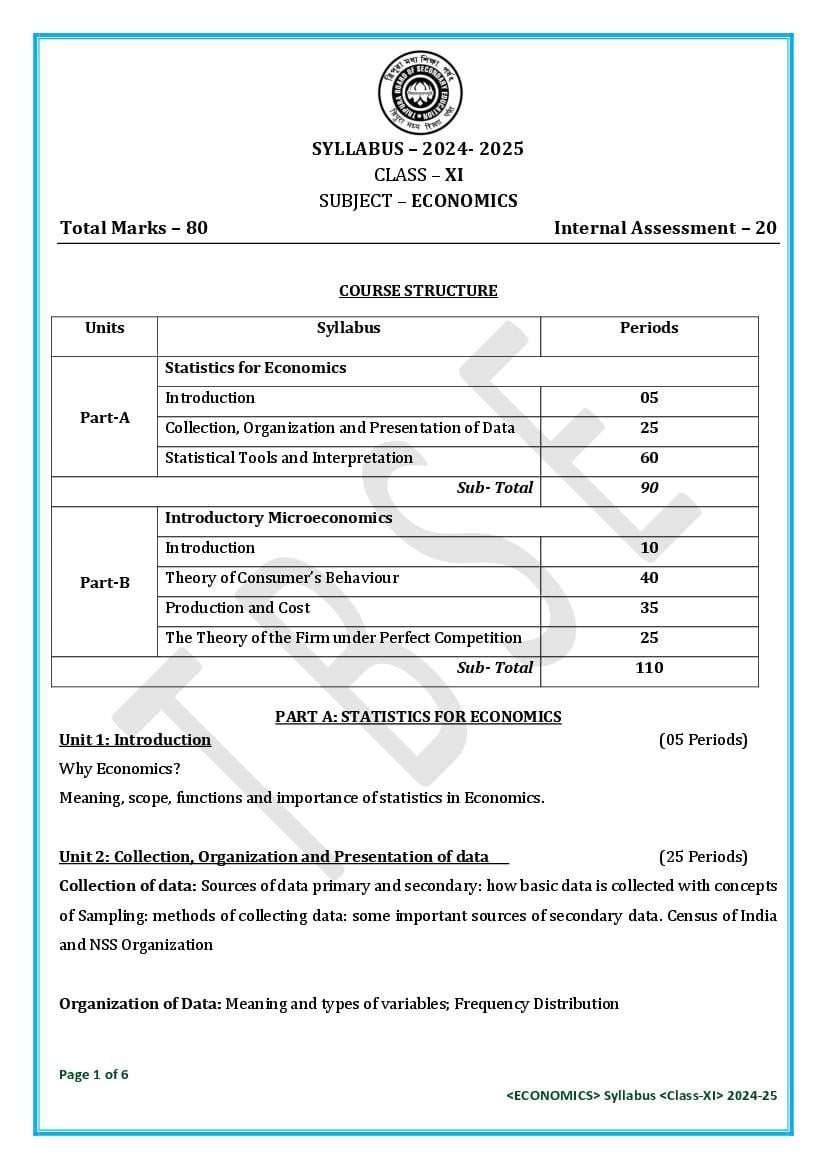
Page 1
CLASS – XI
SUBJECT – ECONOMICS
Total Marks – 80 Internal Assessment – 20
COURSE STRUCTURE
Units Syllabus Periods
Statistics for Economics
Introduction 05
Part-A
Collection, Organization and Presentation of Data 25
Statistical Tools and Interpretation 60
Sub- Total 90
Introductory Microeconomics
Introduction 10
Part-B Theory of Consumer’s Behaviour 40
Production and Cost 35
The Theory of the Firm under Perfect Competition 25
Sub- Total 110
PART A: STATISTICS FOR ECONOMICS
Unit 1: Introduction (05 Periods)
Why Economics?
Meaning, scope, functions and importance of statistics in Economics.
Unit 2: Collection, Organization and Presentation of data (25 Periods)
Collection of data: Sources of data primary and secondary: how basic data is collected with concepts
of Sampling: methods of collecting data: some important sources of secondary data. Census of India
and NSS Organization
Organization of Data: Meaning and types of variables; Frequency Distribution
Page 1 of 6
Page 2
forms (bar diagrams and pie diagrams); Frequency diagrams (histogram, polygon and Ogive);
Arithmetic line graphs (time series graph)
Unit 3: Statistical Tools and Interpretation (60 Periods)
Measures of Central Tendency- Arithmetic mean (simple and weighted), median and mode
Measures of Dispersion- Absolute dispersion(range, quartile deviation, mean deviation and
standard deviation); relative dispersion (co-efficient of range, co-efficient of quartile- deviation, co-
efficient of mean deviation, co-efficient of variation); Lorenz Curve: Meaning, construction and its
application
Correlation: Meaning and properties, Scatter diagram, measures of correlation- Karl Pearson's
method (two variables ungrouped data), Spearman's rank correlation (Non-Repeated Ranks and
Repeated Ranks)
Introduction to Index Numbers:- Meaning, types- Wholesale price index, Consumer price index,
uses of index numbers; inflation and index numbers. Simple Aggregative Method
PART B: INTRODUCTORY MICROECONOMICS
Unit 4: Introduction (10 Periods)
Basic Concepts: Meaning of microeconomics and macroeconomics; positive and normative
economics; what is an economy? Central problems of an economy: what, how and for whom to
produce; concept of production possibility frontier and opportunity cost.
Unit 5: Theory of Consumer Behavior (40 Periods)
Consumer's Behavior: Concepts of Utility. Marginal Utility: Cardinal Utility Approach; Ordinal
Utility Approach; Law of Diminishing Marginal Utility, Consumer's equilibrium using marginal utility
analysis.
Page 2 of 6
Page 3
Consumer's Budget (budget set and budget line); Changes in Budget Set; Conditions of consumer's
equilibrium or Optimal Choice of the Consumer.
Demand: Definition, Law of Demand: Determination of demand curve using indifference curve and
budget line; various types of goods- Normal, Inferior, Substitute, Complementary; Movement along
and shifts in the demand curve; Market demand; Elasticity of Demand; Elasticity of demand on a
linear demand curve; Determinants of elasticity of demand, Elasticity of demand and Cost of a
commodity.
Unit 6: Production ad Costs (35 Periods)
Production Function: Concept, Short and Long-Run; Total Product, Average Product and Marginal
Product; Law of Variable Proportion; Returns to Scale.
Cost Function: Cobb-Douglas Production Function; Short run costs- meaning and concepts of Total
Fixed Cost, Total Variable Cost, Marginal Cost, Average Cost, Average Fixed Cost, Average Variable
Cost and their relationships; Shape of short-run total cost curve; Long-run cost-concept and shape of
long run average cost curve.
Unit 7: Theory of the Firm under Perfect Competition (25 Periods)
Perfect competition: Definition, Characteristics; Revenue- Total, Average and Marginal Revenues;
Conditions and equilibrium of Profit Maximization; Supply curve of a firm; Shut Down and Break
Even Point, Determinants of Firm's supply Curve; Market Supply Curve; Price Elasticity of Supply.
Page 3 of 6
Page 4
BLUE PRINT OF DISTRIBUTION OF MARKS
Very
Short Short Long Long
Short
Answer- Answer- Answer Answer
Answer-I
Objective/ II (2 II (3 (4 (5 Total
Sl (1 Mark)
Chapters MCQ (1 Marks) Marks) Marks) Marks) Marks
No (one
Mark) (20 (60 (80 (120
word/
words) words) words) words)
one
sentence)
A. STATISTICS FOR ECONOMICS
1 Introduction 1x1 1x1 - - 4x1 - 06
Collection of
2 1x2 1x1 - 3x1 4x1 - 10
Data
Organization
3 1x1 1x1 2x1 3x1 4x1 - 11
of Data
Presentation
4 1x1 1x1 2x1 - 4x1* 5x1* 13
of Data
Sub-Total Marks
05 04 04 06 16 05 40
(A)
B. INTRODUCTORY MICROECONOMICS
1 Introduction 1x1 1x1 2x1 3x1 4x1* - 11
Theory of
2 Consumer's 1x3 1x4 2x1 3x1 4x3 5x1 29
Behavior
Sub-Total Marks
04 05 04 06 16 05 40
(B)
Grand Total Marks
09 09 08 12 32 10 80
(A+B)
* Indicates that there is an option of extra one (01) question.
Page 4 of 6
Page 5
BLUE PRINT OF DISTRIBUTION OF MARKS
Very
Short Short Long Long
Short
Answer- Answer- Answer Answer
Answer-I
Objective/ II (2 II (3 (4 (5 Total
Sl (1 Mark)
Chapters MCQ (1 Marks) Marks) Marks) Marks) Marks
No (one
Mark) (20 (60 (80 (120
word/
words) words) words) words)
one
sentence)
A. STATISTICS FOR ECONOMICS
Measures of
1 Central 1x2 1x1 - - 4x1 5x1 12
Tendency
Measures of
2 1x1 1x1 2x1 3x1 4x1* - 11
Dispersion
3 Correlation 1x1 1x1 2x1 - 4x1 - 08
Introduction
4 to Index 1x1 1x1 - 3x1 4x1 - 09
Numbers
Sub-Total Marks
05 04 04 06 16 05 40
(A)
B. INTRODUCTORY MICROECONOMICS
Production
1 1x2 1x3 2x1 3x1 4x2* - 18
and Cost
Theory of the
firm under
2 1x2 1x2 2x1 3x1 4x2 5x1* 22
Perfect
Competition
Sub-Total Marks
04 05 04 06 16 05 40
(B)
Grand Total Marks
09 09 08 12 32 10 80
(A+B)
* Indicates that there is an option of extra one (01) question.
Page 5 of 6
Page 6
Type of Questions Marks (80) Percentage
1. Multiple Choice Questions (MCQ) (1x9)
9 11.25
(Inclusive of Assertion, Reason, Differentiation & Stem)
2. Very Short Answer Type Questions (VSA) (1x9)
9 11.25
(Inclusive of Assertion, Reason, Differentiation & Stem)
3. Short Answer Type Questions- I (SA-I) (2x4)
(Knowledge, Understanding, Application, Analysis, Evaluation, 8 10
Synthesis & Create)
4. Short Answer Type Questions- II (SA-II) (3x4)
(Knowledge, Understanding, Application, Analysis, Evaluation, 12 15
Synthesis & Create)
5. Long Answer Type Questions – I (LA-I) (4×8)
(Knowledge, Understanding, Application, Analysis, Evaluation, 32 40
Synthesis & Create)
6. Long Answer Type Questions – II (LA-II) (5x2)
(Knowledge, Understanding, Application, Analysis, Evaluation, 10 12.5
Synthesis & Create)
80 100
NOTE:-
i) Typology of questions:- MCQ, VSA, Assertion- Reasoning type questions; SA-I, SA-II, LA-I,
LA-II, LA- III.
In LA- type questions source-based/ case- study based/ passage based questions may be
included.
ii) Approximately 33 % internal choice would be given.
Page 6 of 6