ISC Class 12 Specimen Paper Accounts
Finished viewing? Save it for later —
Download ISC Class 12 Specimen Paper Accounts (PDF · 34 pages)About ISC Class 12 Specimen Paper Accounts
ISC Class 12 Specimen Paper Accounts is available here for free download. Published by CISCE for Class 12, this sample paper can be viewed online or downloaded as a PDF (34 pages). Candidates preparing for Class 12 can use ISC Class 12 Specimen Paper Accounts to understand the exam pattern, the type of questions asked, and the overall difficulty level.
Frequently Asked Questions
How can I download ISC Class 12 Specimen Paper Accounts?
Open this page and click the Download button to save ISC Class 12 Specimen Paper Accounts as a PDF. It is completely free on AglaSem Docs.
Is ISC Class 12 Specimen Paper Accounts free to download?
Yes. ISC Class 12 Specimen Paper Accounts can be viewed online and downloaded as a PDF free of cost on AglaSem Docs.
How many pages does ISC Class 12 Specimen Paper Accounts have?
ISC Class 12 Specimen Paper Accounts contains 34 pages, which you can read online or download together as a single PDF.
Where can I find more Class 12 study material?
You can find more Class 12 question papers, sample papers, syllabus, and answer keys on AglaSem Docs.
ISC Class 12 Specimen Paper Accounts – Text
Read the full text of this sample paper below — useful to quickly search, copy and reference the content online without downloading the PDF.
📄 View text version (34 pages)
Page 1
______________________________________________________________
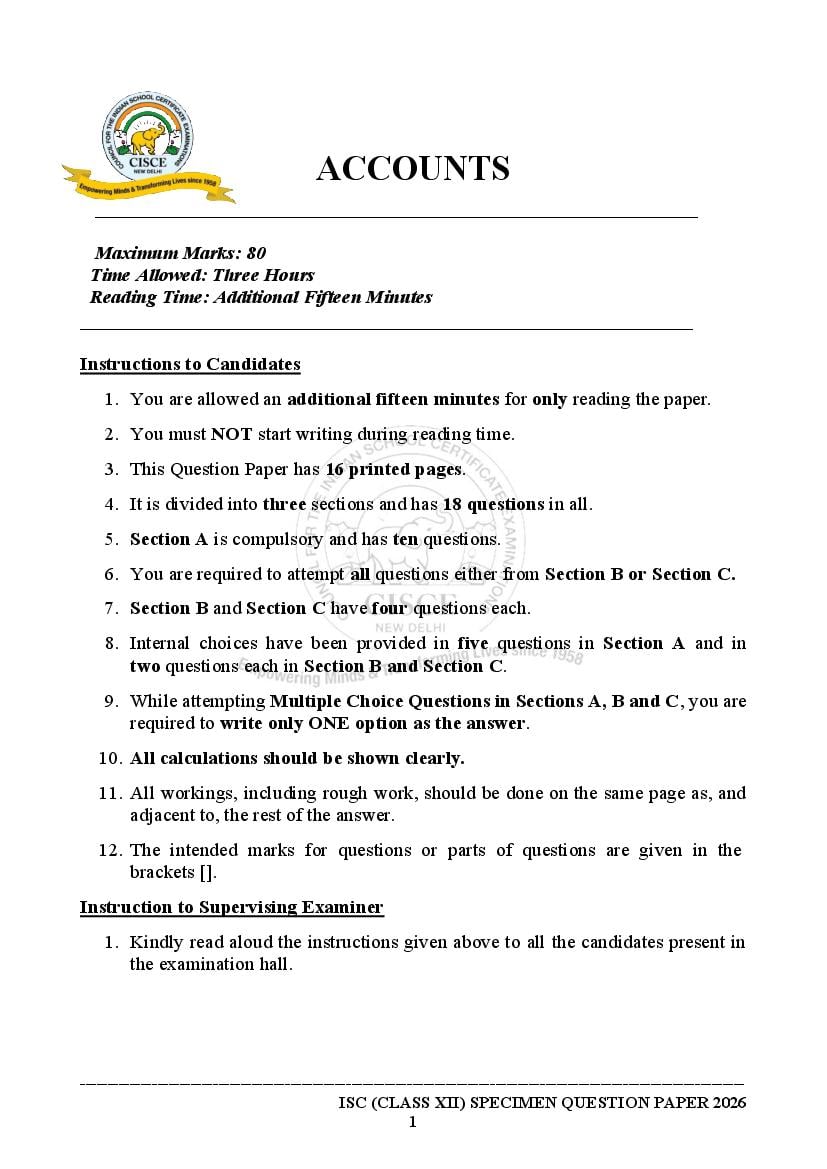
Maximum Marks: 80
Time Allowed: Three Hours
Reading Time: Additional Fifteen Minutes
_______________________________________________________________
Instructions to Candidates
1. You are allowed an additional fifteen minutes for only reading the paper.
2. You must NOT start writing during reading time.
3. This Question Paper has 16 printed pages.
4. It is divided into three sections and has 18 questions in all.
5. Section A is compulsory and has ten questions.
6. You are required to attempt all questions either from Section B or Section C.
7. Section B and Section C have four questions each.
8. Internal choices have been provided in five questions in Section A and in
two questions each in Section B and Section C.
9. While attempting Multiple Choice Questions in Sections A, B and C, you are
required to write only ONE option as the answer.
10. All calculations should be shown clearly.
11. All workings, including rough work, should be done on the same page as, and
adjacent to, the rest of the answer.
12. The intended marks for questions or parts of questions are given in the
brackets [].
Instruction to Supervising Examiner
1. Kindly read aloud the instructions given above to all the candidates present in
the examination hall.
ISC (CLASS XII) SPECIMEN QUESTION PAPER 2026
1
Page 2
Board Examination Question Paper and should be used as a practice tool. The questions for the
Board Examination can be set from any part of the syllabus, though the format of the Board
Examination Question Paper will remain the same as that of the Specimen Question Paper.
The weightage allocated to various topics, as given in the syllabus, will be strictly adhered to.
SECTION A (60 MARKS)
Answer all questions.
Question 1
In subparts (i) to (iv) choose the correct option and in subparts (v) to (x) answer the questions
as instructed.
(i) Anil and Sunil are partners in a firm. On 1st April 2024, their capital balances show [1]
as ₹3,00,000 and ₹2,00,000 respectively. On the same date, firm’s goodwill valued
by Capitalisation of average profit method is determined at ₹3,50,000. Capitalised
value of average profits and average profits are ₹8,50,000 and ₹1,70,000 respectively.
What will be the normal commercial yield on capital invested in such business?
(Application)
(a) 30%
(b) 10%
(c) 20%
(d) 15%
(ii) Akhil, Viren and Sarla are partners in a firm who share profits in 4:3:3 ratio. On the [1]
date of Sarla’s retirement from the firm, the books show the Workmen Compensation
Reserve of ₹ 12,000.
Akhil and Viren decide to share profit in equal ratio after Sarla’s retirement.
Choose the correct journal for the treatment of Workmen Compensation
Reserve if the continuing partners decide to show Workmen Compensation
Reserve in the reconstituted Balance Sheet. (Application)
(a) Debit Workmen Compensation Reserve A/c ₹ 12,000; Credit Akhil’s Capital
A/c ₹4,800; Credit Viren’s Capital A/c ₹ 3,600 and Sarla’s Capital A/c ₹ 3,600
(b) Debit Workmen Compensation Reserve A/c ₹ 3,600 and Credit Sarla’s Capital
A/c ₹ 3,600.
(c) Debit Sarla’s Capital A/c ₹ 3,600; Credit Akhil’s Capital A/c ₹ 1,200 and Credit
Viren’s Capital A/c ₹ 2,400.
(d) Debit Akhil’s Capital A/c ₹ 1,200; Debit Viren’s Capital A/c ₹ 2,400 and Credit
Sarla’s Capital A/c ₹ 3,600.
(iii) On 1st April 2023, Anand Limited issued 10%, 50,000 Debentures of ₹ 100 each as [1]
collateral security to ABC Bank against a loan raised of ₹ 80,00,000. It also issued
12%, 40,000 Debentures of ₹ 100 each on 1st October, 2023 in the stock market to
invest money in a new line of product.
How much interest on Debentures become payable by the company on 31st March
2024? (Application)
ISC (CLASS XII) SPECIMEN QUESTION PAPER 2026
2
Page 3
(b) ₹ 2,40,000
(c) ₹ 5,00,000
(d) ₹ 4,80,000
(iv) Choose the correct sequence of various types of guarantees of profit used while [1]
preparing Profit and Loss Appropriation Account by a partnership firm.
(Understanding)
(P) Guarantee given by the firm to Partners
(Q) Guarantee given by a Partner to the firm
(R) Guarantee given by a Partner to another Partner
(a) P, Q, R
(b) Q, P, R
(c) R, P, Q
(d) Q, R, P
(v) On dissolution of a firm, one of the partners, Abhi demands that his loan of ₹1,50,000 [1]
be paid before payment of capitals of the partners, whereas other partners, Bobby and
Cathy demand that capitals should be paid before the payment of Abhi’s loan.
State the correct order of payment. Give a reason for your answer. (Understanding)
(vi) Rahul and Nikhil are partners in a firm. They admit Tanvi for 1/5th share. On the date [1]
of her admission, the firm’s book shows the following balances:
Rahul’s Capital: ₹ 2,80,000
Nikhil’s Capital: ₹ 2,20,000
Tanvi contributes 20% of the adjusted capital of Rahul and Nikhil. She also
contributes ₹20,000 as half of her share of goodwill.
Pass the journal entry to record the capital contribution made by Tanvi.
(Application)
(vii) Priya was a partner in a firm. On the date its dissolution, her loan was appearing on [1]
the liability side of the Balance Sheet at ₹25,000. Priya accepted an unrecorded asset
of ₹17,500 and the balance was paid to her in cash.
Give the Journal entry for the above transaction. (Application)
(viii) Enumerate two methods of redemption of debentures. (Recall) [1]
(ix) Manilal Ltd.is a manufacturing company. Its operating cycle is 15 months. [1]
On 31st March, 2025, its trade receivable of ₹ 70,000 includes ₹ 20,000 which is due
to be collected on 13th April, 2026 and the remaining after 30th June, 2026.
You are required to calculate current and non-current assets of the company as
at 31st March, 2025. (Application)
(x) Assertion: Forfeited shares can be reissued at a discount. [1]
Reason: The amount received by a company on forfeited shares can be used to cover
the discount on the reissues of forfeited shares.
Which one of the following is correct? (Understanding)
ISC (CLASS XII) SPECIMEN QUESTION PAPER 2026
3
Page 4
Assertion.
(b) Both Assertion and Reason are true but Reason is not the correct explanation
for Assertion.
(c) Assertion is true and Reason is false.
(d) Both Assertion and Reason are false.
Question 2
Amit, Karan and Rakhi were partners in a firm sharing profits and losses in the ratio of 2:2:1.
Amit died on 30th June 2024 while the firm closed its books on 31st March. According to their
partnership deed, Amit’s representative would be entitled to get a share in the interim profits
of the firm calculated on the basis of turnover. Turnover and profit for the year 2023-24 were
₹3,00,000 and ₹90,000 respectively and turnover in the year 2024-25 till the date of his death
amounted to ₹60,000.
You are required to: (Application)
(i) Calculate Amit’s share of interim profit. [1]
(ii) Pass the necessary Journal entry showing Amit’s share of interim profit. [2]
OR
Pratik, Krish and Susan are partners in a firm sharing profits and losses in the ratio of 5:3:2. [3]
On 31st March, 2024, Krish retires and 1/3 of his share is taken by Pratik and the balance by
Susan.
The extract of the Balance Sheet as at 31.03.2024 is as follows:
Balance Sheet (Extract) of Pratik, Krish and Susan
As at 31.3.24
Liabilities ₹ Assets ₹
Investment Fluctuation Reserve 8,000 Investment 52,000
Employee Provident Fund 12,000 Debtors 20,000
Less: P.D.D (2,000)
18,000
Capital Accounts:
Pratik 50,000
Krish 32,500
Susan 21,000 1,03,000
Other information:
(a) Bad debts amounted to ₹3,000.
(b) Remaining debtors are all good.
(c) Market value of the investments is ₹40,000.
(d) Krish was given investments in full settlement.
You are required to pass the journal entries on the date of Krish’s retirement.
(Application)
ISC (CLASS XII) SPECIMEN QUESTION PAPER 2026
4
Page 5
On 1st April, 2024, Zeba Ltd. purchased a running business having a net worth of
₹ 2,00,000 from Ajay Ltd. for a purchase consideration of ₹ 2,10,000. The payment was made
as follows:
(a) By issuing 9,000, 10% Debentures of ₹ 10 each at a premium of 20%.
(b) Balance by accepting a Bills of Exchange payable after 3 months.
You are required to pass journal entries in the books of Zeba Ltd.
(Ignore interest on Debentures). (Application)
OR
On 1st April, 2024, Zubin Ltd. issued 3,000, 8% Debentures of ₹ 100 each at a discount of
5% to be redeemed after two years at a premium of 6%.
On 31st March, 2025, Zubin Ltd. had the following balances in its books before adjustments
of capital losses:
Securities Premium ₹ 23,000
Statement of Profit/Loss ₹ 18,000
General Reserve ₹ 20,000
The company writes off all its capital losses in the same year.
You are required to prepare the following for the year 2024-2025:
(i) Loss on Issue of Debentures A/c (Application) [2]
(ii) Securities Premium A/c (Application) [1]
Question 4
APL Ltd., an unlisted construction company has 50,000, 10% Debentures of ₹ 100 each due
for redemption at par on 31st March, 2024. The Debenture Redemption Investment was
purchased on 30th April, 2023 and was sold on the date of redemption at 104% less 0.7%
commission. APL Ltd. had sufficient balance in its Debenture Redemption Reserve A/c as
per the provisions of the Companies’ Act, 2013.
You are required to prepare the following Ledger Accounts for the year 2023-2024:
(i) Debenture Redemption Reserve A/c (Application) [1]
(ii) Debenture Redemption Investment A/c (Application) [2]
Question 5 [3]
From the following information, calculate Goodwill by Capitalisation of Super profit
method for a firm run by Akshay and Baldev:
Particulars ₹
Akshay’s Capital A/c 1,20,000
Baldev’s Capital A/c 1,00,000
Akshay’s Current A/c 20,000
Baldev’s Current A/c (Dr.) 10,000
General Reserve 20,000
Advertisement Suspense A/c 10,000
ISC (CLASS XII) SPECIMEN QUESTION PAPER 2026
5
Page 6
a) Normal rate of return is 10% p.a.
b) Trading profits for the preceding four years are as follows:
• 2021-2022 - ₹ 40,000
• 2022-2023 - ₹ 45000
• 2023-2024 - ₹ 50,000 (including loss by theft 5,000)
• 2024-2025 - ₹ 60000 (excluding depreciation on machinery ₹ 6,000)
Question 6 [6]
On 31st March 2025, Rishiraj Ltd., an unlisted construction company, showed the following
balances:
Particulars Amount (₹)
Equity Share Capital of ₹ 10 each 10,00,000
Calls-in-arrear (₹ 2 per share) 30,000
8% Debenture of ₹ 100 each 4,00,000
6% Bank Loan 2,10,000
Bank Overdraft 54,000
Cash Credit 12,000
Debenture Redemption Reserve 40,000
Premium on redemption of debentures 20,000
Interest on 8% Debentures due on 31.3.2025 has not been paid 32,000
You are required to prepare an extract of Balance Sheet as at 31st March, 2025, showing
the Equity and Liabilities. (Ignore Notes to Accounts) (Application)
Question 7 [6]
Anu and Binu were partners sharing profits and losses in the ratio of 4:1. Their Balance sheet
as at 31st March, 2025 was as follows:
Balance sheet of Anu and Binu
As at 31st March 2025
Liabilities ₹ Assets ₹
Capital Accounts: Bank 26,000
Anu 25,000
Binu 10,000 35,000
General Reserve 10,000 Building 49,000
Bills Payable 40,000 Goodwill 1,000
Debtors 9,000
85,000 85,000
On 1st April 2025, Tinu is admitted as a new partner on the following terms:
(a) New profit-sharing ratio of the partners to be 2:1:1.
(b) Tinu shall bring in ₹16,000 as his capital and the required amount of Goodwill in cash.
(c) Bills payable was overvalued by ₹2,000.
(d) The value of Goodwill of the firm to be calculated on the basis of Tinu’s share in profit
and the capital contributed by him.
(e) Provision for bad and doubtful debts ₹1,000 to be created out of General Reserve.
Pass the journal entries for treatment of Goodwill and prepare Capital accounts of all
the partners. (Application)
ISC (CLASS XII) SPECIMEN QUESTION PAPER 2026
6
Page 7
Tony and Sony are partners in a firm sharing profits and losses in the ratio of 4:3. On 1st April,
2025, they admit Ronny for 1/3rd share in the profits.
Other information:
(a) Ronny brought in Land and Building worth ₹5,00,000 and Furniture worth ₹50,000 but
was unable to contribute any amount for his share of Goodwill.
(b) At the time of Ronny’s admission, the firm showed the following balances:
Advertisement Suspense A/c ₹49,000
General Reserve ₹56,000
Profit and Loss A/c (Dr) ₹70,000
Goodwill ₹42,000
Employees’ Provident Fund ₹21,000
Loan from Sony (taken on 1st January 2025) ₹1,00,000
(c) Revaluation loss amounted to ₹7,000.
(d) Goodwill of the firm valued at ₹21,000.
You are required to:
i) Pass journal entries for the above transactions on the date of Ronny’s admission.
ii) Pass journal entries regarding loan taken from Sony for the year 2024-25.
(Interest on loan is still due to be paid.) (Application)
Question 8 [6]
Hima, Zoya and Bhanu were partners in a firm sharing profits and losses in the ratio of 5:3:2.
They decided to dissolve the firm on 1st April, 2025. Their Balance Sheet as at 31.3.2025
was as follows.
Balance Sheet of Hima, Zoya and Bhanu
As at 31.3.2025
LIABILITIES ₹ ASSETS ₹
Capital: Hima 50,000 Plant 48,000
Zoya 80,000 Furniture 22,000
Workmen’s Compensation Investment 33,000
Reserve 15,000 Stock 25,000
Investment fluctuation reserve 22,000 Debtors 17,000
Trade Creditors 28,000 Cash at bank 32,000
Hima’s Loan 12,000 Bhanu’s capital 30,000
2,07,000 2,07,000
Additional information:
(a) Stock was taken by Zoya at 75% of the book value.
(b) Some trade creditors took over furniture at a reduced value of ₹18,000 and the
remaining creditors were paid by cheque.
(c) Plant was realised at 10% less than the book value and one debtor from whom ₹2,000
were due could not pay anything.
(d) An unrecorded liability was settled for ₹7,500.
ISC (CLASS XII) SPECIMEN QUESTION PAPER 2026
7
Page 8
(i) Prepare Realisation A/c (Application) [4]
(ii) Calculate the final settlement with the partners (Application) [2]
Question 9
Raman, Shivam and Namita are partners sharing profits and losses in the ratio of 1:1:2.
On 31st March, 2024, their books showed the following balances:
Partners Capital Account Current Account Loan from
Partner
Raman ₹ 2,00,000 ₹ 1,00,000 (Cr)
Shivam ₹ 4,00,000 ₹ 50,000 (Dr.) ₹ 1,50,000
Namita ₹ 6,00,000 ₹ 1,50,000 (Cr) _________
st
On 1 April, 2024, they adopted the fluctuating capital method of accounting, thereby
transferring the current account balances to their capital accounts.
Their partnership deed provided for the following:
• Interest on capital to be allowed @ 10% per annum.
• A monthly allowance of ₹ 8,000, ₹ 6,000 and ₹ 4,000 to be allowed to Raman, Shivam
and Namita respectively.
• Interest on loan taken from a partner to be allowed at 10% per annum. Additional Loan
was taken from Shivam on 1st October, 2024 amounting to ₹50,000.
During the year ending 31st March, 2025, the firm earned a net profit of ₹5,00,000
before allowing interest on Shivam’s loan.
For the year ending 31st March, 2025 you are required to:
(i) Prepare Partners’ Capital a/c (Application) [6]
(ii) Pass adjusting entry for interest on loan from Shivam. (Application) [1]
(iii) Prepare Shivam’s loan account. (Application) [2]
(iv) Pass Journal entries for transferring the current account balances of Shivam and [1]
Namita to their capital accounts. (Application)
OR
(A) Saoli and Paoli are partners in a firm sharing profits and losses equally. The trading [4]
profit for the year ending 31st March, 2025 was ₹51,800.
Other information:
(a) Interest on drawings: Saoli ₹1,200 and Paoli ₹1,000.
(b) Interest on Paoli’s loan to the firm, not debited in the Profit & Loss a/c ₹6,000.
(c) Interest on capital: Saoli ₹20,000 and Paoli ₹15,000.
(d) Salary to partners: Saoli ₹15,000 and Paoli ₹10,000.
Prepare Profit & Loss Appropriation account for the year ended
31st March, 2025. (Application)
ISC (CLASS XII) SPECIMEN QUESTION PAPER 2026
8
Page 9
31st March, 2025, was ₹1,20,000 which was equally distributed among them, without
providing for the following provisions of the partnership deed:
(a) Roy had guaranteed that the firm would earn a profit of at least ₹1,35,000. Any
shortfall in these profits would be personally compensated by him.
(b) Profits to be shared in the ratio of 2:2:1.
(c) Sen is guaranteed by the firm that his share of profits, in any given year, would be
a minimum of ₹30,000.
You are required to pass the necessary Journal entries to rectify the error in
accounting on 1st April 2025. (Application)
Question 10
(A) During the year 2023-24, Nikoy Ltd. registered with an authorised capital of
5,00,000 equity shares of ₹ 10 each. It issued 2,00,000 equity shares, the same year, to
which 95% applications were subscribed.
During the year 2024-25, Nikoy Ltd.
(a) Purchased Land & Building costing ₹ 5,00,000 from Agro Housing Ltd.
Purchase consideration was settled by issuing sufficient number of Equity
shares at 25% premium.
(b) Issued 10,000 Equity Shares to promoters at par.
(c) Invited applications for 20,000 Equity Shares of ₹ 10 each at 25% premium.
Entire money was payable on applications. Applications were received for
16,000 shares. Since it did not fulfil the provisions of the Companies’ Act 2013,
regarding Minimum Subscription, the entire application money was refunded
within 15 days.
(d) The company incurred ₹22,000 as share issue expenses.
You are required to: (Application)
(i) Pass necessary journal entries for the year 2024-25. [7]
(ii) Calculate the Subscribed Capital of Nikoy Ltd. as at 31st March, 2025. [2]
(iii) Prepare the share issue expenses account. (Application) [1]
OR
(B) Maconie Ltd. issued 50,000 Equity Shares of ₹10 each at ₹15, payable as follows:
(a) On Application, ₹ 6 including premium of ₹ 2
(b) On Allotment, ₹ 5 including balance of premium
(c) Remaining amount on First and Final call after 3 months of shares being allotted
Applications were oversubscribed. Applications for 5,000 shares were rejected
and money refunded immediately, and the remaining applications were allotted
on pro rata basis in the ratio of 7:5.
ISC (CLASS XII) SPECIMEN QUESTION PAPER 2026
9
Page 10
Date Particulars L.F. Amount Amount
(₹) (₹)
Bank A/c Dr. ?
To Share Application A/c ?
(Being application money received)
Share Application A/c Dr. ---------
To Share Capital A/c ?
To Securities Premium A/c 1,00,000
To Bank A/c 30,000
To Share Allotment A/c ?
(Being application money transferred
and adjusted)
Share Allotment A/c Dr. 2,50,000
To Share Capital A/c 1,00,000
To Securities Premium A/c 1,50,000
(Being allotment money due)
Bank A/c Dr. ?
To Share Allotment A/c ?
To Calls in advance A/c 8,000
(Being allotment money received
including amount received for call)
Share First & Final Call A/c Dr. 2,00,000
To Share Capital A/c 2,00,000
(Being first call money due)
Bank A/c Dr. 1,92,000
Calls in advance A/c Dr. 8,000
To Share First & Final Call A/c 2,00,000
(Being share first & final call money
received)
Interest on calls in advance A/c Dr. ?
To Shareholders’ A/c ?
(Being interest due on calls in advance
as per provisions of Table F of
Schedule I of the Company Act, 2013)
You are required to:
(i) Complete the entries no. 1, 2, 4 and 7 along with the missing information [8]
represented by ‘?’. (Application)
(ii) Pass journal entries to pay and close Interest on Calls-in-Advance Account. [2]
(Recall)
ISC (CLASS XII) SPECIMEN QUESTION PAPER 2026
10
Page 11
Question 11
In subparts (i) and (ii) choose the correct options and in subparts (iii) to (v) answer the
questions as instructed.
(i) Belrise Industries, an auto ancillary company, plans to raise ₹2,150 crore through a [1]
public issue of equity shares. The funds will primarily be used to partly repay its debt.
(Source: https://economictimes.indiatimes.com/markets/ipos/fpos/strategic-
acquisition-expanding-reach-key-to-future-growth-of-ipo-bound-
belrise/articleshow/121296607.cms?utm_)
Which ratios would be impacted by the decision of the Belrise Industries?
(Understanding)
P Debt to Equity Ratio
Q Inventory Turnover Ratio
R Trade Receivable Turnover Ratio
S Interest Coverage Ratio
(a) Only P
(b) Only Q and R
(c) Only R and S
(d) Only P and S
(ii) Equity shares capital of Royal Ltd. increased from ₹40,00,000 to ₹50,00,000. [1]
The percentage change is: (Application)
(a) 25%
(b) 33∙33%
(c) 20%
(d) 40%
(iii) State whether interest received on calls-in-arrear by a company is considered as [1]
Operating, Investing or Financing activity. (Analysis)
(iv) Given below is an extract of the Cash flow statement of ILO Ltd. [1]
Particulars 31.3.2025 (₹) 31.3.2024 (₹)
Net increase/decrease in cash & cash (13) 23
equivalent
Opening cash and cash equivalent 17612 ?
Closing cash & cash equivalent ? 17612
You are required to find out the missing information represented by ‘?’.
(Application)
ISC (CLASS XII) SPECIMEN QUESTION PAPER 2026
11
Page 12
including payables and debts, with its short-term or current assets.
A current ratio less than 1.00 implies that the business's debts due within 12 months
are more significant than its assets. Conversely, a ratio greater than 1.00 indicates that
the company has sufficient assets to cover its short-term obligations."
(Source: Economic Times, May 16, 2025)
Based on the above extract, explain why a very high current ratio might not always
indicate an optimal financial health. (Understanding)
Question 12 [3]
The pie chart below shows the Equity and Liabilities of Moonside Ltd. as at 31st March, 2025.
You are required to prepare the Equity and Liability side of Common Size Statement
of Moonside Ltd. as at 31st March, 2025, when the total of the Equity and Liabilities side
is ₹10,00,000. (Application)
Question 13 [6]
Answer any three of the following questions:
(i) Calculate the Debt to Equity ratio from the given information: (Application)
Particulars (₹)
Current Liabilities ₹3,50,000
Working Capital ₹2,00,000
Non-current Assets ₹8,00,000
Shareholders’ funds ₹6,00,000
(ii) Calculate the inventory turnover ratio if: (Application)
• Cost of Revenue from operations is ₹3,20,000.
• Gross profit is 20% of Revenue from Operations.
• Closing inventory is 4 times of opening inventory.
• Opening inventory is 10% of Revenue from operations.
ISC (CLASS XII) SPECIMEN QUESTION PAPER 2026
12
Page 13
Particulars (₹)
Opening Inventory 20,000
Closing inventory 9,000
Purchases 80,000
Wages 8,000
Carriage inward 3,000
Depreciation 18,000
Amortization 6,000
Gross Profit 48,000
(iv) The Quick ratio of the company is 2:1. State if the following would improve, reduce
or not change the ratio:
(a) Bills receivable discounted dishonoured on due date. (Understanding)
(b) Debentures issued for purchase of Plant and machinery (Understanding)
Question 14
From the following Balance Sheets of Kiosk Ltd. you are required to prepare a [6]
Cash Flow Statement (As per AS 3) for the period ended 2024-25. (Application)
Balance Sheets of Kiosk Ltd.
As at 31st March, 2025 and 31st March, 2024
Particulars Note 31.3.2025 31.3.2024
No. (₹) (₹)
I EQUITY AND LIABILITIES
1. Shareholders’ Funds
(a) Share Capital 8,50,000 5,50,000
(b) Reserves and Surplus (Statement of P/L) 1,80,000 1,00,000
2. Non-Current Liabilities
Long-term Borrowings (8% Debentures) 50,000 2,00,000
3. Current Liabilities
(a) Short term borrowings (Bank Overdraft) 1,25,000 1,15,000
(b) Short Term Provisions (Provision for tax) 95,000 1,35,000
TOTAL 13,00,000 11,00,000
II ASSETS
1. Non-Current Assets:
Property, Plant & Equipment & Intangible Assets
(i) Property, Plant & Equipment 7,50,000 5,50,000
(ii) Intangible assets (Patent) 1,40,000 85,000
2. Current Assets
(a) Current Investments 65,000 1,45,000
(b) Trade Receivables 1,95,000 2,05,000
(c) Cash & Bank Balances (Cash at Bank) 1,50,000 1,15,000
TOTAL 13,00,000 11,00,000
ISC (CLASS XII) SPECIMEN QUESTION PAPER 2026
13
Page 14
₹ ₹
1) Property, plant and equipment 8,15,000 5,85,000
Accumulated depreciation (65,000) (35,000)
Additional Information:
(i) A machinery costing ₹30,000 (depreciation provided thereon ₹10,000) was sold at a
loss of ₹3,000
(ii) Tax provided for the year 2024 -25 ₹32,000
(iii) 8% Debentures were redeemed on 31.3.2025
(iv) Interest received on current investments was ₹2,500
OR
(A) Prepare a Cash flow statement showing cash generated from the operation of [3]
Solex Ltd. for the year ended 31.3.2025.
Net profit for the year ended 31.3.2025 was ₹1,25,000 after considering the following
items:
Depreciation on plant: ₹17,500
Transfer to general reserve: ₹13,500
Provision for tax: ₹15,000
Provision for doubtful debt: ₹1,600
Note: All Debtors are good.
Position of Current assets & current liabilities:
Particulars 31.3.2025 (₹) 31.3.2024 (₹)
Trade receivable 27,000 28,000
Trade payable 12,000 17,000
Current investment 24,000 18,000
Marketable securities 9,000 7,000
(B) Following is the information provided for Creation Ltd. for the year ended 31.3.2025: [3]
(a) Equity share capital of ₹10 each increased from ₹10,00,000 to ₹15,00,000.
(b) 12%, 3,000 Debentures of ₹100 each redeemed on 30.9.2024.
(c) Proposed dividend on equity shares for the previous year was ₹1,50,000.
(d) 12%, 20,000 Preference shares of ₹100 each issued at par on 31.3.2025.
(e) Out of the equity share capital issued, ₹1,00,000 issued for consideration other
than cash for purchase of machinery.
You are required to ascertain cash flow from the financing activity. (Application)
ISC (CLASS XII) SPECIMEN QUESTION PAPER 2026
14
Page 15
\
Question 15
In subparts (i) and (ii) choose the correct options and in subparts (iii) to (v) answer the
questions as instructed.
(i) Which one of the following keys is used to uniquely identify a record in a table? [1]
(Recall)
(a) Foreign Key
(b) Primary Key
(c) Composite Key
(d) Alternate Key
(ii) Which one of the following keys is the standard short key in MS Excel to ‘Paste’? [1]
(Recall)
(a) Ctrl + Z
(b) Ctrl + V
(c) Ctrl + X
(d) Ctrl + Y
(iii) What is table in a database? (Recall) [1]
(iv) How do you write a formula in a spreadsheet? (Analysis) [1]
(v) How is a cell range specified in a spreadsheet? (Analysis) [1]
Question 16 [3]
(i) List any three data types used in SQL. (Recall)
(ii) Define Composite Attribute with suitable examples. (Recall)
Question 17
Answer any three of the following questions.
(i) Differentiate between Desktop Database and Server Database. (Recall) [2]
(ii) What is the use of ‘Sort’ and ‘Filter’ option in accounting spreadsheets? [2]
(Recall)
(iii) Define Entity and Attribute. (Recall) [2]
(iv) Why is a Foreign Key used in a database? (Recall) [2]
ISC (CLASS XII) SPECIMEN QUESTION PAPER 2026
15
Page 16
Cakes & Bakes runs a bakery that sells sandwiches, cookies, muffins and pastries. The raw
material is sourced from a well-known supplier and fresh items are prepared every day for
the customers. The cost of each item also includes the cost of cutlery and paper napkins.
During the festive season, the bakery gives small discounts to its customers.
The spreadsheet given below is a summary of its Purchases, Sales and Unsold stock for the
month of October, 2023:
A B C D E F G H I J K
1 Bakery No. of Cost Total No. List Festival Total Cost Cost Profit
Items items price cost of price discount Sales of of (₹)
prepared per (₹) items per per item (₹) items unsold
item(₹) sold item(₹) (₹) sold stock
(₹) (₹)
2 Sandwiches 275 80 22,000 220 105 5 ?? 17,600 4,400 4,400
3 Cookies 250 50 12,500 220 75 5 15,400 ?? 1,500 4,400
4 Muffins 330 40 13,200 300 75 5 21,000 12,000 ?? 9,000
5 Pastries 225 60 13,500 200 95 ?? 18,000 12,000 1,500 6,000
6 Total 1,080 61,200 940 23,800
Based on the above transactions and the information given in the spreadsheet,
answer any three of the following questions:
(i) Write the formula to calculate the total sales of sandwiches in cell H2. (Recall) [2]
(ii) Give the formula to calculate the cost of cookies sold in cell I3. (Recall) [2]
(iii) Write the formula to calculate the cost of unsold stock of Muffins in cell J4. (Recall) [2]
(iv) (a) Give the formula to calculate the festival discount on the sale of pastries in cell [1]
G5. (Recall)
(b) Calculate the amount of festival discount per pastry in cell G5. (Application) [1]
ISC (CLASS XII) SPECIMEN QUESTION PAPER 2026
16
Page 17
ANSWER KEY
Candidates must ensure the following while answering the questions:
• All journal entries from Question 2 to Question 10 are in the proper journal format with
‘Journal’ mentioned at the top.
• All journal entries from Question 2 to Question 10 are accompanied by narrations.
• All formulae, whether for valuation of goodwill (Question 5) or calculation of ratios
(Question 14) have been written in full form and not in abbreviations such as SP for Super
Profit; NP for Normal Profit; CA for Current Asset; CL for Current Liability; RFO for
Revenue from Operations etc.
• The only abbreviation used in the Answer Key is DRR for Debenture Redemption Reserve
(Question 4).
• Short forms such as Int on C-I-A for Interest on calls-in-arrears, PFG for Premium for
Goodwill, PDD for Provision for Doubtful Debts, SP for Securities Premium should not be
used.
• The formulae of the ratios in Question 14 are as per the ones given in the scope of the syllabus.
• In Question 13, the amount to be subtracted has been put within brackets.
• The Profit and Loss Appropriation A/c (Question 9), Balance Sheet (Question 7) and Cash
Flow Statement (Question 13) are accompanied by the year/ date of their preparation.
SECTION A- 60 MARKS
Question 1
(i) (c) or 20% [1]
(ii) (d) or Debit Akhil’s capital a/c ₹1,200; Debit Viren’s Capital a/c ₹2,400 and Credit [1]
Sarla’s Capital a/c ₹3,600
(iii) (b) or ₹2,40,000 [1]
(iv) (b) or Q, P, R [1]
(v) As per Section 48 of the Indian partnership Act 1932, partner’s loan is paid before the [1]
payment of partner’s capital.
ISC (CLASS XII) SPECIMEN ANSWER KEY 2026
1
Page 18
Tanvi’s Capital = 5,40,000 x 20% = ₹ 1,08,000
Cash/Bank A/c Dr. 1,08,000
To Tanvi’s Capital A/c 1,08,000
(vii) Priya’s Loan A/c Dr 25,000 [1]
To Realisation A/c 17,500
To Bank A/c 7,500
(viii) Debentures may be redeemed by anyone of the following modes: In lump sum, in [1]
installments by draw of lots
(ix) Current Assets = ₹ 20,000 [1]
Non-Current Assets = ₹ 50,000
(x) (a) or Both Assertion and Reason are true and Reason is the correct explanation for [1]
Assertion
Question 2
(i) Profit percentage on turnover of 2023-24 = 30% [1]
Profit till the death of Amit = ₹18,000
Amit’s share of profit = ₹7,200
(ii) 30.6.2024 Profit and Loss Suspense A/c Dr. 7,200 [2]
To Amit’s Capital A/c 7,200
(Being Amit’s share of profit transferred)
OR
Journal of Pratik, Krish and Susan [3]
Date Particulars L.F. Debit (₹) Credit (₹)
Bad debts A/c Dr. 3,000
To Debtors A/c 3,000
(Being Bad debts incurred)
Provision for doubtful debts A/c Dr. 2,000
Revaluation A/c Dr. 1,000
To Bad Debts A/c 3,000
(Being Bad debts written off)
Investment Fluctuation Reserve A/c Dr. 8,000
Revaluation A/c Dr. 4,000
To Investment A/c 12,000
ISC (CLASS XII) SPECIMEN ANSWER KEY 2026
2
Page 19
market value of the investment adjusted
through IFR and revaluation)
Pratik’s Capital A/c Dr. 2,500
Krish’s Capital A/c Dr. 1,500
Susan’s Capital A/c Dr. 1,000
To Revaluation A/c 5,000
(Being Revaluation loss distributed
among the partners)
Krish’s Capital A/c Dr. 40,000
To Investment A/c 40,000
(Being Krish’s A/c settled by giving him
investments)
Pratik’s Capital A/c Dr. 3,000
Susan’s Capital A/c Dr. 6,000
To Krish’s Capital A/c 9,000
(Being journal entry for hidden goodwill
passed in the gaining ratio 1:2)
Question 3 [3]
Date Particulars Debit (₹) Credit (₹)
1.4.2024 Assets A/c Dr 2,00,000
Goodwill A/c Dr 10,000
To Ajay Ltd. 2,10,000
(Being a running business purchased)
Ajay Ltd. Dr 1,08,000
To 10% Debenture A/c 90,000
To Securities Premium A/c 18,000
(Being 10% Debentures issued at 20%
Premium)
Ajay Ltd. Dr 1,02,000
To Bill Payable 1,02,000
(Being balance paid through Bills of
Exchange)
OR
ISC (CLASS XII) SPECIMEN ANSWER KEY 2026
3
Page 20
Date Particulars ₹ Date Particulars ₹
To 8% Debenture By Securities
1.4.2024 A/c 15,000 31.03.2025 Premium A/c 23,000
To Premium on
redemption of By Statement of
1.4.2024 Debenture A/c 18,000 31.03.2025 Profit / Loss 10,000
33,000 33,000
(ii) [1]
Securities Premium A/c
Date Particulars ₹ Date Particulars ₹
To Loss on issue
31.3.2025 of Debentures A/c 23,000 1.4.2024 By Balance b/d 23,000
23,000 23,000
Question 4
(i) Debenture Redemption Reserve A/c [1]
Date Particulars ₹ Date Particulars ₹
31.3.2024 To General reserve 5,00,000 1.04.2023 By Balance b/d 5,00,000
5,00,000 5,00,000
(ii) Debenture Redemption Investment A/c [2]
Date Particulars ₹ Date Particulars ₹
31.03.2024 By Bank A/c 7,74,540
30.4.2023 To Bank A/c 7,50,000
To Profit on sale
31.3.2024 of Investment 24,540
7,74,540 7,74540
50,00,000 × 15/ 100 = 750,000
104% = 7,80,000
(-) 0∙7% = 5,460
Profit on sale of investments is ₹ 24,540
ISC (CLASS XII) SPECIMEN ANSWER KEY 2026
4
Page 21
Goodwill by capitalization of super profit = Super profit / Normal Rate of Return × 100
Super profit = Average Profit - Normal Profit
Average Profit = 1,94,000/4 = ₹ 48,500
Total Profit for four years = 40,000 + 45,000 + 55,000 + 54,000 = ₹ 1,94,000
Capital Invested = 1,20,000 + 1,00,000 + 20,000 – 10,000 + 20,000 – 10,000 = ₹ 2,40,000
Normal profit = Capital invested x Normal Rate of Return / 100
= 2,40,000 x 10/100 = 24,000
Super profit = 48,500 – 24,000 = ₹ 24,500
Goodwill = 24,500 /10 x 100 = ₹ 2,45,000
Question 6 [6]
Balance Sheet (Extract) of Rishiraj Ltd.
As at 31st March, 2025
Particulars Note 31st March, 31st March,
No. 2025 (₹) 2024 (₹)
I. Equity & Liabilities
(1) Shareholders’ funds
(a) Share Capital 9,70,000
(b) Reserve and Surplus 40,000
(2) Non-Current Liabilities
Long Term Borrowings 6,30,000
(3) Current Liabilities
(a) Short Term Borrowings 66,000
(b) Other Current Liabilities 32,000
Working notes:
• Long Term Borrowings: 4,00,000 + 2,10,000 + 20,000 = ₹ 6,30,000
• Short Term Borrowings: 54,000 + 12,000 = ₹ 66,000
Question 7 [6]
Anu Binu Tinu
Old Ratio: 4 : 1
New Ratio: 2 : 1 : 1
Sacrificing Ratio: 6/20 : -1/20
16,000 ---- ¼
? ------ 1 = Rs.64,000
[Total Capital – Capital of all partners after adjustments = 64,000 – 61,000 = Rs.3,000]
Firm’s Goodwill (Hidden Goodwill): Rs.3,000
Tinu’s share = 3,000 x ¼ = Rs.750 (Sacrificed by Anu)
= 3,000 x -1/20 = Rs.150 (Gaining ratio)
ISC (CLASS XII) SPECIMEN ANSWER KEY 2026
5
Page 22
Date Particulars L.F Amount Amount
Bank A/c Dr. 750
To Premium for Goodwill A/c 750
(Being amount of goodwill contributed)
Premium for Goodwill A/c Dr. 750
To Anu’s Capital A/c 750
(Being distributed premium for goodwill)
Binu’s Capital A/c Dr. 150
To Anu’s Capital A/c 150
(Being adjustment for goodwill)
Capital A/cs
Particulars Anu Binu Tinu Particulars Anu Binu Tinu
To Goodwill 800 200 By Balance b/d 25,000 10,000
A/c
To Anu’s 150 By Bank A/c 16,000
Capital A/c
By Rev. A/c 1,600 400
By General 7,200 1,800
reserve
By Premium for 750
Goodwill
To Balance 33,900 11,850 16,000 By Binu’s 150
c/d Capital A/c
34,700 12,200 16,000 34,700 12,200 16,000
By balance b/d 33,900 11,850 16,000
OR
Tony Sony Ronny
Old Ratio: 4 : 3
New Ratio: 8 : 6 : 7
Sacrificing Ratio: 4 : 3
Firm’s Goodwill: Rs.21,000
Ronny’s share = 21,000 x 1/3 = Rs.7,000 (Sacrificed by Tony and Sony)
ISC (CLASS XII) SPECIMEN ANSWER KEY 2026
6
Page 23
Date Particulars L.F. Debit (₹) Credit (₹)
(i) Land & Building A/c Dr. 5,00,000
Furniture A/c Dr. 50,000
To Ronny’s Capital A/c 5,50,000
(Being capital brought in into the
business)
Ronny’s Current A/c Dr. 7,000
To Tony’s Capital A/c 4,000
To Sony’s Capital A/c 3,000
(Being goodwill adjusted through
current a/c of new partner)
General Reserve A/c Dr. 56,000
To Tony’s Capital A/c 32,000
To Sony’s Capital A/c 24,000
(Being general reserve transferred)
Tony’s Capital A/c Dr. 68,000
Sony’s Capital A/c Dr. 51,000
To Advertisement suspense A/c 49,000
To Profit & loss A/c 70,000
(Being accumulated losses distributed
among the partners)
Tony’s Capital A/c Dr. 24,000
Sony’s Capital A/c Dr. 18,000
To Goodwill A/c 42,000
(Being goodwill written off among
partners)
Tony’s Capital A/c Dr. 4,000
Sony’s Capital A/c Dr. 3,000
To Revaluation A/c 7,000
(Being revaluation loss transferred)
(ii)
01/01/2025 Bank A/c Dr. 1,00,000
To Sony’s Loan A/c 1,00,000
(Being loan taken from Sony)
31/03/2025 Interest on Loan A/c Dr. 1,500
To Sony’s Loan A/c 1,500
(Being interest on loan recorded)
(1,00,000 x 6/100 x 3/12)
31/03/2025 Profit & loss A/c Dr. 1,500
To Interest on loan A/c 1,500
(Being interest on loan account
transferred)
ISC (CLASS XII) SPECIMEN ANSWER KEY 2026
7
Page 24
(i) Realisation A/c [4]
Particulars ₹ Particulars ₹
To Plant 48,000 By Investment fluctuation 22,000
To Furniture 22,000 reserve
To Investment 33,000 By Trade Creditors 28,000
To Stock 25,000 By Joya’s Capital A/c (Stock) 18,750
To Debtors 17,000 By Bank – Plant 43,200
To Bank A/c – - Debtors 15,000
creditors 10,000 - Investment 33,000
Unrecorded liability 7,500
By Hima’s Capital A/c 1,275
By Joya’s Capital A/c 765
By Bhanu’s Capital A/c 510
1,62,500 1,62,500
(ii) Hima
Zoya Bhanu [2]
Opening Capital 50,000
80,000 (30,000)
Workmen’s compensation reserve 7,500
4,500 3,000
Realisation – stock taken (18,750)
Loss on realisation (1,275) (765) (510)
----------- ---------- ---------
56,225 64,985 (27,510)
----------- ---------- ----------
Hima & Zoya will get ₹56,225 and ₹64,985 as final payment respectively; Bhanu will bring ₹27,510
Question 9
(i) Partner’s Capital A/c
Particulars Raman Shivam Namita Particulars Raman Shivam Namita [6]
To By Bal. b/d 2,00,000 4,00,000 6,00,000
Shivam’s 50,000 By Raman’s
Current A/c Current A/c 1,00,000
4,57,625 4,88,625 9,36,250 By Namita’s
To Bal. c/d Current A/c 1,50,000
By Interest on
Capital 30,000 35,000 75,000
By Allowance 96,000 72,000 48,000
By P/L App.
A/c 31,625 31,625 63,250
4,57,625 5,38,625 9,36,250 4,57,625 5,38,625 9,36,250
ISC (CLASS XII) SPECIMEN ANSWER KEY 2026
8
Page 25
Journal
(ii) Date Particulars L.F. Amount Amount
Dr. (₹) Cr. (₹)
Interest on Loan A/c …………………… Dr. 17,500
To Shivam’s loan A/c 17,500
(Being adjusting entry to provide for interest on
loan)
(iii) Shivam’s Loan A/c [2]
Date Particulars L.F Amount Date Particulars L.F Amount
₹ ₹
31.03.25 To Balance c/d 2,17,500 01.04.24 By Balance b/d 1,50,000
01.10.24 By Cash/ Bank
A/c 50,000
31.03.25 By Interest on
loan A/c 17,500
2,17,500 2,17,500
(iv) Journal [1]
Date Particulars L.F. Amount Amount
Dr. (₹) Cr. (₹)
(d) Shivam’s Capital A/c ……………………Dr. 50,000
To Shivam’s Current A/c 50,000
(Being current a/c balances transferred to the
capital a/c of the partners)
Raman’s current A/C Dr. 1,00,000
Nimita’s current A/c …... Dr. 1,50,000
To Raman’s Capital A/C 1,00,000
To Nimita’s capital A/c 1,50,000
(Being current a/c balances transferred to the
capital a/c of the partners))
OR
ISC (CLASS XII) SPECIMEN ANSWER KEY 2026
9
Page 26
P/L Appropriation A/c
for the year ending 31.03.2025
Particulars Amount Particulars Amount
(₹) (₹)
To Interest on capital A/c: By P/L A/c 51,800
Saoli’s capital – 16,000 Interest on loan (6,000) 45,800
Paoli’s capital - 12,000 28,000
By Interest on drawings:
To Salary A/c: Saoli’s capital – 1,200
Saoli’s capital – 12,000 Paoli’s capital - 1,000 2,200
Paoli’s capital - 8,000 20,000
48,000 48,000
(B) Journal [6]
Date Particulars L.F. Amount Dr. Amount
(₹) Cr. (₹)
Das’s Capital A/c Dr. 40,000
Roy’s Capital A/c Dr. 40,000
Sen’s Capital A/c Dr. 40,000
To P/L Adjustment A/c 1,20,000
(Being share of profit distributed reversed)
Roy’s Capital A/c Dr. 15,000
To P/L Adjustment A/c 15,000
(Being Roy’s guarantee to the firm fulfilled)
P/L Adjustment A/c Dr. 1,35,000
To Das’s Capital A/c 54,000
To Roy’s Capital A/c 54,000
To Sen’s Capital A/c 27,000
(Being profit distributed in the profit-sharing
ratio)
Das’s Capital A/c Dr. 1,500
Roy’s Capital A/c Dr. 1,500
To Sen’s Capital A/c 3,000
(Being the guarantee of minimum profit to Sen
given by the firm, fulfilled by Das and Roy in
their profit-sharing ratio)
ISC (CLASS XII) SPECIMEN ANSWER KEY 2026
10
Page 27
(A) (i) Journal of Nikoy Ltd. [7]
Date Particulars LF Amount Amount
(₹) (₹)
Land & Building A/c Dr. 5,00,000
To Agro Housing Ltd. 5,00,000
(Land & Building purchased)
Agro Housing Ltd. Dr. 5,00,000
To Equity Shares Capital A/c 4,00,000
To Securities Premium A/c 1,00,000
(Purchase consideration settled)
Goodwill/Incorporation Cost A/c Dr. 1,00,000
To Promoters A/c 1,00,000
(Incorporation cost is payable to Promoter)
Promoters A/c Dr. 1,00,000
To Equity Share Capital A/c 1,00,000
(Incorporation cost settled to Promoter)
Bank A/c Dr. 2,00,000
To Share Application & Allotment A/c 2,00,000
(Share Application money received)
Share Application & Allotment A/c Dr. 2,00,000
To Bank A/c 2,00,000
(Application money rejected and refunded)
Share issue expenses a/c Dr. 22,000
To Bank a/c
(being share issue expenses paid) 22,000
Securities Premium A/c Dr. 1,00,000
Statement of Profit & Loss Dr. 22,000
To Share issue expenses A/c 22,000
To Incorporation Cost A/c 1,00,000
(being share issue expenses & incorporation
cost written off)
(ii) Subscribed Capital [2]
Subscribed & fully paid up
2,40,000 Equity Shares of ₹ 10 each ₹ 24,00,000
(Note: 1,90,000 + 40,000 + 10,000 = 2,40,000 shares)
ISC (CLASS XII) SPECIMEN ANSWER KEY 2026
11
Page 28
Date Particulars Amount (₹) Date Particulars Amount (₹)
To Bank A/c 22,000 By Securities 22,000
Premium A/c
22,000 22,000
OR
(B) Journal of Maconie Ltd. [8]
Date Particulars L.F. Amount Amount
(i)
(₹) (₹)
Bank A/c Dr. 4,50,000
To Share Application A/c 4,50,000
(Being application money received on 75,000
shares)
Share Application A/c Dr. 4,50,000
To Share Capital A/c 2,00,000
To Securities Premium A/c 1,00,000
To Bank A/c 30,000
To Share Allotment A/c 1,20,000
(Being application money transferred and
adjusted)
Share Allotment A/c Dr. 2,50,000
To Share Capital A/c 1,00,000
To Securities Premium A/c 1,50,000
(Being allotment money due)
Bank A/c Dr. 1,38,000
To Share Allotment A/c 1,30,000
To Calls in advance A/c 8,000
(Being allotment money received including
amount received for call)
Share First & Final Call A/c Dr. 2,00,000
To Share Capital A/c 2,00,000
(Being first call money due)
Bank A/c Dr. 1,92,000
Calls in advance A/c Dr. 8,000
To Share First & Final Call A/c 2,00,000
(Being share first & final call money received)
Interest on calls in advance A/c Dr. 240
To Shareholders’/Sundry members A/c 240
(Being interest due on calls in advance)
ISC (CLASS XII) SPECIMEN ANSWER KEY 2026
12
Page 29
To Bank A/c 240
(Interest on calls in advance paid to Shareholders)
[2]
Statement of Profit and Loss Dr. 240
To Interest on calls in advance A/c 240
(Being Interest on calls in advance A/c is closed)
SECTION B - 20 MARKS
Question 11
(i) (d) or P and S [1]
(ii) (a) or 25% [1]
(iii) Financing Activity [1]
(iv) Opening Cash & cash equivalent on 1st April, 2023 is ₹ 17,589 [1]
Closing Cash & cash equivalent on 31st March, 2025 is 17,599
(v) While a high current ratio indicates strong liquidity, an excessively high ratio might suggest [1]
that the company is not efficiently utilizing its assets. It could imply that too much capital
is tied up in current assets like inventory or receivables, which might not be yielding
adequate returns. Therefore, it is essential to analyse the components of current assets to
assess asset utilization efficiency.
Question 12 [3]
Equity and liability side of Common Size Statement as at 31.03.2025
Equity and Liabilities Absolute amount % of Balance
31.03.2025 Sheet Total
1. Shareholders’ Funds
(a) Share Capital 3,80,000 38
(b) Reserves and surplus 60,000 6
2. Non-Current Liabilities
Long-term borrowings 2,60,000 26
3. Current Liabilities
(a) Short –term borrowings 80,000 8
(b) Trade Payables 1,20,000 12
(c) Other Current Liabilities 1,00,000 10
Total 10,00,000 100
ISC (CLASS XII) SPECIMEN ANSWER KEY 2026
13
Page 30
(i) Working Capital = Current Assets – Current Liabilities
2,00,000 = Current Assets – 3,50,000
Current Assets = 5,50,000
Total assets = Non-current Assets + Current Assets
Total assets = 5,50,000 + 8,00,000
Total assets = 13,50,000
Debt = Total Assets – Shareholders funds – Current Liabilities
Debt = 13,50,000 – 6,00,000 – 3,50,000
Debt = 4,00,000
Debt Equity Ratio = Debt/equity
= 4,00,000/6,00,000
= 0.67: 1
(ii) Cost of Revenue from Operation is ₹ 3,20,000
Revenue from operations is ₹ 4,00,000
Average inventory = 40,000 + 1,60,000 / 2
Average inventory = ₹ 1,00,000
Inventory Turnover Ratio = Cost of revenue from operations / Average inventory
= 3,20,000 / 1,00,000
= 3.2 times
(iii) Cost of revenue from operations = Opening inventory + Purchases + Direct Expenses –
Closing inventory
= 20,000 + 80,000 + 8,000 + 3,000 – 9,000
= ₹ 1,02,000
Operating Ratio = [(Cost of revenue from operations + Operating Expenses –
Operating Income) / Revenue from operations] x100
= 1,02,000 + 18,000 / 1,50,000 x 100
= 80%
(iv) (a) No change
(b) No change
ISC (CLASS XII) SPECIMEN ANSWER KEY 2026
14
Page 31
Cash Flow statement
For the period ended 313.2025
Particulars ₹ ₹
a) Cash flow from operating activities:
Net profit before tax 1,12,000
Adjustment for non-cash & non-operating items;
Loss on sale of machinery 3,000
Depreciation on machinery 40,000
Interest on debentures 16,000
Interest on current investment (2,500)
Net operating profit before working capital 1,68,500
change
Changes in working capital:
Add: Current investment 80,000
Trade receivable 10,000
Cash generated from Operating Activities 2,58,500
Less: Tax paid (72,000)
Net cash flow from Operating Activities 1,86,500
b) Cash flow from investing activities:
Purchase of machinery (2,60,000)
Patent acquired (55,000)
Sale of machinery 17,000
Interest received 2,500
Net Cash used in Investing Activities (2,95,500)
c) Cash flow from Financing Activities:
3,00,000
Issue of shares
(1,50,000)
Redemption of debentures
10,000
Bank overdraft
(16,000)
Interest paid on debentures
Net Cash flow from Financing Activities 1,44,000
Increase in cash & cash equivalent 35,000
Opening cash & cash equivalent 1,15,000
Closing cash & cash equivalent 1,50,000
Working note:
₹
Net profit/loss as per statement of profit and loss 80,000
Provision for tax 32,000
Net profit before tax 1,12,000
ISC (CLASS XII) SPECIMEN ANSWER KEY 2026
15
Page 32
₹ ₹
To Bank 72,000 By Balance b/d 1,35,000
To balance c/d 95,000 By Statement of P/L 32,000
1,67,000 1,67,000
Machinery A/c
₹ ₹
To Balance b/d 5,85,000 By Accumulated 10,000
depreciation
To Bank A/c 2,60,000 By Bank A/c 17,000
By Loss on sale of mach. 3,000
By Balance c/d 8,15,000
8,45,000 8,45,000
Accumulated Depreciation A/c
₹ ₹
To Machinery A/c 10,000 By Balance b/d 35,000
To Balance c/d 65,000 By Depreciation 40,000
75,000 75,000
OR
(A) Cash flow statement [3]
For the year ended 31.03.2025
Cash flow from operating activities: ₹ ₹
Net profit before tax 1,55,100
Adjustment for non-cash & non-operating items:
Depreciation plant 17,500
Net operating profit before working capital change 1,72,600
Adjustment for Working capital:
Trade receivable 1,000
Trade payable (5,000)
Current investment (6,000)
Cash generated from operation 1,62,600
ISC (CLASS XII) SPECIMEN ANSWER KEY 2026
16
Page 33
₹
Redemption of debentures (3,00,000)
Interest paid on debentures (18,000)
Dividend paid (1,50,000)
Proceeds from issue of Preference Shares 2,00,000
Proceeds from issue of Equity Shares 4,00,000
-----------------
Cash used in financing activities 1,32,000
SECTION C - 20 Marks
Question 15
(i) (b) or Primary key [1]
(ii) (b) or Ctrl + V [1]
(iii) A table is a structured collection of data organized in rows and columns. [1]
(iv) A formula can be written by selecting a cell, then type an equal sign = and write the [1]
formula.
(v) A cell range can be specified by selecting the top leftmost corner cell, then typing a [1]
colon(:) symbol followed by the bottom rightmost corner cell of the range or by typing
the starting cell reference, then a colon followed by ending cell reference of the range
and then press ENTER.
Question 16 [3]
(i) Commonly used SQL data types are:
a) Numeric data types INT
b) Character and String data types CHAR(n)
c) Date and Time data types DATE
(ii) A composite attribute is an attribute that can be further divided into smaller or more
specific attributes. Examples: Address; Name.
ISC (CLASS XII) SPECIMEN ANSWER KEY 2026
17
Page 34
(i) [2]
Desktop Database Server Database
It is primarily used by a single It is used by multiple users
user or a small group of users. simultaneously.
It is less expensive to set up and It is more expensive to set up and
maintain. maintain.
(ii) The Sort feature is used to arrange the data in either ascending or descending order. [2]
The Filter feature is used to view only relevant data based on the filtering condition or
criteria which is being used.
(iii) ENTITY: An entity is a real world object, person, concept or a thing about which data [2]
can be stored and managed in database.
ATTRIBUTE: It is a fundamental characteristic or property of an entity defining the
details of that entity.
(iv) • Foreign keys help in preventing repeated data across multiple tables. [2]
• They act as a link between related tables.
Question 18 (Any three)
(i) =E2*(F2-G2) Or = I2+K2 [2]
(ii) =B3*C3- (B3-E3)*C3 Or = D3-J3 Or = H3-K3 [2]
(iii) =(B4*C4)-I4 Or = D4-I4 [2]
(iv) (a) =F5- (H5/E5) Or =F5- ((D5-J5+K5)/E5) [1]
(b) ₹ 5 [1]
ISC (CLASS XII) SPECIMEN ANSWER KEY 2026
18
Document Details
| Board / Org | CISCE |
| Exam | Class 12 |
| Type | Sample Paper |
| Pages | 34 |
| Updated | 24 Sep 2026 |