CBSE Class 10 Sample Paper 2027 Solution (Marking Scheme) for Elements of Book Keeping and Accountancy
Finished viewing? Save it for later —
Download CBSE Class 10 Sample Paper 2027 Solution (Marking Scheme) for Elements of Book Keeping and Accountancy (PDF · 7 pages)About CBSE Class 10 Sample Paper 2027 Solution (Marking Scheme) for Elements of Book Keeping and Accountancy
CBSE Class 10 Sample Paper 2027 Solution (Marking Scheme) for Elements of Book Keeping and Accountancy is available here for free download. Published by CBSE for Class 10, this solution can be viewed online or downloaded as a PDF (7 pages). Candidates preparing for Class 10 can use CBSE Class 10 Sample Paper 2027 Solution (Marking Scheme) for Elements of Book Keeping and Accountancy to understand the exam pattern, the type of questions asked, and the overall difficulty level.
Frequently Asked Questions
How can I download CBSE Class 10 Sample Paper 2027 Solution (Marking Scheme) for Elements of Book Keeping and Accountancy?
Open this page and click the Download button to save CBSE Class 10 Sample Paper 2027 Solution (Marking Scheme) for Elements of Book Keeping and Accountancy as a PDF. It is completely free on AglaSem Docs.
Is CBSE Class 10 Sample Paper 2027 Solution (Marking Scheme) for Elements of Book Keeping and Accountancy free to download?
Yes. CBSE Class 10 Sample Paper 2027 Solution (Marking Scheme) for Elements of Book Keeping and Accountancy can be viewed online and downloaded as a PDF free of cost on AglaSem Docs.
How many pages does CBSE Class 10 Sample Paper 2027 Solution (Marking Scheme) for Elements of Book Keeping and Accountancy have?
CBSE Class 10 Sample Paper 2027 Solution (Marking Scheme) for Elements of Book Keeping and Accountancy contains 7 pages, which you can read online or download together as a single PDF.
Where can I find more Class 10 study material?
You can find more Class 10 question papers, sample papers, syllabus, and answer keys on AglaSem Docs.
CBSE Class 10 Sample Paper 2027 Solution (Marking Scheme) for Elements of Book Keeping and Accountancy – Text
Read the full text of this solution below — useful to quickly search, copy and reference the content online without downloading the PDF.
📄 View text version (8 pages)
Page 1
CBSE Class 10 Sample Paper
2027 Solution (Marking Scheme)
for Elements of Book Keeping
and Accountancy
EXAM YEAR TYPE SUBJECT
CBSE Class 10 2027 Solutions Elements Book Keeping Accountancy
Notes · Sample Papers · Previous Year Papers · Mock Tests
Page 2
m .co s e m
se
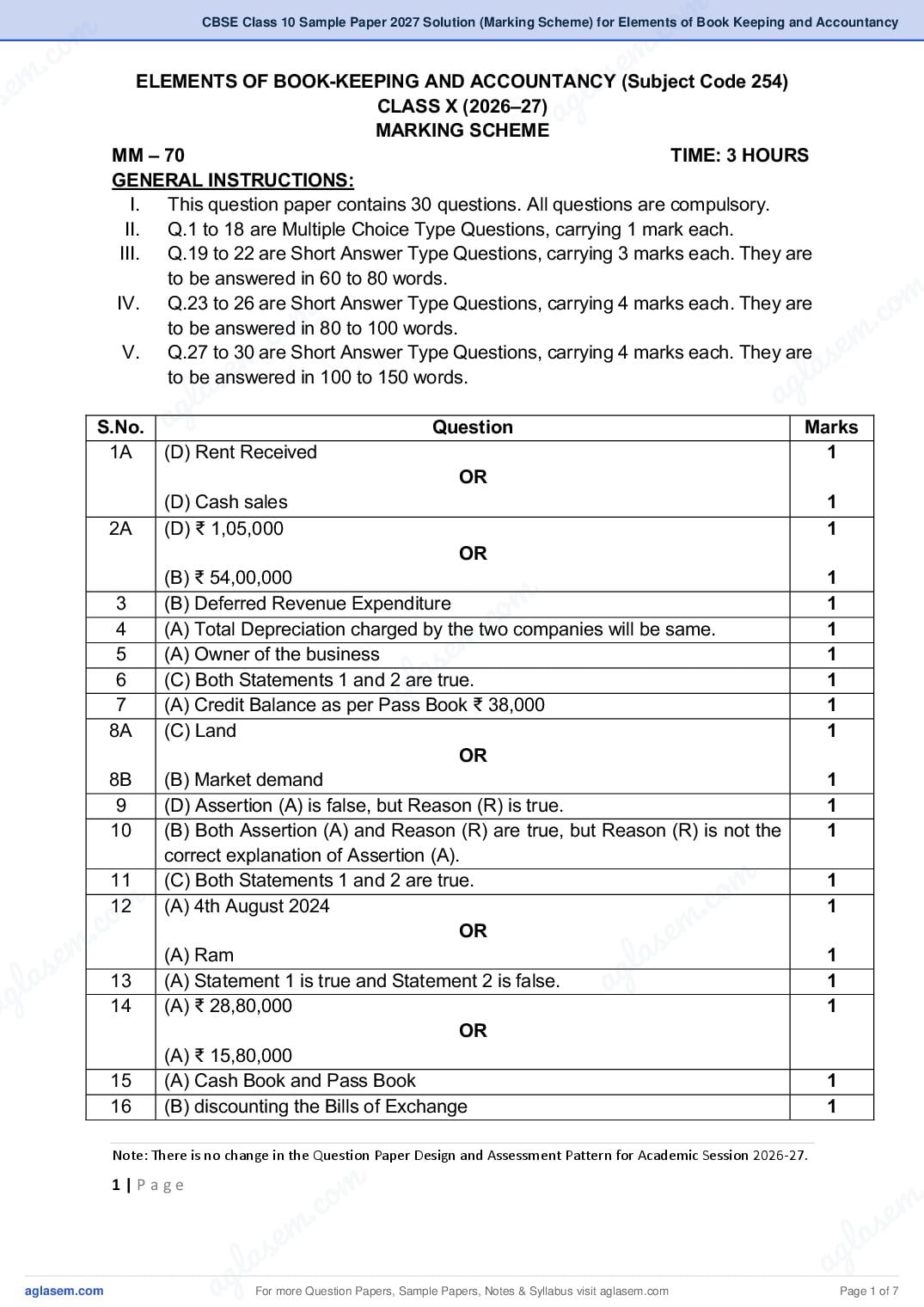
ELEMENTS OF BOOK-KEEPING AND ACCOUNTANCY
CLASS X (2026–27) g l a (Subject Code 254)
MARKING SCHEME
a
MM – 70 TIME: 3 HOURS
GENERAL INSTRUCTIONS:
I. This question paper contains 30 questions. All questions are compulsory.
II. Q.1 to 18 are Multiple Choice Type Questions, carrying 1 mark each.
III. Q.19 to 22 are Short Answer Type Questions, carrying 3 marks each. They are
m
to be answered in 60 to 80 words.
m .co
IV. Q.23 to 26 are Short Answer Type Questions, carrying 4 marks each. They are
.co m
to be answered in 80 to 100 words.
m s e
V. Q.27 to 30 are Short Answer Type Questions, carrying 4 marks each. They are
s e l a
a ag
to be answered in 100 to 150 words.
g l
S.No. a Question Marks
1A (D) Rent Received 1
OR
(D) Cash sales 1
2A (D) ₹ 1,05,000 1
OR
(B) ₹ 54,00,000 1
m
.co
3 (B) Deferred Revenue Expenditure 1
4
m
(A) Total Depreciation charged by the two companies will be same.
e
1
5 (A) Owner of the business
l as 1
ag
6 (C) Both Statements 1 and 2 are true. 1
7 (A) Credit Balance as per Pass Book ₹ 38,000 1
8A (C) Land 1
OR
8B (B) Market demand 1
9 (D) Assertion (A) is false, but Reason (R) is true. 1
10 (B) Both Assertion (A) and Reason (R) are true, but Reason (R) is not the 1
correct explanation of Assertion (A).
m
c. o
11 (C) Both Statements 1 and 2 are true. 1
m
.co
12 (A) 4th August 2024 1
e m
e m
OR
las
las (A) Ram
ag
1
g
13 (A) Statement 1 is true and Statement 2 is false. 1
a 14 (A) ₹ 28,80,000 1
OR
(A) ₹ 15,80,000
15 (A) Cash Book and Pass Book 1
16 (B) discounting the Bills of Exchange 1
m .
.co
1|Page
e m
em l as
las ag
ag For more Question Papers, Sample Papers, Notes & Syllabus visit Page 1 of 7
Page 3
OR
(C) Statement of Affairs 1
18 (B) Capital 1
19 (I) Capital invested in business by Kamakhya = Cash + Bank Balance ½
= ₹10,50,000 + ₹12,50,000 = ₹23,00,000 ½
(II) Total Capital Expenditure = Furniture + Equipment ½
= ₹4,80,000 + ₹4,20,000 = ₹9,00,000 ½
(III) Total Revenue Expenditure = Advertisement + Rent ½
= ₹1,30,000 + ₹2,40,000 = ₹3,70,000 ½
20 (I)
¥ Capital Expenditure → Purchased a new machine to increase ½
production capacity.
¥ Revenue Expenditure → Paid salaries to office staff or Spent money ½
on repairing existing machinery.
(II)
¥ Capital Expenditure → Increases earning capacity by adding new
assets or improving production facilities. ½
¥ Revenue Expenditure → Maintains earning capacity by covering
routine expenses and repairs, but does not add long-term value. ½
(III)
¥ Capital Expenditure (new machine) → Shown in Balance Sheet
under Fixed Assets, and depreciated over time. ½
¥ Revenue Expenditure (salaries, repairs) → Shown in Profit & Loss
Account as expenses, reduces profit. ½
21 (I) The method where higher depreciation is charged in the initial years and 1
lower in later years is called the Written Down Value Method (WDV Method).
(II) Merits of Written Down Value Method:
¥ Better matching of cost with revenue.
¥ Recognition of actual wear and tear. 1
1
22
Date Particulars L.F. Debit (₹) Credit (₹)
On sale of Vladimir’s A/c Dr. 41,30,000
goods To Sales A/c 41,30,000 1
(Goods sold to Vladimir on
credit) 1
On Bills Receivable A/c Dr. 41,30,000
acceptance To Vladimir’s A/c 41,30,000
of bill (Bll accepted by Vladimir)
2|Page
For more Question Papers, Sample Papers, Notes & Syllabus visit Page 2 of 7
Page 4
m .co s e m
se
On maturity Bank A/c Dr.
g la
41,30,000
(bill
honoured)
To Bills Receivable A/c
(Bill retained and
a 41,30,000 1
honoured on due date)
OR
In the Books of Balwan
Date Particulars L.F. Debit (₹) Credit (₹)
2024 Sumit Dr. 13,25,000
Mar 15 To Sales A/c 13,25,000 1
m
m
(Goods sold to Sumit on
.co
.co
credit)
e m
e m
Mar 15 Bills Receivable A/c
s
Dr. 13,25,000
as
13,25,000 gl ½
g l a To Sumit
a
a (Bill accepted by Sumit for 3
months)
Mar 25 Arpita Sood Dr. 14,25,000
To Bills Receivable A/c 13,25,000 1
To Discount Received A/c 1,00,000
(Bill endorsed to Arpita Sood
in settlement of dues)
On due No Entry
m
c. o
date (As the bill was already ½
endorsed, settlement is
e m
complete in Balwan’s books)
l as
ag
23 A
Bank Reconciliation Statement As on 31 October 2025
Particulars Plus Minus
Amount (₹) Amount (₹)
Balance as per Cash Book (positive) 4,50,000 ½
Add: Cheques issued but not yet 1,60,000 1
m
.co
presented for payment
m
c. o
Add: Cheques deposited and cleared 1,20,000 1
e m
e m
but omitted to be entered in Cash
las
las Book
ag 1
g
Add: Interest allowed by Bank not 15,000
a recorded in Cash Book
Balance as per Pass Book 7,45,000 ½
OR
1
m .
.co
3|Page
e m
em l as
las ag
ag For more Question Papers, Sample Papers, Notes & Syllabus visit Page 3 of 7
Page 5
(II) reconcile 1
(III) credit ½+½
(IV) debit, credit
24
Journal Entries in the Books of Tomas (Drawer)
Date Particulars L.F. Debit (₹) Credit (₹)
2024 Bills Receivable A/c Dr. 1,30,000
Nov 25 To Narender A/c 1,30,000 ½
(Bill drawn on Narender and
duly accepted)
2024 Bank A/c Dr. 1,09,450
Nov 25 Discount A/c Dr. 20,550 1
To Bills Receivable A/c 1,30,000
(Bill discounted with bank
@19% p.a. for 4 months)
On No entry
maturity (As the bill was already ½
discounted and duly met by
Narender, Tomas has no
further entry)
Journal Entries in the Books of Narender (Drawee)
Date Particulars L.F. Debit (₹) Credit (₹)
2024 Tomas A/c Dr. 1,30,000
Nov 25 To Bills Payable A/c 1,30,000 1
(Bill accepted for 4 months)
On Bills Payable A/c Dr. 1,30,000
maturity To Bank A/c 1,30,000
(Bill duly met on due date) 1
Working Note:
!" $
Discount = 1,30,000 × × = ₹ 7,800
!## !%
Amount received = 1,30,000 – 7,800 = ₹ 1,22,200
25 (I) Income Statement
The Income Statement is a dynamic report that measures the financial
performance of a business over a specific period of time (usually a month, 1½
4|Page
For more Question Papers, Sample Papers, Notes & Syllabus visit Page 4 of 7
Page 6
m .co s e m
se l a
quarter, or year). It matches revenues against expenses
g
to determine if the
business is running at a profit or a loss.
Position Statement (Balance Sheet)
a
The Position Statement is a static "snapshot" of the financial health of a 1½
business at a specific point in time (usually the last day of the financial
year). It shows what the business owns (Assets) and what it owes (Liabilities
and Capital). 1
(II) Cost of Goods Sold = Opening Stock + Purchases + Direct Expenses –
m
Closing Stock
m .co
26 Particulars Amount (₹)
.co m
Capital at the end of the year (31.03.2025) 44,70,000
e
½
e m
Add: Drawings during the year 11,80,000
l a
1s
l as 56,50,000
ag ½
g
Less: Additional Capital introduced (31.12.2024) (4,40,000)
a Adjusted Capital at the end of the year
Less: Capital at the beginning (31.10.2024)
52,10,000
(41,50,000)
½
Net Profit made during the year 10,60,000 1½
27 (i) Cost of Computer & peripherals = ₹ 39,50,000
Installation = ₹ 2,20,000
Transportation = ₹ 1,30,000
Total Cost = ₹ 43,00,000
m
.co
−Depreciation for 9 months = ₹ 3,22,500
m
Book Value on 31/03/2024 = ₹ 39,77,500
−Depreciation for full year
s e = ₹ 3,97,750
l a
ag
Book Value on 31/03/2024 = ₹ 35,79,750
Date Particulars L.F Debit (₹) Credit (₹)
2023 Machinery A/c Dr. 43,00,000 43,00,000
July 1 To Bank A/c 1
(Computer and peripherals
purchased including
installation and transportation)
2024 Depreciation A/c Dr. 3,22,500
m
.co
Mar To Machinery A/c 3,22,500
31 (Depreciation charged @10%
s em
s em p.a. on WDV for 9 months)
g la
1½
g la 2025 Depreciation A/c Dr.
a
3,97,750
a Mar
31
To Machinery A/c
(Depreciation charged @10%
3,97,750
1½
p.a. on WDV for the year)
Book Value of Machinery to be shown in Balance Sheet as on 31 March
2025 = 43,00,000 -3,22,500 -3,97,750= ₹35,79,750
m .
.co
5|Page
e m
em l as
las ag
ag For more Question Papers, Sample Papers, Notes & Syllabus visit Page 5 of 7
Page 7
28 (I) Subtract ₹12,000 from the Pass Book balance. 6
(II) Subtract ₹1,500 from the Cash Book balance.
(III) Subtract ₹10,000 from the Pass Book balance
(IV) Add ₹3,000 to the Cash Book balance.
(V) Add ₹8,000 to the Pass Book balance.
29 Statement of Affairs as on 31 March 2024
Liabilities ₹ Assets ₹
Creditors 18,000 Cash 25,000 2
Bills Payable 6,000 Bank 12,000
Capital (Balancing Figure) 1,36,000 Debtors 45,000
Furniture 70,000
Bills Receivable 8,000
1,60,000 1,60,000
Statement of Affairs as on 31 March 2025
Liabilities ₹ Assets ₹
Creditors 24,000 Cash 40,000
Bills Payable 5,000 Bank 18,000
2
Capital (Balancing Figure) 1,61,000 Debtors 32,000
Furniture 90,000
Bills Receivable 10,000
1,90,000 1,90,000
Calculation of Profits
Closing Capital = Opening Capital + Capital Introduced – Drawings + Profit
₹1,61,000 = ₹1,36,000 + ₹60,000 – ₹72,000 + Profit 2
₹1,61,000 = ₹1,24,000 + Profit
Profit = ₹37,000
OR
(I) Accounts from Incomplete Records, often referred to as the Single-Entry
System, is a method of bookkeeping where a business does not maintain
its accounts according to the double entry system. Instead, only partial
records are kept, usually covering personal accounts such as debtors, 3
creditors, cash, and bank, while many real and nominal accounts are
missing.
It is generally adopted by small traders or sole proprietors because it is
simple and inexpensive. However, since the dual aspect of transactions is
not recorded, the system is considered unscientific and unreliable, and the
true financial position or profit of the business can only be determined by
reconstructing accounts (for example, through Statements of Affairs).
6|Page
For more Question Papers, Sample Papers, Notes & Syllabus visit Page 6 of 7
Page 8
m .co s em
se g la
a
(II) Balance Sheet: A formal financial statement prepared under double-
entry system and shows assets, liabilities, and capital at a specific date. It
is prepared to show the financial position of a business, based on ledger
accounts and trial balance. 3
Statement of Affairs: It is prepared under Single Entry System (Incomplete
Records) and shows assets, liabilities, and estimated capital at a specific
m
date to ascertain capital or profit/loss when records are incomplete and often
requires estimates and approximations.
c o m
Trading A/c. s e
30
m
eParticulars l a
las g
(₹) a
Amount Particulars Amount
g
aTo Opening Stock
(₹)
60,000 By Sales 4,50,000
To Purchases 2,50,000 2,35,000 Sales Returns (25,000) 4,25,000
Pur.Returns (15,000)
To Wages 40,000 By Closing Stock 75,000
To Gross Profit 1,65,000
5,00,000 5,00,000 2
m
.co
Profit & Loss A/c
em
Particulars Amount Particulars Amount
(₹)
las (₹)
To Rent
To Discount Allowed ag
70,000 By Gross Profit
12,000 By Commission
1,65,000
60,000
Received
2
To Net Profit transferred 1,68,000 By Discount Received 25,000
to Capital A/c
2,50,000 2,50,000
Balance Sheet of Mr. Karan Mehta As on 31 March 2025
m
.co
Liabilities ₹ Assets ₹
m
.co m
Capital 8,52,000 Furniture & Equipment 4,00,000
m s e
la
+ Net Profit 1,68,000 Plant & Machinery 3,00,000
s e g
la
(-) Drawings (40,000) 9,80,000 Goodwill 65,000
g Creditors 55,000 Debtors 85,000 a
a Bank Loan 80,000 Cash in Hand 90,000 2
Bank Balance 1,00,000
Closing Stock 75,000
11,15,000 11,15,000
m .
.co
7|Page
e m
em l as
las ag
ag For more Question Papers, Sample Papers, Notes & Syllabus visit Page 7 of 7
Document Details
| Board / Org | CBSE |
| Exam | Class 10 |
| Type | Solution |
| Pages | 7 |
| Updated | 29 Oct 2026 |