AMUEEE 2023 Sample Paper
Finished viewing? Save it for later —
Download AMUEEE 2023 Sample Paper (PDF · 32 pages)About AMUEEE 2023 Sample Paper
AMUEEE 2023 Sample Paper is available here for free download. Published by AMU for Aligarh Muslim University Engineering Entrance Examination, this sample paper can be viewed online or downloaded as a PDF (32 pages). Candidates preparing for Aligarh Muslim University Engineering Entrance Examination can use AMUEEE 2023 Sample Paper to understand the exam pattern, the type of questions asked, and the overall difficulty level.
Frequently Asked Questions
How can I download AMUEEE 2023 Sample Paper?
Open this page and click the Download button to save AMUEEE 2023 Sample Paper as a PDF. It is completely free on AglaSem Docs.
Is AMUEEE 2023 Sample Paper free to download?
Yes. AMUEEE 2023 Sample Paper can be viewed online and downloaded as a PDF free of cost on AglaSem Docs.
How many pages does AMUEEE 2023 Sample Paper have?
AMUEEE 2023 Sample Paper contains 32 pages, which you can read online or download together as a single PDF.
Where can I find more Aligarh Muslim University Engineering Entrance Examination study material?
You can find more Aligarh Muslim University Engineering Entrance Examination question papers, sample papers, syllabus, and answer keys on AglaSem Docs.
AMUEEE 2023 Sample Paper – Text
Read the full text of this sample paper below — useful to quickly search, copy and reference the content online without downloading the PDF.
📄 View text version (32 pages)
Page 1
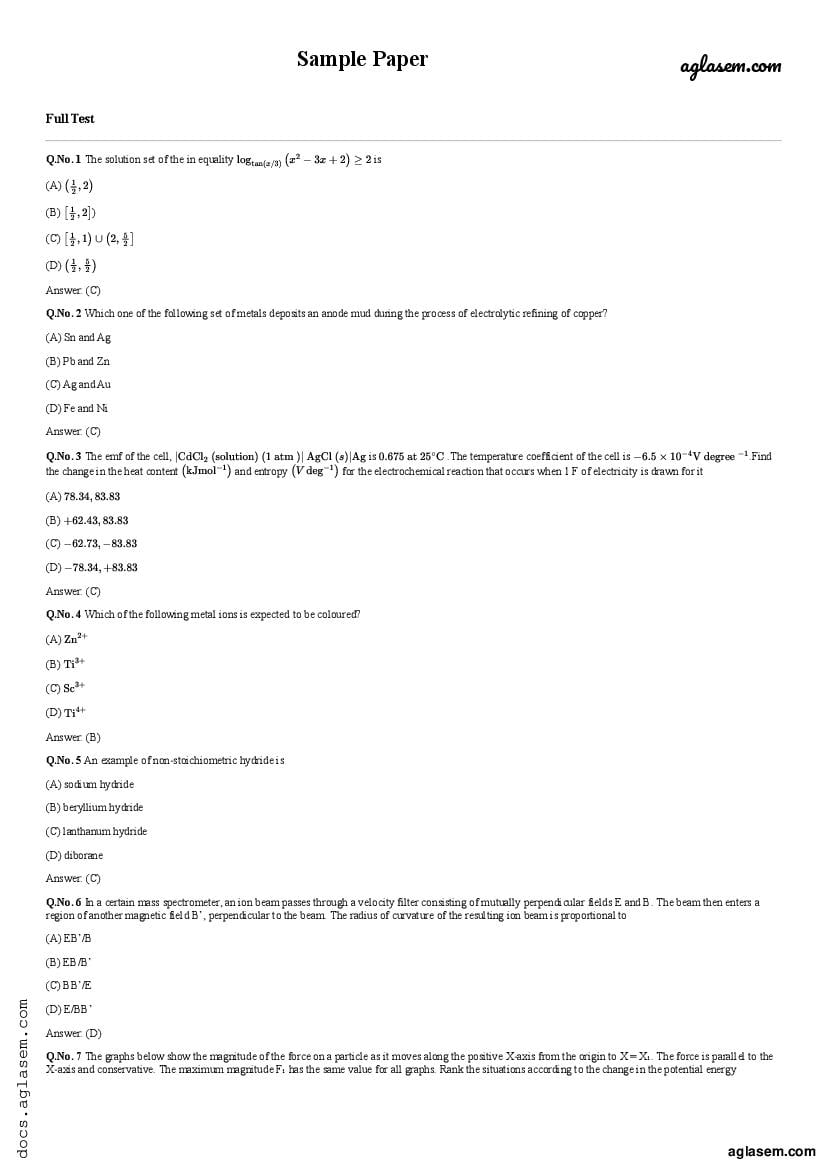
Full Test
Q.No. 1 The solution set of the in equality log tan(x/3)
(x
2
− 3x + 2) ≥ 2 is
(A) ( 1
2
, 2)
(B) [ 1
2
, 2] )
(C) [ 1
2
, 1) ∪ (2,
5
2
]
(D) ( 1
2
,
5
2
)
Q.No. 2 Which one of the following set of metals deposits an anode mud during the process of electrolytic refining of copper?
(A) Sn and Ag
(B) Pb and Zn
(C) Ag and Au
(D) Fe and Ni
Q.No. 3 The emf of the cell, |CdCl (solution) (1 atm )| AgCl (s)|Ag is 0.675 at 25 C .The temperature coefficient of the cell is −6.5 × 10 V degree
2
∘ −4 −1
.Find
the change in the heat content (kJmol ) and entropy (V deg ) for the electrochemical reaction that occurs when 1 F of electricity is drawn for it
−1 −1
(A) 78.34, 83.83
(B) +62.43, 83.83
(C) −62.73, −83.83
(D) −78.34, +83.83
Q.No. 4 Which of the following metal ions is expected to be coloured?
(A) Zn 2+
(B) Ti 3+
(C) Sc 3+
(D) Ti 4+
Q.No. 5 An example of non-stoichiometric hydride is
(A) sodium hydride
(B) beryllium hydride
(C) lanthanum hydride
(D) diborane
Q.No. 6 In a certain mass spectrometer, an ion beam passes through a velocity filter consisting of mutually perpendicular fields E and B. The beam then enters a
region of another magnetic field B’, perpendicular to the beam. The radius of curvature of the resulting ion beam is proportional to
(A) EB’/B
(B) EB/B’
(C) BB’/E
(D) E/BB’
Answer: (D)
Q.No. 7 The graphs below show the magnitude of the force on a particle as it moves along the positive X-axis from the origin to X = X₁. The force is parallel to the
X-axis and conservative. The maximum magnitude F₁ has the same value for all graphs. Rank the situations according to the change in the potential energy
Page 2
(C) (iii), (ii),(i)
(D) (ii), (i), (iii)
Answer: (D)
Q.No. 8 The points z
(A) 4
(B) 3
(C) -3
(D) 0
2
2
(D) None of these
= C
1
(A) a circle with centre origin
= x + iy
(B) a straight line through origin
(C) axis of X
(D) axis of Y
line is
(A) 2xy = C
(B) xy + C
(C) 4x y
2
2
= 0
∣
associated with the force, least (or most positive) to greatest ( or most positive)
(A) (i), (ii), (iii)
and z 2
=
1
−x+iy
in the complex plane lie on
Q.No. 9 A straight line has its extremities on two fixed straight lines and cuts off from them a triangle of constant area C .Then the locus of the middle point of the
Q.No. 10 The function (x − 9) x − 7x + 12 + cos(|x|) is not differentiable at
reduction. The compound ( A) is
(A) pentanal
(B) 2-pentanone
(C) 3-pentanone
(D) allyl alcohol
2
10
2
2
Q.No. 11 A compound C H O ( A) forms a phenyl hydrazone and gives negative Tollen's test and a positive Iodoform reaction. It also gives n-pentane on
5
Q.No. 12 If R is the set of real numbers and f:R → R is a function defined by f(x) = sin x, then f
(A) {x{ x = nt, n is an integer}
(B) {xl x = 1/2 + 2nt, n is an integer}
(C) R
−1
([−1, 1]) is
Page 3
Q.No. 13 For a CE transistor amplifier the audio signal voltage across the collector resistance of 2kΩ is 2 V. The current amplification factor of the transistor is 100.
If the base resistance is 1kΩ, the input signal voltage and base current are respectively
(A) 0.01 V, 10 μA
(B) 0.04 V, 10 μA
(C) 0.01 V, 10 μA
(D) 0.04 V, 10 μA
Q.No. 14 A sample of an ideal gas undergoes an isothermal process as shown by the curve AB in the pV diagram. If ΔQ, ΔU and ΔW represent the amount of heat
absorbed the change in internal energy and the work done respectively, then which of the following statement is correct?
(A) ΔQ = + ve, ΔU = 0, ΔW = −ve
(B) ΔQ = +vθ, ΔU = 0, ΔW = +ve
(C) ΔQ = +vθ, ΔU = 0, ΔW = 0
(D) ΔQ = +ve, ΔU = +ve, ΔW = +ve
Q.No. 15 If both roots of the equation x − 2(a − 1)x + (2a + 1) = 0 are positive, where a is a real number, then
2
(A) a ∈ (4, ∞)
(B) a ∈ (−∞, 0] ∪ [4, ∞]
(C) a ∈ (1, ∞)
(D) a ∈ [4, ∞)
Answer: (D)
Q.No. 16 0.002 M solution of a weak acid has an equivalent conductance (Λ)60 ohm −1
cm
2
eq
−1
What will be the pH ? (Given Λ ∘
= 400 ohm
−1 2
cm eq
−1
)
]
(A) 3.52
(B) 2.52
(C) 1.87
(D) 2.7
Q.No. 17 If lim x→0
|x|
|cos x|
= 1 where [.] denotes the greatest integer function, then the value of l is
(A) 1
(B) -1
(C) 0
(D) does not exist
Page 4
d[A] d[B] 1 [A][B] 0
= − = k[A][B] kt = ln when , [A] 0 ≠ [B] 0 0
≠ [B] 0 0
= [B] 0
dt dt [A] 0 −[B] 0 [B][A] 0
integrated rate law will be
[A]
(A) kt = ln [B]
(B) 1
[B]
=
1
[A] 0
+ kt
(C) 1
[A]
=
1
[B] 0
+ kt
(D) 1
[A]
=
1
[A b
+ kt or
1
[B]
=
1
[B] 0
+ kt
Answer: (D)
Q.No. 19 Three particles, two with masses m and one with mass M, might be arranged in any of the four configurations shown below. Rank the configurations
according to the magnitude of the gravitational force on M, least to greatest
(A) (i), (i), (iii), (iv)
(B) (ii), (i), (iii), (iv)
(C) (ii), (i), (iv), (iii)
(D) (ii), (iii), (iv), (i)
2 2
Q.No. 20 If Sand S' are the foci of the ellipse and P is any point on it then range of values of SP.S'P is
x y
+ = 1
25 26
(A) 9 ≤ f (θ) ≤ 16
(B) 9 ≤ f (θ) ≤ 25)
(C) 16 ≤ f (θ) ≤ 25
(D) 1 ≤ f (θ) ≤ 16
Q.No. 21 The best reducing agent among the following is
(A) NH 3
(B) SbH 3
(C) P H 3
(D) AsH 3
Page 5
x x ≠ 1
Q.No. 22 The area bounded by the curve y = { and y = |x − e| is
e, x = 1
(A) e /22
(B) e 2
(C) 2e 2
(D) 1
Q.No. 23 Leta, be the rth term of an AP, whose first term is a and common difference is d. If for some positive integers m, n, m ≠ n, α m =
1
n
and α n =
1
m
then a –
d equals
(A) mn
1
(B) 1
(C) 0
(D) 1
m
+
1
n
Q.No. 24 Which of the following radioactive element is used in the treatment of cancer?
(A) Uranium
(B) Thorium
(C) Cerium
(D) Plutonium
Q.No. 25 The wave nature of electron was first experimentally verified by
(A) Louis Victor de-Broglie
(B) James Frank and Gustav Hertz
(C) C.J. Davisson and L.H. Germer
(D) Hans Geiger and Ernst Marsden
2NaOH + Cl 2 ⟶ NaCl + X + H 2 O 6NaOH + 3Cl 2 ⟶ NaCl + Y + 3H 2 O
Q.No. 26 Products (X and Y) of the following reactions (I and II) are : 1. 2.
(Cold and di.) (Hot and conc. )
(A) X = NaClO and Y = NaOCl 3
(B) X = N aClO and Y = N aOCl 3
(C) X = NaHClO and Y = NaOCl 3
(D) X = NaClO and Y = NaHClO 3 3
Q.No. 27 A rocket is moving at a speed of 200 m/s towards a stationary target. While moving it emits a wave of frequency 1000 Hz. Some of the sound reaching the
target gets reflected back to the rocket as an echo. The frequency of the echo as detected by the rocket is (velocity of sound = 330 m/s)
(A) 1000 Hz
(B) 1580 Hz
(C) 2540 Hz
(D) 4080 Hz
Answer: (D)
Q.No. 28 The reaction quotient (Q) for the reduction of O to H O in acid solution, O (g) + 4H (aq) + 4e
2 2 2
+ −
⟶ 2H 2 O(l) is, [where, α H
+ = activity of H , p +
O2
=
pressure of O , when it is present in the reaction, p = pressure of O at standard state)].
2
0
2
∘
(A) Q = p
4
α +p 0
+ 2
H
PO
(B) Q = α
4
+ρ
2
∘
H+
4
α + +ρ 0 2
(C) Q = H
p
∘
4 0
α +p
(D) Q = H+
p0
2
Page 6
B by the electric field. Points A and B have equal separations in the three arrangements. If p , p and p are linear momentum of the proton at point B in the three
1 2 3
arrangement respectively, then
(A) p 1
> p3 > p2
(B) p 1
> p2 > p3
(C) p 2
> p1 > p3
(D) ρ 1 = p2 = ρ3
Q.No. 30 The angle of prism and refractive index of the material of the prism are A and cot A
2
, respectively. The angle of minimum deviation of the prism is
(A) π
2
− A
(B) π − A
(C) π − A
2
(D) π − 2A
Answer: (D)
Q.No. 31 The combination of gates shown in figure yields
(A) NAND gate
(B) OR gate
(C) NOT gate
(D) XOR gate
Q.No. 32 A β - hydroxy carbonyl compound is obtained by the action of NaOH on
(A) R CCHO3
(B) C H CHO
6 5
(C) CH CHO
3
(D) HCHO
Q.No. 33 Structure anions of acids HNO , H PO and H SO are, respectively
3 3 4 2 4
(A) tetrahedral, tetrahedral and trigonal bipyramidal
(B) angular, tetrahedral and trigonal bipyramidal
Page 7
(D) planar, tetrahedral and tetrahedral
Answer: (D)
are
(A) in GP
(B) in AP
(C) equal
(D) None of the above
(A) 16
(B) 8
(C) 4
(D) 2
Q.No. 36 If g(x) = x + x − 2 and
(A) 2x-3
(B) 2x + 3
(C) 3x -2
(D) 2x-2
(A) xy(x + y) = C
(B) xy(x − y) = C
(C) x y(x − y) = C
(D) √
2
(D) x y(x − y) = C
3
2 1
2
(gof )x = 2x
Q.No. 37 The solution of the differential equation
Q.No. 38 The shortest distance between the parabolas 2y
(A) 2√2
(B)
(C) 4
1
2√ 2
(A) alkaloid
36
5
Q.No. 39 Aspartame is an
(B) insecticide
(C) artificial sweetener
(D) antiseptic
Q.No. 40 The equation ||x| +
(A) [0, 1)
(B) {0} ∪ (1, ∞)
x
x−1
=
x
|x−1|
2
2
dy
dx
− 5x + 2
=
2xy−y
2xy−x
2
2
2
then f(x) is equal to
,
= 2x − 1, 2x
2
will be always true for x, belonging to
= 2y − 1
∣
Q.No. 34 If a,b,c are the integers between 1 and 9 and a51, b41, c31 are three-digit numbers and the value of determinant D = a51
⋮5
a
4
b41
b
3
c31
i
is zero, then a,b,c
Q.No. 35 Two solid spheres of the same metal but of mass M and 8 M fall simultaneously in a viscous liquid. If their terminal velocities are v and nv, then the value
of n will be
Page 8
(D) (−∞, ∞)
PbS(s) + 4H 2 O 2 (aq) ⟶ PbSO 4 (s)
Q.No. 41 The following reactions show the H O behaviour in I and II reactions as: 1.
2 2 2.
+4H 2 O(l)
+ −
HOCl + H 2 O 2 ⟶ H 3 O + Cl + O2
(A) Oxidising in acidic medium and reducing in basic medium
(B) Reducing in acidic medium and oxidising in basic medium
(C) Oxidising in acidic medium and reducing in acidic medium
(D) Reducing in acidic medium and oxidising in acidic medium
Q.No. 42 If χ and χ represent the mole fractions of a component A in the vapour phase and liquid mixture respectively, and p and |p represent vapour pressures
1 2
0
A
∘
B
of pure A and pure B, then total vapour pressure of liquid mixture is
∘
p χ1
(A) A
χ2
∘
p x2
(B) A
χ1
∘
(C)
p χ1
B
χ2
∘
(D) p
B
χ1
χ2
Q.No. 43 Area of one loop formed by |y| = | sin x| is
(A) 0
(B) 2
(C) 4
(D) 2π
Q.No. 44 Figure shows a rectangular copper plate with is centre of mass at the origin O and side AB = 2BC = 2 m. If a quarter part of the plate (shown as shaded) is
removed, the centre of mass of the remaining plate would lie at
(A) 12
1
m,
1
6
m
(B) 1
6
m,
1
12
m
(C) 1
3
m,
1
6
m
(D) 1 1
m, m
3 2
Q.No. 45 An alpha particle accelerated through V volts is fired towards a nucleus. It distance of closest approach is r. If a proton accelerated through the same
potential is fired towards the same nucleus, its distance of closest approach will be
(A) r
(B) 2r
Page 9
(D) r/4
Q.No. 46 The relation between time t and distance x for a moving particle is t = ax + βx, where α and β are constants. If v is the velocity at distance X, then the
2
retardation of the particle is
(A) 20v 3
(B) 2βv 3
(C) 2αβv 3
(D) 2β v 2 2
Q.No. 47 If cot −1
(√cos α) − tan
−1
(√cos α) = x then sin x is equal to
(A) tan (α/2) 2
(B) cot (α/2)
2
(C) tan α
(D) cot(α/2)
Q.No. 48 An alternating voltage V = 200√2 sin(100n) volt is connected to a 1μF capacitor through an AC ammeter. The reading of the ammeter
(A) 40 mA
(B) 20√2mA
(C) 20 mA
(D) 10√2mA
Q.No. 49 Which of the following is most soluble in water?
(A) CsClO 4
(B) NaClO 4
(C) kClO 4
(D) LiClO 4
Answer: (D)
Q.No. 50 The strongest base in the following is
(A)
(B)
Page 10
(D)
Q.No. 51 The nearest star to our solar system is 4.3 light years away. The distance of this star in Parsec is (Mean distance between the earth and the sun = 5 × 10 11
m
and one light year = 9.46 × 10 m)
15
(A) 3
(B) 8.0
(C) 13.0
(D) 33 × 10 4
Q.No. 52 Which of the following has the maximum vapour pressure?
(A) HCI
(B) HBr
(C) Hf
(D) HI
Q.No. 53 The most reactive to nucleophilic attack at the carbonyl group is
(A)
(B)
Page 11
(D)
Q.No. 54 Which statement is true for the line x−4
8
=
y−2
2
=
z−3
3
and plane having intercepts -4,2 and 3 of the following
(A) line is orthogonal to the plane
(B) line lies in the plane
(C) line makes an acute angle (≠ 0 ) with the plane
∘
(D) None of the above
Q.No. 55 A magnetic field cannot
(A) change the velocity of a charged particle.
(B) change the momentum of a charged particle.
(C) change the kinetic energy of a charged particle.
(D) change the trajectory of a charged particle.
Q.No. 56 What will be the pH of solution formed by mixing 10 mL 0.1 M NaH PO and 15 mL 0.1 M Na HPO . [Given: pK
2 4 2 4 1
= 2.12, pK 2 = 7.2]
(A) 7.0
(B) 6.9
(C) 7.4
(D) 7.5
Q.No. 57 Two seconds after projection, a projectile is moving at 30° above the horizontal, after one more second, it is moving horizontally. The initial speed of the
projectile is (Take g = 10ms )
−2
(A) 10 m/s
(B) 10/3 m/s
(C) 20 m/s
(D) 2013 m/s
Answer: (D)
Q.No. 58 The only force acting on a 2 kg body that is moving in xy-plane has a magnitude of 5 N. The body initially has a velocity of 4 m/s in the positive x-
direction. Some time later, the body has a velocity of 6 m/s in the positive y-direction. The work done on the body by the 5 N force during this time is
(A) 20 J
(B) 40 J
(C) 52 J
(D) 72 J
Q.No. 59 When a beam of 10.6 eV photons of intensity 2.0W/m falls on a metallic surface of area 1 × 10
2 −4 2
m , 0.53% of the incident photons eject
photoelectrons. What is the number of photoelectrons emitted per second?
Page 12
(B) 6.25 × 10 11
(C) 6.25 × 10 13
(D) 6.25 × 10 15
sin(θ−α) cos(θ−α)
Q.No. 60 Let sin(θ−β)
=
a
b
,
cos(θ−β)
=
c
d
.Then the value of cos(α − β) equals
(A) ac−bd
ad+bc
(B) ac+bd
ad+bc
(C) ac+bd
ab+cd
(D) ac−bd
ab+cd
Q.No. 61 A man throws a ball of mass 3.0 kg with a speed of 5.0 m/s. His hand is in contact with the ball for 0.2 s. If he throws 4 balls in 2 seconds, the average
force exerted by him in 1 second is:
(A) 15 N
(B) 30 N
(C) 150 N
(D) 75 N
Q.No. 62 Which of the following structures contain sp-hybridised carbon atom(s)?
(A) I, II and III
(B) I, III and IV
(C) II, III and IV
(D) I, II and IV
Answer: (D)
Q.No. 63 A block is released from rest on a 45° smooth incline and slide a distance d. The time taken to slide the same distance is n times as much to slide on a 45°
rough incline than on the smooth incline. The coefficients of friction for the rough incline is
(A) √1 − n
1
2
(B) 1 − n
1
2
(C) √1 − 2n
1
2
(D) 1 − 1
2n
2
Q.No. 64 Which of the following is an incorrect statement?
(A) n + 3n + 5n + 3 is divisible by 3 for all neI N
3 2
(B) n(n + 1)(2n + 1) is divisible by 6 for all neI N
(C) n − n + 41 is a prime number for all neI N
2
(D) 7 n
− 3
n
is divisible by 4 for all neI N where IN denotes the set of all natural numbers.
Page 13
∘
then undergoes a reversible isothermal expansion until pressure is 1.00 bar what is the total work W during the process?
(A) −23.02 × 10 J 3
(B) −14.0 × 10 J 3
(C) 14.0 × 10 J3
(D) Zero
Q.No. 66 A particle of mass m is moving with a constant velocity along a line parallel to the positive direction of X-axis. The magnitude of its angular momentum
with respect to the origin
(A) is zero.
(B) goes on increasing as x increases.
(C) goes on decreasing as x increases.
(D) remains constant for all positions of the particle.
Answer: (D)
Q.No. 67 If four whole numbers taken at random are multiplied together, then the probability that the last digit in the product is 1, 3, 7, or 9, is
(A) 81/625
(B) 8/625
(C) 32/625
(D) 16/625
Answer: (D)
Q.No. 68
What are 'X' and 'Y ?
(A)
(B)
Page 14
(D) in both cases
Q.No. 69 Acceleration-time graph of a body moving in a straight line is as shown in figure. The body started its motion from rest.
At what point is
the body moving with the largest speed?
(A) 1
(B) 2
(C) 3
(D) 4
Q.No. 70 The air pressure at sea level is 101325 Pa. At the centre of a rarefaction of a sound wave in air, the pressure is 91000 Pa. Which is the most likely pressure
at the centres of a compression of the same wave?
(A) 91000 Pa
(B) 101000 Pa
(C) 111650 Pa
(D) 121000 Pa
Q.No. 71 If A and B are disjoint sets, then B ∩ A where A' is complement of A is equal to
′
(A) A
(B) B
(C) A'
(D) B’
Q.No. 72 Consider the following statements about the four fundamental forces in nature. (i) The strong nuclear force binds protons and neutrons in a nucleus. (ii)
The strong nuclear force is about 10 times the electromagnetic force in strength. (iii) The weak nuclear force is the weakest of all the four fundamental forces. (iv)
The range of the weak nuclear is about 10 m The correct statement(s) is (are)
−16
(A) (i) only
(B) (ii) and (ii)
Page 15
(D) (i), (ii) and (iv)
Q.No. 73 Sound waves from a loudspeaker reach a point P via two paths which differ in length by 1.8 m. When the frequency of sound is gradually increased, the
resultant intensity at P is found to be maximum the frequency is 1000 Hz. At what next higher frequency will a maximum be detected? (velocity of sound= 360 m/s)
(A) 1200 Hz
(B) 1400 Hz
(C) 1600 Hz
(D) 1800 Hz
Heat
Q.No. 74 The intermediate product (X) formed in the following reaction is B H + 6NH
2 6 3 → 3X ⟶ 2B 3 N 3 H 6 + 12H 2
(A) [BH(NH ) ] [BH ] 3 3
+
4
−
(B) [BH OH ) ]
2 3 4
+
[BH 4 ]
(C) [BH(NH ) ]
+
3
[BH 4 ]
4
(D) [BH (NH ) ]
+
2 3 ⋅ [BH 4 ]
2
Answer: (D)
Q.No. 75 A piece of ice is tied using a string to the bottom of bucket A. The bucket is filled with water with ice completely submerged in it.' Another bucket B is
filled with water and a piece of ice is released in water. If floats on the surface of water (see Fig.). What would be the impact on the level of water in the two buckets,
when ice pieces melt away completely?
(A) Level of water remain unchanged in both the buckets.
(B) Level of water will go down in bucket A, but will remain unchanged in bucket B.
(C) Level of water will go down in bucket, A but will go up in bucket B.
(D) Level of water will remain unchanged in bucket A, but will go up in bucket B.
Q.No. 76 On heating an aldehyde with Fehling's reagent, a reddish brown precipitate is obtained due to the formation of
(A) RCOO −
(B) CuO
(C) Cu O2
(D) RCH OH 2
Q.No. 77 A small satellite is in elliptical orbit around the earth as shown in figure, L denotes the magnitude of its angular momentum and K denotes its kinetic
energy. If 1 and 2 denote two positions of the satellite, then
Page 16
(B) L 2
= L1 , K2 > K1
(C) L 2
> L⋅ K2 < K1
(D) L 2
= L1 , K2 < K1
Q.No. 78 In electromagnetic waves travelling in vacuum (i) The electric field E is always perpendicular to the magnetic field B. (ii) The cross product Ex B always
gives the direction in which the waves travel. (iii) The field E and B vary sinusoidally. (iv) There is a phase difference of between E and B. The correct π
2
statement(s) (are)
(A) (i), (iii)
(B) (i), (iii), (iv)
(C) (i), (ii), (iii), (iv)
(D) (i), (ii), (iii)
Q.No. 79 The standard emf of the cell ( E and equilibrium constant (K of the following reaction of 298 K Cd
∘ 2+ 2+
cell eq
) + 4NH 3 ⇌ Cd(NH 3 )
4
(A) E ∘
cell
= 1.0V, K eq = 1.26 × 10
7
(B) E ∘
cell
= 0.21V, K eq = 1.26 × 10
7
(C) E ∘
cell
= 1.0V 1 K eq = 6.60 × 10
33
(D) E ∘
cell
= 021V, K eq = 6.60 × 10
33
Q.No. 80 If A (i = 1, 2, … , n) are n independent events, with P (A ) = 1 −
i i
1
2
i
then the probability that at least one of the n events occurs, is
(A) 2
1
n(n+1)/2
(B) 2
1
(n+1)/2
(C) 1 − 2
1
n(n+1)/2
(D) 1 − 2
1
(n+1)/2
Q.No. 81 A five-digit number divisible by 3 is to be formed using the numbers 0, 1, 3, 4 and 5 without repetition. The total number of ways this can be done is
(A) 216
(B) 600
(C) 240
(D) 3125
Q.No. 82 For the reaction, 1
2
H 2 (g) +
1
2
Cl 2 (g) ⟶ H
+
(aq) + Cl
− ∘
(aq) ΔG recation = −131.23kJmol
−1
The value of ΔG ∘
f ormation
of Ag
+
(aq) shall be given by ,
(if ΔG (H aq) = 0
δ
f
+
(A) −54.12kJmol −1
(B) −131.23kJmol −1
(C) +77.11kJmol −1
(D) +5412kJmol −1
Q.No. 83 Let * be a binary operation on the set R of real numbers defined by a b = ∗ 3ab
7
then the identity element in R for ‘*’ is
(A) 3/7
(B) 3/14
(C) 2/3
(D) None of these
Answer: (D)
Page 17
(A) 100Ω
(B) 200Ω
(C) 500Ω
(D) 1000Ω
Q.No. 85 The angle between the line x − 2y + z = 0 = x + 2y − 2z and the plane 5x – 2y – 2 +17 = 0 is
(A) 30°
(B) 60°
(C) 90°
(D) 0°
Answer: (D)
Q.No. 86 Two long straight wires vertically pierced the plane of the paper at vertices of an equilateral triangle as shown in figure. They each carry 2 A, out of the
paper. The magnetic field at the third vertex P has magnitude.
(A) 10 −5
T
(B) 14 × 10 −5
T
(C) 17 × 10 −5
T
(D) 0.85 × 10 −5
T
Q.No. 87 Which one of the following is not the use of SO ? 2
(A) Preservative
(B) Anti-chlor
(C) Disinfectant
(D) Insecticide
Answer: (D)
Page 18
(A) Bakelite
(B) PVC
(C) Nylon 6, 6
(D) Buna-S
Q.No. 89 A region in the xy-plane is bounded by the curve y = √25 − x and the line y = 0. If the point (a, a + 1) lies in the interior of the region, then
2
(A) a ∈ (−4, 3)
(B) a ∈ (−∞, −1) ∪ (3, ∞)
(C) a ∈ (−1, 3)
(D) None of these
Q.No. 90 One end of massless spring of spring constant 100 N/m and natural length 0.49 m is fixed and other end is connected to a body of mass 0.5 kg lying on a
frictionless horizontal table. The spring remains horizontal. If the body is made to rotate at an angular velocity of 2 rad/s, then the elongation of the spring will be
(A) 2 cm
(B) 1 cm
(C) 0.5 cm
(D) 0.25 cm
Q.No. 91 The area of the region defined by ||x| − |y|| ≤ 1 and x + y 2 2
≤ 1 in the xy-plane is
(A) a
(B) 1
(C) 2
(D) None of these
Q.No. 92 Let A be an event that a family has children of both sexes and B be the event that the family has at most one boy. If the family has 3 children then the
events A and B are
(A) dependent
(B) independent
(C) mutually exclusive
(D) None of these
Q.No. 93 Let a , a , a , … . . a be in AP. If
1 2 3 n
1
a1 an
+
1
a 2 a n−1
+ … +
1
an a1
=
K
a 1 +a n
[
1
a1
+
1
a2
+ … +
1
an
] then K is equal to
(A) 1
(B) 2
(C) 3
(D) 5
Q.No. 94 Two identical conducting spheres A and B carry equal charge. They are initially separated by a distance much larger than their diameters and the force
between them is F. A third identical conducting sphere C is uncharged. Sphere C is first touched to A, then to C and removed. As a result, the force between A and B
now is
(A) F/16
(B) F/4
(C) 3F/8
(D) F/2
Q.No. 95 Which of the following complexes is optically active?
Page 19
3 5
+
(B) [Co (NH )C ]3 5
3−
(C) cis − [Co(en) Cl ] 2 2
(D) tans − [Co(en) Cl ] 2 2
Q.No. 96 The time period of a physical pendulum is 2π√I /mgd, where I is the moment of inertia of the pendulum about the axis of rotation . and d is perpendicular
distance between the axis of rotation and the centre of mass of the pendulum. A circular ring hängs from a nail on a wall. The mass of the ring is 3 kg and its radius is
20 cm. If the ring is slightly displaced, the time of resulting oscillations will be
(A) 1.0 s
(B) 1.3 s
(C) 1.8 s
(D) 2.1 s
Q.No. 97 Two different coils have self-inductance L = 9mH and L = 3mH. At a certain instant, the current in the two coils is increasing at the same rate and the
1 2
power supplied to the coils is also the same. The ratio of the energy stored in the two coils \( \left( U _ { 1 } / U _ { 2 } \right) at that instant is
(A) ⅓
(B) 1
(C) 3
(D) 27
Q.No. 98 A cyclotron’s oscillator frequency is 10 MHz. What should be the operating magnetic field for accelerating protons? (mass of the proton = 167 x 10-27 kg)
(A) 0.33 T
(B) 0.66 T
(C) 1.5 T
(D) 3.0 T
Q.No. 99 The minimum value of z = 2x + 3x subject to the constraints 2x + 7x
1 2 1 2
≥ 22x 1 + x 2 ≥ 6, 5x 1 + x 2 ≥ 10 and x , x1 2
≥ 0 is
(A) 14
(B) 20
(C) 10
(D) 16
Q.No. 100 The rate constant, the activation energy and the Arrhenius parameter of a chemical reaction at 25 C are 3.0 × 10 ∘ −4
s
−1
,104.4kJmol −1
and 6.0 × 10 14
s
−1
respectively. The value of the rate constant at T → ∞ is
(A) 2.0 × 10 18
s
−1
(B) 60 × 10 14
s
−1
(C) 3.6 × 10 30
s
−1
(D) Infinity
Q.No. 101 Assume that the light of wavelength is 6000 Å coming from a star. What is the time resolution of a telescope whose objective has a diameter of 100 inch?
(A) 3.66 × 10 −7
rad
(B) 1.44 × 10 −7
rad
(C) 2.9 × 10 −7
rad
(D) 5.8 × 10 −7
rad
Q.No. 102 The electrode potential, E for the reduction of MnO to Mn in acidic medium is +1.51 V .Which of the following metal(s) will be oxidised? The
∘ −
4
2+
reduction reaētions and standard electrode potentials for Zn , Ag and Au are given as Zn (aq) + 2e ⟶ Zn(s), E = −0.762V
2+ + + 2+ ∘
+ ∘ + ∘
Ag (aq) + e ⇄ Ag(s), E = +0.80V Au (aq) + e ⇌ Au(s), E + 1.69V
Page 20
(B) Ag and Au
(C) Au
(D) Zn and Ag
Answer: (D)
Q.No. 103 Four charges each equal to (-Q) are placed at the four corners of a square and a charge q is placed at its centre. If the system of charges is in equilibrium,
the value of q is
(A) Q
4
(2√ 2 − 1)
(B) Q
4
(2√ 2 + 1)
(C) Q
2
Q√ 2 − 1)
(D) Q
2
R√ 2 + 1
Q.No. 104 Which of the following is used for the estimation of halogens in organic compounds?
(A) Carius method
(B) Duma's method
(C) Kjeldahl's method
(D) Newman method
Q.No. 105 The displacement of a body is given by x = 4t + 5t where x is in metre and t is in second. The difference between the average velocity of the body in
3
the time-interval t =1 s to t= 2 s and its instantaneous- velocity at t=1s is
(A) 20.0 m/s
(B) 22.5 m/s
(C) 27.0 m/s
(D) 39.0 m/s
Q.No. 106 The EAN value y[Ti(σ − C H ) (π − C H ) ] is
6 5 2 5 5 2
∘
(A) 32
(B) 33
(C) 34
(D) 35
2
Q.No. 107 Consider the following relations in the real numbers R 1 = {(x, y)|x
2
+ y
2
≤ 25} R 2 = {(x, y)y ≥
4x
9
} then the range of R ∩ R is
1 2
(A) [0,5]
(B) [-3,3]
(C) [-5,5]
(D) [-3,5]
Q.No. 108 Figure shows a potentiometer. Length of the potentiometer wire AB is 100 cm and its resistance is 100Ω. EMF of the battery E is 2V. A resistance R of
50Ω draws current from the potentiometer. What is the voltage across R when the sliding contact C is at the mid-point of AB?
Page 21
(B) 1 V
(C) 4/3V
(D) 3/2V
Q.No. 109 The length of perpendicular from the point ^i + 2^j + 3k to the line
y−7
^ x−6
= =
z−7
3 2 −2
(A) 6
(B) 7
(C) √17
(D) √14
Q.No. 110 Which of the following structures represents a chiral compound?
(A)
(B)
Page 22
(D)
Answer: (D)
Q.No. 111 Identify the correct statement(s) from among the following (i) The constancy of the binding energy per nucleon in the range 30 < A < 170 is a
consequence of the fact that the nuclear force is short ranged (ii) The nuclear force does not depend on the charge of nucleons (ii) The nuclear force is replusive
when distance between two nucleons is less than 0.8 fm
(A) (i) only
(B) (i), (iii)
(C) (i), (ii)
(D) (i), (i), (ii)
Answer: (D)
Q.No. 112 In Young's double slit experiment using monochromatic light of wavelength λ, the intensity of light at a point on the screen where the path difference is λ,
is k units. The intensity of the light at a point, where path difference is λ/3 is
(A) k/2
(B) k/3
(C) k/4
(D) 2k/3
Page 23
(i) Curve I represent ideal gas behaviour (ii)
Curves II, III and IV also represents ideal gas behaviour at different temperatures T , T and T (iii) Curves II, III and IV represents behaviour of a real gas at
2 3 4
different temperatures T , T and T (iv) T > T > T (v) T < T < T The correct statements are
2 3 4 2 3 4 2 3 4
(A) (i), (ii),(iv)
(B) (i). (iii), (iv)
(C) (i) (iii), (v)
(D) (i), (ii), (v)
Q.No. 114 An inverter battery operated on 24 V and has negligible internal resistance. It is rated at 140 ampere-hour. What external resistance would have to be
connected to the battery, if it were to be discharged in 14 hours.
(A) 1.6Ω
(B) 2.4Ω
(C) 5.9Ω
(D) 10.0Ω-
NH 3 Δ P2 O5
Q.No. 115 Name the end product in the following series of reactions CH COOH ⟶ A ⟶ B ⟶ C
3
(A) Methane
(B) Methanol
(C) Acetonitrile
(D) Acetamide
Q.No. 116 The unit vector which is orthogonal to the vector ^i + ^j + k
^
and is coplanar with vectors ^i + 2^j − k
^
and 2^i + ^j + 3k
^
, is
^
i+5^
(A)
j−6k
√ 62
^ ^
(B)
i+3j−k
√ 11
(C) i+7i
√ 50
^ ^
i+2^
(D)
j+k
√6
Q.No. 117 y = acos(log x) + bsin(log x) is a solution of the differential equation
Page 24
(A) x 2 d y
dx
2 + x
dy
dx
+ y = 0
2
(B) x
d y dy
2
+ + y = 0
dx dx
2
(C) d y
dx
2 +
dy
dx
+ y = 0
2
(D) x
d y 2 dy
2
+ x + y = 0
dx dx
Q.No. 118 Let R and S be any two equivalence relations on a set X. Then which of the following is incorrect statement
(A) R U S is an equivalence relation on X
(B) R −1
is an equivalence relation prix
(C) R −1
∩ S
−1
is an equivalence relation on X
(D) Δ is an equivalence relation on X, where Δ is the diagonal relation on X.
Q.No. 119 Amongst the following interhalogen compounds which one is used for the production of UF during 6
235
U enrichment process?
(A) ClF 3
(B) ClF 5
(C) IF 3
(D) IF 5
Q.No. 120 Let f (x) = x + x, then the equation 3 2
y−f (2)
+
3
y−f (3)
+
4
y−f (4)
= 0 , has
(A) both roots lying in (f(2), f(3))
(B) exactly one root lying in (f(3), f(4))
(C) exactly one root lying in (−∞, f (2))
(D) exactly one root lying in (f (4), ∞)
Q.No. 121 The solubility of pure oxygen in water at 20°C and 1.0 atmosphere pressure is 138 × 10 −3
mol/litre. What will be the concentration of oxygen at 20°C
and partial pressure of 0.21 atmosphere?
(A) 2.9 × 10 −4
mol/litre
(B) 5.8 × 10 −4
mol/litre
(C) 7.6 × 10 −4
mol/litre
(D) 11.6 × 10 −4
mol/litre
Q.No. 122 The graph y + 2xy + 50|x| = 625 divides the plane into regions. Then, the area of bounded regions is
2
(A) 500 sq units
(B) 1250 sq units
(C) 2500 sq units
(D) 800 sq units
Q.No. 123 A ray of light passing through the point (1, 2) reflects on the X-axis at point A and the reflected ray passes through the point (5, 3). The coordinate of A is
(A) ( 13
5
, 0)
(B) ( 13
5
, 0)
(C) ( −5
, 0)
13
(D) ( −13
5
, 0)
k l
Q.No. 124 If A = [ ] and k.n ≠ lm, then the value of A − (k + n)A + (kn − lm)I equals
2
m n
(A) The zero matrix of order 2 x 2
Page 25
(C) -A
(D) 2A where l is the identify matrix of order 2 x 2
–
–
–
–
Cp CV Cp CV Q.No. 125 The difference between and is [ and signify molar quantities]
(A) larger in case of gases in comparison to solids and liquids
(B) larger in case of liquids in comparison to gases and solids
(C) larger in case of solids in comparison to gases liquids
(D) equal in solids, liquids and gases
Q.No. 126 Which one acts as refrigerant?
(A) CF Cl2 2
(B) CF 4
(C) CFCl 3
(D) CF Cl3
Q.No. 127 An electron is placed on X-axis where the electric potential depends on x as shown in figures (the potential does not depend on y and z). What is the
electric force on the electron ?
(A) 40 × 10 −18
N
(B) 80 × 10 −16
N
(C) 3.2 × 10 −56
N
(D) 40 × 10 −16
N
Answer: (D)
Q.No. 128 The crystal field splitting energy (CFSE) for [CoCl ] 6
4−
is about 18000cm −1
What would be the CFSE value of [CoCl ]
4
2−
?
(A) 18000cm −1
(B) 8000cm −1
(C) 16000cm −1
(D) 2000cm −1
Q.No. 129 Which of the following cations has the strongest tendency towards complex formation?
(A) Sm 3+
(B) Lu 3+
(C) Gd 3+
(D) Yb 3+
Page 26
(A) I
(B) II
(C) III
(D) IV
Q.No. 131 A fair coin is tossed n times. Let the random variable X denote the number of times the head occurs. If P[X = 1], P[X = 2) and P[X = 3] are in arithmetic
progression (AP), then the number n of independent trial is
(A) 7
(B) 10
(C) 12
(D) 14
Page 27
(D)
α
2
π
4
−
− α
π
4
π
4
Q.No. 133 If A =
(A) α = 2, β = −
(B) α = 1, β = −1
(C) α = −1, β = 1
(D) α =
1
2
,β =
1
2
⎜⎟
Q.No. 132 The amplitude of the complex number 1 + sin α − i cos αis
(A) π/4
(B) α −
⎛
⎝
1
2
0
1
3
1
2
α
2
3
1
⎞
⎠
A
−1
=
⎛
⎝
1
2
−4
5
2
−
3
−
1
2
3
2
1
2 ⎞
^
β
1 ⎠
2
then
Q.No. 134 In a stack of three polarising sheets, the first and the third are crossed while the middle one has its axis at 45° to the axes of the other two. The fraction of
intensity of an incident unpolarised beam of light that is transmitted by the stack is
(A) ½
(B) ⅓
(C) ¼
(D) ⅛
Answer: (D)
Q.No. 135 The distance of the point of intersection of the line x - 3 = (1/2)(y - 4) = (1/2)(z - 5) and the plane x + y + z=17 from the point (3,4,5) is
(A) 2
(B) 3
(C) 1/3
(D) 1/2
Q.No. 136 Figure represents the position-time graph of a body of mass 4 kg. Impulse (kgms
(A) 6
(B) 4
(C) 3
(D) 0
−1
) imparted to the body at t = 0 is
Page 28
(A)
(B)
(C)
Page 29
Q.No. 138 The coefficient of x 53
in the expansion ∑ 100
m=0
0
10 C m (x − 3)
100−m
⋅ 2
m
(A) 100
C 47
(B) 10
C 53
(C) −100C 53
(D) −100C 100
Q.No. 139 The value of sin (2 sin −1
0.8) is
(A) 0.96
(B) 0.80
(C) 0.64
(D) 0.18
Q.No. 140 The image of the point (1,-1,1) in the plane x − 2y + 3z + 1 = 0 is
(A) (2, -3,4)
(B) (0, −1
2
,
−2
3
)
(C) ( −1
6
,
4
3
,
−5
2
)
(D) ( −7
3
,
−5
6
,
2
3
)
Answer is missing
Q.No. 141 Consider the following (i) Submarine communications (ii) A.M. radio (iii) Shortwave ratio (iv) Radar Arrange the above in increasing frequency of the
waves associated with them
(A) (iv), (iii), (ii), (i)
(B) (i), (ii), (iii), (iv)
(C) (ii), (i), (iv), (iii)
(D) (ii), (iii), (iv), (i)
Q.No. 142 Consider the following thermodynamical variables (i) Pressure (ii) Internal Energy (ii) Volume (iv) Temperature Out of these, the intensive variable(s) is
(are)
(A) (i) only
(B) (i), (iv)
(C) (i), (ii)
(D) (i), (ii), (iv)
Q.No. 143 The solution of the inequality x − 4x < 5 is 2
(A) (-1,5)
Page 30
(C) (-5,4)
(D) (- 1,4)
Q.No. 144 Which of the following compounds is (S) − 4 − chloro − 1 − methylcyclohexene?
(A)
(B)
(C)
(D)
Page 31
sp 3 3
−15
and 1 × 10 −15
respectively at 298 K. The concentration of Pb 2+
ions in a saturated reactants solution
containing M gCO and PbCO is 3 3
(A) 1.5 × 10 −4
M
(B) 3 × 10 −8
M
(C) 2 × 10 −8
M
(D) 2.5 × 10 −8
M
Q.No. 146 Catalytic converters are generally made from
(A) transition metals
(B) alkaline metals
(C) carbon
(D) hydrogen
Q.No. 147 For the given pV isotherms, which of the following is correct for T , T , T ? 1 2 3
(A) T 1
< T2 < T3
(B) T 3
< T2 < T1
(C) T 2
< T3 < T1
(D) T 1
< T3 < T2
Q.No. 148 The ratio of the half-life time (t 1/2
) to the three quarter life-time, (t 3/4
) , for a reaction that is second order
(A) depends directly on concentration of reactants
(B) is independent of concentration of reactant
(C) depends inversely on the concentration of reactants
(D) depends directly to the square of concentration of reactants
Q.No. 149 Let 0 < α < π, 0 < β < π and cos α + cos β − cos(α + β) = 3
2
.Then the relation between α and β will be
(A) α = β
(B) α > β
(C) α < β
(D) α = β
3
Q.No. 150 If ∫ where [.] denotes the greatest integer function, then the value of l is
∞
−x
[3e ]dx = l
0
(A) 0
(B) In3
(C) e 3
Page 32
Document Details
| Board / Org | AMU |
| Exam | Aligarh Muslim University Engineering Entrance Examination |
| Type | Sample Paper |
| Pages | 32 |
| Updated | 09 Jun 2026 |