HBSE Class 12 Syllabus 2023 Chemistry
Finished viewing? Save it for later —
Download HBSE Class 12 Syllabus 2023 Chemistry (PDF · 8 pages)About HBSE Class 12 Syllabus 2023 Chemistry
HBSE Class 12 Syllabus 2023 Chemistry is available here for free download. Published by Haryana Board for Class 12, this syllabus can be viewed online or downloaded as a PDF (8 pages). Candidates preparing for Class 12 can use HBSE Class 12 Syllabus 2023 Chemistry to understand the exam pattern, the type of questions asked, and the overall difficulty level.
Frequently Asked Questions
How can I download HBSE Class 12 Syllabus 2023 Chemistry?
Open this page and click the Download button to save HBSE Class 12 Syllabus 2023 Chemistry as a PDF. It is completely free on AglaSem Docs.
Is HBSE Class 12 Syllabus 2023 Chemistry free to download?
Yes. HBSE Class 12 Syllabus 2023 Chemistry can be viewed online and downloaded as a PDF free of cost on AglaSem Docs.
How many pages does HBSE Class 12 Syllabus 2023 Chemistry have?
HBSE Class 12 Syllabus 2023 Chemistry contains 8 pages, which you can read online or download together as a single PDF.
Where can I find more Class 12 study material?
You can find more Class 12 question papers, sample papers, syllabus, and answer keys on AglaSem Docs.
HBSE Class 12 Syllabus 2023 Chemistry – Text
Read the full text of this syllabus below — useful to quickly search, copy and reference the content online without downloading the PDF.
📄 View text version (8 pages)
Page 1
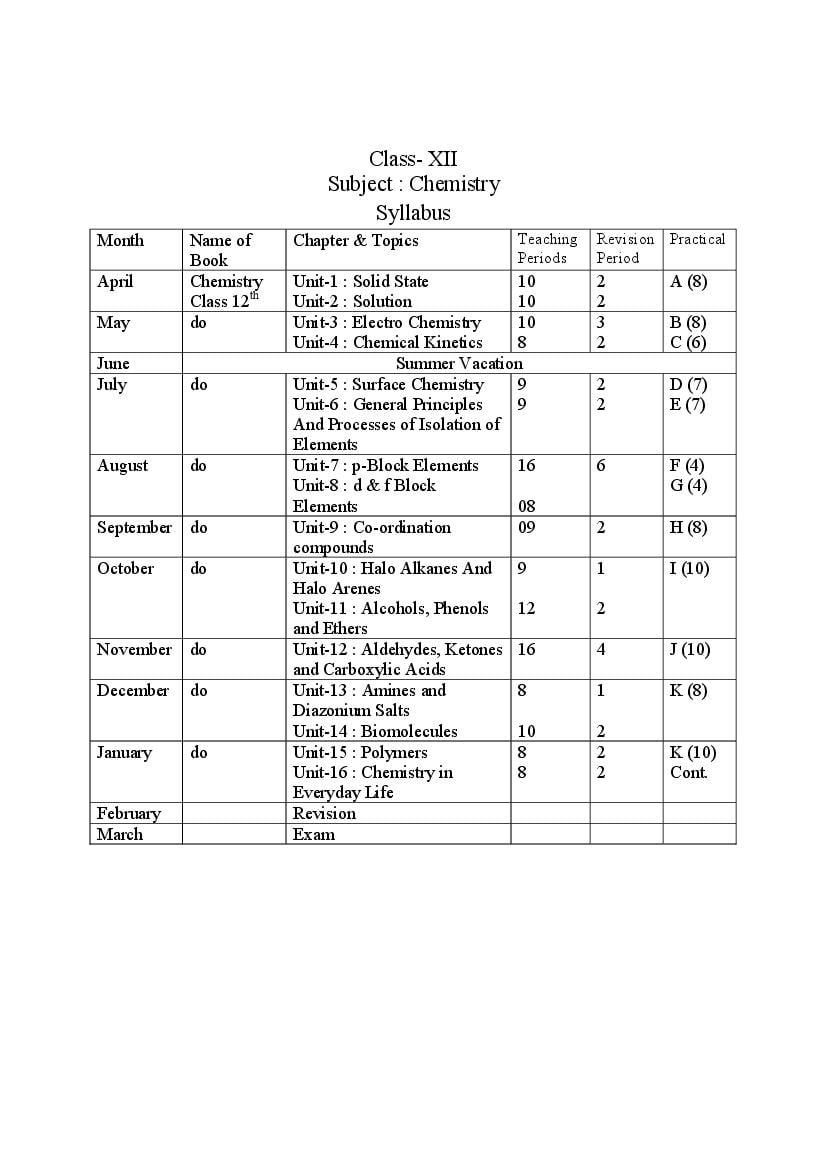
Subject : Chemistry
Syllabus
Month Name of Chapter & Topics Teaching Revision Practical
Book Periods Period
April Chemistry Unit-1 : Solid State 10 2 A (8)
Class 12th Unit-2 : Solution 10 2
May do Unit-3 : Electro Chemistry 10 3 B (8)
Unit-4 : Chemical Kinetics 8 2 C (6)
June Summer Vacation
July do Unit-5 : Surface Chemistry 9 2 D (7)
Unit-6 : General Principles 9 2 E (7)
And Processes of Isolation of
Elements
August do Unit-7 : p-Block Elements 16 6 F (4)
Unit-8 : d & f Block G (4)
Elements 08
September do Unit-9 : Co-ordination 09 2 H (8)
compounds
October do Unit-10 : Halo Alkanes And 9 1 I (10)
Halo Arenes
Unit-11 : Alcohols, Phenols 12 2
and Ethers
November do Unit-12 : Aldehydes, Ketones 16 4 J (10)
and Carboxylic Acids
December do Unit-13 : Amines and 8 1 K (8)
Diazonium Salts
Unit-14 : Biomolecules 10 2
January do Unit-15 : Polymers 8 2 K (10)
Unit-16 : Chemistry in 8 2 Cont.
Everyday Life
February Revision
March Exam
Page 2
Subject-Chemistry
Syllabus
Unit-1: Solid State: April Periods-10 Revision-2 Marks-4
Classification of solids based on different binding forces:
molecular, ionic, covalent and metallic solids, Amorphous and crystalline
solids (only elementary idea) Unit cell in two dimensional and three
dimensional lattices, calculation of density of Unit cell, packing in solids,
packing efficiency, voids number of atoms per unit cell in a cubic unit cells,
Points defects, electrical and magnetic properties.
Unit-2: Solution: April Periods-10 Revision-2 Marks-4
Types of solutions, expression of concentration of solution of
solid in liquids, solubility of gases in liquids, (Henry’s law) solid solutions,
colligative properties- relative lowering of vapour pressure, Raoults’s law,
ideal and non Ideal solutions, osmotic pressure, osmosis and it’s applications,
depression of freezing point, elevation of boiling point, determination of
molecular masses using colligative properties, Abnormal molecular masses,
Van’t Hoff- factor, Van’t Hoff equation for colligative properties.
Unit-3: Electrochemistry: May Periods-10 Revision-3 Marks-4
Redox reactions, conductance in electrolytic solutions, specific
and molar conductivity, variation of conductivity with concentration,
Kohlrausch’s law, electrolysis and laws of electrolysis (only elementary
Idea), Electrochemical cell, (construction, representation and working) dry
cell- electrolytic cells, lead accumulator, Ni-cd cell, fuel cell, EMF of a cell,
standard electrode potential, Nernst equation and it’s application to chemical
cells, reference electrode (NHE) Relation between Gibb’s free energy change
and EMF of a cell, Electrochemical series and it’s applications, corrosion
(Rusting of Iron and it’s methods of prevention).
Page 3
Rate of reaction (Average and instantaneous), factors affecting on
the rate of reaction: concentration, temperature, catalyst, order and
molecularity of a reaction; rate law and specific rate constant, Integrated rate
equations and half life (Only for zero and first order reactions), concept of
collision theory (elementary idea, no mathematical treatment), Activation
energy, Arrhenius equation.
June Summer Vacation 1st june to 30th june.
Unit-5: Surface Chemistry: July Periods-9 Revision-2 Marks-3
Adsorption- Physisorption and chemisorptions, distinction
between adsorption and absorption, Mechanism of adsorption, characteristics
of adsorption, adsorption Isotherm, (Freundlich’s Isothem), Application of
adsorption, Factors affecting adsorption of gases on solids.
Catalysis, Homogenous and Hetrogenous, activity and their
selectivity; enzyme catalysis, adsorption theory of Hetrogenous catalysis
(zeolites).
Colloidal state, colloids and crystalloids, true solution, colloidal
solution and suspension. Lyophillic and Lyophobic colloids, multimolecular
colloids, macromolecular and associated colloids, properties of colloids,
Tyndall effect, Brownian movement, electrophoresis, coagulation, dialysis,
electro dialysis, ultracentrifugation, emulsion- types of emulsions, methods of
Preparation of colloids.
Unit-6: General Principles and Processes of Isolation of Elements:
July Periods-9 Revision-2 Marks-3
Principles and methods of extraction –concentration, oxidation,
reduction- electrolytic method and refining, occurrence and principles of
extraction of aluminium, copper, zinc and iron.
Page 4
Group 15- elements: General Introduction, electronic
configuration, occurrence, oxidation states, trends in physical and chemical
properties, nitrogen-preparation, Properties and Uses: Compounds of
nitrogen, preparation and properties of ammonia and nitric acid, oxides of
nitrogen (structure only);
Phosphorus: allotropic forms, compounds of phosphorus,
preparation and properties of phosphine, halides PCl3, PCl5 oxoacids
(elementary Idea only).
Group 16: General Introduction, electronic configuration,
oxidation state, occurrence, trends in physical and chemical properties,
dioxygen: Preparation, properties and uses, classification of oxides, ozone,
sulphur allotropic forms: compounds of sulphur, preparation, properties and
uses of sulphur dioxide, sulphuric acid: Industrial process of manufacture,
properties and uses; oxoacids of sulphur (structure only)
Group 17: General introduction, electronic configuration,
oxidation states, occurrence, trends in physical and chemical properties:
compounds of halogens, preparation, properties and uses of chlorine and
hydrochloric acid, interhalogen compounds, oxoacids of halogens (structure
only)
Group 18: General introduction, electronic configuration,
occurrence, trends in physical and chemical properties, uses.
Unit-8: d and f block elements:
August. Periods-08 Marks-5
General introduction, electronic configuration, occurrence and
characteristics of transition metals, general trends in properties of the First
row transition metals- metallic character, atomic size, ionic radii, melting &
boiling point, Ionization enthalpy, oxidation state, colour, formation of
Page 5
formation, preparation and properties of K2Cr2O7 and KMnO4 .
Lanthanoids: Electronic configuration, oxidation states, chemical
reactivity and lanthanoid contraction and its consequences.
Actinoids: Electronic configuration, oxidation states and
comparison with lanthanoids.
Unit-9: Coordination compounds:
September. Periods-9 Revision-2 Marks-3
Coordination compounds- Introduction, difference between
Coordination compounds and double salts, liagands, coordination number,
colour, magnetic properties and shapes, IUPAC nomenclature of mono
nuclear Coordination compounds, bonding in complex compounds, Werner’s
theory, VBT and CFT: Structure and stereo isomerism, importance of
Coordination compounds (In qualitative inclusion, extraction of metals and
biological system).
Unit-10: Haloalkanes and Haloarenes:
October Periods-9 Revision- Marks-4
Haloalkanes: Nomenclature, nature of C-X bond
physical and chemical properties, mechanism of substitution reaction,
optical rotation.
Haloarenes: Nature of C-X bond, substitution reaction
(Directive Influence of halogen in monosubstituted compounds only)
Uses and environmental effects of – dichloromethane,
trichloro methane, tetra chloro methane, Iodoform, freons, DDT.
Unit-11: Alcohols, Phenols and Ethers:
Page 6
Alcohols: Nomenclature, methods of preparation, physical and
chemical properties (Primary alcohols only), Identification of Primary,
Secondary and Tertiary alcohols, Mechanism of dehydration of alcohols,
uses of alcohol with special reference to ethanol and methanol.
Phenols: Nomenclature, methods of preparation, physical and
chemical properties, acidic nature of phenol, electrophilic
substitution reactions, uses of phenol.
Ethers: Nomenclature, methods of preparation, physical and
chemical properties, uses.
Unit-12: Aldehydes, Ketones and Carboxylic acids:
November Periods-16 Revision-4 Marks-6
Aldehydes and Ketones: Nomenclature, nature of
corbonyl group, methods of preparation of aldehyde & ketones, physical
and chemical properties and mechanism of nucleophilic addition,
reactivity of alpha hydrogen in aldehydes; uses.
Carboxylic acids: Nomenclature, acidic nature, methods of
preparation, physical and chemical properties; uses.
Unit-13: Organic compounds containing Nitrogen:
December Periods-8 Revision-1 Marks-3
Amines: Nomenclature, classification, structure, methods of
preparation, Physical and chemical properties, basic nature of amines.
Page 7
uses of amines.
Diazonium salts: Preparation, chemical reaction and importance in
synthetic organic chemistry.
Unit-14: Biomolecules:
Decemberr Periods-10 Revision-2 Marks-3
Carbohydrate: Classification (aldoses and ketoses)
monosaccahrides (glucose and fructose), D-L configuration,
oligosaccharides (sucrose, lactose, maltose), poly saccharides (starch,
cellulose, glycogen) importance.
Proteins: Elementary Idea of amino acids, peptide bond,
polypeptides, proteins, primary, secondary and tertiary and quaternary
structure of proteins. (qualitative Idea only) denaturation of proteins:
enzymes.
Vitamins: Classification and deficiency diseases.
Nucleic acids: DNA and RNA.
Unit-15: Polymers:
January Periods-8 Revision-2 Marks-2
Classification: Natural and synthetic, method of
polymerization (addition and condensation), copolymersation, some
important polymers: Natural and synthetic like polythene, nylon,
polyesters, Bakelite, rubber, Biodegradable and non biodegradable
polymers.
Unit-16: Chemistry in every day life:
Page 8
1. Chemical in medicines: analgesics, tranquillizers,
antiseptics, disinfectants, antimicrobials, antifertility
drugs, antibiotics, antacids, antihistamines.
2. Chemicals in food; Preservatives, artificial sweetening
agents, elementary Idea of antioxidants.
3. Cleansing agents: Soaps and detergents cleansing action.
Document Details
| Board / Org | Haryana Board |
| Exam | Class 12 |
| Type | Syllabus |
| Pages | 8 |
| Updated | 22 Jul 2026 |