Karnataka 2nd PUC Model Question Paper 2027 for Physics (Paper 3)
Finished viewing? Save it for later —
Download Karnataka 2nd PUC Model Question Paper 2027 for Physics (Paper 3) (PDF · 4 pages)About Karnataka 2nd PUC Model Question Paper 2027 for Physics (Paper 3)
Karnataka 2nd PUC Model Question Paper 2027 for Physics (Paper 3) is available here for free download. Published by Karnataka Board for Class 12, this sample paper can be viewed online or downloaded as a PDF (4 pages). Candidates preparing for Class 12 can use Karnataka 2nd PUC Model Question Paper 2027 for Physics (Paper 3) to understand the exam pattern, the type of questions asked, and the overall difficulty level.
Frequently Asked Questions
How can I download Karnataka 2nd PUC Model Question Paper 2027 for Physics (Paper 3)?
Open this page and click the Download button to save Karnataka 2nd PUC Model Question Paper 2027 for Physics (Paper 3) as a PDF. It is completely free on AglaSem Docs.
Is Karnataka 2nd PUC Model Question Paper 2027 for Physics (Paper 3) free to download?
Yes. Karnataka 2nd PUC Model Question Paper 2027 for Physics (Paper 3) can be viewed online and downloaded as a PDF free of cost on AglaSem Docs.
How many pages does Karnataka 2nd PUC Model Question Paper 2027 for Physics (Paper 3) have?
Karnataka 2nd PUC Model Question Paper 2027 for Physics (Paper 3) contains 4 pages, which you can read online or download together as a single PDF.
Where can I find more Class 12 study material?
You can find more Class 12 question papers, sample papers, syllabus, and answer keys on AglaSem Docs.
Karnataka 2nd PUC Model Question Paper 2027 for Physics (Paper 3) – Text
Read the full text of this sample paper below — useful to quickly search, copy and reference the content online without downloading the PDF.
📄 View text version (5 pages)
Page 1
Karnataka 2nd PUC
Model Question Paper
2027 for Physics
(Paper 3)
EXAM YEAR TYPE SUBJECT
Karnataka Class 12 2027 Sample Paper Physics
Notes · Sample Papers · Previous Year Papers · Mock Tests
Page 2
m .co
m .co s em
se g la
a
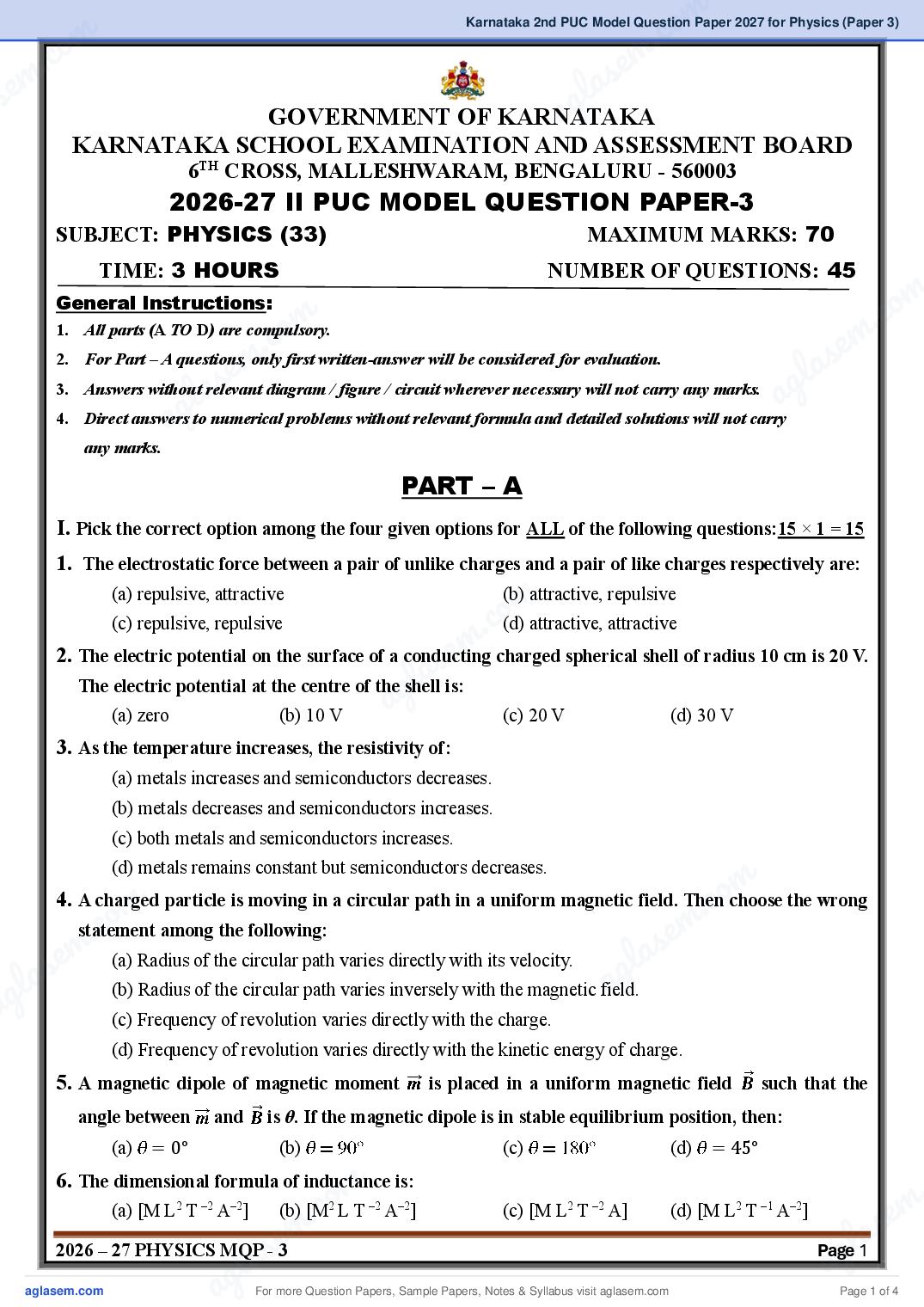
GOVERNMENT OF KARNATAKA
KARNATAKA SCHOOL EXAMINATION AND ASSESSMENT BOARD
6TH CROSS, MALLESHWARAM, BENGALURU - 560003
2026-27 II PUC MODEL QUESTION PAPER-3
SUBJECT: PHYSICS (33) MAXIMUM MARKS: 70
TIME: 3 HOURS NUMBER OF QUESTIONS: 45
m
m .co
General Instructions:
. c o
1. All parts (A TO D) are compulsory.
e m
2. For Part – A questions,m
e only first written-answer will be considered for evaluation.
l as
3. Answers without a
l s
relevant diagram / figure / circuit wherever necessary will not carry any marks.
ag
agto numerical problems without relevant formula and detailed solutions will not carry
4. Direct answers
any marks.
PART – A
I. Pick the correct option among the four given options for ALL of the following questions:15 × 1 = 15
1. The electrostatic force between a pair of unlike charges and a pair of like charges respectively are:
(a) repulsive, attractive
m
(b) attractive, repulsive
(c) repulsive, repulsive c. o(d) attractive, attractive
s em
2. The electric potential on the surface of a conducting charged spherical shell of radius 10 cm is 20 V.
g la is:
a
The electric potential at the centre of the shell
(a) zero (b) 10 V (c) 20 V (d) 30 V
3. As the temperature increases, the resistivity of:
(a) metals increases and semiconductors decreases.
(b) metals decreases and semiconductors increases.
(c) both metals and semiconductors increases.
m
(d) metals remains constant but semiconductors decreases.
m
4. A charged particle is moving in a circular path in a uniform magnetic field. Then choose the wrong
.co
m .co
statement among the following:
s e m
s e (a) Radius of the circular path varies directly with its velocity. gla
g la a
(b) Radius of the circular path varies inversely with the magnetic field.
a (c) Frequency of revolution varies directly with the charge.
(d) Frequency of revolution varies directly with the kinetic energy of charge.
5. A magnetic dipole of magnetic moment 𝒎 is placed in a uniform magnetic field 𝒎𝒎 such that the
angle between 𝒎 and 𝒎𝒎 is θ. If the magnetic dipole is in stable equilibrium position, then:
(a) θ = 0° (b) θ = 90° (c) θ = 180° (d) θ = 45°
6. The dimensional formula of inductance is:
m .
(a) [M L2 T –2 A–2]
m .co
(b) [M2 L T –2 A–2] (c) [M L2 T –2 A] (d) [M L2 T –1 A–2]
s e m
2026 – 27 PHYSICS MQP s - 3e l a
g la ag 1
Page
a For more Question Papers, Sample Papers, Notes & Syllabus visit Page 1 of 4
Page 3
relations of electric current with the voltage are listed in the second column. Choose the correct
match:
AC source connected to Electric Current
𝜋
(i) resistor (p) lags behind the voltage by 2
(ii) inductor (q) is in phase with voltage
𝜋
(iii) capacitor (r) leads the voltage by 2
(a) (i) → (p); (ii) → (q); (iii) → (r) (b) (i) → (r); (ii) → (p); (iii) → (q)
(c) (i) → (q); (ii) → (p); (iii) → (r) (d) (i) → (q); (ii) → (r); (iii) → (p)
8. Expression for displacement current is given by (symbols have usual meanings):
𝑑𝜙𝐸 𝑑𝜙𝐸
(a) 𝑖𝑑 = 𝜖𝑜 (b) 𝑖𝑑 = 𝜇𝑜
𝑑𝑡 𝑑𝑡
𝑑𝜙𝐸 𝑑𝜙𝐸
(c) 𝑖𝑑 = 𝜇𝑜 𝜖𝑜 𝑑𝑡 (d) 𝑖𝑑 = 𝑑𝑡
9. The objective lens of a refracting telescope is a __________ and the magnifying power of the
telescope for normal adjustment is ___________.
𝑓 𝑓
(a) convex lens of large aperture; 𝑚 = 𝑒 . (b) convex lens of small aperture; 𝑚 = 𝑒 .
𝑓0 𝑓0
𝑓 𝑓
(c) convex lens of large aperture; 𝑚 = 𝑓0 . (d) convex lens of small aperture; 𝑚 = 𝑓0.
𝑒 𝑒
10. Among the given two statements:
Statement-I: Wavefront is the surface of constant phase.
Statement-II: When a plane wavefront is passed through a thin prism, it emerges out as a
spherical wavefront.
(a) Both the statements are correct (b) Both the statements are wrong
(c) I is correct but II is wrong (d) I is wrong but II is correct
11. In photoelectric effect experiment, the graph of a physical quantity ‘y’ v/s a physical quantity ‘x’ is
a straight line passing through origin. Then:
(a) y is photoelectric current and x is collector plate potential.
(b) y is photoelectric current and x is frequency of incident radiation.
(c) y is stopping potential and x is frequency of incident radiation.
(d) y is photoelectric current and x is intensity of incident radiation.
12. An α - particle, a proton, an electron and a neutron are moving with same speed. Then the particle
having longest de Broglie wavelength is:
(a) proton (b) electron (c) neutron (d) α - particle
13. Rutherford’s nuclear model of atom fails to explain:
(a) large angle scattering of α – particles. (b) charge distribution in an atom.
(c) energy of electrons revolving round the nucleus. (d) origin of line spectra of hydrogen atom.
2026 – 27 PHYSICS MQP - 3 Page 2
For more Question Papers, Sample Papers, Notes & Syllabus visit Page 2 of 4
Page 4
omNuclear binding energy per nucleon is (A is the mass number of theenucleus): .co
c. 14. m
m (a) more for heavy nuclei (A > 170). a s
se forl lighter nuclei (A < 30).
(b) more g
a
(c) less for both light and heavy nuclei. (d) independent of mass number.
15. If ne and nh are the number of free electrons and holes in a semiconductor respectively, then in
case of an intrinsic semiconductor:
(a) ne = nh (b) ne < nh (c) ne > nh (d) ne >> nh
II. Fill in the blanks by choosing appropriate answer given in the bracket for ALL the
m
.co
following questions: 5×1=5
m
.co
(magnetic susceptibility, diffraction, electric field, magnetic field, equal to unity, total internal reflection)
m s e m
s e l a
16. An example foradimensionless quantity is ______________.
g l coil stores energy in the form of ___________. ag
a
17. A current carrying
18. The power factor of a series LCR circuit at resonance is ____________.
19. The principle of optical fibre is ___________.
20. The bending of light around the corners and entering into geometrical shadow region is called _______.
PART – B
III. Answer any FIVE of the following questions:
o m 5 × 2 = 10
21. Define electric flux through an area element. Mention.cits SI unit.
22. What is meant by equipotential surface? Drawas em
23. Write two limitations of Ohm’s law. ag
l equipotential surfaces for an electric dipole.
24. Give the vector form of Biot-Savart law and explain the terms.
25. What is AC generator? What is its working principle?
26. List two uses of microwaves.
27. The radius of the innermost electron orbit of a hydrogen atom is 5.3 × 10⁻¹¹ m. Determine the radius of
the n = 2 orbit.
m
m
28. Mention two differences between half wave rectifier and full wave rectifier.
.co
.co PART – C s e m
seIV.mAnswer any FIVE of the following questions: g la
l a a 5 × 3 = 15
ag 29. Define linear charge density. Mention the expression for electric field at a point due to an infinitely long
uniformly charged wire and explain the terms.
30. Obtain the expression for equivalent capacitance of two capacitors connected in series.
31. Explain the conversion of galvanometer into an ammeter using relevant circuit diagram and expression.
32. Write three differences between diamagnetic and paramagnetic materials.
m
33. Derive the expression for the motional emf induced in a conducting rod moving perpendicular to a
.
uniform magnetic field.
m .co s e m
2026 – 27 PHYSICS MQP s - 3e l a
g la ag 3
Page
a For more Question Papers, Sample Papers, Notes & Syllabus visit Page 3 of 4
Page 5
35. The work function of caesium is 2.14 eV. Calculate the threshold frequency for caesium.
36. Mention three features of nuclear force.
PART – D
V. Answer any THREE of the following questions: 3 × 5 = 15
37. Derive an expression for the electric field at a point on the axis of an electric dipole.
38. Using Kirchhoff’s laws, arrive at the balancing condition of Wheatstone network.
39. i) State Ampere’s circuital law. (1)
ii) Using Ampere’s circuital law, derive the expression for the magnetic field at a point due to an
infinitely long current carrying straight wire. (4)
40. Derive the expression for refractive index of the material of a prism in terms of angle of the prism and
angle of minimum deviation.
41. i) Explain the formation of energy bands in solids. (2)
ii) On the basis of energy bands, distinguish between a conductor, a semiconductor and an insulator. (3)
VI. Answer any TWO of the following questions: 2 × 5 = 10
42. Three point charges 3 nC, – 2 nC and 4 nC are placed at the vertices A, B and C of an equilateral
triangle ABC of sides 0.2 m. Calculate the potential energy of the system. Also calculate the amount of
work required to place the same charges at the vertices of an equilateral triangle of side 0.1 m.
1
(Take: 4𝒎𝒎 = 9 × 10⁹ N m2 𝒎 − 2 ).
𝒎
43. Calculate the power dissipated in the 10 Ω resistor in the given circuit.
44. An inductor and a resistor are connected in series with 200 V, 50 Hz ac source. The current in the circuit
𝒎
is 2 A and voltage leads the current by . Calculate the inductance of the inductor.
3
45. In Young’s double slit experiment, the slits are separated by a distance of 0.5 mm and the screen is at a
distance of 1.5 m from the slits. If the distance of 9th bright fringe from the central maximum is 1.3 cm,
calculate the wavelength of light used. Also calculate the distance of 5 th dark fringe from the central
maximum.
********
2026 – 27 PHYSICS MQP - 3 Page 4
For more Question Papers, Sample Papers, Notes & Syllabus visit Page 4 of 4
Document Details
| Board / Org | Karnataka Board |
| Exam | Class 12 |
| Type | Sample Paper |
| Pages | 4 |
| Language | english |
| Updated | 03 Nov 2026 |