GATE 2025 Syllabus for Mechanical Engineering
Finished viewing? Save it for later —
Download GATE 2025 Syllabus for Mechanical Engineering (PDF · 3 pages)About GATE 2025 Syllabus for Mechanical Engineering
GATE 2025 Syllabus for Mechanical Engineering is available here for free download. Published by IIT for GATE, this syllabus can be viewed online or downloaded as a PDF (3 pages). Candidates preparing for GATE can use GATE 2025 Syllabus for Mechanical Engineering to understand the exam pattern, the type of questions asked, and the overall difficulty level.
Frequently Asked Questions
How can I download GATE 2025 Syllabus for Mechanical Engineering?
Open this page and click the Download button to save GATE 2025 Syllabus for Mechanical Engineering as a PDF. It is completely free on AglaSem Docs.
Is GATE 2025 Syllabus for Mechanical Engineering free to download?
Yes. GATE 2025 Syllabus for Mechanical Engineering can be viewed online and downloaded as a PDF free of cost on AglaSem Docs.
How many pages does GATE 2025 Syllabus for Mechanical Engineering have?
GATE 2025 Syllabus for Mechanical Engineering contains 3 pages, which you can read online or download together as a single PDF.
Where can I find more GATE study material?
You can find more GATE question papers, sample papers, syllabus, and answer keys on AglaSem Docs.
GATE 2025 Syllabus for Mechanical Engineering – Text
Read the full text of this syllabus below — useful to quickly search, copy and reference the content online without downloading the PDF.
📄 View text version (3 pages)
Page 1
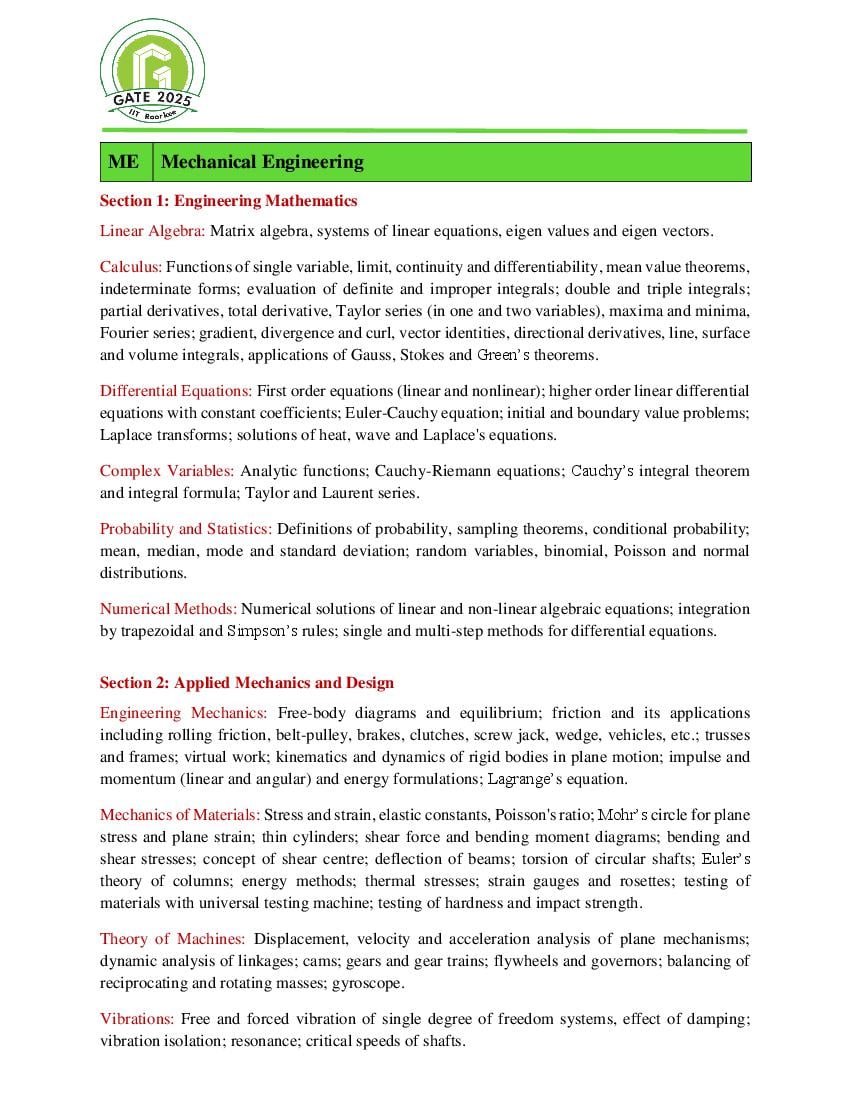
Section 1: Engineering Mathematics
Linear Algebra: Matrix algebra, systems of linear equations, eigen values and eigen vectors.
Calculus: Functions of single variable, limit, continuity and differentiability, mean value theorems,
indeterminate forms; evaluation of definite and improper integrals; double and triple integrals;
partial derivatives, total derivative, Taylor series (in one and two variables), maxima and minima,
Fourier series; gradient, divergence and curl, vector identities, directional derivatives, line, surface
and volume integrals, applications of Gauss, Stokes and Green’s theorems.
Differential Equations: First order equations (linear and nonlinear); higher order linear differential
equations with constant coefficients; Euler-Cauchy equation; initial and boundary value problems;
Laplace transforms; solutions of heat, wave and Laplace's equations.
Complex Variables: Analytic functions; Cauchy-Riemann equations; Cauchy’s integral theorem
and integral formula; Taylor and Laurent series.
Probability and Statistics: Definitions of probability, sampling theorems, conditional probability;
mean, median, mode and standard deviation; random variables, binomial, Poisson and normal
distributions.
Numerical Methods: Numerical solutions of linear and non-linear algebraic equations; integration
by trapezoidal and Simpson’s rules; single and multi-step methods for differential equations.
Section 2: Applied Mechanics and Design
Engineering Mechanics: Free-body diagrams and equilibrium; friction and its applications
including rolling friction, belt-pulley, brakes, clutches, screw jack, wedge, vehicles, etc.; trusses
and frames; virtual work; kinematics and dynamics of rigid bodies in plane motion; impulse and
momentum (linear and angular) and energy formulations; Lagrange’s equation.
Mechanics of Materials: Stress and strain, elastic constants, Poisson's ratio; Mohr’s circle for plane
stress and plane strain; thin cylinders; shear force and bending moment diagrams; bending and
shear stresses; concept of shear centre; deflection of beams; torsion of circular shafts; Euler’s
theory of columns; energy methods; thermal stresses; strain gauges and rosettes; testing of
materials with universal testing machine; testing of hardness and impact strength.
Theory of Machines: Displacement, velocity and acceleration analysis of plane mechanisms;
dynamic analysis of linkages; cams; gears and gear trains; flywheels and governors; balancing of
reciprocating and rotating masses; gyroscope.
Vibrations: Free and forced vibration of single degree of freedom systems, effect of damping;
vibration isolation; resonance; critical speeds of shafts.
Page 2
S-N diagram; principles of the design of machine elements such as bolted, riveted and welded
joints; shafts, gears, rolling and sliding contact bearings, brakes and clutches, springs.
Section 3: Fluid Mechanics and Thermal Sciences
Fluid Mechanics: Fluid properties; fluid statics, forces on submerged bodies, stability of floating
bodies; control-volume analysis of mass, momentum and energy; fluid acceleration; differential
equations of continuity and momentum; Bernoulli’s equation; dimensional analysis; viscous flow
of incompressible fluids, boundary layer, elementary turbulent flow, flow through pipes, head
losses in pipes, bends and fittings; basics of compressible fluid flow.
Heat Transfer: Modes of heat transfer; one dimensional heat conduction, resistance concept and
electrical analogy, heat transfer through fins; unsteady heat conduction, lumped parameter system,
Heisler's charts; thermal boundary layer, dimensionless parameters in free and forced convective
heat transfer, heat transfer correlations for flow over flat plates and through pipes, effect of
turbulence; heat exchanger performance, LMTD and NTU methods; radiative heat transfer, Stefan-
Boltzmann law, Wien's displacement law, black and grey surfaces, view factors, radiation network
analysis
Thermodynamics: Thermodynamic systems and processes; properties of pure substances, behavior
of ideal and real gases; zeroth and first laws of thermodynamics, calculation of work and heat in
various processes; second law of thermodynamics; thermodynamic property charts and tables,
availability and irreversibility; thermodynamic relations.
Applications: Power Engineering: Air and gas compressors; vapour and gas power cycles,
concepts of regeneration and reheat. I.C. Engines: Air-standard Otto, Diesel and dual cycles.
Refrigeration and air-conditioning: Vapour and gas refrigeration and heat pump cycles; properties
of moist air, psychrometric chart, basic psychrometric processes. Turbomachinery: Impulse and
reaction principles, velocity diagrams, Pelton-wheel, Francis and Kaplan turbines; steam and gas
turbines.
Section 4: Materials, Manufacturing and Industrial Engineering
Engineering Materials: Structure and properties of engineering materials, phase diagrams, heat
treatment, stress-strain diagrams for engineering materials.
Casting, Forming and Joining Processes: Different types of castings, design of patterns, moulds
and cores; solidification and cooling; riser and gating design. Plastic deformation and yield criteria;
fundamentals of hot and cold working processes; load estimation for bulk (forging, rolling,
extrusion, drawing) and sheet (shearing, deep drawing, bending) metal forming processes;
principles of powder metallurgy. Principles of welding, brazing, soldering and adhesive bonding.
Page 3
and multi-point cutting tools, tool geometry and materials, tool life and wear; economics of
machining; principles of non-traditional machining processes; principles of work holding, jigs and
fixtures; abrasive machining processes; NC/CNC machines and CNC programming.
Metrology and Inspection: Limits, fits and tolerances; linear and angular measurements;
comparators; interferometry; form and finish measurement; alignment and testing methods;
tolerance analysis in manufacturing and assembly; concepts of coordinate-measuring machine
(CMM).
Computer Integrated Manufacturing: Basic concepts of CAD/CAM and their integration tools;
additive manufacturing.
Production Planning and Control: Forecasting models, aggregate production planning, scheduling,
materials requirement planning; lean manufacturing.
Inventory Control: Deterministic models; safety stock inventory control systems.
Operations Research: Linear programming, simplex method, transportation, assignment, network
flow models, simple queuing models, PERT and CPM.
Document Details
| Board / Org | IIT |
| Exam | GATE |
| Type | Syllabus |
| Pages | 3 |
| Updated | 30 Apr 2026 |