Karnataka PGCET 2015 Question Paper Biotechnology
Finished viewing? Save it for later —
Download Karnataka PGCET 2015 Question Paper Biotechnology (PDF · 12 pages)About Karnataka PGCET 2015 Question Paper Biotechnology
Karnataka PGCET 2015 Question Paper Biotechnology is available here for free download. Published by KEA for Karnataka Post Graduate Common Entrance Test, this question paper can be viewed online or downloaded as a PDF (12 pages). Candidates preparing for Karnataka Post Graduate Common Entrance Test can use Karnataka PGCET 2015 Question Paper Biotechnology to understand the exam pattern, the type of questions asked, and the overall difficulty level.
Frequently Asked Questions
How can I download Karnataka PGCET 2015 Question Paper Biotechnology?
Open this page and click the Download button to save Karnataka PGCET 2015 Question Paper Biotechnology as a PDF. It is completely free on AglaSem Docs.
Is Karnataka PGCET 2015 Question Paper Biotechnology free to download?
Yes. Karnataka PGCET 2015 Question Paper Biotechnology can be viewed online and downloaded as a PDF free of cost on AglaSem Docs.
How many pages does Karnataka PGCET 2015 Question Paper Biotechnology have?
Karnataka PGCET 2015 Question Paper Biotechnology contains 12 pages, which you can read online or download together as a single PDF.
Where can I find more Karnataka Post Graduate Common Entrance Test study material?
You can find more Karnataka Post Graduate Common Entrance Test question papers, sample papers, syllabus, and answer keys on AglaSem Docs.
Karnataka PGCET 2015 Question Paper Biotechnology – Text
Read the full text of this question paper below — useful to quickly search, copy and reference the content online without downloading the PDF.
📄 View text version (10 pages)
Page 1
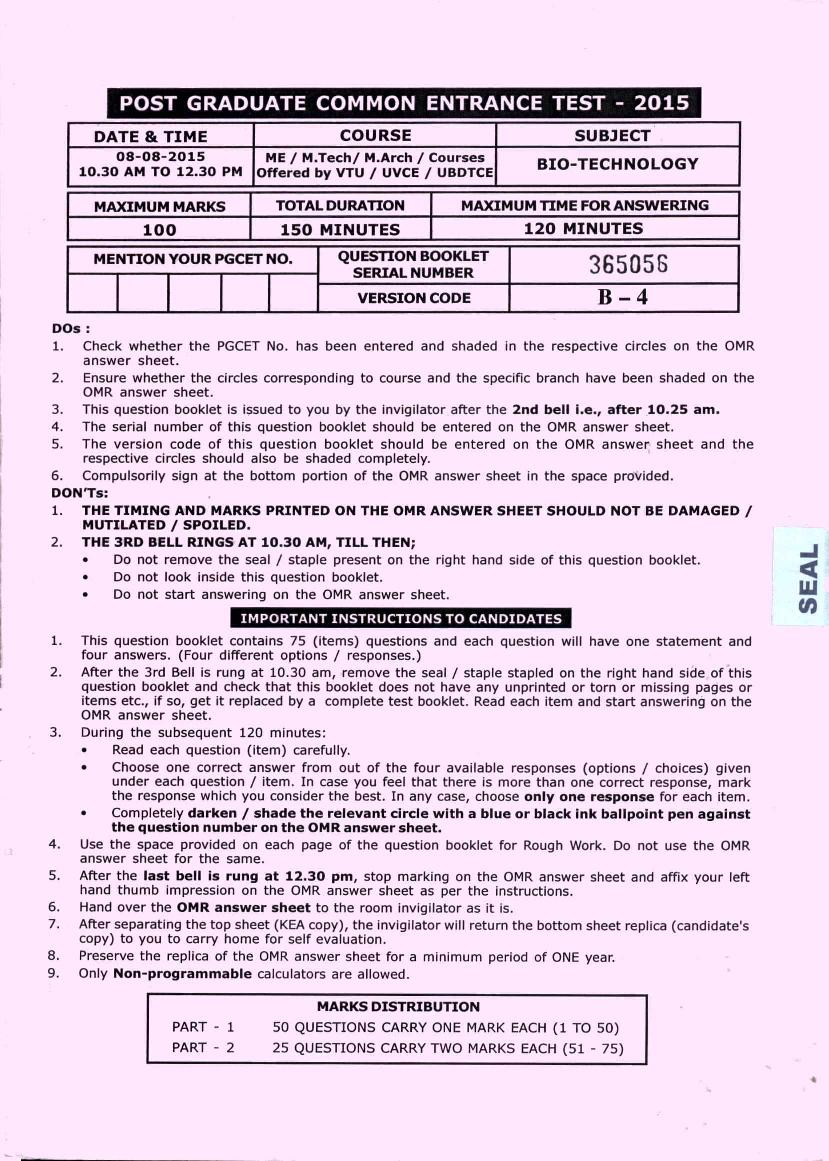
DATE & TIME COURSE SUBJECT
08-08-2015 ME / M.Tech/ M.Arch / Courses
10.30 AM TO 12.30 PM
BIO-TECHNOLOGY
Offered by VTU / UVCE / UBDTCE
MAXIMUM MARKS TOTAL DURATION MAXIMUM TIME FOR ANSWERING
100 150 MINUTES 120 MINUTES
MENTION YOUR PGCET NO. QUESTION BOOKLET
SERIAL NUMBER 36505G
VERSION CODE B -4
DOs :
1. Check whether the PGCET No. has been entered and shaded in the respective circles on the OMR
answer sheet.
2. Ensure whether the circles corresponding to course and the specific branch have been shaded on the
OMR answer sheet.
3. This question booklet is issued to you by the invigilator after the 2nd bell i.e., after 10.25 am.
4. The serial number of this question booklet should be entered on the OMR answer sheet.
5. The version code of this question booklet should be entered on the OMR answer sheet and the
respective circles should also be shaded completely.
6. Compulsorily sign at the bottom portion of the OMR answer sheet in the space provided.
DON'Ts:
1. THE TIMING AND MARKS PRINTED ON THE OMR ANSWER SHEET SHOULD NOT BE DAMAGED /
MUTILATED / SPOILED.
2. THE 3RD BELL RINGS AT 10.30 AM, TILL THEN;
• Do not remove the seal / staple present on the right hand side of this question booklet.
• Do not look inside this question booklet.
• Do not start answering on the OMR answer sheet.
IMPORTANT INSTRUCTIONS TO CANDIDATES
1. This question booklet contains 75 (items) questions and each question will have one statement and
four answers. (Four different options / responses.)
2. After the 3rd Bell is rung at 10.30 am, remove the seal / staple stapled on the right hand side of this
question booklet and check that this booklet does not have any unprinted or torn or missing pages or
items etc., if so, get it replaced by a complete test booklet. Read each item and start answering on the
OMR answer sheet.
3. During the subsequent 120 minutes:
• Read each question (item) carefully.
• Choose one correct answer from out of the four available responses (options / choices) given
under each question / item. In case you feel that there is more than one correct response, mark
the response which you consider the best. In any case, choose only one response for each item.
• Completely darken / shade the relevant circle with a blue or black ink ballpoint pen against
the question number on the OMR answer sheet.
4. Use the space provided on each page of the question booklet for Rough Work. Do not use the OMR
answer sheet for the same.
5. After the last bell is rung at 12.30 pm, stop marking on the OMR answer sheet and affix your left
hand thumb impression on the OMR answer sheet as per the instructions.
6. Hand over the OMR answer sheet to the room invigilator as it is.
7. After separating the top sheet (KEA copy), the invigilator will return the bottom sheet replica (candidate's
copy) to you to carry home for self evaluation.
8. Preserve the replica of the OMR answer sheet for a minimum period of ONE year.
9. Only Non-programmable calculators are allowed.
MARKS DISTRIBUTION
PART - 1 50 QUESTIONS CARRY ONE MARK EACH (1 TO 50)
PART - 2 25 QUESTIONS CARRY TWO MARKS EACH (51 - 75)
Page 2
PART - 1
(Each question carry one mark) (50 X 1 = 50)
1. Western blotting used 5. Prokaryyotic cell
a. Augiosperms
a. RNA
b. Gymnosperms
b. DNA
c. Bacteria
c. • Fungi
Amino acids
6. Cytoplasmic Inclusions
a. Golgi
2. Viral vectors b. Mitochoudria
a. Bacteriophages c. Triacylglycerols
Cosmid d. ATP Molecules
b.
c. Plasmid
7. Lipid Metabolism synthesis
d. Bacteria a. Phospholipids
h ADP
c. ATP
3. CDK
d. Glycogens
a. Cyclin Dependant Kinases
b. Cyclin Dependant Kinetochores 8. One gene one enzyme
c. Cyclin Dependant Karyotype a. Robert Cook
la Beadle 8s Tatum
None of the above
c. Louis Pastuer
d. Watson 8s Crick
4. Jumping Genes
9. Production of homozygous diploids
a. Mc Clintock
a. Avenploids
b. Hugo De-vries
b. Triploids
c. Morgan c. Polyploids
d. Mendel d Haploids
B-4 2 BT
Page 3
uracil are:-
a. Paul Berg
a. Purine
b. Watson & Crick
b. Pyramidines
c. Kary Mullis
c. Nitrogen bases
d. H.O. Smith d. Monosaccarides
11. Characteristic feature of all micro organisms 15. Currency of a cell is
a. They are multicellular a. ATP b. ADP
c. AMP d. All the above
b. Cells have distinct nuclei
c. Visible only under microscope
16. One turn of DNA possesses
cl. They perform photosynthesis
a. One base pair
b. Two base pairs
12. A substance whose pH is 9.3 is said to be c. Five base pairs
a. Alkaline d. Ten base pairs
b. Acidic
c. Neutral 17. Number of codons in the genetic triplet code
is
d. Inert
a. 4 b. 16
c. 32 d. 64
13. The carbohydrate Maltose
18. Initiation codon for protein synthesis
a. A polysaceaharide
a. UUU, GGG
b. Contains Amino acids
b. AAU & UAA
c. Contains two glucose units
c. AUG & GUA
d. Found in table sugar d_ AUG & GUG
B-4 3 BT
Page 4
a. AAA, UUU 8s UGA a. Small fragments of RNA
b. UGA, UAA & UAG b. Small fragments of DNA
c. AUU, AUG 86 GUU
c. Small peptides
d. UAU, UAG 8s UUA
d. None of the above
20. The two antiparallel strands of DNA are:-
a. Equidistant and run in 5' - 7 3' 24. Stoichiometry is often used to
direction.
a. Physical force —+ calculation
b. Equidistant but run in 5' - 3' and 3' - 5'
directions. b. Balanced chemical equation
c. Unequal & run in opposite directions
c. Measure Geometry
d. Unequal & diverge from each other
d. Evaluate trignometric function
21. The area of unwinding & separation of DNA
strands during replication is called 25. Photo - excited - electron can stay in triplet
state for about
a. Origin
h Initiation point a. 10-9 sec b. 10-12 sec
c. Primer
C. 10-3 sec id- 1 0- 15 sec
d. Replication fork
26. Blender experiment to prove DNA as genetic
22. Topoisomerase is involved in material was performed by
a. Producing RNA primer a. Hershey & Chase
h Joining the DNA segments b. Messelson & stake
c. Producing nick in DNA c. Watson & Crick
d. Separation of DNA strands d. Rosalind & Franklin
B-4 4 BT
Page 5
a. Release of energy in the form of heat a. Arthrospore
b. Transfer of ADP to ATP b. Blastospore
c. Release of energy in the form of light c. Conidiospores
d. Photo excitation of chloroplast d. All the above
28. The only tetrose produced in photosynthesis 32. Mushrooms toxic to humans
is
a. Agaricus
a. Erythrose
b. Amanita
b. Xylulose
c. Ribose c. Saccharomyces
d Ribulose d. Yeast
29. Site of Kreb's Cycle 33. The carbondioxide released by yeast cells
during metabolism used
a. Cytoplasm
a. For producing silk
b. Mitochondria
h to flavor liquors
c. Ribosome
c. to produce spores
d. Chloroplast
d. to make bread rise
30. The purple and green bacteria are
anaerobic that carry photosynthesis in the 34. Puffballs, mushroom and truffles belong to
absence of:- class of fungi
a. Oxygen a. Ascomycetes
b. Carbondioxide b. Basidomycetes
c. Nitrogen c. Oomycetes
d. Amino acids d. Deuteromycetes
B-4 5 BT
Page 6
a. Aids virus a. As source of formentation enzymes.
h TMU b. A producer of cheese 86 cheese
products
c. Cauliflower mosaic virus
c. An Insecticide
d. Herpes simplex virus
d. A purifier of water system
36. Capsomeres 40. Chemical not approved for food preservation
a. Bacteria a. Sulphurdioxide
b. Bacteriophage b. Sorbic acid
c. Fungi c. Benzoic acid
d. Cyanobacteria d. Nitric acid
41. Physical methods used in food preservation
37. Interferons used against viruses
a. Ultrasonic vibrations
a. Protein
h Gamma irradiations
h Carbohydrates
c. Ultra voilet light
c. Vitamins
d. All of the above
d. Amino Acids
42. Essential cellular element of amino acids,
38. Immunoglobulins purines, pyrimidines and co - enzymes
a. Nitrogen
a. Antigen
b. Oxygen
b. Antibody
c. Carbondioxide
c. T - Cells
d. Ammonia
d. B - Cells
B-4 6 BT
Page 7
by
a. Atmosphere
a. F. C. Bawden
b. Hydrosphere
b. K.N. Smith
c. Lithosphere
c. W. M. Stanley
d. Biosphere
d. V.Iwanowsky
44. The presence of E.coli in water detected by
48. A virulent poison produced in canned food by
a. Eosin methylene blue [EMB]
b. Murashige & Skoog [MS] a. Xanthomonas
c. Nutrient agar media b. Pseudomonas
d. None of the above c. Rhizobium
d. Clostridium
45. Gene probes useful to detect the presence of
DNA from an organism
49. Xenobiotics
a. Water bacteriology
a. Aglacones
b. Soil bacteriology b. Antigens
c. Air bacteriology c. Glucans
d. None of the above d. Antibiotics
46. Viruses first isolated by 50. Population Genetics
a. Stanley a. Newton's Law
b. Miller b. Thermodynamics Law
c. Iwanowsky c. Mendelian Laws
d. Schwann d. Hardy Weinberg Law
B-4 7 BT
Page 8
(Each question carries two marks)
(25 X 2 = 50)
51. The most widely used program for Multiple 55. Techinique used to synthesize RNA
sequence alignment is
a. RTPCR
a. BLAST
b. CLUSTAL h Southern Blotting
c. CHIME c. Northern Blotting
d. FASTA d. Micro array
52. What is NCBI
56. Genomic DNA Library is constructed with the
a. National Centre for Biotechnology help of
Information
h National Congress of Biotechnology a. YAC b. BAC
Information
c. Vectors d. Probes
c. National Council for Biotechnolgy
Information
d. National Corporation of Bio-technology 57. Viruses inserted in genome can be
Information recognized
a. Southern Blot
53. DNA fragment having size between 500 to
2000 KDa can be separated b. Northern Blot
a. PAGE c. FISH
h Chromatography
d Microarray
c. Centrifugation
d. Pulse field gel electrophoresis
58. "Tag" enzyme utilized in PCR
54. Yeast artificial chromosomes posses a. Ligase
a. Centromeres b. RNA polymerase
b. Centromeres 8s Telomeres
c. DNA Polymerase
c. Telomeres 8s ARS
d. Reverse transcriptase
Centromere, Telomere 86 ARS
B-4 8 BT
Page 9
Myeloma cells are made to fuse and form
a. Genome size la DNA
a. Immune Cells
c. RNA d. Proteins
b. Carcinoma cells
c. Hybridoma cells
60. Immunofluorescence involves fluorescently
labelled d. Bone Marrow cells
a. Antigens
la Antibodies 64. The structure of Protein can be determined
in Proteomics
c. Antigen specific antibodies
a. Gene Bank h PDB
d Immunoglobulin specific antibodies
c. EMBI d. NIH
61. Antibody tagged with ferritin can be seen 65. To PCR amplify the sequence
through ATGTTGTACG AAGGTTGCGG
TAGAAGATGC TTCGAACCCG
a. Electron Microscope
The required Primers are
b. Fluorescence Microscope
a. ATCTICTA and CGAACGCC
c. Autoradiography
b. ATCTTCTA and CCGCAAGC
d. Phase contrast microscope c. TAGAAGAT and CGAACGCC
d. TAGAAGAT and CCGCAAGC
62. Stem cells can be converted into insulin
producing fi -cells was discovered by 66. Heterofogous protein for its expression in
milk of a transgene animal - gene coding for
a. Assady Etal
a. fi -Lactoglobulin
b. Stanley h Lac Z
c. Joseph Kolereuter c. /3 - Globin
d. Dobzhansky d. Lac Y
B-4 9 BT
Page 10
the essential components required
a. Organism h Drone
a. Origin of replication c. Hybrid d. Ramet
b. Tumor inducing gene
c. Nopline utilization gene 72. Irregular unorganised and undifferentiated
mass of cells produced from tissue culture
d. All of the above a. Clones b. Callus
c. Embryoids d Plantlets
68. More indoor chemical pollution is cause by
73. Somatic cell capable of producing a complete
a. Burning coal organism
b. Burning cooking gas a. Cellular totipotency
b. Stem Cell
c. Burning Mosquito coil
c. Multipotent cell
d. Room spray
d. Pleuripotent
69. Positional cloning approach exploits 74. In human body the chlorinated hydrocarbons
information keep on accumulating in
a. Bones
a. On the status of its expression
h Brain
b. On the location of the gene in the
genome c. Fatty tissue
d Skin
c. Restriction sites
d Promoter Sites
75. The study of Evolutionary relationships is
known as
a. Genetics
70. Father of plant tissue culture
b. Phylogenetics
a. Skoog b. Hanning
c. Genomics
c. Murashige d. Haberlandt d Proteomics
B-4 10 BT
Document Details
| Board / Org | KEA |
| Exam | Karnataka Post Graduate Common Entrance Test |
| Type | Question Paper |
| Pages | 12 |
| Updated | 22 Jul 2026 |