PSEB 12th Model Test Paper 2023 Philosophy
Finished viewing? Save it for later —
Download PSEB 12th Model Test Paper 2023 Philosophy (PDF · 4 pages)About PSEB 12th Model Test Paper 2023 Philosophy
PSEB 12th Model Test Paper 2023 Philosophy is available here for free download. Published by Punjab Board for Class 12, this sample paper can be viewed online or downloaded as a PDF (4 pages). Candidates preparing for Class 12 can use PSEB 12th Model Test Paper 2023 Philosophy to understand the exam pattern, the type of questions asked, and the overall difficulty level.
Frequently Asked Questions
How can I download PSEB 12th Model Test Paper 2023 Philosophy?
Open this page and click the Download button to save PSEB 12th Model Test Paper 2023 Philosophy as a PDF. It is completely free on AglaSem Docs.
Is PSEB 12th Model Test Paper 2023 Philosophy free to download?
Yes. PSEB 12th Model Test Paper 2023 Philosophy can be viewed online and downloaded as a PDF free of cost on AglaSem Docs.
How many pages does PSEB 12th Model Test Paper 2023 Philosophy have?
PSEB 12th Model Test Paper 2023 Philosophy contains 4 pages, which you can read online or download together as a single PDF.
Where can I find more Class 12 study material?
You can find more Class 12 question papers, sample papers, syllabus, and answer keys on AglaSem Docs.
PSEB 12th Model Test Paper 2023 Philosophy – Text
Read the full text of this sample paper below — useful to quickly search, copy and reference the content online without downloading the PDF.
📄 View text version (4 pages)
Page 1
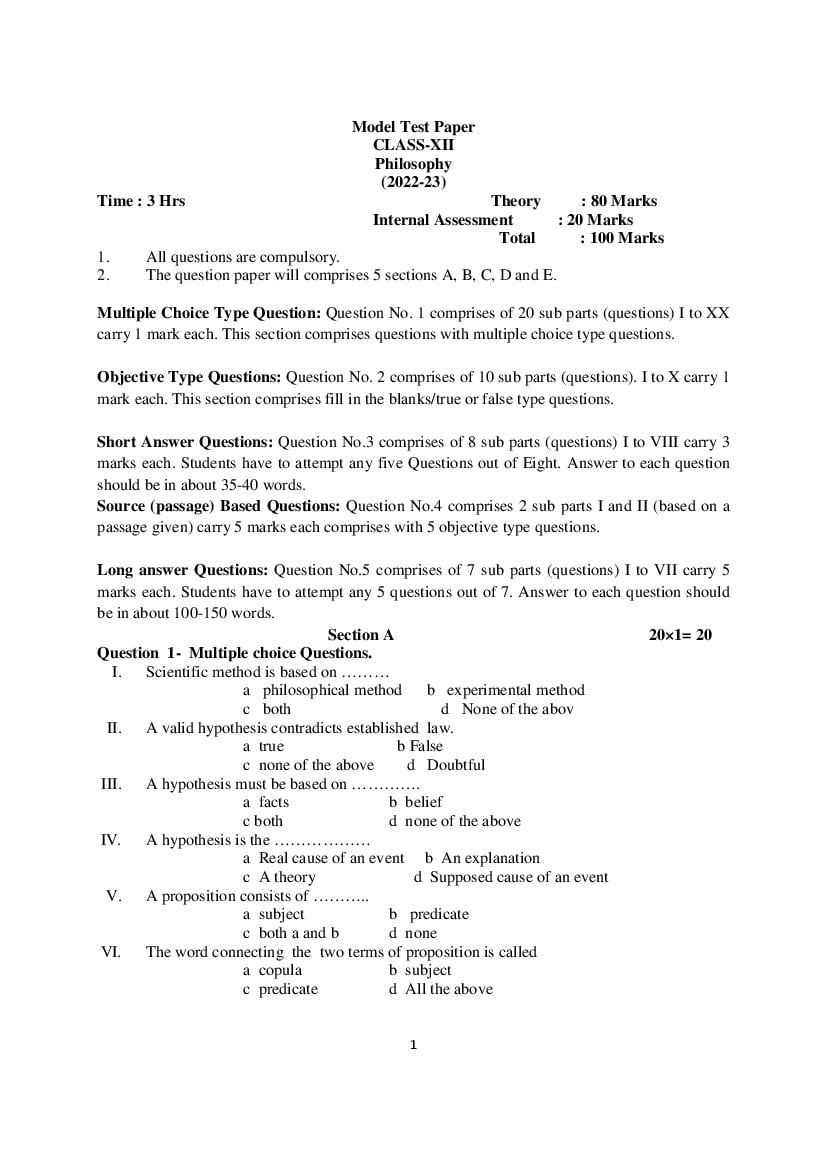
CLASS-XII
Philosophy
(2022-23)
Time : 3 Hrs Theory : 80 Marks
Internal Assessment : 20 Marks
Total : 100 Marks
1. All questions are compulsory.
2. The question paper will comprises 5 sections A, B, C, D and E.
Multiple Choice Type Question: Question No. 1 comprises of 20 sub parts (questions) I to XX
carry 1 mark each. This section comprises questions with multiple choice type questions.
Objective Type Questions: Question No. 2 comprises of 10 sub parts (questions). I to X carry 1
mark each. This section comprises fill in the blanks/true or false type questions.
Short Answer Questions: Question No.3 comprises of 8 sub parts (questions) I to VIII carry 3
marks each. Students have to attempt any five Questions out of Eight. Answer to each question
should be in about 35-40 words.
Source (passage) Based Questions: Question No.4 comprises 2 sub parts I and II (based on a
passage given) carry 5 marks each comprises with 5 objective type questions.
Long answer Questions: Question No.5 comprises of 7 sub parts (questions) I to VII carry 5
marks each. Students have to attempt any 5 questions out of 7. Answer to each question should
be in about 100-150 words.
Section A 20×1= 20
Question 1- Multiple choice Questions.
I. Scientific method is based on ………
a philosophical method b experimental method
c both d None of the abov
II. A valid hypothesis contradicts established law.
a true b False
c none of the above d Doubtful
III. A hypothesis must be based on ………….
a facts b belief
c both d none of the above
IV. A hypothesis is the ………………
a Real cause of an event b An explanation
c A theory d Supposed cause of an event
V. A proposition consists of ………..
a subject b predicate
c both a and b d none
VI. The word connecting the two terms of proposition is called
a copula b subject
c predicate d All the above
1
Page 2
a compound proposition b categorical proposition
c simple proposition d conditional proposition
VIII. Sensory experience as the source of knowledge is given by …………
a Descartes b Spinoza
c Locke d Leibnitz
IX. Reason as the source of knowledge is given by
a Hume b Locke
c Berkely d Descartes
X. Coherence theory of truth proves the validity of
a material b formal
c none of above d both
XI. The supporter of pragmatic theory is ………..
a Locke b Leibritz
c. David Hume d William James
XII. Only mind and its ideas are real—Name the theory.
a. Materialism b. Idealism
c. Both d. none of the above
XIII. Martter is the ultimate reality according to ……….
a. Idealism b. Materialism
c. both d. None of the above
XIV. Who says that things exist as ideas in the mind .
a. Berkeley b Descartes
c. Leibnitz d Hocking
XV. Indian philosophy is –
a. spiritualistic b materialistic
c. both d. none of above
XVI. Which of the following is a part of orthodox systems of Indian philosophy
a. Buddhism b. Jainism
c. Sikhism d. Vedanta
XVII. The ultimate goal of Indian philosophy is ……
a. Liberation b. Learning the world
c. both d. none of the above
XVIII. According to Sikhism liberation can be attained by
a. leaving the world b. naam simran
c. both d. None of the above
XIX. Sikhism does not believe in ….
a. caste system b. God
c. good deeds d. Sewa
ANS- a
XX. Bhagwad Gita believes in
a. Theory of karma b.God
c. shedding of ego d. all the above
2
Page 3
Question 2 Objective type questions
State whether the following statements are True or false
I. Scientific method is based on belief.
II. Hypothesis is one of the steps in scientific method.
III. Scientific explanation is related to particular fact.
IV. A proposition has three parts.
V. Knowledge is an addition to the existing experience.
Fill in the blanks
I. Scientific Laws are ________( General/Particular).
II. Hypothesis which does not explain all the facts in the field is __________(valid/invalid).
III. Particular explanation is ______ (systematic/unsystematic).
IV. No student is intelligent is _________ proposition (E/O).
V. According to _________ reason is the source of knowledge (Descartes/David hume).
Section-C 3×5= 15
(Short answer type Questions)
Question 3 Answer the following questions in about 30 to 35 words each. Each question
carries 5
Marks.
I. Describe the meaning and main features of scientific method in brief.
II. Discuss in brief the difference between scientific explanation and unscientific
explanation.
III. Briefly discuss the Pragmatic theory of truth.
IV. Discuss the meaning and any two features of idealism.
V. Describe the difference between Idealism and Materialism in brief.
VI. Describe the concept of RE-birth in Indian philosophy.
VII. What are the five stages of spiritual progress according to Sikhism? Discuss.
VIII. Describe in brief the concept of Sewa (service ) in Sikhism.
SECTION-D
Question 4 Source Based questions. Each question carry 5 marks. 5×2= 10
In a very simple term one can say a scientist works like a detective. He (detective) uses all
techniques, devices and means to solve his case. A detective is a dispassionate and keen
observer. He uses empirical reasoning (induction) as well as formal reasoning (deduction) to
reach to a testable and verifiable conclusion. The pattern of scientific inquiry is just the same. As
we have seen the aim of a scientist (natural as well as social) is to find general laws. For this he
makes use of two logical processes Induction and Deduction. Induction and Deduction are not
contradictory logical procedures but are rather complimentary to one another.
1. How does a scientist work? 1
2. What are his methods? 1
3. What is the aim of the scientist? 1
4. Name the logical processes used by the scientist. 1
5. How does a scientist reach to a conclusion? 1
A proposition is a unit of reasoning or logical thinking. Both premises and conclusion of
reasoning are propositions. Since propositions are so important, we must know what a
proposition is? A proposition is that which is believed to be true or false or doubtful. For
3
Page 4
Propositions are classified in many ways. Let us take three classifications. The first classification
is general classification of propositions which is based on the composition of propositions. The
second classification is the traditional classification of propositions. The third classification is the
one accepted by modern logicians.
1. What is a proposition? 1
2. How many ways a preposition can be classified? 1
3. Describe the first classification of preposition. 1
4. Describe the third classification of preposition. 1
5. Give an example of preposition. 1
SECTION-E 5×5= 25
(Long Answer type question )
I. Describe the importance of scientific method in Science.
II. Define scientific explanation and popular explanation. How they are different from each
other?
III. Describe Intution as the source of knowledge.
IV. Define materialism and idealism. Discuss the difference between them.
V. Describe the salient features of Indian Philosophy.
VI. Describe the various teachings of Sikhism. Discuss the values of these teachings.
VII. Describe the concept of ‘ SEWA’ (service) and its significance in Sikhism.
4
Document Details
| Board / Org | Punjab Board |
| Exam | Class 12 |
| Type | Sample Paper |
| Pages | 4 |
| Language | english |
| Updated | 22 Jul 2026 |