Karnataka PGCET 2015 Question Paper Environmental Engineering
Finished viewing? Save it for later —
Download Karnataka PGCET 2015 Question Paper Environmental Engineering (PDF · 12 pages)About Karnataka PGCET 2015 Question Paper Environmental Engineering
Karnataka PGCET 2015 Question Paper Environmental Engineering is available here for free download. Published by KEA for Karnataka Post Graduate Common Entrance Test, this question paper can be viewed online or downloaded as a PDF (12 pages). Candidates preparing for Karnataka Post Graduate Common Entrance Test can use Karnataka PGCET 2015 Question Paper Environmental Engineering to understand the exam pattern, the type of questions asked, and the overall difficulty level.
Frequently Asked Questions
How can I download Karnataka PGCET 2015 Question Paper Environmental Engineering?
Open this page and click the Download button to save Karnataka PGCET 2015 Question Paper Environmental Engineering as a PDF. It is completely free on AglaSem Docs.
Is Karnataka PGCET 2015 Question Paper Environmental Engineering free to download?
Yes. Karnataka PGCET 2015 Question Paper Environmental Engineering can be viewed online and downloaded as a PDF free of cost on AglaSem Docs.
How many pages does Karnataka PGCET 2015 Question Paper Environmental Engineering have?
Karnataka PGCET 2015 Question Paper Environmental Engineering contains 12 pages, which you can read online or download together as a single PDF.
Where can I find more Karnataka Post Graduate Common Entrance Test study material?
You can find more Karnataka Post Graduate Common Entrance Test question papers, sample papers, syllabus, and answer keys on AglaSem Docs.
Karnataka PGCET 2015 Question Paper Environmental Engineering – Text
Read the full text of this question paper below — useful to quickly search, copy and reference the content online without downloading the PDF.
📄 View text version (12 pages)
Page 1
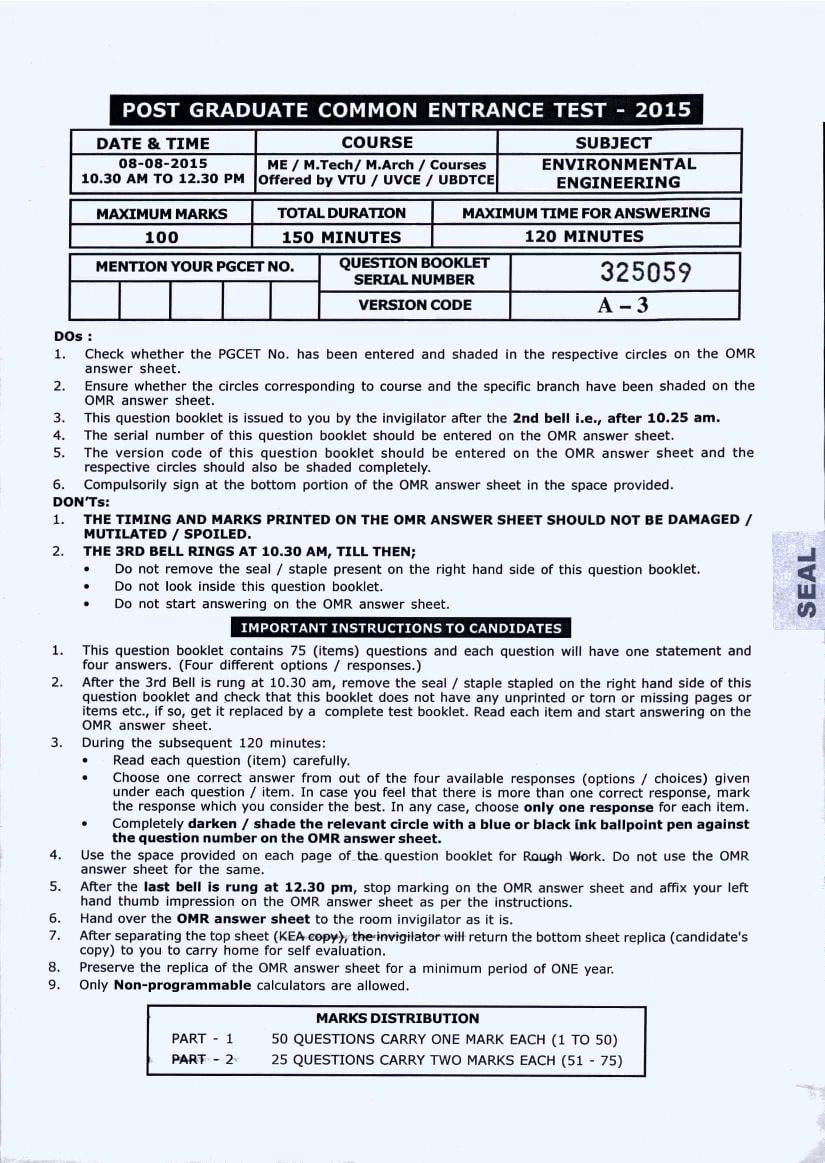
DATE & TIME COURSE SUBJECT
08-08-2015 ME / M.Tech/ M.Arch / Courses ENVIRONMENTAL
10.30 AM TO 12.30 PM Offered by VTU / UVCE / UBDTCE ENGINEERING
MAXIMUM MARKS TOTAL DURATION MAXIMUM TIME FOR ANSWERING
100 150 MINUTES 120 MINUTES
MENTION YOUR PGCET NO. QUESTION BOOKLET
SERIAL NUMBER 325059
VERSION CODE A -3
DOs :
1. Check whether the PGCET No. has been entered and shaded in the respective circles on the OMR
answer sheet.
2. Ensure whether the circles corresponding to course and the specific branch have been shaded on the
OMR answer sheet.
3. This question booklet is issued to you by the invigilator after the 2nd bell i.e., after 10.25 am.
4. The serial number of this question booklet should be entered on the OMR answer sheet.
5. The version code of this question booklet should be entered on the OMR answer sheet and the
respective circles should also be shaded completely.
6. Compulsorily sign at the bottom portion of the OMR answer sheet in the space provided.
DON'Ts:
1. THE TIMING AND MARKS PRINTED ON THE OMR ANSWER SHEET SHOULD NOT BE DAMAGED /
MUTILATED / SPOILED.
2. THE 3RD BELL RINGS AT 10.30 AM, TILL THEN;
• Do not remove the seal / staple present on the right hand side of this question booklet.
• Do not look inside this question booklet.
• Do not start answering on the OMR answer sheet.
IMPORTANT INSTRUCTIONS TO CANDIDATES
1. This question booklet contains 75 (items) questions and each question will have one statement and
four answers. (Four different options / responses.)
2. After the 3rd Bell is rung at 10.30 am, remove the seal / staple stapled on the right hand side of this
question booklet and check that this booklet does not have any unprinted or torn or missing pages or
items etc., if so, get it replaced by a complete test booklet. Read each item and start answering on the
OMR answer sheet.
3. During the subsequent 120 minutes:
• Read each question (item) carefully.
• Choose one correct answer from out of the four available responses (options / choices) given
under each question / item. In case you feel that there is more than one correct response, mark
the response which you consider the best. In any case, choose only one response for each item.
• Completely darken / shade the relevant circle with a blue or black ink ballpoint pen against
the question number on the OMR answer sheet.
4. Use the space provided on each page of the question booklet for Rough Work. Do not use the OMR
answer sheet for the same.
5. After the last bell is rung at 12.30 pm, stop marking on the OMR answer sheet and affix your left
hand thumb impression on the OMR answer sheet as per the instructions.
6. Hand over the OMR answer sheet to the room invigilator as it is.
7. After separating the top sheet (KEA copy), the invigilator wifl return the bottom sheet replica (candidate's
copy) to you to carry home for self evaluation.
8. Preserve the replica of the OMR answer sheet for a minimum period of ONE year.
9. Only Non-programmable calculators are allowed.
MARKS DISTRIBUTION
PART - 1 50 QUESTIONS CARRY ONE MARK EACH (1 TO 50)
PART - 2 25 QUESTIONS CARRY TWO MARKS EACH (51 - 75)
Page 2
Page 3
PART - 1
(50 X 1 = 50)
(Each question carries one mark)
1. The oxygen content in air is approximately: 6. Presence of high algal content in water
a. 20% b. 60% indicates that the water is:
c. 40 % d. 78% a. Alkaline b. Acidic
c. Neutral cL Soft
2. In the Gaussian Dispersion model for air
7. TON refers to:
pollution, (72 refers to:
a. Typical Oxygen Normal
a. VC
b. Threshold Odor number
b. Vertical dispersion coefficient
c. Tonnes of Cane
c. MMD
d Tons of Nitrates
d. Horizontal dispersion coefficient
8. In a large lake, during stratification, the
3. In Bleaching powder, the amount of chlorine middle portion is called:
present is: a. Abyss
a. 33% b. 45% b. Hypolimnion
c. 70 % d 100 % c. Epilimnion
cL Thermocline
4. The color of water is measured on a:
a. Platinum Cobalt scale 9. Schmutzdecke layer is formed in:
b. Turbidity scale a. RSF b. SSF - 2
c. CaCo3 scale c. SSF cL SDB
d. Nallo3 scale
10. Back washing water used in RSF accounts
for about:
5. 'Point of zero charge' (PZC) of carbon or carbon a. 4 % h 16 %
like sludge can be determined using:
c. 12% cl. 25%
a. KNO3 or CaCO3
b. KNO3 or NaC1 11. Normal soil contains oxygen by:
c. NaCl or CaCO3 a. 80 % b. 60 %
d. Na2SO4 or CuSO4 c. 100 % d 25 %
A-3 3 EN
Page 4
influence of the project is: is:
a. 7- 10 km a. Film diffusion
b. 30 - 50 km
b. Intraparticle diffusion
c. 15 - 20 km
c. Pore diffusion
d. 70 - 80 km
cl. All the above
13. When attributes and activities are matched
on a 'Matrix' sheet, the cells contain:
18. The BIS drinking water quality standards for
a. Environment drinking water falls in the range of:
b. Importance only a. 0.5 - 1 mg/L
c. Magnitude only
b. 1.0 - 1.5 mg/L
d Magnitude & Importance
c. 2.0 - 2.5 mg/L
cl. None of the above
14. VFGs means:
a. Valued Fluoride Goods
b. Value Function Graphs 19. Iron causes color problems even at low
concentrations of:
c. Volatile Fluorosis Grids
cL None of the above a. 6 mg/L
b. > 8 mg/ L
15. NDS means: c. > 0.3 mg/L
a. Negative Declaration Statement d < 2 mg/L
b. Nitrogen Dissolved Sulfur
c. Nickel Doped Sulfur
20. In the bacterial growth curve, the second
d. None of the above growth phase is the:
a. Lag phase
16. The best season data that must be presented
in REIA is: b. Arithmetic phase
a. Rainy b. Winter c. Stationary phase
c. Summer d Fall - spring d. Log phase
A-3 4 EN
Page 5
are for a period of: waste water treatment, the most important
water quality parameter is:
a. 10 years
a. Alkalinity
h 15 - 20 years b. Chlorides
c. 30 - 40 years c. Total hardness
d. 20 - 30 years d. Iron
26. In an ecosystem, pyramids of energy is:
22. Imhoff cone is used to determine:
a. Multi directional
a. Volatile solids b. Unidirectional
b. Suspended solids c. Inverted
d_ None of the above
c. Settleable solids
d. Total solids
27. Aeration of water is carried out for the
removal of:
a. Odor
23. The solids content in water is determined
by: b. Color
a. AAS c. Fluoride
cL Hardness
b. Gravimetric method
c. HPLC
28. In electrochemical coagulation, for medium
d. Titrimetric method strength waste waters, only two steps occur
in sludge settling, they are:
a. 2 and 3
24. In Population projection forecasting, b. 1 and 4
geometric increase represents:
c. 1 and 2
dp dp d. 1 and 3
a. di oc b. — = K
dt
29. In venturiflumes, the throat width size is:
dp p dp a. 100 cm b. 30 cm
=t
c. dt
c. 40 cm d. 20 cm
A-3 5 EN
Page 6
normally placed is: pressure head to be maintained should be:
a. Proportional weir a. 10 - 12 m
b. Venturimeter b. 6-8m
c. 12 - 15 m
c. Turbine
d. 8 -10 m
d Pump
36. Corrosion in sewer pipes is mainly because
31. Wind speeds are measured using an: of:
a. Anemometer a. CO2 b. H2S
b. Barometer c. 02 d C6H1206
c. HVAS
d Impinger tube 37. A velocity cap in Intakes is designed not to
allow:
a. Whales b. Sharks
32. The acronym CSI means:
c. Fish d. Turtles
a. Centrifugal settleability index
b. Central suspended index
38. The conversion factor from MLD to m 3 / s is:
c. Carbon sludge index
a. 1.1343 b. 0.11569
d. None of the above
c. 1.9234 d. 0.011574
33. Mottling of teeth enamel disease is related
to the parameter: 39. Now a days, 'n' value in the velocity
calculations for sewer design is taken as:
a. Fluoride b. Nitrates
a. 0.023 b. 0.103
c. Arsenic d. Phosphorus
c. 0.013 d. 0.333
34. The permissible limit for nitrate in drinking 40. The waste waters become non-bio degradable
water is: if COD:BOD ratios are:
a. < 45 mg/L b. > 60 mg/L a. > 3.0 b. < 2.2
c. 300 mg/L d. 1500 mg/ L c. 5 d. 7
A-3 6 EN
Page 7
like material that separates out from the
a. Ground water substrate is called:
b. Surface water a. Sloughing
c. Salt water b. Terminator
d. All the above
c. Maceration
d. Communition
42. While designing sedimentation tanks, the
most important parameter that decides the
diameter is:
47. The most updated version of the ASP today
a. S.O.R h H.R.T is:
c. S.V.I d. D.0 a. Lagoon b. UASB
c. RBC d. MBR
43. The valve which allows uni-directional flow
of water in a pipe is called:
48. The best method to dispose off municipal solid
a. Sluice valve wastes today is:
b. Reflux valve a. Burning in open
c. Gate valve
b. Plasma
d. Air valve
c. SLF
d. Complete Incineration
44. In a water tank, over flow pipes are provided
at:
a. FSL b. MWL 49. In air pollution, 'Pasquill Stability Class' is of
types:
c. Floor level d. NWL
a. B-F b. A - C
c. A-D d. A - F
45. As a norm, a rural population having more
than 1000 persons, should be provided with:
a. BW (HP) 50. When the ELR meets the DALR, one can
b. MWS obtain:
c. PWS a. Pressure b. Wind speed
d. None of the above c. MMD d. VC
A-3 7 EN
Page 8
(Each question carries two marks)
(25 X 2 = 50)
51. In designing settling tanks, of circular type, 55. The pivot of the rotating arm of the Trickling
the vertical settling velocity should be: filter unit is placed on:
b. < v„ a. Solid carbon
b. Liquid nitrogen
d None of the above
c. Liquid oxygen
d. Mercury liquid
52. In 'Value functions' the X-axis and Y-axis
are:
56. Recent advances in membranes show that
a. Environmental Quality and Parameter the material used for membranes is:
b. Parameter and Environmental quality a. PVDF
c. Subjectivity and TON b. Ceramic
d. None of the above c. PVC
d Clay
53. The best style to design and lay a waste water
treatment facility is:
57 In sludge settling in a column, Type IV refers
a. Linear style to:
b. Campus style a. Compression settling
c. Random style b. Hindered settling
d Compact style c. Zone settling
d All of the above
54. Soluble colloidal particles that remain after
electrochemical coagulation of waste water
can be easily removed by: 58. All waste water (domestic/industrial)
treatment facilities must be designed for:
a. Adding alum
a. Average flow
b. Adding Sulfur
b. Maximum flow
c. Adding Polymer aid
c. Minimum flow
d. Adding salts of iron
d. All the above
A-3 8 EN
Page 9
washing clothes are referred to: influence of the project on the environment
is
a. Grey water
a. 100 km
h Black water
b. 25 km
c. Pink water
c. 10 km
d. Dark water
d. 500 km
60. In sanitary land fills, the layer of material
placed at the bottom of it is made of: 64. To obtain EIUs, in EIA, one has to multiply
EQs by:
a. Rubber a. PIUs
b. Polymer b. mg/L
c. Metal grids c. %
d. Bentonite clay d. meq/L
61. Solid waste Abhiyan in India focusses on: 65. Wherever Igneous rocks are encountered,
one can expect:
a. Reactive approach
a. Hard water
b. Continuous reactive approach
b. Soft water
c. Proactive approach
c. Brackish water
d P2
d. Cold water
62. Most air pollution episodes have occurred in
the season: 66. Excess aluminum in water causes a disease
in children called:
a. Summer
a. Leprosy
b. Rainy
b. Inflammation
c. Winter
c. Dysentry
d. All the above d Dementia
A-3 9 EN
Page 10
not exceed:
a. X/M b. M/X
a. 11 b. 15
c. X/n d. n/X
c. 45 d. 20
68. In water mains, air valves are provided at:
a. Near pumps 73. The chloride content in water (treated) for
public supplies should not exceed:
b. Pipe junctions
c. Highest points a. 100 mg/L b. 150 mg/L
d. Low points c. 250 mg/L d. 290 mg/L
69. The last phase the population growth curve
is: 74. Two most important parameters for a
successful electrocoagulation in waste water
a. Lag phase treatment are:
b. Survival phase
a. Chlorides and Alkalinity
c. Endogenous phase
b. Alkalinity and Sulphates
d. Log phase
c. Sulphates and Nitrates
70. Schistosomiasis is caused by: d. Nitrates and Phosphates
a. Bacteria
b. Crustaceans
75. In the beginning of the EC process for water
c. Virus treatement, the kind of corrosion is:
d. Protozoans
a. Wave corrosion
b. Pitting corrosion
71. One of the following is an algicide:
a. Alum b. CuSO4 c. Edge corrosion
c. Al2S03 d. Nallo3 d. None of the above
A-3 10 EN
Page 11
i
Page 12
$
/
Document Details
| Board / Org | KEA |
| Exam | Karnataka Post Graduate Common Entrance Test |
| Type | Question Paper |
| Pages | 12 |
| Updated | 22 Jul 2026 |