ISC Class 12 Specimen Paper 2022 Western Music Semester 1
Finished viewing? Save it for later —
Download ISC Class 12 Specimen Paper 2022 Western Music Semester 1 (PDF · 19 pages)About ISC Class 12 Specimen Paper 2022 Western Music Semester 1
ISC Class 12 Specimen Paper 2022 Western Music Semester 1 is available here for free download. Published by CISCE for Class 12, this sample paper can be viewed online or downloaded as a PDF (19 pages). Candidates preparing for Class 12 can use ISC Class 12 Specimen Paper 2022 Western Music Semester 1 to understand the exam pattern, the type of questions asked, and the overall difficulty level.
Frequently Asked Questions
How can I download ISC Class 12 Specimen Paper 2022 Western Music Semester 1?
Open this page and click the Download button to save ISC Class 12 Specimen Paper 2022 Western Music Semester 1 as a PDF. It is completely free on AglaSem Docs.
Is ISC Class 12 Specimen Paper 2022 Western Music Semester 1 free to download?
Yes. ISC Class 12 Specimen Paper 2022 Western Music Semester 1 can be viewed online and downloaded as a PDF free of cost on AglaSem Docs.
How many pages does ISC Class 12 Specimen Paper 2022 Western Music Semester 1 have?
ISC Class 12 Specimen Paper 2022 Western Music Semester 1 contains 19 pages, which you can read online or download together as a single PDF.
Where can I find more Class 12 study material?
You can find more Class 12 question papers, sample papers, syllabus, and answer keys on AglaSem Docs.
ISC Class 12 Specimen Paper 2022 Western Music Semester 1 – Text
Read the full text of this sample paper below — useful to quickly search, copy and reference the content online without downloading the PDF.
📄 View text version (19 pages)
Page 1
SPECIMEN QUESTION PAPER
WESTERN MUSIC
PAPER 1
(THEORY)
---------------------------------------------------------------------------------------------------------------------
Maximum Marks: 70
Time allowed: One and a half hours
(Candidates are allowed additional 15 minutes for only reading the paper.)
ALL QUESTIONS ARE COMPULSORY
The marks intended for questions are given in brackets [ ].
Each question / subpart of a question carries one mark.
----------------------------------------------------------------------------------------------------
Select the correct option for each of the following questions.
-----------------------------------------------------------------------------------------------
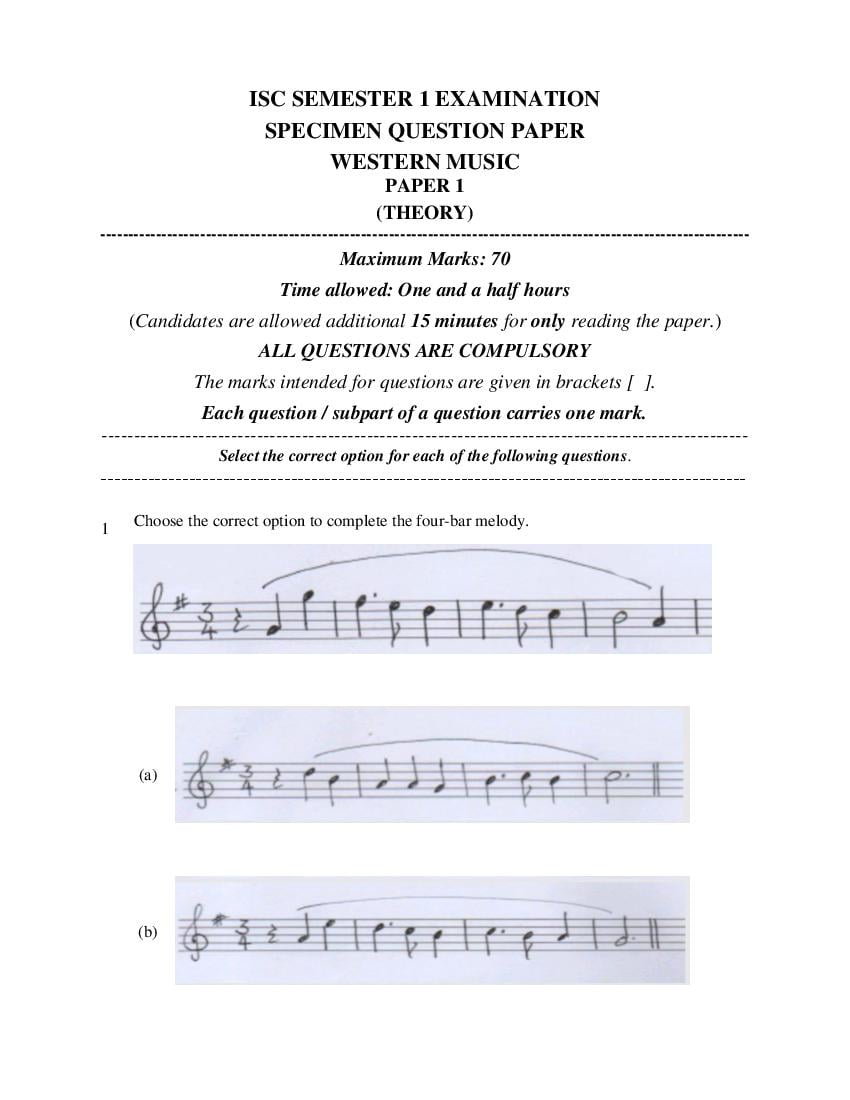
Choose the correct option to complete the four-bar melody.
1
(a)
(b)
Page 2
(d)
Choose the melody that would suit the given lyrics.
2
Sing a Song of Six Pence, a Pocket Full of Rye.
(a)
(b)
(c)
(d)
Page 3
Mozart. Based on the image, choose the correct option to answer the questions from number
3 - 12.
3 What does SATB mean?
(a) Saxophone, Accordion, Trumpet, Bassoon
(b) Soprano, Alto, Tenor, Bass
(c) Scherzando, Allegro, Tanto, Brio
(d) Saxophone, Alto, Tanto, Bass
4 Which of the notes, shown in the image, are not a part of the key signature?
(a) B flat, D sharp, G sharp
(b) A, C sharp, G natural
(c) D natural, F sharp, B
(d) C sharp, F sharp, B flat
5 Which is the largest harmonic interval between the two upper voices?
(a) Major 6th
(b) Perfect 8th
(c) Minor 7th
(d) Diminished 5th
6 Which is the smallest harmonic interval between the two lower voices?
(a) Minor second
(b) Minor third
(c) Major second
(d) Major third
Page 4
(a) C, G, A
(b) F sharp, B, A
(c) D, G, D
(d) B, F sharp, C sharp
8 Which note is sung in unison by two of the voices?
(a) D
(b) C
(c) E
(d) F sharp
9 Name two orchestral instruments that can play the bass part.
(a) Tuba, cello
(b) Trumpet, clarinet
(c) Violin, viola
(d) Horn, flute
10 The curved line in bars 1 to 2 is:
(a) Slur
(b) Tie
(c) Accent
(d) Soft
11 The curved line in bar 3 is:
(a) Tie
(b) Slur
(c) Accent
(d) Soft
Page 5
(a) G major
(b) F major
(c) D major
(d) A minor
Choose the correct option to answer the following questions.
13 In which year was Beethoven born?
(a) 1760
(b) 1770
(c) 1775
(d) 1773
14 How many movements does the Symphony number 2 have?
(a) 4 movements
(b) 2 movements
(c) 3 movements
(d) 5 movements
15 When was Symphony number 2 written?
(a) 1815 – 1816
(b) 1801 – 1802
(c) 1840 – 1841
(d) 1803 – 1805
16 To whom was Symphony number 2 dedicated?
(a) Prince Lichnowsky
(b) Prince Kinsky
(c) Prince Razumovsky
(d) Emperor Latchsky
Page 6
(a) Prague
(b) Bonn
(c) Heiligenstadt
(d) Nuremberg
18 What was his physical condition while composing the Symphony number 2?
(a) His eyesight was failing
(b) His deafness was becoming more pronounced
(c) He was having difficulty with his memory
(d) He was suffering from severe arthritis
19 In place of the standard Minuet which movements did Beethoven use?
(a) A sonata
(b) Allegro con brio
(c) Scherzo
(d) Candence
20 Beethoven’s second Symphony is scored for which of the following?
(a) Strings, flauti, oboi, timpani, corni, trombe
(b) Strings, flauti, oboi, clarinetti, corni, trombe
(c) Strings, flauti, oboi, corni, clarinetti, trombe, timpani, fagotti
(d) Strings, flauti, oboi, timpani, trombe
Page 7
(a) ADAGIO
(b) Allegro molto
(c) Andante
(d) Andantino
22 The fourth movement of Beethoven’s second Symphony is in which key?
(a) A major
(b) D major
(c) F major
(d) G major
23 The initial presentation of the thematic material of the musical composition is called:
(a) The recapitulation
(b) The development
(c) The exposition
(d) The coda
24 Just before the development in Beethoven’s second Symphony there is a ________.
(a) Prelude
(b) Codetta
(c) Grand piano duo
(d) Interlude
Page 8
(a) Coda
(b) Interlude
(c) Scherzo
(d) Da capo
26 The longest symphonic slow movement that was composed by Beethoven is in:
(a) The third movement
(b) The second movement
(c) The fourth movement
(d) The first movement
27 The third movement in the Symphony number 2 is a:
(a) Melodious string quartet
(b) Melodious oboe and bassoon quartet
(c) Melodious flute and clarinet quartet
(d) Melodious violin and viola duet
28 The fourth movements Beethoven’s Symphony number 2 is composed of _________.
(a) Melodious quartets
(b) Rapid string passages
(c) A piano trio
(d) A violin solo
Page 9
(a) 1st, 2nd, 3rd movements
(b) 2nd, 3rd, 4th movements
(c) 1st, 3rd, 4th movements
(d) 1st, 2nd, 4th movements
30 The first movement in Beethoven’s second Symphony is:
(a) Un poco sostenuto – Allegro
(b) Allegretto e grazios
(c) Adagio Molto – Allegro con brio
(d) Vivace
31 In Beethoven’s second Symphony, the first movement is in the key of:
(a) F major
(b) A major
(c) D major
(d) G major
32 In Beethoven’s second Symphony, the second movement is:
(a) Adagio
(b) Allegro non tropo
(c) Larghetto
(d) Allegretto
Page 10
(a) F major
(b) A major
(c) D major
(d) G major
34 In Beethoven’s second Symphony, the third movement is:
(a) Minuet -Moderato
(b) Scherzo Allegro Trio
(c) Allegretto & grazioso
(d) Allegro non troppo
35 In Beethoven’s second Symphony, the third movement is in the key of:
(a) F major
(b) A major
(c) D major
(d) G major
36 In the first movement, 11th bar, the key changes from D major to _________.
(a) A major
(b) Bb major
(c) G major
(d) C major
Page 11
(a) B minor
(b) C minor
(c) A minor
(d) G minor
Give the meaning of the following performance directions used in Beethoven’s Symphony
number 2.
38 Ff
(a) Fugue
(b) Forte
(c) Fortissimo
(d) Fine’
39 P
(a) Presto
(b) Piano
(c) Piu
(d) Plucked
40 Cresc
(a) Central
(b) Cease
(c) Crescendo
(d) Calculated
Page 12
(a) Sophisticated
(b) Some force
(c) Senza force
(d) sforzando
42 Tr
(a) Treble clef
(b) Terrifyingly
(c) Trill
(d) Tranquil
43 Pp
(a) Piano
(b) Pio presto
(c) Pianissimo
(d) Peaceful playing
44 Fp
(a) Forced piu
(b) Final playing
(c) Forte piano
(d) Forte piu
Page 13
(a) Decrease
(b) Demolish
(c) Decrescendo
(d) Decorate
46 Arco
(a) Attractive
(b) With the bow
(c) Very fast
(d) Artificial
47 Molto
(a) Less
(b) More
(c) Much
(d) A little
48 Pizz
(a) Pizza
(b) Picasso
(c) Pizzicato
(d) Pleasing
Page 14
(a) Lively
(b) Gracefully
(c) Playful
(d) Immediately
50 Da capo
(a) End
(b) Repeat from the beginning
(c) A sign
(d) A movable bar attached to the guitar to raise pitch
Give the meaning of the following words used in Beethoven’s symphony no 2 –
51 Flauti
(a) Forte
(b) Fast
(c) Flutes
(d) Fugue
52 Oboi
(a) Expression of grief
(b) Oboes
(c) Open strings
(d) Bassoon
Page 15
(a) Faster
(b) Without
(c) Bassoons
(d) Flutes
54 Corni
(a) Sweetly
(b) Cello
(c) Horns
(d) Clarinets
55 Trombe
(a) Trumpet
(b) Double Bass
(c) Tuba
(d) Trombone
56 Violon Cello
(a) Cello
(b) Violin
(c) Viola
(d) Double Bass
Page 16
(a) Trombone
(b) Contra Bass
(c) Bassoon
(d) Viola
58 Timpani
(a) Cymbal
(b) Gong
(c) Set of kettle drums
(d) Tambourine
59 A Woodwind Instrument
(a) Viola
(b) Flute
(c) Tuba
(d) Cymbal
60 A String Instrument
(a) Gong
(b) Trumpet
(c) Cello
(d) Clarinet
Page 17
(a) Oboe
(b) Trumpet
(c) Timpani
(d) Contra bass
62 A Percussion Instrument
(a) Bassoon
(b) Flute
(c) Horn
(d) Tambourine
63 A Double Reed Instrument
(a) Flute
(b) French horn
(c) Oboe
(d) Tuba
64 A Single Reed Instrument
(a) Clarinet
(b) Trumpet
(c) Timpani
(d) Trombone
Page 18
65 An instrument that uses the Treble Clef is ___________.
(a) Cello
(b) Trombone
(c) Violin
(d) Viola
66 An instrument that uses Alto Clef is ____________.
(a) Flute
(b) Timpani
(c) Clarinet
(d) Viola
67 An instrument that also uses the Tenor Clef is __________.
(a) Cello
(b) Tuba
(c) Trumpet
(d) Bassoon
68 An instrument that uses the Bass Clef is ___________.
(a) Clarinet
(b) Oboe
(c) Viola
(d) Tuba
Page 19
(a) Tuba
(b) Trumpet
(c) Timpani
(d) Violin
70 When did Beethoven die?
(a) March 29, 1826
(b) March 26, 1827
(c) March 24, 1872
(d) March 26, 1882
Document Details
| Board / Org | CISCE |
| Exam | Class 12 |
| Type | Sample Paper |
| Pages | 19 |
| Language | english |
| Updated | 22 Jul 2026 |