aglasem.com
Schools Admission Mock Test Playground
ClassChoose class
StateSelect state

NCERT Class 10 Syllabus for History
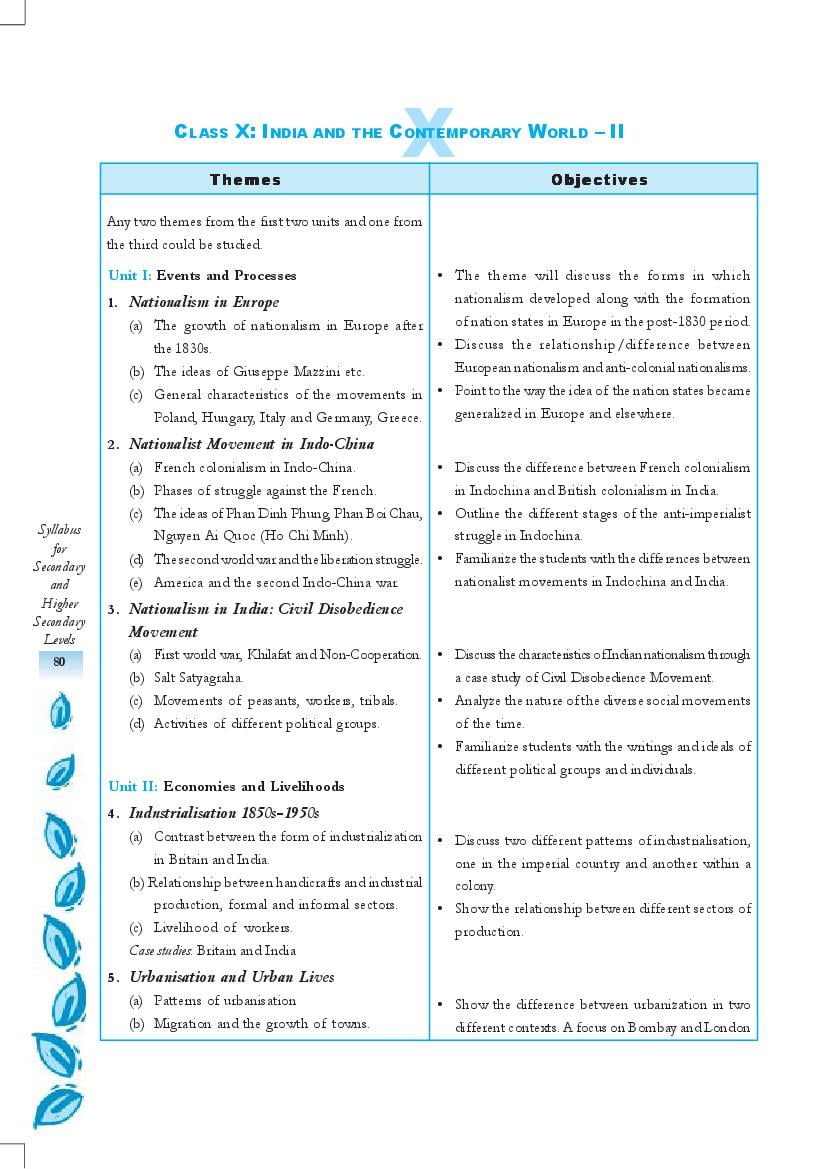
Download NCERT Class 10 Syllabus for History PDF free from AglaSem Docs. Check the complete syllabus with topics, unit-wise weightage and exam pattern to plan your studies effectively. More Detail
NCERT Class 10 Syllabus for History - Page 1 of 2

Finished viewing? Save it for later —

Download NCERT Class 10 Syllabus for History (PDF · 2 pages)
Downloaded 535 times

About NCERT Class 10 Syllabus for History

NCERT Class 10 Syllabus for History is available here for free download. Published by NCERT for Class 10, this syllabus can be viewed online or downloaded as a PDF (2 pages). Candidates preparing for Class 10 can use NCERT Class 10 Syllabus for History to understand the exam pattern, the type of questions asked, and the overall difficulty level.

Frequently Asked Questions

How can I download NCERT Class 10 Syllabus for History?

Open this page and click the Download button to save NCERT Class 10 Syllabus for History as a PDF. It is completely free on AglaSem Docs.

Is NCERT Class 10 Syllabus for History free to download?

Yes. NCERT Class 10 Syllabus for History can be viewed online and downloaded as a PDF free of cost on AglaSem Docs.

How many pages does NCERT Class 10 Syllabus for History have?

NCERT Class 10 Syllabus for History contains 2 pages, which you can read online or download together as a single PDF.

Where can I find more Class 10 study material?

You can find more Class 10 question papers, sample papers, syllabus, and answer keys on AglaSem Docs.

NCERT Class 10 Syllabus for History – Text

Read the full text of this syllabus below — useful to quickly search, copy and reference the content online without downloading the PDF.

📄 View text version (1 page)

Page 1

Themes X CLASS X: INDIA AND THE CONTEMPORARY WORLD – II Objectives Any two themes from the first two units and one from the third could be studied. Unit I: Events and Processes • The theme will discuss the forms in which 1. Nationalism in Europe nationalism developed along with the formation (a) The growth of nationalism in Europe after of nation states in Europe in the post-1830 period. the 1830s. • Discuss the relationship/difference between (b) The ideas of Giuseppe Mazzini etc. European nationalism and anti-colonial nationalisms. (c) General characteristics of the movements in • Point to the way the idea of the nation states became Poland, Hungary, Italy and Germany, Greece. generalized in Europe and elsewhere. 2. Nationalist Movement in Indo-China (a) French colonialism in Indo-China. • Discuss the difference between French colonialism (b) Phases of struggle against the French. in Indochina and British colonialism in India. (c) The ideas of Phan Dinh Phung, Phan Boi Chau, • Outline the different stages of the anti-imperialist Syllabus Nguyen Ai Quoc (Ho Chi Minh). struggle in Indochina. for Secondary (d) The second world war and the liberation struggle. • Familiarize the students with the differences between and (e) America and the second Indo-China war. nationalist movements in Indochina and India. Higher 3. Nationalism in India: Civil Disobedience Secondary Movement Levels 80 (a) First world war, Khilafat and Non-Cooperation. • Discuss the characteristics of Indian nationalism through (b) Salt Satyagraha. a case study of Civil Disobedience Movement. (c) Movements of peasants, workers, tribals. • Analyze the nature of the diverse social movements (d) Activities of different political groups. of the time. • Familiarize students with the writings and ideals of different political groups and individuals. Unit II: Economies and Livelihoods 4. Industrialisation 1850s–1950s (a) Contrast between the form of industrialization • Discuss two different patterns of industrialisation, in Britain and India. one in the imperial country and another within a (b) Relationship between handicrafts and industrial colony. production, formal and informal sectors. • Show the relationship between different sectors of (c) Livelihood of workers. production. Case studies: Britain and India 5. Urbanisation and Urban Lives (a) Patterns of urbanisation • Show the difference between urbanization in two (b) Migration and the growth of towns. different contexts. A focus on Bombay and London

Showing the first page only. Download the PDF above for the complete document.

Document Details

Board / OrgNCERT
ExamClass 10
TypeSyllabus
Pages2
Updated09 Jun 2026