TBSE Class 11 Syllabus 2025 Philosophy
Finished viewing? Save it for later —
Download TBSE Class 11 Syllabus 2025 Philosophy (PDF · 6 pages)About TBSE Class 11 Syllabus 2025 Philosophy
TBSE Class 11 Syllabus 2025 Philosophy is available here for free download. Published by Tripura Board for Class 11, this syllabus can be viewed online or downloaded as a PDF (6 pages). Candidates preparing for Class 11 can use TBSE Class 11 Syllabus 2025 Philosophy to understand the exam pattern, the type of questions asked, and the overall difficulty level.
Frequently Asked Questions
How can I download TBSE Class 11 Syllabus 2025 Philosophy?
Open this page and click the Download button to save TBSE Class 11 Syllabus 2025 Philosophy as a PDF. It is completely free on AglaSem Docs.
Is TBSE Class 11 Syllabus 2025 Philosophy free to download?
Yes. TBSE Class 11 Syllabus 2025 Philosophy can be viewed online and downloaded as a PDF free of cost on AglaSem Docs.
How many pages does TBSE Class 11 Syllabus 2025 Philosophy have?
TBSE Class 11 Syllabus 2025 Philosophy contains 6 pages, which you can read online or download together as a single PDF.
Where can I find more Class 11 study material?
You can find more Class 11 question papers, sample papers, syllabus, and answer keys on AglaSem Docs.
TBSE Class 11 Syllabus 2025 Philosophy – Text
Read the full text of this syllabus below — useful to quickly search, copy and reference the content online without downloading the PDF.
📄 View text version (6 pages)
Page 1
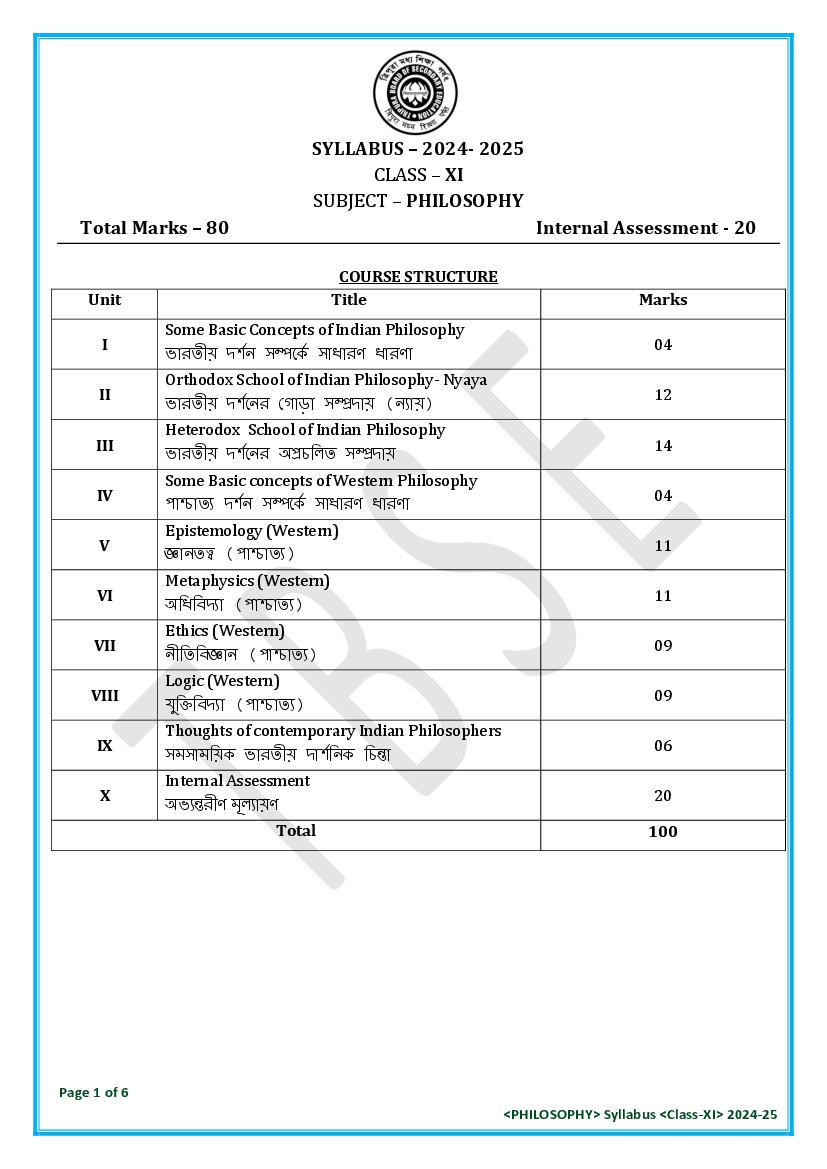
CLASS – XI
SUBJECT – PHILOSOPHY
Total Marks – 80 Internal Assessment - 20
COURSE STRUCTURE
Unit Title Marks
Some Basic Concepts of Indian Philosophy
I 04
ভারতীয় দলশন সম্পর্কশ সাধারণ ধারণা
Orthodox School of Indian Philosophy- Nyaya
II 12
ভারতীয় দলশর্নর গ াড়া সম্প্রদায় (নযায়)
Heterodox School of Indian Philosophy
III 14
ভারতীয় দলশর্নর অপ্রচলত সম্প্রদায়
Some Basic concepts of Western Philosophy
IV 04
াশ্চাতয দলশন সম্পর্কশ সাধারণ ধারণা
Epistemology (Western)
V 11
জ্ঞানতত্ত্ব (াশ্চাতয)
Metaphysics (Western)
VI 11
অলধলিদযা (াশ্চাতয)
Ethics (Western)
VII 09
নীলতলিজ্ঞান (াশ্চাতয)
Logic (Western)
VIII 09
যুলিলিদযা (াশ্চাতয)
Thoughts of contemporary Indian Philosophers
IX 06
সমসামলয়ক ভারতীয় দালশলনক লচন্তা
Internal Assessment
X 20
অভযন্তরীণ মূযায়ণ
Total 100
Page 1 of 6
Page 2
Some basic concepts of Indian Philosophy:
Darsana - its meaning 12
I
Different school of Indian Philosophy - A brief study
Purusartha as in Indian Philosophy.
Orthodox School of Indian Philosophy – Nyaya:
Definition and classification of Pratyaksa
II Sannikarsa - Laukika & Alaukika 24
Different kinds of Laulika Sannikarsa
Vyapti & Vyaptigraha
Heterodox School of Indian Philosophy:
Origin of the term Carvaka
Carvaka epistemology- Perception as source of valid knowledge
III Bhutacatustayavada, Sukha Vada, Swabhav Vada, 24
Buddist doctrine of four Nobel truths with special reference to
Bhavachakra
Nirvana, Astangika Marga, Prartityasamutpadavada.
Some basic concepts of Western Philosophy:
Philosophy - its meaning
IV Epistemology, Metaphysics, Psychology, Social Philosophy and 16
Aesthetic as branches of Philosophy
Philosophy & Science
Epistemology (Western):
Different Senses of word 'know' and conditions of propositional
V Knowledge.
20
Empiricism as a theory of the origin of knowledge,
Rationalism as a theory of the origin of knowledge,
Kant's criticism
Metaphysics (Western):
Realism and its different forms,
VI Idealism and its different forms, 25
Necessary - connection theory of Causality,
Hume's theory of causality
Ethics (Western):
Definition and scope
VII Fundamental concepts: 20
Right - Wrong, Good - Bad, Duty - Virtue, Moral - Non-moral
actions.
Page 2 of 6
Page 3
Nature and subject matter
Terms - denotation and connotation, Sentences, Propositions
VIII 35
Judgement. Distribution of terms
Transformation of sentences into logical propositions
Argument
Thoughts of contemporary Indian Philosophers:
IX Swami Vivekananda: Teaching towards the Youth 12
Mahatma Gandhi: Concepts of Ahinsa
Page 3 of 6
Page 4
BLUE-PRINT OF DISTRIBUTION OF MARKS
MCQ VSA SA-I SA-II LA-I LA-II Total
Unit Contents
1x10 1x10 2x5 3x4 4x7 5x2 Marks
Basic Concepts of Indian
Philosophy
I ভারতীয় দলশন সম্পর্কশ সাধারণ 1x2 1x2 2x1 - 4x1 - 10
ধারণা
Orthodox School of Indian
Philosophy- Nyaya
II ভারতীয় দলশর্নর গ াড়া 1x2 1x2 2x1 3x1 4x2 5x1 22
সম্প্রদায় (নযায়)
Heterodox School of Indian
(Carvaka)
III ভারতীয় দলশর্নর অপ্রচলত 1x3 1x2 2x1 3x1 4x1 5x1 19
সম্প্রদায় (চািশাক)
Some Basic concepts of
Western Philosophy
IV াশ্চাতয দলশন সম্পর্কশ সাধারণ 1x1 1x2 2x1 3x1 4x2 - 16
ধারণা
Epistemology (Western)
V 1x2 1x2 2x1 3x1 4x1 - 13
জ্ঞানতত্ত্ব (াশ্চাতয)
Total Marks 10 10 2x5 3x4 4x7 5x2 80
(Total No of Questions) (10) (10) (5) (4) (7) (2) (38)
N.B.:
1. Internal choice: There is no overall choice in the paper. However, internal choice may be given in 2 (two)
questions of 4(four) marks weightage and 2(two) questions of 5 marks weightage.
2. In SA-I,SA-II, LA-I & LA-II types, total allotted marks in each may be sub-divided, if necessary.
3. Questions should be set covering each unit.
Page 4 of 6
Page 5
BLUE-PRINT OF DISTRIBUTION OF MARKS
Unit Contents MCQ VSA SA-I SA-II LA-I LA-II Total
1x10 1x10 2x5 3x4 4x7 5x2 Marks
Heterodox School of Indian
(Buddism)
III ভারতীয় দলশর্নর অপ্রচলত 1x2 1x3 2x2 3x1 4x2 5x1 25
সম্প্রদায় (গিৌদ্ধধমশ)
Metaphysics (Western)
VI 1x2 1x2 2x1 3x2 4x2 5x1 25
অলধলিদযা (াশ্চাতয)
Ethics (Western)
VII 1x2 1x2 2x1 - 4x1 - 10
নীলতলিজ্ঞান (াশ্চাতয)
Logic (Western)
VIII 1x3 1x3 2x1 3x1 4x1 - 15
যুলিলিদযা (াশ্চাতয)
Thoughts of contemporary
Indian Philosophers
IX সমসামলয়ক ভারতীয় দালশলনক 1x1 - - - 4x1 - 05
লচন্তা
Total Marks 10 10 2x5 3x4 4x7 5x2 80
(Total No of Questions) (10) (10) (5) (4) (7) (2) (38)
N.B.:
1. Internal choice: There is no overall choice in the paper. However, internal choice may be given in 2 (two)
questions of 4(four) marks weightage and 2(two) questions of 5 marks weightage.
2. In SA-I,SA-II, LA-I & LA-II types, total allotted marks in each may be sub-divided, if necessary.
3. Questions should be set covering each unit.
Page 5 of 6
Page 6
Type of Questions Marks (80) Percentage
1. Multiple Choice Questions (MCQ) (1x10)
10 12.5
(Inclusive of Assertion, Reason, Differentiation & Stem)
2. Very Short Answer Type Questions (VSA) (1x10)
10 12.5
(Inclusive of Assertion, Reason, Differentiation & Stem)
3. Short Answer Type Questions- I (SA-I) (2x5)
(Knowledge, Understanding, Application, Analysis, Evaluation, 10 12.5
Synthesis & Create)
4. Short Answer Type Questions- II (SA-II) (3x4)
(Knowledge, Understanding, Application, Analysis, Evaluation, 12 15
Synthesis & Create)
5. Long Answer Type Questions – I (LA-I) (4×7)
(Knowledge, Understanding, Application, Analysis, Evaluation, 28 35
Synthesis & Create)
6. Long Answer Type Questions – II (LA-II) (5x2)
(Knowledge, Understanding, Application, Analysis, Evaluation, 10 12.5
Synthesis & Create)
80 100
NOTE:-
i) Typology of questions:- MCQ, VSA, Assertion- Reasoning type questions; SA-I, SA-II, LA-I,
LA-II, LA- III.
In LA- type questions source-based/ case- study based/ passage based questions may be
included.
ii) Approximately 33 % internal choice would be given.
Page 6 of 6