Goa Board Class 11 Sample Paper 2026 Banking (CWSN)
Finished viewing? Save it for later —
Download Goa Board Class 11 Sample Paper 2026 Banking (CWSN) (PDF · 38 pages)About Goa Board Class 11 Sample Paper 2026 Banking (CWSN)
Goa Board Class 11 Sample Paper 2026 Banking (CWSN) is available here for free download. Published by Goa Board for Class 11, this sample paper can be viewed online or downloaded as a PDF (38 pages). Candidates preparing for Class 11 can use Goa Board Class 11 Sample Paper 2026 Banking (CWSN) to understand the exam pattern, the type of questions asked, and the overall difficulty level.
Frequently Asked Questions
How can I download Goa Board Class 11 Sample Paper 2026 Banking (CWSN)?
Open this page and click the Download button to save Goa Board Class 11 Sample Paper 2026 Banking (CWSN) as a PDF. It is completely free on AglaSem Docs.
Is Goa Board Class 11 Sample Paper 2026 Banking (CWSN) free to download?
Yes. Goa Board Class 11 Sample Paper 2026 Banking (CWSN) can be viewed online and downloaded as a PDF free of cost on AglaSem Docs.
How many pages does Goa Board Class 11 Sample Paper 2026 Banking (CWSN) have?
Goa Board Class 11 Sample Paper 2026 Banking (CWSN) contains 38 pages, which you can read online or download together as a single PDF.
Where can I find more Class 11 study material?
You can find more Class 11 question papers, sample papers, syllabus, and answer keys on AglaSem Docs.
Goa Board Class 11 Sample Paper 2026 Banking (CWSN) – Text
Read the full text of this sample paper below — useful to quickly search, copy and reference the content online without downloading the PDF.
📄 View text version (37 pages)
Page 1
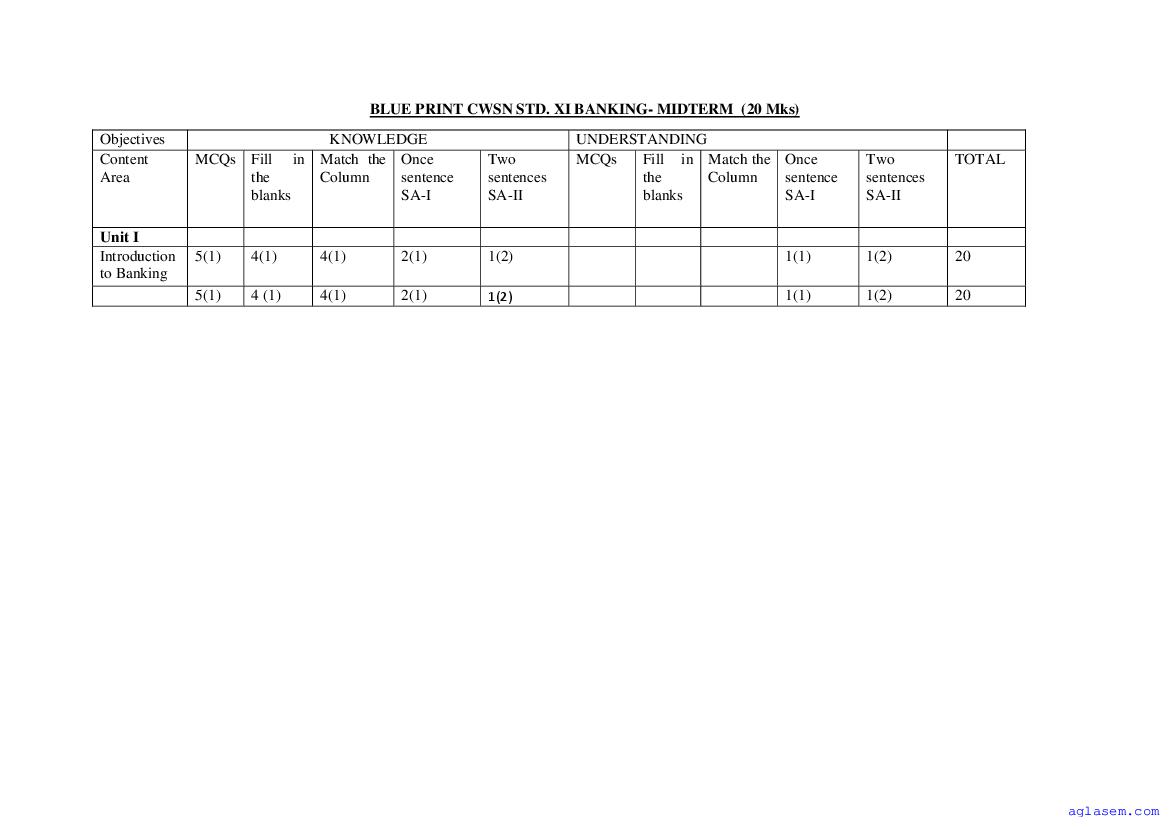
Objectives KNOWLEDGE UNDERSTANDING
Content MCQs Fill in Match the Once Two MCQs Fill in Match the Once Two TOTAL
Area the Column sentence sentences the Column sentence sentences
blanks SA-I SA-II blanks SA-I SA-II
Unit I
Introduction 5(1) 4(1) 4(1) 2(1) 1(2) 1(1) 1(2) 20
to Banking
5(1) 4 (1) 4(1) 2(1) 1(2) 1(1) 1(2) 20
Page 2
STANDARD XI BANKING (CWSN)
MID TERM EXAMINATION 2025-26
TIME: 1 Hour Maximum Marks: 20
INSTRUCTIONS:
All questions are compulsory.
This question paper consists of 18 questions.
Figures to the right indicate maximum marks.
Write your answers as per the instructions given.
Answer in the space provided.
Note: This is a question paper cum answer booklet.
QI Select the correct alternative from the options given to complete the statement/answer the question.
Write only the answer in the space provided.
1. Which of the following is a secondary function of a bank? (1)
Overdraft
Traveller’s cheque
Cash credit
Term Loan
Ans: _________________________
Page 3
Saving Deposit
Current Deposit
Recurring Deposit
Fixed Deposit
Ans: _________________________
3. Which of the following statement is true with regards to a bank? (1)
A bank does not charge any interest on the loans granted to its customers.
Different types of accounts can be opened with a bank.
A bank does not need any license to start its operations.
A bank is usually undertaking trading business.
Ans: _________________________
4. SMS facility is an important feature of which of the following? (1)
Internet Banking
Mobile banking
E-banking
Online banking
5. Which of the following is an account of a person residing outside India for a long duration during the year? (1)
Page 4
NRI
NRF
NRY
Ans: _________________________
Q.II Fill in the blanks by choosing the correct alternative from those given in the bracket.
( A.T.M , Bank, Agency Function, Foreign Currency Non-Resident )
6) A financial institution which allows its customers to deposit and withdraw as and when needed is _____________. (1)
Ans: __________________________
7) The facility that allows the customer to withdraw from his bank account without visiting the bank branch i______. (1)
Ans: __________________________
8) FCNR stand for ____________________________________. (1)
Ans: __________________________
9) When a bank makes payment of money on behalf of his customer, the bank is considered to be undertaking (1)
____________________.
Page 5
Q.III Match Column ‘A’ with column ‘B’ and write the correct answer in the space provided below:
Column A Column B Column C ( Answers)
10. NEFT a) The remittance of funds from one bank to (1)
another with the help of postal service.
11. Demand Draft b) It is an electronic method of remittance also (1)
called as wire transfer basically used in
international transfers.
12. Mail Transfer c) Electronic transfer of funds from one bank (1)
account to another within India.
13. Telegraphic d) A type of remittance in which one branch of a (1)
transfer bank orders its other branch to make the payment
to a particular person or order.
Q IV Answer the following questions.
14. State the primary functions of a bank. (1)
15. State any one feature of a bank. (1)
16. Give an example of a service provided by a banker where it acts as an agent to its customer. (1)
Q V Answer the following questions.
Page 6
18. How does the locker facility offered by a bank benefit its customers? (2)
*******************************************************
Page 7
STD. XI BANKING CWSN - FIRST TERM EXAM (60 Mks)
Objectives KNOWLEDGE UNDERSTANDING
Content Area MCQ Fill in Match Once Two MCQs Fill in Match Once Two TOTAL
s the the sentence sentences the the sentence sentences
blanks Colu SA-I SA-II blanks Column SA-I SA-II
mn
Unit I
Introduction to 6(1) 3(1) 2(1) 1(1) 1(2) 14
Banking
Unit II
Structure of 2(1) 3(1) 5(1) 3(1) 1(2) 15
Indian
Banking
System
Unit III
Various Kinds 4(1) 4(1) 5(1) 1(2) 15
of Bank
accounts
Unit IV
Types of 5(1) 3(1) 5 (1) 1(1) 1(2) 16
Customers
17(1) 13 (1) 10(1) 10(1) 2(2) 1(1) 1 (1) 2(2) 60
Page 8
STANDARD XI BANKING (CWSN)
FIRST TERM EXAMINATION 2025-2026
TIME: 3 Hours Maximum Marks: 60
INSTRUCTIONS:
All questions are compulsory.
This question paper consists of 56 questions.
Figures to the right indicate maximum marks.
Write your answers as per the instructions given.
Answer in the space provided.
Note: This is a question paper cum answer booklet.
Select the correct alternative from the options given to complete the statement/answer the question. Write only
the answer in the space provided.
1. Which of the following is a not a deposit account of a bank? (1)
Saving
Current
Fixed
Overdraft
Page 9
2. One of the important primary function of a bank is to_______________. (1)
Accept Deposit
Issue Traveller’s Cheque
Issue Letter of credit
Provide educational loan
Answer__________________
3. A bank is a financial intermediary because (1)
It acts as the broker between depositor and borrower
It acts as the link between the savers and the borrowers
It is in the finance industry
It is in the intermediary industry
Answer__________________
4. Miss Call facility is used to get update of account balance in case of _________________ (1)
Internet Banking
Phone banking
E-banking
Online banking
Page 10
5. What does NRO stand for? (1)
Non Residing Open
Non Resident Open
Non Resident Ordinary
Non Residing Ordinary
Answer__________________
6. When a bank makes makes payment of electricity bills on behalf of his customer, the bank is considered to be (1)
undertaking____________________.
Primary Function
Remittance Function
Agency Function
Credit creation function
Answer__________________
7. The bank facility which provides safety to the customer’s valuable is _______________. (1)
Demand Draft
Locker
Gift Cheque
Page 11
Answer__________________
8. All the banks in India are governed by the Indian Banking Regulation Act, _________ (1)
1934
1949
1956
1962
Answer__________________
9 Which of the following is not an organized banking sector in India? (1)
Nationalized Banks
Regional Rural Banks
Cooperative Banks
Money lenders
Answer__________________
10. Which of the following statement stands true regarding fixed deposit account? (1)
There are unlimited deposits in such account.
A passbook is issued for such account
It receives highest rate of interest on deposits
Page 12
Answer__________________
11. Which among the following is demand deposit account? (1)
Saving deposit
Fixed deposit
Cumulative deposit
Recurring deposit
Answer__________________
12. Only current account holders enjoy the benefit of ____________. (1)
Cheque
Overdraft
ATM
Interest on deposit
Answer____________________
13 There are restrictions on withdrawals from ____________ (1)
Saving Deposit Account
Current Deposit Account
Fixed Deposit Account
Page 13
Answer _________________
14 Which of the following is the most suitable type of bank account for a husband and wife who wish to operate (1)
the account together?
Partner’s Account
Joint Account
Company Account
Family Account
Answer ___________________
15 Which of the following is an example of a non- profit association as a customer of the bank? (1)
Partnership Firm
Joint stock Company
Co-operative society
Sole Proprietorship
Answer __________________________
16 A partnership firm can be created _______. (1)
Without any agreement
Only with written agreement
Page 14
By registering with Registrar of Companies
Answer __________________
17 A loan agreement entered by a minor is considered _______ (1)
Valid
Valid if witnessed by his guardian
Invalid and void
Legally binding
Answer ___________________________________
Q II Fill in the blanks by choosing the correct alternative from those given in the bracket.
( Scheduled banks, Insolvent ,Adhar Card, Term Deposits , Limited, , FCNR, Illiterate customer, Saving
Deposit, Businessmen, Minor’s Account, Banker’s bank , 1932, Electronic Fund Transfer , AXIS Bank, Minor )
18. NEFT is an example of ______________________________. (1)
Answer __________________
19. A customer deposit his funds for a particular period of time in _________________. (1)
Answer __________________
20. The account that can be opened and maintained by the NRI's in foreign currency is _______________ . (1)
Answer __________________
21. The banks that are included in the Second schedule of the Reserve Bank of India Act, 1934 are _________________. (1)
Page 15
22. Every bank is required to maintain an account with the RBI, therefore RBI is called________. (1)
Answer __________________
23. An example of a private sector bank is __________________________. (1)
Answer __________________
24. The partnership firm is regulated by the Indian Partnership Act, _________. (1)
Answer __________________
25. The liability of the members of a joint stock company is _______________. (1)
Answer __________________
26. A person whose liabilities are more than his assets is called as an ______________. (1)
Answer __________________
27. The terms and conditions of the banking operations have to be explained by the banker in a local language to a (1)
_________.
Answer __________________
28. A bank account opened for a Std. I student is an account of a _______________________. (1)
Answer __________________
29. The bank account that encourages a thrift of saving is _______________ (1)
Answer __________________
30. An example of KYC requirement for a bank account holder is ________________ (1)
Answer __________________
31. Current Account is usually suitable for ______________________. (1)
Page 16
32. Fixed Deposit and Recurring Deposit are examples of ____________________. (1)
Answer __________________
Q III Match the Types of banks in Column A with the Correct feature given in Column B and write the correct
answer in the space provided :
Column A Column B Column C (Answers)
33. Reserve Bank of India a) Known as land (1)
development banks
34. Co-operative Bank b) Accepts deposits and (1)
lends loans
35. Commercial Banks c) Monopoly of issuing (1)
notes and currency
36. Industrial Banks d) Operates at three tier (1)
system
37. Agricultural Banks e) Supports (1)
entrepreneurship and
business development
Q IV Match the Types of customer in Column A with the correct requirement for opening bank account given in
Column B and write the correct answer in the space provided :
Column A Column B Column C (Answers)
Page 17
39. Partnership Firm Account b) Incorporation
Certificate (1)
40. Account of a Lunatic c) Birth Certificate
(1)
41. Joint Stock Company d) Partnership Deed
Account (1)
42. Illiterate Person’s Account e) Medical Certificate
(1)
Q. V Answer the following questions.
43. What do you mean by Mail Transfer? (1)
Answer_________________________________________________________________________________________
_______________________________________________________________________________________________
_______________________________________________________________________________________________
44. What do you understand by the term ‘Demand Draft’? (1)
Answer________________________________________________________________________________________
_______________________________________________________________________________________________
______________________________________________________________________________________________
45. Which is the central bank of India? (1)
Answer_________________________________________________________________________________________
Page 18
_______________________________________________________________________________________________
46. What does SBI stand for? (1)
Answer_________________________________________________________________________________________
_______________________________________________________________________________________________
_______________________________________________________________________________________________
47. What do you mean by Unscheduled Banks? (1)
Answer_________________________________________________________________________________________
_______________________________________________________________________________________________
_______________________________________________________________________________________________
48. Give the full form of KYC . (1)
Answer_________________________________________________________________________________________
_______________________________________________________________________________________________
_______________________________________________________________________________________________
49. What do you understand by the term ‘Specimen Signature’ with regards to opening of a bank account? (1)
Answer_________________________________________________________________________________________
_______________________________________________________________________________________________
_______________________________________________________________________________________________
50. State any one use of passbook. (1)
Answer_________________________________________________________________________________________
_______________________________________________________________________________________________
_______________________________________________________________________________________________
Page 19
Answer_________________________________________________________________________________________
_______________________________________________________________________________________________
_______________________________________________________________________________________________
52. State any one situation when a bank account can be closed. (1)
Answer_________________________________________________________________________________________
_______________________________________________________________________________________________
_______________________________________________________________________________________________
Q. VI Answer the following questions.
53. Mr. ‘X’ a businessmen wants to open an account with the bank. Guide him with regards to which account he should (2)
open and why?
Answer_________________________________________________________________________________________
_______________________________________________________________________________________________
_______________________________________________________________________________________________
_______________________________________________________________________________________________
_______________________________________________________________________________________________
54. Explain the role of Industrial Banks in uplifting the Indian economy. (any 2 points) (2)
Answer_________________________________________________________________________________________
_______________________________________________________________________________________________
_______________________________________________________________________________________________
_______________________________________________________________________________________________
55. Highlight the features of a fixed deposit bank account . (any 2 points) (2)
Page 20
_______________________________________________________________________________________________
_______________________________________________________________________________________________
_______________________________________________________________________________________________
_______________________________________________________________________________________________
56. Why should banks avoid opening a current account for a minor?’ (any 2 points) (2)
Answer
_______________________________________________________________________________________________
_______________________________________________________________________________________________
_______________________________________________________________________________________________
_______________________________________________________________________________________________
_______________________________________________________________________________________________
Page 21
XI BANKING CWSN - SECOND TERM (60 Mks)
Objectives KNOWLEDGE UNDERSTANDING
Content MCQ Fill in Match Once Two MCQs Fill in Match Once Two TOTAL
Area s the the sentence sentences the the sentence sentences
blanks Column SA-I SA-II blanks Column SA-I SA-II
Unit V
Negotiable 6(1) 2(1) 5(1) 3(1) 2 (2) 20
Instruments
Unit VI
Collection 5(1) 6(1) 4(1) 2(2) 1(1) 20
and Payment
of Cheques
Unit VII
Principles of 6(1) 5(1) 5(1) 3(1) 1(1) 20
Bank
Lending
17(1) 13 (1) 10 (1) 10(1) 2(2) 2(1) 2(2) 60
Page 22
STANDARD XI BANKING (CWSN)
SECOND TERM EXAMINATION 2025-2026
TIME: 3 Hours Maximum Marks: 60
INSTRUCTIONS:
All questions are compulsory.
This question paper consists of 56 questions.
Figures to the right indicate maximum marks.
Write your answers as per the instructions given.
Answer in the space provided.
Note: This is a question paper cum answer booklet.
Q1. Select the correct alternative from the options given to complete the statement/answer the question.
Write only the answer in the space provided.
1. Which of the following is true about bank loans? (1)
A loan has to be repaid in full, in one installment
A loan without collateral security is a secured loan
A Loan is granted without any agreement
Interest is charged on the whole loan amount
Answer _____________________________
2. What is the minimum percentage of bank lending prescribed by the RBI towards the priority sector? (1)
20%
Page 23
40%
50%
Answer _____________________________
3. What is the purpose of asking a collateral during bank lending? (1)
To get more profit
To increase the loan amount
To decrease the interest
To secure the loan
Answer _____________________________
4. Which of the following is false about the principle of profitability in bank lending? (1)
Profit is needed to pay dividend to the shareholders
Profit helps to meet the financial obligations of the bank
There should be a balance between profit & safety
Huge loans should be given for long term to earn profit
Answer _____________________________
5. The most appropriate collateral security value for a loan of Rs. 50,000/- is : (1)
Page 24
Rs.30,000/-
Rs.50,000/-
Rs. 56,000/-
Answer _____________________________
6. What does the principle of diversification mean in bank lending? (1)
Lending to only individual borrower
Lending to large companies
Lending to small scale businesses
Lending to multiple borrowers across different sectors of the economy
Answer _____________________________
7. What does MICR stand for? (1)
Magnetic Ink Code Recognition
Magnetic Ink Character Recognition
Magnetic Ink Code Reading
Magnetic Ink Character Reading
Answer _____________________________
Page 25
Promissory Note
Cheque
Deposit slip
Bill of exchange
Answer _____________________________
9 The number of parties involved in a bill of exchange are ___________. (1)
Two
Three
Four
Five
Answer _____________________________
10. A cheque bearing a future date is called as : (1)
Bearer cheque
Crossed cheque *
Antedated cheque
Postdated cheque
Answer _____________________________
Page 26
It can be transferred once
It can be transferred multiple times
It cannot be transferred
It can be transferred after receiving the payment
Answer _____________________________
12. Who is the maker of the promissory note? (1)
The person who lends money
The person who wish to pay money
The person who borrows money and promise to pay
The person who borrows money and orders to pay
Answer _____________________________
13 The signature on the cheque should tally with __________________ (1)
Drawer’s signature
Drawee’s signature
Payee’ signature
Bank Manager’s signature
Answer _______________________
Page 27
A small change on the cheque
A change in the format of the cheque
A significant change to the cheque that affects its meaning and validity
A change in the material of the cheque
Answer ____________________________
15 Under which situation is a banker considered to be holder for value? (1)
When customer request banker to hold the instrument
When banker makes the payment before due date of the instrument
When banker takes possession of the instrument
When the payee makes the payment to the banker
Answer ____________________________
16 Under what condition can a banker claim protection while paying a bearer cheque? (1)
If the cheque is paid in good faith and without negligence
If the cheque is endorsed properly
If the cheque is presented during validity period
If the cheque is presented by account holder
Page 28
17 What is the primary role of a collecting banker? (1)
To provide loans to customers
To issue guarantee to drawer
To collect cheques from the drawer
To collect payment on behalf of the payee
Answer ____________________________
Fill in the blanks by choosing the correct alternatives from those given in the bracket:
( Public holiday, Reserve Bank of India, Verification ,Cheque truncation system, Bill Discounting , Or
Bearer, Holder for value, 1881, Current , Unsecured , Good faith, Agent , Two days, Liquidity ,
Creditworthiness )
18) The banks ability to recover loans quickly, refer to the principle of ____________. (1)
Answer ____________________________
19) When a bill is discounted , the position of the banker is that of a ________________. (1)
Answer ____________________________
20) The primary authority for fixing the interest rate is ______________________. (1)
Answer ____________________________
21) The borrower’s ability to repay a loan on time denotes his ______________. (1)
Answer ____________________________
Page 29
Answer ____________________________
23) When bank grants loan without accepting any security, such loan is considered as _______________. (1)
Answer ____________________________
24) The law that governs the use of negotiable instruments in India is the Negotiable Instrument (1)
Act,____________________.
Answer ____________________________
25) The facility that boosts credit sales in business operations is_____________________. (1)
Answer ____________________________
26) To check the genuineness of the instrument before making the payment, the paying banker has to do its (1)
__________________
Answer ____________________________.
27) A cheque can be converted from a bearer cheque to order cheque by canceling the words______________. (1)
Answer ____________________________
28) The maximum number of days taken for local cheque clearance is __________________. (1)
Answer ____________________________
29) A cheque cannot be presented for payment on a _____________. (1)
Answer ____________________________
30) While clearance of a cheque, the collecting bank acts as an ____________. (1)
Page 30
31) The paying banker can claim protection with regards to bearer cheque if payment of the cheque is done in (1)
__________
Answer ____________________________
32) CTS stand for ____________________. (1)
Answer ____________________________
Q.III Match the bank lending principles in Column A with its purpose given in Column B and write the correct
answer in the space provided :
Column A Column B Column C ( Answers)
33) Liquidity a) To Balance the development of economy (1)
34) Profitability b) To controls bank credit (1)
35) Safety c) To Diversify risk (1)
36) National Interest d) To recover bank loans (1)
37) Spread e) To fulfill the operating expenses of the (1)
bank
Page 31
the correct answer in the space provided :
Column A Column B Column C ( Answers)
38) Drawee a) The party who receives the payment of (1)
the cheque
39) Endorser b) The party who gives the order to pay (1)
40) Drawer c) The party on whose name the cheque is (1)
transferred
41) Endorsee d) The bank to whom order is given to pay (1)
42) Payee e) The party who transfers his right of the (1)
instrument to another party
QV Answer the following questions.
43) What is a demand loan? (1)
Answer_______________________________________________________________________________________
_____________________________________________________________________________________________
_____________________________________________________________________________________________
44) State any one feature of cash credit. (1)
Answer_______________________________________________________________________________________
_____________________________________________________________________________________________
45) Highlight any one importance of a bank overdraft facility. (1)
Answer_______________________________________________________________________________________
Page 32
Answer_______________________________________________________________________________________
_____________________________________________________________________________________________
_____________________________________________________________________________________________
47) What do you understand by blank endorsement? (1)
Answer_______________________________________________________________________________________
_______
_____________________________________________________________________________________________
_____________________________________________________________________________________________
_______________
48) What is the essential feature of special crossing of a cheque? (1)
Answer_______________________________________________________________________________________
_____________________________________________________________________________________________
_____________________________________________________________________________________________
_____________________________________________________________________________________________
49) Who is the Payee in case of the promissory note? (1)
Answer_______________________________________________________________________________________
_____________________________________________________________________________________________
_____________________________________________________________________________________________
_____________________________________________________________________________________________
50) What is material alteration? (1)
Answer_______________________________________________________________________________________
_____________________________________________________________________________________________
Page 33
Answer_______________________________________________________________________________________
_____________________________________________________________________________________________
_____________________________________________________________________________________________
______
52) What is meant by a mutilated cheque? (1)
Answer_______________________________________________________________________________________
_____________________________________________________________________________________________
_____________________________________________________________________________________________
Q VI Answer the following questions.
53) Why is a crossed cheque considered as a safe cheque? (2)
Answer
_____________________________________________________________________________________________
_____________________________________________________________________________________________
_____________________________________________________________________________________________
_____________________________________________________________________________________________
_____________________________________________________________________________________________
_______________________________________
54) What do you understand by ‘General Crossing’ of a cheque? (any 2 points) (2)
Answer
_____________________________________________________________________________________________
___________________________________________________________________________________________
Page 34
Answer_______________________________________________________________________________________
_____________________________________________________________________________________________
_____________________________________________________________________________________________
_____________________________________________________________________________________________
_____________________________________________________________________________________________
______________________________________________
56) How can the paying bank practice carefulness before clearing a cheque? ( any 2 points) (2)
Answer_______________________________________________________________________________________
_____________________________________________________________________________________________
_____________________________________________________________________________________________
_____________________________________________________________________________________________
_____________________________________________________________________________________________
______
SUGGESTED TOPICS FOR PROJECT WORK STD. XI BANKING (CWSN) (2025-2026)
1. Enlist 20 commonly used banking terms along with their meanings.
2. Obtain specimens of forms for deposit, withdrawal and transfer of funds and fill the same.
3. Role of ATM in modern banking .
4. Role of Reserve Bank of India in regulating the Indian Banking System.
5. Obtain a form for opening a Savings Account or a Recurring Deposit Account, fill up the same and enlist the documents needed to
open the account and state the procedure involved in opening the account.
Page 36
XI BANKING CWSN
2025-2026
MIDTERM TEST
Duration: 1 hour Max. Marks: 20
Unit No. Name of the Unit Marks
Unit 1 Introduction To Banking 20
Total 20
FIRST TERM EXAMINATION
Duration: 2 1/2 hours Max. Marks: 60
Unit No. Name of the Unit Marks
Unit I Introduction To Banking 14
Unit II Structure Of Indian Banking System 15
Unit III Various Kinds Of Bank Accounts 15
Unit IV Types Of Customers 16
Total 60
FIRST TERMINAL PRACTICAL EXAMINATION
Duration: 1 hour Max. Marks: 20
Problems 1. Who can introduce a prospective depositor to the Any 2 problem for
bank? 4 marks each
2. Issue of cheque book
3. Telegraphic Transfer
Specimens 1. Pay-in-slip Any two Specimen
2. Withdrawal slip for 3 marks each
3. Demand Draft
Page 37
Forms 2. Application Form for Traveller’s Cheque 4 marks
Journal Neat and complete 2 mark
STD XI FIRST TERM THEORY PAPER
Duration: 2 1/2 hours Max. Marks: 60
WEIGHTAGE TO LEARNING OUT COMES AND DIFFICULTY LEVELS:
Sr. Learning Marks Percentage Difficulty Marks Percentage
No. outcomes levels
1 Knowledge 48 80% Easy 48 80 %
2 Understanding 12 20% Average 12 20%
Total 60 100 % Total 60 100 %
CHAPTER WISE DISTRIBUTION OF MARKS
Unit No. Name of the Unit Marks
Unit I Introduction To Banking 14
Unit II Structure Of Indian Banking System 15
Unit III Various Kinds Of Bank Accounts 15
Unit IV Types Of Customers 16
Total 60
FIRST TERMINAL PRACTICAL EXAMINATION
Duration: 1 hour Max. Marks: 20
Problems 1. Who can introduce a prospective depositor to the Any 2 problem for
bank? 4 marks each
2. Issue of cheque book
3. Telegraphic Transfer
Specimens 1. Pay-in-slip Any two Specimen
2. Withdrawal slip for 3 marks each
3. Demand Draft
Application 1. Application Form to open Savings Bank Account Any one Form for
Forms 2. Application Form for Traveller’s Cheque 4 marks
Journal Neat and complete 2 mark
Page 38
Duration: 2 1/2 hours Max. Marks: 60
Unit No. Name of the Unit Marks
Unit V Negotiable Instruments 20
Unit VI Collection And Payment Of Cheques 20
Unit VII Principles Of Bank Lending 20
Total 60
Weightage to learning out comes and difficulty levels.
Sr. Learning Marks Percentage Difficulty Marks Percentage
outcomes
No. levels
1 Knowledge 48 80% Easy 48 80 %
2 Understanding 12 20% Average 12 20%
Total 60 100 % Total 60 100 %
SECOND TERMINAL PRACTICAL EXAMINATION
Duration: 1 Hour Max. Marks: 20
Problems 1. Cheque- Period of validity Any 2 problem
for 4 marks each
2. Order/ bearer cheques
3. Cash credit advance- Margin stipulation
Specimens 1. Crossed Cheque Any two
2. Bill of exchange Specimen for 3
3. Demand Promissory Note marks each
Application 1. Application Form for Housing Loan Any one Form
for 4 marks
Forms 2. Application Form to open Fixed Dep. Bank Account
Journal Neat and complete 2 mark