TIFR GS 2021 Question Paper Physics
Finished viewing? Save it for later —
Download TIFR GS 2021 Question Paper Physics (PDF · 57 pages)About TIFR GS 2021 Question Paper Physics
TIFR GS 2021 Question Paper Physics is available here for free download. Published by Default for TIFR GS, this question paper can be viewed online or downloaded as a PDF (57 pages). Candidates preparing for TIFR GS can use TIFR GS 2021 Question Paper Physics to understand the exam pattern, the type of questions asked, and the overall difficulty level.
Frequently Asked Questions
How can I download TIFR GS 2021 Question Paper Physics?
Open this page and click the Download button to save TIFR GS 2021 Question Paper Physics as a PDF. It is completely free on AglaSem Docs.
Is TIFR GS 2021 Question Paper Physics free to download?
Yes. TIFR GS 2021 Question Paper Physics can be viewed online and downloaded as a PDF free of cost on AglaSem Docs.
How many pages does TIFR GS 2021 Question Paper Physics have?
TIFR GS 2021 Question Paper Physics contains 57 pages, which you can read online or download together as a single PDF.
Where can I find more TIFR GS study material?
You can find more TIFR GS question papers, sample papers, syllabus, and answer keys on AglaSem Docs.
TIFR GS 2021 Question Paper Physics – Text
Read the full text of this question paper below — useful to quickly search, copy and reference the content online without downloading the PDF.
📄 View text version (57 pages)
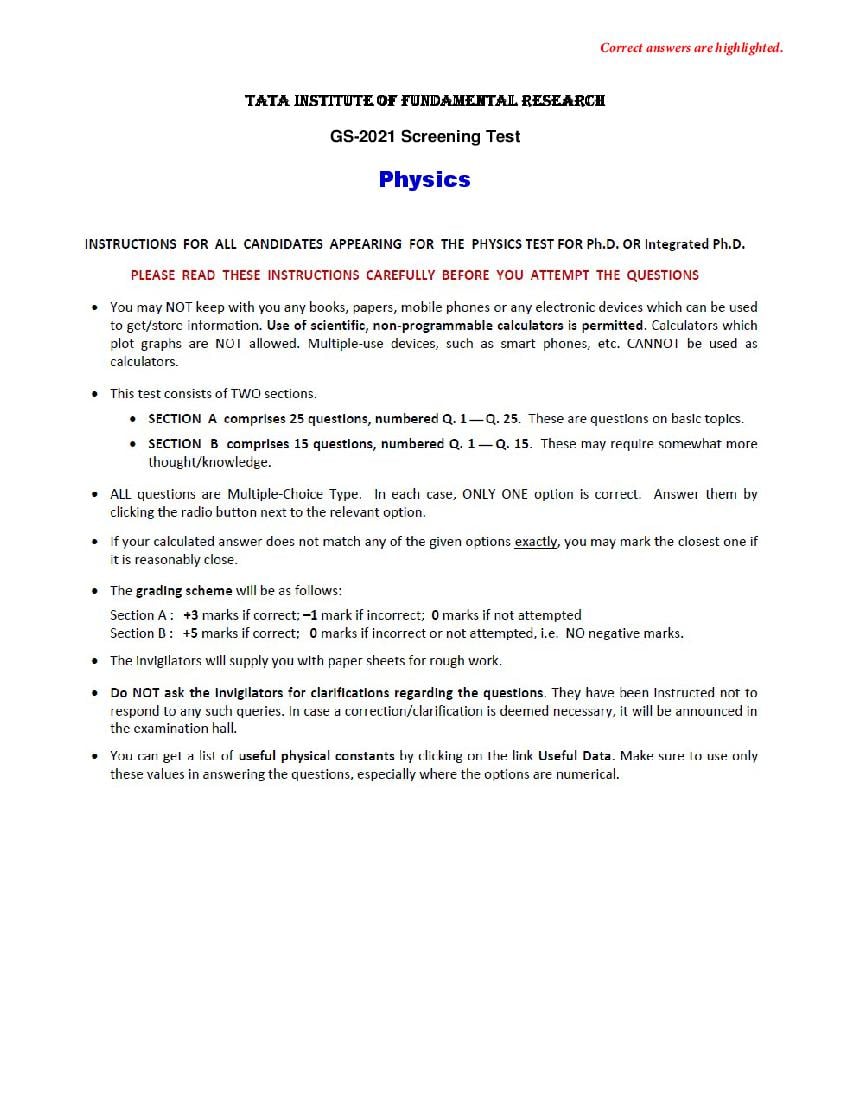
Page 1
0
TATA INSTITUTE OF FUNDAMENTAL RESEARCH
GS-2021 Screening Test
Physics
Page 2
unless otherwise instructed
Page 3
Section A
(for both Integrated M.Sc.--Ph.D. and Ph.D. candidates)
This Section consists of 25 questions. All are of multiple-choice type. Mark only one option on
the online interface provided to you. If more than one option is marked, it will be assumed
that the question has not been attempted. A correct answer will get +3 marks, an incorrect
answer will get ̶ 1 mark.
1. A 3-dimensional view of a polygon, whose faces are either squares or isosceles triangles,
is sketched below.
Which of the following 2-dimensional figures represents it after flattening?
(a) (c)
(b) (d)
Page 4
⁄
2. The integral
1
= exp − exp
⁄
evaluates to =
(a) 0.00215
(b) exp √2
(c) 1.762633
(d) − exp −1
Page 5
3. A unitary matrix is expressed in terms of a Hermitian matrix , such that
= ! "# /
If the matrix % is given by
1) 0 √2)
3 3
( ,
1)
= √3 '
'
0 0 +
+
' √3 +
√2) 0 − 1)3
3
& *
then will have the form
. ⁄√3 0 .√2⁄√3
- 0 . 0 /
.√2⁄√3 0 − . ⁄√3
(a)
√3 0 √6
- 0 3√3 0 /
√6 0 −√3
(b)
.√3 1⁄√3 √2⁄√3
- 1⁄√3 . 1 ⁄ √3 /
√2⁄√3 1⁄√3 .√3
(c)
3√3. √3 3⁄2
- √3 . 0 /
√2⁄√3 0 3√3.
(d)
Page 6
4. In a country, the fraction of population infected with Covid-19 is 0.2. It is also known
that out of the people who are infected with Covid-19, only a fraction 0.3 show
symptoms of the disease, while the rest do not show any symptoms.
If you randomly select a citizen of this country, the probability that this person will
NOT show symptoms of Covid-19 is
(a) 0.94
(b) 0.56
(c) 0.86
(d) 0.80
Page 7
5. In a futuristic scenario, an inter-planetary meeting is arranged on planet Pegasus XIV,
which is 10 light years away from the Earth. The team of representatives from Earth
would like to take a spaceship to Pegasus XIV that has a one-hour flight time
according to the watches of the passengers. The Team Leader from Earth would like
to leave from the Earth half-an-hour later, but taking a spaceship that has a half-an-
hour flight time according to the watches of the passengers. If the time taken for
acceleration may be neglected for both spaceships, which of the following statements
is correct ?
(a) The Team Leader would reach Pegasus XIV before the committee members.
(b) The Team Leader would reach Pegasus XIV at the same time as the committee
members.
(c) The Team Leader would reach Pegasus XIV after the committee members.
(d) The situation described in the problem is not possible by the laws of physics.
Page 8
6. A planet is moving around a star of mass 34 in a circular orbit of radius 5. The star
mass 3 (3 < 34 ). If the motion of the planet is still circular at that time, the radius
starts to lose its mass very slowly (adiabatically), and after some time, it reaches a
of its orbit will become
34
5
3
(a)
3
(b) 5
34
34 /
5
3
(c)
3
(d) 5
34
Page 9
7. A star moves in an orbit under the influence of massive but invisible object with the
effective one-dimensional potential
1 : :
7 8 = − + −
8 28 8
where : is the angular momentum of the star. There would be two possible circular
orbits of the star if
(a) : > 12
(b) : > 6
(c) : >3
(d) : > 9
Page 10
8. A particle of mass < moves in a plane 8, > under the influence of a force
<A
?@ = B 8̂ + D>EF
8
where = 8 cos > and D = 8 sin >, while A is a constant. The Lagrangian for this
system is
1 A
:= < 8L + 8 >L −
2 8
(a)
1 AD
(b) : = < L + DL −
2 8
1 8L A D
:= < M + 8>L − N
2 8 8
(c)
1 A
(d) : = < L + DL +
2 8
Page 11
the D-plane about the O axis. The O axis passes through the
9. Consider a diatomic molecule of oxygen which is rotating in
O
centre of the molecule and is perpendicular to its length. At
two oxygen atoms is 1.21 × 10Q 4 m (the atoms are treated
room temperature, the average separation between the
D
as point masses). The molar mass of oxygen is 16 gm/mol.
If the angular velocity of the molecule about the O axis is
2 × 10 rad/s, its rotational kinetic energy will be closest
to
(a) 3.89 × 10Q Joule
(b) 7.78 × 10Q Joule
(c) 15.56 × 10Q Joule
(d) 1.95 × 10Q Joule
Page 12
10. A hydrogen atom in its ground state collides with an electron of energy 13.377 eV,
absorbs most of the energy of the electron, and goes into an excited state. The
5UVWXY − R VWV[VXY
maximum possible fraction
S≡
5VWV[VXY
by which its radius 5 would increase will be
(a) S = 0.63
(b) S = 0.48
(c) S = 0.60
(d) S = 0.07
Page 13
simple quantum harmonic oscillator (each body having mass <) with the following
11. What are the energy eigenvalues for relative motion in one-dimension of a two-body
Hamiltonian?
\ \ 1
%= + + <] −
2< 2< 2
1
(a) √2 ^ + ℏ]
2
1
^+ ℏ]
2
(b)
1 1
^+ ℏ]
√2 2
(c)
3 1
` ^ + ℏ]
2 2
(d)
Page 14
12. An electron is confined to a two-dimensional square box with the following potential
0 for 0 < < : and < 0 < D < :, i
7= a
∞ otherwise
The probability distribution of the electron in one of its eigenstates is shown below
D
How many total different eigenstates of the electron have the same energy as this
state?
(a) 4
(b) 2
(c) 6
(d) 1
Page 15
A particle of mass <, confined in a one-dimensional box between = −: and
= :, is in its first excited quantum state. Now, a rectangular potential barrier of
13.
height 7 = 1 and extending from = −j to = j is suddenly switched on,
7
as shown in the figure below.
2
1
−: −j +j +:
average energy k〈m〉 of the system when plotted as a function of j/: ,
Which of the following curves most closely represents the resulting change in
immediately after the barrier is created ?
k〈m〉 k〈m〉
Energy
Energy
1.0
1.0
(a) (c) 0.8
0.8
0.6
0.6
0.4
0.4
j/: j/:
0.2
0.2
a
a
0.2 0.4 0.6 0.8 1.0 L
0.2 0.4 0.6 0.8 1.0 L
Energyk〈m〉 Energyk〈m〉
1.0
1.0
(b) (d) 0.8
0.8
0.6
0.6
0.4 0.4
j/: j/:
0.2 0.2
a a
0.2 0.4 0.6 0.8 1.0 L 0.0 0.2 0.4 0.6 0.8 1.0 L
Page 16
14. The pictures below are intended to denote a two-dimensional
dimensional lattice with
primitive vectors indicated by arrows and with the unit cell shaded. Which of the
following pictures is correct?
(a) (c)
(b) (d)
Page 17
A boiler of volume 1.7 m , when filled with 1.0 kg of steam at 100℃, has a pressure of
1.0 atm. What will be the boiling point of water in this boiler when the pressure is 2.0
15.
atm?
[The latent heat of vaporization of water is 2250 × 10 q/kg ; 1 atm = 10t N/m ]
(a) 128℃
(b) 118℃
(c) 78℃
(d) 88℃
Page 18
temperatures 2v and v are brought into thermal contact and allowed to reach
16. Which of the following is the entropy generated when two identical blocks at
equilibrium?
[Assume that the heat capacity of each block is w ]
(a) w 2 ln 3 − 3 ln 2
(b) zero
3
2w ln
2
(c)
(d) w 2 ln 2 − 3 ln 3
Page 19
17. In a Universe with only two spatial dimensions, the total energy radiated by a perfect
blackbody across all wavelengths per unit surface area per unit time is proportional
to
(a) v
(b) v
(c) v
(d) v /
Page 20
18. The lower half of a single slit of width is covered with a half-wave plate P as shown
in the figure below.
>
S
P
As a result, a beam of coherent monochromatic light of wave vector A = 2y⁄z
incident on the single slit, transmits with an amplitude
1 for 0 < ≤ ⁄2
v = {−1 for − ⁄2 < ≤ 0i
0 otherwise
and a Fraunhofer diffraction pattern is formed on a screen S placed parallel to the slit.
The intensity at a point on the screen at an angle > measured from the centre of the
slit (see figure), is proportional to
1 1
sin Φ where Φ = A sin >
Φ 2
(a)
1
sin Φ where Φ = A tan >
Φ
(b)
1
sin Φ where Φ = A cos >
Φ
(c)
1 1
cos Φ where Φ = A sin >
Φ 2
(d)
Page 21
19. A collimated coherent light beam of wavelength λ is incident normally on an assembly
placed at the position A with a small angle > with respect to the mirror surface as
of a mirror and a photographic plate as shown below. The photographic plate is
shown in the figure below. Assume that the photographic plate is almost transparent
to the incident light and has a negligible thickness. After sufficient exposure, the plate
is developed.
incident beam
photographic plate
A >
mirror
Which of the following statements is true for the above experimental setup?
~
•VW €
(a) The plate will show dark strips separated by distances
~
•VW €
with the first strip at a distance from the point of contact
~
•VW €
(b) The plate will show dark strips separated by distances
with the first strip at the point of contact.
~
•VW €
(c) The plate will show dark strips separated by distances
~
•VW €
with the first strip at a distance from the point of contact
~
•"‚ €
(d) The plate will show dark strips separated by distances
with the first strip at the point of contact.
Page 22
In an experiment that measures the resistivity ƒ of a substance it was observed that ƒ
varies with temperature v and a parameter ∆, as
20.
ƒ = ƒ4 ! ∆⁄…
where ƒ4 is a constant.
In one measurement, made at v = 100 K and ∆ = 50, the percentage error in ∆ is
found to be 2% while the percentage error in v was 3%. What was the approximate
percentage error for the resistivity ƒ ?
(a) 1.8 %
(b) 3.6 %
(c) 9%
(d) 18 %
Page 23
21. Consider 6 charges fixed at the vertices of a regular hexagon of side j, as shown in the
figure below.
D
+‰ 8
j
−‰ −‰
+‰ +‰
−‰
The behaviour of the electrostatic potential at distance 8 → ∞ in the D plane is
proportional to
(a) 1⁄8
(b) 1⁄8 t
(c) 1⁄8
(d) 1⁄8
Page 24
Consider an infinite uniform layer of point-like dipoles, placed in the D − O plane,
with a constant dipole strength \@ = \ Š per unit area, as shown in figure below.
22.
D
\@
O
Which graph best represents the variation of potential along the direction?
7 7
(a) (c)
7
(b) (d) 7
Page 25
23. An operational amplifier is configured as shown in the figure below. For an AC input
this circuit behaves effectively as
w
‹Œ
5 5
(a) a capacitor with a negative capacitance.
(b) an inductor with a negative inductance.
(c) a resistor with a negative resistance.
(d) an inductor with a positive inductance
Page 26
24. A three variable (A, B, C) truth table has a high output for the input conditions
000, 010, 100, and 110 and low otherwise. This effectively means the circuit
following this truth table is the equivalent of
Ž
(a) C
•
(b) A + A
(c) A+B
Ž A+B
(d) C
Page 27
25. In an archery contest, the aim is to shoot arrows at the center of a board. Three
archers, Amar, Akbar and Anthony each shot 5 arrows at the board. The locations of
their arrow hits are shown in the figures with red stars. Which of the following
statements are true?
Amar Akbar Anthony
(a) Akbar has more precision than Anthony
(b) Amar has more precision than Akbar
(c) Akbar has more accuracy than Anthony
(d) Amar has more accuracy than Anthony
Page 28
Section B
(only for Integrated M.Sc.-Ph.D. candidates)
This Section consists of 15 questions. All are of multiple-choice type. Mark only one option on
the online interface provided to you. If more than one option is marked, it will be assumed
that the question has not been attempted. A correct answer will get +5 marks, an incorrect
answer will get 0 mark.
26. A differentiable function S obeys
’
S D
D= S
D
4
If S 1 = 1. it follows that S 2 =
(a) 4
(b) 3/4
(c) 1
(d) 6
Page 29
27. If D satisfies the following differential equation
D
= cot D − cosec D cos
and we have
lim D =0
’→4
then D y/2 =
(a) − cos Q B2)y − 2F
(b) sinQ B2)yF
y)
(c) 2
(d) 0
Page 30
A body is dropped from rest at a height ℎ above the surface of the Earth at a latitude
z” in the northern hemisphere. If the angular velocity of rotation of the Earth is ],
28.
the lateral displacement of the body at its point of impact on the Earth's surface will
be
8ℎ ]
⁄
(a) M N cos z”
9•
8ℎ ]
⁄
(b) M N sin z”
9•
2ℎ ]
⁄
M N cos z”
9•
(c)
2ℎ ]
⁄
(d) M N sin z”
9•
Page 31
29. Three stars, each of mass 3, are rotating under gravity
vertices of an equilateral triangle of side : (see figure). :
around a fixed common axis such that they are always at the
:
The time period of rotation of this triple star system is :
2y: /
–3—” 3
(a)
2y: /
3–—” 3
(b)
y: /
–3—” 3
(c)
y: /
3–—” 3
(d)
Page 32
30. The wave function of a one-dimensional particle of mass < is shown below. The
average kinetic energy of the particle can be written as
™
− j+˜ −j 0 +j + j+˜
3ℏ
2<˜ 3j + ˜
(a)
(b) 0
ℏ
2<˜
(c)
ℏ
2<˜ j + ˜
(d)
Page 33
31. Suppose a system is in a normalised state |iΨœ such that
i|Ψœ = •B|ž4 œ + ! "€ |ž œF
simple harmonic oscillator of frequency ], and • > 0 is a real constant.
where |ž4 œ and |ž œ are the first two normalised eigenstates of a one-dimensional
If the expectation value of the position operator Š is given by
1 ℏ
ŸΨ| Š|Ψœ = `
2 <]
the value of > must be
(a) y/4
(b) y/2
(c) 3y/2
(d) y
Page 34
A very sensitive spring balance with spring constant A = 2 × 10 NmQ is
operating at a temperature of 300 K. The thermal fluctuations can lead to an error
32
in the measurement of mass. If you are trying to measure a mass of 1 mg, the
relative error in the measurement is closest to
(a) 0.9 %
(b) 10.0 %
(c) 20.0 %
(d) 0.01 %
Page 35
A pulsed laser beam has photon number density ^ in each pulse. The photon
number density ^′ inside each pulse, when measured from a frame moving in a
33.
direction perpendicular to the beam with velocity ¡ is given by
[Assume the usual notation ¢ = ¡⁄•, £ = 1 − ¢ Q /
]
^
£
(a)
(b) £ 1 − ¢ ^
(c) ^
¢^
£
(d)
Page 36
A spherical balloon of radius 5 is made of a material with surface tension £ and filled
with ¤ particles of an ideal gas. If the outside air pressure is ¥, the pressure ¥¦ inside
34.
the balloon is given by
(a) ¥¦ = ¥ + 2γ/5
(b) ¥¦ = ¥
(c) ¥¦ = ¥ − 2γ/5
(d) ¥¦ = ¥ + 3γ/5
Page 37
of conduction electrons is about ^ = 10 cmQ . At this temperature, the electron and
35. For a pure germanium semiconductor, cooled in liquid nitrogen, the average density
hole mobilities are equal and have the common value § = 5.0 × 10 cm V Q s Q .
If a potential of 100 V is applied across opposite faces of a cube of this cooled
germanium sample having side 1 cm, the current through the sample can be
estimated as
(a) 160 mA
(b) 16 mA
(c) 8 mA
(d) 80 mA
Page 38
• > ˜ > j (see figure) are charged with charges !© ,
36. Three concentric spherical metallic shells with radii
!¦ , and !ª respectively. The outermost shell (of radius
•) is at a potential 7©4 .
Now, the innermost shell (of radius j) is grounded,
and the potential of the outermost shell becomes 7© .
«
The difference 7© − 7©4 will be
«
1 j !ª !¦ !©
(a) − - + + ®
4y¬4 • j ˜ •
1 • !ª !¦ !©
(b) − - + + ®
4y¬4 j j ˜ •
1 • !ª !¦ !©
− - + + ®
4y¬4 j • ˜ j
(c)
1 j !© !¦
(d) − - + ®
4y¬4 • • − j ˜
Page 39
Two positive charges ‰ and ¯ are placed on opposite sides of a grounded sphere of
radius 5 at distances of 25 and 45 respectively, from the centre of the sphere, as
37.
shown in the diagram below.
The charge ¯ feels a force AWAY from the centre of the sphere if
25
<
‰̄ 144
(a)
25
<
‰̄ 16
(b)
25
<
‰̄ 36
(c)
49
<
‰̄ 144
(d)
Page 40
38. Consider the following circuit with an op-amp.
If the output voltage 74 is measured to be 74 = −7, then the value of the feedback
resistance 5° must be
65
(a) 5° =
^ ^ + 1 2^ + 1
35
(b) 5° =
^ ^ + 1 2^ + 1
(c) 5° = ^5
(d) 5° = 5/^
Page 41
39. In an amplifier circuit, an input sine wave of amplitude 5 V gives a sine wave of
amplitude 25 V as an output in an open load configuration. On applying a 20 kΩ
load resistance, the output drops to 10 V. This implies that the output resistance
of the amplifier must be
(a) 30 kΩ
(b) 20 kΩ
(c) 10 kΩ
(d) 2 kΩ
Page 42
40. In an experiment, a counting device is used to record the number of charged
particles passing through it. Once this counter records a charged particle, it does
not respond for a short interval of time, called the 'dead time' of that counter.
This device is used to count the charged particles emitted by a particular
radioactive source. It is found that if the source emits 20,000 counts/second at
random intervals, the counter records 19,000 particles per second on an average.
It follows that the counter dead time must be
(a) 2.63 microseconds
(b) 2.63 nanoseconds
(c) 50.0 milliseconds
(d) 2.63 seconds
Page 43
Section B
(only for Ph.D. candidates)
This Section consists of 15 questions. All are of multiple-choice type. Mark only one option on
the online interface provided to you. If more than one option is marked, it will be assumed
that the question has not been attempted. A correct answer will get +5 marks, an incorrect
answer will get 0 mark.
26. How many distinct values can the following function take at a given value of O ?
O −1
S O = ` O−. /
√O
(a) 12
(b) 3
(c) 4
(d) 24
Page 44
27. Given the following − D data table
1.0 2.0 3.0 4.0 5.0 6.0
D 0.602 0.984 1.315 1.615 1.894 2.157
which would be the best-fit curve, where j and ˜ are constant positive parameters?
(a) D=˜ ⁄ ±ª
(b) D = j − ˜
(c) D = j + ! ¦’
(d) D = j log 4 ˜
Page 45
28. A particle of mass <, moving in one dimension satisfies the Lagrangian
1
:= < L ! ²’
2
where A is a constant.
If % is the Hamiltonian of the system, the canonical equations of motion are
\ Q ²’
L= ! , \L = −2A%
<
(a)
\ ²’
L= ! , \L = −2%
<
(b)
\ Q ²’ 1
L= ! , \L = − A%
< 2
(c)
\ Q ²’
L= ! , \L = −2%
<
(d)
Page 46
29. A stick S of uniform density of mass 3, length :, and negligible width, is constrained
ring of inner radius 5, as shown below.
to move such that its two ends always stay on the inside of a fixed vertical, circular
25
S
>4
If the stick S is displaced by a small angle >4 from its equilibrium position and then
allowed to oscillate freely, the angular frequency ] of oscillations will be
[Ignore the friction between the stick and the ring. ]
6• :
/ /
M5 − N
65 − : 4
(a)
4• :
/ /
M5 − N
65 − : 4
(b)
6• :
/ /
M5 − N
35 − : 4
(c)
4• :
/ /
M5 − N
25 − : 4
(d)
Page 47
The Hamiltonian of a spin-½ particle in a magnetic field ³́@ is given by % = −§µ@ ⋅ ³́@,
where the components of the spin operator µ@ have eigenvalues ± ℏ⁄2 . The spin is
30.
pointing in the + Š direction, when a magnetic field ³́@ = ³DŠ is turned on. After a time
¸ = y⁄2§³ , the spin will be pointing along the direction
(a) +Ô
(b) −Ô
(c) −Š
(d) ¹ + Ô
Page 48
31. An electron moves in a hydrogen atom potential in a state |Ψ that has the wave
function
Ψ 8, >, ž = ¤ 5 8 º 2. » Q >, ž + 2 + . » 4 >, ž + 3. » >, ž ¼
where ¤ is a normalization constant, 5‚½ 8 is the radial wave function and the
»½¾ >, ž are spherical harmonics.
The expectation value of :E¿ , i.e. the O¹-component of the angular momentum operator
is
5
ℏ
18
(a)
4
ℏ
18
(b)
9
ℏ
18
(c)
13
ℏ
18
(d)
Page 49
32. Consider a one-dimensional simple harmonic oscillator with frequency ]4 in its ground
potential of the form 7 , ¸ = À cos ]¸, where À and ] are constants. If the absorption
state. An external wave passes through this system, creating a small time-dependent
rate of the wave is measured as a function of ], which of the following graphs is the likely
result of such a measurement?
(a) (c)
Absorption Rate
Absorption Rate
]/]4 ]/]4
(b) (d)
Absorption Rate
Absorption Rate
]/]4 ]/]4
Page 50
A certain system has one state with energy m, two states with energy 2m, three states
with energy 3m and so on, where m > 0. The partition function ‹ of the system at
33.
temperature v is given by
1 m
= 4 sinh
‹ 2v
(a)
1 m
= 2 cosh
‹ 4v
(b)
1 m
= 4 coth
‹ 2v
(c)
1 m
= 2 tanh
‹ 4v
(d)
Page 51
34. The temperature dependence of specific heat of two metals A and B, both with
quadratic dispersion relations are shown in the figure below.
wÁ /v
A
B
v
Which of the following statements is necessarily false?
(a) The density of states at Fermi energy of A is smaller than that of B.
(b) The effective mass of B is larger than that of A.
(c) The effective mass of A is smaller than that of B.
(d) The density of states at Fermi energy of B is smaller than that of A.
Page 52
35. The Cartesian components of the electric field ḿ@ = Âm" | . = 1,2,3Ã in a charge-free
region of space are
m" = w" + Ä 8Å ÆÅ"
Å
where w" and ÆÅ" ′s are constant. The matrix of constants ÆÅ" is
(a) symmetric and traceless
(b) symmetric but not traceless
(c) anti-symmetric and traceless
(d) anti-symmetric but not traceless
Page 53
An oscillating point dipole of moment \@ ¸ = Ô \4 cos ]¸ generates time-dependent
electric and magnetic fields. At distances 8 far away from the dipole, the vector
36.
potential due to this dipole, in SI units, is
§4 \4 ] 8
À@ = Ô sin ] -¸ − ®
4y8 •
The total power radiated from this dipole is
§4 \4 ]
12y•
(a)
§4 \4 ]
8y•
(b)
§4 \4 ]
16y •
(c)
§4 \4 ]
24y•
(d)
Page 54
37. A radioactive tritium atom in its ground state undergoes a beta decay
H → He± + ! Q
where the He nucleus is stable. The probability that this beta decay will be
followed immediately by emission of a photon is
(a) 0.3
(b) zero
(c) 0.7
(d) 0.5
Page 55
38. Consider the È-wave capture of a pion y Q by a deuteron in its ground state,
which then produces two neutrons, i.e.
yQ + →^+^
If we consider the two neutrons in the final state, they will satisfy
(a) : = 1, µ = 1
(b) : = 0, µ = 1
(c) : = 1, µ = 0
(d) : = 0, µ = 1
Page 56
39. A sealed box containing a digital circuit has a circuit diagram pasted on its lid as
shown below.
+5V
10 kΩ 10 kΩ
X1 Y
X3
S1 S2 X2
A
However, the output of the circuit is not as per this diagram. Some of the outputs
actually obtained were as shown below
Switch S1 is Switch S1 is
open closed
Switch S2 is Switch S2 is
closed closed
+5V +5V
Pin A 0V 0V
+5V +5V
Pin Y 0V
0V
Based on this we can conclude that the actual circuit inside has
(a) OR gates instead of AND gates (X1 and X2)
(b) NAND gate instead of NOR gate (X3)
(c) OR gate instead of NOR gate (X3)
(d) AND gate instead of NOR gate (X3)
Page 57
40. The following picture shows the cross-sectional view of an apparatus used to
detect O+ ions produced in an experiment. The entire apparatus is kept in
vacuum.
+100 V 0V −500 V
A
F D
5 mm
−500 V
P Q
10 mm 7 mm 55 mm 5 mm
F is a conducting cylinder with a small aperture at its entrance. The electric
potentials between various electrodes (except the detector D) are shown in the
figure. The O+ ions are generated in its ground state at point A with negligible
kinetic energy. The wire mesh on the electrode Q allows ions to pass through,
and also maintains a uniform electric field in the PQ region. The dimensions of
the spectrometer are shown in the figure.
The ions are detected by the detector D situated at the end of the flight tube. If
the detector can only detect ions with kinetic energy more than 550 eV, the
potential on the detector to detect the O+ ions must be
(a) more negative than −500 V
(b) more positive than 500 V
(c) zero, as the ions already have enough energy to be detected
(d) more positive than −500 V
Document Details
| Board / Org | Default |
| Exam | TIFR GS |
| Type | Question Paper |
| Pages | 57 |
| Updated | 09 Jun 2026 |