TIFR GS 2021 Question Paper Chemistry
Finished viewing? Save it for later —
Download TIFR GS 2021 Question Paper Chemistry (PDF · 19 pages)About TIFR GS 2021 Question Paper Chemistry
TIFR GS 2021 Question Paper Chemistry is available here for free download. Published by Default for TIFR GS, this question paper can be viewed online or downloaded as a PDF (19 pages). Candidates preparing for TIFR GS can use TIFR GS 2021 Question Paper Chemistry to understand the exam pattern, the type of questions asked, and the overall difficulty level.
Frequently Asked Questions
How can I download TIFR GS 2021 Question Paper Chemistry?
Open this page and click the Download button to save TIFR GS 2021 Question Paper Chemistry as a PDF. It is completely free on AglaSem Docs.
Is TIFR GS 2021 Question Paper Chemistry free to download?
Yes. TIFR GS 2021 Question Paper Chemistry can be viewed online and downloaded as a PDF free of cost on AglaSem Docs.
How many pages does TIFR GS 2021 Question Paper Chemistry have?
TIFR GS 2021 Question Paper Chemistry contains 19 pages, which you can read online or download together as a single PDF.
Where can I find more TIFR GS study material?
You can find more TIFR GS question papers, sample papers, syllabus, and answer keys on AglaSem Docs.
TIFR GS 2021 Question Paper Chemistry – Text
Read the full text of this question paper below — useful to quickly search, copy and reference the content online without downloading the PDF.
📄 View text version (19 pages)
Page 1
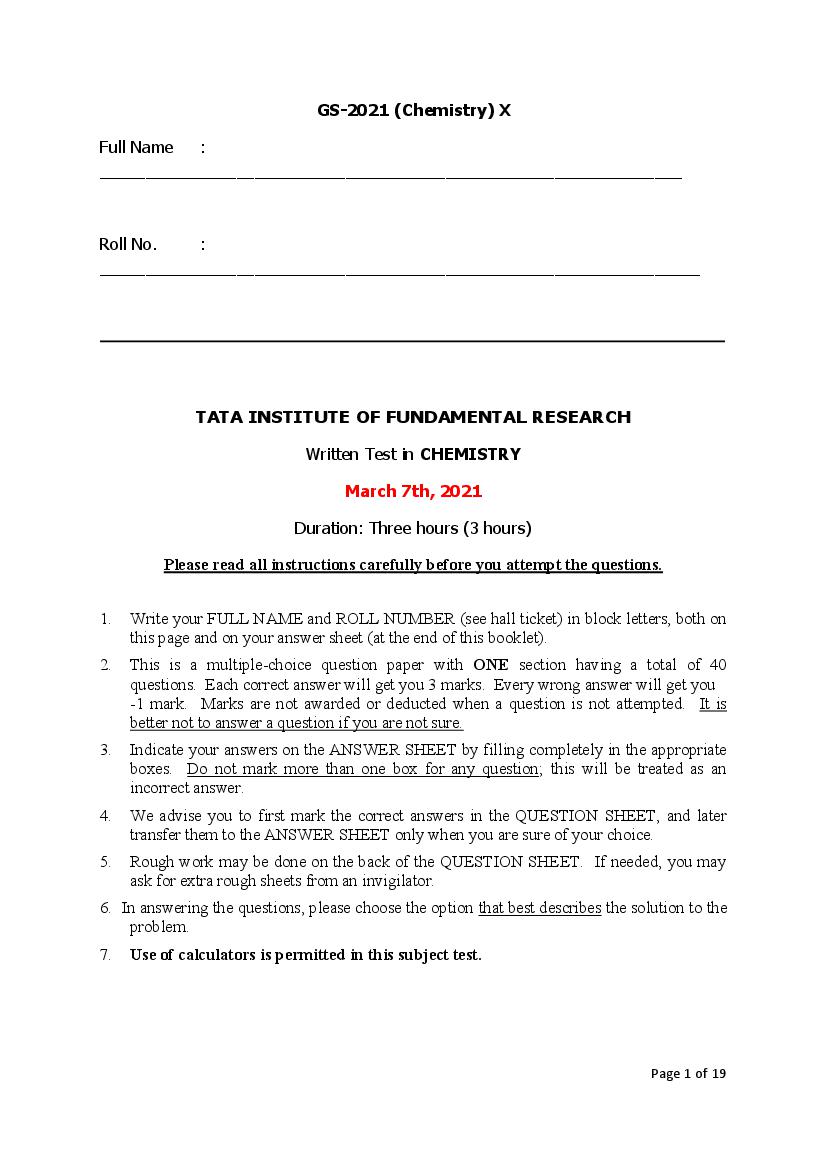
Full Name :
________________________________________________________________
Roll No. :
__________________________________________________________________
TATA INSTITUTE OF FUNDAMENTAL RESEARCH
Written Test in CHEMISTRY
March 7th, 2021
Duration: Three hours (3 hours)
Please read all instructions carefully before you attempt the questions.
1. Write your FULL NAME and ROLL NUMBER (see hall ticket) in block letters, both on
this page and on your answer sheet (at the end of this booklet).
2. This is a multiple-choice question paper with ONE section having a total of 40
questions. Each correct answer will get you 3 marks. Every wrong answer will get you
-1 mark. Marks are not awarded or deducted when a question is not attempted. It is
better not to answer a question if you are not sure.
3. Indicate your answers on the ANSWER SHEET by filling completely in the appropriate
boxes. Do not mark more than one box for any question; this will be treated as an
incorrect answer.
4. We advise you to first mark the correct answers in the QUESTION SHEET, and later
transfer them to the ANSWER SHEET only when you are sure of your choice.
5. Rough work may be done on the back of the QUESTION SHEET. If needed, you may
ask for extra rough sheets from an invigilator.
6. In answering the questions, please choose the option that best describes the solution to the
problem.
7. Use of calculators is permitted in this subject test.
Page 1 of 19
Page 2
Avogadro number = 6.021023 mol1 e = 1.61019 C
RT/F = 0.0257 V at 25C h = 6.6261034 J s
Faraday constant = 96500 C/mol c = 3108 m s1
Boltzmann constant kB = 1.381023 J K1 R = 8.314 J K1 mol1
Mass of an electron = 9.1091031 kg
1. What is the oxidation state of gold in below complex?
A) 0
B) 1
C) 2
D) 3
2. What is the correct C-H bond (shown in below molecules) dissociation energy,
A) C>B>A
B) A>B>C
C) A>C>B
D) C>A>B
Page 2 of 19
Page 3
A) Energy gap in semiconductor is proportional to the inverse of the square root of
the size
B) Energy gap in semiconductor is proportional to the inverse of the size
C) Energy gap in semiconductor is proportional to the square of size
D) Energy gap in semiconductor is proportional to the inverse of the square of size
4. A mixture of KCl and KClO3 weighing 1.8 gms was heated. After the reaction, the
dry oxygen gas generated occupied 140 ml at STP. What percent of original mixture
was KClO3?
A) 28.4%
B) 42.9%
C) 64.3%
D) 37.5%
5. A 1 mm thick transparent crystal of a metalloprotein absorbs 75% of the incident light
of wavelength 500 nm. What is the extinction coefficient? (Density of the crystal is
1.5 g/cc, Molecular weight of the protein is 100 KDa)
A) 400 M-1cm-1
B) 500 M-1cm-1
C) 920 M-1cm-1
D) None of the above
6. The lifetime () of an electronic state would be the following:
If only fluorescence occurred, = 5 ns.
If only thermal de-excitation occurred, = 10 ns.
If only intersystem crossing occurred, = 10 ns.
If only photobleaching occurred, = 5 ns.
If only quenching occurred, = 5 ns.
In reality, all of these happen together. What are the observed lifetime and the
Page 3 of 19
Page 4
A) 0.1 ns, 1
B) 1.5 ns, 0.25
C) 35 ns, 0.2
D) 1.25 ns, 0.25
7. For a particle in a 1-D box of length 2L the normalization constant A for its
wavefunction ( ) ( )( ) is given by:
A) √ (Key: the length is 2L so replace L with 2L in the standard answer C or
explicit normalization.)
B) √
C) √
D) √
8. The wavefunction of a particle is given by ( ) ( ( ) ) Relative
to an initial reference time of t=0, the probability of finding the particle at a later time
at the point
A) Increases
B) Decreases (Key: at t=0, the sine function has zeros at x= (where n=0,2,
4….) whereas at , the zeros are shifted to , thus at , the
probability is non-zero initially and zero at the latter time point.)
C) Stays the same
D) May increase or decrease depending on k
9. A folded protein in solution at temperature T has two different conformations A and B
with a free energy difference G=GB-GA < 0 and separated by a single transition state
Page 4 of 19
Page 5
the enthalpy of both state A and B by the same amount, but increases the entropy of
state B relative to state A. Additionally, the entropy of the transition state also
decreases. Which of the following statements is true for the equilibrium population
ratio PA/PB and the transition rates kAB and kBA after the mutation is introduced.
A) PA/PB . kA, and kB all increase
B) PA/PB decreases but kA and kB both increase.
C) PA/PB increases but kA and kB decrease
D) PA/PB . kA, and kB all decrease. (Key: B is entropically stabilized relative to A
increasing PB relative to A. Transition barriers should go up as both states are stabilized
relative to TS lowering the rates)
10. An instrument measures the position of two independent atoms with respect to origin
along a line as 20 3 Å and 40 4 Å. The distance between the two atoms on the line
is:
a.
b.
c. (distance . for independent variables error in d is given
by √( ) ( )
d.
11. Which amongst the following metal carbonyls has paramagnetic property.
(a) Ni(CO)4
(b) Fe(CO)4
(c) V(CO)6
(d) Cr(CO)6
Page 5 of 19
Page 6
following statements on the dipole moments of CH3Br and CH3F is true?
A) The dipole moment of CH3Br is greater than CH3F
B) The dipole moment of CH3F is greater than CH3Br
C) The dipole moments of CH3F and CH3Br are same
D) Both molecules have zero dipole moment
13. Indicate the stereo chemical relationship between the two molecules.
A) Enantiomers
B) Diastereomers
C) Identical and chiral
D) Identical and achiral
14. Predict the product of the following reaction [PCC = Pyridinium chlorochromate].
Page 6 of 19
Page 7
A) Light
B) Base
C) Heat
D) Acid
16. A magnetic moment μ placed in an external magnetic field H has the following
energies: Epar = - μH and Eanti = + μH, in configurations parallel and anti-parallel to
the external field, respectively. Which of the following statements are true for
magnitude of the average magnetic moment (|m|) and susceptibility (d|m|/dH)H=0 ?
Page 7 of 19
Page 8
(B) |m| = μ tanh(μH/kBT), susceptibility increases with increasing temperature
(C) Average magnetic moment = (1/2)exp(-μH/kBT), susceptibility = decreases with
increasing temperature
(D) Average magnetic moment = exp(-μH/kBT), susceptibility = decreases with
temperature
17. Consider the following chemical reactions in gas phase:
Reaction 1: H + D2 → HD + D
Reaction 2: D + H2 → HD + H
Which of the following statement is true?
(A) Reaction 1 is endothermic, Reaction 2 is endothermic
(B) Reaction 1 is endothermic, Reaction 2 is exothermic
(C) Both reactions are thermoneutral as they involve isotopes which differ by the
number of neutrons, which do not play any role in chemical reactions.
(D) Reaction 1 is exothermic, Reaction 2 is exothermic
18. Consider measurement of area of a rectangle with sides 10 cm and 5 cm. If the
uncertainty in the measurement in the length of the sides is 1 mm, what is the
resulting uncertainty in the area? (Assume errors are uncorrelated)
(A) 2 mm2
(B) 5 mm2
(C) 236 mm2
(D) 111 mm2
19. Rank the organic amines shown below in the order of increasing pKa values.
Page 8 of 19
Page 9
b. C < A < D < B
c. A < D < B < C
d. D < C < B < A
20. Viruses constitute of a protein coat encapsulating the genetic material. Methods for
detecting viruses rely upon extraction of the genetic material from the viral capsid
followed by polymerase chain reaction (PCR) amplification. Which of the following
methods can be used to extract the genetic material from viruses?
a. heat a sample containing the virus
b. treatment with guanidinium isothiocyanate
c. treatment with detergent
d. all of the above
Page 9 of 19
Page 10
(molecular weight < 100 g/mol) has the following properties: 1. White crystalline
volatile solid; 2. Reacts with aqueous ferric chloride to afford a violet, blue
organometallic complex.
What product will be obtained if X is reacted with carbon dioxide under basic conditions
under 100 atm pressure at 125 °C?
a.
b.
c.
d.
Page 10 of 19
Page 11
a.
b.
c.
d.
Page 11 of 19
Page 12
sinh(x) = (ex – e-x)/2 and cosh(x) = (ex + e-x)/2
Which of the plots below correctly represent the above functions:
A)
B)
C)
D)
Page 12 of 19
Page 13
Z = PV/RT = 1 + B(T)P/RT where B(T) is function of temperature
a) (𝛿H/𝛿P`)T = B(T) – T(dB/dT)
b) (𝛿H/𝛿P)T = T(dB/dT)
c) (𝛿H/𝛿P)T = 0
d) (𝛿H/𝛿P)T = T2(𝛿2B/ 𝛿T2)
25. Predict the product of the following reaction.
Page 13 of 19
Page 14
27. Predict the product of the following reaction.
Page 14 of 19
Page 15
29. The change of entropy ΔS` for an isothermal expansion from V`1 to V`2 for a gas that
obeys the equation of state P (V-b) = RT is given by
a) ΔS = Rln(V`2 - b/V`1 - b)
b) ΔS = Rln(V1/V2)
c) ΔS = 0
d) ΔS = Rlnb
30. During the electrolysis of aqueous KCl solution using inert electrodes, gaseous
hydrogen is evolved at one electrode and gaseous chlorine at the other electrode.
Which one of the following statements is correct?
(a) Hydrogen is forming at the anode due to water reduction (2H2O + 2e- = H2 + 2OH-)
(b) At the negative electrode, water oxidation is taking place (2 H2O = O2 + 4H+ + 4e-)
(c) The solution around the cathode becomes basic as the electrolysis proceeds
(d) At the negative electrode, electrons flow from the electrode to the external circuit
Page 15 of 19
Page 16
butene reaction is faster due to..
A) 2-butene is energetically higher than 1-butene
B) 1-butene is energetically higher than 2-butene
C) Nucleophilic attach of Cl– is hindered
D) Formation of more stable carbocation by 1-butene
32. Predict the major product of the following reaction.
33. A molecule has two isomers A and B. When pure A is prepared at the initial time,
there is an exponential decay of the isomer A and concomitant rise of the B-form. The
time constant for the decay is 100 minutes. After a long time we find 50% of A-form
and 50% of B-form. After the equilibrium is reached, we follow one molecule of the
B-form for one whole day. Which of the following will we likely observe?
A) The molecule remains in B-form
Page 16 of 19
Page 17
C) There is equal probability to find the molecule either in the A-form or in the B-form
D) There is inadequate data given in the problem to make any prediction
34. A 100 amino acid sequence of a protein contains only Phenylalanine, Valine, Leucine,
Isoleucine, Proline, Alanine and Tryptophan. Which of the following statements is do
you expect to be true?
A) The protein will be very soluble in aqueous buffer and will have reasonable
absorbance at 370 nm.
B) Relatively insoluble in aqueous buffer and absorb well at 370 nm
C) Very soluble in aqueous buffer and absorb well at 270 nm
D) Rather insoluble in aqueous buffer and absorb well at 270 nm
35. Suppose you want to produce the following laser pulse:
What range of light frequency will you need for constructing the pulse?
A) Single frequency at 1012 Hz
B) A range of frequencies from 0 to 1012 Hz
C) A range of frequencies from 0.5 to 1012 Hz
D) An infinite range of frequencies
Page 17 of 19
Page 18
k1 k2
A B C
k1 k2
An experimentalist wants to verify the above scheme, but can observe and measure
the concentration of only A or C. Is it possible that under certain conditions, the
measurements of [A] or [C] as function of time would lead the experimenter to
conclude that the kinetic scheme is as given below, and that the species B is absent?
kobs
A C
kobs
(A) No, that is not possible.
(B) Yes, if k1 >> k1 and k2 >> k2.
k k
(C) Yes, if 1 2 .
k 1 k 2
(D) Yes, if [B] attains a steady-state concentration during the experiment.
37. Predict the order of reactivity of the organometallic compounds MeTiCl3 towards the
following sets of ligands NMe3, PMe3, SMe2
a) PMe3>NMe3>SMe2
b) NMe3>SMe2>PMe3
c) NMe3>PMe3>SMe2
d) NMe2=PMe3>SMe2
38. An isomer of the complex Co(en)2(H2O)Cl2Br, on reaction with concentrated H2SO4
(dehydrating agent) suffers loss in weight and on reaction with AgNO3 solution gives
a white precipitate, which is soluble in NH3(aq). The correct formula of the complex
is:
(a) [CoCl2Br(en)(H2O)](en)
(b) [CoCl(en)2(H2O)]BrCl
(c) [CoBr(en)2(H2O)]Cl2
(d) [CoBrCl(en)2]Cl.H2O
Page 18 of 19
Page 19
hospitals that each randomly tested 5 people. What percentage of hospitals will find
no cases, and wrongly conclude the virus has disappeared?
a) 10%
b) 5%
c) 60%
d) 40%
40. What is the ratio of areas of outer circle and inner circle?
a) 4
b) 2
c) sqrt(2)
d) 2*sqrt(2)
Page 19 of 19
Document Details
| Board / Org | Default |
| Exam | TIFR GS |
| Type | Question Paper |
| Pages | 19 |
| Updated | 09 Jun 2026 |