Goa Board Class 11 Syllabus 2027 Biology
Finished viewing? Save it for later —
Download Goa Board Class 11 Syllabus 2027 Biology (PDF · 11 pages)About Goa Board Class 11 Syllabus 2027 Biology
Goa Board Class 11 Syllabus 2027 Biology is available here for free download. Published by Goa Board for Class 11, this syllabus can be viewed online or downloaded as a PDF (11 pages). Candidates preparing for Class 11 can use Goa Board Class 11 Syllabus 2027 Biology to understand the exam pattern, the type of questions asked, and the overall difficulty level.
Frequently Asked Questions
How can I download Goa Board Class 11 Syllabus 2027 Biology?
Open this page and click the Download button to save Goa Board Class 11 Syllabus 2027 Biology as a PDF. It is completely free on AglaSem Docs.
Is Goa Board Class 11 Syllabus 2027 Biology free to download?
Yes. Goa Board Class 11 Syllabus 2027 Biology can be viewed online and downloaded as a PDF free of cost on AglaSem Docs.
How many pages does Goa Board Class 11 Syllabus 2027 Biology have?
Goa Board Class 11 Syllabus 2027 Biology contains 11 pages, which you can read online or download together as a single PDF.
Where can I find more Class 11 study material?
You can find more Class 11 question papers, sample papers, syllabus, and answer keys on AglaSem Docs.
Goa Board Class 11 Syllabus 2027 Biology – Text
Read the full text of this syllabus below — useful to quickly search, copy and reference the content online without downloading the PDF.
📄 View text version (12 pages)
Page 1
Goa Board Class 11
Syllabus 2027 Biology
EXAM YEAR TYPE SUBJECT
Goa Class 11 2027 Syllabus Biology
Notes · Sample Papers · Previous Year Papers · Mock Tests
Page 2
m .co
c. o
e m
em l a s
s a g
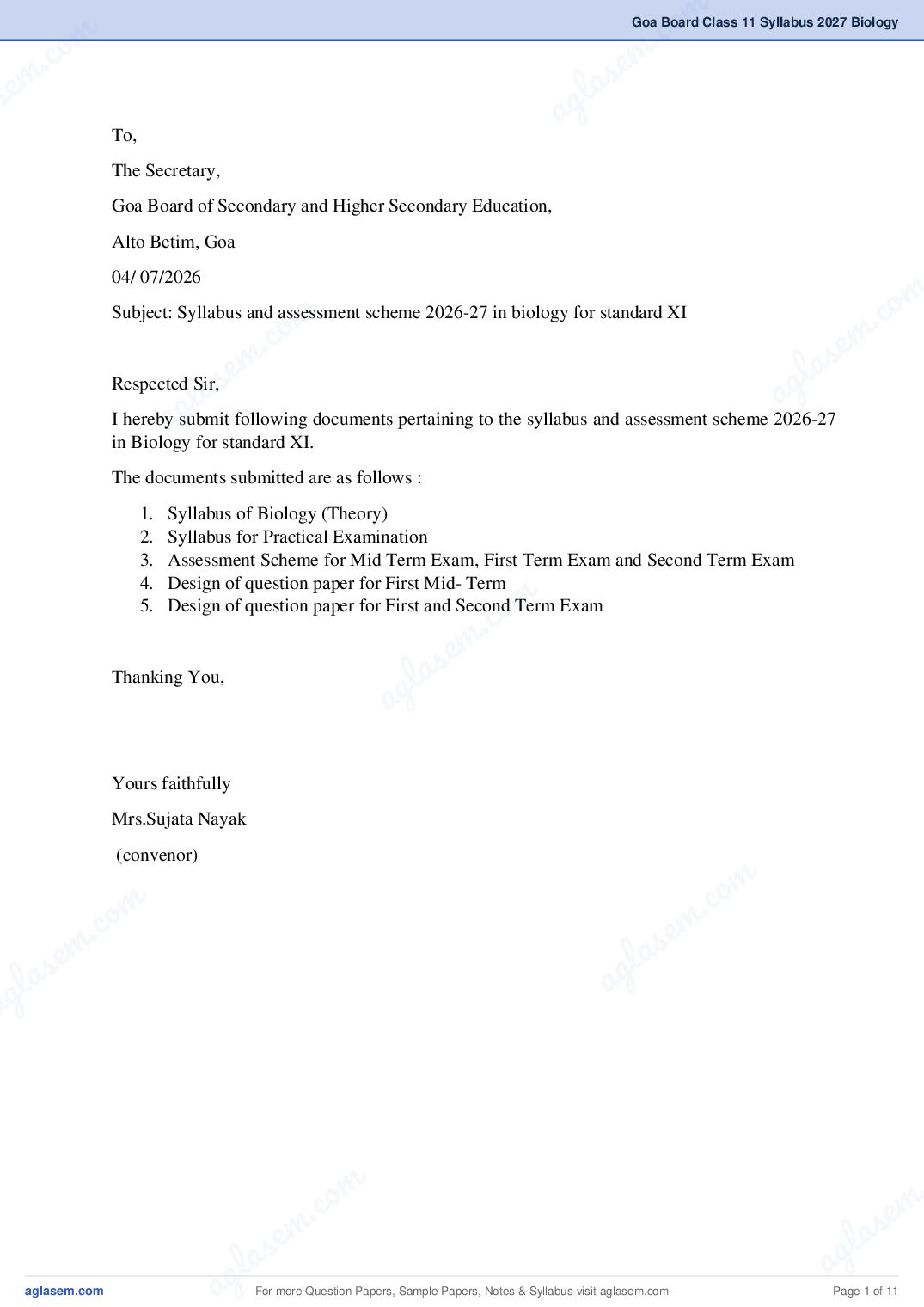
To,
The Secretary,
Goa Board of Secondary and Higher Secondary Education,
Alto Betim, Goa
m
c. o
04/ 07/2026
m
co m
Subject: Syllabus and assessment scheme 2026-27 in biology for standard XI
m . s e
a s e g la
l a
ag
Respected Sir,
I hereby submit following documents pertaining to the syllabus and assessment scheme 2026-27
in Biology for standard XI.
The documents submitted are as follows :
1. Syllabus of Biology (Theory)
2. Syllabus for Practical Examination
3. Assessment Scheme for Mid Term Exam, First Term Exam and Second Term Exam
m
co
4. Design of question paper for First Mid- Term
.
5. Design of question paper for First and Second Term Exam
s em
g l a
a
Thanking You,
Yours faithfully
Mrs.Sujata Nayak
m
(convenor)
m .co
c. o se
m
s em g la
gla a
a
m .
.co s e m
e m l a
l a s a g
ag For more Question Papers, Sample Papers, Notes & Syllabus visit Page 1 of 11
Page 3
XI SCI BIOLOGY SYLLABUS 2026 -2027 THEORY
_____________________________________________________________________________
UNIT TITLE
I DIVERSITY OF LIVING ORGANISMS
II STRUCTURAL ORGANIZATION IN PLANTS AND ANIMALS
III CELL: STRUCTURE AND FUNCTION
IV PLANT PHYSIOLOGY
V HUMAN PHYSIOLOGY
UNIT-I: DIVERSITY OF LIVING ORGANISMS
Chapter-1: The Living World
Biodiversity; Need for classification; three domains of life; taxonomy and systematics; concept of
species and taxonomical hierarchy; binomial nomenclature
Chapter-2: Biological Classification
Five kingdom classification; Salient features and classification of Monera, Protista and Fungi into
major groups; Lichens, Viruses and Viroid’s.
Chapter-3: Plant Kingdom
Classification of plants into major groups; Salient and distinguishing features and a few examples
of Algae, Bryophyta, Pteridophyta, Gymnospermae
(Topics excluded – Angiosperms, Plant Life Cycle and Alternation of Generations)
Chapter-4: Animal Kingdom
Salient features and classification of animals, non-chordates up to phyla level and chordates up to
class level (salient features and a few examples of each category).
(No live animals or specimen should be displayed.)
UNIT-II: STRUCTURAL ORGANIZATION IN PLANTS AND ANIMALS
Chapter-5: Morphology of Flowering Plants
Morphology of different parts of flowering plants: root, stem, leaf, inflorescence, flower, fruit and
seed. Description of family Solanaceae
Chapter-6: Anatomy of Flowering Plants
Anatomy and functions of tissue systems in dicots and monocots.
Chapter-7: Structural Organization in Animals
Animal Tissues
For more Question Papers, Sample Papers, Notes & Syllabus visit Page 2 of 11
Page 4
m .co
c. o
e m
em l a s
s a g
UNIT-III: CELL: STRUCTURE AND FUNCTION
Chapter-8: Cell-The Unit of Life
Cell theory and cell as the basic unit of life, structure of prokaryotic and eukaryotic cells; Plant
cell and animal cell; cell envelope; cell membrane, cell wall; cell organelles - structure and
function; endomembrane system, endoplasmic reticulum, golgi bodies, lysosomes, vacuoles,
m
c. o
mitochondria, ribosomes, plastids, microbodies; cytoskeleton, cilia, flagella, centrioles
m
(ultrastructure and function); nucleus.
.co s e m
m
Chapter-9: Biomolecules
a s e g la
l a
Chemical constituents of living cells: biomolecules, structure and function of proteins,
ag
carbohydrates, lipids, nucleic acids; Enzyme - types, properties, enzyme action.
(Topics excluded: Nature of Bond Linking Monomers in a Polymer, Dynamic State of Body
Constituents – Concept of Metabolism, Metabolic Basis of Living, The Living State)
Chapter-10: Cell Cycle and Cell Division
Cell cycle, mitosis, meiosis and their significance
o m
c
UNIT-IV: PLANT PHYSIOLOGY
Chapter-13: Photosynthesis in Higher Plants .
s em site of photosynthesis, pigments involved in
g la
Photosynthesis as a means of autotrophic nutrition;
a
photosynthesis (elementary idea); photochemical and biosynthetic phases of photosynthesis;
cyclic and non-cyclic photophosphorylation; chemiosmotic hypothesis; photorespiration; C3 and
C4 pathways; factors affecting photosynthesis.
Chapter-14: Respiration in Plants
Exchange of gases; cellular respiration - glycolysis, fermentation (anaerobic), TCA cycle and
electron transport system (aerobic); energy relations - number of ATP molecules generated;
amphibolic pathways; respiratory quotient.
o m
m germination; phases of plant growth and plant growth rate; conditions c
. of growth;
c. oSeed
Chapter-15: Plant - Growth and Development
m
e processes in a
em differentiation, l a s
s plant cell; growth regulators - auxin, gibberellin, cytokinin, ethylene,gABA
dedifferentiation and redifferentiation; sequence of developmental
l a a
ag
UNIT-V: HUMAN PHYSIOLOGY
Chapter-17: Breathing and Exchange of Gases
Respiratory organs in animals (recall only); Respiratory system in humans; mechanism of
breathing and its regulation in humans - exchange of gases, transport of gases and regulation of
respiration, respiratory volume; disorders related to respiration - asthma, emphysema,
m .
co m
occupational respiratory disorders.
m . s e
se g l a
l a a
ag For more Question Papers, Sample Papers, Notes & Syllabus visit Page 3 of 11
Page 5
Composition of blood, blood groups, coagulation of blood; composition of lymph and its function;
human circulatory system - Structure of human heart and blood vessels; cardiac cycle, cardiac
output, ECG; double circulation; regulation of cardiac activity; disorders of circulatory system -
hypertension, coronary artery disease, angina pectoris, heart failure.
Chapter-19: Excretory Products and their Elimination
Modes of excretion - ammonotelism, ureotelism, uricotelism; human excretory system – structure
and function; urine formation, osmoregulation; regulation of kidney function - renin - angiotensin,
atrial natriuretic factor, ADH and diabetes insipidus; role of other organs in excretion; disorders -
uremia, renal failure, renal calculi, nephritis; dialysis and artificial kidney, kidney transplant.
Chapter-20: Locomotion and Movement
Types of movement - ciliary, flagellar, muscular; skeletal muscle, contractile proteins and muscle
contraction; skeletal system and its functions; joints; disorders of muscular and skeletal systems -
myasthenia gravis, tetany, muscular dystrophy, arthritis, osteoporosis, gout.
Chapter-21: Neural Control and Coordination
Neuron and nerves; Nervous system in humans - central nervous system; peripheral nervous
system and visceral nervous system; generation and conduction of nerve impulse
Chapter-22: Chemical Coordination and Integration
Endocrine glands and hormones; human endocrine system - hypothalamus, pituitary, pineal,
thyroid, parathyroid, adrenal, pancreas, gonads; mechanism of hormone action (elementary idea);
role of hormones as messengers and regulators, hypo – and hyperactivity and related disorders;
dwarfism, acromegaly, cretinism, goiter, exophthalmic goiter, diabetes, Addison's disease.
Note: diseases related to all the human physiological systems to be taught in brief.
Ms. Sujata Nayak (Convenor)
For more Question Papers, Sample Papers, Notes & Syllabus visit Page 4 of 11
Page 6
m .co
c. o
e m
em l a s
s a g
GOA BOARD OF SECONDARY AND HIGHER SECONDARY EDUCATION
XI SCI BIOLOGY SYLLABUS 2026 -2027 FOR PRACTICAL EXAMINATION
_________________________________________________________________________
FIRST TERM (20 Marks)
Section A- Physiology Experiment (6 Marks)
m
c. o
1) To test presence of sugar, starch, proteins and fats in suitable plant and animal material.
o m m
c
2) To study action of salivary amylase on starch.
m . of Temporary stained Slides (4 Marks) s e
e Eg. Human cheek squamous epithelial cells la
Section B- Preparation
1) Animalscell- g
g a
l cells- Eg Onion epidermal cells a
aTo highlight similarities and differences.
2) Plant
Section C- Identification/ Spotting (6 Marks)
1) Biological classification: Identify, classify and comment/ Identify, classify and draw a neat
labelled diagram.
i) Kingdom Monera- Bacteria/ Cyanobacteria
m
ii) Kingdom Protista- Amoeba/ Paramoecium
co
iii) Kingdom Fungi-Mucor/ Rhizopus/ Agaricus
.
em
iv) Kingdom Plantae-
s
a) Algae- Spirogyra/ Ulothrix
b) Bryophyta- Funaria/ Riccia
g l a
a
c) Pteridophyta- Nephrolepis/ Selaginella
d) Gymnospermae- Cycas/ Thuja/ Pinus
e) Angiospermae – Monocot (Oryza/ Zea) and Dicot (Vinca/ Mangifera)
f) Lichens
Any other suitable example may be used
2) Study and describe one flowering plant belonging to family – Solanaceae (Eg. Chilli/ tomato/
Datura/ Petunia/ Angel’s Trumpet) with dissection and display of floral whorls, anther and ovary
m
co
to show number of chambers along with floral formula and floral diagram
3)m .
c. oi) Racemose (e.g., Caesalpinia ) se
m
Study of type of inflorescence:
s em ii) Cymose (e.g., Jasminum/Mogra). g l a
gla a
a Any locally available inflorescence may be used.
Journal work (2 Marks)
Viva (2 Marks)
SECOND TERM (20 Marks)
m .
.co e m
Section A- Physiology Experiment (6 Marks)
e m l as
l a s a g
ag For more Question Papers, Sample Papers, Notes & Syllabus visit Page 5 of 11
Page 7
2) Separation of plant pigments using paper chromatography.
Section B- Preparation of Temporary Stained Slides (4 Marks)
i) T.S. of Dicot Stem
ii) T.S. of Monocot Stem
iii) T.S of Dicot root.
iv) T.S of Monocot root
Section C- Identification/ Spotting (6 Marks)
1) Biological classification: Identify, classify and comment/ Identify, classify and draw a
neat labelled diagram.
Kingdom Animalia:
i) Phylum Porifera- Sycon/ Sponges
ii) Phylum Cnidaria- Hydra/ Aurelia
iii) Phylum Platyhelminthes- Fasciola/ Tenia
iv) Phylum Nemathelminthes- Ascaris
v) Phylum Annelida- Pheritema/ Leech
vi) Phylum Arthropoda- Periplanata/ Palaemon / Centipede/Spider
vii) Phylum Mollusca – Pila/ Sepia/ Unio
viii) Phylum Echinodermata- Asterias/ Ophiura
ix) Phylum Hemicordata- Balanoglossus
x) Phylum Chordata
a) Class Cyclostomata- Petromyzon
b) Class Chondricthyes- Scoliodon
c) Class Osteichthyes- Labeo
d) Class Amphibia- Rana
e) Class Reptilia- Calotes/ Hemidactylus/ Snake
f) Class Aves- Columba/ Crow
g) Class Mammalia- Oryctolagus/ Rat
ii)Study of the Animal tissues.
I) Epithelial tissue (any one).
II) Connective tissue (any one).
III) Muscular tissue (any one).
Journal work (2 Marks)
Viva (2 Marks)
Ms. Sujata Nayak (Convenor)
For more Question Papers, Sample Papers, Notes & Syllabus visit Page 6 of 11
Page 8
m .co
c. o
e m
m a s
se g l EDUCATION ALTO –
BETIM 403521 a
GOA BOARD OF SECONDARY AND HIGHER SECONDARY
TEST WISE PORTION IN BIOLOGY
ASSESSMENT SCHEME FOR THE ACADEMIC YEAR 2026-2027
STD: XI SCI
m
___________________________________________________________________________
m c. o
co
PORTION FOR MIDTERM EXAMINATION
. e m
m la s
Sr Units Marks
No.
s e g
l a 3 a
ag
DIVERSITY IN THE LIVING WORLD
1 Chapter 1: The Living World
2 Chapter 2: Biological Classification 4
3 Chapter 3: Plant Kingdom 4
STRUCTURAL ORGANISATION IN PLANTS AND ANIMALS
4 Chapter 5: Morphology of Flowering Plants 5
5 Chapter 6: Anatomy of Flowering Plants 4
Total 20
m
c. o
s emTERM EXAMINATION
la
PORTION FOR FIRST
Sr.
No.
Units
a g Marks
DIVERSITY IN THE LIVING WORLD
1 Chapter 1: The Living World 3
2 Chapter 2: Biological Classification 5
3 Chapter 3: Plant Kingdom 6
4 Chapter 4: Animal Kingdom 7
m8
c. o 6
STRUCTURAL ORGANISATION IN PLANTS AND ANIMALS
m
5 Chapter 5: Morphology of Flowering Plants
c. o se
m 6
6 Chapter 6: Anatomy of Flowering Plants
em la
7 Chapter 7: Structural Organisation in animals
las a g
g
STRUCTURE AND FUNCTIONS
a 8
9
Chapter 8: Cell the unit of life
Chapter 9: Biomolecules
7
6
10 Chapter 10: Cell cycle and cell division 6
Total 60
m .
.co s e m
e m l a
l a s a g
ag For more Question Papers, Sample Papers, Notes & Syllabus visit Page 7 of 11
Page 9
Sr. No. Units Marks
PLANT PHYSIOLOGY
1 Chapter 13: Photosynthesis in Higher Plants 8
2 Chapter 14: Respiration in Plants 8
3 Chapter 15: Plant Growth and Development 5
HUMAN PHYSIOLOGY
4 Chapter 17: Breathing and Exchange of Gases 6
5 Chapter 18: Body Fluids and Circulation 8
6 Chapter 19: Excretory Products and their Elimination 6
7 Chapter 20: Locomotion and Movement 5
8 Chapter 21: Neural Control and Coordination 6
9 Chapter 22: Chemical coordination and Integration 8
Total 60
Ms. Sujata Nayak (Convenor)
For more Question Papers, Sample Papers, Notes & Syllabus visit Page 8 of 11
Page 10
m .co
c. o
e m
em l a s
s a g
GOA BOARD OF SECONDARY AND HIGHER SECONDARY EDUCATION
ALTO – BETIM 403521
DESIGN OF THE QUESTION PAPER FOR MIDTERM (2026 – 2027)
CLASS: XI
m
c. o
TIME: 1Hr SUBJECT: BIOLOGY Max. Marks: 20
o m
The weightage of the. distribution of marks over different dimensions of the question paper shall em
c
__________________________________________________________________________
be as follows: em l a s
l a s a g
a g
1. Weightage to learning outcomes
Sr No Learning Outcomes Marks Percentage of Marks
1 Knowledge 6 30 %
2 Understanding 7 35 %
3 Application 5 25 %
4 Skill 2 10%
m
Total 20 100 %
2. Weightage to difficulty level of Questions .c
.
o
s em
Estimated Difficulty Level ofaQuestions
Sr No
g l Percentage
1
2
Easy
Average a 20 %
60 %
3 Difficulty 20 %
Total 100 %
All questions are compulsory.
m
Section A- 4 questions of 1 mark [ 2 MCQ type questions]
m .co
c. oSection C- 2 questions of 3 marks [1 internal choice]
Section B- 5 questions of 2 marks [ 1 internal choice]
m
em la se
las a g
Ms. Sujata Nayak (Convenor)
ag
m .
.co s e m
e m l a
l a s a g
ag For more Question Papers, Sample Papers, Notes & Syllabus visit Page 9 of 11
Page 11
EDUCATION, ALTO – BETIM 403521
DESIGN OF THE QUESTION PAPER FOR FIRST TERM AND SECOND TERM
(2026 – 2027)
CLASS: XI SCI
TIME: 2hrs 30 mins SUBJECT: BIOLOGY MAX. MARKS: 60
___________________________________________________________________________
The weightage of the distribution of marks over different dimensions of the question paper shall
be as follows:
1. Weightage to learning outcomes
Sr. No Learning Outcomes Marks Percentage of Marks
1 Knowledge 18 30%
2 Understanding 21 35%
3 Application 15 25 %
4 Skill 06 10 %
Total 60 100 %
2. Weightage to forms of questions:
Sr No Form of Questions Marks for each No. of Questions Total
Question Marks
1 Long Answer types (LA) 05 2 10
2 Short Answer Type (SA– I) 03 5 15
3 Short Answer Type (SA– II) 02 11 22
4 Very Short Answer Type 01 13 13
(VSA)
Total 31 60
3. Expected Time for different types of questions should be as follows
Sr. Forms of Questions Approx. Time for No. of Approx. Time for
No. each Question in Questions each form of
mins (t) (n) Questions in mins (n
x t)
1 Long Answer types (LA) 14min 02 2 x14min= 28
2 Short Answer Type(SA – I) 07 min 05 5 x 07min = 35
3 Short Answer Type (SA – II) 05 min 11 11 x 05min = 55
4 Very Short Answer Type 02 min 13 13 x 02min = 26
(VSA)
Total 31 144 mins
For more Question Papers, Sample Papers, Notes & Syllabus visit Page 10 of 11
Page 12
m .co
c. o
e m
m a s
se As the total time is calculated on the basis of the number of g l required to be answered
a be advisable for the candidates to
questions
and the length of their anticipated answers. It would, therefore
budget their time properly by cutting out the superfluous words and be within the expected time
limits.
Scheme of options
(There will be no overall choice. However, there is an internal choice in 01 sub question of 05
marks, 03 marks & 02 marks category)
m
m c. o
4. Weightage to difficulty level of Questions
.co s e m
m
Sr No Estimated Difficulty Level of Questions Percentage
s e g la
1 Easy 30 %
l a a
ag
2 Average 50 %
3 Difficulty 20 %
Total 100 %
Question paper will have four sections A, B, C, D.
a. Section A will have 13 questions of 01 mark. (7 MCQ questions)
b. Section B will have 11 questions of 02 marks. (1 internal choice)
m
c. o
c. Section C will have 05 questions of 03 marks. (1 internal choice)
em above.
d. Section D will have 02 questions of 05 marks. (1 internal choice)
la s
e. Question shall be from all the chapters specified
f. Total number of questions will be 31.g
a
Ms. Sujata Nayak (Convenor)
m
m .co
c. o se
m
s em g la
gla a
a
m .
.co s e m
e m l a
l a s a g
ag For more Question Papers, Sample Papers, Notes & Syllabus visit Page 11 of 11