Goa Board Class 11 Syllabus 2027 Physics
Finished viewing? Save it for later —
Download Goa Board Class 11 Syllabus 2027 Physics (PDF · 9 pages)About Goa Board Class 11 Syllabus 2027 Physics
Goa Board Class 11 Syllabus 2027 Physics is available here for free download. Published by Goa Board for Class 11, this syllabus can be viewed online or downloaded as a PDF (9 pages). Candidates preparing for Class 11 can use Goa Board Class 11 Syllabus 2027 Physics to understand the exam pattern, the type of questions asked, and the overall difficulty level.
Frequently Asked Questions
How can I download Goa Board Class 11 Syllabus 2027 Physics?
Open this page and click the Download button to save Goa Board Class 11 Syllabus 2027 Physics as a PDF. It is completely free on AglaSem Docs.
Is Goa Board Class 11 Syllabus 2027 Physics free to download?
Yes. Goa Board Class 11 Syllabus 2027 Physics can be viewed online and downloaded as a PDF free of cost on AglaSem Docs.
How many pages does Goa Board Class 11 Syllabus 2027 Physics have?
Goa Board Class 11 Syllabus 2027 Physics contains 9 pages, which you can read online or download together as a single PDF.
Where can I find more Class 11 study material?
You can find more Class 11 question papers, sample papers, syllabus, and answer keys on AglaSem Docs.
Goa Board Class 11 Syllabus 2027 Physics – Text
Read the full text of this syllabus below — useful to quickly search, copy and reference the content online without downloading the PDF.
📄 View text version (10 pages)
Page 1
Goa Board Class 11
Syllabus 2027 Physics
EXAM YEAR TYPE SUBJECT
Goa Class 11 2027 Syllabus Physics
Notes · Sample Papers · Previous Year Papers · Mock Tests
Page 2
om .co
. c e m
m as
se l
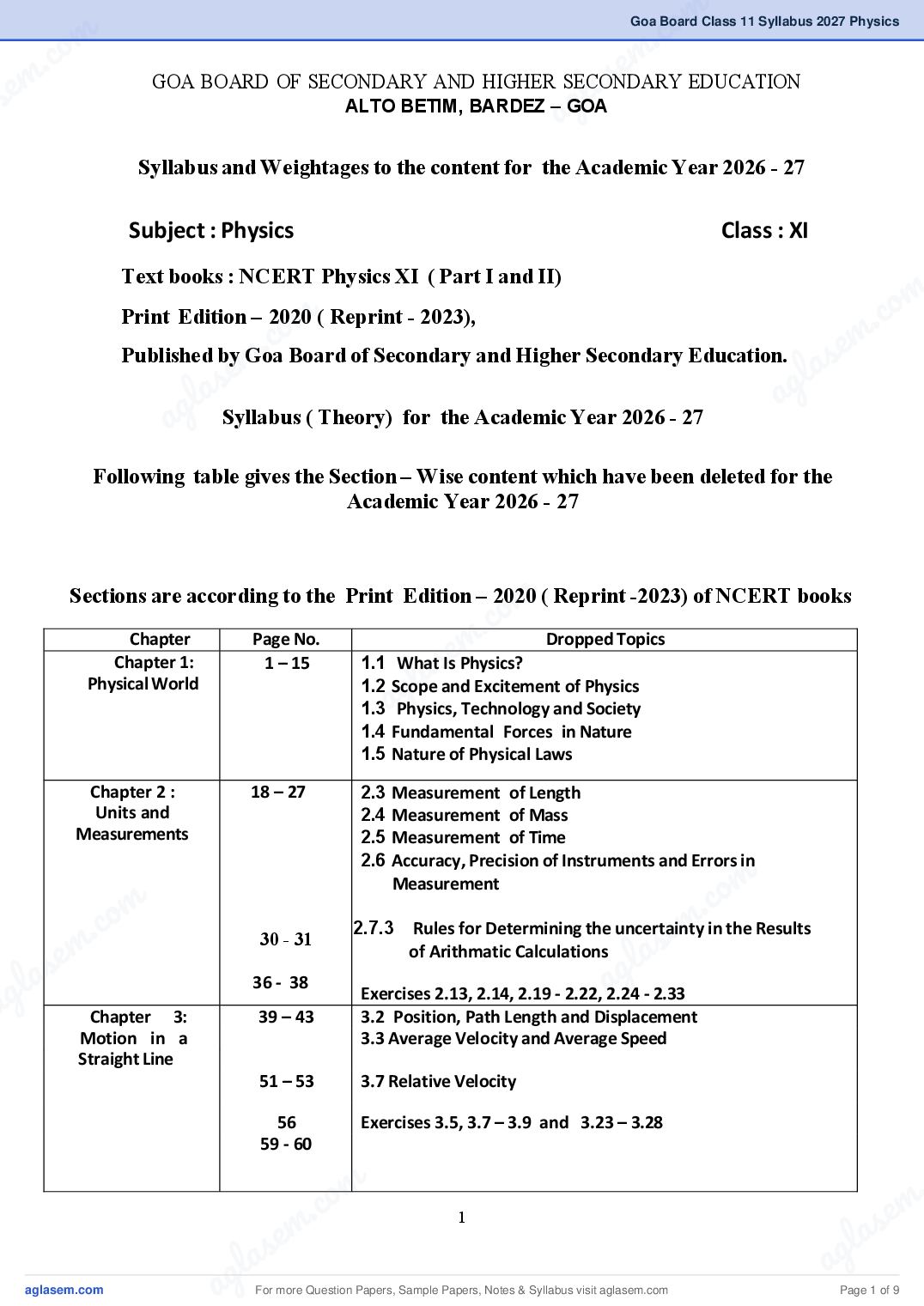
GOA BOARD OF SECONDARY AND HIGHER SECONDARY EDUCATION
ag
ALTO BETIM, BARDEZ – GOA
Syllabus and Weightages to the content for the Academic Year 2026 - 27
Subject : Physics Class : XI
Text books : NCERT Physics XI ( Part I and II)
m
m
Print Edition – 2020 ( Reprint - 2023),
o .co
Published by m . Board of Secondary and Higher Secondary Education. sem
c
s e Goa
g l a
g la Syllabus ( Theory) for the Academic Year 2026 - 27 a
a
Following table gives the Section – Wise content which have been deleted for the
Academic Year 2026 - 27
m
Sections are according to the Print Edition – 2020 ( Reprint -2023) of NCERT books
m .co
Chapter Page No.
s e Dropped Topics
la
Chapter 1: 1 – 15 1.1 What Is Physics?
Physical World
ag
1.2 Scope and Excitement of Physics
1.3 Physics, Technology and Society
1.4 Fundamental Forces in Nature
1.5 Nature of Physical Laws
Chapter 2 : 18 – 27 2.3 Measurement of Length
Units and 2.4 Measurement of Mass
Measurements 2.5 Measurement of Time
2.6 Accuracy, Precision of Instruments and Errors in
m
.co
Measurement
m
.co 2.7.3
s em
Rules for Determining the uncertainty in the Results
em la
30 - 31
s
of Arithmatic Calculations
la Exercises 2.13, 2.14, 2.19 - 2.22, a
g
ag Chapter 3:
36 - 38
39 – 43
2.24 - 2.33
3.2 Position, Path Length and Displacement
Motion in a 3.3 Average Velocity and Average Speed
Straight Line
51 – 53 3.7 Relative Velocity
56 Exercises 3.5, 3.7 – 3.9 and 3.23 – 3.28
59 - 60
m .
.co s e m
em a
1
s l
l a ag
ag For more Question Papers, Sample Papers, Notes & Syllabus visit Page 1 of 9
Page 3
Motion in a Plane
86 - 89 Exercises 4.12 – 4.14 ; 4.26 – 4.32
Chapter 5: Laws of 111 - 113 Exercises 5.24 – 5.40
Motion
Chapter 6: Work, 126 – 128 6.10 Various Forms of Energy : the Law of Conservation
Energy and Power of Energy
137 - 139 Exercises 6.24 – 6.29
Chapter 7: System 164 – 167 7.10 Theorems of Perpendicular and Parallel Axes
of Particles and
Rotational Motion 173 – 175 7.14 Rolling Motion
178 - 182 Exercises 7.10, 7.18 – 7.19, 7.21 – 7.33
Chapter 8: Gravitation 196 - 198 8.11 Geostationary and Polar Satellites
8.12 Weightlessness
201 - 202 Exercises 8.3 – 8.5, 8.22 – 8.25
Chapter 9: 234 9.2 Elastic Behaviour of Solids
Mechanical
Properties of 239 9.6.2 Determination of Young’s Modulus of the
Solids material of a Wire.
247 Exercises 9.17 – 9.21
Chapter 10: 258 10.4.2 Venturi-meter
Mechanical
Properties of 259 10.4.3 Blood Flow and Heart Attack
Fluids
267 10.6.6 Detergents and Surface Tension
272 – 273 Exercises 10.21 – 10.31
Chapter 11: 293 – 294 11.9.5 Greenhouse Effect
Thermal
Properties of 300 Exercises 11.21 – 11.22
Matter
Chapter 12: 311 – 312 12.9 Heat Engines
Thermodynamics 12.10 Refrigerators and Heat Pumps
320 Exercises 12.7 and 12.10
Chapter 13: 333 13.6.5 Specific Heat Capacity of Water
Kinetic Theory
338 Exercises 13.11 – 13.14
2
For more Question Papers, Sample Papers, Notes & Syllabus visit Page 2 of 9
Page 4
om .co
m . c Chapter 14:
s
14.9 Damped Simple Harmonic Motion em
se Oscillations 353 – 357
g la
a
14.10 Forced Oscillations and Resonance
363 – 364 Exercises 14.16, 14.20 – 14.25
Chapter 15: 382 – 385 15.8 Doppler Effect
Waves
391 - 392 Exercises 15.20 – 15.27
m
Topic – Wise Weightage m .co
.co s e m
em a
Theory Component
las a gl
g
Sr. Chapter Marks Allotted for
No. a Mid Term First Term Second Term Supplementary
Examination
(20) (60) (60) (70)
1 Physical World ---- ---- ---- -----
2 Units and Measurements 05 04 ---- -----
3 Motion in a Straight line 07 05 ---- -----
m
.co
4 Motion in a Plane 08 06 ---- -----
5 Laws of Motion ----
s em10 ---- -----
---- gl
a 11
a
6 Work, Energy and Power ---- -----
7 System of particles and ---- 12 ---- -----
Rotational Motion
8 Gravitation ---- 12 ---- ------
9 Mechanical Properties of ---- --- 04 05
m
Solids
10
o m
Mechanical Properties of --- 10
c. o 12
11 .c
Fluids
e m
e12m
Thermal properties of matter ---- --- 08
l as 10
las Thermodynamics ---- ---- 08g
a 08
ag 13 Kinetic Theory ---- ---- 07 09
14 Oscillations ---- ---- 12 13
15 Waves ---- ---- 11 13
Total 20 60 60 70
m .
.co s e m
em a
3
s l
l a ag
ag For more Question Papers, Sample Papers, Notes & Syllabus visit Page 3 of 9
Page 5
Mid - Term
Time : 1 Hour Max. Marks: 20
1. Weightage to learning outcomes :
Sr. No. Learning Outcomes Marks Percentage of Marks
1 Knowledge 05 25 %
2 Understanding 10 50 %
3 Application 05 25 %
Total 20 100%
2. Weightage to forms of question :
Sr. Forms of Questions Marks for Number of Total Marks
No. each question questions
1 MCQ’s 01 02 02
2 Very Short Answer Type 01 02 02
(VSA)
3 Short Answer Type 02 05 10
(SAI)
4 Short Answer Type 03 02 06
(SAII)
Total 11 20
3. Weightage to difficulty level of questions :
Sr. No. Estimated difficulty level of Marks Percentage of Marks
questions
1 Easy 06 30 %
2 Average 10 50 %
3 Difficult 04 20 %
Total 20 100%
4. Scheme of Option :
There will be no overall choice. However an internal choice of 3 marks will
be provided to question number 11.
4
For more Question Papers, Sample Papers, Notes & Syllabus visit Page 4 of 9
Page 6
om .co
. c DESIGN OF QUESTION PAPERsem
m la
se ag
For First and Second Terminal Examination
Time : 2 and ½ Hour Max. Marks: 60
1. Weightage to learning outcomes :
Sr. No. Learning Outcomes Marks Percentage of Marks
1 Knowledge 15 25 %
2 Understanding 30 50 %
m
3
m
Application 15 25 %
.co
Total
.co 60 100%
s e m
s em l a
g la to forms of question : ag
a
2. Weightage
Sr. No. Forms of Questions Marks for each Number of Total Marks
question questions
1 MCQ’s 01 07 07
2 Very Short Answer Type 01 06 06
(VSA)
3 Short Answer Type 02 10 20
m
.co
(SAI)
4 Short Answer Type 03 05 15
(SAII)
s em04
5 Long Answer Type
g la 03 12
( LA )
Total a 31 60
3. Weightage to difficulty level of questions :
Sr. No. Estimated difficulty level of questions Marks Percentage of Marks
1 Easy 18 30 %
m
.co
2 Average 30 50 %
m
.co m
3 Difficult 12 20 %
s e
emScheme of Option :
Total 60 100%
s4.
g l a
g la a
a There will be no overall choice. However internal choice for two 4 marks
questions and one 3 mark question will be provided .
m .
.co s e m
em a
5
s l
l a ag
ag For more Question Papers, Sample Papers, Notes & Syllabus visit Page 5 of 9
Page 7
For Supplementary Examination
Time : 3 Hours Max. Marks: 70
1. Weightage to learning outcomes :
Sr. No. Learning Outcomes Marks Percentage of Marks
1 Knowledge 15 25 %
2 Understanding 30 50 %
3 Application 15 25 %
Total 60 100%
2. Weightage to forms of question :
Sr. No. Forms of Questions Marks for each Number of Total Marks
question questions
1 MCQ’s 01 08 08
2 Very Short Answer Type 01 08 08
(VSA)
3 Short Answer Type 02 10 20
(SAI)
4 Short Answer Type 03 06 18
(SAII)
5 Long Answer Type 04 04 16
( LA )
Total 35 70
3. Weightage to difficulty level of questions :
Sr. No. Estimated difficulty level of questions Marks Percentage of Marks
1 Easy 18 30 %
2 Average 30 50 %
3 Difficult 12 20 %
Total 60 100%
4. Scheme of Option :
There will be no overall choice. However internal choice for two 4 marks
questions and one 3 mark question will be provided .
Total Theory Component : 140 marks
Mid – Term : 20 marks + First Term : 60 marks + Second Term : 60 marks
6
For more Question Papers, Sample Papers, Notes & Syllabus visit Page 6 of 9
Page 8
om .co
. c e m
m as
se PRACTICALS
ag l
For the academic year 2026 -2027:
1. Students to perform at least 12 experiments ( 6 each from Section A and Section B)
2. 8 Activities
3. Project
m
.co
Distribution of Marks:
o m m
. c s e
st
e m
1 Term Practical Examination : 20 marks
l a
nd
l as Examination : 20 marks
2 Term Practical
ag
Project ag : 20 marks
Total Practical Component : 60 marks
EVALUATION SCHEME
For First and Second Term Practical Examination
m
.co
em
Time 2 hours Max. Marks: 20
s
la = 10 marks
One experiment
Record of 4 activities
g
a = 04 marks
Practical record ( Journal) = 03 marks
Viva on experiments and activities = 03 marks
Total = 20 marks
m
m
Break – Up of 10 marks
c.i) oExperimental arrangement m .co
s e
em a = 03 marks
s g l
g la ii) Tabulation of the measurements and correctness of measurements
a = 04 marks
a iii) Calculations and Graph = 02 marks
iv) Results with units = 01 marks
m .
.co s e m
em a
7
s l
l a ag
ag For more Question Papers, Sample Papers, Notes & Syllabus visit Page 7 of 9
Page 9
Experiments
1. To measure diameter of a small spherical/cylindrical body and to measure internal diameter and depth of a
given beaker/calorimeter using Vernier Callipers and hence find its volume.
2. To measure diameter of a given wire and thickness of a given sheet using screw gauge.
3. To determine volume of an irregular lamina using screw gauge.
4. To determine radius of curvature of a given spherical surface by a spherometer.
5. To determine the mass of two different objects using a beam balance.
6. To find the weight of a given body using parallelogram law of vectors.
7. Using a simple pendulum, plot its L-T2 graph and use it to find the effective length of second's pendulum.
8. To study variation of time period of a simple pendulum of a given length by taking bobs of same size but
different masses and interpret the result.
9. To study the relationship between force of limiting friction and normal reaction and to find the co-
efficient of friction between a block and a horizontal surface.
10. To find the downward force, along an inclined plane, acting on a roller due to gravitational pull of the
earth and study its relationship with the angle of inclination θ by plotting graph between force and Sinθ.
SECTION–B
Experiments
1. To determine Young's modulus of elasticity of the material of a given wire.
2. To find the force constant of a helical spring by plotting a graph between load and extension.
3. To study the variation in volume with pressure for a sample of air at constant temperature by plotting
graphs between P and V, and between P and 1/V.
4. To determine the surface tension of water by capillary rise method.
5. To determine the coefficient of viscosity of a given viscous liquid by measuring terminal velocity of a
given spherical body.
6. To study the relationship between the temperature of a hot body and time by plotting a cooling curve.
7. To determine specific heat capacity of a given solid by method of mixtures.
8. To study the relation between frequency and length of a given wire under constant tension using
sonometer.
9. To study the relation between the length of a given wire and tension for constant frequency using
sonometer.
10. To find the speed of sound in air at room temperature using a resonance tube by two resonance positions.
8
For more Question Papers, Sample Papers, Notes & Syllabus visit Page 8 of 9
Page 10
om .co
. cActivities e m
m as
se List of Activities ag l
1. To make a paper scale of given least count, e.g., 0.2cm, 0.5 cm.
2. To determine mass of a given body using a metre scale by principle of moments.
3. To plot a graph for a given set of data, with proper choice of scales and error bars.
4. To measure the force of limiting friction for rolling of a roller on a horizontal plane.
5. To study the variation in range of a projectile with angle of projection.
m
.co
6. To study the conservation of energy of a ball rolling down on an inclined plane (using a double inclined
m
.co
plane).
e m
s
7. To study dissipation of energy of a simple pendulum by plotting a graph between square of amplitude and
e m l a
s
time.
l a
8. To observe change of state and plot a cooling curve for molten wax.
g ag
a
9. To observe and explain the effect of heating on a bi-metallic strip.
10. To note the change in level of liquid in a container on heating and interpret the observations.
11. To study the effect of detergent on surface tension of water by observing capillary rise.
12. To study the factors affecting the rate of loss of heat of a liquid.
13. To study the effect of load on depression of a suitably clamped metre scale loaded at (i) its end (ii) in the
middle.
14. To observe the decrease in pressure with increase in velocity of a fluid.
m
Project
.co
s em
la
* The project will be allotted in groups of 2-5 students.
* Allotment of the project to be done a
g
before the commencement of mid – term
examination. ( Students will get sufficient time to do the research work and plan the
project)
* The project will be evaluated in the second term.
m
.co
* Each group will submit one report and the marks will be allotted to each student
o m m
. c s e
e m
according to the following criteria :
l a
as
l 1. Report ag
ag : 05 marks
2. Presentation ( oral / PPT) : 05 marks
3. Team work : 05 marks
4. Viva : 05 marks
Total : 20 marks
m .
.co s e m
em a
9
s l
l a ag
ag For more Question Papers, Sample Papers, Notes & Syllabus visit Page 9 of 9