Tamil Nadu 12th Std Model Question Paper 2026 Botany
Finished viewing? Save it for later —
Download Tamil Nadu 12th Std Model Question Paper 2026 Botany (PDF · 8 pages)About Tamil Nadu 12th Std Model Question Paper 2026 Botany
Tamil Nadu 12th Std Model Question Paper 2026 Botany is available here for free download. Published by Tamil Nadu Board for Class 12, this sample paper can be viewed online or downloaded as a PDF (8 pages). Candidates preparing for Class 12 can use Tamil Nadu 12th Std Model Question Paper 2026 Botany to understand the exam pattern, the type of questions asked, and the overall difficulty level.
Frequently Asked Questions
How can I download Tamil Nadu 12th Std Model Question Paper 2026 Botany?
Open this page and click the Download button to save Tamil Nadu 12th Std Model Question Paper 2026 Botany as a PDF. It is completely free on AglaSem Docs.
Is Tamil Nadu 12th Std Model Question Paper 2026 Botany free to download?
Yes. Tamil Nadu 12th Std Model Question Paper 2026 Botany can be viewed online and downloaded as a PDF free of cost on AglaSem Docs.
How many pages does Tamil Nadu 12th Std Model Question Paper 2026 Botany have?
Tamil Nadu 12th Std Model Question Paper 2026 Botany contains 8 pages, which you can read online or download together as a single PDF.
Where can I find more Class 12 study material?
You can find more Class 12 question papers, sample papers, syllabus, and answer keys on AglaSem Docs.
Tamil Nadu 12th Std Model Question Paper 2026 Botany – Text
Read the full text of this sample paper below — useful to quickly search, copy and reference the content online without downloading the PDF.
📄 View text version (8 pages)
Page 1
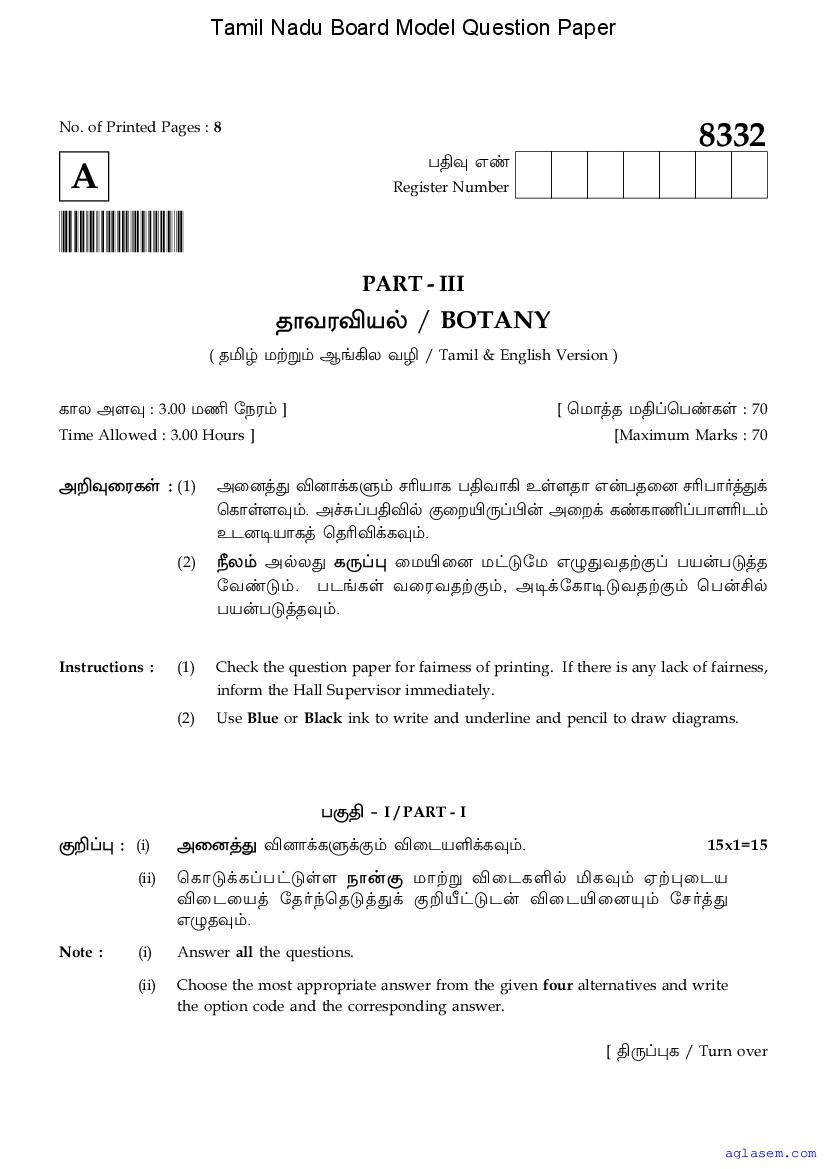
No. of Printed Pages : 8
8332
£vÄ Gs
A Register Number
!8332Botany!
PART - III
uõÁµÂ¯À / BOTANY
( uªÌ ©ØÖ® B[Q» ÁÈ / Tamil & English Version )
Põ» AÍÄ : 3.00 ©o ÷|µ® ] [ ö©õzu ©v¨ö£sPÒ : 70
Time Allowed : 3.00 Hours ] [Maximum Marks : 70
AÔÄøµPÒ : (1) AøÚzx ÂÚõUPЮ \›¯õP £vÁõQ EÒÍuõ GߣuøÚ \›£õºzxU
öPõÒÍÄ®. Aa_¨£vÂÀ SøÓ°¸¨¤ß AøÓU PsPõo¨£õÍ›h®
EhÚi¯õPz öu›ÂUPÄ®.
(2) }»® AÀ»x P¸¨¦ ø©°øÚ ©mk÷© GÊxÁuØS¨ £¯ß£kzu
÷Ásk®. £h[PÒ ÁøµÁuØS®, AiU÷PõikÁuØS® ö£ß]À
£¯ß£kzuÄ®.
Instructions : (1) Check the question paper for fairness of printing. If there is any lack of fairness,
inform the Hall Supervisor immediately.
(2) Use Blue or Black ink to write and underline and pencil to draw diagrams.
£Sv & I / PART - I
SÔ¨¦ : (i) AøÚzx ÂÚõUPÐUS® Âøh¯ÎUPÄ®. 15x1=15
(ii) öPõkUP¨£mkÒÍ |õßS ©õØÖ ÂøhPÎÀ ªPÄ® Hئøh¯
Âøhø¯z ÷uº¢öukzxU SÔ±mkhß Âøh°øÚ²® ÷\ºzx
GÊuÄ®.
Note : (i) Answer all the questions.
(ii) Choose the most appropriate answer from the given four alternatives and write
the option code and the corresponding answer.
[ v¸¨¦P / Turn over
Page 2
1. öÁΰ¼¸¢x CÓUS©v ö\´¯¨£k® CµP[PÒ ©ØÖ® uõÁµ[Pøͨ ¦v¯
`ǾUS¨ £ÇUP¨£kzxÁx :
(A) ÷uº¢öukzuÀ (B) |P»õUP®
(C) AÔ•P¨£kzxuÀ (D) P»¨¤Ú Û¯®
Importing better varieties and plants from outside and acclimatising them to local environment
is called :
(a) Selection (b) Cloning
(c) Introduction (d) Heterosis
2. ‘X’ GÝ® uõÁµ® ]Ô¯ ©»º, SßÔ¯ §ÂuÌ, _ÇÀ Cøn¨¦øh¯ ©Pµ¢u¨ø£
öPõskÒÍx. C®©»›ß ©Pµ¢ua ÷\ºUøPUS \õzv¯©õÚ •PÁº Gx ?
(A) £mhõ®§a] (B) }º (C) ÁskPÒ (D) PõØÖ
A plant called ‘X’ possesses small flower with reduced perianth and versatile anther. The
probable agent for pollination would be :
(a) butterfly (b) water (c) beetles (d) air
3. Ti ¤Íõìªm G¢u £õUj›¯zvÀ Põn¨£kQÓx ?
(A) Bºz÷µõ£õUhº ¿mi¯ì
(B) D ÷Põø»
(C) ÷£]À»ì Aø©÷»õ¼U³÷£]¯ßì
(D) AU÷µõ£õUj›¯® i²ª÷£]¯ßì
The bacteria, which possess Ti plasmid is :
(a) Arthrobacter luteus
(b) E. coli
(c) Bacillus amyloliquefaciens
(d) Agrobacterium tumifaciens
4. hõö©›ßhì CsiPõÂß ¤Ó¨¤h® :
(A) öuß Aö©›UPõ, QŸì (B) B¨¤›UP öÁ¨£©sh»¨ £Sv
(C) C¢v¯õ ©mk® (D) öußÛ¢v¯õ, ÿ »[Põ
Tamarindus indica is indigenous to :
(a) South America, Greece (b) Tropical African region
(c) India alone (d) South India, Sri Lanka
A
Page 3
5. ]» uøhUPmk (öµìm›U\ß) ö|õvPÎÚõÀ DNA &Âß ¤ßÁ¸® G¢u J¸
•ß¤ß Jzu (£õ¼¯õsm÷µõ®) öuõhºÁ›ø\°ß ø©¯zvÀ GÎuõP
xsiUQÓx ?
(A) 5’ GAATTC 3’ 3’ CTTAAG 5’ (B) 5’ CGTTCG 3’ 3’ ATCGTA 5’
(C) 5’ CACGTA 3’ 3’ CTCAGT 5’ (D) 5’ GATATG 3’ 3’ CTACTA 5’
Which one of the following palindromic base sequence in DNA can be easily cut at about the
middle by some particular restriction enzymes ?
(a) 5’ GAATTC 3’ 3’ CTTAAG 5’ (b) 5’ CGTTCG 3’ 3’ ATCGTA 5’
(c) 5’ CACGTA 3’ 3’ CTCAGT 5’ (d) 5’ GATATG 3’ 3’ CTACTA 5’
6. ¦v¯ E»Q¼¸¢x E¸ÁõÚx®, ÁͺUP¨£mhx©õÚ J÷µ uõÛ¯® :
(A) i›miUP® i³µ® (B) Jøµ\õ \møhÁõ
(C) â¯õ ÷©´ì (D) i›miUP® HìiÁ®
The only cereal that has originated and domesticated from the New World.
(a) Triticum duram (b) Oryza sativa
(c) Zea mays (d) Triticum aestivum
7. øÁµì AØÓ uõÁµ[PÒ __________ &À C¸¢x E¸ÁõUP¨£kQßÓÚ.
(A) ¦÷µõm÷hõ¤Íõ\ Áͺ¨¦ (B) EÖ¨¦ Áͺ¨¦
(C) ö\À ªuøÁ Áͺ¨¦ (D) BUSzv_ Áͺ¨¦
Virus free plants are developed from :
(a) Protoplast culture (b) Organ culture
(c) Cell Suspension culture (d) Meristem culture
8. ""÷P«mPÒ G¨ö£õÊx® P»¨¦°ºPÍõP C¸¨£vÀø»'' GÝ® TØÖ GuÝhß
öuõhº¦øh¯x ?
(A) uÛzx¨ ¤›uÀ Âv (B) K[S Âv
(C) Cø¯¤»õU P¸ÄÖuÀ Âv (D) \õº¤ßÔ Jx[SuÀ Âv
“Gametes are never hybrid”. This statement is associated with the :
(a) Law of segregation (b) Law of dominance
(c) Law of random fertilization (d) Law of independent assortment
9. uõÁµ[PÎß JÎa÷\ºUøPUS ©mk÷© £¯ß£kzu¨£k® `›¯ JÎ AÍÄ :
(A) 3 - 10% (B) 2 - 8% (C) 2 - 9% (D) 2 - 10%
Solar energy used by green plants for photosynthesis is only :
(a) 3 - 10% (b) 2 - 8% (c) 2 - 9% (d) 2 - 10%
A [ v¸¨¦P / Turn over
Page 4
10. RÌPsh G¢u ©soß }º uõÁµ[PÐUS¨ £¯ß£kQÓx ?
(A) ~s¦øÇ }º (B) ¦Â±º¨¦ }º
(C) Dµ¨£u }º (D) ÷Áv°¯À ¤øn¨¦ }º
Which one of the following soil water is available for plants ?
(a) Capillary Water (b) Gravitational Water
(c) Hygroscopic Water (d) Chemically bound Water
11. £mi¯À - I I £mi¯À - II Ehß ö£õ¸zxP.
£mi¯À - I £mi¯À - II
(1) C¸©i¯zxhß J¸ Cøn (i) ÷©õ÷Úõ÷\õª
S÷µõ÷©õ÷\õ®PÒ AvP©õP Põn¨£kÁx
(2) C¸©i¯zxhß J¸ S÷µõ÷©õ÷\õ® (ii) öhmµõ÷\õª
AvP©õP Põn¨£kÁx
(3) C¸©i¯zvÀ J¸ S÷µõ÷©õ÷\õ® (iii) møµ÷\õª
SøÓÁõP Põn¨£kÁx
(4) C¸©i¯zv¼¸¢x Cµsk uÛzuÛ (iv) Cµmøh ÷©õ÷Úõ÷\õª
S÷µõ÷©õ÷\õ® SøÓÁõP Põn¨£kÁx
(A) (1)-(ii), (2)-(iii), (3)-(i), (4)-(iv)
(B) (1)-(i), (2)-(iii), (3)-(ii), (4)-(iv)
(C) (1)-(iii), (2)-(ii), (3)-(i), (4)-(iv)
(D) (1)-(ii), (2)-(iii), (3)-(iv), (4)-(i)
Match List - I with List - II :
List - I List - II
(1) A pair of chromosomes extra with diploid (i) monosomy
(2) One chromosome extra to the diploid (ii) tetrasomy
(3) One chromosome loses from diploid (iii) trisomy
(4) Two individual chromosomes loses from diploid (iv) double monosomy
(a) (1)-(ii), (2)-(iii), (3)-(i), (4)-(iv)
(b) (1)-(i), (2)-(iii), (3)-(ii), (4)-(iv)
(c) (1)-(iii), (2)-(ii), (3)-(i), (4)-(iv)
(d) (1)-(ii), (2)-(iii), (3)-(iv), (4)-(i)
A
Page 5
12. \›¯õP ö£õ¸¢v¯ Cønø¯z ÷uºÄ ö\´P.
(A) ©mh{»zusk & ª³\õ
(B) QÇ[S & AÀ¼¯® ^¨£õ
(C) ÷ÁºÂk® Kkusk & âßâLö£º
(D) uøµURÌ E¢xusk & ¤ìi¯õ
Identify the correctly matched pair :
(a) Rhizome - Musa
(b) Tuber - Allium cepa
(c) Stolon - Zingiber
(d) Sucker - Pistia
13. öuõhUP SÔ¯ß Gߣx :
(A) AUG (B) UUU (C) UAG (D) UGA
Initiation codon is :
(a) AUG (b) UUU (c) UAG (d) UGA
14. öuß Aö©›UPõ¼¸¢x C¢v¯õÂÀ AÔ•P¨£kzu¨£mh BUQµª¨¦
]ØÔÚ® :
(A) £õºzwÛ¯® (B) ö»shõÚõ
(C) P¨£õLø£Pì (D) ¦÷µõ\õ¨¤ì
The invasive species introduced in India from South America :
(a) Parthenium (b) Lantana
(c) Kappaphycus (d) Prosopis
15. ¤ßÁ¸ÁÚÁØÖÒ Gx £ÀTmk £õµ®£›¯zvØS Euõµn©õS® ?
(A) ÷uõmh¨ £mhõo°ß ÂøuUPÛ°ß ÁiÁ®
(B) ªµõ¤¼ì á»õ£õ ©»›ß {Ó®
(C) ©ÛuºPÎß ÷uõÀ {Ó®
(D) Bs ÷uÜ EØ£zv
Which one of the following is an example of polygenic inheritance ?
(a) Pod shape in Garden Pea
(b) Flower colour in Mirabilis jalapa
(c) Skin colour in humans
(d) Production of male honey bee
A [ v¸¨¦P / Turn over
Page 6
£Sv & II / PART - II
SÔ¨¦ : GøÁ÷¯Ý® BÖ ÂÚõUPÐUS ©mk® Âøh¯ÎUPÄ®. ÂÚõ Gs 24 &US
Pmhõ¯©õP Âøh¯ÎUPÄ®. 6x2=12
Note : Answer any six questions. Question No. 24 is Compulsory.
16. ö£õ´ uõÛ¯® GßÓõÀ GßÚ ? GkzxUPõmk u¸P.
What is pseudo cereal ? Give an example.
17. ""•x©µ¦ «m]'' – Áøµ¯ÖUPÄ®.
Define - “Atavism”.
18. TATA ÷£øÇ GßÓõÀ GßÚ ?
What is TATA Box ?
19. P¸ÄÖ £ØÔ }º AÔÁx ¯õx ?
What do you mean by embryoids ?
20. Âøu¨ £¢vøÚ GÆÁõÖ u¯õ›¨£õ´ ?
How will you prepare seed ball ?
21. EnÄa \[Q¼ GßÓõÀ GßÚ ?
What is food chain ?
22. K÷\õß xøÍ GßÓõÀ GßÚ ?
What is Ozone hole ?
23. ""÷£õß\õ´'' – Áøµ¯ÖUPÄ®.
Define ‘Bonsai’.
24. P¸¨ø£°ß £h® Áøµ¢x £õP® SÔUPÄ®.
Draw and label the structure of embryo sac.
£Sv & III / PART - III
SÔ¨¦ : GøÁ÷¯Ý® BÖ ÂÚõUPÐUS ©mk® Âøh¯ÎUPÄ®. ÂÚõ Gs 33 &US
Pmhõ¯©õP Âøh¯ÎUPÄ®. 6x3=18
Note : Answer any six questions. Question No. 33 is Compulsory.
25. JmkuÀ ©ØÖ® £v¯ªhÀ ÷ÁÖ£kzxP.
Differentiate grafting and layering.
26. öuõhºa]¯õÚ ÷ÁÖ£õkPøÍ öuõhºa]¯ØÓ ÷ÁÖ£õkPÐhß ÷ÁÖ£kzxP.
Differentiate continuous variation with discontinuous variation.
A
Page 7
27. ¤øn¨¦ ©ØÖ® SÖU÷PØÓzvØS Cøh÷¯¯õÚ ÷ÁÖ£õkPøÍ GÊxP.
Write the differences between linkage and Crossing over.
28. E°› öuõÈÀ~m£Â¯¼ß £¯ß£õkPÒ H÷uÝ® ‰ßÔøÚ GÊxP.
Mention any three applications of Bio-technology.
29. ö\À ªuøÁ Áͺ¨¦ {ø»°À EÒÍ £À÷ÁÖ £i{ø»PøÍ GÊxP.
Write the various steps involved in cell suspension culture.
30. AÀ¤÷hõ ÂøÍÄ GßÓõÀ GßÚ ? Auß ÂøÍÄPøÍ GÊxP.
What is Albedo effect ? Write its effects.
31. B̪S ©sh»zvÀ EØ£zvvÓß SøÓÁõP C¸US®. Hß ?
Productivity of profundal zone will be low. Why ?
32. Põº£ß PÁµ¨£kuÀ ©ØÖ® ÷\P›zuÀ (CCS) GßÓõÀ GßÚ ?
What is Carbon Capture and Storage (CCS) ?
33. £_ø© CÀ» Áõ²UPÎß \õº¦ £[PΨ¦ £hzvøÚ ÁøµP.
Draw the chart of Relative Contribution of green house gases.
£Sv & IV / PART - IV
SÔ¨¦ : AøÚzx ÂÚõUPÐUS® Âøh¯ÎUPÄ®. 5x5=25
Note : Answer all the questions.
34. (A) •vº¢u ©Pµ¢u¨ø£°ß SÖUS öÁmkz ÷uõØÓzøu £h® Áøµ¢x £õP®
SÔUPÄ®.
AÀ»x
(B) ö£õxÁõP ©ÛuÛß ö\¯À£õkPÒ `ÇÀ ©sh»zvØS GvµõP÷Á EÒÍx.
J¸ ©õnÁÚõP } `ÇÀ©sh» £õxPõ¨¤ØS GÆÁõÖ EuÄÁõ´ ?
(a) Draw and label the structure of T.S. of mature anther.
OR
(b) Generally human activities are against the ecosystem. As a student how will you
help to protect ecosystem.
A [ v¸¨¦P / Turn over
Page 8
35. (A) •Êø©¯ØÓ K[Sz ußø©ø¯ J¸ GkzxUPõmkhß ÂÁ›UPÄ®.
AÀ»x
(B) Cµshõ® {ø» Áͺa]øu ©õØÓ ö£õ¸mPÎß uõÁµ ‰»[PøͲ® Auß
£¯ßPøͲ® AmhÁøn¨£kzxP.
(a) Explain Incomplete Dominance with an example.
OR
(b) Tabulate Secondary metabolites and its plant resources with uses.
36. (A) J¸£õÀ ©»ºz uõÁµ[PÎÀ £õÀ {ºn¯® GÆÁõÖ wº©õÛUP¨£kQÓx ?
AvÀ £[S ö£Ö® ©µ£qUPøÍ GÊxP.
AÀ»x
(B) ©µ£q ©õØÓ¨£mh EnÂß (GMF) |ßø©PÒ ©ØÖ® A£õ¯[PÒ ¯õøÁ ?
(a) How sex is determined in monoecious plants ? Write their genes involved in it.
OR
(b) Write the benefits and risks of Genetically Modified Foods.
37. (A) ÷ÁÍõsPõk Áͺ¨¤ß |ßø©Pøͨ £mi¯¼kP.
AÀ»x
(B) }º £ØÓõUSøÓ wºøÁ B÷»õ]zx Auß |ßø©PøÍ ÂÍUPÄ®.
(a) List out the benefits of agro forestry.
OR
(b) Suggest a solution to water crisis and explain its advantages.
38. (A) P»¨¦Özu •øÓ°ß £À÷ÁÖ ÁøPPøÍ ÂÍUSP.
AÀ»x
(B) Eß Ãmkz ÷uõmhzvØPõÚ C¯ØøP §a]UöPõÀ¼ø¯, Ãmi¾ÒÍ
Põ´PÔPøͨ £¯ß£kzv GÆÁõÖ u¯õ›¨£õ´ ?
(a) What are the different types of hybridization ? Explain.
OR
(b) How will you prepare an organic pesticide for your home garden with the vegetables
available from your kitchen ?
-oOo-
A
Document Details
| Board / Org | Tamil Nadu Board |
| Exam | Class 12 |
| Type | Sample Paper |
| Pages | 8 |
| Updated | 24 Sep 2026 |