GATE 2025 Syllabus for Textile Engineering & Fibre Science
Finished viewing? Save it for later —
Download GATE 2025 Syllabus for Textile Engineering & Fibre Science (PDF · 4 pages)About GATE 2025 Syllabus for Textile Engineering & Fibre Science
GATE 2025 Syllabus for Textile Engineering & Fibre Science is available here for free download. Published by IIT for GATE, this syllabus can be viewed online or downloaded as a PDF (4 pages). Candidates preparing for GATE can use GATE 2025 Syllabus for Textile Engineering & Fibre Science to understand the exam pattern, the type of questions asked, and the overall difficulty level.
Frequently Asked Questions
How can I download GATE 2025 Syllabus for Textile Engineering & Fibre Science?
Open this page and click the Download button to save GATE 2025 Syllabus for Textile Engineering & Fibre Science as a PDF. It is completely free on AglaSem Docs.
Is GATE 2025 Syllabus for Textile Engineering & Fibre Science free to download?
Yes. GATE 2025 Syllabus for Textile Engineering & Fibre Science can be viewed online and downloaded as a PDF free of cost on AglaSem Docs.
How many pages does GATE 2025 Syllabus for Textile Engineering & Fibre Science have?
GATE 2025 Syllabus for Textile Engineering & Fibre Science contains 4 pages, which you can read online or download together as a single PDF.
Where can I find more GATE study material?
You can find more GATE question papers, sample papers, syllabus, and answer keys on AglaSem Docs.
GATE 2025 Syllabus for Textile Engineering & Fibre Science – Text
Read the full text of this syllabus below — useful to quickly search, copy and reference the content online without downloading the PDF.
📄 View text version (4 pages)
Page 1
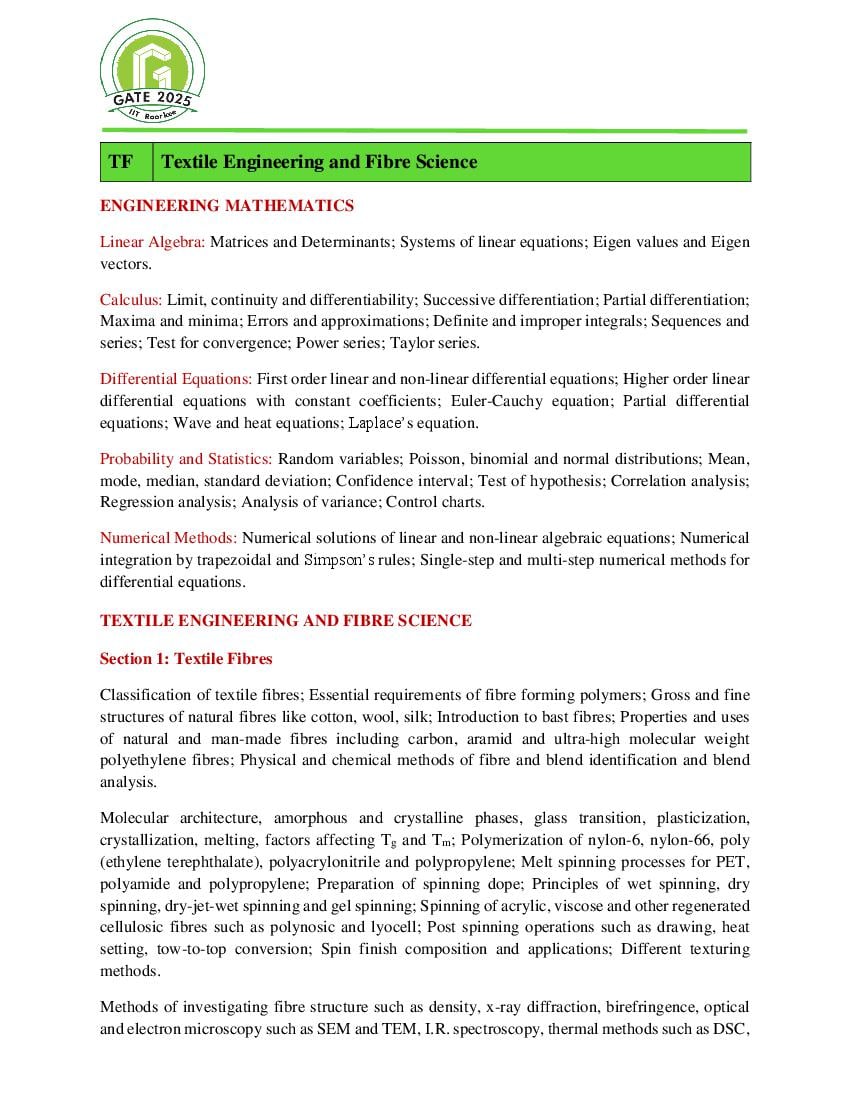
ENGINEERING MATHEMATICS
Linear Algebra: Matrices and Determinants; Systems of linear equations; Eigen values and Eigen
vectors.
Calculus: Limit, continuity and differentiability; Successive differentiation; Partial differentiation;
Maxima and minima; Errors and approximations; Definite and improper integrals; Sequences and
series; Test for convergence; Power series; Taylor series.
Differential Equations: First order linear and non-linear differential equations; Higher order linear
differential equations with constant coefficients; Euler-Cauchy equation; Partial differential
equations; Wave and heat equations; Laplace’s equation.
Probability and Statistics: Random variables; Poisson, binomial and normal distributions; Mean,
mode, median, standard deviation; Confidence interval; Test of hypothesis; Correlation analysis;
Regression analysis; Analysis of variance; Control charts.
Numerical Methods: Numerical solutions of linear and non-linear algebraic equations; Numerical
integration by trapezoidal and Simpson’s rules; Single-step and multi-step numerical methods for
differential equations.
TEXTILE ENGINEERING AND FIBRE SCIENCE
Section 1: Textile Fibres
Classification of textile fibres; Essential requirements of fibre forming polymers; Gross and fine
structures of natural fibres like cotton, wool, silk; Introduction to bast fibres; Properties and uses
of natural and man-made fibres including carbon, aramid and ultra-high molecular weight
polyethylene fibres; Physical and chemical methods of fibre and blend identification and blend
analysis.
Molecular architecture, amorphous and crystalline phases, glass transition, plasticization,
crystallization, melting, factors affecting Tg and Tm; Polymerization of nylon-6, nylon-66, poly
(ethylene terephthalate), polyacrylonitrile and polypropylene; Melt spinning processes for PET,
polyamide and polypropylene; Preparation of spinning dope; Principles of wet spinning, dry
spinning, dry-jet-wet spinning and gel spinning; Spinning of acrylic, viscose and other regenerated
cellulosic fibres such as polynosic and lyocell; Post spinning operations such as drawing, heat
setting, tow-to-top conversion; Spin finish composition and applications; Different texturing
methods.
Methods of investigating fibre structure such as density, x-ray diffraction, birefringence, optical
and electron microscopy such as SEM and TEM, I.R. spectroscopy, thermal methods such as DSC,
Page 2
fibres; Moisture sorption of fibres; Fibre structure-property correlation.
Section 2: Yarn Manufacture, Yarn Structure and Properties
Principles of ginning; Principles of opening, cleaning and blending; Working principles of modern
blow room machines; Fundamentals of carding; Conventional vs. modern carding machine; Card
setting; Card clothing; Periodic mass variation in card sliver; Card auto leveller; Principles of roller
drawing; Roller arrangements in drafting systems; Periodic mass variation in drawn sliver; Draw
frame auto leveller; Principles of cotton combing; Combing cycle and mechanisms; Recent
developments in combing machine; Principles of drafting, twisting, and bobbin building in roving
formation; Modern developments in roving machine; Principles of drafting, twisting and cop
building in ring spinning; Causes of end breakages; Modern developments in ring spinning
machine; Working principles of ring doubler and two-for-one twister; Relationship between single
yarn twist and folded yarn twist; Principles of compact, rotor, air-jet, air-vortex, friction, core,
wrap and twist-less spinning processes.
Influence of fibre geometry, fibre configuration and fibre orientation in yarn; Fibre packing density
of yarn; Yarn diameter; Yarn twist and its relation to yarn strength; Helical arrangement of fibres
in yarns; Yarn contraction; Fibre migration in yarns; Stress-strain relation in yarn; Mass
irregularity of yarn; Structure-property relationship in ring, compact, rotor, air-jet and friction spun
yarns.
Section 3: Fabric Manufacture, Structure and Properties
Principles of winding processes; Classification of winding methods; Patterning mechanism; Yarn
clearers and tensioners; Different systems of yarn splicing; Warping objectives and classification;
Different types of warping creels; Features of beam and sectional warping machines; Different
sizing systems; Sizing of spun and filament yarns;Drawing-in process; Principles of pirn winding.
Primary and secondary motions of loom; Shedding motion; Positive and negative shedding
mechanisms; Type of sheds; Tappet, dobby and jacquard shedding; Weft insertion; Mechanics of
weft insertion with shuttle; Shuttle picking and checking; Beat-up; Kinematics of sley; Loom
timing diagram; Cam designing; Effect of sley setting and cam profile on fabric formation; Take-
up and Let-off motions; Warp and weft stop motions; Warp protection; Weft replenishment;
Principles of weft insertion systems of shuttle-less weaving machines such as projectile, rapier,
water-jet and air-jet; Principles of functioning of multiphase and circular looms; Types of
selvedges.
Basic woven fabric constructions and their derivatives; Crepe, cord, terry, gauze, leno and double
cloth constructions; Drawing and lifting plans.
Page 3
constructions such as plain, rib, interlock and purl; Different knit stitches such as loop, tuck and
float.
Principle of warp knitting; Classification of warp knitting technologies; Swinging and shogging
motion of guide bar; Basic warp knit construction such as pillar, tricot, atlas, inlay and nets.Fibre
preparation processes for nonwovens; Web formation and bonding processes;Spun-bonding and
melt-blowing technologies; Applications of nonwoven fabrics.
Principles of braiding; Type of braids; Maypole braiding technology.
Peirce’s equations for plain woven fabric geometry; Elastic a model of plain-woven fabric;
Thickness, cover and maximum set of woven fabrics; Geometry of plain weft knitted loop;
Munden’s constants and tightness factor for plain weft knitted fabrics; Geometry of tubular braids.
Section 4: Textile Testing
Sampling techniques for fibres, yarns and fabrics; Sample size and sampling errors.
Moisture in textiles; Fibre length, fineness, crimp, maturity and trash content; Tensile testing of
fibres; High volume fibre testing.
Linear density of sliver, roving and yarn; Twist and hairiness of yarn; Tensile testing of yarns;
Evenness testing; Fault measurement and analysis of yarns.
Fabric thickness, compressibility, stiffness, shear, drape, crease recovery, tear strength, bursting
strength, pilling and abrasion resistance; Tensile testing of fabrics; Objective evaluation of low
stress mechanical characteristics; Air permeability; Wetting and wicking; Water-vapour
transmission through fabrics; Thermal resistance of fabrics.
Section 5: Chemical Processing
Impurities in natural fibre; Singeing; Chemistry and practice of preparatory processes for cotton;
Preparatory processing of wool and silk; Mercerization of cotton; Preparatory processes for
manmade fibres and their blends; Optical brightening agent.
Classification of dyes; Dyeing of cotton, wool, silk, polyester, nylon and acrylic with appropriate
classes of dyes; Dyeing of polyester/cotton and polyester/wool blends; Dyeing machines; Dyeing
processes and machines for cotton knitted fabrics; Dye-fibre interaction; Introduction to
thermodynamics and kinetics of dyeing; Brief idea about the relation between colour and chemical
constitution; Beer-Lambert’s law; Kubelka-Munk theory and its application in colour
measurement; Methods for determination of wash, light and rubbing fastness.
Page 4
Various types of thickeners; Printing auxiliaries; Direct styles of printing of (i) cotton with reactive
dyes, (ii) wool, silk, nylon with acid and metal complex dyes, (iii) polyester with disperse dyes;
Resist and discharge printing of cotton, silk and polyester; Pigment printing; Transfer printing of
polyester; Inkjet printing; Printing faults.
Mechanical finishing of cotton; Stiff, soft, wrinkle resistant, water repellent, flame retardant and
enzyme (bio-polishing) finishing of cotton; Milling, decatizing and shrink resistant finishing of
wool; Antistatic and soil release finishing; Heat setting of synthetic fabrics; Minimum application
techniques.
Pollution control and treatment of effluents.
Document Details
| Board / Org | IIT |
| Exam | GATE |
| Type | Syllabus |
| Pages | 4 |
| Updated | 30 Apr 2026 |