Karnataka PGCET 2015 Question Paper Polymer Science and Technology
Finished viewing? Save it for later —
Download Karnataka PGCET 2015 Question Paper Polymer Science and Technology (PDF · 12 pages)About Karnataka PGCET 2015 Question Paper Polymer Science and Technology
Karnataka PGCET 2015 Question Paper Polymer Science and Technology is available here for free download. Published by KEA for Karnataka Post Graduate Common Entrance Test, this question paper can be viewed online or downloaded as a PDF (12 pages). Candidates preparing for Karnataka Post Graduate Common Entrance Test can use Karnataka PGCET 2015 Question Paper Polymer Science and Technology to understand the exam pattern, the type of questions asked, and the overall difficulty level.
Frequently Asked Questions
How can I download Karnataka PGCET 2015 Question Paper Polymer Science and Technology?
Open this page and click the Download button to save Karnataka PGCET 2015 Question Paper Polymer Science and Technology as a PDF. It is completely free on AglaSem Docs.
Is Karnataka PGCET 2015 Question Paper Polymer Science and Technology free to download?
Yes. Karnataka PGCET 2015 Question Paper Polymer Science and Technology can be viewed online and downloaded as a PDF free of cost on AglaSem Docs.
How many pages does Karnataka PGCET 2015 Question Paper Polymer Science and Technology have?
Karnataka PGCET 2015 Question Paper Polymer Science and Technology contains 12 pages, which you can read online or download together as a single PDF.
Where can I find more Karnataka Post Graduate Common Entrance Test study material?
You can find more Karnataka Post Graduate Common Entrance Test question papers, sample papers, syllabus, and answer keys on AglaSem Docs.
Karnataka PGCET 2015 Question Paper Polymer Science and Technology – Text
Read the full text of this question paper below — useful to quickly search, copy and reference the content online without downloading the PDF.
📄 View text version (11 pages)
Page 1
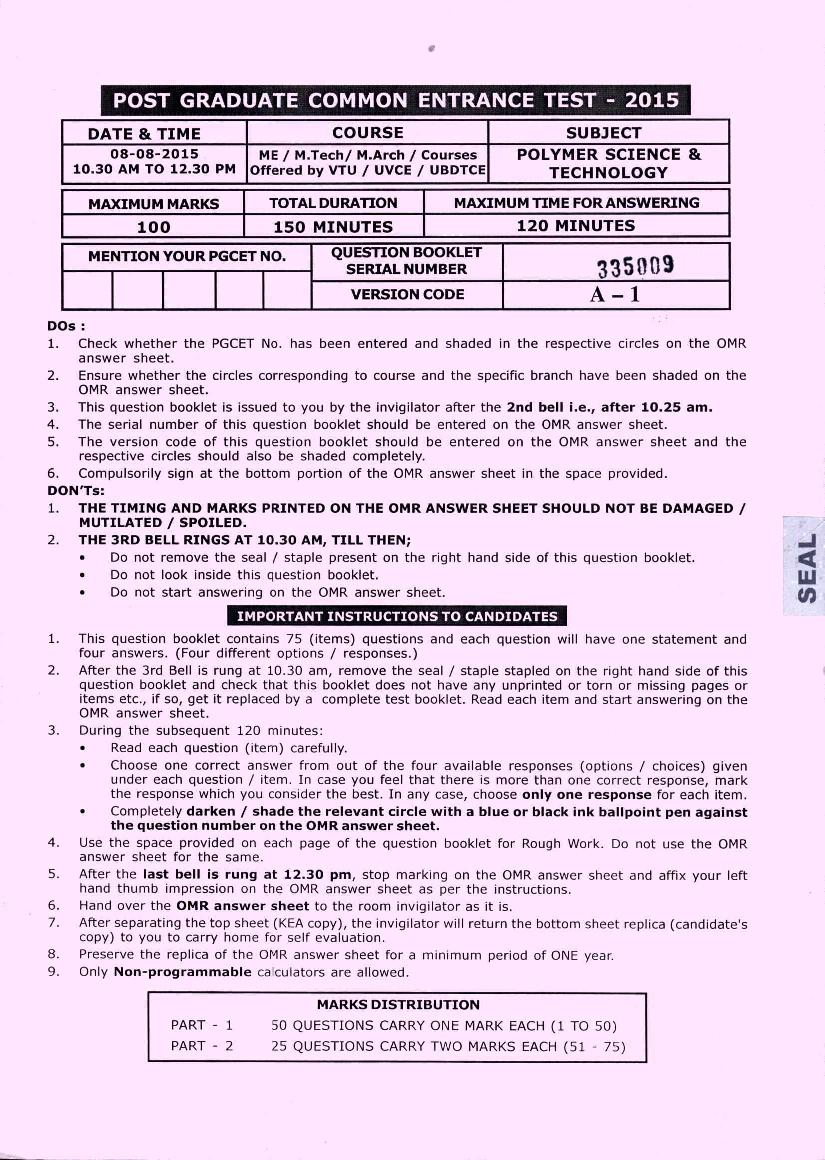
DATE & TIME COURSE SUBJECT
08-08-2015 ME / M.Tech/ M.Arch / Courses POLYMER SCIENCE &
10.30 AM TO 12.30 PM Offered by VTU / UVCE / UBDTCE TECHNOLOGY
MAXIMUM MARKS TOTAL DURATION MAXIMUM TIME FOR ANSWERING
100 150 MINUTES 120 MINUTES
MENTION YOUR PGCET NO. QUESTION BOOKLET
SERIAL NUMBER 335009
VERSION CODE A -1
DOs :
1. Check whether the PGCET No. has been entered and shaded in the respective circles on the OMR
answer sheet.
2. Ensure whether the circles corresponding to course and the specific branch have been shaded on the
OMR answer sheet.
3. This question booklet is issued to you by the invigilator after the 2nd bell i.e., after 10.25 am.
4. The serial number of this question booklet should be entered on the OMR answer sheet.
5. The version code of this question booklet should be entered on the OMR answer sheet and the
respective circles should also be shaded completely.
6. Compulsorily sign at the bottom portion of the OMR answer sheet in the space provided.
DON'Ts:
1. THE TIMING AND MARKS PRINTED ON THE OMR ANSWER SHEET SHOULD NOT BE DAMAGED /
MUTILATED / SPOILED.
2. THE 3RD BELL RINGS AT 10.30 AM, TILL THEN;
Do not remove the seal / staple present on the right hand side of this question booklet.
Do not look inside this question booklet.
Do not start answering on the OMR answer sheet.
IMPORTANT INSTRUCTIONS TO CANDIDATES
1. This question booklet contains 75 (items) questions and each question will have one statement and
four answers. (Four different options / responses.)
2. After the 3rd Bell is rung at 10.30 am, remove the seal / staple stapled on the right hand side of this
question booklet and check that this booklet does not have any unprinted or torn or missing pages or
items etc., if so, get it replaced by a complete test booklet. Read each item and start answering on the
OMR answer sheet.
3. During the subsequent 120 minutes:
• Read each question (item) carefully.
Choose one correct answer from out of the four available responses (options / choices) given
under each question / item. In case you feel that there is more than one correct response, mark
the response which you consider the best. In any case, choose only one response for each item.
Completely darken / shade the relevant circle with a blue or black ink ballpoint pen against
the question number on the OMR answer sheet.
4. Use the space provided on each page of the question booklet for Rough Work. Do not use the OMR
answer sheet for the same.
5. After the last bell is rung at 12.30 pm, stop marking on the OMR answer sheet and affix your left
hand thumb impression on the OMR answer sheet as per the instructions.
6. Hand over the OMR answer sheet to the room invigilator as it is.
7. After separating the top sheet (KEA copy), the invigilator will return the bottom sheet replica (candidate's
copy) to you to carry home for self evaluation.
8. Preserve the replica of the OMR answer sheet for a minimum period of ONE year.
9. Only Non-programmable calculators are allowed.
MARKS DISTRIBUTION
PART - 1 50 QUESTIONS CARRY ONE MARK EACH (1 TO 50)
PART - 2 25 QUESTIONS CARRY TWO MARKS EACH (51 - 75)
Page 2
Page 3
PART - 1
(50 X 1 = 50)
(Each question carries one mark)
1. In a closed system, there is 6. According to first law of thermodynamics, the
total energy of an isolated system
a. No change of energy of the system
a. Increases
b. Exchange of energy with surroundings
and not mass b. Decreases
c. Exchange of mass and energy with c. Remains constant
surroundings
d None of these
d Exchange of mass with surroundings
2. A State function is 7. CP - C v= R is valid for
a. Internal energy a. Ideal gases
h Free energy b. Real gases
c. Pressure c. All gases
d All of these d Nobel gases
3. During adiabatic expansion of gas 8. Solid and liquid phases of a substance are in
a. Pressure remains constant equilibrium at
b. Pressure is increased a. Melting point
c. Temperature is decreased b. Freezing point
d. None of these c. Both (a) & (b)
d. None of these
4. Work of expansion is given by
a. PAV b. APV
9. In the reaction, N2 + 02 :Fa 2NO ,
c. V AP d None of these Increasing pressure will result in
a. Shifting of equilibrium towards right
5. In an isobaric process b. Shifting the equilibrium towards left
a. dp = 0 b. dq = 0 c. No change in equilibrium condition
c. dv = 0 d dT = 0 d None of these
A-1 3 PO
Page 4
pressure separated by
a. Increases a. Steam distillation
b. Decreases b. Azeotropic distillation
c. Is independent
c. Flash distillation
d None of these
d. None of these
11. The value of gas constant R is
16. Term used in diffusion theory is
a. 1.987 cal/g mole (VC
b. 1.987 BTU/ lb mole 0 R a. Velocity
c. Both (a) & (b) b. Transfer rate across a plane
d None of these c. Flux & concentration
d. All of these
12. Free energy change of mixing two liquid
substances is a function of
17. Mass transfer is a result of
a. Concentration of the constituents only
b. Quantities of the constituents only a. Concentration difference
c. Temperature only h Diffusion
d All of these c. Both (a) & (b)
d None of these
13. Transfer of heat by molecular collision is
called
18. In a distillation operation, the reflux ratio
a. Conduction
may vary between
b. Convection
a. Zero & one
c. Radiation
b. Zero & infinity
d All of these
c. Minimum & infinity
14. Heat is transferred by conduction, convection d One & two
and radiation in
a. Boiler furnaces 19. Polyethylene is a polymer obtained by the
b. Melting of ice polymerization of
c. Condensation of steam in condenser a. Ethane b. Ethylene
d. None of these c. Isoprene d. Methylene
A-1 4 PO
Page 5
making of
a. Linear b. Branched
a. Thermoplastic b. Thermoset
c. Crosslinked d. Thermoset
c. Elastomers d. All of these
21. The kinetics and degree of polymerization of
polymer during emulsion polymerization
depends upon 26. Rotational molding
a. Temperature and time of process a. Is also called roto molding
b. Quantity of initiator b. Is used to make plastic hollow articles
c. Intensity of agitator c. Has moulds usually made of aluminium
d. All of these cL All of these
22. Thermoset is
27. An extrusion machine cannot be used for the
a. Phenol-formaldehyde resin production of
h Epoxy a. Pipes b. Buckets
c. Melamine-formaldehyde resin c. Filaments d. All of these
d. All of these
28. Purpose of preheating of sheet in
23. In extrusion blow molding, the barrel heaters thermoforming is to reduce the
is of the type of
a. Heating time
a. Band heater
b. Forming time
b. Cast heater
c. Clamping time
c. Either (a) or (b)
d. All of these
cl. None of these
24. Blow molding is a process to produce 29. Styrene can be polymerized by
a. Hollow articles a. Bulk polymerization
b. Bottles b. Solution polymerization
c. Both (a) & (b) c. Suspension polymerization
cl. None of these cl. All of these
A-1 5 PO
Page 6
a. Nylon b. Polyacetal a. CO b. CO2
c. PET d. PC
c. N2 d. NO
31. High pressure process uses oxygen as
catalyst in the manufacture of 37. Example for free radical initiator
a. LDPE b. HDPE a. Benzoyl peroxide
c. LLDPE d XLPE
b. NaOH
32. The polymer SBS represents c. TiC14
a. Block copolymer d. Nitrobenzene
b. Graft copolymer
c. Blend
38. Chain carrier in cationic polymerization is
d. Random copolymer
a. Carbonium ion
33. Living polymers can be produced by b. Carbanion
a. Anionic polymerization
c. Hydroxyl group
b. Cationic polymerization
d None of these
c. Addition polymerization
• Free radical polymerization
39. EPDM is an example for
34. Which of the following are water resistive
polymers? a. Blend
a. PTFE h HDPE b. Alloy
c. Iso PP d. All of these
c. Copolymer
d None of these
35. Pearl or bead type polymerization is nothing
but
a. Addition polymerization
40. Which of the following is an example for
b. Suspension polymerization heteropolymer?
c. Solution polymerization
a. PVC b. PET
d. Condensation polymerization
c. PMMA d PP
A-1 6 PO
Page 7
a. Oligomer a. Ring opening polymerization
Macromolecule b. Polyaddition polymerization
b.
c. Condensation polymerization
c. Subpolymer
d. Solution polymerization
d. None of these
47. Latex polymer product is obtained from
42. PP is an example for
a. Solution polymerization
a. Tacticity b. Bulk polymerization
b. Geometric isomerism c. Emulsion polymerization
c. Conformation d. Melt polymerization
d. All of these
48. Caprolactum is the monomer for
43. Requirements for geometric isomerisms is a. PU
b. Nylon 6
a. Asymmetric carbon atom
c. PC
b. Symmetric carbon atom
d. Nylon 66
c. Carbon-carbon double bond
d. Carbon-carbon single bond
49. Stereoregular polymers are produced by
a. Co-ordination polymerization
44. Copolymer is a h Vinyl polymerization
a. Physical mixture of polymers c. Condensation polymerization
b. Chemical mixtures of polymers None of these
c. Both (a) & (b)
d. None of these 50. Kinematic similarity is obtained when there
is equal
a. Liquid motion
45. Reaction between diol and diol yields
b. Solid suspension
a. Polyether b. Polyester
c. Mass transfer
c. Polyol d. None of these d. Surface behaviour
A-1 7 PO
Page 8
(Each question carries two marks)
(25 X 2 = 50)
51. Advantages of emulsion polymerization is 55. Which of the following statements is true for
addition polymerization?
a. Control of temperature & viscosity
a. Elemental composition of reactant and
b. High molecular weight obtained product are same
c. Homogeneity of the polymer h Is a single step polymerization
d All of these c. Polymerization occurs without
by products
cL All of these
52. Nylon is a
a. Thermoplastic polymer 56. Which of the following belongs to
thermoplastic, thermoset and elastomer
h Condensed polymer family?
c. Polyamide a. PP, epoxy and PF
d. All of these b. PMMA, PP and NR
c. PP, epoxy and NR
53. Vulcanization of rubber is carried out to d. PP, NR and epoxy
increase
a. Strength
57. Which of the following contain nitrogen
b. Weight of polymer element?
c. Oxidation resistance a. Nylon b. PAN
d. All of these c. NBR d. All of these
58. Example for ring opening polymerization
54. Which of the following statement is true with
reference to thermoset? I. Epoxy II. Caprolactum
a. They cannot be remoldable/recyclable III. Vinyl chloride IV. Styrene
b. They do not possess T m and not a. Both (I) & (II)
soluble b. Both (I) & (III)
c. Both (a) 86 (b) c. Both (I) & (IV)
d None of these d Both (II) & (III)
A-1 8 PO
Page 9
cannot be minimized by
a. PS & HDPE
b. . - HDPE & PTFE a. Decreasing temperature
c. PP 86 PTFE
Increasing pressure
d. None of these
c. A longer cycle
60. Barometers are used to measure d. Keeping the mold cool
a. Flow rate
Temperature
65. HDPE water storage tank is an example of
c. Viscosity
d. Pressure a. Extrusion process
b. Injection molding
61. Functionality of ethylene glycol and
acetylene is c. Rotational molding
a. 2 86 4 b. 4 8s 4
d. Thermoforming
c. 2 8s 2 d. 4 8s 2
62. A screw is used in extrusion blow molding 66. The unit of diffusion coefficient is
process to
a. m2 i s b. m/s
a. Get minimum difference in melt
temperature
b. Permit materials and colors to be c. mole/ (m2. s) d None of these
blended
c. Deliver a more uniform melt to the mold
d. All of these
67. 1 g mol of ammonia contains
63. Advantage of blow molding as compared to a. 6.02 x 10 23 atoms of hydrogen
injection molding is
a. Possibility of re-entrant curves b. 3 g mol of hydrogen
(irregular)
la Low stresses and favourable cost factor c. 2 x 10 23 molecules of ammonia
c. Possibility of variable wall thickness
None of these
d. All of these
A-1 9 PO
Page 10
polybutadiene is 1000, the molecular weight
enthalpy change (AH) and internal energy of polybutadiene is
(AE) at constant temperature is given by a. 5400 b. 54000
a. All = AE PV c. 10800 d 42000
b. AH = OE + A n, RT
c. AG = AH+ TAS 73. A high Reynolds number
a. Power number tends to be independent
cl• ex = AE 13 A T of impeller Reynolds number
where P,V,T & S are pressure, volume,
temperature and entropy respectively and n b. Power number is dependent on the
is the number of moles. geometry of the impeller
c. Both (a) & (b)
RT a
69. In Vander Wall's equation P v _b v d. All of these
the constants a and b are zero for
a. Ideal gases 74. Laminar flow region exists during agitation,
h Real gases when Reynold's number is
c. Liquid
a. Less than 10
d. None of these
b. More than 50
70. In p - v diagram of isotherms as given by
c. More than 1000
equation of state, for the isotherm T > Tc ,
with increasing v, pressure decreases d. More than 2500
a. Rapidly b. Monotonically
c. Slowly d. None of these
75. Newton's law of Viscosity states that
71. Intensive properties are the properties whose a. Shear stress is directly proportional to
magnitude the velocity
a. Depends on the quantity of material
involved b. Shear stress is directly proportional to
b. Does not depend on the quantity of velocity gradient
material involved
c. Shear stress is directly proportional to
c. Depends on the path followed shear strain
None of these d. Shear stress is directly proportional to
the viscosity
A-1 10 PO
Page 12
~_
1, '>
Document Details
| Board / Org | KEA |
| Exam | Karnataka Post Graduate Common Entrance Test |
| Type | Question Paper |
| Pages | 12 |
| Updated | 30 Apr 2026 |