Karnataka 2nd PUC Model Question Paper 2027 for Physics (Paper 5)
Finished viewing? Save it for later —
Download Karnataka 2nd PUC Model Question Paper 2027 for Physics (Paper 5) (PDF · 4 pages)About Karnataka 2nd PUC Model Question Paper 2027 for Physics (Paper 5)
Karnataka 2nd PUC Model Question Paper 2027 for Physics (Paper 5) is available here for free download. Published by Karnataka Board for Class 12, this sample paper can be viewed online or downloaded as a PDF (4 pages). Candidates preparing for Class 12 can use Karnataka 2nd PUC Model Question Paper 2027 for Physics (Paper 5) to understand the exam pattern, the type of questions asked, and the overall difficulty level.
Frequently Asked Questions
How can I download Karnataka 2nd PUC Model Question Paper 2027 for Physics (Paper 5)?
Open this page and click the Download button to save Karnataka 2nd PUC Model Question Paper 2027 for Physics (Paper 5) as a PDF. It is completely free on AglaSem Docs.
Is Karnataka 2nd PUC Model Question Paper 2027 for Physics (Paper 5) free to download?
Yes. Karnataka 2nd PUC Model Question Paper 2027 for Physics (Paper 5) can be viewed online and downloaded as a PDF free of cost on AglaSem Docs.
How many pages does Karnataka 2nd PUC Model Question Paper 2027 for Physics (Paper 5) have?
Karnataka 2nd PUC Model Question Paper 2027 for Physics (Paper 5) contains 4 pages, which you can read online or download together as a single PDF.
Where can I find more Class 12 study material?
You can find more Class 12 question papers, sample papers, syllabus, and answer keys on AglaSem Docs.
Karnataka 2nd PUC Model Question Paper 2027 for Physics (Paper 5) – Text
Read the full text of this sample paper below — useful to quickly search, copy and reference the content online without downloading the PDF.
📄 View text version (5 pages)
Page 1
Karnataka 2nd PUC
Model Question Paper
2027 for Physics
(Paper 5)
EXAM YEAR TYPE SUBJECT
Karnataka Class 12 2027 Sample Paper Physics
Notes · Sample Papers · Previous Year Papers · Mock Tests
Page 2
m .co
m .co s em
se g la
a
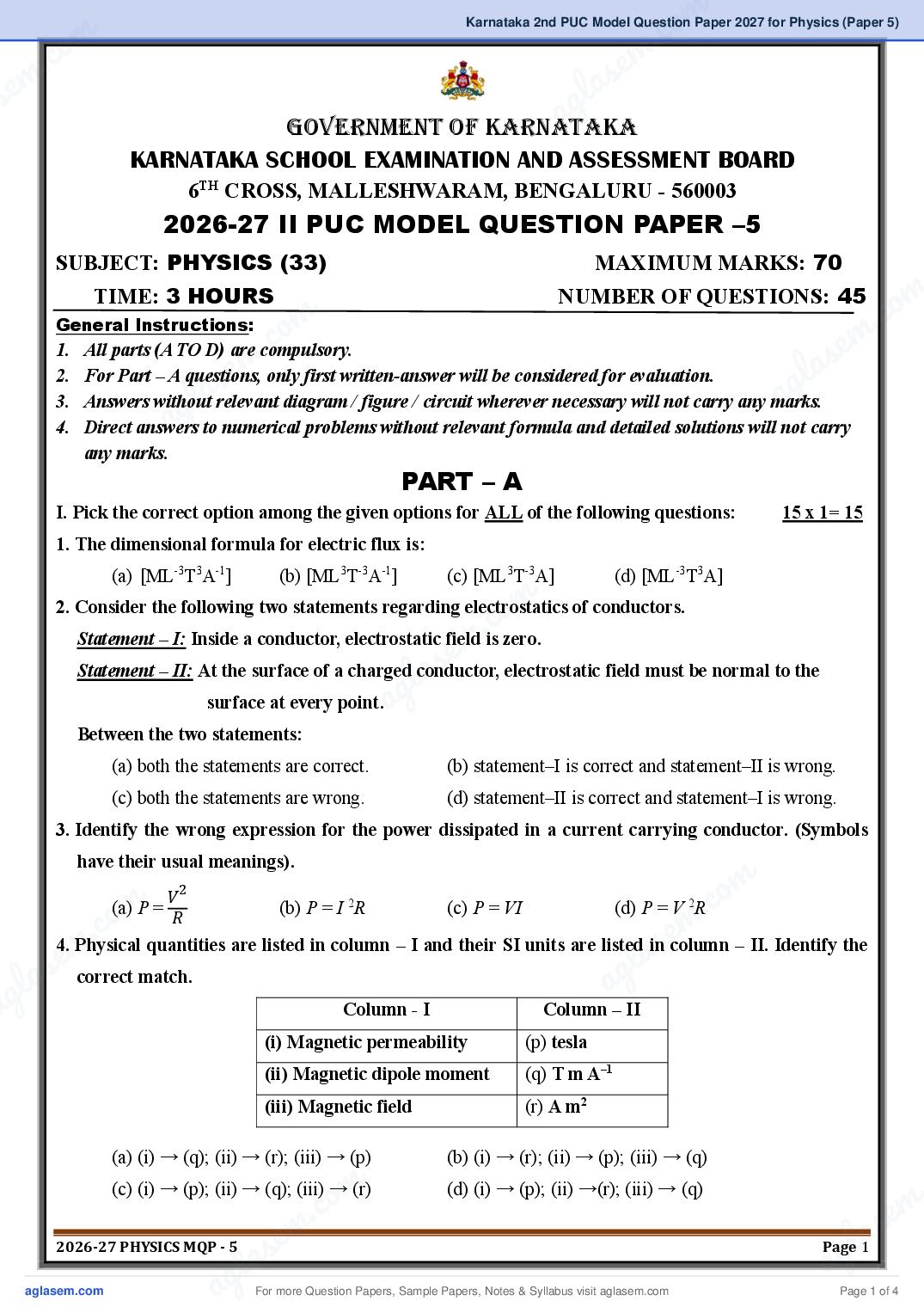
GOVERNMENT OF KARNATAKA
KARNATAKA SCHOOL EXAMINATION AND ASSESSMENT BOARD
6TH CROSS, MALLESHWARAM, BENGALURU - 560003
2026-27 II PUC MODEL QUESTION PAPER –5
SUBJECT: PHYSICS (33) MAXIMUM MARKS: 70
m
.co
TIME: 3 HOURS NUMBER OF QUESTIONS: 45
o m m
General Instructions:
. c s e
em only first written-answer will be considered for evaluation. a
1. All parts (A TO D) are compulsory.
s
2. For Part – A questions,
a g l
l a
ag to numerical problems without relevant formula and detailed solutions will not carry
3. Answers without relevant diagram / figure / circuit wherever necessary will not carry any marks.
4. Direct answers
any marks.
PART – A
I. Pick the correct option among the given options for ALL of the following questions: 15 x 1= 15
1. The dimensional formula for electric flux is:
(a) [ML-3T3A-1] (b) [ML3T-3A-1] (c) [ML3T-3A] (d) [ML-3T3A]
o m
c
2. Consider the following two statements regarding electrostatics of conductors.
.is zero.
m
Statement – I: Inside a conductor, electrostatic field
e electrostatic field must be normal to the
l a s
Statement – II: At the surface of a charged conductor,
surface at every point. ag
Between the two statements:
(a) both the statements are correct. (b) statement–I is correct and statement–II is wrong.
(c) both the statements are wrong. (d) statement–II is correct and statement–I is wrong.
3. Identify the wrong expression for the power dissipated in a current carrying conductor. (Symbols
have their usual meanings).
o m
o m 𝑉
2
2
(d) P = V R. c 2
m – II. Identify the
(a) P = (b) P = I R (c) P = VI
4. m
c 𝑅
. quantities are listed in column – I and their SI units are listed insecolumn
s e correct match.
Physical
g l a
la a
ag Column - I Column – II
(i) Magnetic permeability (p) tesla
(ii) Magnetic dipole moment (q) T m A–1
(iii) Magnetic field (r) A m2
(a) (i) → (q); (ii) → (r); (iii) → (p) (b) (i) → (r); (ii) → (p); (iii) → (q)
m .
c. o
(c) (i) → (p); (ii) → (q); (iii) → (r) (d) (i) → (p); (ii) →(r); (iii) → (q)
e m
em l as
2026-27 PHYSICS MQP - 5
las ag
Page 1
ag For more Question Papers, Sample Papers, Notes & Syllabus visit Page 1 of 4
Page 3
(a) Superconductors exhibit perfect diamagnetism.
(b) At high enough temperature, a ferromagnet becomes a paramagnet.
(c) Paramagnetic materials are strongly magnetised in the direction of external magnetic field.
(d) In soft ferromagnetic materials, the magnetisation disappears on removal of external magnetic field.
6. In electromagnetic induction, the induced e.m.f. in a coil is independent of:
(a) change in the magnetic flux. (b) time taken for change of magnetic flux.
(c) resistance of the circuit. (d) number of turns in the coil.
7. The energy required to build up a current I in a coil of inductance L is directly proportional to:
1
(a) I (b) 2 (c) I 3 (d) I 2
𝐼
8. In an AC circuit, the phase difference between current and voltage is 60°. The circuit may be:
(a) pure resistor ac circuit. (b) pure inductor ac circuit.
(c) pure capacitor ac circuit. (d) series LCR ac circuit.
9. Among the following, which electromagnetic waves have highest wavelength?
(a) Microwaves (b) Infrared waves (c) Ultraviolet rays (d) Gamma rays
10. A ray of light is passing through a prism in its minimum deviation position. Then:
(a) the angle of incidence is greater than the angle of emergence.
(b) the angle of refraction at the first face and angle of incidence at the second face are not equal.
(c) the refracted ray inside the prism is parallel to its base.
(d) the angle of incidence is smaller than the angle of emergence.
11. When a light wave undergoes refraction, the physical quantity that remains constant is:
(a) wavelength (b) frequency (c) amplitude (d) speed
12. The process of emission of electrons from a metal surface by heating is called:
(a) thermionic emission (b) photoelectric emission
(c) field emission (d) secondary emission
13. Let K be the kinetic energy and E be the total energy of electron revolving around the nucleus in a
hydrogen atom, then which of the following is correct?
𝐸
(a) K = E (b) K = 2E (c) K = – E (d) K = – 2
14. The pairs of nuclei 𝟏𝟗𝟖 𝟏𝟗𝟕 𝟑 𝟑
𝟖𝟎𝑯𝒈, 𝟕𝟗𝑨𝒖 and 𝟏𝑯, 𝟐𝑯𝒆 are respectively:
(a) isobars and isotones. (b) isotones and isobars.
(c) isobars and isotopes. (d) isotones and isotopes.
15. The cut-in voltage for a silicon diode is nearly:
(a) 0.2 V (b) 0.7 V (c) 1.1 V (d) 5.4 V
2026-27 PHYSICS MQP - 5 Page 2
For more Question Papers, Sample Papers, Notes & Syllabus visit Page 2 of 4
Page 4
m .co
c. II.o Fill in the blanks by choosing appropriate answer givensinemthe bracket for ALL of
m la
se the following questions: a g 5×1=5
[more, diffraction, photons, magnetic field, magnetisation, focal length]
16. The ratio of ____________ to magnetic intensity is called magnetic susceptibility.
17. In a step-down transformer, the current through secondary coil is _____________ than the current
through the primary coil.
18. The distance between pole and principal focus of a spherical mirror is called _____________.
m
o m
19. The redistribution of light energy takes place during ___________.
c m .co
m . cannot deflect ___________. s e
e
20. Electric and magnetic fields
s l a
g l a PART – B ag
a
III. Answer the FIVE of the following questions: 5 × 2 = 10
21. Mention two factors on which electric field at a point due to a point charge depends.
22. The electrostatic potential energy of a system of two like charges decreases with increase in the distance
of separation. Explain the statement using suitable expression.
23. State and explain Kirchhoff’s loop rule.
m
.co
24. When is the force on a charged particle moving in a uniform magnetic field is
a) maximum and
s em
b) zero?
25. Give the expression for mutual inductanceg la two co-axial solenoids and explain the terms.
a
between
26. Mention two applications of X - rays.
27. Calculate the angular momentum of an electron revolving in the 1st orbit of hydrogen atom.
28. What is meant by energy gap? Give its value for a conductor.
PART – C
m 5 × 3 = 15
.co
IV. Answer any FIVE of the following questions:
m
.co
29. Mention three properties of electric field lines.
s e m
s emDerive the relation between electric field and electric potential.
30.
g l a
g la 31. Define ‘current sensitivity’ of a galvanometer. Write two factors on which
a current sensitivity depends.
a 32. Obtain the expression for the potential energy of a magnetic needle pivoted in uniform magnetic field.
33. The pedals of the bicycle are attached to a 100-turn coil of area 0.10 m2. The coil is rotated at half a
revolution per second, and it is placed in a uniform magnetic field of 0.01 T which is perpendicular to
the axis of rotation of the coil. Calculate the maximum voltage generated in the coil.
34. Draw the ray diagram for the formation of image in case of a refracting telescope. Mention any one
m .
.co e m
advantage of using objective of larger diameter in a refracting telescope.
em l as
2026-27 PHYSICS MQP - 5
las ag
Page 3
ag For more Question Papers, Sample Papers, Notes & Syllabus visit Page 3 of 4
Page 5
photoelectric effect.
36. What is meant by radioactive decay? Name any two types of radioactive decay.
PART – D
V. Answer any THREE of the following questions: 3 × 5 = 15
37. State Gauss law in electrostatics. Using it, derive the expression for the electric field at a point due to an
infinitely long, straight, uniformly charged wire.
38. What is meant by drift velocity of free electrons in a conductor? Derive an expression for electric current
in terms of drift velocity and number density of free electrons.
39. Derive the expression for the magnetic field at a point inside an air cored long current carrying solenoid
using Ampere’s circuital law.
40. i) Using Huygen’s principle, show that the angle of incidence is equal to the angle of reflection during
reflection of a plane wavefront at a surface. (3)
ii) Write the conditions for constructive interference and destructive interference in terms of path
difference. (2)
41. i) With the help of a figure, explain how a p-type semiconductor is obtained from an intrinsic
semiconductor. (3)
ii) What happens to the width of depletion layer of a p-n junction diode when it is
(a) forward biased and (b) reverse biased? (2)
VI. Answer any TWO of the following questions: 2 × 5 = 10
42. Two capacitors of capacitances 3 μF and 6 μF are connected in series and the resulting combination is
connected across a 300 V battery. Calculate i) the effective capacitance of the combination; ii) the charge
collected by each capacitor and iii) the energy stored in 3 μF capacitor.
43. A wire of length 15 m and uniform cross-section 6.0 × 10⁻⁷ m2 has a resistance of 5.0 Ω at 27 °C. Find
the resistivity of the material at that temperature. Also find the resistance of the wire at 0 °C if the
temperature co-efficient of resistance of the material of the wire is 1.5 × 10⁻⁴ °C-1.
1
44. A series combination of a 12π mF capacitor and a 40 Ω resistor is connected to a 200 V, 50 Hz ac supply.
Calculate the maximum current in the circuit and the power dissipated by circuit.
45. An object of height 2 cm is placed at 25 cm in front of a concave lens of focal length 20 cm. Find the
position, nature and size of the image formed.
****
2026-27 PHYSICS MQP - 5 Page 4
For more Question Papers, Sample Papers, Notes & Syllabus visit Page 4 of 4
Document Details
| Board / Org | Karnataka Board |
| Exam | Class 12 |
| Type | Sample Paper |
| Pages | 4 |
| Language | english |
| Updated | 03 Nov 2026 |