Finished viewing? Save it for later —
Download CBSE Class 11 Maths Syllabus 2021-22 (PDF · 6 pages)About CBSE Class 11 Maths Syllabus 2021-22
CBSE Class 11 Maths Syllabus 2021-22 is available here for free download. Published by CBSE for Class 11, this syllabus can be viewed online or downloaded as a PDF (6 pages). Candidates preparing for Class 11 can use CBSE Class 11 Maths Syllabus 2021-22 to understand the exam pattern, the type of questions asked, and the overall difficulty level.
Frequently Asked Questions
How can I download CBSE Class 11 Maths Syllabus 2021-22?
Open this page and click the Download button to save CBSE Class 11 Maths Syllabus 2021-22 as a PDF. It is completely free on AglaSem Docs.
Is CBSE Class 11 Maths Syllabus 2021-22 free to download?
Yes. CBSE Class 11 Maths Syllabus 2021-22 can be viewed online and downloaded as a PDF free of cost on AglaSem Docs.
How many pages does CBSE Class 11 Maths Syllabus 2021-22 have?
CBSE Class 11 Maths Syllabus 2021-22 contains 6 pages, which you can read online or download together as a single PDF.
Where can I find more Class 11 study material?
You can find more Class 11 question papers, sample papers, syllabus, and answer keys on AglaSem Docs.
CBSE Class 11 Maths Syllabus 2021-22 – Text
Read the full text of this syllabus below — useful to quickly search, copy and reference the content online without downloading the PDF.
📄 View text version (6 pages)
Page 1
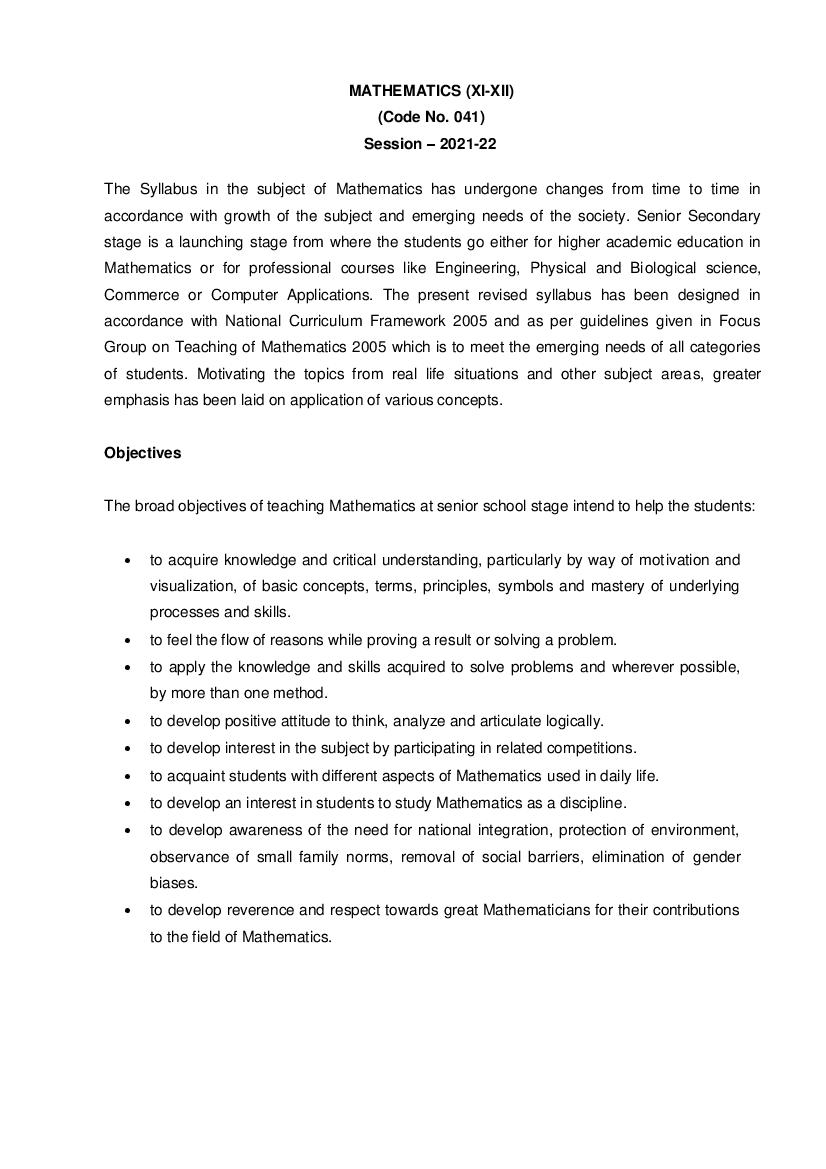
(Code No. 041)
Session – 2021-22
The Syllabus in the subject of Mathematics has undergone changes from time to time in
accordance with growth of the subject and emerging needs of the society. Senior Secondary
stage is a launching stage from where the students go either for higher academic education in
Mathematics or for professional courses like Engineering, Physical and Biological science,
Commerce or Computer Applications. The present revised syllabus has been designed in
accordance with National Curriculum Framework 2005 and as per guidelines given in Focus
Group on Teaching of Mathematics 2005 which is to meet the emerging needs of all categories
of students. Motivating the topics from real life situations and other subject areas, greater
emphasis has been laid on application of various concepts.
Objectives
The broad objectives of teaching Mathematics at senior school stage intend to help the students:
to acquire knowledge and critical understanding, particularly by way of motivation and
visualization, of basic concepts, terms, principles, symbols and mastery of underlying
processes and skills.
to feel the flow of reasons while proving a result or solving a problem.
to apply the knowledge and skills acquired to solve problems and wherever possible,
by more than one method.
to develop positive attitude to think, analyze and articulate logically.
to develop interest in the subject by participating in related competitions.
to acquaint students with different aspects of Mathematics used in daily life.
to develop an interest in students to study Mathematics as a discipline.
to develop awareness of the need for national integration, protection of environment,
observance of small family norms, removal of social barriers, elimination of gender
biases.
to develop reverence and respect towards great Mathematicians for their contributions
to the field of Mathematics.
Page 2
CLASS XI (2021-22)
One Paper Total Period–240 [35 Minutes each]
Three Hours Max Marks: 80
No. Units No. of Periods Marks
I. Sets and Functions 60 23
II. Algebra 70 30
III. Coordinate Geometry 40 10
IV. Calculus 30 05
V. Mathematical Reasoning 10 02
VI. Statistics and Probability 30 10
Total 240 80
Internal Assessment 20
*No chapter/unit-wise weightage. Care to be taken to cover all the chapters.
Unit-I: Sets and Functions
1. Sets (20) Periods
Sets and their representations, Empty set, Finite and Infinite sets, Equal sets, Subsets,. Subsets
of a set of real numbers especially intervals (with notations). Power set. Universal set. Venn
diagrams. Union and Intersection of sets. Difference of sets. Complement of a set. Properties of
Complement.
2. Relations & Functions (20) Periods
Ordered pairs. Cartesian product of sets. Number of elements in the Cartesian product of two
finite sets. Cartesian product of the set of reals with itself (upto R x R x R).Definition of relation,
pictorial diagrams, domain, co-domain and range of a relation. Function as a special type of
relation. Pictorial representation of a function, domain, co-domain and range of a function. Real
valued functions, domain and range of these functions, constant, identity, polynomial, rational,
modulus, signum, exponential, logarithmic and greatest integer functions, with their graphs. Sum,
difference, product and quotients of functions.
Page 3
Positive and negative angles. Measuring angles in radians and in degrees and conversion from
one measure to another. Definition of trigonometric functions with the help of unit circle. Truth of
the identity sin2x + cos2x = 1, for all x. Signs of trigonometric functions. Domain and range of
trigonometric functions and their graphs. Expressing sin (x±y) and cos (x±y) in terms of sinx, siny,
cosx & cosy and their simple applications. Deducing identities like the following:
tan x ± tan y cot x cot y ∓ 1
tan(x ± y) = , cot(x ± y) =
1 ∓ tan x tan y cot y ± cot x
1 1
sinα ± sinβ = 2sin (α ± β)cos (α ∓ β)
2 2
1 1
cosα + cosβ = 2cos (α + β)cos (α − β)
2 2
1 1
𝑐𝑜𝑠𝛼 − 𝑐𝑜𝑠𝛽 = −2𝑠𝑖𝑛 (𝛼 + 𝛽)𝑠𝑖𝑛 (𝛼 − 𝛽)
2 2
Identities related to sin2x, cos2x, tan2 x, sin3x, cos3x and tan3x. General solution of trigonometric
equations of the type siny = sina, cosy = cosa and tany = tana.
Unit-II: Algebra
1. Principle of Mathematical Induction (10) Periods
Process of the proof by induction, motivating the application of the method by looking at natural
numbers as the least inductive subset of real numbers. The principle of mathematical induction
and simple applications.
2. Complex Numbers and Quadratic Equations (15) Periods
Need for complex numbers, especially√−1, to be motivated by inability to solve some of the
quardratic equations. Algebraic properties of complex numbers.Argand plane and polar
representation of complex numbers.Statement of Fundamental Theorem of Algebra, solution of
quadratic equations (with real coefficients) in the complex number system. Square root of a
complex number.
3. Linear Inequalities (15) Periods
Linear inequalities. Algebraic solutions of linear inequalities in one variable and their
representation on the number line. Graphical solution of linear inequalities in two variables.
Graphical method of finding a solution of system of linear inequalities in two variables.
Page 4
Fundamental principle of counting. Factorial n. (n!) Permutations and combinations, derivation of
Formulae fornpr and ncr and their connections, simple applications.
5. Binomial Theorem (10) Periods
Historical perspective, statement and proof of the binomial theorem for positive integral indices.
Pascal’s triangle, General and middle term in binomial expansion, simple applications.
6. Sequence and Series (10) Periods
Sequence and Series. Arithmetic Progression (A. P.). Arithmetic Mean (A.M.) Geometric
Progression (G.P.), general term of a G.P., sum of n terms of a G.P., infinite G.P. and its sum,
geometric mean (G.M.), relation between A.M. and G.M. Formulae for the following special
sums.
n n n
∑ k , ∑ k and ∑ k 3
2
k=1 k=1 k=1
Unit-III: Coordinate Geometry
1. Straight Lines (10) Periods
Brief recall of two dimensional geometry from earlier classes. Shifting of origin. Slope of a line
and angle between two lines. Various forms of equations of a line: parallel to axis, point -slope
form, slope-intercept form, two-point form, intercept form and normal form. General equation of a
line. Equation of family of lines passing through the point of intersection of two lines. Distance of
a point from a line.
2. Conic Sections (20) Periods
Sections of a cone: circles, ellipse, parabola, hyperbola, a point, a straight line and a pair of
intersecting lines as a degenerated case of a conic section. Standard equations and simple
properties of parabola, ellipse and hyperbola. Standard equation of a circle.
3. Introduction to Three-dimensional Geometry (10) Periods
Coordinate axes and coordinate planes in three dimensions. Coordinates of a point. Distance
between two points and section formula.
Page 5
1. Limits and Derivatives (30) Periods
Derivative introduced as rate of change both as that of distance function and geometrically.
Intuitive idea of limit. Limits of polynomials and rational functions trigonometric, exponential and
logarithmic functions. Definition of derivative relate it to scope of tangent of the curve, derivative of
sum, difference, product and quotient of functions. Derivatives of polynomial and trigonometric
functions.
Unit-V: Mathematical Reasoning
1. Mathematical Reasoning (10) Periods
Mathematically acceptable statements. Connecting words/ phrases - consolidating the
understanding of "if and only if (necessary and sufficient) condition", "implies", "and/or", "implied
by", "and", "or", "there exists" and their use through variety of examples related to real life and
Mathematics. Validating the statements involving the connecting words, difference among
contradiction, converse and contrapositive.
Unit-VI: Statistics and Probability
1. Statistics (15) Periods
Measures of Dispersion: Range, Mean deviation, variance and standard deviation of
ungrouped/grouped data. Analysis of frequency distributions with equal means but different
variances.
2. Probability (15) Periods
Random experiments; outcomes, sample spaces (set representation). Events; occurrence of
events, ‘not’, ‘and’ and ‘or’ events, exhaustive events, mutually exclusive events, Axiomatic (set
theoretic) probability, connections with other theories of earlier classes. Probability of an event,
probability of ‘not’, ‘and’ and ‘or’ events.
Page 6
QUESTION PAPER DESIGN
CLASS – XI (2021-22)
Time: 3 Hours Max. Marks: 80
%
S. Total Weight
Typology of Questions
No. Marks age
Remembering: Exhibit memory of previously learned material by
recalling facts, terms, basic concepts, and answers.
1 55
44
Understanding: Demonstrate understanding of facts and ideas by
organizing, comparing, translating, interpreting, giving descriptions,
and stating main ideas
Applying: Solve problems to new situations by applying acquired
2 20 25
knowledge, facts, techniques and rules in a different way.
Analysing :
Examine and break information into parts by identifying motives
or causes. Make inferences and find evidence to support
generalizations
Evaluating:
Present and defend opinions by making judgments about
3 16 20
information, validity of ideas, or quality of work based on a set of
criteria.
Creating:
Compile information together in a different way by combining
elements in a new pattern or proposing alternative solutions
Total 80 100
1. No chapter wise weightage. Care to be taken to cover all the chapters
2. Suitable internal variations may be made for generating various templates keeping the overall
weightage to different form of questions and typology of questions same.
Choice(s):
There will be no overall choice in the question paper.
However, 33% internal choices will be given in all the sections
INTERNAL ASSESSMENT 20 MARKS
Periodic Tests ( Best 2 out of 3 tests conducted) 10 Marks
Mathematics Activities 10 Marks
Note: Please refer the guidelines given under XII Mathematics Syllabus:
Document Details
| Board / Org | CBSE |
| Exam | Class 11 |
| Type | Syllabus |
| Pages | 6 |
| Updated | 15 Jul 2026 |