CBSE Class 10 Sample Paper 2027 Solution (Marking Scheme) for Maths Basic
Finished viewing? Save it for later —
Download CBSE Class 10 Sample Paper 2027 Solution (Marking Scheme) for Maths Basic (PDF · 11 pages)About CBSE Class 10 Sample Paper 2027 Solution (Marking Scheme) for Maths Basic
CBSE Class 10 Sample Paper 2027 Solution (Marking Scheme) for Maths Basic is available here for free download. Published by CBSE for Class 10, this solution can be viewed online or downloaded as a PDF (11 pages). Candidates preparing for Class 10 can use CBSE Class 10 Sample Paper 2027 Solution (Marking Scheme) for Maths Basic to understand the exam pattern, the type of questions asked, and the overall difficulty level.
Frequently Asked Questions
How can I download CBSE Class 10 Sample Paper 2027 Solution (Marking Scheme) for Maths Basic?
Open this page and click the Download button to save CBSE Class 10 Sample Paper 2027 Solution (Marking Scheme) for Maths Basic as a PDF. It is completely free on AglaSem Docs.
Is CBSE Class 10 Sample Paper 2027 Solution (Marking Scheme) for Maths Basic free to download?
Yes. CBSE Class 10 Sample Paper 2027 Solution (Marking Scheme) for Maths Basic can be viewed online and downloaded as a PDF free of cost on AglaSem Docs.
How many pages does CBSE Class 10 Sample Paper 2027 Solution (Marking Scheme) for Maths Basic have?
CBSE Class 10 Sample Paper 2027 Solution (Marking Scheme) for Maths Basic contains 11 pages, which you can read online or download together as a single PDF.
Where can I find more Class 10 study material?
You can find more Class 10 question papers, sample papers, syllabus, and answer keys on AglaSem Docs.
CBSE Class 10 Sample Paper 2027 Solution (Marking Scheme) for Maths Basic – Text
Read the full text of this solution below — useful to quickly search, copy and reference the content online without downloading the PDF.
📄 View text version (12 pages)
Page 1
CBSE Class 10 Sample
Paper 2027 Solution
(Marking Scheme) for
Maths Basic
EXAM YEAR TYPE SUBJECT
CBSE Class 10 2027 Solutions Maths
Notes · Sample Papers · Previous Year Papers · Mock Tests
Page 2
m .co
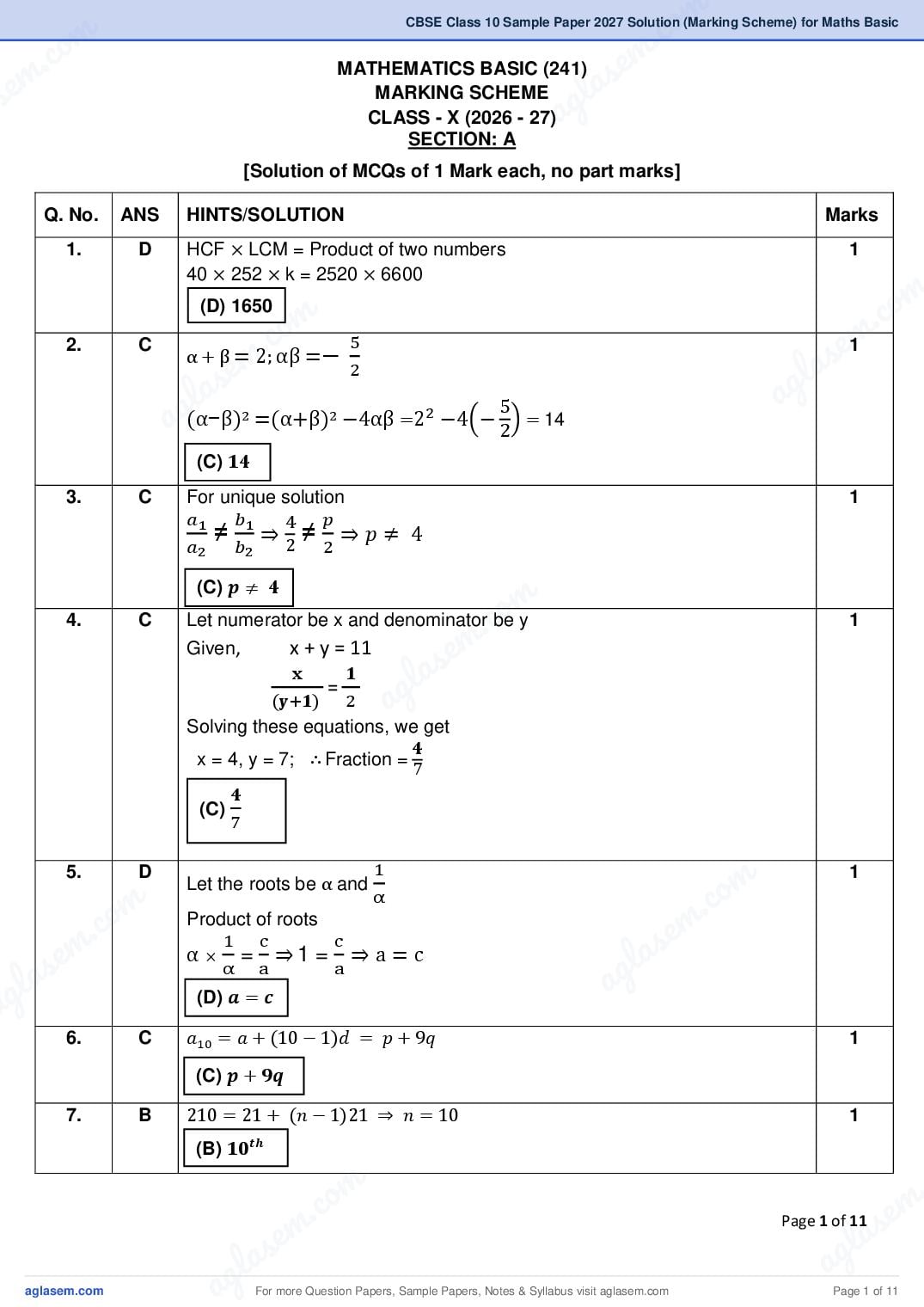
m .co MATHEMATICS BASIC (241)
s e m
se MARKING SCHEME
g l a
CLASS - X (2026 - 27) a
SECTION: A
[Solution of MCQs of 1 Mark each, no part marks]
Q. No. ANS HINTS/SOLUTION Marks
1. D HCF × LCM = Product of two numbers 1
40 × 252 × k = 2520 × 6600
m
m 5 .co
(D) 1650
c o 1m
α + β =m2.; αβ =− s e
2. C
s e 2
l a
g a
l(α−β) 5 ag
a =(α+β) −4αβ =22 −4(− ) = 14
2 2
2
(C) 𝟏𝟒
3. C For unique solution 1
𝑎1 𝑏 4 𝑝
≠ 1⇒2≠ ⇒𝑝≠ 4
𝑎2 𝑏2 2
(C) 𝒑 ≠ 𝟒
m
4. C Let numerator be x and denominator be y
m .co 1
Given, x + y = 11
s e
𝐱 𝟏
g la
(𝐲+𝟏) 2
=
a
Solving these equations, we get
𝟒
x = 4, y = 7; ∴ Fraction =
7
𝟒
(C)
7
om
5. D 1 1
Let the roots be α and
om
α
. c
. c Product of roots
e m
e m 1 c c
α × = ⇒1 = ⇒ a = c l as
las α a a
ag
ag (D) 𝒂 = 𝒄
6. C 𝑎10 = 𝑎 + (10 − 1)𝑑 = 𝑝 + 9𝑞 1
(C) 𝒑 + 𝟗𝒒
7. B 210 = 21 + (𝑛 − 1)21 ⇒ 𝑛 = 10 1
(B) 𝟏𝟎𝒕𝒉
m .
m .co Page 1 of 11 se
m
as e g la
g l a
a For more Question Papers, Sample Papers, Notes & Syllabus visit Page 1 of 11
Page 3
Using Section formula, =2 ⇒ =2 ⇒ 𝑦 = 1
3+1 4
(D) 𝟏
9. C INDEPENDENCE; 1
Total number of letters = 12
Number of times ‘I’ occurs = 1; Number of times ‘E’ occurs = 4
4 1
P(most occurring vowel ‘E’) = =
12 3
𝟏
(C)
𝟑
10. B 𝑁 66 1
= = 33, which lies in the interval 10-15
2 2
⇒ Median Class is 10-15
Lower limit of median class =10
(B) 𝟏𝟎
11. C (Distance of point from the centre)2 = (Length of tangent)2+(radius)2 1
(10)2 = (8)2 +(radius)2 ⇒ 𝑟 = √100 − 64 ⇒ 𝑟 = 6
(C) 𝟔 𝒄𝒎
12. B Mode = 3Median – 2Mean ⇒ Mode= 3×30 - 2×32 ⇒ Mode = 26 1
(B) 𝟐𝟔
13. B (Hypotenuse )2 =(Base)2 + (Perpendicular)2 ⇒ (15)2 = (Base)2 +(12)2 1
⇒ Base = 9 m
(B) 𝟗𝐦
14. A 𝟐 𝟐 1
√𝟑 √𝟑
sin 60°−2tan 45°−cos 30° = ( ) – 2(1) – ( ) = −2
2 2 22
𝟐 𝟐
(A) −𝟐
15. A Perimeter of First Triangle Side of first Triangle 1
=
Perimeter of second Triangle Side of second Triangle
28 8
⇒ = ⇒ side of second triangle = 10cm
35 Side of second Triangle
(A) 𝟏𝟎𝐜𝐦
Page 2 of 11
For more Question Papers, Sample Papers, Notes & Syllabus visit Page 2 of 11
Page 4
om .co
c. 16. e m
em
B In ∆ABC and ∆PQR ,
l as 1
s ∠B = ∠Q ; ∠R = ∠C ;
AB
PQ
=
2
1 ag
∴ ∆ABC ~∆PQR
Hence , the triangles are similar but not congruent because AB≠PQ
(B) 𝐒𝐢𝐦𝐢𝐥𝐚𝐫 𝐛𝐮𝐭 𝐧𝐨𝐭 𝐜𝐨𝐧𝐠𝐫𝐮𝐞𝐧𝐭
17. D ∠APB = 80° 1
Join OA and OB
∠OAP = ∠OBP = 90°
m
m
(Radius through the point of contact is
.co
.co
perpendicular to tangent)
m s e m
e
In Quadrilateral AOBP,
s l a
g a
∠APB + ∠OAP + ∠AOB + ∠OBP = 360°
l ag
a ⇒ 80°+ 90°+ ∠AOB + 90° = 360°
⇒ ∠AOB = 100°
(D) 100°
18. B Volume of cube, 𝑎3 = 64 ⇒ 𝑎 = 4 cm 1
On joining two cubes of side = 4 cm, we get a cuboid whose
Length (𝑙) = 8 cm, Breadth (𝑏) = 4 cm, Height (ℎ) = 4 cm
Surface area of resulting cuboid = 2(𝑙𝑏 + 𝑏ℎ + ℎ 𝑙)
m
.co
= 2(8 × 4 + 4 × 4 + 4 × 8)
(B) 𝟏𝟔𝟎𝐜𝐦𝟐
=160 cm2
e m
la0s
P(getting 8 on rolling a die)g=
19. 1
A
a 8
This is an impossible event as the numbers on the faces of a die are 1,2,3,4,5
and 6
(𝐀)𝐁𝐨𝐭𝐡 𝐀𝐬𝐬𝐞𝐫𝐭𝐢𝐨𝐧 (𝐀)𝐚𝐧𝐝 𝐑𝐞𝐚𝐬𝐨𝐧 (𝐑)𝐚𝐫𝐞 𝐭𝐫𝐮𝐞 𝐚𝐧𝐝 𝐑𝐞𝐚𝐬𝐨𝐧 (𝐑)𝐢𝐬 𝐭𝐡𝐞
𝐜𝐨𝐫𝐫𝐞𝐜𝐭 𝐞𝐱𝐩𝐥𝐚𝐧𝐚𝐭𝐢𝐨𝐧 𝐨𝐟 𝐀𝐬𝐬𝐞𝐫𝐭𝐢𝐨𝐧 (𝐀)
m
.co
20. B 1
m (𝐁)𝐁𝐨𝐭𝐡 𝐀𝐬𝐬𝐞𝐫𝐭𝐢𝐨𝐧 (𝐀)𝐚𝐧𝐝 𝐑𝐞𝐚𝐬𝐨𝐧 (𝐑)𝐚𝐫𝐞 𝐭𝐫𝐮𝐞 𝐚𝐧𝐝 𝐑𝐞𝐚𝐬𝐨𝐧 (𝐑)𝐢𝐬 𝐧𝐨𝐭
m .co s e m
s e
𝐭𝐡𝐞 𝐜𝐨𝐫𝐫𝐞𝐜𝐭 𝐞𝐱𝐩𝐥𝐚𝐧𝐚𝐭𝐢𝐨𝐧 𝐨𝐟 𝐀𝐬𝐬𝐞𝐫𝐭𝐢𝐨𝐧 (𝐀)
g l a
g la a
a Section –B
[This section comprises of solution of very short answer type questions (VSA) of 2 marks
each]
21(A). 520 = 23 x 5 x 13; 468 = 22 x 32 x 13 1
LCM = 23 x 32 x 5 x 13 = 4680 ½
½
m
∴ The required number is (4680 – 17). i.e., 4663
.
m .co Page 3 of 11 se
m
as e g la
g l a
a For more Question Papers, Sample Papers, Notes & Syllabus visit Page 3 of 11
Page 5
21(B). (25)n = (52)n = 52n ½
So, prime factorization of (25)n contains only 5 and this factorization is unique.
Now, for (25)n to end with digit 0, there must be pair of 2 and 5 in its prime ½
factorization. But 2 is not a factor of (25)n. ½
Hence, (25)n can never end with digit zero for any natural number. ½
22. sinθ 4 4
= ⇒ tan θ = ½+½
cosθ 3 3
4 9 4
∴ sinθ + cos 2 θ − 1 = + −1 = 1
5 25 25
23. Since, 3 is a zero of 𝑝(𝑥) = 2𝑥 2 − 3𝑥 + 𝑝 ⇒ p(3) = 0 ⇒ 2(3)2 – 3(3) + 𝑝 = 0 ½
⇒ 𝑝 =–9 ½
− (−𝟑)
Let another zero be β, 3 + β = (sum of zeroes)
𝟐 ½
𝟑
⇒ β=− ½
𝟐
24. BQ = QA
= 5 cm (Lengths of tangents from an external point to a circle are equal)
½+½
CP = PA
= 9 cm
PQ = AP – AQ = 9cm – 5cm = 4cm 1
For visually Impaired students only
Join OC, OA
∠ACO = 90° (Radius through the point of contact ½
is perpendicular to tangent)
In rt ∆ACO, AC = √𝐎𝐀𝟐 − 𝐎𝐂 𝟐 = 4cm ½
∴ AB = 2(AC) (perpendicular from centre bisects
the chord) ½
= 2×4 cm = 8 cm ½
25(A). Since, diagonals of parallelogram bisect each other
3+a 1+b
∴ Midpoint of AC = midpoint of BD ⇒ (
2
, 2 )= (5+42
, 1+3
2
) ½
3+a 9 1+b 4 1
⇒ = and = ½
2 2 2 2
⇒ a = 6; b = 3
OR
25(B). PA = PB ⇒ √(𝑥 − 1)2 + (𝑦 − 4)2 = √(𝑥 + 1)2 + (𝑦 − 2)2 ½
⇒ 𝑥 2 − 2𝑥 + 1 + 𝑦 2 − 8𝑦 + 16 = 𝑥 2 + 2𝑥 + 1 + 𝑦 2 − 4𝑦 + 4 1
⇒ 4𝑥 + 4𝑦 = 12
⇒ 𝑥 + 𝑦 = 3 ½
Page 4 of 11
For more Question Papers, Sample Papers, Notes & Syllabus visit Page 4 of 11
Page 6
m .co
m .co Section –C
s e m
se g l a
[This section comprises of solution short answer type questions (SA) of 3 marks each]
26. Let 2 +3√5 be a rational.
a
𝑝
Then 2+3√5 = , where p and q are integers and q ≠0 ½
𝑞
𝑝 − 2𝑞 1
√5 =
3𝑞
𝑝 − 2𝑞
Since p,q are integers, so will be rational number.
3𝑞
m
.co
½
But √5 is irrational
m
.co m
Since, rational is not equal to irrational
m
½
s e
This is a contradiction
s e l a
a ag
Hence, our assumption is incorrect. Therefore, 2 +3√5 is irrational. ½
g l
27(A).
a
AB+BC+CA= AB+BQ+CQ+AC
= AB+BP+CR+AC 1
(BQ = BP and CQ = CR, lengths of tangents from an external point to a circle
are equal) ½
= AP + AR
= 2AP ( AP = AR ) 1
1
Hence, AP = ( AB + BC + CA)
2 ½
For visually Impaired students only
m
Parallelogram ABCD circumscribes a circle as .co
shown in figure.
s em
Lengths of tangents drawn to a g la from an
a
circle
external point are equal.
So, AP = AS, PB = BQ,
CR = CQ, DR = DS 1
On adding the above equations,
(AP + PB) + (CR + RD) = (AS + DS) + (CQ + QB) ½
⇒ AB + CD = AD + BC ½
⇒ 2AB = 2BC (Opposite sides of parallelogram are equal) ½
m
.co
Thus, AB = BC
m
c. o Since, ABCD is a parallelogram with pair of adjacent sides equal.sem
s em Hence, ABCD is a rhombus. g l a ½
la a
ag
OR
27(B). In ∆APB, ∠APB+∠BAP+∠ABP=180° ½ (for
correct
∠APB+2∠BAP=180° (∠BAP=∠ABP)
figure)
______(i) ½
∠OAB+∠BAP=90° ⇒ ∠BAP= 90°– ∠OAB
______(ii) ½
(tangent is perpendicular to the radius at the point of contact)
m .
m .co Page 5 of 11 se
m
as e g la
g l a
a For more Question Papers, Sample Papers, Notes & Syllabus visit Page 5 of 11
Page 7
∠APB + 2(90°– ∠OAB) = 180° 1
Hence, ∠APB = 2∠OAB ½
28. 𝐴(−3, −1); 𝐵(− 8, 9) are given points
Let the ratio in which 𝐴𝐵 is divided be 𝑘: 1 ½
−8𝑘−3 9𝑘−1
Coordinates of the required point are ( , )
𝑘+1 𝑘+1 ½
−8𝑘−3 3
Hence, = – 6 ⇒ 𝑘 = , i.e., Required ratio is 3:2
𝑘+1 2 1
3
9( )−1 1
2
∴𝑦 = 3 ⇒𝑦=5
(2)+1
29. AC = √(AB)2 − (BC)2 = √292 − 212
= √400 = 20 units ½
AC 20 BC 21
sinθ = = , COSθ = =
AB 29 AB 29
½
20 2 841
(i) 1 + tan2θ = 1 + ( ) = 1
21 441
21 2 20 2 41
(ii) cos2θ – sin2θ = ( ) − ( ) = 1
29 29 841
30(A). xi
𝒙𝒊 −𝟒𝟓
Class interval fi (mid- ui= fi ui
𝒉
value)
20-30 8 -225 - 16
30-40 6 -135 -6 1
40-50 x 045 0
50-60 11 155 11
60-70 y 265 2y
Total 25+ x+ y 2y - 11
Assumed mean(A) = 45, Width of the interval (h) = 10 ½
25 + x + y = 50 ⇒x + y = 25……(1)
½
2y − 11 2y − 11
Mean = 45 + ( ) × 10 ⇒ 48 = 45 + ( )
50 5 ½
⇒ y = 13
∴ from (1), x = 12 ½
OR
Weight (in kg) No. of
30(B). students
35 – 45 5
45 – 55 10 f0 1
Modal class 55 – 65 20 f1
65 – 75 12 f2
75 – 85 3
Page 6 of 11
For more Question Papers, Sample Papers, Notes & Syllabus visit Page 6 of 11
Page 8
m .co
.co s em
em
∴ Modal class = 55 – 65, l = 55, h = 10
la
½
s g
)a10 = 60.555…
𝑓1 −𝑓0 20 −10
Mode = l + ( )h = 55 + ( 1
2𝑓1 −𝑓0 −𝑓2 2(20)−10−12
Hence, modal weight of students is 60.56 kg (approx.) ½
31. Let the ten's place digit be 𝑥
Let the unit's place digit be 𝑦
Number = 10𝑥 + 𝑦 ½
m
m
Reversed Number = 10𝑦 + 𝑥
.co
.co s e m
em
ATQ
s l a
ag
𝑥 + 𝑦 = 9 —---------(1)
g a
l + 𝑦) = 2(10𝑦 + 𝑥) -------------(2)
½
a Solving (1) and (2), we get
9(10𝑥 ½
𝑥 = 1 ,𝑦 = 8 1
Required Number = 18 ½
Section –D
m
[This section comprises of solution of long answer type questions (LA) of 5 marks each]
32. Correct figure, Given, To prove and Construction .co 4x½ = 2
s em
gla
Correct proof of theorem 3
33(A). Let the speed of the train be 𝑥akm/h
Then the increased speed of the train be (𝑥 + 5) km/h
360 360 ½
ATQ, − =1
𝑥 𝑥+5 1
On simplifying, we get
𝑥 2 + 5𝑥 − 1800 = 0 1
−5±√52 +4(1800)
𝑥= 1
2
𝑥 = 40, −45 m
c. o
1
m Hence, 𝑥 = 40
c. o ∴ Speed of the train= 40 km/h
½
e m
em l as
s
la 33(B).
OR
a g
ag Let the number of marbles John had in the beginning be 𝑥
Then the number of marbles Jivanti had in the beginning = 45 − 𝑥 ½
ATQ
(𝑥 − 5)(40 − 𝑥) = 124 1
𝑥 2 − 45𝑥 + 324 = 0 ½
45±√452 −4 (324) 1
𝑥 =
2
om .
𝑥 = 36, 9 1
.c Page 7 of 11 se
m
e m la
l as a g
ag For more Question Papers, Sample Papers, Notes & Syllabus visit Page 7 of 11
Page 9
Number of marbles John had in the beginning = 𝑥 = 36
Then, number of marbles Jivanti had in the beginning = 45 − 𝑥 = 9 ½
Case 2
Number of marbles John had in the beginning = 𝑥 = 9
½
Then, number of marbles Jivanti had in the beginning = 45 − 𝑥 = 36
34. Side of cube (a) = 21 cm
21
Radius of hemi-sphere (r) = cm ½
2
i) Volume of solid = VCube – VHemi-sphere
½
2
= a3 – 𝜋𝑟 3
3
2 22 21×21×21
= 213 – × × 1
3 7 2×2×2
3
= 6835.5 cm ½
ii) Surface area of wooden block
= 6a2 – 𝜋𝑟 2 + 2 𝜋𝑟 2
22 21 2 ½+1
= 6a2 + 2
𝜋𝑟 = 6(21)2 + ×( )
7 2
= 2992.5 cm2 1
Let height of drone (AB) be ℎ m
35(A). Let speed of ambulance be x m/min
CD = 12 x m 1 for
In rt ∆ABC, correct
AB ℎ figure
tan60° = ⇒ BC =
BC √3
1
In rt ∆ABD,
AB
tan30° = ⇒ BD = ℎ√3
BD 1
ℎ
⇒ + 12𝑥 = ℎ√3 ⇒ ℎ = 6√3𝑥
√3
∴ BC = 6 𝑥 1
6𝑥
time taken from C to B is = 6 minutes ½
𝑥
∴ Total time taken = (6+12) minutes = 18 minutes ½
OR
Page 8 of 11
For more Question Papers, Sample Papers, Notes & Syllabus visit Page 8 of 11
Page 10
m .co
c. o35(B). s e m
m a
se Let height of the pedestal (BC) be ℎ m
CD = height of statue = 1.6 m
ag l
1 for
correct
In rt ∆ABC, figure
BC ℎ
tan45° = ⇒ 1=
AB AB
⇒ AB = ℎ --------(i)
In rt ∆ABD, 1
m
.co
BD ℎ+1.6
tan60° =
o m AB
⇒ √3 =
m
c
AB
m . s e
1
s
⇒ AB =
ℎ+1.6
e √3 -------(ii) l a
g l a ag ½
aEquating (i) and (ii), we get
ℎ+1.6
ℎ =
√3
(√3-1) ℎ = 1.6
1.6 1
ℎ = = 0.8(√3 + 1)
√3−1
∴ height of the pedestel is 0.8(√3 + 1) m ½
m
Section –E .co
s em
la
[This section comprises solution of 3 case- study/passage-based questions of 4 marks]
g
36. a R = 10cm
Central angle, Θ = 60° , r = 4cm,
θ 60 22
(i) Required area of one face of the fan = πR2 = × × 102
360 360 7
= 52.38 cm2 ½+½
θ
(ii) Required area of black sheet = π(R2 − r 2 )
360
60 22
= × (102 − 42 ) = 44 cm2 ½+½
360 7
m
m (iii) (A) boundary length of black sheet region on one face of the fan
.co
.co e m
60 22
= 2(10 – 4) + × 2 × (10 + 4)
s
1
e m 44 80
360 7
l a
las =12 +
3
=
3
cm
ag 1
ag OR
θ 22
(iii) (B) 2(10 – 4) + ×2× (10 + 4) = 29.6 ½
360 7
θ
× 88 = 17.6
360 1
17.6×360
θ= = 72°
88 ½
m .
m .co Page 9 of 11 se
m
as e g la
g l a
a For more Question Papers, Sample Papers, Notes & Syllabus visit Page 9 of 11
Page 11
Radius, i.e., range of distance covered, 𝑟 = 24 m; Central angle, θ = 70°
𝜃
A 𝜋𝑟 2 1
(i)
𝑙
= 360
𝜃 ⇒ A = 𝑙𝑟
2
½+½
×2𝜋𝑟
360
θ
(ii) Area monitored = π𝑟 2
360
70 22
= × × 242 = 352 m2 ½+½
360 7
θ 150
(iii) (A) π(24)2 = × 352 ½
360 100
3 7×360
θ=
2
× 22×242 × 352 1
θ = 105° ½
OR
91 130
(iii) (B) π𝑟 2 = 100 × 352 ½
360
13 7×360
𝑟2 = × × 352 = 36 ×16 1
10 22×91
𝑟 = 24 m ½
37. Number of trees planted by class I = 2{2(1) +3} = 10
Number of trees planted by class II = 2{2(2) +3} = 14
Number of trees planted by class III = 2{2(3) +3} = 18 ……so on
Hence, it follows AP: 10, 14, 18, 22, ….
(i) Common difference = 14 – 10 = 4 1
(ii) Number of trees planted by class VI = 2{2(6) +3} = 30 1
𝑛
(iii) (A) Total number of trees planted = 𝑆𝑛 = {2𝑎 + (𝑛 − 1)𝑑}
2
12
= {2(10) + (12 − 1)4} 1
2
= 6 × 64 = 384 1
OR
(iii) (B) Let class that planted 34 trees be 𝑛.
2{2(𝑛) + 3} = 34 1
2(𝑛) + 3 = 17 ½
𝑛 = 7 ½
Page 10 of 11
For more Question Papers, Sample Papers, Notes & Syllabus visit Page 10 of 11
Page 12
m .co
c. o 38. s e m
m Total number T-shirts printed = 400
a
se Number of T-shirts with good print = 312
ag l
Number of T-shirts with minor print defect = 54
312 39
(i) P(Harish buys T-shirt) = or 1
400 50
312+54 366 183
(ii) P(Trader buys T-shirt) = = or 1
400 400 200
m
m 312 88 11
.co
.co
(iii) (A) P(T-shirt is not good) = 1 – P(T-shirt is good) = 1 – = 1+1
m
or
e 400 400 50
em Harish nor Trader buys T-shirt) = 400−54−312
OR
l as
as
(iii) (B)P(neither
l 400
=
34
400
or
17
ag 1+1
ag
200
m
m .co
s e
g la
a
m
m .co
m .co s e m
s e g l a
g la a
a
m .
m .co Page 11 of 11 se
m
as e g la
g l a
a For more Question Papers, Sample Papers, Notes & Syllabus visit Page 11 of 11
Document Details
| Board / Org | CBSE |
| Exam | Class 10 |
| Type | Solution |
| Pages | 11 |
| Updated | 29 Oct 2026 |