CBSE Class 10 Sample Paper 2027 Solution (Marking Scheme) for Maths Standard
Finished viewing? Save it for later —
Download CBSE Class 10 Sample Paper 2027 Solution (Marking Scheme) for Maths Standard (PDF · 12 pages)About CBSE Class 10 Sample Paper 2027 Solution (Marking Scheme) for Maths Standard
CBSE Class 10 Sample Paper 2027 Solution (Marking Scheme) for Maths Standard is available here for free download. Published by CBSE for Class 10, this solution can be viewed online or downloaded as a PDF (12 pages). Candidates preparing for Class 10 can use CBSE Class 10 Sample Paper 2027 Solution (Marking Scheme) for Maths Standard to understand the exam pattern, the type of questions asked, and the overall difficulty level.
Frequently Asked Questions
How can I download CBSE Class 10 Sample Paper 2027 Solution (Marking Scheme) for Maths Standard?
Open this page and click the Download button to save CBSE Class 10 Sample Paper 2027 Solution (Marking Scheme) for Maths Standard as a PDF. It is completely free on AglaSem Docs.
Is CBSE Class 10 Sample Paper 2027 Solution (Marking Scheme) for Maths Standard free to download?
Yes. CBSE Class 10 Sample Paper 2027 Solution (Marking Scheme) for Maths Standard can be viewed online and downloaded as a PDF free of cost on AglaSem Docs.
How many pages does CBSE Class 10 Sample Paper 2027 Solution (Marking Scheme) for Maths Standard have?
CBSE Class 10 Sample Paper 2027 Solution (Marking Scheme) for Maths Standard contains 12 pages, which you can read online or download together as a single PDF.
Where can I find more Class 10 study material?
You can find more Class 10 question papers, sample papers, syllabus, and answer keys on AglaSem Docs.
CBSE Class 10 Sample Paper 2027 Solution (Marking Scheme) for Maths Standard – Text
Read the full text of this solution below — useful to quickly search, copy and reference the content online without downloading the PDF.
📄 View text version (13 pages)
Page 1
CBSE Class 10 Sample
Paper 2027 Solution
(Marking Scheme) for
Maths Standard
EXAM YEAR TYPE SUBJECT
CBSE Class 10 2027 Solutions Maths Standard
Notes · Sample Papers · Previous Year Papers · Mock Tests
Page 2
m .co
m .co s em
se g
MATHEMATICS STANDARD – Code
a (041)
lNo.
MARKING SCHEME
a
CLASS X (2026 - 27)
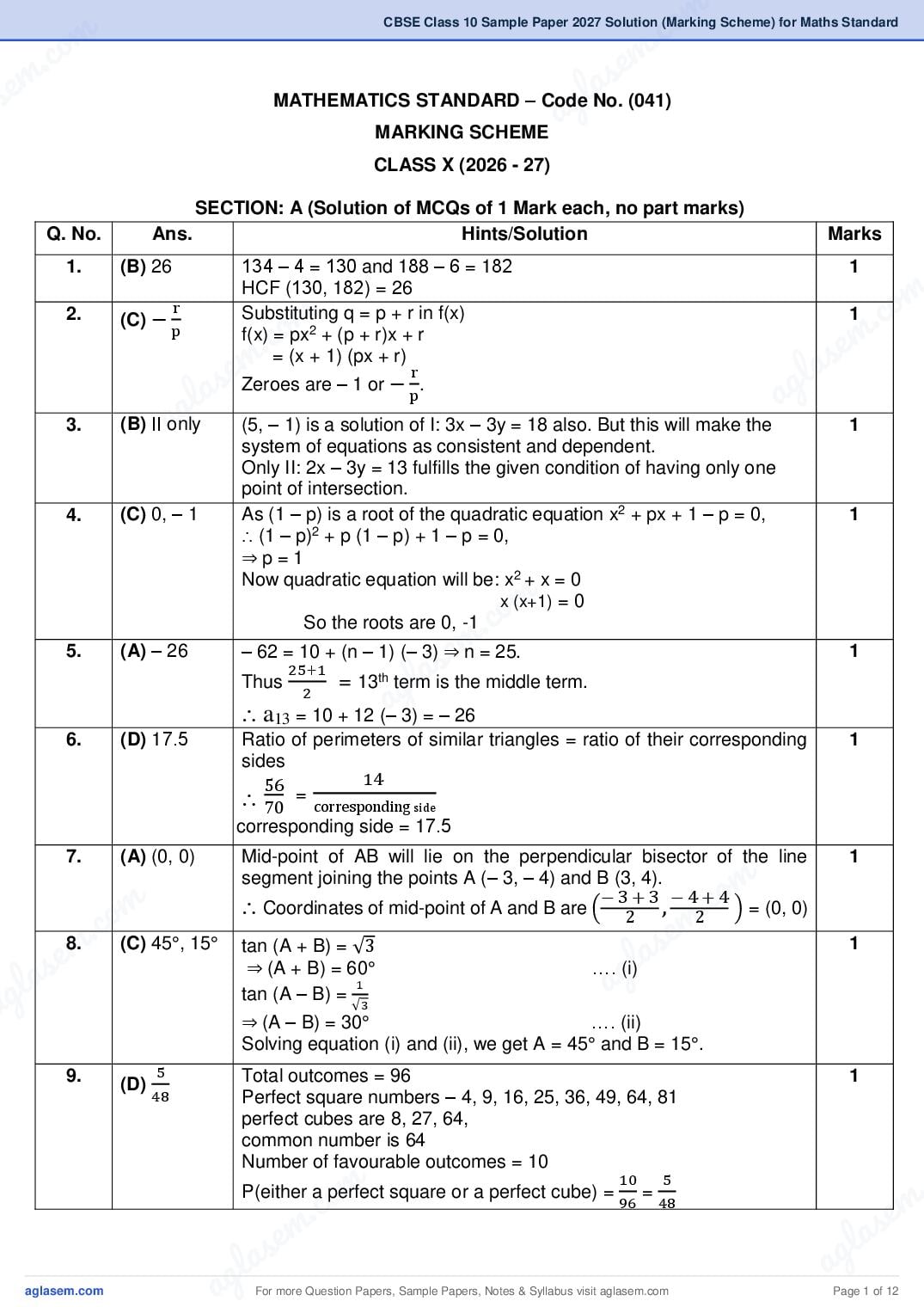
SECTION: A (Solution of MCQs of 1 Mark each, no part marks)
Q. No. Ans. Hints/Solution Marks
1. (B) 26 134 – 4 = 130 and 188 – 6 = 182 1
HCF (130, 182) = 26
m
(C) −
r
m
Substituting q = p + r in f(x)
.co
.co
2. 1
p f(x) = px2 + (p + r)x + r
e m
em
= (x + 1) (px + r)
l as
las Zeroes are – 1 or − .
r
ag
g
p
3. (B) II a
only (5, – 1) is a solution of I: 3x – 3y = 18 also. But this will make the 1
system of equations as consistent and dependent.
Only II: 2x – 3y = 13 fulfills the given condition of having only one
point of intersection.
4. (C) 0, – 1 As (1 – p) is a root of the quadratic equation x2 + px + 1 – p = 0, 1
⸫ (1 – p)2 + p (1 – p) + 1 – p = 0,
⇒p=1
Now quadratic equation will be: x2 + x = 0
m
.co
x (x+1) = 0
So the roots are 0, -1
5. (A) – 26
s em
– 62 = 10 + (n – 1) (– 3) ⇒ n = 25. 1
Thus
25+1
g
= 13 term lais the middle term.
th
⸫ a13 = 10 + 12 (–a 3) = – 26
2
6. (D) 17.5 Ratio of perimeters of similar triangles = ratio of their corresponding 1
sides
56 14
⸫ 70 = corresponding side
corresponding side = 17.5
7. (A) (0, 0) Mid-point of AB will lie on the perpendicular bisector of the line 1
segment joining the points A (– 3, – 4) and B (3, 4). m
c o m ⸫ Coordinates of mid-point of A and B are (− 32+ 3 , − 42+ 4 ) = (0, 0)
m.co
8. . (C) 45°, 15° tan (A + B) = √3 s e
em a 1
s (i)l
…. g
l a ⇒ (A + B) = 60°
a
ag
1
tan (A – B) =
√3
⇒ (A – B) = 30° …. (ii)
Solving equation (i) and (ii), we get A = 45° and B = 15°.
9. 5 Total outcomes = 96 1
(D)
48 Perfect square numbers – 4, 9, 16, 25, 36, 49, 64, 81
perfect cubes are 8, 27, 64,
common number is 64
Number of favourable outcomes = 10
om .
10 5
.c m
P(either a perfect square or a perfect cube) = =
96 48
s e
s em l a
g la ag
a For more Question Papers, Sample Papers, Notes & Syllabus visit Page 1 of 12
Page 3
Total revolutions = = 105
22 ×21
11. (B) 160 cm2 Side of cube = 4 cm 1
Dimensions of resulting cuboid: length = 8 cm, breadth = 4 cm, height
= 4 cm.
Total surface area = 2 (8 × 4 + 4 × 4 + 8 × 4) = 160 cm2
12. (D) 37.5 Let number of men be x and number of women be y 1
38 x +30y
= 35
x+y
⇒ 38x + 30y = 35x + 35y
⇒ 3x = 5y
x 5
⸫ =
y 3
3
% age of women = × 100 = 37.5
8
13. 1 Total outcomes = 36 1
(A)
4 Favourable outcomes = (1, 1), (1, 2), (1, 3), (2, 1), (2, 2), (2, 3), (3, 1),
(3, 2), (3, 3)
9 1
P (E) = =
36 4
14. (A) 2 √17 6+0 4+0 1
Coordinates of midpoint of QR i.e. M are ( , ) = (3, 2)
units 2 2
Median PM = √(5 − 3)2 + (− 6 − 2)2 = √68 = 2√17 units
15. (B) 8 cm 1 1
A= l×r
2
1
⇒ 24𝜋 = ×6𝜋 × r
2
⇒ r = 8 cm.
16. (C) 25 Mode = 3 Median – 2 Mean 1
= 3 (32) – 2 (35.5) = 25
17. (C) 48 m 1
12
tan θ =
5
12
⸫ sin θ =
13
h 12
⇒ = ⇒ h = 48 m
52 13
18. (B)
13 Total remaining cards = 52 – (2 + 4) = 46 1
46 13
P(a heart card) =
46
19. (A) Both Assertion (A) and Reason (R) are true and Reason (R) is the 1
correct explanation of Assertion (A).
20. (A) Both Assertion (A) and Reason (R) are true and Reason (R) is the 1
correct explanation of Assertion (A).
For more Question Papers, Sample Papers, Notes & Syllabus visit Page 2 of 12
Page 4
m .co
m .co s e m
Section –B
gla questions (VSA) of 2 marks
se [This section comprises of solution of very short answeratype
each]
Q. No. HINTS/SOLUTION Marks
21. (A) Length = 9.75 m = 975 cm
Breadth = 6.75 m = 675 cm
Height = 5.25 m = 525 cm
½
m
Length of longest unmarked ruler = HCF (975, 675, 525)
975 = 3 × 52 × 13
m . c o
675 = 33 × 52
m .co s e1m
525 = 3 × 52 × 7
s e l a
a
∴ HCF (975, 675, 525) = 3 × 52 = 75
g l ag ½
a
Hence, the length of longest unmarked ruler is 75 cm or 0.75 m
OR
21. (B) LCM of 5, 6 and 8 is 120 1
i.e., all the bells toll together after an interval of 120 minutes or 2 hours.
Thus, all the bells will again toll together at 12:00 noon, 2:00 pm, 4:00 pm and 6
p.m. i.e., 4 times 1
So, the bells will toll together 4 more times, till the park is closed at 7:00 p.m.
m
.co
22. (A)
e m
las
ag
In ∆ AOB and ∆ COD
∠ OAB = ∠ OCD
(Alternate interior angles) 1
∠ OBA = ∠ ODC
∴ ∆ AOB ∼ ∆ COD (AA criterion)
m
c. o
½
m = or =
AO BO AO CO
c. o CO DO BO DO
⇒
m s em ½
as e OR
g la
l a
ag
22. (B)
In ∆ PRQ and ∆ PQS
∠ PQR = ∠ QSP (Given)
m .
.co m
∠ QPR = ∠ QPS (Common)
s e
em
1
∴ ∆ PRQ ∼ ∆ PQS (AA criterion)
s l a
g la ag
a For more Question Papers, Sample Papers, Notes & Syllabus visit Page 3 of 12
Page 5
⇒ = ⇒ =
PS PQ 3 6
∴ PR = 12 cm ½
For visually Impaired Candidates:
In triangle BCD and triangle ACB
Angle BDC = Angle ABC (each 90 degree) ½
Angle BCD = Angle ACB (common) ½
∴ Triangle BCD is similar to Triangle ACB (AA criterion) 1
23. 1
tanθ = ⇒ cotθ = √5
√5
1 2 6
sec2θ = 1 + tan2θ = 1 + ( ) =5 ½
√ 5
2
and cosec2θ = 1 + cot2θ = 1 + (√5) = 6 ½
6
cosec2 θ − sec2 θ 6 − 5 2
∴ = 6 = 1
cosec2 θ + sec2 θ 6+ 5 3
24. 28 ½
Radius = = 14 cm
2
1
Area of sector = × l×r
2
1
= × 22 × 14 1
2
= 154 cm2 ½
25. Total number of outcomes = 36 ½
Favourable outcomes = 6 {(1,2), (1,3), (1,5), (2,1), (3,1), (5,1)} ½
6 1
P (Prime Product) = = 1
36 6
Section – C
[This section comprises of solution short answer type questions (SA) of 3 marks each]
Q. No. HINTS/SOLUTION Marks
26. Let us assume that 2 + 3√3 be rational number.
a
Then 2 + 3√3 = , where ‘a’ and ‘b’ are integers & b ≠ 0
b
a − 2b
⇒ √3 = 1
3b
For more Question Papers, Sample Papers, Notes & Syllabus visit Page 4 of 12
Page 6
m .co
m .co Since ‘a’ and ‘b’ are integers. s e m
se a − 2b
g l a 1
∴
3b
is rational number.
a
So, √3 is rational number which contradicts the given fact that √3 is irrational
number.
Hence, our assumption is wrong. Therefore 2 + 3√3 is irrational number. 1
27. 5
α + β = 4 and αβ = 1
2
1 1 αβ + 1 αβ + 1 (αβ + 1)2
(𝛼 + ) × (𝛽 + )=( )×( )= ½
𝛽 𝛼 β α αβ
m
m .co
5 2
.c=o
( + 1)
m
2 1
5
s e
em = 49 a
2
s l
g l a 10 ag ½
a of the sides of the given polygon is ‘n’.
28. (A) Number
The exterior angles of the given polygon are in A.P.
Here a = 8 and d = 4
As sum of all the exterior angles of a polygon is 360°
∴ Sn = 360
n
⇒ [2 × 8 + (n – 1) × 4] = 360
2 1
⇒ n2 + 3n – 180 = 0 m
.co
em
⇒ (n + 15) (n – 12) = 0 1
∴ n = – 15 or 12
las ½
Angle is always positive. ag
∴ n = 12 ½
So, the number of sides in the given polygon is 12.
OR
28. (B) Required A.P. is 20, 40, 60, …, 380 1
Here a = 20 and d = 20
m
m a = 380
c. o⇒ 20 + (n – 1) × 20 = 380
Let n
m.co
s e
em a
½
as g l
l ⇒ n = 19
a
ag
½
19
∴ S19 = [20 + 380] ½
2
= 3800 ½
m .
.co s e m
s em l a
g la ag
a For more Question Papers, Sample Papers, Notes & Syllabus visit Page 5 of 12
Page 7
Given, ABCD is a parallelogram circumscribing a circle.
AS = AR --- (i)
BS = BP --- (ii) (Length of tangents drawn from an external point to 1
CQ = CP --- (iii) a circle are equal)
DQ = DR --- (iv)
Adding (i), (ii), (iii) and (iv), we get
AS + BS + CQ + DQ = AR + BP + CP + DR 1
⇒ AB + CD = AD + BC
⇒ 2 AB = 2 AD
⇒ AB = AD 1
Since adjacent sides of parallelogram ABCD are equal. Therefore, ABCD is a
rhombus.
30.
Let x-axis divides the line segment joining the points A (– 4, – 6) and B (–1, 7) at P
(x, 0) in the ratio k:1.
k (−1) + 1 (−4) k (7) + 1 (−6) − k −4 7k −6
Coordinates of P are [ , ] or [ , ] 1
k+1 k+1 k+1 k+1
Since point P lies on x – axis
7k −6 6
∴ =0⇒k= ½
k+1 7
So, point P divides AB in the ratio 6:7
½
− 34
Coordinates of P, are ( , 0). 1
13
31. (A) Jyoti made error in step 2. 1
The correct solution is as under:
cos θ 1 − sin θ
+
1− sin θ cos θ
cos2 θ+(1− sinθ)2
=
(1− sin θ)×cosθ
cos2 θ + 1 + sin2 θ − 2sinθ
=
(1− sin θ)×cosθ 1
2 − 2sinθ
= ½
(1− sin θ)×cosθ
For more Question Papers, Sample Papers, Notes & Syllabus visit Page 6 of 12
Page 8
m .co
m .co 2 × (1 − sinθ)
s e m
se
=
(1 − sin θ)×cosθ
g l a
=
2
= 2 secθ
a ½
cosθ
OR
31. (B) 1 cosec 𝑥
Given: =
sin 𝑥 − cos 𝑥 √2
⇒ sin 𝑥 − cos 𝑥 = √2 sin 𝑥 ½
Squaring both sides, we get
m
m 2
2 sin 𝑥 cos 𝑥 = 1 − 2 sin2 𝑥 --- (i) .co
.c1o
1
e m
Now, LHS = (
em
1
) = 1 + 2 sin 𝑥 cos 𝑥
l as½
la=s sin 𝑥 + cos 𝑥
ag ½
ag 1 + (1 −
1
2𝑠𝑖𝑛 𝑥)
=
1
2
2𝑐𝑜𝑠 𝑥 2
sec2 𝑥
= = RHS ½
2
Section –D
[This section comprises of solution of long answer type questions (LA) of 5 marks each]
m
c. o
Q. No. HINTS/SOLUTION Marks
32.
e m
las
ag
m
m is the rectangular park and PQRS is the swimming pool. m
c. oABCD .co
m Let ‘x’ be the uniform width of the grass strip.
s e
s e g l a
l a Then, length of the swimming pool, PQ = (50 – 2x) m
a
ag
½
and breadth of the swimming pool, QR = (40 – 2x) m
Area of rectangular park – Area of swimming pool = Area of grass strip.
50 × 40 – (50 – 2x) (40 – 2x) = 1184 1
⇒ x2 – 45x + 296 = 0 1
⇒ (x – 8) (x – 37) = 0 ½
⇒ x = 8, 37
m .
.co m
Rejecting x = 37, as length and breadth cannot be negative integers.
s e
s em l a
g la ag
a For more Question Papers, Sample Papers, Notes & Syllabus visit Page 7 of 12
Page 9
Thus, length of the swimming pool = (50 – 2x) = 50 – 16 = 34 m. ½
and breadth of the swimming pool = (40 – 2x) = 40 – 16 = 24 m ½
33. Correct figure, given, to prove, construction 1
Correct proof 2
Join PR intersecting XY at M. ½
In ∆ PSR, XM ‖ SR
PX PM
∴ = --- (i)
XS MR ½
In ∆ PQR, MY ‖ PQ
QY PM
∴ = --- (ii) ½
YR MR
From (i) and (ii), we get
PX QY
= ½
XS YR
34. (A)
Height of Conical part = 13.5 – 3 = 10.5 m ½
Slant height (l) = √(14)2 + (10.5)2 = 17.5 m 1
22
CSA of Conical part = 𝜋rl = × 14 × 17.5 = 770 m2 1
7
22
CSA of Cylindrical part = 2𝜋rh = 2 × × 14 × 3 = 264 m2 1
7
Total area of canvas required = CSA of conical part + CSA of cylindrical part
+ Wastage
= 770 + 264 + 26 = 1060 m2 ½
Cost of canvas to be purchased @ ₹ 250 / m2 = 250 × 1060 = ₹ 265000 1
OR
For more Question Papers, Sample Papers, Notes & Syllabus visit Page 8 of 12
Page 10
m .co
c.34.o(B) Let ‘h’ cm be the height of conical part. s e m
m a
se Volume of wood in the toy = Volume of conical part +
ag l
Volume of hemispherical part
5 1 2
166 = × π × r2 × h + × π × r3
6 3 3
1001 1 22 2 22
⇒ = × × (3.5)2 × h + × × (3.5)3 2
6 3 7 3 7
⇒ h = 6 cm 1
m
.co
CSA of hemispherical part = 2 × π × r 2
m = 2 × 22 × (3.5)
.co 2
s e m
em
7
s l a
a ag
= 77 cm 2
1
l
agpainting hemispherical part @ ₹ 15 / cm = 15 × 77
Cost of 2
= ₹ 1155 1
35. (A)
m
.co
s em
g la
Correct figure
a
Let Manish is standing at point ‘A’ and Mahesh is standing at point ‘D’.
1
Distance of kite from Manish = 200 m
In rt. angled ∆ AEB
BE 1
= sin 30° = 1
200 2
⇒ BE = 100 m ½
om
BR = BE – RE = BE – DC = 100 – 50 = 50 m 1
o m
In rt. angled ∆ BRD . c
.c 50 e m
s
1
em a
= sin 45° = 1
s
BD √2
g l
g la ⇒ BD = 50√2 m a ½
a ∴ Distance of kite from Mahesh is 50√2 m
OR
35. (B)
m .
.co s e m
s em l a
g la ag
a For more Question Papers, Sample Papers, Notes & Syllabus visit Page 9 of 12
Page 11
Let the height of the lighthouse be ‘h’ m.
In rt. angled ∆ ABC
h 1
= tan 45° = 1
BC
⇒ BC = h --- (i) ½
In rt. angled ∆ ABD
h 1
= tan 30° = 1
h + 200 √3
200 √3 + 1 ½
⇒h= ×
√3 −1 √3 + 1
⇒ h = 100 (√3 + 1) 1
∴ height of the lighthouse is 100 (√3 + 1) m.
Section –E
[This section comprises solution of 3 case- study/passage-based questions of 4 marks]
Q. No. HINTS/SOLUTION Marks
36. Let the number of small bottles and large bottles be ‘x’ and ‘y’ respectively.
(i) 10x + 15y = 12750 or 2x + 3y = 2550 1
(ii) 12x + 17y = 34250 1
(iii) (A) According to the question,
x + y = 1000 --- (i) 1
10x + 15y = 12750 --- (ii)
Solving (i) and (ii), we get x = 450 & y = 550 1
Number of small and large bottles sold are 450 and 550 respectively.
OR
(iii) (B) According to the question,
x + y = 2500 --- (i)
12x + 17y = 34250 --- (ii) 1
Solving (i) and (ii), we get x = 1650 & y = 850 1
Number of small and large bottles sold are 1650 and 850 respectively.
37.
(i) ∠OAP = 90° (Radius is perpendicular to tangent at the point of contact) 1
For more Question Papers, Sample Papers, Notes & Syllabus visit Page 10 of 12
Page 12
m .co
m .co (ii) In right angled ∆ OAP, OP2 = OA2 + AP2 s e m
se g l a
⇒ (18)2 = (9)2 + AP2
a ½
⇒ AP = √243 = 9√3 m
½
(iii) (A)
m
m .co
m .co s e m
s e l a
ag 1
9 1
g l a
In right angled ∆ OAP, cos θ = = = cos 60°
18 2
a ⇒ θ = 60° ½
∴ ∠ AOB = 2θ = 120° ½
OR
(iii) (B)
m
m .co
s e
g la
a
1
If tangent inclined at 60°, then ∠OPA = × 60° = 30° ½
2
9 1
In right angled ∆ OPA, = tan 30° = 1
AP √3
⇒ AP = 9√3 m ½
m30 – 40 . com
c. o m
38. (i) 1
s e
s em (ii)
g l a
g la Marks Number of students (f) a cf
a 0 – 10 3 3
10 – 20 6 9
20 – 30 12 21
30 – 40 15 36
40 – 50 14 50
N
m .
c. o
= 25. ∴ Median class is 30 – 40. 1
m
Since
e
2
em l as
las ag
ag For more Question Papers, Sample Papers, Notes & Syllabus visit Page 11 of 12
Page 13
C.I. fi xi fixi
0 – 10 3 5 15
10 – 20 6 15 90
Correct
20 – 30 12 25 300 Table
1
30 – 40 15 35 525
40 – 50 14 45 630
Total 50 1560
1560 1
Average performance i.e. mean = = 31.2
50
OR
(iii) (B) Here, modal class is 30 – 40, f0 = 12, f1 = 15, f2 = 14 ½
15 − 12
Mode = 30 + ( ) × 10 1
2 × 15 − 12 − 14
= 37.5 ½
For more Question Papers, Sample Papers, Notes & Syllabus visit Page 12 of 12
Document Details
| Board / Org | CBSE |
| Exam | Class 10 |
| Type | Solution |
| Pages | 12 |
| Updated | 29 Oct 2026 |