Tamil Nadu 12th Std Model Question Paper 2026 Economics
Finished viewing? Save it for later —
Download Tamil Nadu 12th Std Model Question Paper 2026 Economics (PDF · 11 pages)About Tamil Nadu 12th Std Model Question Paper 2026 Economics
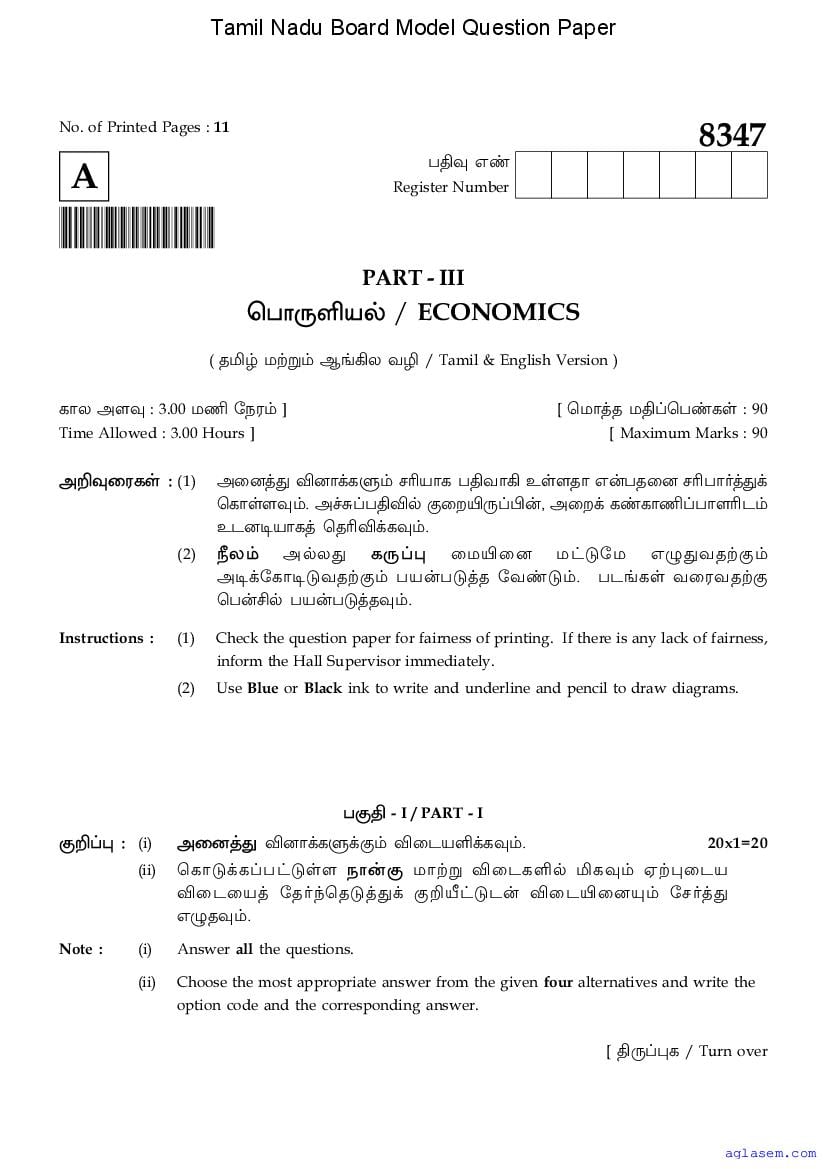
Tamil Nadu 12th Std Model Question Paper 2026 Economics is available here for free download. Published by Tamil Nadu Board for Class 12, this sample paper can be viewed online or downloaded as a PDF (11 pages). Candidates preparing for Class 12 can use Tamil Nadu 12th Std Model Question Paper 2026 Economics to understand the exam pattern, the type of questions asked, and the overall difficulty level.
Frequently Asked Questions
How can I download Tamil Nadu 12th Std Model Question Paper 2026 Economics?
Open this page and click the Download button to save Tamil Nadu 12th Std Model Question Paper 2026 Economics as a PDF. It is completely free on AglaSem Docs.
Is Tamil Nadu 12th Std Model Question Paper 2026 Economics free to download?
Yes. Tamil Nadu 12th Std Model Question Paper 2026 Economics can be viewed online and downloaded as a PDF free of cost on AglaSem Docs.
How many pages does Tamil Nadu 12th Std Model Question Paper 2026 Economics have?
Tamil Nadu 12th Std Model Question Paper 2026 Economics contains 11 pages, which you can read online or download together as a single PDF.
Where can I find more Class 12 study material?
You can find more Class 12 question papers, sample papers, syllabus, and answer keys on AglaSem Docs.
Tamil Nadu 12th Std Model Question Paper 2026 Economics – Text
Read the full text of this sample paper below — useful to quickly search, copy and reference the content online without downloading the PDF.
📄 View text version (11 pages)
Page 1
No. of Printed Pages : 11
8347
£vÄ Gs
A Register Number
!8347Economics!
PART - III
ö£õ¸Î¯À / ECONOMICS
( uªÌ ©ØÖ® B[Q» ÁÈ / Tamil & English Version )
Põ» AÍÄ : 3.00 ©o ÷|µ® ] [ ö©õzu ©v¨ö£sPÒ : 90
Time Allowed : 3.00 Hours ] [ Maximum Marks : 90
AÔÄøµPÒ : (1) AøÚzx ÂÚõUPЮ \›¯õP £vÁõQ EÒÍuõ GߣuøÚ \›£õºzxU
öPõÒÍÄ®. Aa_¨£vÂÀ SøÓ°¸¨¤ß, AøÓU PsPõo¨£õÍ›h®
EhÚi¯õPz öu›ÂUPÄ®.
(2) }»® AÀ»x P¸¨¦ ø©°øÚ ©mk÷© GÊxÁuØS®
AiU÷PõikÁuØS® £¯ß£kzu ÷Ásk®. £h[PÒ ÁøµÁuØS
ö£ß]À £¯ß£kzuÄ®.
Instructions : (1) Check the question paper for fairness of printing. If there is any lack of fairness,
inform the Hall Supervisor immediately.
(2) Use Blue or Black ink to write and underline and pencil to draw diagrams.
£Sv - I / PART - I
SÔ¨¦ : (i) AøÚzx ÂÚõUPÐUS® Âøh¯ÎUPÄ®. 20x1=20
(ii) öPõkUP¨£mkÒÍ |õßS ©õØÖ ÂøhPÎÀ ªPÄ® Hئøh¯
Âøhø¯z ÷uº¢öukzxU SÔ±mkhß Âøh°øÚ²® ÷\ºzx
GÊuÄ®.
Note : (i) Answer all the questions.
(ii) Choose the most appropriate answer from the given four alternatives and write the
option code and the corresponding answer.
[ v¸¨¦P / Turn over
Page 2
1. MPC=0.5 GÛÀ ö£¸UQ°ß ©v¨¦ :
(A) 0.2 (B) 2 (C) 20 (D) 1/2
If the MPC is 0.5, the value of multiplier is __________.
(a) 0.2 (b) 2 (c) 20 (d) 1/2
2. ÷PÒÂzuõÒ ‰»® ¦ÒÎ ÂÁµ® vµmh¨£mhõÀ Ax __________.
(A) öÁΰh¨ö£ØÓ ÂÁµ® (B) •uÀ{ø» ÂÁµ®
(C) öuõSUP¨£mh ÂÁµ® (D) Cµshõ®{ø» ÂÁµ®
The data collected by questionnaires are __________.
(a) Published data (b) Primary data
(c) Grouped data (d) Secondary data
3. RÌÁ¸ÁÚÁØÖÒ Gx ÷|º•P Á› ?
(A) Á¸©õÚ Á› (B) P»õÀ Á›
(C) ÷\øÁ Á› (D) _[P Á›
Which of the following is a direct tax ?
(a) Income tax (b) Excise duty
(c) Service tax (d) Customs duty
4. Âø»Áõ] ö©xÁõP E¯¸® ö£õÊx HØ£kÁx :
(A) £nÁõmh® (B) uõÄ® £nÃUP®
(C) ªu©õÚ £nÃUP® (D) E¯º £nÃUP®
When the prices rise slowly, we call it as :
(a) deflation (b) galloping inflation
(c) mild inflation (d) hyper inflation
A
Page 3
5. ÷á.G®. Rßì ö£õ¸ÍõuõµzvØS AÎzu £[PΨø£ SÔ¨¤kP.
(A) ‰»uÚ® (B) |õkPÎß ö\ÀÁ®
(C) ö£õx {v (D) ö£õxU ÷Põm£õk
Indicate the contribution of J.M. Keynes to Economics :
(a) Capital (b) Wealth of Nations
(c) Public Finance (d) General Theory
6. ""_ØÖa`ÇÀ ö\¯À£õkPÎß £õxPõ¨¦ Âv'' HØ£kzu¨£mh Bsk __________.
(A) 1999 (B) 1997 (C) 1996 (D) 1998
“Protection of the Environment Operations Act” was set up in __________.
(a) 1999 (b) 1997 (c) 1996 (d) 1998
7. {v B÷¯õUQß (NITI Aayog) B[Q» ›ÁõUP® ?
(A) National Institution to Transform India
(B) National Institute of Transport India
(C) National Institution for Transforming India
(D) National Institute for Trade in India
Expansion of NITI Aayog :
(a) National Institution to Transform India
(b) National Institute of Transport India
(c) National Institution for Transforming India
(d) National Institute for Trade in India
8. ¦v¯ £ßÚõmk ÁõoPU ÷Põm£õk Guß Ai¨£øh°À Aø©¢ux ?
(A) J¨¦ø©a ö\»Ä (B) •Êø©a ö\»Ä
(C) EØ£zvU PõµoU ÷Põm£õk (D) CÁØÖÒ GxĪÀø»
Which of the following is a Modern theory of International Trade ?
(a) Comparative cost (b) Absolute cost
(c) Factor Endowment theory (d) None of these
A [ v¸¨¦P / Turn over
Page 4
9. ö£¸UQ°ß ©v¨¦ __________.
(A) 1/(1−MPC) (B) 1/MPS (C) 1/MPC (D) (A) ©ØÖ® (B)
The value of multiplier is __________.
(a) 1/(1−MPC) (b) 1/MPS (c) 1/MPC (d) Both (a) and (b)
10. Põµ {»® AvP©õP __________ \©öÁΰÀ Põn¨£k®.
(A) ÁhC¢v¯ (B) P[øP
(C) ]¢x & P[øP (D) ÷©ØTÔ¯ AøÚzx®
Alkali Soils are predominantly located in the __________ plains.
(a) North-Indian (b) Gangetic
(c) Indus-Ganga (d) All the above
11. ""÷©U÷µõ'' (Macro) GßÓ ö\õÀø» AÔ•P¨£kzv¯Áº ¯õº ?
(A) ÷á.G®. Rß_ (B) µõUÚº ¤›U_
(C) PõµÀ ©õºU_ (D) Bh® ìªz
Who coined the word ‘Macro’ ?
(a) J.M. Keynes (b) Ragnar Frisch
(c) Karl Marx (d) Adam Smith
12. RÌPõq® G¢uz vmh®, ÷ÁÍõsø©ø¯²® Qµõ©¨ ö£õ¸Íõuõµzøu²®
ø©¯©õPU öPõshx ?
(A) Põ¢v¯z vmh® (B) ©UPÒ vmh®
(C) Âì÷Á_Áµ´¯õ vmh® (D) £õ®÷£ vmh®
Which of the following plan has focused on the agriculture and rural economy ?
(a) Gandhian plan (b) People’s plan
(c) Vishveshwarayya plan (d) Bombay plan
A
Page 5
13. •ußø©¨ £ØÓõUSøÓ=__________.
(A) ö©õzu ö\»Ä−ö©õzu ÁµÄ
(B) {v¨£ØÓõUSøÓ−Ámi ö\¾zxuÀ
(C) ö©õzu Á¸Áõ´ ö\»ÂÚ®−ö©õzu Á¸Áõ´ ÁµÄPÒ
(D) ÁµÄ ö\»Äz vmh¨ £ØÓõUSøÓ−Aµ]ß A[PõiU PhßPЮ
HøÚ¯ ö£õÖ¨¦PЮ
Primary Deficit (PD)=__________.
(a) Total Expenditure−Total Revenue
(b) Fiscal Deficit−Interest Payment
(c) Total Revenue Expenditure−Total Revenue Receipts
(d) Budget Deficit−Government Market borrowings and liabilities
14. 2016 &CÀ £n©v¨¦ }UP® G¢öu¢u ©v¨¦ £n[PÐUS HØ£kzu¨£mhx ?
(A) ` 500 ©ØÖ® ` 1000 (B) ` 200 ©ØÖ® ` 500
(C) ` 1000 ©ØÖ® ` 2000 (D) (A) ©ØÖ® (B)
2016 Demonetization of currency includes denominations of :
(a) ` 500 and ` 1000 (b) ` 200 and ` 500
(c) ` 1000 and ` 2000 (d) Both (a) and (b)
15. ÷Áø»Áõ´¨¦ £ØÔ öuõßø©U ÷Põm£õmiß ø©¯U P¸zx Gߣx __________.
(A) SøÓ¢x ö\À ÂøÍÄ Âv (B) A[Põi Âv
(C) ÷uøÁ Âv (D) ~PºÄ Âv
The core of the classical theory of employment is __________.
(a) Law of Diminishing Returns (b) Law of Markets
(c) Law of Demand (d) Law of Consumption
16. £ßÚõmk¨ £n {v¯® __________ ©õ|õmiÀ E¸ÁõUP¨£mhx.
(A) ¤›mhß Ämì (B) £õßk[
(C) ][P¨§º (D) ÷uõíõ
International Monetary Fund was an outcome of __________.
(a) Bretton Woods Conference (b) Pandung Conference
(c) Singapore Conference (d) Doha Conference
A [ v¸¨¦P / Turn over
Page 6
17. •ußø© xøÓ Gߣx __________.
(A) Pmhh® PmkuÀ (B) ÁoP®
(C) öuõÈÀ (D) ÷ÁÍõsø©
Primary sector is __________.
(a) Construction (b) Trade
(c) Industry (d) Agriculture
18. A¯À|õmka ö\¾zxa \©{ø»U TÖPÒ RÌUPõs£ÁØÔÀ GøÁ ?
(A) ø©¯ Á[Q wºÄ PnUS (B) ‰»uÚU PnUS
(C) |h¨¦ PnUS (D) ÷©ØTÔ¯ AøÚzx®
Components of Balance of Payments of a country include the :
(a) Official Settlement account (b) Capital account
(c) Current account (d) All of the above
19. \õºU Ea] ©õ|õk __________ BskPÐUöPõ¸•øÓ |øhö£ÖQÓx.
(A) 2 (B) 5 (C) 3 (D) 4
SAARC meets once in __________ years.
(a) 2 (b) 5 (c) 3 (d) 4
20. |£õºk Á[Q G¨ö£õÊx Bµ®¤UP¨£mhx ?
(A) áüø» 1982 (B) áüø» 1992
(C) áüø» 1962 (D) áüø» 1972
NABARD was started in __________.
(a) July 1982 (b) July 1992
(c) July 1962 (d) July 1972
A
Page 7
£Sv - II / PART - II
SÔ¨¦ : GøÁ÷¯Ý® HÊ ÂÚõUPÐUS Âøh¯ÎUPÄ®. ÂÚõ Gs 30 & US
Pmhõ¯©õP Âøh¯ÎUPÄ®. 7x2=14
Note : Answer any seven questions. Question No. 30 is Compulsory.
21. £nÃUP® GÝ® £uzvøÚ Áøµ¯ÖUPÄ®.
Define the term ‘Inflation’.
22. |õmk Á¸©õÚzøu Áøµ¯ÖUPÄ®.
Define National Income.
23. uØ÷£õxÒÍ `ǼÀ BÒ SøÓ¨¤ØPõÚ Põµnzøuz u¸P.
Give reasons for Labour retrenchment at present situation.
24. ""~PºÄ |õmh®'' GßÓõÀ GßÚ ?
What is meant by “Propensity to Consume” ?
25. CÖv {ø» ÷\ª¨¦ |õmh® (MPS) & Áøµ¯ÖUPÄ®.
Define Marginal Propensity to Save (MPS).
26. £nÁõmh® GßÓõÀ GßÚ ?
What is Deflation ?
27. Phß E¸ÁõUP® GßÓõÀ GßÚ ?
What is Credit Creation ?
28. ÁoP ÃuzvøÚ Áøµ¯ÖUPÄ®.
Define Terms of Trade.
A [ v¸¨¦P / Turn over
Page 8
29. G[S, G¨ö£õÊx \õºU uø»ø© A¾Á»P® xÁUP¨£mhx ?
When and where was SAARC Secretariat established ?
30. ÷u]¯ ©õv› TöÓkzuÀ A¾Á»P® (NSSO) £ØÔ GÊxP.
Write about National Sample Survey Office (NSSO).
£Sv - III / PART - III
SÔ¨¦ : GøÁ÷¯Ý® HÊ ÂÚõUPÐUS Âøh¯ÎUPÄ®. ÂÚõ Gs 40 &US
Pmhõ¯©õP Âøh¯ÎUPÄ®. 7x3=21
Note : Answer any seven questions. Question No. 40 is Compulsory.
31. ö£õ¸Íõuõµ •øÓPÎß ÁøPPøÍ SÔ¨¤kP.
Describe the types of Economic systems.
32. uø»Ãu Á¸©õÚ® £ØÔ J¸ ]Ö SÔ¨¦ ÁøµP.
Write a short note on Per Capita Income.
33. RÌPõs£ÚÁØÔØS _¸UP©õÚ Âøhø¯ GÊxP.
(i) £¸ÁPõ» ÷Áø»°ßø©
(ii) EhߣõiÀ»õ ÷Áø»°ßø©
(iii) PØ÷Óõº ÷Áø»°ßø©
Give short answer to the following.
(i) Seasonal Unemployment
(ii) Frictional Unemployment
(iii) Educated Unemployment
34. •kUQUS®, ö£¸UQUS® EÒÍ ÷ÁÖ£õkPøÍ ÂÍUSP.
Mention the differences between Accelerator and Multiplier effect.
35. ÷uøÁ Cʨ¦¨ £nÃUP®, ö\»Ä E¢x £nÃUP® BQ¯ÁØøÓ ÂÍUSP.
Explain Demand-Pull and Cost Push Inflation.
A
Page 9
36. ö\¯À£hõu ö\õzx £ØÔ ÂÁ›UPÄ®.
Describe about Non-Performing Asset.
37. uØPõ» Aµ]ß £oPÒ ¯õøÁ ?
What are the functions of Modern State ?
38. ¤ßÁ¸® ÂÁµ[PÐUS vmh»UPzvøÚU Põs.
14, 22, 9, 15, 20, 17, 12, 11.
Find the Standard Deviation of the following data :
14, 22, 9, 15, 20, 17, 12, 11.
39. PõØÖ ©õ_£ku¼ß £À÷ÁÖ ÁøPPøÍ ÂÍUSP.
Explain the different types of air pollution.
40. ¦Òΰ¯¼ß SøÓ£õkPÒ H÷uÝ® ‰ßÔøÚU SÔ¨¤kP.
Mention any three Limitations of Statistics.
£Sv - IV / PART - IV
SÔ¨¦ : AøÚzx ÂÚõUPÐUS® Âøh¯ÎUPÄ®. 7x5=35
Note : Answer all the questions.
41. (A) |hÁiUøPPÒ Ai¨£øh°À J¸ ö£õ¸Íõuõµ Aø©¨¦ ö\¯À£kÁøu
ÂÁ›.
AÀ»x
(B) £À÷ÁÖ ÁøP¯õÚ vmhªhÀ ÁøPPøÍ ÂÁ›.
(a) Illustrate the functioning of an economy based on its activities.
OR
(b) Describe different types of Planning.
A [ v¸¨¦P / Turn over
Page 10
42. (A) |õmk Á¸©õÚ® PnURmiÀ EÒÍ ]UPÀPÒ ¯õøÁ ?
AÀ»x
(B) öuõßø©U ÷Põm£õk, Rß_ ÷Põm£õk BQ¯ÁØÔØS Cøh°»õÚ
÷ÁÖ£õkPøÍ ÂÍUSP.
(a) What are the difficulties involved in the measurement of National Income ?
OR
(b) Explain the differences between Classical theory and Keyne’s theory.
43. (A) ‰»uÚzvß CÖv{ø» EØ£zv vÓÝUS® (MEC) •u½miß CÖv{ø» EØ£zv
vÓÝUS® (MEI) EÒÍ ÷ÁÖ£õkPÒ ¯õøÁ ?
AÀ»x
(B) CºÂ[ L¤å›ß £n AÍÄU ÷Põm£õmiøÚ ÂÍUSP.
(a) What are the differences between Marginal Efficiency of Capital (MEC) and Marginal
Efficiency of Investment (MEI) ?
OR
(b) Illustrate Irving Fisher’s Quantity theory of Money.
44. (A) £n¯À öPõÒøP°ß ÷|õUP[PÒ ¯õøÁ ? ÂÍUSP.
AÀ»x
(B) ¦v¯ £ßÚõmk ÁõoPU ÷Põm£õmiøÚ ÂÁõvUPÄ®.
(a) What are the objectives of Monetary Policy ? Explain.
OR
(b) Discuss the Modern Theory of International Trade.
45. (A) SÔ¨¦ GÊxP : (i) \õºU (ii) ¨›Uì
AÀ»x
(B) Aµ_a ö\»Ä AvP›¨£uØPõÚ Põµn[PÒ ¯õøÁ ?
(a) Write a note on : (i) SAARC (ii) BRICS
OR
(b) What are the reasons for the recent growth in Public Expenditure ?
A
Page 11
46. (A) ÁµÄ ö\»Äz vmhzvÀ EÒÍ £»ÁøP¨ £ØÓõUSøÓPøÍ ÂÍUSP.
AÀ»x
(B) ¦Ó ÂøÍÄPÒ GßÓ P¸zvøÚ²® Auß ÁøP£õkPøͲ® ÂÍUSP.
(a) Describe the various types of deficit in budget.
OR
(b) Explain the concepts of externality and its classification.
47. (A) ö£õ¸Íõuõµ AÍøÁ°¯¼ß ÷|õUP[PÒ ¯õøÁ ?
AÀ»x
(B) ¤ßÁ¸® ÂÁµ[PÐUS PõºÀ ¤¯º\Ûß Eh¢öuõhº¦U öPÊÂøÚU
PshÔP.
÷uøÁ X : 23 27 28 29 30 31 33 35 36 39
ÂØ£øÚ Y : 18 22 23 24 25 26 28 29 30 32
(a) What are the objectives of Econometrics ?
OR
(b) Calculate the Karl Pearson’s Correlation Co-efficient for the following data.
Demand of
23 27 28 29 30 31 33 35 36 39
Product X :
Sale of
18 22 23 24 25 26 28 29 30 32
Product Y :
-oOo-
A [ v¸¨¦P / Turn over
Document Details
| Board / Org | Tamil Nadu Board |
| Exam | Class 12 |
| Type | Sample Paper |
| Pages | 11 |
| Updated | 24 Sep 2026 |