TBSE Class 11 Syllabus 2024 Physics
Finished viewing? Save it for later —
Download TBSE Class 11 Syllabus 2024 Physics (PDF · 9 pages)About TBSE Class 11 Syllabus 2024 Physics
TBSE Class 11 Syllabus 2024 Physics is available here for free download. Published by Tripura Board for Class 11, this syllabus can be viewed online or downloaded as a PDF (9 pages). Candidates preparing for Class 11 can use TBSE Class 11 Syllabus 2024 Physics to understand the exam pattern, the type of questions asked, and the overall difficulty level.
Frequently Asked Questions
How can I download TBSE Class 11 Syllabus 2024 Physics?
Open this page and click the Download button to save TBSE Class 11 Syllabus 2024 Physics as a PDF. It is completely free on AglaSem Docs.
Is TBSE Class 11 Syllabus 2024 Physics free to download?
Yes. TBSE Class 11 Syllabus 2024 Physics can be viewed online and downloaded as a PDF free of cost on AglaSem Docs.
How many pages does TBSE Class 11 Syllabus 2024 Physics have?
TBSE Class 11 Syllabus 2024 Physics contains 9 pages, which you can read online or download together as a single PDF.
Where can I find more Class 11 study material?
You can find more Class 11 question papers, sample papers, syllabus, and answer keys on AglaSem Docs.
TBSE Class 11 Syllabus 2024 Physics – Text
Read the full text of this syllabus below — useful to quickly search, copy and reference the content online without downloading the PDF.
📄 View text version (9 pages)
Page 1
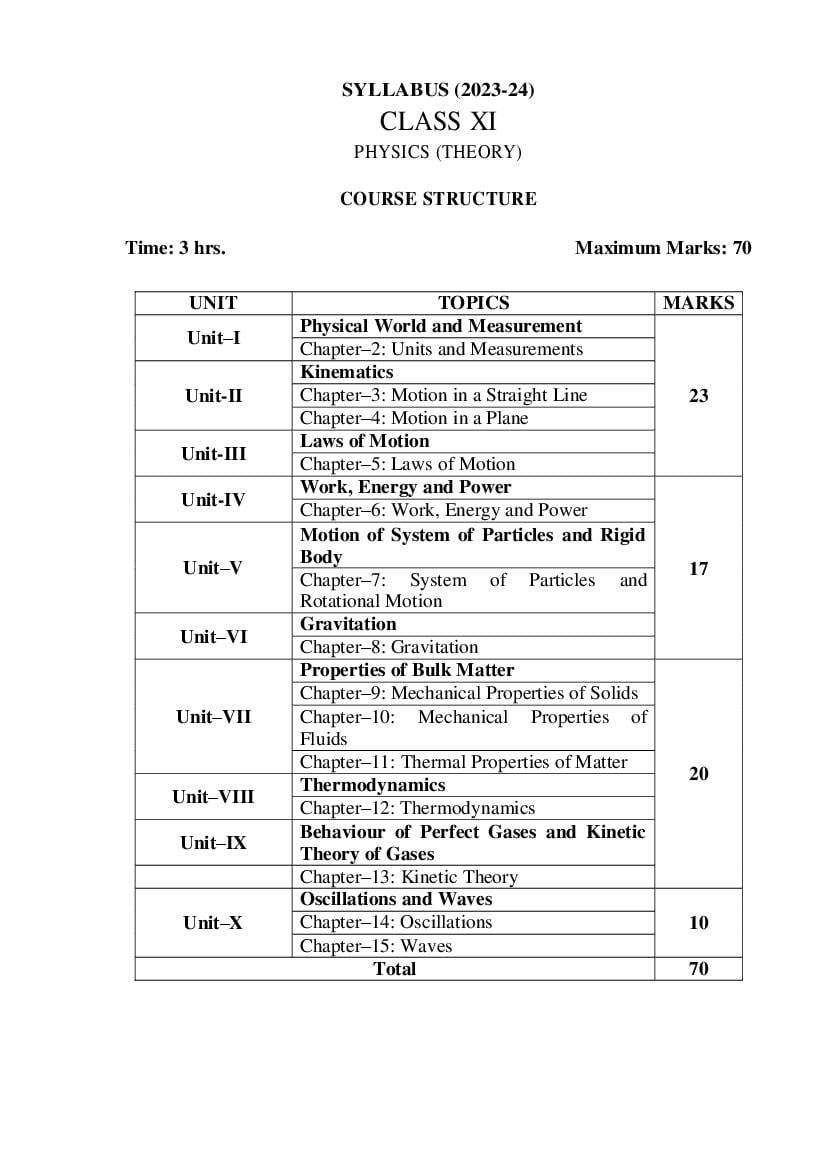
CLASS XI
PHYSICS (THEORY)
COURSE STRUCTURE
Time: 3 hrs. Maximum Marks: 70
UNIT TOPICS MARKS
Physical World and Measurement
Unit–I
Chapter–2: Units and Measurements
Kinematics
Unit-II Chapter–3: Motion in a Straight Line 23
Chapter–4: Motion in a Plane
Laws of Motion
Unit-III
Chapter–5: Laws of Motion
Work, Energy and Power
Unit-IV
Chapter–6: Work, Energy and Power
Motion of System of Particles and Rigid
Body
Unit–V 17
Chapter–7: System of Particles and
Rotational Motion
Gravitation
Unit–VI
Chapter–8: Gravitation
Properties of Bulk Matter
Chapter–9: Mechanical Properties of Solids
Unit–VII Chapter–10: Mechanical Properties of
Fluids
Chapter–11: Thermal Properties of Matter
20
Thermodynamics
Unit–VIII
Chapter–12: Thermodynamics
Behaviour of Perfect Gases and Kinetic
Unit–IX
Theory of Gases
Chapter–13: Kinetic Theory
Oscillations and Waves
Unit–X Chapter–14: Oscillations 10
Chapter–15: Waves
Total 70
Page 2
Chapter–2: Units and Measurements
Need for measurement: Units of measurement; systems of units; SI units,
fundamental and derived units. significant figures. Dimensions of physical quantities,
dimensional analysis and its applications.
Unit II: Kinematics
Chapter–3: Motion in a Straight Line
Frame of reference, Motion in a straight line, Elementary concepts of
differentiation and integration for describing motion, uniform and non- uniform
motion, and instantaneous velocity, uniformly accelerated motion, velocity - time and
position-time graphs. Relations for uniformly accelerated motion (graphical
treatment).
Chapter–4: Motion in a Plane
Scalar and vector quantities; position and displacement vectors, general vectors
and their notations; equality of vectors, multiplication of vectors by a real number;
addition and subtraction of vectors, Unit vector; resolution of a vector in a plane,
rectangular components, Scalar and Vector product of vectors.
Motion in a plane, cases of uniform velocity and uniform acceleration-
projectile motion, uniform circular motion.
Unit III: Laws of Motion
Chapter–5: Laws of Motion
Intuitive concept of force, Inertia, Newton's first law of motion; momentum and
Newton's second law of motion; impulse; Newton's third law of motion.
Law of conservation of linear momentum and its applications.
Equilibrium of concurrent forces, Static and kinetic friction, laws of friction,
rolling friction, lubrication.
Dynamics of uniform circular motion: Centripetal force, examples of circular
motion (vehicle on a level circular road, vehicle on a banked road).
Unit IV: Work, Energy and Power
Chapter–6: Work, Energy and Power
Work done by a constant force and a variable force; kinetic energy, work-
energy theorem, power.
Notion of potential energy, potential energy of a spring, conservative forces:
non- conservative forces, motion in a vertical circle; elastic and inelastic collisions in
one and two dimensions.
Unit V: Motion of System of Particles and Rigid Body
Chapter–7: System of Particles and Rotational Motion
Centre of mass of a two-particle system, momentum conservation and Centre of
mass motion. Centre of mass of a rigid body; centre of mass of a uniform rod.
Moment of a force, torque, angular momentum, law of conservation of angular
momentum and its applications.
Equilibrium of rigid bodies, rigid body rotation and equations of rotational
motion, comparison of linear and rotational motions.
Page 3
geometrical objects (no derivation).
Unit VI: Gravitation
Chapter–8: Gravitation
Kepler's laws of planetary motion, universal law of gravitation. Acceleration
due to gravity and its variation with altitude and depth.
Gravitational potential energy and gravitational potential, escape velocity,
orbital velocity of a satellite.
Unit VII: Properties of Bulk Matter Chapter–
9: Mechanical Properties of Solids
Elasticity, Stress-strain relationship, Hooke's law, Young’s modulus, bulk
modulus, shear modulus of rigidity (qualitative idea only), Poisson's ratio; elastic
energy.
Chapter–10: Mechanical Properties of Fluids
Pressure due to a fluid column; Pascal's law and its applications (hydraulic lift
and hydraulic brakes), effect of gravity on fluid pressure.
Viscosity, Stokes' law, terminal velocity, streamline and turbulent flow, critical
velocity, Bernoulli's theorem and its simple applications.
Surface energy and surface tension, angle of contact, excess of pressure across a
curved surface, application of surface tension ideas to drops, bubbles and capillary
rise.
Chapter–11: Thermal Properties of Matter
Heat, temperature, thermal expansion; thermal expansion of solids, liquids and
gases, anomalous expansion of water; specific heat capacity; C p, Cv - calorimetry;
change of state - latent heat capacity.
Heat transfer-conduction, convection and radiation, thermal conductivity,
qualitative ideas of Blackbody radiation, Wein's displacement Law, Stefan's law.
Unit VIII: Thermodynamics
Chapter–12: Thermodynamics
Thermal equilibrium and definition of temperature zeroth law of
thermodynamics, heat, work and internal energy. First law of thermodynamics,
Second law of thermodynamics: gaseous state of matter, change of conditionof
gaseous state -isothermal, adiabatic, reversible, irreversible, and cyclic processes.
Unit IX: Behavior of Perfect Gases and Kinetic Theory of Gases
Chapter–13: Kinetic Theory
Equation of state of a perfect gas, work done in compressing a gas.
Kinetic theory of gases - assumptions, concept of pressure. Kinetic
interpretation of temperature; rms speed of gas molecules; degrees of freedom, law of
equi-partition of energy (statement only) and application to specific heat capacities of
gases; concept of mean free path, Avogadro's number.
Unit X: Oscillations and Waves
Chapter–14: Oscillations
Periodic motion - time period, frequency, displacement as a function of time,
periodic functions and their application.
Page 4
oscillations of a loaded spring- restoring force and force constant; energy in S.H.M.
Kinetic and potential energies; simple pendulum derivation of expression for its time
period.
Chapter–15: Waves
Wave motion: Transverse and longitudinal waves, speed of travelling wave,
displacement relation for a progressive wave, principle of superposition of waves,
reflection of waves, standing waves in strings and organ pipes, fundamental mode and
harmonics, Beats.
SYLLABUS FOR HALF-YEARLY EXAMINATION
PHYSICS (THEORY)
Time: 3 hrs. Maximum Marks: 70
UNIT TOPICS MARKS
Physical World and Measurement
Unit–I
Chapter–2: Units and Measurements
Kinematics
Unit-II Chapter–3: Motion in a Straight Line 40
Chapter–4: Motion in a Plane
Laws of Motion
Unit-III
Chapter–5: Laws of Motion
Work, Energy and Power
Unit-IV
Chapter–6: Work, Energy and Power
Motion of System of Particles and Rigid
Body
Unit–V 30
Chapter–7: System of Particles and
Rotational Motion
Gravitation
Unit–VI
Chapter–8: Gravitation
Total 70
SYLLABUS FOR ANNUAL EXAMINATION
PHYSICS (THEORY)
Time: 3 hrs. Maximum Marks: 70
UNIT TOPICS MARKS
Properties of Bulk Matter
Chapter–9: Mechanical Properties of Solids
Unit–VII Chapter–10: Mechanical Properties of 24
Fluids
Chapter–11: Thermal Properties of Matter
Thermodynamics
Unit–VIII
Chapter–12: Thermodynamics
Behaviour of Perfect Gases and Kinetic 22
Unit–IX
Theory of Gases
Chapter–13: Kinetic Theory
Page 5
Unit–X Chapter–14: Oscillations 24
Chapter–15: Waves
Total 70
PRACTICALS
The record, to be submitted by the students, at the time of their annual
examination, has to include:
• Record of at least 6 Experiments [with 3 from each section], to be performed
by the students.
EVALUATION SCHEME
Time 3 hours Maximum Marks: 30
Topic Marks
Two experiments one from each section 10+10
Practical record (experiment and activities) 3
Attendance 5
Viva on experiments 2
TOTAL 30
SECTION–A
Experiments
1. To measure diameter of a small spherical/cylindrical body and to measure
internal diameter and depth of a given beaker/calorimeter using Vernier
Calipers and hence find its volume.
2. To measure diameter of a given wire and thickness of a given sheet using screw
gauge.
3. To determine volume of an irregular lamina using screw gauge.
4. To determine radius of curvature of a given spherical surface by a spherometer.
5. Using a simple pendulum, plot its L-T2 graph and use it to find the effective
length of second's pendulum.
6. To study variation of time period of a simple pendulum of a given length by
taking bobs of same size but different masses and interpret the result.
SECTION–B
Experiments
1. To determine Young's modulus of elasticity of the material of a given wire.
2. To determine the surface tension of water by capillary rise method.
3. To determine the coefficient of viscosity of a given viscous liquid by measuring
terminal velocity of a given spherical body.
4. To study the relation between frequency and length of a given wire under
constant tension using sonometer.
5. To study the relation between the length of a given wire and tension for constant
frequency using sonometer.
6. To find the speed of sound in air at room temperature using a resonance tube by
two resonance positions.
Page 6
1. Physics Part-I, Textbook for Class XI, Published by NCERT/SCERT.
2. Physics Part-II, Textbook for Class XI, Published by NCERT/SCERT.
3. Laboratory Manual of Physics, Class XI Published by NCERT.
4. The list of other related books and manuals brought out by NCERT (consider
multimedia also).
Note: The content indicated in NCERT textbooks as excluded for the year
2023-2024 is not to be tested by schools.
Page 7
PHYSICS - XI
FOR THE SESSION 2023-2024
HALF-YEARLY EXAMINATION
Unit Unit Wise MCQ VSA SA MA LA VLA TOTAL
Chapter/Contents Marks (1 mark) (1 marks) (2 marks) (3 Marks) (4 Marks) (5 Marks) Marks
Unit -I Physical World and
Measurement
10 1 4 2x1 3x1 - -
Chapter–1: Physical
World
Chapter–2: Units and
Measurements 40
Kinematics
Unit-II
Chapter–3: Motion in a
14 2 5 2x2 3x1 - -
Straight Line
Chapter–4: Motion in a
Plane
Laws of Motion
Unit -III Chapter–5: Laws of 16 3 4 2x2 - - 5x1
Motion
Unit-IV Work, Energy and Power
8 2 3 0 3x1 - -
Chapter-6:Work,
Energy and Power 30
Page 8
Chapter/Contents Marks (1 mark) (1 marks) (2 marks) (3 Marks) (4 Marks) (5 Marks) Marks
Motion of System of
Unit -V Particles and Rigid Body
12 1 2 - - 4x1 5x1
Chapter–7: System of
Particles and Rotational
Motion
Gravitation
Unit –VI Chapter–8: Gravitation 10 1 2 0 3x1 4x1
Total Question / Marks 10 20 10 12 8 10 70
BLUE-PRINT OF QUESTION PAPER
PHYSICS - XI
FOR THE SESSION 2023-2024
ANNUAL EXAMINATION
Unit Chapter/Contents Unit Wise MCQ VSA SA (2 MA LA VLA TOTAL
Marks) (1 mark) (1 marks) marks) (3 Marks) (4 Marks) (5 Marks)
Unit–VII Properties of Bulk Matter
Chapter–9: Mechanical
Properties of Solids
30 5 9 2x2 3x1 4x1 5x1
Chapter–10: Mechanical
46
Properties of Fluids
Chapter–11: Thermal
Properties of Matter
Page 9
Marks) (1 mark) (1 marks) marks) (3 Marks) (4 Marks) (5 Marks)
Thermodynamics
Unit-VIII Chapter–12: 10 2 3 2x1 3x1 - -
Thermodynamics
Unit–IX Behaviour of Perfect
Gases and Kinetic Theory
of Gases 6 1 2 0 3x1 - -
Chapter–13: Kinetic Theory
Unit–X Oscillations and Waves
Chapter–14: Oscillations 24 2 6 2x 2 3x1 4x1 5x1 24
Chapter–15: Waves
Total Questions/Marks 10 20 10 12 8 10 70