Uttarakhand Board Class 12 Syllabus 2025
Finished viewing? Save it for later —
Download Uttarakhand Board Class 12 Syllabus 2025 (PDF · 159 pages)About Uttarakhand Board Class 12 Syllabus 2025
Uttarakhand Board Class 12 Syllabus 2025 is available here for free download. Published by Uttarakhand Board for Class 12, this syllabus can be viewed online or downloaded as a PDF (159 pages). Candidates preparing for Class 12 can use Uttarakhand Board Class 12 Syllabus 2025 to understand the exam pattern, the type of questions asked, and the overall difficulty level.
Frequently Asked Questions
How can I download Uttarakhand Board Class 12 Syllabus 2025?
Open this page and click the Download button to save Uttarakhand Board Class 12 Syllabus 2025 as a PDF. It is completely free on AglaSem Docs.
Is Uttarakhand Board Class 12 Syllabus 2025 free to download?
Yes. Uttarakhand Board Class 12 Syllabus 2025 can be viewed online and downloaded as a PDF free of cost on AglaSem Docs.
How many pages does Uttarakhand Board Class 12 Syllabus 2025 have?
Uttarakhand Board Class 12 Syllabus 2025 contains 159 pages, which you can read online or download together as a single PDF.
Where can I find more Class 12 study material?
You can find more Class 12 question papers, sample papers, syllabus, and answer keys on AglaSem Docs.
Uttarakhand Board Class 12 Syllabus 2025 – Text
Read the full text of this syllabus below — useful to quickly search, copy and reference the content online without downloading the PDF.
📄 View text version (158 pages)
Page 1
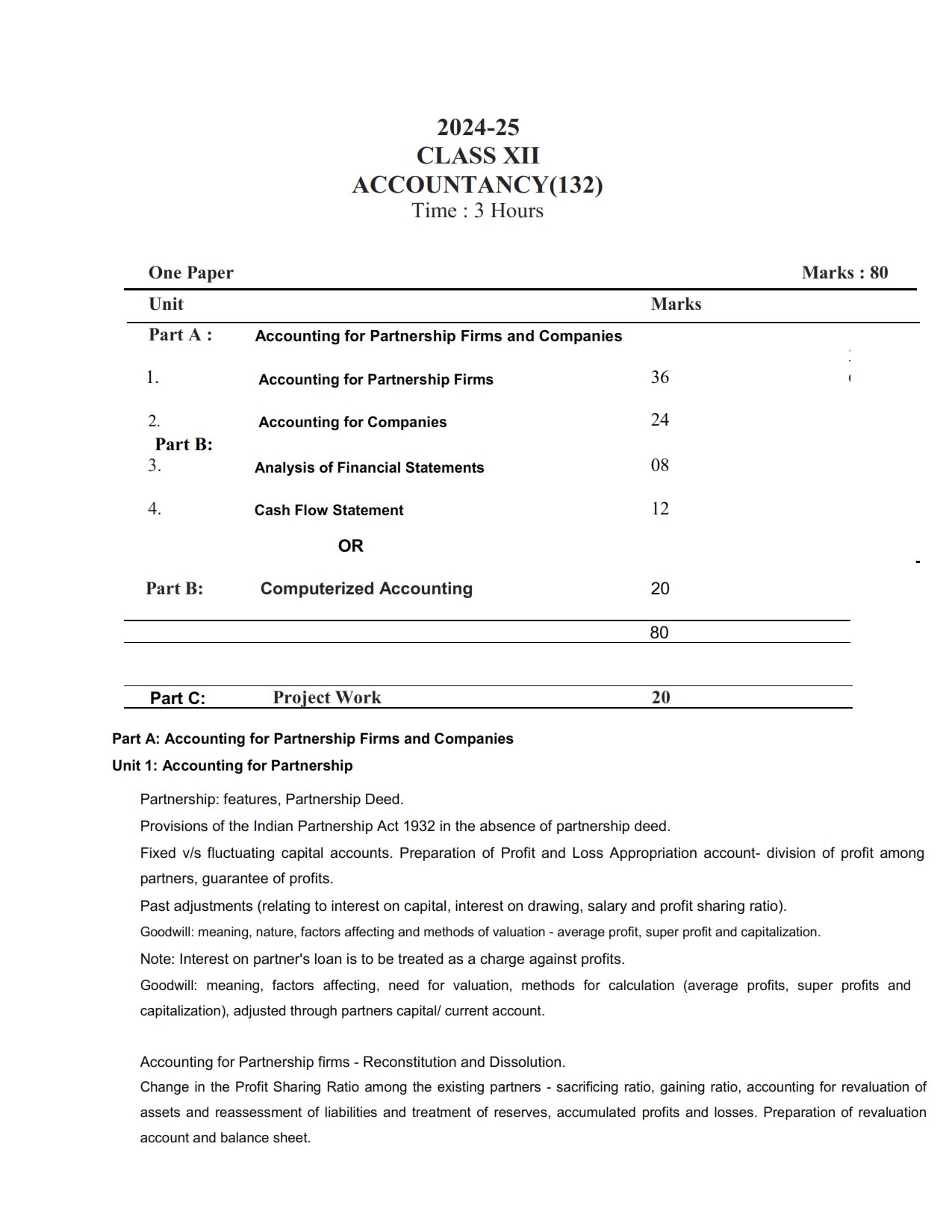
CLASS XII
ACCOUNTANCY(132)
Time : 3 Hours
One Paper Marks : 80
Unit Marks
Part A : Accounting for Partnership Firms and Companies
3
1. Accounting for Partnership Firms 36 6
2. Accounting for Companies 24
Part B:
3. Analysis of Financial Statements 08
4. Cash Flow Statement 12
OR
Part B: Computerized Accounting 20
80
Part C: Project Work 20
Part A: Accounting for Partnership Firms and Companies
Unit 1: Accounting for Partnership
Partnership: features, Partnership Deed.
Provisions of the Indian Partnership Act 1932 in the absence of partnership deed.
Fixed v/s fluctuating capital accounts. Preparation of Profit and Loss Appropriation account- division of profit among
partners, guarantee of profits.
Past adjustments (relating to interest on capital, interest on drawing, salary and profit sharing ratio).
Goodwill: meaning, nature, factors affecting and methods of valuation - average profit, super profit and capitalization.
Note: Interest on partner's loan is to be treated as a charge against profits.
Goodwill: meaning, factors affecting, need for valuation, methods for calculation (average profits, super profits and
capitalization), adjusted through partners capital/ current account.
Accounting for Partnership firms - Reconstitution and Dissolution.
Change in the Profit Sharing Ratio among the existing partners - sacrificing ratio, gaining ratio, accounting for revaluation of
assets and reassessment of liabilities and treatment of reserves, accumulated profits and losses. Preparation of revaluation
account and balance sheet.
Page 2
26), treatment for revaluation of assets and re-assessment of liabilities, treatment of reserves, accumulated profits and losses,
adjustment of capital accounts and preparation of capital, current account and balance sheet.
Retirement and death of a partner: effect of retirement / death of a partner on change in profit sharing ratio, treatment of goodwill
(as per AS 26), treatment for revaluation of assets and reassessment of liabilities, adjustment of accumulated profits, losses and
reserves, adjustment of capital accounts and preparation of capital, current account and balance sheet. Preparation of loan
account of the retiring partner.
Calculation of deceased partner’s share of profit till the date of death. Preparation of deceased partner’s capital account and
his executor’s account.
Dissolution of a partnership firm: meaning of dissolution of partnership and partnership firm, types of dissolution of a firm. Settlement of
accounts - preparation of realization account, and other related accounts: capital accounts of partners and cash/bank a/c
(excluding piecemeal distribution, sale to a company and insolvency of partner(s)).
Note:
(i) If the realized value of tangible assets is not given it should be considered as realized at book value itself.
(ii) If the realized value of intangible assets is not given it should be considered as nil (zero value).
(ii) In case, the realization expenses are borne by a partner, clear indication should be given regarding the payment
thereof.
Unit-2 Accounting for Companies
Features and types of companies.
Share and share capital: nature and types.
Accounting for share capital: issue and allotment of equity and preferences shares. Public subscription of shares - over
subscription and under subscription of shares; issue at par and at premium, calls in advance and arrears (excluding
interest), issue of shares for consideration other than cash.
Concept of Private Placement and Employee Stock Option Plan (ESOP), Sweat Equity.
Accounting treatment of forfeiture and re-issue of shares.
Disclosure of share capital in the Balance Sheet of a company.
Accounting for Debentures
Debentures: Meaning, types, Issue of debentures at par, at a premium and at a discount. Issue of debentures for consideration
other than cash; Issue of debentures with terms of redemption; debentures as collateral security-concept, interest on debentures
(concept of TDS is
excluded). Writing off discount / loss on issue of debentures.
Note: Discount or loss on issue of debentures to be written off in the year debentures are allotted from Security Premium
Reserve (if it exists) and then from Statement of Profit and Loss as Financial Cost (AS 16)
Page 3
Unit 3: Analysis of Financial Statements
Financial statements of a Company: Meaning, Nature, Uses and importance of financial Statement. Statement of
Profit and Loss and Balance Sheet in prescribed form with major headings and sub headings (as per Schedule III to
the Companies Act, 2013)
Note: Exceptional items, extraordinary items and profit (loss) from discontinued operations are excluded.
Financial Statement Analysis: Meaning, Significance Objectives, importance and limitations.
Tools for Financial Statement Analysis: Comparative statements, common size statements, Ratio analysis, Cash
flow analysis.
Accounting Ratios: Meaning, Objectives, Advantages, classification and computation.
Liquidity Ratios: Current ratio and Quick ratio.
Solvency Ratios: Debt to Equity Ratio, Total Asset to Debt Ratio, Proprietary Ratio and Interest Coverage Ratio. Debt
to Capital Employed Ratio.
Activity Ratios: Inventory Turnover Ratio, Trade Receivables Turnover Ratio, Trade Payables Turnover Ratio, Fixed Asset
Turnover Ratio, Net Asset Turnover Ratio and Working Capital Turnover Ratio.
Profitability Ratios: Gross Profit Ratio, Operating Ratio, Operating Profit Ratio, Net Profit Ratio and Return on Investment.
Unit 4: Cash Flow Statement
Meaning, objectives Benefits, Cash and Cash Equivalents, Classification of Activities and preparation (as per AS 3
(Revised) (Indirect Method only)
Note:
(i) Adjustments relating to depreciation and amortization, profit or loss on sale of assets including investments, dividend (both
final and interim) and tax.
(ii) Bank overdraft and cash credit to be treated as short term borrowings.
Current Investments to be taken as Marketable securities unless otherwise specified
Note: Previous years’ Proposed Dividend to be given effect, as prescribed in AS-4, Events occurring after the Balance
Sheet date. Current years’ Proposed Dividend will be accounted for in the next year after it is declared by the
shareholders
OR
Part B: Computerised Accounting
Computerised Accounting
Overview of Computerised Accounting System
Introduction: Application in Accounting.
Features of Computerised Accounting System. Structure of CAS.
Software Packages: Generic; Specific; Tailored.
Accounting Application of Electronic Spreadsheet.
Concept of electronic spreadsheet.
Features offered by electronic spreadsheet.
Application in generating accounting information - bank reconciliation statement; asset accounting; loan repayment of
loan schedule, ratio analysis
Data representation- graphs, charts and diagrams.
Using Computerized Accounting System.
Page 4
validation and verification.
Adjusting entries, preparation of balance sheet, profit and loss account with closing entries and opening entries.
Need and security features of the system.
Project Work
One specific project based on financial statement analysis of a company covering any two aspects from the following:
1. Comparative and common size financial statements
2. Accounting Ratios
3. Segment Reports
4. Cash Flow Statements
Project work Evaluation Scheme
1-Project Work Marks
a) Relevance of the topic 3
b) Knowledge content /Research Work 3
c) Presentation Technique 3
d) Viva based on project 6
2- Continuous assessment (Unit Test) 5
Total 20
Prescribed Books:
Financial Accounting –I Class XI NCERT Publication
Accountancy –II Class XI NCERT Publication
Accountancy –I Class XII NCERT Publication
Accountancy –II Class XII NCERT Publication
Accountancy – Computerised Accounting System Class XII NCERT Publication
Page 5
d`f’k 'kL; foKku ¼139½
d{kk&12
‘k’Be iz”u&i=
lS)kfUrd
iw.kkZd
a &50 le;% 3 ?k.Vk
'kL; foKku ¼flapkbZ] ty fudkl ,oa 'kkd rFkk Qy lao/kZu½&
1&flapkbZ rFkk ty fudkl&Qlyksa dks ikuh dh vko';drk] tyeku izLrko ,oa mldk e`nk
xBu ls lEcU/k] flapkbZ ty ds viO;; dh jksdFkke] flapkbZ ty ds xq.k vkSj muds izHkkoA 10
2&flapkbZ dh iz.kkfy;ka ,oa fof/k;ka& Hkjko] flapkbZ Fkkyk fof/k] ckSNkjh flapkbZ] fMªi flapkbZ] mBko
flapkbZ] rksM+ flapkbZ] iÍh flapkbZ ¼okMZj fof/k½ izR;sd ds ykHk vkSj lhek;sAa 05
3&flapkbZ ty dh eki&ch dVko gsDVs;j] ls0 eh0] ehVj eki dh iz.kkyhA 05
4&ty fudkl dh vko';drk& feÍh esa vfr ueh ls gkfu;ka] Hkwfe fodkj ,oa lq/kkj ¼vEyh;
fefV~V;ka] mudk cuuk] jksdFkke ,oa lq/kkj] {kkjh; ,oa iz{ks= Qke ½A 05
5&nSoh vkink;s& a ck<+] vfro`f’V] vuko`f’V] miyo`f’V] HkwdEi vkfn dk Lo:i] laons u'khy {ks=] gkfu]
fu;a=.k ds mik;A 05
6&'kkd rFkk Qy lao)Zu&fuEufyf[kr 'kkdksa rFkk Qyksa dh Qlyksa dk v/;;u] laLrqr iztkfr;ka
rFkk muds eq[; xq.k] izns'k ds mi;qDr {ks=] cksus dk le;] cht cksus dh fof/k] [kkn nsus ] flapkbZ
djuk] jksx ,oa dhV igpku ,oa fuokj.k] mit ,oa chtksRiknuA 20
¼d½ xksHkh oxhZ; Qlysa&Qwy xksHkh] xkaB xksHkhA
¼[k½ cYo Qlys& a I;kt]A
¼x½ dqdqjfcV& ykSdh] dn~n]w djsyk] [kjcwtk] rqjbZ A
¼?k½ tM+ Qlys& a xktj] ewyh] 'kyte] “kdjdUn A
¼p½ ysX;we&eVjA
¼N½ elkys&yky fepZA
¼t½ fofo/k&cSxu] VekVj] fHk.MhA
¼>½ dsyk] lso] yhph] vke] ve:n] iihrk] csj] uhacw] vkMwA
¼´½ iq"i mRiknu& xqykc A
1
Page 6
'kkd Qlyksa dks mxkuk vkSj mudh ckn dh ns[kHkky] ulZjh rS;kj djuk vkSj muds cht mRiknu
¼fl)kUr½ fuEufyf[kr fØ;kvksa esa vH;kl&
¼d½ ,d o"khZ; 'kkd Qlyksa dh cht 'kkf;dk dh fofHké ;=aksa }kjk rS;kjhA
¼[k½ gkFk rFkk cSyksa ls pfyr ;a=ksa }kjk varjd"kZ.kA
¼x½ izfrp;u fof/k ls mit dk vuqekuA
¼?k½ fofHké fof/k;ksa ls flapkbZ rFkk flapkbZ dh ykxrA
¼³½ [kkn rFkk moZjdksa ds 'kkd Qlyksa ds lanHkZ esa iz;ksx dh fof/k;kaA
¼p½ 'kkd&Hkkth ds cht rFkk lEcfU/kr [kj&irokjksa dh igpkuA
¼N½ 'kkd&Hkkth ds eq[; chekfj;ksa rFkk dhVksa dh igpkuA
¼t½ chekfj;ksa rFkk dhM+ksa ds fuokj.k ds fy;s nokb;ksa dk ?kksy cukuk rFkk MLVj ,oa Lizs;j dk
iz;ksxA
Nk= fdlkuksa ds 'kkd QkeksZa esa v/;;u djus Hkze.kkFkZ tk;sx a sA iz;ksxkRed dk;Z] Qlyksa dk eq[;
voyksduksa rFkk Hkze.k LFkkuksa ds v/;;u dk vfHkys[k j[kk tk;sxkA
iqLrds&a
fo"k; v/;kid ds ijke'kZ ls ikB~;Øe ds vuq:i iqLrd dk p;u dj ysAa
vf/kdre vad % 50 U;wure mRrh.kkZd
a % 17 le; % 03 ?kaVk
oká ijh{kd }kjk ewY;kadu & 25 vad
1&cht 'kS¸;k dk fuekZ.k 07 vad
2&ekSf[kdh 06 vad
3&¼d½ vkafdd iz'u }kjk [kkn dh x.kuk djuk& 06 vad
¼[k½ Qlyksa dh flapkbZ ls lEcfU/kr vkafdd iz'u& 06 vad
vkUrfjd ijh{kd }kjk ewY;kadu & 25 vad
1&cht] [kj&irokj] [kkn rFkk Qlyksa dh igpku 10 vad
2&vH;kl iqfLrdk 05 vad
3&izkstsDV 05 vad
4& lrr ewY;kadu ¼bdkbZ ijh{kk½ 05 vad
uksV&vH;kl iqfLrdk ,oa izkstsDV dk;Z fo|kfFkZ;ksa }kjk ifj"knh; iz;ksxkRed ijh{kk ds le; izLrqr
djuk vfuok;Z gksxkA
O;fDrxr ijh{kkfFkZ;ksa dh iz;ksxkRed ijh{kk&
O;fDrxr ijh{kkfFkZ;ksa dh iz;ksxkRed ijh{kk gsrq tks fo|ky; iz;ksxkRed ijh{kk dsUnz fu/kkZfjr fd;s
tk;sx
a s] mu fo|ky;ksa ds lEcfU/kr fo"k;ksa ds v/;kid }kjk vkUrfjd ijh{kd :i esa O;fDrxr
ijh{kkfFkZ;ksa dks ipkl izfr'kr vad iznku fd;s tk;sx a s] 'ks"k ipkl izfr'kr vad oká ijh{kd }kjk
ns; gksxa sA
2
Page 7
d`f’k&vFkZ”kkL= ¼140½
d{kk&12
lS)kfUrd
vf/kdre vad&50 le;% 3 ?k.Vk
¼1½&izkjfEHkd vFkZ'kkL=&fl)kUr] vFkZ'kkL= dk vFkZ vkSj {ks=] vU; foKkuksa ls lEcU/k] jk"Vªh;
fu;kstu esa d`f"k vFkZ'kkL= dk egRoA 15
mRiknu ds miknku] izfrQy fu;e] izns'k ds izeq[k mRiknu vkadM+s&
Hkwfe&bldh fo'ks"krk;s]a Hkwfe dk mRiknu ds lk/ku ds :i esa egRo] l?ku rFkk foLr`r [ksrhA
Je&Je dh fo'ks"krk;sa] Je dk la;kstu] Je dh n{krk] xfr”khyrkA
iwt
a h&iwt
a h dk oxhZdj.k] d`f"k esa iwt
a h dk egRoA
laxBu& izcU/k vkSj mÙke d`f’k mRiknu ds miknkuksa dk la;kstuA
¼2½ fofue;&ifjHkk"kk ,oa izdkj] fofue; ds ykHk] cktkj ds izdkj] cktkj vkSj lkekU; ewY;] ekax
vkSj iwfrZ dk fu;eA 10
¼3½ forj.k&ifjHkk"kk ,oa fu/kkZj.k ds fl)kUr&yxku] etnwjh] C;kt vkSj ykHk] ewY; dk fl)kUr]
nzO;] vUrjkZ’Vªh; O;kikj ds fl)kUrA 05
¼4½ miHkksx& ifjHkk"kk] vko”;drk;sa] ewY; lkis{krk vkSj thou Lrj] muds y{k.k] gzkleku] rqf"Vxq.k
fu;e] ekax dk fu;eA 05
¼5½ lgdkfjrk dk izkjfEHkd Kku] lgdkfjrk ds fl)kUr] muds laxBu ] ,d /ka/kh cuke cgq/ka/kh
lgdkjh lfefr;ka] Hkwfe fodkl cSad] ,oa xzkeh.k cSadksa dk d`f"k esa ;ksxnkuA 05
¼6½ izkjfEHkd xzkeh.k lekt'kkL=] xzke tho dk mn~Hko vkSj fodkl] xzkeksa dk lkekftd xBu]
fofHkUu lkeqnkf;d laLFkkvksa ds dk;Z] xzke f”k{kk] lkekftd xfr'khyrk rFkk lkekftd ifjorZuA
tula[;k ncko ,oa csjkstxkjh leL;k dk lek/kkuA xzke fodkl esa ;ksxnkuA 05
¼7½ iapo"khZ; ;kstuk esa d`f"k dk LFkku] izns”k esa d`f’k mRiknu ds izeq[k vkadMs A 05
3
Page 8
d`f’k&tUrq foKku ¼141½
d{kk&12
lS)kfUrd
vf/kdre vad&50 le;% 3 ?k.Vk
1&¼v½ tho nzO; dk jklk;fud laxBu] HkkSfrd xq.k ,oa tSfod xq.k ltho] futhZo esa HksnA 10
¼c½ vehck] iSjkehf”k;e tSls&tUrqvksa }kjk thfor inkFkZ dk v/;;uA
2&fuEufyf[kr ds oká vkdkj] LoHkko rFkk thou&o`Ùk dk v/;;u& 10
¼d½ vd'ks#dh;&] dspqvk] js'ke dk dhV] e/kqeD[kh] xksykd`fe] frypÍk] nhed A
¼[k½ d'ks#dh;&fdlh ,d i{kh rFkk ,d Lru/kkjh ¼fxygjh ;k [kjxks'k½A
3&fuEufyf[kr dh vkUrfjd lajpuk& 10
frypÍk] dspqvk] rFkk [kjxks'kA
4&¼d½ Lru/kkjh ds vkek'k;] Qq¶Qql] o`Dd]#f/kj dh fgLVksykWth dk izkjfEHkd v/;;uA 10
¼[k½ “olu ]ikpu rFkk mRltZu dh fØ;k&foKku dk lk/kkj.k KkuA
5&¼d½ vuqPNsn&2 ds tUrqvksa dk oxhZdj.kA 10
¼[k½ ekuo vuqokaf'kdh dk izkjfEHkd KkuA
¼x½ dks'kk foHkktu dk egRoA
iz;ksxkRed
1&fl)kUr ikB~;Øe ds vUrxZr vuqPNsn 1¼d½] 2¼d½ o 2¼[k½ ds tUrqvksa dh igpkuA
2&fl)kUr ikB~;Øe ds vUrxZr 2 tUrqvksa dk oká vkdkj ,oa thou o`Ùk dk v/;;u
3&izkstDs V dk;Z&
¼d½ d`f"k Qlyksa dks uqdlku igqapkus okys tUrqvksa dh lwphA
¼izR;sd Qkbye ls de ls de ,d tUrq½ rS;kj djsAa
¼[k½ Qlyksa dks uqdlku igaqpkus okys fdUgha nks tUrqvksa ds eq[kkaxksa dk pkVZ@ekWMy ds ek/;e ls
v/;;u vd'ks#dh vFkok i{kh ;k Lru/kkjh ds lanHkZ esa]
uksV&fo"k; v/;kid Nk= dh lqfo/kkuqlkj izkstsDV dk;Z fu/kkZfjr djsx a sA
4&LikWV igpku ¼06 LikWV½&
¼d½ LFkk;h LykbM dk v/;;u&fl)kUr ikB~;Øe&4¼d½ ds vUrxZr mfYyf[kr
inkFkksZa ds LFkk;h vkjksi.k dk v/;;u] lw{en'khZ; KkuA
¼[k½ mÙkjk[k.M esa ik;s tkus okys d`f"k egRo ds lk/kkj.k if{k;ksa dh igpku]
lekt”kkL= oxhZdj.k dk Kku rFkk muds ukeA
4
Page 9
iz;ksxkRed mÙkj iqfLrdk tks fd v/;kid }kjk gLrk{kfjr gks rFkk ftlesa ijh{kkFkhZ dk okLrfod
dk;Z gks] izLrqr djuk gksxkA
6&ekSf[kd&
¼d½ ekSf[kd iz'u&lS)kfUrd Hkkx esa fn;s x;s ikB~;Øe ds vUrxZr lkekU; Kku lEcU/kh iz'u
vk/kkfjr gksxa As
¼[k½ lEcfU/kr tUrqvksa dk laxzgA
iqLrds&a
dksbZ iqLrd laLrqr ugha dh x;h gSA fo|ky; ds fo"k; v/;kid ds ijke'kZ ls ikB~;Øe ds
vuq:i mi;qDr iqLrd dk p;u dj ysAa
iz;ksxkRed ijh{kk
vf/kdre vad % 50 U;wure mRrh.kkZad % 17 le; % 03 ?kaVk
oká ijh{kd }kjk ewY;kadu & 25 vad
1&tUrqvksa ,oa oLrqvksa dh igpku& 07 vad
2&fn;s x;s inkFkksZa dk lw{e foospu& 05 vad
3&lw{en'khZ; LykbM dh igpku& 07 vad
4&ekSf[kd 06 vad
vkUrfjd ijh{kd }kjk ewY;kadu & 25 vad
5&izkstDs V dk;Z& 08 vad
6&vH;kl iqfLrdk& 05 vad
7&ekSf[kd ,oa l=h; dk;Z& 07 vad
8& lrr~ ewY;kadu ¼bdkbZ ijh{kk ½ 05 vad
uksV&vH;kl iqfLrdk ,oa izkstsDV dk;Z fo|kfFkZ;ksa }kjk ifj"knh; iz;ksxkRed ijh{kk ds le; izLrqr
djuk vfuok;Z gksxkA
O;fDrxr ijh{kkfFkZ;ksa dh iz;ksxkRed ijh{kk&
O;fDrxr ijh{kkfFkZ;ksa dh iz;ksxkRed ijh{kk gsrq tks fo|ky; iz;ksxkRed ijh{kk dsUnz fu/kkZfjr fd;s
tk;sxa s] mu fo|ky;ksa ds lEcfU/kr fo"k;ksa ds v/;kid@iz/kkukpk;Z }kjk vkUrfjd ijh{kd :i esa
O;fDrxr ijh{kkfFkZ;ksa dks ipkl izfr'kr vad iznku fd;s tk;sx a s] 'ks"k ipkl izfr'kr vad oká
ijh{kd }kjk ns; gksx a sA
5
Page 10
d{kk&12
d`f’k i”kqikyu ,oa Ik”kq fpfdRlk foKku¼142½
lS)kfUrd
vf/kdre vad&50 le;% 3 ?k.Vk
1&i'kqvksa ds izeq[k uLyksa ds fooj.k dk v/;;u] mnkgjk.kkFkZ&xk;] HkSl a ] cdjh] Hks M+ rFkk eqxhZA]
i'kqvksa dh vk;q vkadukA mÙke n/wk nsrh xk; rFkk HkSl a ds y{k.k] cSy vkSj lkaM+ks ds y{k.k vkSj
mudk xq.kkadu&i= fof/k ls p;uA 15
2&xkfHku xk;] C;kus ds le; xk;] uotkr cPpks]a gky dh C;kuh xk;ksa vkSj nw/k nsrh xk;ksa rFkk
i'kqvksa dk ca/;kdj.k ¼cf/k;kdj.k½A 07
3&fofHké oxZ ds i'kqvksa rFkk cNM+k&cNM+h] xkfHku xk;ks]a nw/k nsrh xk;ks]a eqfxZ;ksa dh ns[k&js[k
vkSj izcU/k lEcU/kh lkekU; fl)kUrA fofHkUu izdkj ds pkjksa vkSj nkuksa dks o’kZ Hkj lLrh
miyfC/k ij lkekU; fopkj] xk;ksa dks nksgus ds fy;s lkQ djuk vkSj rS;kj djuk] xkS'kkykvksa
dh lQkbZ vkSj jksxk.kq jfgr djus ij lkekU; fopkjA nksgu ds fl)kUr vkSj fof/k;ksa rFkk nw/k
dk LoPNrk ls mRiknu] d`f=e nw/k dh igpku] nw/k vfHkys[k.kA 10
4&nw/k ls cuus okys inkFkksZa tSls Øhe] eD[ku] iuhj] ngh] ?kh] vkbldzhe dh lkekU; tkudkjhA
vkijs”ku iyM dh laf{kIr tkudkjh 08
5&i'kq iztuu] mn~ns'; ,oa fof/k;ksa dh lkekU; tkudkjhA 05
6&i”kq fpfdRlk O;ogkj esa izeq[k lk/kkj.k vkS’kf/k;ksa vkSj mudh iz;ksx fof/k] mipkj ds fy;s i'kqvksa
dks lEHkkyuk] fxjkuk vkSj cka/kuk] cNM+ksa dks cf/k;k djukA i'kqvksa esa gksus okys jksx&[kqjidk]
eqga idk] xyk?kksVa ]w FkuSyk] vQkjk] jkuhs[ksr chekfj;ksa ds y{k.k ,oa cpkoA 05
iz;ksxkRed
1&xk; vkSj cSyksa dh oká 'kjhj jpukA
2&xk;] cSy vkSj HkSl a dh vk;q vkadukA
3&mÙke xk;] HkSl a ] lkaM+ vkSj cSyksa ds y{k.kksa dk v/;;uA
4&larqfyr vkgkj cukukA i'kq vkgkj ds cktkj Hkkoksa ij ekSf[kd iz'uA
6&i'kqvksa dh djus ds fy;s laHkkyuk] fxjkuk vkSj cka/kukA
7&i'kq fpfdRlk] O;ogkj esa iz;qDr lk/kkj.k vkS"kf/k;ksa dh tkudkjh vkSj mudh iz;ksx fof/kA
8&ikyr w i'kqvkas dh rki] ukM+h vkSj 'okl xfr dks Kkr djukA
9&Msjh QkeZ ij j[ks tkus okys fofHké vfHkys[kksa dh tkudkjhA
10&o"kZ Hkj esa fd;s x;s iz;ksxkRed dk;Z dk vfHkys[kA
iqLrds&
a
fo"k; v/;kid ds ijke'kZ ls ikB~;Øe ds vuq:i iqLrd dk p;u dj ysAa
6
Page 11
vf/kdre vad % 50 U;wure mRrh.kkZd
a % 17 le; % 03 ?kaVk
oká ijh{kd }kjk ewY;kadu &25 vad
1&vkgkj ifjdyu& 10 vad
2&i'kq izcU/k @ Ik”kq fpfdRlk
¼d½ i'kq dk fu;a=.k djuk o fxjkuk& 04 vad
¼[k½ ikyrw i'kqvksa ds rkiØe] ukM+h o 'olu dk Kku 04 vad
3&ekSf[kd& 07 vad
vkUrfjd ijh{kd }kjk ewY;kadu & 25 vad
4&Ik”kqvksa ds oká vaxksa dh igpku& 04 vad
5&vkgkj ifjdyu& 04 vad
6&vkS"kf/k ,oa ;a=ksa dh igpku& 05 vad
7&vH;kl iqfLrdk 07 vad
8& lrr~ ewY;kadu ¼bdkbZ ijh{kk ½ 05 vad
O;fDrxr ijh{kkfFkZ;ksa dh iz;ksxkRed ijh{kk&
O;fDrxr ijh{kkfFkZ;ksa dh iz;ksxkRed ijh{kk gsrq tks fo|ky; iz;ksxkRed ijh{kk dsUnz fu/kkZfjr fd;s
tk;sx
a s] mu fo|ky;ksa ds lEcfU/kr fo"k;a ds v/;kid }kjk vkUrfjd ijh{kd :i esa O;fDrxr
ijh{kkfFkZ;ksa dks ipkl izfr'kr vad iznku fd;s tk;saxs] 'ks"k ipkl izfr'kr vad oká ijh{kd }kjk
ns; gksxa sA
7
Page 12
d`f’k jlk;u foKku¼143½
lS)kfUrd
vf/kdre vad&50 le;% 3 ?k.Vk
iz'u&i= fuEufyf[kr izdkj ls rhu Hkkxksa esa foHkkftr gksxk&¼1½ HkkSfrd jlk;u] ¼2½ vdkcZfud
jlk;u rFkk ¼3½ dkcZfud jlk;uA
1&HkkSfrd jlk;u& 10
bdkbZ&1
¼1½ HkkSfrd o jlk;fud ifjorZuA
¼2½ jlk;fud la;ksx ds fu;e ¼vkafdd iz'u jfgr½A
nzo dh vfoukf'krk dk fu;e] fLFkj vuqikr dk fu;e] xqf.kr vuqikr dk fu;e] O;qRØe vuqikr
dk fu;e o xSlksa dk vk;ru lEcU/kh fu;eA mifjfyf[kr fu;eksa dh vk/kqfud ijek.kq fl)kUr ds
vk/kkj ij O;k[;kA
¼3½ ijek.kq fl)kUr] vk/kqfud ,oa izkphu /kkj.kk;sa ¼izkjfEHkd fopkj½A
¼4½ fuEufyf[kr dh ifjHkk"kk] ljy O;k[;k o ijLij lEcU/k&la;kstdrk] ijek.kq Hkkj] v.kqHkkj ,oa
rqY;kad HkkjA
¼5½ ijek.kq dh lajpuk ,oa jsfM;ks,fDVfoVh
¼6½ ,oksxsMªks dh ifjdYiuk ,oa mlds mi;ksx
bdkbZ&2&¼1½ vk;uokn&fl)kUr] ijek.kq vkSj vk;u esa vUrj vkSj fuEu dh vk;uokn dh lgk;rk
ls O;k[;k oS|qr~ vi?kVu] vEy] {kkj] yo.k] ty] vi?kVu vkSj mnklhuhdj.kA 05
¼2½ vkDlhdj.k ,oa vip;u
¼3½ e`nk ijh{k.k dh lkekU; tkudkjh& ih ,p eku] thoka'k inkFkZ ,oa e`nk ds vEyh;] {kkjh; xq.kksa
dk rqyukRed v/;;uA
2&vdkcZfud jlk;u
bdkbZ&3&rRoksa dk vkorhZ oxhZdj.k& 05
ty&LFkk;h ,oa vLFkk;h dBksjrk o dBksj ty dks e`nq cukus dh fof/k;kaA ty dh flapkbZ dk;Z
esa mi;qDrrkA fuEu rRo muds ;kSfxdksa dh mifLFkfr xq.k o mi;ksfxrk ds fo'ks"k lUnHkZ esaA
bdkbZ&4& 15
v/;;u&ukbVªkt s u] veksfu;k] ukbfVªd vEy] dkcZu] dkcZu MkbZ vkDlkbM] QkLQksjl] QkLQksfjd
vEyA xU/kd] lYQj Mkb vkDlkbM] lYQ~;wfjd ,flM] Dyksjhu] gkbMªkDs yksfjd vEy A
fuEufyf[kr ds izkfIr LFky xq.k vkSj mi;ksx rFkk ikS/kksa esa dk;Z] lksfM;e] lksfM;e DyksjkbM]
lksfM;e dkcksZusV] lksfM;e ckbZ dkcksZuVs ] lksfM;e ukbVªsV] iksVSf'k;e] iksVSf'k;e ukbVªsV] iksVSf'k;e
8
Page 13
,Y;wfefu;e QkLQsV] ,Y;wfefu;e lYQsVA
ukbVªkstu pØ] Hkwfe esa ukbVªkt
s u dk fLFkjhdj.k ,oa QkLQksjl ,oa iksVk'k dk ikS/kksa esa dk;Z] d`f"k
esa mi;ksx gksus okyh lkekU; [kknsAa
3&dkcZfud jlk;u
bdkbZ&5&dkcZfud jlk;u dh ifjHkk"kk ,oa egRo] dkcZfud ;kSfxdksa dh jpuk ,oa lzksr] HkkSfrd
xq.k] oxhZdj.k rFkk ukedj.kA 15
fuEufyf[kr ;kSfxdksa dk lkekU; Kku] lkekU; lw= cukus dh ljy fof/k;ka] lkekU; xq.k rFkk
eq[;&eq[; mi;ksx] jpukRed lw= ¼[kfut rsy] olk] dkcksZgkbMªVs rFkk izksVhu dks NksMd
+ j½A
gkbMªkstu dkcZu&lar`Ir rFkk vlar`IrA
vYdksgy&,fFky vYdksgy rFkk fXyljhuA
,YMhgkbM rFkk dhVksu&QkesZYMhgkbM] ,flVsYMhgkbM] ,lhVksu
vehu rFkk vekbM&esfFky rFkk ,fFky vehu] ;wfj;kA
vEy&,flfVd] O;wfVfjd] ySfDVd rFkk vkDtSfyd vEyA olk rFkk rsy] lkcqu ,oa lkcquhdj.k
dkcksZgkbMªsV&Xywdksl] ÝDVksl] ba{kq “kadZjk LVkpZ] csUtksu rFkk fQuksy ds cukus dh lkekU; fof/k;ka
rFkk lkekU; xq.kA
iz;ksxkRed
vdkcZfud
¼1½ fuEufyf[kr dh xq.kkRed vfHkfØ;k;sa&
DyksjkbM] czksekbM] vk;ksMkbM] ukbVªsV] lYQsV] lYQkbM] dkcksZusV] QkLQsV] lhlk] rkack] vklsZfud]
yksgk] ,Y;wfefu;e] tLrk] eSxuht] dSfY'k;e] csfj;e] eSxuhf'k;e] lksfM;e] iksVSf'k;e vkSj
veksfu;eA
ty ;k [kfut vEyksa esa ?kqyu'khy ljy feJ.kksa dk ftlesa fofHké oxksZa ds mi;qZDr nks ls vf/kd
vEyh; vkSj nks ls vf/kd {kkjh;ewyd u gks]a dk xq.kkRed fo'ys"k.k ¼lk/kkj.k fo'ys"k.k esa O;frdj.k
u djus okys½A
¼2½ mi;qDr ekud foy;u dks izekf.kd ekudj vEyh; rFkk {kkjh; ?kksyksa dk cukuk rFkk budk
ekudhdj.kA
lY¶;fwjd] gkbMªksDyksfjd] vkDtsfyd vEykas] lksfM;e dkcksZusV] lksMk ckbdkcksZusV rFkk lksfM;e
gkbMªkDlkbMksa dk vk;ru vuqekiu dkcksZusV vkSj gkbMªkDlkbMksa dk buds feJ.kksa esa vk;ruh
vuqekiuA
iksVfS 'k;e ijeSxusV }kjk Qsjl veksfu;e lYQsV dk vk;rfud vuqekiuA
¼3½ e`nk ijh{k.k& ih ,p eku rFkk vEyh; {kkjh; e`nk dh igpku djukA
dkcZfud
fuEufyf[kr dkcZfud ;kSfxdksa dh igpku&
9
Page 14
dkcZfud ;kSfxdksa dh igpku&,fFky ,ydksgy] ]vkDtsfyd vEy] nzk{k”kdZjk] Qy 'kdZjk] bZ[k
'kdZjk] LVkpZ rFkk izksVhu A
laLrqr iqLrds&a
fo"k; v/;kid ds ijke'kZ ls ikB~;Øe ds vuq:i mi;qDr iqLrd dk p;u dj ysaA
Ikz;ksxkRed ijh{kk
vf/kdre vad % 50 U;wure mRrh.kkZd
a % 17 le; % 04 ?kaVk
oká ijh{kd }kjk ewY;kadu & 25 vad
1&vdkcZfud HkkSfrd rFkk xq.kkRed fo'ys"k.k& 06 vad
2&dkcZfud ;kSfxdksa dh igpku& 05 vad
3& vk;ruh fo'ys"k.k & 06 vad
4&ekSf[kd ijh{kk& 08 vad
vkUrfjd ijh{kd }kjk ewY;kadu & 25 vad
5&jlk;uksa dk vip;u] mip;u] vuqekiu& 10 vad
6&izkstDs V dk;Z& 05 vad
7&vH;kl iqfLrdk& 05 vad
8&lrr EkwY;kadu ¼bdkbZ ijh{kk ½ 05 vad
O;fDrxr ijh{kkfFkZ;ksa dh iz;ksxkRed ijh{kk&
O;fDrxr ijh{kkfFkZ;ksa dh iz;ksxkRed ijh{kk gsrq tks fo|ky; iz;ksxkRed ijh{kk dsUnz fu/kkZfjr fd;s
tk;sx
a s] mu fo|ky;ksa ds lEcfU/kr fo"k;ksa ds v/;kid }kjk vkUrfjd ijh{kd :i esa O;fDrxr
ijh{kkfFkZ;ksa dks ipkl izfr'kr vad iznku fd;s tk;saxs] 'ks"k ipkl izfr'kr vad oká ijh{kd }kjk
ns; gksxa sA
&&&&
10
Page 15
CLASS: XII, 2024-2025
COURSE STRUCTURE
3 Hours Maximum Marks- 80
Section A Reading 10
Section B Grammar 15
Section C Literature 45
Section D Creative Writing 10
Internal Project 10
Assessment
ASL- Listening 05
Speaking 05
PRESCRIBED BOOKS:
1. SahityaCharcha: Bangla ‘ka’: Class XII Published by PaschimbangaUchchaMadhyamikSikshaSansad.
2. Ucchataro Bangla Byakoron (Nabom o Dashomshreni) Bamondeb
Chakraborty (Published by AkashyayMalancha)
NB: All text and grammar books will be the latest editions only.
4
Page 16
SYLLABUS
CLASS – XII (2024 - 2025)
PART- A PART- B
Multiple Choice Questions(MCQ) Subjective Questions
MARKS DISTRIBUTION
TOPICS MARKS
PART-A
10
∙Reading Comprehension (Unseen Passage)- MCQ
∙ Grammar 05
∙ Literature ( Textbook & Supplementary Reader) 10
PART-B
∙ Grammar 10
∙ Literature ( Textbook & Supplementary Reader) 35
∙ Creative Writing 10
TOTAL 80
SECTION DETAILS OF TOPICS/CHAPTERS WEIGHTAGE
(MARKS)
Comprehension: Two unseen passages of around
SECTION – A
Reading 200 words each
● Multiple Choice Questions from given
passage each of 01 mark 10
● Fifth question (01 mark-VSA)
should be grammar based (Sandhi,
Antonyms,Sadhu – Chalit and
Synonyms )
SECTION – B 1. Dhwanitatwa (definition with two examples)
Grammar a) Apinihiti
b) Abhishruti
c) Swarasangati
d) Swarobhokti
2. Shabdarthotatwa (definition with three examples)
a. Orther Utkarsho
b. Orther Opokarsho 15
c. Orther Songkochon
d. Orther Prosaron
2. Proverbs and Idioms – Meaning and
sentence making (Selected 50 given) .
Please refer to Annexure 1
Prose:
SECTION –C 1. Ke banchay, ke banche –
Literature Manik Bandyopadhayay 45
2. Bharatbarsha - Syed Mustafa Siraj
3. Bhat - Mahasweta Devi
Drama: Nana Ranger Din (Drama) – Ajitesh
Bandyopadhaya
5
Page 17
1. Roopnaraner Kule- RabindraNath Thakur
2. Aami Dekhi - Shakti Chattopadhyaya
3. Krandanrata Jananir Pashe - Mridul
Dasgupta
4. Porte Jane Emon Ek Majurer
Proshno -Bertolt Brecht
(International Poem)
Supplementary Reader: Amar Bangla -
Subhash Mukhopadhyay
1. Garo Paharer Niche
2. Chhatir Badole Hati
3. Megher Gaye Jelkhana
4. Patalpurir Rajye
SECTION – D 1. Report Reading ( News Headline/Focus on
Creative Writing main topic in three sentences)
10
2. Advertisement Writing ( Non classified only)
INTERNAL ASSESSMENT
Any one of the following Project Work is to be
undertaken in Class XI and another one will be chosen
in Class XII.
1. Translation: Students are to translate a story
Project written in English or Hindi or in any Indian
(File+ Viva) language to Bengali within 1000 words.
04+03=07
2. Interview: An interview of any distinguished
personality can be taken by the students.
3. Dramatization: Students can transform a
story written in any of the Indian languages
into drama within 1000 - 2000 words.
4. Self-Composed Story: Students can write a
story on any special incident or day they
experienced in their life.
5. Project on any Field Trip
Speaking 04
ASL
Listening 04
Continuous Assessment(Unit Test) 05
TOTAL 100
6
Page 18
বাদ- বচন ও বাগধারা ¼ dgkorsa vkSj eqgkojs½
1) অকাল কু া
2) অন্ধ ◌র যষ্টি◌
3) অম◌াবস◌্ য◌ার চাদ
◌ঁা
4) অরন্ধযয রর◌াদন
5) আঠ◌ান্ধরা ম◌ান্ধস্ বছর
6) ইচ◌ঁা ন্ধ ◌ প◌াকা
7) উল◌ু বন্ধন ম◌ু ন্ধত◌া ছ ◌◌ান্ধন◌া
8) উভয় স◌্ ঙ্কট
9) ওজন ব◌ু ন্ধ ◌ চলা
10) রক◌া◌ঁ চ গণ্ড◌ু ষ
11) ক◌ূ পমণ্ড◌ু ক
12) গ◌া◌া◌ঁ য় ম◌ান্ধন ন◌া আপষ্টন রম◌া ◌ল
13) গভীর জন্ধলর মাছ
14) গ লকা বাহ
15) রগ◌ৗরচষ্টি◌কা
16) ঘ◌ু ◌াঁ ট রপ◌ান্ধ ◌ রগ◌াবর হ◌ান্ধস্
17) চা◌া◌ঁ দর হ◌াট
18) রচ◌ান্ধর রচ◌ান্ধর ম◌াস◌্ ত◌ু ন্ধত◌া ভ◌াই
19) রচ◌ান্ধ ◌ স◌্ ন্ধষ◌ ফ◌ু ল রদ ◌◌া
7
Page 19
21) ছাই চাপা আ ন
22) জন্ধল ব◌াস্ কন্ধর ক◌ু ম◌ীন্ধরর স◌্ ন্ধ ◌ ষট্ বব◌াদ
23) টনক না
24) রঠাট কাটা
25) রU◌া◌ঁ ক স্বন্ধগ◌ গন্ধয়ও ধ◌ান ভান্ধন
26) ত◌ান্ধস◌্ র ঘর
27) ত◌ীন্ধথর কাক
28) দন্ধ ◌ ম ল ক র কাজ , হ◌া র জত ন◌া হ লাজ
29) দন্ধ ◌র লা ঠ এন্ধকর রব◌া ◌◌া
30) দ◌ু -রন◌ৗকায় পা রদওয়◌া
31) ধন্ধমর কল ব◌াত◌ান্ধস্ নন্ধ ◌
32) ধনুক ভাঙা পয
33) ন◌ু ন আনন্ধত প◌া া ফ◌ু র◌ায়
34) ন◌াচন্ধত না জ◌ানন্ধল উন্ধঠ◌ান্ধনর রদ◌াষ
35) প◌াকা ধ◌ান্ধন মই
36) ব আট◌াঁ ◌ু ষট্ ন ফস্ক◌া রগন্ধরা
37) ভ ◌ ঘ U◌ালা
38) ম◌া টর ম◌ান◌ু ষ
39) মাে◌◌াতার আমল
40) মছরর ছ◌ু ষট্ র
41) রথ রেদা কলা রবচা
42) রাঘব রবায়াল
43) যত য াস্ তত য আ
44) লাগ◌াম ছ◌া ◌◌া
45) ◌ তর ভত নর মর যম
46) ◌◌া◌া◌ঁ ◌র করাত
47) স◌্ ◌ু ন্ধ ◌র প◌ায়র◌া
48) হ◌ান্ধতর প◌াচ◌াঁ
49) হ◌ান্ধতর ল ◌ী প◌ান্ধয় রঠলা
50) হ-য-ব-র-ল
8
Page 20
BUSINESS STUDIES(133)
CLASS XII
Time : 3 Hours
Theory Marks : 80
One Paper Time : 3 Hours
Unit No. Title Weightage
Part A : Principles and Functions of
Management
1 Nature and Significance of Management 06 Marks
2 Principles of Management 06 Marks
3 Business Environment 04 Marks
4 Planning 06 Marks
5 Organizing 08 Marks
6 Staffing 07 Marks
7 Directing 08 Marks
8 Controlling 05 Marks
Total 50 Marks
Part B: Business Finance and Marketing
9 Financial Management 09 Marks
10 Financial Markets 06 Marks
11 Marketing Management 10 Marks
12 Consumer Protection 05 Marks
Total 30 Marks
TOTAL 80 Marks
Part C: Project Work 20 Marks
Part A: Principles and Functions of Management
Unit I: Nature and significance of Management
• Management - concept, objectives, importance
• Management as Science, Art and Profession.
• Levels of management
• Management functions - planning, organizing, staffing, directing and
controlling
• Coordination - concept and importance
Unit 2: Principles of Management
• Principles of Management - concept and significance
• Fayol’s principles of management
• Taylor’s Scientific Management - Principles and Techniques
Unit 3: Business Environment
• Business Environment - concept and importance
Page 21
Technological, Political and Legal
• Demonetization- concept and features
Unit 4: Planning
• Concept, importance and limitations
• Planning process
• Single use and Standing Plans. Objectives, Strategy, Policy, Procedure,
•
Method, Rule, Budget
Types and Programme
of Plans -
Unit 5: Organising
• Concept and importance.
• Organising Process
• Structure of organisation- functional and divisional concept.
• Formal and informal organization – concept
• Delegation: concept, elements and importance
• Decentralization: concept and importance
Unit 6: Staffing
Staffing: Concept and importance of staffing
Staffing as a part of Human Resource Management concept
Staffing process
Recruitment process
Selection – process
Training and Development - Concept and importance, Methods of training - on
the job and off the job - vestibule training, apprenticeship training and internship training
Unit 7: Directing
• Directing: Concept and importance
• Elements of Directing
• Motivation - concept, Maslow’s hierarchy of needs, Financial and non-financial
incentives
• Leadership - concept, styles - authoritative, democratic and laissez faire
Communication - concept, formal and informal communication; barriers to effective
communication, how to overcome the barriers?
Unit 8: Controlling
• Controlling - Concept and importance
• Relationship between planning and controlling
• Steps in the process of control
Part B : Business Finance and Marketing
Unit 9: Financial Management
• Meaning, role, objectives of financial management
• Financial decisions : meaning and factors affecting
• Financial planning - meaning and importance.
• Capital Structure - meaning and factors
• Fixed and Working Capital -Meaning and factors affecting its
requirements.
Unit 10: Financial Markets
• Financial Markets: Concept
• Money Market: Concept
Page 22
• Stock Exchange - Functions and trading procedure
• Securities and Exchange Board of India (SEBI) - objectives and functions
Unit 11: Marketing
• Marketing – Concept, functions and philosophies
• Marketing Mix – Concept and elements
• Product – branding, labelling and packaging – Concept
• Price - Concept, Factors determining price
• Physical Distribution – concept, components and channels of distribution
• Promotion – Concept and elements; Advertising, Personal Selling, Sales
Promotion and Public Relations
Unit 12: Consumer Protection
• Consumer Protection: Concept and importance
The Consumer Protection Act, 2019:
Source:
• http://egazette.nic.in/WriteReadData/2019/210422.pdf
Meaning of consumer
Rights and responsibilities of consumers Who can file a complaint?
• Redressal machinery Remedies available
• Consumer awareness - Role of consumer organizations and Non-Governmental
Organizations (NGOs)
Part C- Assessment of Project Work:
Topics Marks
Project
1 Initiative, cooperativeness and participation 2 Marks
2 Creativity in presentation 2 Marks
3 Content, observation and research work 4 Marks
4 Analysis of situations 4 Marks
5 Viva 3 Marks
Total Marks of Project 15 Marks
6 Continuous Assessment (Unit Test) 5 Marks
Total 20 Marks
Asessment will be done by internal examiner
PROJECT WORK IN BUSINESS STUDIES FOR CLASS XI AND XII
CLASS XI: GUIDELINES FOR TEACHERS
This section provides some basic guidelines for the teachers to launch the projects in
Business Studies. It is very necessary to interact, support, guide, facilitate and encourage
students while assigning projects to them.
The teachers must ensure that the project work assigned to the students whether individually
or in group are discussed at different stages right from assignment to drafts review and
finalization. Students should be facilitated in terms of providing relevant
Page 23
malls etc for their project. The periods assigned to the Project Work should be suitably
spaced throughout the academic session. The teachers MUST ensure that the students
actually go through the rigors and enjoy the process of doing the project rather than
depending on any readymade material available commercially.
The following steps might be followed:
1. In Class 11th two projects will be assigned.
2. First project will be assigned before Half Yearly Examination and will be assessed at
the time of Half yearly assessment.
3. Second project will be assigned after Half Yearly Examination and will be assessed
at the time of Annual assessment.
4. The project may be done in a group or individually.
5. The topic should be assigned after discussion with the students in the class and
should then be discussed at every stage of submission of the draft/final project
work.
6. The teacher should play the role of a facilitator and should closely supervise the
process of project completion.
7. The teachers must ensure that the student’s self esteem should go up, and he
/she should be able to enjoy this process.
8. The project work for each term should culminate in the form of Power Point
Presentation/Exhibition/ Skit before the entire class. This will help in developing
ICT and communication skills among them.
The teacher should help students to identify any one project from the
given topics.
I. Project One: Field Visit
The objective of introducing this project among the students is to give a first hand experience
to them regarding the different types of business units operating in their surroundings, to
observe their features and activities and relate them to the theoretical knowledge given in
their text books. The students should select a place of field visit from the following: – (Add
more as per local area availability.)
1. Visit to a Handicraft unit.
2. Visit to an Industry.
3. Visit to a Whole sale market (vegetables, fruits, flowers, grains, garments, etc.)
4. Visit to a Departmental store.
5. Visit to a Mall.
The following points should be kept in mind while preparing this visit.
1. Select a suitable day free from rush/crowd with lean business hours.
2. The teacher must visit the place first and check out on logistics. It’s better to seek
permission from the concerned business- incharge.
3. Visit to be discussed with the students in advance. They should be encouraged
to prepare a worksheet containing points of observation and reporting.
4. Students may carry their cameras (at their own risk) with prior permission for
collecting evidence of their observations.
1. Visit to a Handicraft Unit
The purpose of visiting a Handicraft unit is to understand nature and scope of its
business, stake holders involved and other aspects as outlined below
Page 24
which they obtain their raw material.
b) The market, the buyers, the middlemen, and the areas covered. c) The countries to
which exports are made.
d) Mode of payment to workers, suppliers etc.
e) Working conditions.
f) Modernization of the process over a period of time.
g) Facilities, security and training for the staff and workers.
h) Subsidies available/ availed.
i) Any other aspect that the teachers deem fit.
2. Visit to an Industry.
The students are required to observe the following:
a) Nature of the business organisation.
b) Determinants for location of business unit.
c) Form of business enterprise: Sole Proprietorship, Partnership, Undivided Hindu
Family, Joint Stock Company (a Multinational Company).
d) Different stages of production/process
e) Auxiliaries involved in the process.
f) Workers employed, method of wage payment, training programmes and facilities
available.
g) Social responsibilities discharged towards workers, investors, society, environment
and government.
h) Levels of management.
i) Code of conduct for employers and employees.
j) Capital structure employed- borrowed v/s owned.
k) Quality control, recycling of defective goods.
l) Subsidies available/availed.
m) Safety Measures employed.
n) Working conditions for labour in observation of Labour Laws.
o) Storage of raw material and finished goods.
p) Transport management for employees, raw material and finished goods.
q) Functioning of various departments and coordination among them (Production,
Human Resource, Finance and Marketing)
r) Waste Management.
s) Any other observation.
3. Visit to a whole sale market: vegetables/fruits/flowers/grains/garments
etc.
The students are required to observe the following:
a) Sources of merchandise.
b) Local market practices.
c) Any linked up businesses like transporters, packagers, money lenders, agents, etc.
d) Nature of the goods dealt in.
e) Types of buyers and sellers.
f) Mode of the goods dispersed, minimum quantity sold, types of packaging employed.
g) Factors determining the price fluctuations.
Page 25
i) Weekly/ monthly non-working days.
j) Strikes, if any- causes thereof.
k) Mode of payments.
l) Wastage and disposal of dead stock.
m) Nature of price fluctuations, reason thereof.
n) Warehousing facilities available\availed.
o) Any other aspect.
4. Visit to a Departmental store
The students are required to observe the following:
a) Different departments and their lay out.
b) Nature of products offered for sale.
c) Display of fresh arrivals.
d) Promotional campaigns.
e) Spaces and advertisements.
f) Assistance by Sales Personnel.
g) Billing counter at store – Cash, Credit Card/ Debit Card, swipe facility. Added
attractions and facilities at the counter.
h) Additional facilities offered to customers
i) Any other relevant aspect.
5. Visit to a Mall.
The students are required to observe the following:
a) Number of floors, shops occupied and unoccupied.
b) Nature of shops, their ownership status
c) Nature of goods dealt in: local brands, international brands,
d) Service business shops- Spas, gym, saloons etc.
e) Rented spaces, owned spaces,
f) Different types of promotional schemes.
g) Most visited shops.
h) Special attractions of the Mall- Food court, Gaming zone or Cinema etc.
i) Innovative facilities.
j) Parking facilities. Teachers may add more to the list.
II. Project Two: Case Study on a Local Product
a) Take a local product having seasonal growth and regular demand with which
students can relate.
Students may develop a Case Study on the following lines:
(i) Research for change in price of the product.
(ii) Effect on prices in the absence of effective transport system.
(iii) Effect on prices in the absence of suitable warehouse facilities.
(iv) Duties performed by the warehouses.
(v) Demand and supply situation of the product during harvesting season, prices
near the place of origin and away.
Students may be motivated to find out the importance of producing and selling these
products and their processed items along with the roles of Transport, Warehousing,
Advertising, Banking, Insurance, Packaging, Wholesale selling, Retailing, Co-operative
farming, Co-operative marketing etc.
Page 26
on.
The teacher may assign this project as ‘group’ project and may give different products to
different groups. It could conclude in the form of an exhibition.
III. Project Three: Aids to Trade
Taking any one AID TO TRADE, for example Insurance and gathering information on following
aspects
1. History of Insurance Lloyd’s contribution.
2. Development of regulatory Mechanism.
3. Insurance Companies in India
4. Principles of Insurance.
5. Types of Insurance. Importance of insurance to the businessmen.
6. Benefits of crop, orchards, animal and poultry insurance to the farmers.
7. Terminologies used (premium, face value, market value, maturity value, surrender
value) and their meanings.
8. Anecdotes and interesting cases of insurance. Reference of films depicting people
committing fraudulent acts with insurance companies.
9. Careers in Insurance.
Teachers to develop such aspects for other aids to trade.
IV. Project Four: Import /Export Procedure
Any one from the following
1. Import /Export procedure
The students should identify a product of their city/country which is imported /exported. They
are required to find the details of the actual import/export procedure. They may take help
from the Chambers of Commerce, Banker, existing Importers/Exporters, etc.
They should find details of the procedure and link it with their Text knowledge.
The specimens of documents collected should be pasted in the Project file with brief
description of each. They may also visit railway godowns/dockyards/ transport agencies and
may collect pictures of the same.
Presentation and submission of project report.
At the end of the stipulated term, each student will prepare and submit his/her project report.
Following essentials are required to be fulfilled for its preparation and submission.
1. The total project will be in a file format, consisting of the recordings of the value of
shares and the graphs.
2. The project will be handwritten.
3. The project will be presented in a neat folder.
4. The project report will be developed in the following sequence-
o Cover page should project the title, student information, school and year.
o List of contents.
o Acknowledgements and preface (acknowledging the institution, the news
papers read, T.V. channels viewed, places visited and persons who have
helped).
o Introduction.
o Topic with suitable heading.
o Planning and activities done during the project, if any.
o Observations and findings while conducting the project.
Page 27
o Conclusions (summarised suggestions or findings, future scope of study).
o Appendix (if needed).
o Teachers report.
o Teachers will initial preface page.
o At the completion of the evaluation of the project, it will be punched in the
centre so that the report cannot be reused but is available for reference
only.
o The projects will be returned after evaluation. The school may keep the best
projects.
V. Project Five: A visit to any State Emporium (other than your school
state).
The purpose of this project is that it leads to -
Development of deeper understanding of the diversity of products in the states like
Assam, Tripura, Nagaland, Mizoram, Manipur, Meghalaya, Sikkim, Arunachal Pradesh,
Jammu and Kashmir, Kerala, Chhatisgarh, Telangana, Andhra Pradesh and other states
of the country.
Sensitization and orientation of students about other states, their trade, business and
commerce,
Understanding the cultural and socio-economic aspects of the state by the students,
Developing the understanding of role of folk art, artisanship and craftsmanship of the
state in its growth and economic development
Understanding the role of gifts of nature and natural produce in the development of
trade, business and commerce
Understanding the role of vocational skills and abilities on the livelihood of artisans/
craftsman
Understanding of entrepreneurial skills and abilities of the artisans/craftsman
Understanding of the unemployment problem of the state and role of art and craft of
the state in generating employment opportunities
Value aspect -
Sense of gratitude - by appreciating the contributions made by others in the
betterment of our lives
Appreciating the dignity of work
Sensitivity towards social, cultural, ethnical and religious differences Benefits of social
harmony and peace
Understanding and appreciating the unity in diversity in India
Appreciating differences in race, skin colour, languages, religion, habits, festivals,
clothing coexistence
Presentation and Submission of Project Report
At the end of the stipulated term, each student will prepare and submit his/her project report.
Following essentials are required to be fulfilled for its preparation and submission.
1. Nature of the business organisation (emporium)
2. Determinants for location of the concerned emporium
3. Is the space rented or owned
4. Nature of the goods dealt in
5. Sources of merchandise of the emporium
6. Role of co-operative societies in the manufacturing and/or marketing of the
merchandise
Page 28
8. Types of buyers and sellers
9. Modes of goods dispersed, minimum quantity sold and type of carrying bag or
package used for delivery of the products sold
10. Factors determining the pricing at the emporium
11. Comparison between the prices of goods available at the emporium with the prices
in the open market. Also highlight probable causes of variations if any.
12. Kind of raw material available naturally, used in making the products
13. The technique used in making the products i.e., hand made or machine made
14. Has the child labour being used in making the products sold at the emporium
15. Are the products eco-friendly, in terms of manufacturing, disposal and packing
16. Seasonal factors if any affecting the business of the emporium
17. Weekly/ Monthly non-working days
18. Mode of billing and payments - Cash, Credit Card/ Debit Card, Swipe facility.
19. Does the emporium sell its merchandise in installment / deferred payment basis
20. Do they provide home delivery and after sales services.
21. Different types of promotional campaigns / schemes
22. Assistance by Sales Personnel
23. Export orientation of this emporium and procedure used
24. Policies related to damaged/ returned goods
25. Any government facility available to the emporium
26. Warehousing facilities available / availed
27. Impact of tourism on the business of emporium
28. Additional facility offered to customers
29. Any Corporate Social Responsibility (CSR) assumed by the emporium
30. Contribution made by the emporium to its locality
Guidelines for Subject having Project Work:
1. The objectives of the project work:
Objectives of project work are to enable learners to:
acquired during the course of class XI-XII.
lication of critical and creative thinking skills and abilities to produce an
independent and extended piece of work
2. Role of the teacher:
The teacher plays a critical role in developing thinking skills of the learners. A teacher should:
ject work of the learner through periodic
discussions;
in their projects and duly acknowledge the same;
during the research and give appropriate references used in doing the research work.
portance of quoting the source of the information to
ensure authenticity of research work.
Page 29
Students may work upon the following lines –
1. Choose a Title/Topic
2. Need of the Study, Objective of the Study
3. Hypothesis
4. Content -Timeline, Maps, Mind maps, Pictures, etc
5. Organization of Material/Data
6. Present Material/Data
7. Analyzing the Material/Data for Conclusion
8. Draw the Relevant Conclusion
9. Bibliography
4. Expected Checklist for the Project Work:
-term and long-term implications of strategies suggested in the course of research
in the project file
5. Assessment of Project Work:
Project Work has broadly the following phases: Synopsis/ Initiation, Data Collection, Data
Analysis and Interpretation, Conclusion.
The aspects of the project work to be covered by students can be assessed during the academic year.
Asessment will be done by internal examiner
6. Viva-Voce
At the end of the stipulated term, each learner will present the research work in the Project
File to the Internal examiner.
is/her own original
work.
Page 30
Students are supposed to select one unit out of four and are required to make only
ONE project from the selected unit. (Consist of one project of 15 marks and 5 Marks of
Continuous Assessment)
1. Help students to select any ONE Topic for the entire year.
2. The topic should be assigned after discussion with the students in the class and
should then be discussed at every stage of the submission of the project.
The teacher should play the role of a facilitator and should closely supervise the
process of project completion. The teachers must ensure that the project work
assigned to the students whether individually or in group are discussed at different
stages right from assignment to drafts review and finalization. Students should be
facilitated in terms of providing relevant materials or suggesting websites, or
obtaining required permissions from business houses, malls etc for their project. The
periods assigned to the Project Work should be suitably spaced throughout the
academic session. The teachers MUST ensure that the student actually go through
the rigors and enjoy the process of doing the project rather than depending on any
readymade material available outside.
3. The students must make a presentation of the project before the class.
4. The teachers must ensure that the student’s self-esteem and creativity is
enhanced and both the teacher and the student enjoy this process.
5. The teachers should feel pride in the fact that they have explored the different
dimensions of the project in an innovative way and their students have put in
genuine work.
I. Project One: Elements of Business Environment
The teachers should help the students in selecting any one element of the following:
1. Changes witnessed over the last few years on mode of packaging and its economic
impact. The teacher may guide the students to identify the following changes:
a) The changes in transportation of fruits and vegetables such as cardboard crates being
used in place of wooden crates, etc. Reasons for above changes.
b) Milk being supplied in glass bottles, later in plastic bags and now in tetra-pack and
through vending machines.
c) Plastic furniture [doors and stools] gaining preference over wooden furniture.
d) The origin of cardboard and the various stages of changes and growth.
e) Brown paper bags packing to recycled paper bags to plastic bags and cloth bags.
f) Re use of packaging [bottles, jars and tins] to attract customers for their products.
g) The concept of pyramid packaging for milk.
h) Cost being borne by the consumer/manufacturer.
i) Packaging used as means of advertisements.
2. The reasons behind changes in the following:
Coca – Cola and Fanta in the seventies to Thums up and Campa Cola in the eighties to
Pepsi and Coke in nineties.
The teacher may guide the students to the times when India sold Coca Cola and Fanta
which were being manufactured in India by the foreign companies.
The students may be asked to enquire about
Page 31
b) The introduction of Thums up and Campa cola range.
c) Re entry of Coke and introduction of Pepsi in the Indian market.
d) Factors responsible for the change.
e) Other linkages with the above.
f) Leading brands and the company having the highest market share.
g) Different local brands venturing in the Indian market.
h) The rating of the above brands in the market.
i) The survival and reasons of failure in competition with the international brands.
j) Other observations made by the students
The teacher may develop the following on the above lines
3. Changing role of the women in the past 25 years relating to joint families, nuclear
families, women as a bread earner of the family, changes in the requirement trend of
mixers, washing machines, micro wave and standard of living.
4. The changes in the pattern of import and export of different Products.
5. The trend in the changing interest rates and their effect on savings.
6. A study on child labour laws, its implementation and consequences.
7. The state of ‘anti plastic campaign,’ the law, its effects and implementation.
8. The laws of mining /setting up of industries, rules and regulations, licences required
for running that business.
9. Social factors affecting acceptance and rejection of an identified product. (Dish
washer, Atta maker, etc)
10. What has the effect of change in environment on the types of goods and services?
The students can take examples like:
a) Washing machines, micro waves, mixers and grinder.
b) Need for crèche, day care centre for young and old.
c) Ready to eat food, eating food outside, and tiffin centres.
11. Change in the man-machine ratio with technological advances resulting in change of
cost structure.
12. Effect of changes in technological environment on the behaviour of employee.
II. Project Two: Principles of Management
The students are required to visit any one of the following:
1. A departmental store.
2. An Industrial unit.
3. A fast food outlet.
4. Any other organisation approved by the teacher.
They are required to observe the application of the general Principles of management advocated
by Fayol.
Fayol’s principles
1. Division of work.
2. Unity of command.
3. Unity of direction.
4. Scalar chain
5. Espirit de corps
6. Fair remuneration to all.
7. Order.
8. Equity.
9. Discipline
10. Subordination of individual interest to general interest.
11. Initiative.
12. Centralisation and decentralisation.
Page 32
14. Authority and Responsibility
OR
They may enquire into the application of scientific management techniques by F.W. Taylor in
the unit visited.
Scientific techniques of management.
1. Functional foremanship.
2. Standardisation and simplification of work.
3. Method study.
4. Motion Study.
5. Time Study.
6. Fatigue Study
7. Differential piece rate plan.
Tips to teacher
(i) The teacher may organize this visit.
(ii) The teacher should facilitate the students to identify any unit of their choice and guide
them to identify the principles that are being followed.
(iii) Similarly they should guide the students to identify the techniques of scientific
management implemented in the organisation.
(iv) It may be done as a group activity.
Page 33
The different stages of division of work resulting to specialisation.
Following instructions and accountability of subordinates to higher authorities.
Visibility of order and equity in the unit.
Balance of authority and responsibility.
Communication levels and pattern in the organisation.
Methods and techniques followed by the organisation for unity of direction and
coordination amongst all.
Methods of wage payments followed.The arrangements of fatigue study.
Derivation of time study.
Derivation and advantages of method study.
Organisational chart of functional foremanship.
Any other identified in the organisation
vi. It is advised that students should be motivated to pick up different areas of visit. As
presentations of different areas in the class would help in better understanding to the
other students.
vii. The students may be encouraged to develop worksheets. Teachers should help
students to prepare observation tools to be used for undertaking the project.
Examples; worksheets, questionnaire, interviews and organisational chart etc.
III. Project Three: Stock Exchange
The purpose of this project is to teach school students the values of investing and utilising
the stock market. This project also teaches important lessons about the economy,
mathematics and financial responsibility.
The basis of this project is to learn about the stock market while investing a specified amount
of fake money in certain stocks. Students then study the results and buy and sell as they see
fit.
This project will also guide the students and provide them with the supplies necessary to
successfully monitor stock market trends and will teach students how to calculate profit and
loss on stock.
The project work will enable the students to:
understand the topics like sources of business finance and capital market
understand the concepts used in stock exchange
inculcate the habit of watching business channels, reading business
journals/newspapers and seeking information from their elders.
The students are expected to:
a) Develop a brief report on History of Stock Exchanges in India. (your country)
b) Prepare a list of at least 25 companies listed on a Stock Exchange.
c) To make an imaginary portfolio totalling a sum of Rs. 50,000 equally in any of the 5
companies of their choice listed above over a period of twenty working days.
The students may be required to report the prices of the stocks on daily basis and present it
diagrammatically on the graph paper.
They will understand the weekly holidays and the holidays under the
Negotiable Instruments Act.
They will also come across with terms like closing prices, opening prices, etc.
Page 34
the daily and starting and closing prices of the week other days under the
negotiable instrument act so that they acquire knowledge about closing and
opening prices.
The students may conclude by identifying the causes in the fluctuations of
prices. Normally it would be related to the front page news of the a business
journal, for example,
Change of seasons.
Festivals.
Spread of epidemic.
Strikes and accidents
Natural and human disasters.
Political environment.
Lack of faith in the government policies.
Impact of changes in government policies for specific industry.
International events.
Contract and treaties at the international scene.
Relations with the neighbouring countries.
Crisis in developed countries, etc.
The students are expected to find the value of their investments and accordingly rearrange
their portfolio. The project work should cover the following aspects;
1. Graphical presentation of the share prices of different companies on different dates.
2. Change in market value of shares due to change of seasons, festivals, natural and
human disasters.
3. Change in market value of shares due to change in political environment/ policies of
various countries/crisis in developed countries or any other reasons
4. Identify the top ten companies out of the 25 selected on the basis of their market
value of shares.
It does not matter if they have made profits or losses.
IV. Project Four: Marketing
1. Adhesives 20. Cutlery
2. Air conditioners 21. Cycle
3. Baby diapers 22. DTH
4. Bathing Soap 23. Eraser
5. Bathroom cleaner 24. e-wash
6. Bike 25. Fairness cream
7. Blanket 26. Fans
8. Body Spray 27. Fruit candy
9. Bread 28. Furniture
10. Breakfast cereal 29. Hair Dye
11. Butter 30. Hair Oil
12. Camera 31. Infant dress
13. Car 32. Inverter
14. Cheese spreads 33. Jams
15. Chocolate 34. Jeans
16. Coffee 35. Jewellery
17. Cosmetology product 36. Kurti
18. Crayons 37. Ladies bag
19. Crockery 38. Ladies footwear
Page 35
40. Lipstick 60. Sauces/ Ketchup
41. Microwave oven 61. Shampoo
42. Mixers 62. Shaving cream
43. Mobile 63. Shoe polish
44. Moisturizer 64. Shoes
45. Music player 65. Squashes
46. Nail polish 66. Suitcase/ airbag
47. Newspaper 67. Sunglasses
48. Noodles 68. Tea
49. Pen 69. Tiffin Wallah
50. Pen drive 70. Toothpaste
51. Pencil 71. Wallet
52. Pickles 72. Washing detergent
53. Razor 73. Washing machine
54. Ready Soups 74. Washing powder
55. Refrigerator 75. Water bottle
56. RO system 76. Water storage tank
57. Roasted snacks 77. Wipes
58. Salt
Any more as suggested by the teacher.
The teacher must ensure that the identified product should not be items whose
consumption/use is discouraged by the society and government like alcohol products/pan
masala and tobacco products, etc.
Identify one product/service from the above which the students may like to
manufacture/provide [pre-assumption].
Now the students are required to make a project on the identified product/service keeping in
mind the following:
1. Why have they selected this product/service?
2. Find out ‘5’ competitive brands that exist in the market.
3. What permission and licences would be required to make the product?
4. What are your competitors Unique Selling Proposition.[U.S.P.]?
5. Does your product have any range give details?
6. What is the name of your product?
7. Enlist its features.
8. Draw the ‘Label’ of your product.
9. Draw a logo for your product.
10. Draft a tag line.
11. What is the selling price of your competitor’s product?
(i) Selling price to consumer
(ii) Selling price to retailer
(iii) Selling price to wholesaler
What is the profit margin in percentage to the
Manufacturer.
Wholesaler.
Retailer.
Page 36
13. Which channel of distribution are you going to use? Give reasons for selection?
14. Decisions related to warehousing, state reasons.
15. What is going to be your selling price?
(i) To consumer
(ii) To retailer
(iii) To wholesaler
16. List 5 ways of promoting your product.
17. Any schemes for
(i) The wholesaler
(ii) The retailer
(iii) The consumer
18. What is going to be your ‘U.S.P?
19. What means of transport you will use and why?
20. Draft a social message for your label.
21. What cost effective techniques will you follow for your product.
22. What cost effective techniques will you follow for your promotion plan.
At this stage the students will realise the importance of the concept of marketing mix and the
necessary decision regarding the four P’s of marketing.
Product
Place
Price
Promotion
On the basis of the work done by the students the project report should include the following:
1. Type of product /service identified and the (consumer/industries) process involve
there in.
2. Brand name and the product.
3. Range of the product.
4. Identification mark or logo.
5. Tagline.
6. Labeling and packaging.
7. Price of the product and basis of price fixation.
8. Selected channels of distribution and reasons thereof.
9. Decisions related to transportation and warehousing. State reasons.
10. Promotional techniques used and starting reasons for deciding the particular
technique.
11. Grading and standardization.
Presentation and Submission of Project Report
At the end of the stipulated term, each student will prepare and submit his/her project report.
Following essentials are required to be fulfilled for its preparation and submission.
1. The total length of the project will be of 25 to 30 pages.
2. The project should be handwritten.
3. The project should be presented in a neat folder.
4. The project report should be developed in the following sequence-
o Cover page should include the title of the Project, student information, school
and year.
o List of contents.
o Acknowledgements and preface (acknowledging the institution, the places
visited and the persons who have helped).
o Introduction.
o Topic with suitable heading.
Page 37
o Observations and findings of the visit.
o Conclusions (summarized suggestions or findings, future scope of study).
o Photographs (if any).
o Appendix
o Teacher’s observation.
o Signatures of the teachers.
o At the completion of the evaluation of the project, it should be punched in the
centre so that the report may not be reused but is available for reference only.
o The project will be returned after evaluation. The school may keep the best
projects.
ASSESSMENT
Allocation of Marks = 20 Marks
The marks will be allocated under the following heads:
Topics Marks
Project
1 Initiative, cooperativeness and participation 2 Marks
2 Creativity in presentation 2 Marks
3 Content, observation and research work 4 Marks
4 Analysis of situations 4 Marks
5 Viva 3 Marks
Total Marks of Project 15 Marks
6 Continuous Assessment (Unit Test) 5 Marks
Total 20 Marks
Asessment will be done by internal examiner
Page 38
Carnatic Music
(Percussion Instrumental)
(119)
CLASS XII
Time : 3 Hours
One Theory paper Marks : 30
Part A : Theory
History and Theory of Indian Music
1- (a) Brief history of Karnatak music with special reference to
Laya and percussion in chaturdandi Prakashika ,Sangita
Ratanakaar ,Laya Vadhyas
(b) Short life-sketch and contribution of the following lemeneries
(c) Needemangalam Meenakshi Sundaram Pillai and
(d) Tanjore Vaidyanathe Iyer
(e) Brief History and evolution of the musical form , Pullavis
,sollukattus and Tillana
2. Definition and the explanation of the following –
Padagrabham,Arudi,Eduppu,Gati-
bhedaAnuloma,Pradiloma,Tisram,Trikalan, Tekka,108
Tala,Shadangas,Tiruppugazh Tala,TalaVadya ensemble.
3. The candidate should have an outline knowledge of the
classification of the instruments in general and a brief history of
the instrumental opted for :
4. Technical terms :
(Villambra,Madhya,Druta),Atitam,Anagatam,Pharan,Kalaprama
nam,Ghumki, Konnakkoi Choru,Varu
5. The candidate should possess knowledge of the fundamental
structure technique and playing of other percussion instruments
like moresing Tabla, Chenda, Edakka and Gettu Vadhya
Part B One Practical Paper Marks -70
1. Ability to construct Mohra ,Korvai to the talas from the 35 tala scheme
2. An exhibition of the accompanying ability
3. Demonstration of the various types and usage of Gumki
4. Ability to play Tani Avertanam, in Chapu Talas and some of the 35
talas.
5. Continuous Assessment (Unit Test)
Page 39
Carnatic Music (Vocal)
(117)
CLASS XII
Time : 3 Hours
One Theory paper Marks :30
Part A :Theory
History and Theory of Indian Music
1- (a) Brief history of Karnatak music with special reference to SangitaSaramte
and SangitaSampradayaPradarshni, Raga Vibodham, Brihaddesi,
Dattillam.
(b) Short life-sketch and contribution of the following:
Annamaacharya, Kshetrajna Swati TirunalGopala Krishna Bharti,
Mahavaidyanathalyer;
(c) Brief History and evolution of the musical form Tiruppugarh, pada,
javaliandtillana.
2. Definition and the explanation of the following –
Janakajanya System of Ragas, Bhashanga, Upanga, Varja, Varka, Ragas,
GamakasArudi, Eduppu, Probandhams, Grama,
MurchchanaJaati&VikashaPrayoga.
3- Description of the ragas prescribed forPractical
4- Candidates should be able to write in notation composition in the ragas
prescribed.
5- Brief description of concert instruments their construction andtechnique.
Part B One Practical Paper Marks -70
1- Ragas Prescribed
Pantuvarli, Todi, Nata, Gowla, Varali, Sri SaveriMukhari, Kedaragowla,
Purvikalyani.
2- Two Varnam in Atatala in two degrees of speed.
3- Alapana of the ragasprescribed.
4- Compositions in authentic tradition atleast one in each of the prescribed
ragas, covering musical forms kirtanas, Kirtis, Padams, Javalis, Tillanas and
Ragamalikas.
5- Niraval and KalpanaSvaras in Adi, rupakam, and Chaputalas in two degrees
of speed.
6- Chapu and DesadiTalas.
Talas prescribed
SuladiSaptaTalas with their Jaati and Gati and Bhedas :Chapputalas and their
varieties.
7- Continuous assessment (Unit Test)
Page 40
Carnatic Music (Melodic Instrumental)
Code-118
CLASS XII
Time : 3 Hours
One Theory paper Marks : 30
Part A : Theory
History and Theory of Indian Music
1- (a) Brief history of Karnatak music with special reference to Sangita
Saramrta and Sangita Sampradaya Pradarshni, Raga
(b) Short life-sketch and contribution of the following :
Annamaacharya, Swati Tirunal, Kshetrajna, Gopala Krishna Bharti, Maha
Vaidyanatha lyer;
(c) Brief History and evolution of the musical form Tiruppugarh, Padam, javali
and Tilana.
2- Definition and the explanation of the following :
Janaka janya System of Ragas, bhushanga, upanga, Varjavakra, Ragas Gamakas
Arudi, Eduppu, Probandhams, Grama Murchchana Jaati & Visksha Prayoga.
3- Description of the ragas prescribed for Practical
4- Candidates should be able to write in notation composition in the ragas prescribed.
5- The Candidate should be able to describe the construction of the instrument opted
for alongwith the basic techniques of playing.
6- The candidate should have an outline knowledge of the classification of the
instruments in general & a brief history of the instrumental opted for.
Part B One Practical Paper Marks -70
1- Practical Activities
Ragas Prescribed
Pantuvarli, Todi, Nata, Gowla, Sri, Saveri, Kederagowla.
2- One Varnam in Ata Tala in two degrees of speed. 3-
Alpana of the ragas prescribed.
4- Atleast one authentic compositons traditionally rendered. In each of the prescribed
Ragas covering the musical forms Kirtanas, Kirtis, Padams, Javalis, Tillans and
Ragamalikas.
5- Kalpana Svaras in Adi, Rupakam and Chapu Talas in two degrees of speed. 6-
Desadi and chapu Talas.
Talas prescribed
Suladi Sapta Talas with their Jaati and Gati and Bhedas, Chappu talas and their
varieties.
7- Continuous Assessment (Unit Test)
Page 41
CHEMISTRY
CLASS XII
(THEORY)
Time : 3 Hours 70 Marks
S.No. Title Marks
1 Solutions 7
2 Electrochemistry 9
3 Chemical Kinetics 7
4 d -and f -Block Elements 7
5 Coordination Compounds 7
6 Haloalkanes and Haloarenes 6
7 Alcohols, Phenols and Ethers 6
8 Aldehydes, Ketones and Carboxylic Acids 8
9 Amines 6
10 Biomolecules 7
Total 70
Unit I: Solutions
Types of solutions, expression of concentration of solutions of solids in liquids, solubility of
gases in liquids, solid solutions, Raoult's law, colligative properties - relative lowering of
vapour pressure, elevation of boiling point, depression of freezing point, osmotic pressure,
determination of molecular masses using colligative properties, abnormal molecular mass,
Van't Hoff factor.
Unit II: Electrochemistry
Redox reactions, EMF of a cell, standard electrode potential, Nernst equation and its
application to chemical cells, Relation between Gibbs energy change and EMF of a cell,
conductance in electrolytic solutions, specific and molar conductivity, variations of
conductivity with concentration, Kohlrausch's Law, electrolysis and law of electrolysis
(elementary idea), dry cell-electrolytic cells and Galvanic cells, lead accumulator, fuel cells,
corrosion.
Page 42
Rate of a reaction (Average and instantaneous), factors affecting rate of reaction:
concentration, temperature, catalyst; order and molecularity of a reaction, rate law and
specific rate constant, integrated rate equations and half-life (only for zero and first order
reactions), concept of collision theory (elementary idea, no mathematical treatment),
activation energy, Arrhenius equation.
Unit IV: d and f Block Elements
General introduction, electronic configuration, occurrence and characteristics of transition
metals, general trends in properties of the first row transition metals – metallic character,
ionization enthalpy, oxidation states, ionic radii, colour, catalytic property, magnetic
properties, interstitial compounds, alloy formation, preparation and properties of K 2Cr2O7 and
KMnO4.
Lanthanoids - Electronic configuration, oxidation states, chemical reactivity and lanthanoid
contraction and its consequences.
Actinoids - Electronic configuration, oxidation states and comparison with lanthanoids.
Unit V: Coordination Compounds
Coordination compounds - Introduction, ligands, coordination number, colour, magnetic
properties and shapes, IUPAC nomenclature of mononuclear coordination compounds.
Bonding, Werner's theory, VBT, and CFT; structure and stereoisomerism, importance of
coordination compounds (in qualitative analysis, extraction of metals and biological system).
Unit VI: Haloalkanes and Haloarenes.
Haloalkanes: Nomenclature, nature of C–X bond, physical and chemical properties, optical
rotation mechanism of substitution reactions.
Haloarenes: Nature of C–X bond, substitution reactions (Directive influence of halogen in
monosubstituted compounds only).
Uses and environmental effects of - dichloromethane, trichloromethane, tetrachloromethane,
iodoform, freons, DDT.
Unit VII: Alcohols, Phenols and Ethers
Alcohols: Nomenclature, methods of preparation, physical and chemical properties (of
primary alcohols only), identification of primary, secondary and tertiary alcohols, mechanism
of dehydration, uses with special reference to methanol and ethanol.
Phenols: Nomenclature, methods of preparation, physical and chemical properties, acidic
nature of phenol, electrophillic substitution reactions, uses of phenols.
Ethers: Nomenclature, methods of preparation, physical and chemical properties, uses.
Page 43
Aldehydes and Ketones: Nomenclature, nature of carbonyl group, methods of
preparation, physical and chemical properties, mechanism of nucleophilic
addition, reactivity of alpha hydrogen in aldehydes, uses.
Carboxylic Acids: Nomenclature, acidic nature, methods of preparation, physical
and chemical properties; uses.
Unit IX: Amines
Amines: Nomenclature, classification, structure, methods of preparation,
physical and chemical properties, uses, identification of primary, secondary and
tertiary amines.
Diazonium salts: Preparation, chemical reactions and importance in synthetic
organic chemistry.
Unit X: Biomolecules
Carbohydrates - Classification (aldoses and ketoses), monosaccahrides
(glucose and fructose), D-L configuration oligosaccharides (sucrose, lactose,
maltose), polysaccharides (starch, cellulose, glycogen); Importance of
carbohydrates.
Proteins -Elementary idea of - amino acids, peptide bond, polypeptides, proteins,
structure of proteins
- primary, secondary, tertiary structure and quaternary structures (qualitative idea
only), denaturation of proteins; enzymes. Hormones - Elementary idea excluding
structure.
Vitamins - Classification and functions.
Nucleic Acids: DNA and RNA.
Page 44
Topic Marks
Internal External
Examiner Examiner
Project work 05 -
Practical Record 05 -
Continuous assessment(Unit Test) 05 -
Volumetric analysis - 05
Salt Analysis - 05
Content Based Experiment - 03
Viva voice - 02
Total 15 15
PRACTICAL SYLLABUS
Micro-chemical methods are available for several of the practical
experiments. Wherever possible, such techniques should be used.
A. Surface Chemistry
(a) Preparation of one lyophilic and one
lyophobic sol Lyophilic sol - starch, egg
albumin and gum
Lyophobic sol - aluminium hydroxide, ferric hydroxide, arsenous sulphide.
(b) Dialysis of sol-prepared in (a) above.
(c) Study of the role of emulsifying agents in stabilizing the emulsion of different oils.
B. Chemical Kinetics
(a) Effect of concentration and temperature on the rate of reaction between Sodium
Thiosulphate and Hydrochloric acid.
(b) Study of reaction rates of any one of the following:
(i) Reaction of Iodide ion with Hydrogen Peroxide at room temperature using different
concentration of Iodide ions.
Page 45
starch solution as indicator (clock reaction).
C. Thermochemistry
Any one of the following experiments
i) Enthalpy of dissolution of Copper Sulphate or Potassium Nitrate.
ii) Enthalpy of neutralization of strong acid (HCI) and strong base (NaOH).
iii) Determination of enthaply change during interaction (Hydrogen bond formation)
between Acetone and Chloroform.
D. Electrochemistry
2+ 2+
Variation of cell potential in Zn/Zn || Cu /Cu with change in concentration of electrolytes
(CuSO4 or ZnSO4) at room temperature.
E. Chromatography
i) Separation of pigments from extracts of leaves and flowers by paper chromatography
and determination of Rf values.
ii) Separation of constituents present in an inorganic mixture containing two cations only
(constituents having large difference in Rf values to be provided).
F. Preparation of Inorganic Compounds
Preparation of double salt of Ferrous Ammonium Sulphate or Potash Alum.
Preparation of Potassium Ferric Oxalate.
G. Preparation of Organic Compounds
Preparation of any one of the following compounds
i) Acetanilide ii) Di -benzalAcetone iii) p-Nitroacetanilide iv) Aniline yellow or 2 - Naphthol
Anilinedye.
H. Tests for the functional groups present in organic compounds:
Unsaturation, alcoholic, phenolic, aldehydic, ketonic, carboxylic and amino (Primary)
groups.
I. Characteristic tests of carbohydrates, fats and proteins in pure samples and
their detection in given foodstuffs.
J.Determination of concentration/ molarity of KMnO4 solution by titrating it
against a standard solution of:
i) Oxalic acid,
ii) Ferrous Ammonium Sulphate
(Students will be required to prepare standard solutions by weighing themselves). K.
Qualitative analysis
Determination of one cation and one anion in a given salt.
2+, 2+ 3+ 3+ 3+ 2+ 2+ 2+ 2+ 2+ 2+ 2+ 2+ +
Cation : Pb Cu As , Aℓ , Fe , Mn , Zn , Cu , Ni , Ca , Sr , Ba , Mg , NH4
2- 2- 2- - 2- - - - 3- 2- - -
Anions: (CO3) , S , (SO3) , (NO2) , (SO4) , Cℓ , Br , I , PO 4, (C2O4) , CH3COO ,NO3
(Note: Insoluble salts excluded)
Page 46
Scientific investigations involving laboratory testing and collecting information from
other sources
few suggested Projects.
• Study of the presence of oxalate ions in guava fruit at different stages of ripening.
• Study of quantity of casein present in different samples of milk.
• Preparation of soybean milk and its comparison with the natural milk with respect to curd
formation, effect of temperature, etc.
• Study of the effect of Potassium Bisulphate as food preservative under various conditions
(temperature, concentration, time, etc.)
• Study of digestion of starch by salivary amylase and effect of pH and temperature on it.
• Comparative study of the rate of fermentation of following materials: wheat flour, gram
flour, potato juice, carrot juice, etc.
• Extraction of essential oils present in Saunf (aniseed), Ajwain (carum), Illaichi (cardamom).
• Study of common food adulterants in fat, oil, butter, sugar, turmeric power, chilli powder
and pepper.
Note: Any other investigatory project, which involves about 10 periods of work, can be
chosen with the approval of the teacher.
Prescribed Books:
1. Chemistry Part – I, Class-XII, Published by NCERT.
2. Chemistry Part – II, Class-XII, Published by NCERT.
Note- The contents those are part of syllabus but not part of
NCERT textbooks for the year 2024-25 are to be taught in
classroom by teacher but not to be tested in examinations by
schools and examination board.
Page 47
CLASS-XII
Code No. 144
2024-25
1. Prerequisites
Computer Science- Class XI
2. Learning Outcomes
Student should be able to
a) apply the concept of function.
b) explain and use the concept of file handling.
c) use basic data structure: Stacks
d) explain basics of computer networks.
e) use Database concepts, SQL along with connectivity between Python and SQL.
3. Distribution of Marks:
Unit No. Unit Name Marks
I Computational Thinking and 40
Programming – 2
II Computer Networks 10
III Database Management 20
Total 70
4. Unit wise Syllabus
Unit I: Computational Thinking and Programming – 2
● Revision of Python topics covered in Class XI.
● Functions: types of function (built-in functions, functions defined in module, user
defined functions), creating user defined function, arguments and parameters, default
Page 48
scope of a variable (global scope, local scope)
● Exception Handling: Introduction, handling exceptions using try-except-finally blocks
● Introduction to files, types of files (Text file, Binary file, CSV file), relative
and absolute paths
● Text file: opening a text file, text file open modes (r, r+, w, w+, a, a+), closing a text
file, opening a file using with clause, writing/appending data to a text file using write()
and writelines(), reading from a text file using read(), readline() and readlines(), seek
and tell methods, manipulation of data in a text file
● Binary file: basic operations on a binary file: open using file open modes (rb, rb+,
wb, wb+, ab, ab+), close a binary file, import pickle module, dump() and load()
method, read, write/create, search, append and update operations in a binary file
● CSV file: import csv module, open / close csv file, write into a csv file using
writer(),writerow(),writerows() and read from a csv file using reader()
● Data Structure: Stack, operations on stack (push & pop), implementation of stack
using list.
Unit II: Computer Networks
● Evolution of networking: introduction to computer networks, evolution of networking
(ARPANET, NSFNET, INTERNET)
● Data communication terminologies: concept of communication, components of data
communication (sender,receiver, message, communication media, protocols),
measuring capacity of communication media (bandwidth, data transfer rate), IP
address, switching techniques (Circuit switching, Packet switching)
● Transmission media: Wired communication media (Twisted pair cable, Co-axial cable,
Fiber-optic cable), Wireless media (Radio waves, Micro waves, Infrared waves)
● Network devices (Modem, Ethernet card, RJ45, Repeater, Hub, Switch, Router,
Gateway, WIFI card)
● Network topologies and Network types: types of networks (PAN, LAN, MAN, WAN),
networking topologies (Bus, Star, Tree)
● Network protocol: HTTP, FTP, PPP, SMTP, TCP/IP, POP3, HTTPS, TELNET, VoIP
● Introduction to web services: WWW, Hyper Text Markup Language (HTML),
Extensible Markup Language (XML), domain names, URL, website, web
browser, web servers, web hosting
Unit III: Database Management
● Database concepts: introduction to database concepts and its need
● Relational data model: relation, attribute, tuple, domain, degree, cardinality, keys
(candidate key, primary key, alternate key, foreign key)
● Structured Query Language: introduction, Data Definition Language and Data
Manipulation Language, data type (char(n), varchar(n), int, float, date), constraints
(not null, unique, primary key), create database, use database, show databases, drop
database, show tables, create table, describe table, alter table (add and remove an
attribute, add and remove primary key), drop table, insert, delete, select, operators
(mathematical, relational and logical), aliasing, distinct clause, where clause, in,
between, order by, meaning of null, is null, is not null, like, update command, delete
command, aggregate functions (max, min, avg, sum, count), group by, having clause,
Page 49
● Interface of python with an SQL database: connecting SQL with Python, performing
insert, update, delete queries using cursor, display data by using connect(), cursor(),
execute(), commit(), fetchone(), fetchall(), rowcount, creating database connectivity
applications, use of %s format specifier or format() to perform queries
5. Practical
S.No Unit Name Marks
(Total=30)
1 Lab Test: 8
1. Python program (60% logic + 20%
documentation + 20% code quality)
2. SQL queries (4 queries based on one or 4
two tables)
2 Report file: 7
● Minimum 15 Python programs.
● SQL Queries – Minimum 5 sets using
one table / two tables.
● Minimum 4 programs based on Python -
SQL connectivity
3 Project (using concepts learnt in Classes 11 8
and 12)
4 Viva voce 3
6. Suggested Practical
List: Python Programming
● Read a text file line by line and display each word separated by a #.
● Read a text file and display the number of vowels/consonants/uppercase/lowercase
characters in the file.
● Remove all the lines that contain the character 'a' in a file and write it to another file.
● Create a binary file with name and roll number. Search for a given roll number and
display the name, if not found display appropriate message.
● Create a binary file with roll number, name and marks. Input a roll number and update
the marks.
● Write a random number generator that generates random numbers between 1 and 6
(simulates a dice).
Page 50
● Create a CSV file by entering user-id and password, read and search the password for
given userid.
Database Management
● Create a student table and insert data. Implement the following SQL commands on
the student table:
o ALTER table to add new attributes / modify data type / drop
attribute o UPDATE table to modify data
o ORDER By to display data in ascending / descending
order o DELETE to remove tuple(s)
o GROUP BY and find the min, max, sum, count and average
● Similar exercise may be framed for other cases.
● Integrate SQL with Python by importing suitable module.
7. Suggested Reading Material
● NCERT Textbook for COMPUTER SCIENCE (Class XII)
8. Project
The aim of the class project is to create something that is tangible and useful using
Python file handling/ Python-SQL connectivity. This should be done in groups of two to
three students and should be started by students at least 6 months before the
submission deadline. The aim here is to find a real world problem that is worthwhile to
solve.
Students are encouraged to visit local businesses and ask them about the problems that
they are facing. For example, if a business is finding it hard to create invoices for filing
GST claims, then students can do a project that takes the raw data (list of transactions),
groups the transactions by category, accounts for the GST tax rates, and creates
invoices in the appropriate format. Students can be extremely creative here. They can
use a wide variety of Python libraries to create user friendly applications such as games,
software for their school, software for their disabled fellow students, and mobile
applications, of course to do some of these projects, some additional learning is required;
this should be encouraged. Students should know how to teach themselves.
The students should be sensitized to avoid plagiarism and violations of copyright issues
while working on projects. Teachers should take necessary measures for this.
Page 51
Mªkbax ,.M isfUVax¼120½
¼lS)kfUrd½
CLASS XII
One Paper Time- 3 Hours
Marks : 30
bdkbZokj izkFkfedrk
Hkkjrh; dyk dk bfrgkl
bdkbZ vad
1- jktLFkkuh ,oa igkM+h 'kSyh ds y?kq fp= 10
2- eqxy vkSj nf{k.k 'kSyh ds y?kq fp= 10
3- caxky Ldwy dh isfUVx vkSj Hkkjrh; dyk ekMZu VsªUM 10
30
bdkbZ&1- 10 vad
jktLFkkuh vkSj igkM+h 'kSyh ds y?kq fp= ¼16oha 'krkCnh bZ- ls 19oha 'krkCnh bZ-½
Hkkjrh; y?kq fp= 'kSyh dk ifjp; % ik'pkR;& Hkkjrh;] iky] jktLFkkuh] eqxy] e/; Hkkjr]
nf{k.k vkSj igkM+hA
A - jktLFkkuh 'kSyh
1- mn~Hko vkSj fodkl
2- mi'kSfy;ka& esokM] cwna h] tks/kiqj] chdkusj] fd'kux<+ vkSj t;iqj
3- jktLFkkuh 'kSyh ds eq[; y{k.k
4- uhps fn, x, jktLFkkuh fp=ksa dk v/;;u
'kh"kZd fp=dkj mi'kSSfy;ka
ek: jkxhuh lkfgcnhu esokM+
jktk vfu:) flag gkjk mRdy jke cwna h
NkSxu Iys;lZ nkuk tks/kiqj
>wys esa Jhd`".k uq#nhu chdkusj
jk/kk ¼cuh&Buh½ fugky pUnz fd'kux<+
Hkjr ls jke dk feyu xqeku t;iqj
B - igkM+h+ 'kSyh
1- mn~Hko vkSj fodkl
2- mi'kSyh & clksgyh vkSj dkaxM+k
3- igkM+h 'kSyh ds eq[; y{k.k
4- uhps fn, x, igkM+h fp=ksa dk v/;;u
'kh"kZd mi'kSyh
d`".k vkSj xksfi;ka clksgyh
jkx es?k ¼es?k jkx½ dkaxMk
Page 52
eqxy vkSj nf{k.k 'kSyh ds y?kq fp= ¼16oha- 'krkCnh bZ- ls 19oh- 'krkCnh bZ-½
A - eqqxy 'kSyh
1- mn~Hko vkSj fodkl
2- eqxy 'kSyh ds eq[; y{k.k
3- uhps fn, x, eqxy fp=ksa dk v/;;u
'kh"kZd fp=dkj dky
xkso/kZu ioZr mBk, gq, d`".k fefLdu vdcj
lksu unh ikj djrs gq, ckcj txUukFk vdcj
eMksuk dk fp= idM+s gq, tgk¡xhj vcqy glu tgk¡xhj
QkydkWu vkWu v cMZ jsLV mLrkn ealwj tgk¡xhj
dchj vkSj jSna kl mLrkn Qfd#Yykg [kku 'kkgtgk¡
nkjk f'kdksg dh 'kknh gkth enuh eqxy tuin ¼vo/k½
B - nf{k.k 'kSyh
1- mn~Hko vkSj fodkl
2- nf{k.k 'kSyh ds eq[; y{k.k
3- nf{k.k 'kSyh ds fp=ksa dk v/;;u
'kh"kZd mi'kSyh
urZd gSnjkckn
pk¡n chch iksyks [ksyrh gqbZ ¼pkSxku½ xksy dq.Mk
bdkbZ&3- 10 vada
caxky Ldwy vkSj vk/kqfud 'kSyh esa Hkkjrh; dyk
A 1- (a) Hkkjrh; dyk dk u;k ;qx & ,d ifjp;
(b) uhps fn, x, fp=ksa dk v/;;u
1- leqnz ds ?keaM dks pwj djrs jke & jktk jfo oekZ
2- Hkkjrh; ?ot dk ewY;kadu ¼izFke 1906] e/;&1921 vkSj vfUre :i&19470½ vkdkjksa rFkk jaxksa dk pquko ,d
v/;;uA
B. ¼1½ caxky fp= 'SkSyh dk ifjp;
1- caxky 'kSyh dk mn~Hkko vkSj fodkl
2- caxky 'kSyh ds eq[; fp=
¼2½ jk"Vªh; Lora=rk ds vkUnksyu ds la?k"kZ esa Hkkjrh; dykdkjksa dk ;ksxnkuA
¼3½ uhps fn, x, oaxky 'kSyh dh isfUVx dk v/;;u
1- ;k=k dk vUr & vofuUnz ukFk VSxksj
2- ikFkZlkjFkh & uUnyky cksl
3- jkf/kdk & ,e-,-vkj- pqxrkbZ
C. Hkkjrh; dyk esa vk/kqfud pyu
ifjp;
¼1½- uhps fn, x, fp=kssa a dk v/;;u
1- tknwxj & xxusUnz ukFk VSxksj
2- ek¡ vkSj cPpk & ;kfeuh jk;
3- oweSu Qsl & jfoUnz ukFk VSxksj
4- rhu yM+fd;k¡ & ve`rk 'ksjfxy
Page 53
1- VªEiu ¼esgur dh thr½ & Mh-ih- jk; pkS/kjh
2- laFkky ifjokj & jkefdadj oSt
¼3½ uhps fn, x, Hkkjrh; ledkyhu dyk dk v/;;u
A. fp=dyk
1- enj Vsjl s k & ,e-,Q- gqlSu
2- dfork dk tUe & ds-ds- gSCckj
3- xkWfli & ,u-,l-csUnzs
4- vuVkbfVy & th-vkj- larks"k
5- Mkbxuy & rS;c esgrk
¼4½ xzSzfSQd fizzaV~l
1- ogZyiwy & d`".kk jsM~Mh
2- fpYMªsu & lkseukFk gksj
3- nsoh & T;ksfr HkV~V
4- vkQ okYl & vuqie lwn
5- eSu] oweSu ,.M Vªh & ds- y{e.k xS.k
¼5½ ewfrZdyk
1- LVSf.Mx oweuSa & /kujkt Hkxr
2- Økbt vu gMZ & vejukFk lgxy
3- x.ks'k & ih-oh- tkudhjk;
4- fQxj & 'ka[kks pkS/kjh
5- prqeZq[kh & bDdk ;knk fxjh jko
ukssV & mijkssDr mfYyf[kr dykdkjksas a ds uke ,oa muds dykRed dk;Z dsoy lqq>ko ek= gSSa u fd iww.kZ A
f'k{kd vkSj vkSj fo|kFkhZ mUgsas a vius all
a k/kuksas ds vuq:i c<+k ldrs gSSa ysfdu izz'u i= dsoy mijks Dr lEcfU/kr
dykRed dk;ksZsa ij gh vk/kkfjr gksxs A
izk;ksfxd
iw.kkZd
a % 70 le;% 6 ?k.Vs
bdkbZokj izkzkFkfedrk ,o vd ;kstuk
bdkbZ +vkUrfjd ewY;kadudrkZ o+ kg~; ewY;kadudrkZ
1- izd`fr ,oa oLrq fp=.k 20
2- fp= la;kstu 05 15
3- l=h; dk;Z ¼lsluy dk;Z½ 15 &
4- ekSf[kd 10 &
5- lrr ewY;kadu ¼bdkbZ ijh{kk½ 05 &
bdkbZ 1 & izzd`fr ,oa oLrq fp=.k 20
jaxkssa }kjk Nk;k&izdk'k n'kkZrs gq,
Û izd`fr fp=.k & Qy] Qwy] ikS/ks rFkk lfCt;k¡
Û oLrq fp= & T;kferh; vkdkjksa ¼'kadq] fizTe] ?ku rFkk csyu ,oa feys&tqys :i½ okyh oLrq,a ¼fLVy ykbQ½
bdkbZ 2 & fp= laa;ksstu@n`”; fp=kadu 20
jaxkssa }kjk fp=kadau fd;k tkuk gSAA
Page 54
Û Ldsfpax&ykbQ ¼ekuokd`fr;k¡½ ,oa izd`fr vkfnA
bdkbZ 3 & ls'kuy
l= ds nkSjku fd, x, dk;ksZas esas ls
Û l= ds nkSjku cuk, x, ikap p;fur izd`fr ,oa oLrq fp=.k gksus pkfg, ftlesa 2 fLVQ ykbZQ fp=.k fdlh Hkh ek/;e
esa fy, tk,aA 10
Û l= ds nkSjku fd, nks p;fur isfUVx ftrus Hkh p;fur fp= fo|kfFkZ;ksa }kjk rS;kj fd, x,A os gh fp= ijh{kd ds
lkeus izLrqr fd, tk,a tks f'k{kd@f'kf{kdkvksa }kjk izekf.kr gksaA
05
bdkbZ 4 & ekSf[kd ijh{kk 10
bdkbZ 5& lrr ewY;kadu 05
Page 55
ECONOMICS(112)
CLASS XII
(lS}kfUrd)
Time: 3 Hours
OnePaper Marks :80
Units Marks
PartA :Introductory Microeconomics
1. Introduction 04
2. Consumer Equilibrium and Demand 14
3. Producer Behaviour and Supply 14
4. Forms of Market and Price Determination under perfect competition with simple 08
applications
40
Part B: Introductory Macroeconomics
5. National Income and Related Aggregates 10
6. Money and Banking 06
7. Determination of Income and Employment 12
8. Government Budget and the Economy 06
9. Balance of Payments 06
40
Part A: Introductory Microeconomics
Unit 1: Introduction
Meaning of microeconomics and macroeconomics; positive and normative economics
What is an economy? Central problems of an economy: what, how and for whom to produce;
concepts of Production Possibility Frontier and Opportunity Cost.
Unit 2: Consumer's Equilibrium and Demand
Consumer's equilibrium - meaning of Utility, Marginal Utility, Law of DiminishingMarginal Utility,
conditions of consumer's equilibrium using marginal utility analysis.
Indifference curve analysis of consumer's equilibrium-the consumer's budget (budget set and
budget line), preferences of the consumer (indifference curve, indifference map) and conditions
of consumer's equilibrium.
Demand, market demand, determinants of demand, demand schedule, demand curve and its slope,
movement along and shifts in the demand curve; price elasticity of demand - factors affecting
price elasticity of demand; measurement of price elasticity of demand – percentage-change
method and total expenditure method
Unit 3: Producer Behaviour and Supply
Meaning of Production Function – Short-Run and Long-Run Total Product, Average Product and
Marginal Product. Returns to a Factor Cost – Short run costs - Total Cost, Total Fixed Cost, Total
Variable Cost; Average Cost; Average Fixed Cost, Average Variable Cost and Marginal Cost -
meaning and their relationships.
Revenue – Total Revenue, Average Revenue and Marginal Revenue - meaning and their
4
Page 56
Producer's Equilibrium - meaning and its conditions in terms of Marginal Revenue- Marginal
Cost.
Supply, market supply, determinants of supply, supply schedule, supply curve and its slope,
movements along and shifts in supply curve, price elasticity of supply; measurement of price
elasticity of supply - percentage-change method.
Unit 4: Perfect Competition - Price Determination and simple applications.
Perfect competition - Features; Determination of market equilibrium and effects of shifts in
demand and supply. (Short Run Only) Simple Applications of Demand and Supply: Price
ceiling, Price floor.
Part B: Introductory Macroeconomics
Unit 5: National Income and Related Aggregates
What is Macroeconomics?
Basic concepts in macroeconomics: consumption goods, capital goods, final goods, intermediate
goods; stocks and flows; gross investment and depreciation. Circular flow of income (two sector
model); Methods of calculating National Income - Value Added or Product method, Expenditure
method, Income method.Aggregates related to National Income: Gross National Product (GNP),
Net National Product (NNP), Gross Domestic Product (GDP) and Net Domestic Product (NDP) -
at market price, at factor cost; Real and Nominal GDP ,GDP Deflator, GDP and Welfare
Unit 6: Money and Banking
Money – meaning and functions, supply of money - Currency held by the public and net demand
deposits held by commercial banks.
Money creation by the commercial banking system.
Central bank and its functions (example of the Reserve Bank of India): Bank of issue, Govt.
Bank, Banker's Bank, Control of Credit through Bank Rate, Cash Reserve Ratio (CRR), Statutory
Liquidity Ratio (SLR), Repo Rate and Reverse Repo Rate, Open Market Operations, Margin
requirement.
Unit 7: Determination of Income and Employment
Aggregate demand and its components. Propensity to consume and propensity to save (average and
marginal).Short-run equilibrium output; investment multiplier and its mechanism. Meaning of full
employment and involuntary unemployment. Problems of excess demand and deficient demand;
measures to correct them -changes in government spending, taxes and money supply.
Unit 8: Government Budget and the Economy
Government budget - meaning, objectives and components. Classification of receipts – revenue
receipts and capital receipts; Classification of expenditure – revenue expenditure and capital
expenditure.Balanced, Surplus and Deficit Budget – measures of government deficit.
Unit 9: Balance of Payments
Balance of payments account - meaning and components;Balance of payments – Surplus and
Deficit .Foreign exchange rate - meaning of fixed and flexible rates and managed floating.
Determination of exchange rate in a free market, Merits and demerits of flexible andfixed
exchange rate. Managed Floating exchange rate system
5
Page 57
ECONOMICS - 112
Class XII
Project work
PROJECT WORK MM-20
Guidelines for Project Work in Economics
Objectives of the project work are to enable learners to:
probe deeper into theoretical concepts learnt in classes XI andXII
analyse and evaluate real world economic scenarios using theoretical constructs and
arguments
demonstrate the learning of economictheory
follow up aspects of economics in which learners haveinterest
develop the communication skills to argue logically
Expectationsof the project work are that:
project should be of 3,500-4,000 words (excluding diagrams & graphs), preferably hand-
written
it will be an independent, self-directed piece of study
Role of the teacher:
The teacher plays a critical role in developing thinking skills of the learners. A teacher should:
help each learner select the topic based on recently published extracts from the news
media, government policies, RBI bulletin, NITI Aayog reports, IMF/World Bank reports
etc., after detailed discussions and deliberations of thetopic
play the role of a facilitator and supervisor to monitor the project work of the learner
through periodicdiscussions
guide the research work in terms of sources for the relevantdata
educate learner about plagiarism and the importance of quoting the source of the
information to ensure authenticity of researchwork
prepare the learner for the presentation of the projectwork
arrange a presentation of the projectfile
6
Page 58
Introduction of topic/title
Identifying the causes, consequences and/or remedies
Various stakeholders and effect on each of them
Advantages and disadvantages of situations or issues identified
Short-term and long-term implications of economic strategies suggested in the course
ofresearch
Validity, reliability, appropriateness and relevance of data used for research work
andfor presentation in the project file
Presentation and writing that is succinct and coherent in project file
Citation of the materials referred to, in the file in footnotes,
resources section,bibliography etc.
Mode of presentation/submission of the Project:
At the end of the stipulated term, each learner will present the research work in the Project
File to the Internal examiner. The questions should be asked from the Research Work/
Project File of the learner. The Internal Examiner should ensure that the study
submitted by the learner is his/her own original work. In case of any doubt, authenticity
should be checked and verified.
Marking Scheme :
Marks are suggested to be given as –
Topics Marks
1-Project Work
a) Relevance of the topic 3
b) Knowledge content /Research Work 3
c) Presentation Technique 3
d) Viva based on project 6
2- Continuous assessment (Unit Test) 5
Total 20
7
Page 59
Class XII
Micro and Small Scale Industries Food Supply Channel in India
Contemporary Employment situation in India Disinvestment policy of the government
Goods and Services Tax Act and its Impact on Health Expenditure (of anystate)
GDP
Human Development Index Inclusive GrowthStrategy
Self-help group Trends in Credit availability in India
Monetary policy committee and its functions Role of RBI in Control ofCredit
Government Budget & its Components Trends in budgetary condition ofIndia
Exchange Rate determination – Methods and Currency War – reasons and repercussions
Techniques
Livestock – Backbone of RuralIndia Alternate fuel – types and importance
Sarwa Siksha Abhiyan – Cost Ratio Benefits Golden Quadrilateral- Cost ratiobenefit
Minimum Support Prices Relation between Stock Price Index and
Economic Health ofNation
Waste Management in India – Need of the Minimum Wage Rate – approach and
hour Application
Digital India- Step towards thefuture Rain Water Harvesting – a solution towater
crises
Vertical Farming – an alternate way Silk Route- Revival of thepast
Make in India – The way ahead Bumper Production- Boon or Bane forthe
farmer
Rise of Concrete Jungle- Trend Analysis Organic Farming – Back to theNature
Effect of equilibirium prices in local market Opportunity cost as economic tool (taking real life
(Taking real life situation or recent news) situation)
Effect of price change on a complementary good Demand and supply of any goods / services
(taking price from real life visiting local market) /factors.
Any other newspaper article and its evaluation Any other topic
on basis of economicprinciples
8
Page 60
Education(124)
Class – XII
Theory Paper
le;% 3 ?k.Vk iw.kZkad% 80
[k.M *v* ¼f”k{kk ds fl)kUr½
1- bdkbZ& 1 “kSf{kd fopkj/kkjk dk fodkl 12 vad
¼v½ izkphu Hkkjrh; f”k{kk&oSfnd f”k{kk] ckS) dkyhu f”k{kk
¼c½ e/;dkyhu Hkkjrh; f”k{kk ¼eqfLye f”k{kk½
¼l½ vk/kqfud Hkkjrh; f”k{kk&fczfV”k dkyhu f”k{kk Lokra=;ksÙkj Hkkjrh; f”k{kk
¼n½ jk’Vªh; f”k{kk uhfr 1968
¼;½ ubZ f”k{kk uhfr 1986] iqujhf{kr 1992
2- bdkbZ&2 Hkkjrh; f”k{kk “kkL=h vkSj mudk ;ksxnku 08 vad
¼v½ johUnz ukFk VSxksj
¼c½ egkRek xk¡/kh
¼l½ ,suh cslsUV
¼n½ ia0 enu eksgu ekyoh;
3- bdkbZ&3 i;kZoj.k f”k{kk 08 vad
¼v½ vo/kkj.kk] Lo:i] vko”;drk] egRo
¼c½ i;kZoj.k izn’w k.k dh leL;k,¡ ,oa mudk fujkdj.k
¼l½ i;kZoj.k dks izHkkfor djus okyh vkink,a& vkx] lw[kk] ck<+] HkwdEi] leqnzh ygjsa vkfn
dh tkudkjh] izHkko rFkk cpko ds mik;A
4- bdkbZ& 4 f”k{kk dh leL;k,¡ 12 vad
¼v½ “kSf{kd izlkj &leL;k,¡ o lek/kku ¼nwjLFk f”k{kk½
¼c½ L=h f”k{kk & leL;k,¡ o vfHkuo iz;kl ¼,u-ih-bZ-th-bZ-,y-]
dLrwjck xk¡/kh fo|ky; vkfn½
¼n½ “kSf{kd Lrj dh leL;k
¼;½tula[;k f”k{kk
¼j½ f”k{kk esa uokpkj ¼[ksy iz.kkyh] fl)kUr] “kSf{kd egRo] xq.k&nks’k½ lesfdr f”k{kkA
Page 61
5- bdkbZ&5 izjs .kk ,oa ewy izo`fÙk;k¡ 10 vad
¼v½ izsj.kk & vFkZ] “kSf{kd egRo] #fp] vo/kku iqjLdkj ,oa n.M
¼c½ ewy izo`fÙk;ka & vFkZ] “kSf{kd egRo] ewy izo`fÙk;ksa dk “kks/ku
6- bdkbZ&6 ekufld LokLF; ,oa ekufld LokLF; foKku 08 vad
¼v½ vFkZ] ekufld LokLF; ds rRo] fo”ks’krk,
¼c½ ekufld vLoLFkrk & vFkZ] dkj.k] gkfudkjd izHkko rFkk fuokj.k
¼l½ v/;kid dk ekufld LokLF;
¼n½ ekufld LokLF; foKku& vFkZ] vko”;drk
7- bdkbZ&7 ijh{k.k ,oa fujh{k.k 12 vad
¼v½ cqf) ,oa c`f) ijh{k.k
¼c½ miyfC/k ijh{k.k
¼l½ O;fDrRo ,oa O;fDrRo ijh{k.k
8- bdkbZ&8 funsZ”ku 10 vad
¼v½ vFkZ] egRo] “kSf{kd funsZ”ku] O;kolkf;d funsZ”ku
¼c½ vijk/kh ,oa eancqf) ckydksa ds O;ogkj dh leL;k,¡ vkSj mfpr ekxZn”kZu
Page 62
Topics Marks
1-Project Work
a) Relevance of the topic 3
b) Knowledge content /Research Work 3
c) Presentation Technique 3
d) Viva based on project 6
2- Continuous assessment (Unit Test) 5
Total 20
Page 63
CLASS – XII
2024-25
--------------------------------------------------------------------------------------------------------------------------------
Section A – 22 Marks
Reading Skills
I- Reading Comprehension through Unseen Passage (12+10 = 22 Marks)
1. One unseen passage to assess comprehension, interpretation, analysis and inference.
Vocabulary assessment will also be assessed via inference. The passage may be
factual, descriptive or literary.
2. One unseen case-based factual passage with verbal/visual inputs like statistical data,
charts etc. to assess comprehension, interpretation, analysis, inference and evaluation.
Note: The combined word limit for both the passages will be 700-750 words.
Multiple Choice Questions / Objective Type Questions and Short Answer type Questions
(to be answered in 40-50 words) will be asked.
Section B – 18 Marks
Creative Writing Skills
II. Creative Writing Skills
3. Notice, up to 50 words. One out of the two given questions to be answered.(4 Marks:
Format :1 / Content : 2 / Accuracy of Spelling and Grammar : 1 ).
4. Formal/Informal Invitation and Reply, up to 50 words. One out of the two given questions to
be answered. (4 Marks: Format : 1 / Content : 2 / Accuracy of Spelling and Grammar :1 ).
5. Letters based on verbal/visual input, to be answered in approximately 120-150 words.
Letter types include application for a job with bio data or resume. Letters to the editor (giving
suggestions or opinion on issues of public interest) . One out of the two given questions to
be answered . (5 Marks: Format : 1 / Organisation of Ideas: 1/Content : 2 / Accuracy of
Spelling and Grammar :1 ).
6. Article/ Report Writing, descriptive and analytical in nature, based on verbal inputs, to be
answered in 120-150 words. One out of the two given questions to be answered . (5 Marks:
Format : 1 /Organisation of Ideas: 1/Content : 2 / Accuracy of Spelling and Grammar :1 ).
Section C – 40 Marks
Literature Text Book and Supplementary Reading Text
This section will have variety of assessment items including Multiple Choice
Questions, Objective Type Questions, Short Answer Type Questions and Long
Answer Type Questions to assess comprehension, interpretation, analysis, evaluation
and extrapolation beyond the text.
Page 64
interpretation, analysis, inference and appreciation. (6x1=6 Marks)
8. One Prose extract out of two, from the book Vistas, to assess comprehension,
interpretation,analysis, evaluation and appreciation. (4x1=4 Marks)
9. One prose extract out of two from the book Flamingo, to assess comprehension,
interpretation, analysis, inference and evaluation. (6x1=6Marks)
10. Short answer type questions (from Prose and Poetry from the book Flamingo), to
be answered in 40-50 words each. Questions should elicit inferential responses
through critical thinking. Five questions out of the six given, are to be answered.
(5x2=10 Marks)
11. Short answer type questions, from Prose (Vistas), to be answered in 40- 50 words
each. Questions should elicit inferential responses through critical thinking. Any two
out of three questions to be done. (2x2=4 Marks)
12. One Long answer type question, from Prose/Poetry (Flamingo), to be answered in
120-150 words. Questions can be based on incident / theme / passage / extract / event
as reference points to assess extrapolation beyond and across the text. The question
will elicit analytical and evaluative response from the student. Any one out of two
questions to be done. (1x5=5 Marks)
13. One Long answer type question, based on the chapters from the book Vistas, to be
answered in 120-150 words, to assess global comprehension and extrapolation beyond
the text. Questions to provide analytical and evaluative responses using incidents,
events, themes, as reference points. Any one out of two questions to be done.
(1x5=5 Marks)
Page 65
1. Flamingo: English Reader published by National Council of Education Research
and Training,New Delhi
(Prose)
The Last Lesson
Lost Spring
Deep Water
The Rattrap
Indigo
Poets and Pancakes
The Interview
Going Places
(Poetry)
My Mother at Sixty-Six
Keeping Quiet
A Thing of Beauty
A Roadside Stand
Aunt Jennifer’s Tigers
2. Vistas: Supplementary Reader published by National Council of Education
Research and Training, New Delhi
The Third Level
The Tiger King
Journey to the End of the Earth
The Enemy
On the Face of It
Memories of Childhood
The Cutting of My Long Hair
We Too are Human Beings
INTERNAL ASSESSMENT
Assessment of Listening Skills = 04 marks.
Assessment of Speaking Skills = 04 Marks
Project Work = 04 Marks
Viva On Project = 03 Marks
Continuous Assessment = 05 Marks
Page 66
Code No. 403
2024-25
English XII
Section Competencies Total marks
Reading Skills Conceptual understanding, decoding, Analyzing,
inferring, interpreting, appreciating, literary,
conventionsand vocabulary, summarizing and using 22
appropriate format/s.
Creative Writing Sills Conceptual Understanding, application of rules,
Analysis, Reasoning, appropriacy of style and tone,
using appropriate format and fluency, inference, 18
analysis, evaluation and creativity.
Literature Text Book Recalling, reasoning, critical thinking, appreciating
and Supplementary literary convention, inference, analysis, creativity
Reading Text with fluency. 40
TOTAL 80
Internal Assessment Assessment of Listening and Speaking Skills
Listening 4+4=08
Speaking
Project Work 04
03
Viva On Project
05
Continuous Assessment
GRAND TOTAL 100
Page 67
GEOGRAPHY(111)
CLASS XII
Theory one paper
Marks:70 Time:: 3 Hrs
Book- Fundamental of Human Geography
Chapter No. Chapter Name Weightage
Unit 1
1 Human Geography 3
Unit 2
2 The World Population Density Distribution and Growth
8
3 Human Development
Unit 3
4 Primary Activities
5 Secondary Activities
6 Tertiary and Quaternary Activities 19
7 Transport, Communication and Trade
8 International Trade
5
Map Work (Based on identification of features on World Political Map)
35
Total
Book- India People and Economy
Chapter No. Chapter Name Weightage
Unit 4
1 Population Distribution Density Growth and Composition 5
Unit 5
3
2 Human Settlements
Unit 6
10
3 Land Resources and Agriculture
4 Water Resources
5 Mineral And Energy Resources
6 Planning and Sustainable Development in Indian Context
Unit 7
7
7 Transport and Communication
8 International Trade
Unit 8
5
9 Geographical Perspective on selected issues and problems
5
10 Map Work (Based on identification of features on Political Map of
India
35
Total
Page 68
Chapter No. Chapter Name Weightage
1 Data-its source and Compilation
2 Data Processing 15
3 Graphical representation of Data
4 Spatial Information Technology 5
Practical Record Book and Viva Voce 5
Continuous Assessment (Unit Test) 5
Total 30
Evaluation Scheme of Geography Practical Work Class XII
S. No. Topic Internal Examiner External Examiner
1 Data-its source and -
Compilation
2 Data Processing - 12 (Written Exam)
3 Graphical representation of -
Data
4 Spatial Information Technology 05(Written Exam) -
Viva Voice 03
Practical Record Book 05 -
Continuous Assessment (Unit Test) 05 -
Total 15 15
Guidelines for Internal Assessment/Geography Practical
A practical file must be prepared by students covering all the topics prescribed
in the practical syllabus.
The file should be completely handwritten with a cover page, index page and
acknowledgment.
All statistical diagrams and maps should be drawn neatly with
appropriate headings, scale, index etc. Data to draw statistical
Page 69
The practical file will be assessed by the internal examiner at the time of
practical examinations.
A written exam of 12 marks will be conducted by external examiner and written
exam of 05 marks will be conducted by internal examiner based on the above
given practical syllabus on the day of the practical exam.
Viva will be conducted based on practical syllabus only.
Map Items for identification only on outline political map of the World
Fundamentals of Human Geography
Chapter No. and Name Map Items
1-Human Geography Nil
2-The World Population Density Nil
Distribution and Growth
3-Human Development Nil
4-Primary Activities Areas of subsistence gathering
Major areas of nomadic herding of the
world
Major areas of commercial livestock
rearing
Major areas of extensive commercial
grain faming
Major areas of mixed farming of the
World
Nil
5-Secondary Activities
Nil
6-Tertiary and Quaternary Activities
7-Transport, Communication and Trade Terminal Stations of
Transcontinental Railways– Trans-
Siberian, Trans Canadian, Trans-
Australian Railways
Major Sea Ports
Europe: North Cape, London,
Hamburg
North America: Vancouver, San
Francisco, New Orleans
South America: Rio De Janeiro,
Colon, Valparaiso
Page 70
Asia: Yokohama, Shanghai, Hong
Kong, Aden, Karachi, Kolkata
Australia: Perth, Sydney, Melbourne
Major Airports:
Asia: Tokyo, Beijing, Mumbai, Jeddah,
Aden
Africa: Johannesburg & Nairobi
Europe: Moscow, London, Paris,
Berlin and Rome
North America: Chicago, New
Orleans, Mexico City
South America: Buenos Aires,
Santiago
Australia: Darwin and Wellington
Inland Waterways
Suez Canal, Panama Canal, Rhine
waterways and St. Lawrence Seaways
8-International Trade Nil
Map Items for locating and labelling on political outline map of India
India - People and Economy
Chapter No. and Name Map Items
1-Population Distribution Density Growth
State with highest population density &
and Composition
state with lowest population density
(2011)
2-Human Settlement
Nil
3-Land Resources and Agriculture
Leading producing states of the following
crops: (a) Rice (b) Wheat (c) Cotton (d)
Jute (e) Sugarcane (f) Tea and (g) Coffee
4-Water Resources
Nil
5-Mineral And Energy Resources
Mines:
Iron-ore mines: Mayurbhanj, Bailadila,
Ratnagiri, Bellary
Manganese mines: Balaghat,
Shimoga
Copper mines: Hazaribagh,
Page 71
Bauxite mines: Katni, Bilaspur and
Koraput
Coal mines: Jharia, Bokaro, Raniganj,
Neyveli
Oil Refineries: Mathura, Jamnager,
Barauni
6-Planning and Sustainable Development
Nil
in Indian Context
7-Transport and Communication
Nil
8-International Trade
Mark and label the major sea ports and
airports on an outline map of India.
Major Sea Ports: Kandla, Mumbai,
Marmagao, Kochi, Mangalore,
Tuticorin, Chennai, Vishakhapatnam,
Paradwip, Haldia
International Air ports: Ahmedabad,
Mumbai, Bengaluru, Chennai,
Kolkata, Guwahati, Delhi, Amritsar,
Thiruvananthapuram & Hyderabad.
9-Geographical Perspective on selected Nil
issues and problems
Prescribed Textbook
1. Fundamentals of Human Geography
2. India- People and Economy
3. Practical work in Geography- Part II
Note:
The above textbooks are also available in Hindi medium.
Kindly refer to the latest editions of all NCERT Textbooks.
Page 72
Class – XII (127)
Geology
lS)kfUrd
Lke;& 3 ?k.Vk iw.kkZad& 70
UNIT - I 05
1- ifjp; & ,d ifjp; HkwxHkZ foKku
2- HkwxHkZ foKku dk {ks= (Scope)
UNIT -II - “kSy foKku 20
1- ifjp; & “kSy foKku D;k gS \
2- vkXus; “kSy & ifjHkk’kk] mnkgj.k] xBu ,oa lajpuk,aA
3- volknh “kSy & ifjHkk’kk] mnkgj.k] xBu ,oa lajpuk,aA
4- dk;kUrjh “kSy& ifjHkk’kk] mnkgj.k] xBu ,oa lajpuk,aA
5- “kSyksa dk oxhZdj.k] HkkSfrd xq.k] lajpuk,a] vfuok;Z [kfut xBu rFkk mi;ksxA
6- eq[; “kSy&
1- ekjcy& HkkSfrd xq.k] vfuok;Z [kfut xBu lajpuk,a ,oa mi;ksxA
2- dkaXyksejsV& HkkSfrd xq.k] vfuok;Z [kfut xBu lajpuk,a ,oa mi;ksxA
3- xzsukbV& HkkSfrd xq.k] vfuok;Z [kfut xBu lajpuk,a ,oa mi;ksxA
4- ckyw iRFkj& HkkSfrd xq.k] vfuok;Z [kfut xBu lajpuk,a ,oa mi;ksxA
5- pwuk iRFkj& HkkSfrd xq.k] vfuok;Z [kfut xBu lajpuk,a ,oa mi;ksxA
6- [kfM+;k& HkkSfrd xq.k] vfuok;Z [kfut xBu lajpuk,a ,oa mi;ksxA
7- MksysjkbV& HkkSfrd xq.k] vfuok;Z [kfut xBu lajpuk,a ,oa mi;ksxA
8- iSXesVkbV& HkkSfrd xq.k] vfuok;Z [kfut xBu lajpuk,a ,oa mi;ksxA
9- czsf”k;k& HkkSfrd xq.k] vfuok;Z [kfut xBu lajpuk,a ,oa mi;ksxA
UNIT - III - thok”e foKku 10
1- ifjp; % thok”e foKku D;k gS \
thok”e fdls dgrs gSa \
2& xSLVªksiksMk % ifjp;] mnkgj.k rFkk mudk lfp= o.kZuA
3& ySehyhczafs d;k % ifjp;] mnkgj.k rFkk mudk lfp= o.kZuA
4- thok”e ds mi;ksx rFkk muds }kjk “kSyksa dh vk;q Kkr djukA
Page 73
1- ifjp; & Lrjh; foKku D;k gS \
2- xks.Mokuk “kSy lewg & ifjp;] oxhZdj.k] vk;q rFkk muesa ik, tkus okys
eq[; [kfut rFkk “kSy
3- dM+Iik “kSy lewg & ** ** ** **
4- vkdhZ;u “kSy lewg & ** ** ** **
5- f”kokfyd “kSy lewg & ** ** ** **
UNIT - V - vkfFkZd HkwxHkZ foKku 10
1- ifjp;
2- v;Ld & ifjHkk’kk] HkkSfrd xq.k] jlk;fud xq.k muds forj.k rFkk mi;ksx
3- v;Ld %
v& ckDlkbV & HkkSfrd xq.k] jlk;fud xq.k muds forj.k rFkk mi;ksx
c& pkydksikbjkbV & ** ** ** **
l& ftIle & ** ** ** **
;& gsesVkbV & ** ** ** **
j& eSXusVkbV & ** ** ** **
4- dks;yk & dks;ys ds izdkj] Hkkjr esa dks;ys dk forj.k rFkk mi;ksxA
5- iSVªksfy;e & Hkkjr eas forj.k izkfIr rFkk mi;ksxA
UNIT - VI 10
1- mÙkjk[k.M dh izeq[k Hkw vkinkvksa dk laf{kIr ifjp;A
2- Hkw&L[kyu & muds izeq[k izdkj rFkk mÙkjk[k.M esa Hkw&L[kyuksa dh fLFkfrA
3- mÙkjk[k.M esa HkwdEiksa dk laf{kIr bfrgkl rFkk HkwdEi dh n`f’V ls izns”k ds izeq[k
laosnu”khy {ks=A
4- vfro`f’V rFkk vpkud ck<+ mÙkjk[k.M ds ifjis{k esAa
Page 74
Lke; 3 ?k.Vs iw.kZakd% 30 vad
S. N. Topic Internal Examiner External Examiner
1- Map 2
2 Model- Cube, Zircon, 3
Tetrahadron
3 Sessional 5
4 Continuous Assessment/Unit Test 5
5 To Identify relative density of 3
given Mineral
6 Spotting
a) 3 Fossils:Murex, Pectin, Area 3
b) 3 Minerals: Talc, Calcite, 3
Quartz
c) 3 Rocks: Granite, Marble, Sand 3
Stone
10 Viva Voice 3
Total 15 15
Page 75
CLASS XII
Time : 3 Hours
fgUnh ¼d`f’k oxZ gsrq½
dksM&102
ikB~; fooj.k@vadfu/kkZj.k vf/kdre vad
,d iz”ui= 80
le; & 3 ?kaVs
d vifBr cks/k ¼x|ka”k½ 10 vad
[k jpukRed ys[ku ,oa tulapkj ek/;e 18 vad
x vkjksg Hkkx& 1
vkjksg Hkkx& 2 20 vad
iwjd iqLrd % forku Hkkx& 1
forku Hkkx& 2 08 vad
?k laLd`r ifBr cks/k % laLd`r izcksf/kuh Hkkx& 1 06 vad
laLd`r izcksf/kuh Hkkx& 2
M+ laLd`r izcksf/kuh Hkkx& 1 o Hkkx& 2 ij vk/kkfjr 08 vad
iz”uksÙkj
Pk ] N okD; jpuk ,oa O;kdj.k 06 vad
Tk d.BLFk “yksd fy[kdj mldk fgUnh vuqokn fy[kuk 04 vad
d- vifBr x|ka”k cks/k
x|ka”k cks/k ij vk/kkfjr cks/k] iz;ksx] jpukUrj.k] “kh’kZd vkfn ij y?kqÙkjkRed iz”u 10
[k- jpukRed ys[ku ,oa tu&lapkj ek/;e 18
fucU/k 08
tulapkj dh fo/kkvksa ij nks iz”u
fizVa ek/;e lEikndh;
fjiksVZ 05
vkys[k 05
¼x½
vkjksg Hkkx& 1
,d dkO;ka”k ij vFkZ xzg.k lEcU/kh rhu iz”uksa esa ls nks iz”u 1$1 = 2
Page 76
,d dkO;ka”k ij vFkZ xzg.k lEcU/kh rhu iz”uksa esa ls nks iz”u 1$1 = 2
vkjksg Hkkx& 1
dkO;ka”k ds lkSUn;Zcks/k ij ,d iz”u 2
vkjksg Hkkx& 2
dkO;ka”k ds lkSUn;Z cks/k ij ,d iz”u 2
vkjksg Hkkx& 1
dfork dh fo’k; oLr qij vk/kkfjr nks esa ls ,d iz”u 2
vkjksg Hkkx& 2
dfork dh fo’k; oLrq ij vk/kkfjr nks esa ls ,d iz”u 2
vkjksg Hkkx& 1
,d x|ka”k esa ls vFkZ xzg.k lEcU/kh nks iz”u 2
vkjksg Hkkx& 2
,d x|ka”k esa ls vFkZ xzg.k lEcU/kh nks iz”u 2
vkjksg Hkkx& 1
ikBksa dh fo’k; oLrq ij vk/kkfjr nks esa ls ,d iz”u 2
vkjksg Hkkx& 2
ikBksa dh fo’k; oLrq ij vk/kkfjr nks esa ls ,d iz”u 2
iwjd iqLrd forku Hkkx& 1
fopkj@lans”k ij vk/kkfjr nks iz”uksa esa ls ,d iz”u 2
iwjd iqLrd forku Hkkx& 2
fopkj@lans”k ij vk/kkfjr nks iz”uksa esa ls ,d iz”u 2
fo’k; oLrq ij vk/kkfjr nks esa ls ,d fucU/kkRed iz”u
¼forku&Hkkx&1 o forku Hkkx&2½ 4
?k- laLd`r ifBr cks/k &
laLd`r izcksf/kuh Hkkx& 1 ds iznÙk x|ka”k ij vk/kkfjr rhu iz”uksa esa ls nks iz”u
1$1=2
laLd`r izcksf/kuh Hkkx& 2 ds iznÙk x|ka”k ij vk/kkfjr rhu iz”uksa esa ls nks iz”u
1$1=2
ikB~; iqLrd ij vk/kkfjr iz”uksÙkj&
laLd`r izcksf/kuh Hkkx&1 esa ls “yksd ij vk/kkfjr nks iz”uksa esa ls ,d iz”u dk mÙkj 1
Page 77
M+- laLd`r ikB~; iqLrd ij vk/kkfjr iz”uksÙkj&
laLd`r izcksf/kuh Hkkx&1
pkj iz”uksa esa ls nks iz”uksa ds mÙkj 2$2=4
laLd`r izcksf/kuh Hkkx&2
pkj iz”uksa esa ls nks iz”uksa ds mÙkj 2$2=4
p- laLd`r okD; jpuk&
fn;sx;slqoUr] frM+Ur] vO;; vkfn ls lEcfU/kr nl inksa esa ls pkj inksa dh okD; jpuk
djukA 3
N- laLd`r O;kdj.k
O;atulfU/k o folxZlfU/k] lekl] dkjd] “kCn :i] /kkrq :Ik vkfn ls lEcfU/kr y?kqÙkjh;
iz”uA 3
Tk- dksbZ d.BLFk “yksd fy[kdj mldk fgUnh vuqokn fy[kuk 2$2¾4
fu/kkZfjr iqLrds&a
i. vkjksg Hkkx& 1 ii.vkjksg Hkkx& 2 iii.forku Hkkx& 1
iv.forku Hkkx& 2 v.laLd`r izcksf/kuh& 1 vi.laLd`r izcksf/kuh& 2
vkUrfjd ewY;kadu iw.kkZd
a &20
dz0l0 ewY;kadu fcUnq vad
1- Jo.k dkS”ky 4
2- Okkpu dkS”ky 4
3- Ikfj;kstuk dk;Z
d½ fo’k; oLrq 3
[k½ Hkk’kk ,oa izLrqfr 2
x½ “kks/k ,oa ekSfydrk 2
4 Lkrr ewY;kadu 5
;ksx 20
Page 78
fu/kkZfjr ikBksa dh lwph
iqLrd dk uke& vkjksg Hkkx&1
v/;k; l0 ikB dk uke
Xk| [k.M
1- izsepUnz& ued dk njksxk
2- d`’.kk lkscrh& fe;k ulh#n~nhu
4- ckyeqdqUn xqIr& fonkbZ laHkk’k.k
5- “ks[kj tks”kh&xyrk yksgk
6- eUuw Hk.Mkjh&jtuh
7- d`”upanj&tkequ dk isM+
8- Tkokgjyky usg:& Hkkjr ekrk
dkO; [k.M
1- dchj& ge rkS ,d ,d dfj tkuk
2- Ekhjk&esjs rks fxj/kj xksiky] nwljks u dksbZ
3- Hkokuh izlkn feJ&?kj dh ;kn
5 nq’;Ur dqekj & xty
6 vDdegknsoh& 1- gs Hkw[k er epy
2- gs esjs twgh ds Qwy tSls bZ”oj
7 vorkj flag ik”k&lcls [krjukd
8- fueZyk iqrqy& vkvks feydj cpk;sa
iqLrd dk uke& forku Hkkx&1
v/;k; l0 ikB dk uke
1- jktLFkku dh jtr cwna &vuqie feJ
2- vkyks vk/kkaWfj&csch gkynkj
3- Hkkjrh; dyk,a
4- Yks[kdksa ds ckjs esa
iqLrd dk uke& laLd`r izcksf/kuh izFke% Hkkx%
ikBkuqdze% ikBL; uke
ljLorh oUnuk
izFke% ikB% Hkkstua dq#
f}rh;% ikB% Uhfropukfu
Rk`rh;% ikB% iz”uksRrj&fookn%
prqFkZ ikB% Ikzk.kH;% laLd`fr% Js’Bk%
Ikape% ikB% Okf.kxoS|;ks% okrkZyki%
Page 79
lIre% ikB% HkwdEi fofHkf’kdk
v’Ve% ikB% fnO; /kue~
iqLrd dk uke& vkjksg Hkkx&2
v/;k; l0 ikB dk uke
dkO; [k.M
1- gfjoa”k jk; cPPku
1- vkRe ifjp;
2- ,d xhr
2- vkyksd /kUok& irax
3- dqWoj ukjk;.k
1- dfork ds cgkus
2- ckr lh/kh Fkh ij
4- j?kqohj lgk;
1- dSejs esa cUn vikfgt
6- Lwk;ZdkUr f=ikBh ^fujkyk^& ckny jkx
7- Rkqylhnkl&
1- dforkoyh ¼mRRkjdk.M ls½
2- y{e.k&ewNkZ ,oa jke dk foyki
8- fQjkd xksj[kiqjh& #ckb;kW
9- meka”kadj tks”kh
1- NksVk esjk [ksr
2- Ckxqyksa ds ia[k
Xk| [kaM
10 Ekgknsoh oekZ& HkfDru
11 tSusUnz dqekj& cktkj n”kZu
12 /keZohj Hkkjrh& dkys es?kk ikuh ns
14 gtkjh izlkn f}osnh& f”kjh’k ds Qwy
15 Ckkck lkgsc Hkhejko vacsMdj
1- Je foHkktu vkSj tkfr izFkk
2- Eksjh dYiuk dk vkn”kZ lekt
Page 80
v/;k; l0 ikB dk uke
1- flYoj oSfMax& euksgj “;ke tks”kh
2- Tkw>& vkuUn ;kno
3- vrhr esa ncs ikao&vkse Fkkuoh
iqLrd dk uke& laLd`r izcksf/kuh f}rh;% Hkkx%
ikBkuqdze% ikBL; uke
oUnuk
izFke% ikB% uhfrlkSjHke~
f}rh;% ikB% fo|ky;L; okf’kZdksRlo%
Rk`rh;% ikB% Y{;Sdn`f’V%
prqFkZ ikB% HkkjrjRu% xksfoUncYyHkiUr%
Ikape% ikB% OkU;Ik”ko% Hkkjr% bo
‘k’B% ikB% Jhd`’.k nkSR;e~
lIre% ikB% o`{ks’kq pSrU;a fo|rs
v’Ve% ikB% mRrjk[k.Ms tyizy;%
uksV& bl iz”ui= esa 20 izfr”kr iz”u ¼16 iz”u½oLrqfu’B izdkj ds iwNs tk;sxs ftuesa ls vk/ks iz”u
¼8 iz”u½ cgqfodYih; izdkj ds gksx
a sA
Page 81
fgUnh ¼101½
lS)kfUrd
d{kk & 12
le;&3 ?kaVs iw.kkZd
a ¼56$24½¾80
vad
¼d½ vifBr cks/k ¼x|ka”k cks/k½ 10
¼[k½ jpukRed ys[ku ,oa tu&lapkj ek/;e 18
¼x½ vkjksg Hkkx&2 21
iwjd iqLrd % forku Hkkx&2 07
¼?k½ laLd`r ifBr cks/k 06
¼M+½ ikB~;iqLrd ij vk/kkfjr iz”uksÙkj 08
¼p½ okD; jpuk 03
¼N½ O;kdj.k 03
¼t½ d.BLFk “yksd fy[kdj mldk fgUnh vuqokn 04
¼d½ vifBr cks/k %
1- x|ka”k cks/k ij vk/kkfjr cks/k] iz;ksx] jpukarj.k] “kh’kZd vkfn ij y?kqÙkjkRed iz”u 10 vad
¼[k½ jpukRed ys[ku ,oa tu&lapkj ek/;e% 18 vad
2- fuca/k 08 vad
3- tulapkj dh fo/kkvksa ij nks iz”u
fiazV ek/;e lEikndh;
fjiksVZ 05 vad
vkys[k 05 vad
¼x½ vkjksg Hkkx&2 21 vad
4- nks dkO;ka”kksa esa ls fdlh ,d ij vFkZxzg.k ds rhu iz”u ¼2$2$1½ 05
5- ,d dkO;ka”k ds lkSUn;Z cks/k ij ,d iz”u ¼Hkko vFkok f”kYi½ 02
6- dfork dh fo’k;&oLrq ij vk/kkfjr rhu esa ls nks y?kwÙkjkRed iz”u ¼2$2½ 04
7- nks esa ls ,d x|ka”k ij vk/kkfjr vFkZxzg.k ds rhu iz”u ¼2$2$2½ 06
8- ikBksa dh fo’k; oLrq ij -vk/kkfjr rhu esa ls nks cks/kkRed iz”u ¼2$2½ 04
iwjd iqLrd % forku Hkkx&2 07 vad
9- fopkj@lans”k ij vk/kkfjr pkj esa ls rhu y?kqÙkjkRed iz”u ¼1$1$1½ 03
10- fo’k; oLrq ij vk/kkfjr nks esa ls ,d fuca/kkRed iz”u 04
Page 82
¼I½ laLd`r ikB~;iqLrd ds iznÙk x|ka”k ij vk/kkfjr pkj y?kqÙkjh; iz”uksa esa ls
rhu iz”uksa ds mÙkj ¼1$1$1½ 03
¼II½ ikB~;iqLrd ds iznÙk “yksd ds vk/kkj ij vk/kkfjr pkj y?kqÙkjh; iz”uksa esa ls
rhu iz”uksa ds mÙkj ¼1$1$1½ 03
¼M+½ laLd`r ikB~;&iqLrd ij vk/kkfjr iz”uksÙkj 08 vad
ikB~;&iqLrdksa ds ikBksa ij vk/kkfjr N% y?kqÙkjh; iz”uksa esa ls pkj iz”uksa ds laLd`r esa iw.kZ
okD;ksa esa mÙkj ¼2$2$2$2½ 08
¼p½ laLd`r okD; jpuk 03 vad
fn;s x;s lqcUr] frMUr] vO;; vkfn ls lEcfU/kr vkB inksa esa ls rhu inksa dks ys dj rhu
okD;ksa dh jpuk djuk ¼1$1$1½ 03
¼N½ laLd`r O;kdj.k 03 vad
lekl] dkjd] “kCn :i /kkrq :i vkfn ls lEcfU/kr y?kqÙkjh; iz”u ¼1$1$1½ 03
folxZ lfU/k & foltZuh;L; l% lltq’kksl% vrksjksjIyqrknIyqrs
¼t½ “yksd 04 vad
dksbZ d.BLFk “yksd fy[kdj mldk fgUnh vuqokn djuk ¼2$2½ 04
fu/kkZfjr iqLrdsa %
1- vkjksg Hkkx & 2
2- forku Hkkx & 2
3- vfHkO;fDr vkSj ek/;e
4- laLd`r ikB~; iqLrd & izcksf/kuh Hkkx & 2
Page 83
a &20
dz0l0 ewY;kadu fcUnq vad
1- Okkpu 4
2- Jo.k 4
3- Ikfj;kstuk dk;Z
d½ fo’k; oLrq 3
[k½ Hkk’kk ,oa izLrqfr 2
x½“kks/k ,oa ekSfydrk 2
4 Lkrr ewY;kadu ¼bdkbZ ijh{kk½ 5
;ksx 20
okrkZyki dh n{krk,¡%
okrkZyki dh n{krkvksa dk ewY;kadu fujarjrk ds vk/kkj ij ijh{kk ds le; gksxkA
Jo.k ¼lquuk½ fVIi.kh dk ewY;kadu %
ijh{kd fdlh izklafxd fo’k; ij ,d vuqPNsn dk Li’V okpu djsxkA vuqPNsn] rF;kRed ;k
lq>kokRed gks ldrk gSA vuqPNsn YkxHkx 250 “kCnksa dk gksuk pkfg,A ijh{kd@v/;kid dks
lqurs&lqurs ijh{kkFkhZ vyx dkxt ij fn;s gq, Jo.k&cks/k ds vH;klksa dks gy dj ldsx
a sA
okpu ¼cksyuk½ dk EkwY;kadu %
1- fp=ksa ds Øe ij vk/kkfjr o.kZu % bl Hkkx esa vis{kk dh tk;sxh fd fooj.kkRed Hkk’kk dk iz;ksx
djsAa
2- fdlh fp= dk o.kZu % fp= yksxksa ;k LFkkuksa ds gks ldrs gSaA
3- fdlh fu/kkZfjr fo’k; ij cksyuk] ftlls fo|kFkhZ@ijh{kkFkhZ vius O;fDrxr vuqHko dk izR;kLej.k
dj ldsA
4- dksbZ dgkuh lquuk ;k fdlh ?kVuk dk o.kZu djukA
fVIIk.kh%
ijh{k.k ls iwoZ ijh{kkFkhZ dks dqN rS;kjh ds fy, le; fn;k tk,A
fooj.kkRed Hkk’kk esa orZeku dky esa iz;ksx vko”;d gSA
fu/kkZfjr fo’k; ijh{kkFkhZ ds vuqHko&txr ds gksa tSls&
dksbZ pqVdqyk ;k gkL; izlax lqukukA
gky esa i<h+ iqLrd ;k ns[ks flusek dh dgkuh lqukukA
tc ijh{kkFkhZ cksyuk vkjEHk dj ns arks ijh{kd de ls de gLr{ksi djsaA
Page 84
¼bl ckr dk fu”p; djuk fd D;k fo|kFkhZ esa Jo.k vkSj okpu dh fuEufyf[kr ;ksX;rk,¡ gSaA½
Jo.k ¼lquuk½ okpu ¼cksyuk½
fo|kFkhZ esa & fo|kFkhZ esa &
1- ifjfpr lanHkksZa esa iz;qDr “kCnksa vkSj inksa dks 1- dsoy vyx&vyx “kCnksa vkSj inks d a s
le>us dh lkekU; ;ksX;rk gS fdUrq og iz;ksx dh ;ksX;rk iznf”kZr djrk gS fdUrq
lqlca ) vk”k; dks ugha le> ikrkA ,d lqlca ) Lrj ij ugha cksy ldrkA
2- NksVs lEc) dFkuksa dks ifjfpr lanHkksZa esa 2- ifjfpr lanHkksZa dks dsoy NksVs lac) dFkuksa
le>us dh ;ksX;rk gSA dk lhfer “kq)rk ls iz;ksx djrk gSA
3- ifjfpr ;k vifjfpr nksuksa lanHkksZa esa dfFkr 3- vis{kkd`r nh?kZ Hkk’k.k esa vf/kd tfVy
lwpuk dks Li’V le>us dh ;ksX;rk gSA dFkuksa ds iz;ksx dh ;ksX;rk iznf”kZr djrk
gS] vHkh Hkh dqN v”kqf);ka djrk gS ftlls
izs’k.k esa :dkoV vkrh gSA
4- nh?kZ dFkuksa dh J`[kyk dks i;kZIr “kq)rk 4- vifjfpr fLFkfr;ksa esa fopkjksa dks rkfdZd
ls le>us vkSj fu’d’kZ fudky ldus dh <ax ls laxfBr dj /kkjk izokg :i esa
;ksX;rk gSA izLrqr djrk gS ftuls izs’k.k esa :dkoV
ugha vkrhA
5- tfVy dFkuksa ds fopkj&fcUnqvksa dks 5- mn~ns”; vkSj Jksr ds fy, mi;qDr “kSyh
le>us dh ;ksX;rk iznf”kZr djus dh {kerk dks viuk ldrk gS] dsoy ekewyh xyfr;k¡
gS] og mn~ns”; ds vuqdwy lquus dh djrk gSA
dq”kyrk iznf”kZr djrk Gsa
ifj;kstuk dk;Z
ifj;kstuk 'kCn ^;kstuk^ esa ifj milxZ yxus ls cuk gSA
ifj dk vFkZ gS iw.kZr% vFkkZRk% ,slh ;kstuk tks vius vki esa iw.kZ gksa ifj;kstuk dgykrh gSA fdlh fo'ks"k
y{; dh çkfIr gsrq tks ;kstuk cukà vkSj dk;kZfUor dh tkrh gS mls ifj;kstuk dgrs gSAa ;g fdlh
leL;k ds funku ;k fdlh fo"k; ds rF;ksa dks çdkf'kr djus ds fy, rS;kj dh xà ,d iw.kZ fopkj ;kstuk
gksrh gSA
jk"Vªh; ikBîp;kZ dh :ijs[kk] jk"Vªh; f'k{kk uhfr 2020 }kjk vuqHkokRed vfèkxe] vkuaniw.kZ vfèkxe dh
ckr dgh xà gSA mPprj ekè;fed Lrj ij f'k{kkÆFk;ksa ds fy, Çgnh dk vè;;u ,d l`tukRed]]
lkfgfR;d] lkaL—frd vkSj fofHkUu ç;qfä;ksa dh Hkk"kk ds :i esa ç;ksx djus vkSj djokus ds fy, ifj;kstuk
dk;Z vR;ar egRoiw.kZ o ykHknk;d fl) gksrk gSA
ifj;kstuk dk egÙo
O;fäxr Lrj ij [kkst] dk;Zokgh vkSj X;kjgoÈ ckjgoÈ d{kk ds nkSjku vÆtr Kku] vksj dkS'kyA
fopkjksa vkfn ij Çpru dk mi;ksxA
lS)kafrd fuekZ.kksa vkSj rdks± dk mi;ksx djds okLrfod nqfu;k dh ifj–';ksa dk fo'ys"k.k vkSj
ewY;kadu
,d Lora= vkSj foLrkfjr dk;Z dk fuekZ.k djus ds fy, egRoiw.kZ] vkSj jpukRed Çpru dkS'ky vkSj
{kerkvksa ds vuqç;ksx dk çn'kZu
mu fo"k;ksa ij dk;Z djus dk volj ftues f'k{kkÆFk;ksa dh #fp gSA
u, Kku dh vksj vxzlj
[kksth ço`fÙk esa o`f)
Page 85
leL;k lekèkku dh {kerk dk fodkl
ifj;kstuk dk;Z fuèkkZfjr djrs le; è;ku nsus ;ksX; ckrsa
ifj;kstuk dk;Z f'k{kkÆFk;ksa esa ;ksX;rk vkèkkfjr {kerk dks è;ku esa j[kdj fn, tk,a ftlls fo"k; ds
lkFk tqM+rs gq, mlds O;kogkfjd i{k dks le> ldsA orZeku le; esa mldh çklafxdrk ij Hkh
è;ku fn;k tk,A
l= ds çkjaHk esa gh f'k{kkÆFk;ksa dks fo"k; pquus dk volj feys rkfd mls 'kksèk rS;kjh vkSj ys[ku ds
fy, i;kZIr le; fey lds
vè;kfidk @ vè;kid }kjk d{kk esa ifj;kstuk dk;Z dks ysdj foLrkj iwoZd ppkZ dh tk, ftlls
f'k{kkFkÊ] mlds vFkZ egÙo o çfØ;k dks Hkyh Hkkafr le>us esa l{ke gks ldsa
Çgnh Hkk"kk vkSj lkfgR; ls tqMas+ fofoèk fo"k;ks]a foèkkvks]a lkfgR;dkjks]a ledkyhu ys[ku ]Hkk"kk ds
rduhdh i{k] çHkko vuqç;ksx ]lkfgR; ds lkekftd lanHkks± ,oa thou ewY; lacèa kh çHkkoksa vkfn ij
ifj;kstuk dk;Z fn, tkus pkfg,A
f'k{kkFkÊ dks mldh #fp ds vuqlkj fo"k; dk p;u djuh dh NwV nh tkuh pkfg, rFkk vè;kid
@vè;kfidk dks ekxZn'kZd ds :i esa mldh lgk;rk djuh pkfg,
ifj;kstuk dk;Z djrs le; fuEufyf[kr vkèkkj dks viuk;k tk ldrk gS
1- çek.ki=
2- vkHkkj Kkiu
3- fo"k; lwph
4- mís';
5- leL;k dk o.kZu
6- ifjdYiuk
7- çfØ;k
8- çLrqrhdj.k
9- vè;k; dk ifj.kke
10- vè;;u dh lhek,a
11- L=ksr
12- vè;kid dh fVIi.kh
ifj;kstuk dk;Z esa 'kksèk ds nkSjku lfEefyr fd, x, fp=ksa vkSj lanHkks± ds fo"k; esa mfpr tkudkjh
nh tkuh pkfg, mudh lzksr dks vo'; vafdr djuk pkfg,A
fp=ks js[kkfp=] foKkiu] xzkQ] fo"k; ls lacfa èkr vk¡dM+]s lekpkj dh drjusa ,df=r dh tkuh
pkfg,A
çek.kLo:i lfEefyr fd, x, vkadM+s]] fp=]foKkiu vkfn ds lzksr vafdr djus ds lkFk lkFk
lekpkj i= if=dkvksa ds uke ,oa fnukad Hkh fy[kuk pkfg,A
lkfgR;d dks'k] lanHkZ xzFa k 'kCndks'kA vkfn dh lgk;rk ysuh pkfg,A
ifj;kstuk dk;kZy; f'k{kkÆFk;ksa ds fy, vusd lEHkkouk,a gSAa muds O;fäxr fopkj rFkk mudh
dYiuk dh foLr`r lalkj dks vkokt+ lfEefyr fd;ktk,A
ifj;kstuk dk;Z ds dqN fos"k; lq>kokRed :i esa fn, tk jgs gSa
Çgnh dfork esa ç—fr fp=.k
fofHkUu dfo;ksa dh dforkvksa dk rqyukRed vè;;u
Hkkjrh; xzkeh.k dk thou
ledkyhu fo"k; ^th&20 vkSj Hkkjr^
vkfn
Page 86
iqLrd dk uke& vkjksg Hkkx&2
v/;k; l0 ikB dk uke
dkO; [k.M
1- gfjoa”k jk; cPPku
1- vkRe ifjp;
2- ,d xhr
2- vkyksd /kUok& irax
3- dqWoj ukjk;.k
1- dfork ds cgkus
2- ckr lh/kh Fkh ij
4- j?kqohj lgk;
1- dSejs esa cUn vikfgt
6- Lwk;ZdkUr f=ikBh ^fujkyk^& ckny jkx
7- Rkqylhnkl&
1- dforkoyh ¼mRRkjdk.M ls½
2- y{e.k&ewNkZ ,oa jke dk foyki
8- fQjkd xksj[kiqjh& #ckb;kW
9- meka”kadj tks”kh
1- NksVk esjk [ksr
2- Ckxqyksa ds ia[k
Xk| [kaM
10 Ekgknsoh oekZ& HkfDru
11 tSusUnz dqekj& cktkj n”kZu
12 /keZohj Hkkjrh& dkys es?kk ikuh ns
14 gtkjh izlkn f}osnh& f”kjh’k ds Qwy
15 Ckkck lkgsc Hkhejko vacsMdj
1- Je foHkktu vkSj tkfr izFkk
2- Eksjh dYiuk dk vkn”kZ lekt
d{kk &12 fo’k;& fgUnh
iqLrd dk uke& forku Hkkx&2
v/;k; l0 ikB dk uke
1- flYoj oSfMax& euksgj “;ke tks”kh
2- Tkw>& vkuUn ;kno
3- vrhr esa ncs ikao&vkse Fkkuoh
Page 87
iqLrd dk uke& laLd`r izcksf/kuh f}rh;% Hkkx%
ikBkuqdze% ikBL; uke
oUnuk
izFke% ikB% uhfrlkSjHke~
f}rh;% ikB% fo|ky;L; okf’kZdksRlo%
Rk`rh;% ikB% Yk{;Sdn`f’V%
prqFkZ ikB% HkkjrjRu% xksfoUncYyHkiUr%
Ikape% ikB% OkU;Ik”ko% Hkkjr% bo
‘k’B% ikB% Jhd`’.k nkSR;e~
lIre% ikB% o`{ks’kq pSrU;a fo|rs
v’Ve% ikB% mRrjk[k.Ms tyizy;%
uksV& fgUnh Hkk’kk ds iz”ui= esa 20 izfr”kr iz”u ¼16 iz”u½oLrqfu’B izdkj ds iwNs tk;sxs
ftuesa ls vk/ks iz”u ¼8 iz”u½ cgqfodYih; izdkj ds gksx
a sA
Page 88
Hindustani Music (Instrumental Percussion)
Code: 116
CLASS XII
Time : 3 Hours
One Theory paper Marks : 30
Part A : Theory
1- (a) Definition of the following terms :
Verna, Alankar, (Gamak, Krintan, Zamzama) Zarab, Kala, Kriya, Anga,
Peshkar, chakkardar, (Classification of Ragas, Time theory of Ragas)
Rela and Paran, Gharana.
(b) Comparative study of some antarTalas
(a) Chautal – Ektal
(b) Jhaptal – Sul Tal
(c) Dhamar – chautal
(c) Classification of Jatis of different patterns.
(d) Classification of Layakari.
2- (a) Brief history of ancient Hindustani Music with special reference to
Sangeet Ratnakar.
(b) Brief history of medival and modern period of Hindustani Music
With special reference to SangeetParijat and the works of Pt. V. N. Bhatkhande.
3- Description of the Talas Prescribed for Class XII Practical.
4- Writing Notation of the prescribed Talas.
5- Recognition of Talas from give portion of the Thekas.
6- Biographies of Natthan Khan, Ahmed janthira-Kawa, Parbat Singh,
Habibuddin Khan
Part B : One Practical Paper Marks 70
B. Practical Activities
1- Playing of the thekas of Jhaptal and Rupak of Sooltala and ChautalTala on
Tabla with simple elaborations.
Page 89
Jhaptal/Chautal and Dhamar.
3- Playing the Thekas of Rupak, TilwaraChautala and Dhamar with Dugun and
Chaugun, with Mukhda and Tihai.
4- Recitation of the prescribed talas with Dugun and Chaugun keeping tala with hand
beats.
5- A few simple laggis in Dadra tala or Thapia on Pakhawaj.
6- Knowledge of tuning of the instrument.
7- Continuous Assessment (Unit Test)
Page 90
Hindustani Music (Vocal)
Code:114
CLASS XII
Time : 3 Hours
One Theory paper Marks : 30
Part A : Theory
1- (a) Definition of the following :
Verna, Grama, Murchchana, Alankar, Gamaka, Khatka, Murki,
Kan,
Laya, Tala, Gharana
(b) Classification of Ragas. Time theory of Ragas.
2- (a) Brief history of ancient Hindustani Music with special reference to
SangeetRatnakar.
(Brief history of medieval, and modern periods Hindustani Music with
special reference to SangeetParijata and the works of Pt. Bhatkhande.)
3- Description of the Ragas prescribed for Class XII (Practical)
4- To recognize the Ragas from given passages of Svaras.
5- Writing of Notation of prescribed Songs and Talas.
6- Biography of musicians.
Part B : One Practical Paper Marks 70
1- (a) One DrutKhayal, Bihag, Bhairav, Kedar and Bhimpalasi with simple
elaborations.
(b) One Tarana, One Dhrupada, one Dhamar in any prescribed raga.
(c) One Tarana, One Dhrupada one Dhamar in any prescribed raga.
(d) One Thumri Style of Dadra style composition in Khamaj or a
devotional song.
(e) One Swarmalika each Rag.
2- The recitation of Thekas of Kharwa, Dadra, Jhaptaal, Rupak,
Tilwada and Dhamar with Dugun, keeping Tala with hand beats.
3- Ability to sing Aroha, Avaroha, pakad and simple Svaravistar with
Alap and Tana in the Prescribed Ragas.
4- Ability to recognize the prescribed Ragas from the passaged of
svaras rendered by the Examiner.
5- To recognise the swaras.
Page 91
1. Ustad Abdul Karim Khan
2. UstadFiaiyaz Khan
3. Pt. Krishna Rao Shankar Pandit
4. Ustad Bade Ghulam Ali Khan
5. Thyagaraja
6. UstadAlladiya Khan
7. UstadMushtaq Ali Khan
7- Continuous Assessment (Unit Test)
Page 92
Hindustani Music (Melodic Instrumental)
Code 115
CLASS XII
Time : 3 Hours
One Theory paper Marks : 30
Part A : Theory
1- (a) Definition of the following :
Gram, Murchana, Varna, Alankar, Gamaka, Kritan, Zamzama
(b) Classification of Ragas, Time theory of Ragas, Gharana
2- (a) Brief history of ancient Hindustani Music with special reference to
Sangeet Ratnakar.
(b) Brief history of medival and modern period of Hindustani Music with
special reference to Sangeet Parijata and works
of Pt. V. N. Bhatkhande. .
(c) Description of the Ragas Prescribed for Class XII Practical.
3- Description of construction of instruments opted for alongwith the basic
techniques of playing.
4- To Recognise the Ragas from given passages of Svaras.
5- Writing Notation of compositions (Gat) and Talas.
6- Biographies of musicians :
Tansen, UstadInayat Khan, Ustad Mushtaq Ali Khan, Ustad Alauddin
Khan, Pt. Pannalal Ghosh.
Part B : One Practical Paper Marks 70
1- (a) One Razakhani gat in Bhairav, Bihag, Kedar and Bhimpalasi with
elaborations (Toda and Jhala) with Sthaya and Antara.
(b) Two MasitKhani compositions (Gats) in a Prescribed Raga with
elaborations.
(c) One composition in Khamaj in Thumri style or Dhun.
(d) Ability to produce Meend in any prescribed Raga of minimum two
svaras.
(e) One composition in Ektal and one in Jhaptal.
2- Ability to play Aroha, Avaroha, Pakad, Simple Svara – Vistars
withAlap and Toda in the prescribed Ragas.
3- Ability to recite thekas of Jhaptal, Rupak, TilwadaadDhamar with
Dugun, keeping tala with hand beats.
4- Ability to recognize the prescribed Ragas from passages of Svaras
Page 93
5- To recognize the Swaras
6- Continuous Assessment (Unit Test)
Page 94
CLASS XII
HISTORY(110)
COURSE STRUCTURE
Theory Marks: 80
S. No Part Marks
1 Themes in Indian History Part—I 25
2 Themes in Indian History Part—II 25
3 Themes in Indian History Part – III 25
4 Map 05
Total 80
Themes in Indian History Part—I 25 Marks
Theme No. Theme Title Marks
Bricks, Beads and Bones
1
The Harappa Civilisation
Kings, Farmers and Towns
2 Early States and Economies (c.600 BCE600 CE) 25
Kingship, Caste and class
3
Early Societies (c. 600 BCE600 CE)
Thinkers, Beliefs and Buildings
4
Cultural Developments (c. 600 BCE600 CE)
Themes in Indian History Part—II 25 marks
Through the eyes of Travellers
5
Perceptions of Society (c. tenth to seventeenth centuries)
Bhakti-Sufi Traditions 25
6
Changes in Religious Beliefs and Devotional Texts (c. eighth to eighteenth centuries)
7 An Imperial Capital – Vijayanagar (c. fourteenth to sixteenth centuries)
Page 95
8
(c. sixteenth-seventeenth centuries)
Themes in Indian History Part—III 25 marks
Theme No. Theme Title Marks
Colonialism and The Countryside
09
Exploring Official Archives
Rebels and Raj
10
1857 Revolt and its Representations
25
Mahatma Gandhi and the National Movement
11
Civil Disobedience and Beyond
Framing of the Constitution
12
The Beginning of a New Era
Including Map work of the related Themes 05
Theory Total 80
Project Work 20
100
TOTAL
Page 96
Mature Harappan sites: Harappa, Banawali, Kalibangan, Balakot, Rakhigarhi, Dholavira, Nageshwar,
1 Lothal, Mohenjodaro, Chanhudaro, KotDiji.
Mahajanapada and cities: Vajji, Magadha, Kosala, Kuru, Panchala, Gandhara, Avanti, Rajgir, Ujjain, Taxila,
2 Varanasi.
Distribution of Ashokan inscriptions:
3 Pillar inscriptions – Sanchi, Topra, Meerut Pillar and Kaushambi.
Kingdom of Cholas, Cheras and Pandyas.
Important kingdoms and towns:
4 Kushanas, Shakas, Satavahanas, Vakatakas,Guptas
Cities/towns: Mathura, Kanauj, Puhar, Braghukachchha, Shravasti, Rajgir, Vaishali, Varanasi,Vidisha
5 Major Buddhist Sites: Nagarjunakonda, Sanchi, Amaravati, Lumbini, Bharhut, Bodh Gaya, Ajanta
Part II – Maps
6 Bidar, Golconda, Bijapur, Vijayanagar, Chandragiri, Kanchipuram, Mysore, Thanjavur, Kolar, Tirunelveli
Territories under Babur, Akbar and Aurangzeb:
7
Delhi, Agra, Panipat, Amber, Ajmer, Lahore, Goa.
Part III – Maps
Territories/cities under British Control in1857: Punjab, Sindh, Bombay, Madras Berar, Bengal, Bihar,
8
Orissa, Surat, Calcutta, Patna, Allahabad
Page 97
9
Gwalior, Jabalpur, Agra, Awadh
Important centres of the National Movement: Champaran, Kheda, Ahmedabad, Benaras, Amritsar, Chauri
10
Chaura, Lahore, Bardoli, Dandi, Bombay (Quit India Resolution), Karachi
PROJECT WORK
PROJECT WORK MM-20
OBJECTIVES
Project work will help students:
To develop skill to gather data from a variety of sources, investigate diverse viewpoints and arrive at logical deductions.
To develop skill to comprehend, analyse, interpret, evaluate historical evidence, and understand the limitation of historical evidence.
To develop 21st century managerial skills of co-ordination, self-direction, and time management.
To learn to work on diverse cultures, races, religions, and lifestyles.
To learn through constructivism-a theory based on observation and scientific study.
To inculcate a spirit of inquiry and research.
To communicate data in the most appropriate form using a variety of techniques.
To provide greater opportunity for interaction and exploration.
To understand contemporary issues in context to our past.
To develop a global perspective and an international outlook.
To grow into caring, sensitive individuals capable of making informed, intelligent, and independent choices.
To develop lasting interest in history discipline.
GUIDELINES TO TEACHERS
This section provides some basic guidelines for the teachers to take up projects in History. It is very necessary to interact, support, guide, facilitate and encourage students while
assigning projects to them.
The teachers must ensure that the project work assigned to the students individually/ In-groups and discussed at different stages right from assigning topic, draft review to
finalization.
Students should be facilitated in terms of providing relevant materials, suggesting websites, obtaining of required permission for archives, historical sites, etc.
The Project Work should be suitably spaced from April to November in classes XI and XII so that students can prepare for Final Examination.
The teachers must ensure that the students submit original work.
Project report should be Handwritten only. (Eco-friendly materials can be used by students)
Page 98
1. Teacher should design and prepare a list of 15-20 projects and should give an option to a student to choose a project as per his/
her interest.
2. The project must be done individually/ In-groups.
3. The topic should be assigned after discussion with the students in the class to avoid repetition and should then be discussed at
every stage of submission of the draft/final project work.
4. The teacher should play the role of a facilitator and should closely supervise the process of project completion, and should guide
the children by providing necessary inputs, resources etc. to enrich the subject content.
5. The Project Work needs to enhance cognitive, affective, and psychomotor domains in the learners. It will include self-assessment
and peer assessment, and progress of the child in project-based and inquiry-based learning. Art integrated Activities,
experiments, models, quizzes, role plays, group work, portfolios, etc., along with teacher assessment. (NEP-2020) The Project
work can culminate in the form of Power Point Presentation/Exhibition/Skit/albums/files/song and dance or culture show /story
telling/debate/panel discussion, paper presentation and whichever is suitable to visually impaired candidates.
6. Students can use primary sources available in city archives, Primary sources can also include newspaper cuttings, photographs,
film footage and recorded written/speeches. Secondary sources may also be used after proper authentication.
7. Evaluation will be done by Internal examiner.
A FEW SUGGESTIVE TOPICS FOR CLASS XII PROJECTS
1. The Indus Valley Civilization-Archaeological Excavations and New Perspectives
2. The History and Legacy of Mauryan Empire
3. “Mahabharat”- The Great Epic of India
4. The History and Culture of the Vedic period
5. Buddha Charita
6. A Comprehensive History of Jainism
7. Bhakti Movement- Multiple interpretations and commentaries.
8. “The Mystical Dimensions of Sufism
Page 99
10. The Architectural Culture of the Vijayanagar Empire
11. Life of women in the Mughal rural society
12. Comparative Analysis of the Land Revenue Systems introduced by the Britishers in India
13. The Revolt of 1857- Causes; Planning & Coordination; Leadership, Vision of Unity
14. The Philosophy of Guru Nanak Dev
15. The Vision of Kabir
16. An insight into the Indian Constitution
17. Comparative study of Stupas and Pillar edicts
18. Comparative study of Mughal and Vijayanagar architecture
One Project to be done throughout the session in class XII.
1. Steps involved in the conduct of the project:
Students may work upon the following lines as suggested:
1. Choose a Title/Topic
2. Need of the Study, Objective of the Study
3. Hypothesis
4. Content -Timeline, Maps, Mind maps, Pictures, etc. (Organization of Material/Data Present Material/Data)
5. Analysing the Material/Data for Conclusion
6. Draw the Relevant Conclusion
7. Bibliography
Page 100
1. Introduction of topic/ title
2. Identifying the causes, events, consequences and/or remedies
3. Various stakeholders and effect on each of them
4. Advantages and disadvantages of situations or issues identified
5. Short-term and long-term implications of strategies suggested during research
6. Validity, reliability, appropriateness, and relevance of data used for research work and for presentation in the project file
7. Presentation and writing that is succinct and coherent in project file
8. Citation of the materials referred to, in the file in footnotes, resources section, bibliography etc.
3. Assessment of Project Work:
PROJECT WORK: 20 Marks
The teacher will assess the the project work in the following manner
S.N. Topics Marks
PROJECT WORK
1. Relevance of the topic 3
2. Knowledge content /Research Work 3
3 Presentation Technique 3
4 Viva based on project 6
CONTINUOUS ASSESSMENT
5 Continuous assessment (Unit Test) 5
Total 20
Page 101
Home Science(113)
Class XII
Theory One Paper
Time-3 Hours Theory: 70 marks
No. Units Marks
1 Work, Livelihood and Career 05
2 Nutrition, Food Science and Technology 23
3 Human Development and Family Studies 10
4 Fabric and Apparel 17
5 Resource Management 10
6 Communication and Extension 05
THEORY 70
PRACTICAL 30
GRAND TOTAL 100
UNIT I WORK, LIVELIHOOD AND CAREER
Chapter: WORK, LIVELIHOOD AND CAREER
Introduction
Work and meaningful work
Work, careers and livelihood
Traditional occupation in India
Agriculture
Handicrafts
Indian cuisine
Visual arts
Work ,Age and Gender
Gender issues in relation to work
Issues and concerns related to women and work
KGBV
Beti bachao ,Beti Padhao Yojana
Attitudes and approaches to work and life skills for livelihood
Attitudes and approaches to work
Life skills for livelihood
Essential soft skills at workplace
Ergonomics
Definition and need for ergonomics
Benefits of Ergonomics
Page 102
Definition and characteristics
UNIT II: NUTRITION, FOOD SCIENCE AND TECHNOLOGYChapter:
CLINICAL NUTRITION AND DIETETICS
Introduction
Nutrition
Clinical Nutrition
Significance
Basic concepts
Diet therapy
Types of diets: Regular Diet and Modified diets
Changes in consistency
Feeding routes
Prevention of chronic diseases
Preparing for career
Scope
Chapter: PUBLIC NUTRITION AND HEALTH
Introduction
Significance
Basic concept
Public health nutrition
Nutritional Problems of India
o Protein energy malnutrition
o Micronutrient deficiencies
Iron deficiency anemia
Vitamin A deficiency
Iodine deficiency disorders
Strategies/Intervention to tackle Nutritional problems
Diet or food based strategies
Nutrient based strategies
Nutrition programmes operating in India
ICDS
Nutrient Deficiency Control Programmes
Food Supplementation Programmes
Food Security Programme
Health Care
Scope
Page 103
Introduction
Significance
Basic Concepts
Food Science
Food Processing
Food Technology
Food Manufacturing
Development of food processing and technology
Importance of Food processing and Preservation
Classification of food on the basis of extent and type of processing
Preparing for a career
Scope
Chapter: FOOD QUALITY AND FOOD SAFETY
Introduction
Significance
Basic Concepts
Food safety (Toxicity & Hazard)
Hazards (Physical, chemical and biological)
Food infection
Food poisoning
Food quality
Food standards regulation in India-FSSA (2006)
International Organization and agreements in the area of Food
Standards, Quality, Research and Trade
Codex Alimentarius Commission
International Organization for Standardisation
World Trade Organization
Food Safety Management Systems
Good manufacturing practices (GMP)
Good handling practices (GHP)
Hazard Analysis Critical Control Points (HACCP)
Scope
UNIT III HUMAN DEVELOPMENT AND FAMILY STUDIES
Chapter: Early Childhood Care and Education
Significance
Basic concepts
Preparing for a career
Scope
Chapter: Management of support services, Institutions and programmes for
children, youth and elderly
Page 104
Basic concepts
Why are children vulnerable?
Institutions, programmes and initiatives for children
ICDS
SOS Children‟s Village
Children‟s Homes run by the Government
Adoption
Why are Youth vulnerable?
Youth programmes in India
Why are the elderly vulnerable?
Some programmes for the elderly
Preparing for a career
Scope
UNIT IV FABRIC AND APPAREL
Chapter: Design for Fabric and Apparel
Introduction
Basic concepts (Design: Structural & Applied)
Elements of design
Colour
Texture
Line
Shapes or form
Principles of Design
Proportion
Balance
Emphasis
Rhythm
Harmony
Preparing for career
Scope
Chapter: Fashion Design and Merchandising
Introduction
Significance
Basic Concepts
Fashion terminology –Fashion ,fads, style, classic
Fashion Development
France-The centre of fashion
Fashion Evolution
Fashion Merchandising
Page 105
Preparing For a career
Scope
Chapter: Care and maintenance of fabrics in Institution
Introduction
Basic concepts
Washing equipment
Drying equipment
Ironing/pressing equipment
Institutions
Preparing for a career
Scope
UNIT V RESOURCE MANAGEMENT
Chapter: Hospitality Management
Introduction
Significance
Basic concepts
Departments involved in hospitality management of an organization
Scope
Chapter: Consumer Education and Protection
Introduction
Significance of consumer education and protection
Basic concepts
Consumer product
Consumer behaviour
Consumer forum
Consumer footfalls
Consumer problems
Consumer rights
Standardized marks (ISI, Wool Mark, Hall Mark, Silk Mark)
Protection Councils
Consumer Responsibilities
Scope
UNIT VI COMMUNICATION AND EXTENSION
Chapter: Development communication and Journalism
Introduction
Significance
Basic concepts
Development
Development journalism
Development Communication
Page 106
Campaign
Radio and television
Print media
Information and communication technologies
Knowledge and skills required for a career in this field
Scope and career avenues in development communication
Page 107
UNIT I NUTRITION, FOOD SCIENCE AND TECHNOLOGY
1. Modification of normal diet to soft diet for elderly person.
2. Development and preparation of supplementary foods for nutrition
programme.
3. Planning a menu for a school canteen or mid-day meal in school for a week.
4. Design, prepare and evaluate a processed food product.
5. Qualitative test for food adulteration in: pure ghee, tea leaves, whole black
pepper, turmeric powder, milk, asafoetida.
UNIT II HUMAN DEVELOPMENT AND FAMILY STUDIES
1. Preparation and use of any one teaching aid to communicate socially relevant
messages for children/ adolescents /adults in the community.
OR
Preparation of any one toy for children (age appropriate) using locally available and
indigenous material
UNIT III FABRIC AND APPAREL
1. Preparation of any one article using applied textile design techniques; tie and dye/
batik/block printing
2. Remove different types of stains from white cotton cloth –Ball pen, curry, grease,
ink, lipstick, tea and coffee.
UNIT IV RESOURCE MANAGEMENT
1. Evaluate any one advertisement for any job position.
2. Develop a leaflet/pamphlet for Consumer Education and Protection on anyone of
the following-
a) Consumer Protection Act (CPA)
b) Consumer responsibilities
c) Consumer organization
d) Consumer Problem
PROJECT
ANY ONE OF THE FOLLOWING PROJECT MAY BE UNDERTAKEN AND
EVALUATED-
1. Study of an integrated community based, nutrition/health programme being
implemented in own area, with reference to-
a) Programme objectives
b) Focal Group/Beneficiaries
c) Modalities of implementation
2. Visit to the neighboring areas and interview two adolescents and two
adults regarding their perception of persons with special needs.
Page 108
clothing, activities, physical and psychological needs.
4. Planning any five messages for nutrition, health and life skills using different
modes of communication for different focal groups.
5. Market survey any five processed foods with their packaging and label
information.
SCHEME FOR PRACTICAL EXAMINATION 30 Marks
1. Project (3 marks)
2. Modification of any one family meal for elderly person. Preparing any one of the
modified dish. (3 marks)
OR
Development and preparation of any one supplementary food for pre-schooler (2-
6 years) nutrition programme.
OR
Planning a menu for school canteen and preparing any one nutritious dish.
3. Identify adulterant using chemical test in any one of the following- pureghee, tea
leaves, whole black pepper, turmeric powder, milk, asafoetida. (2 marks)
4. Prepare a sample using applied textile design techniques tie and dye/batik/block
printing. (3 marks)
5. Remove any one of the stain from white cotton cloth –Ball pen, curry, grease, ink,
lipstick, tea, coffee. (2 marks)
6. Develop a leaflet/pamphlet for Consumer Education and Protection on anyone
of the following- (5 marks)
a) Consumer Protection Act (CPA)
b) Consumer responsibilities
c) Consumer organization
d) Consumer Problems
7. File (5 marks)
8. Viva (2 marks)
9. Continuous Assessment (Unit Test) (5 marks)
Page 109
Time: 3 Hours 30 Marks
S. No Item Marks
External Examiner
1. Project 3
2. Modification of any one family meal for elderly person. 3
Preparing any one of themodified dish.
OR
Development and preparation of any one supplementary food for
pre-schooler (2-6 years) nutrition programme.
OR
Planning a menu for school canteen and preparing any one
nutritious dish.
3. Prepare a sample using applied textile design techniques tie 2
and dye/batik/blockprinting.
4. Prepare a sample using applied textile design techniques tie 3
and dye/batik/blockprinting.
5. Remove any one of the stain from white cotton cloth –Ball pen, 2
curry, grease, ink,lipstick, tea, coffee.
6. Viva 2
Internal Examiner
7. Develop a leaflet/pamphlet for Consumer 5
Education and Protection on anyone of the
following-
a) Consumer Protection Act (CPA)
b) Consumer responsibilities
c) Consumer organization
d) Consumer Problems
8. File 5
9. Continuous Assessment (Unit Test) 5
Page 110
MATHEMATICS (128)
CLASS-XII
One Paper
No. Units Marks
I. Relations and Functions 08
II. Algebra
10
III. Calculus
35
IV. Vectors and Three - Dimensional Geometry
14
V. Linear Programming
05
VI. Probability
08
Total
80
Internal Assessment
20
Unit-I: Relations and Functions
1. Relations and Functions
Types of relations: reflexive, symmetric, transitive and equivalence relations. One to one and onto
functions.
2. Inverse Trigonometric Functions
Definition, range, domain, principal value branch. Graphs of inverse trigonometric functions.
Unit-II: Algebra
1. Matrices
Concept, notation, order, equality, types of matrices, zero and identity matrix, transpose of a matrix,
symmetric and skew symmetric matrices. Operations on matrices: Addition and multiplication and
multiplication with a scalar. Simple properties of addition, multiplication and scalar multiplication.
Non-commutativity of multiplication of matrices and existence of non-zero matrices whose product is
the zero matrix (restrict to square matrices of order 2). Invertible matrices and proof of the
uniqueness of inverse, if it exists; (Here all matrices will have real entries).
Page 111
applications of determinants in finding the area of a triangle. Adjoint and inverse of a square matrix.
Consistency, inconsistency and number of solutions of system of linear equations by examples, solving
system of linear equations in two or three variables (having unique solution) using inverse of a matrix.
Unit-III: Calculus
1. Continuity and Differentiability
Continuity and differentiability, chain rule, derivative of inverse trigonometric functions,
sin−1 , cos−1 and tan−1 , derivative of implicit functions. Concept of exponential and logarithmic
functions.
Derivatives of logarithmic and exponential functions. Logarithmic differentiation, derivative of
functions expressed in parametric forms. Second order derivatives.
2. Applications of Derivatives
Applications of derivatives: rate of change of quantities, increasing/decreasing functions, maxima and
minima (first derivative test motivated geometrically and second derivative test given as a provable
tool). Simple problems (that illustrate basic principles and understanding of the subject as well as real-
life situations).
3. Integrals
Integration as inverse process of differentiation. Integration of a variety of functions by substitution, by
partial fractions and by parts, Evaluation of simple integrals of the following types and problems
based on them.
2
√ + + ,
Fundamental Theorem of Calculus (without proof). Basic properties of definite integrals and
evaluation of definite integrals.
4. Applications of the Integrals
Applications in finding the area under simple curves, especially lines, circles/ parabolas/ellipses (in
standard form only)
5. Differential Equations
Definition, order and degree, general and particular solutions of a differential equation. Solution of
differential equations by method of separation of variables, solutions of homogeneous differential
equations of first order and first degree. Solutions of linear differential equation of the type:
Page 112
1. Vectors
Vectors and scalars, magnitude and direction of a vector. Direction cosines and direction ratios of a vector.
Types of vectors (equal, unit, zero, parallel and collinear vectors), position vector of a point, negative of a
vector, components of a vector, addition of vectors, multiplication of a vector by a scalar, position vector of a
point dividing a line segment in a given ratio. Definition, Geometrical Interpretation, properties and
application of scalar (dot) product of vectors, vector (cross) product of vectors.
2. Three - dimensional Geometry
Direction cosines and direction ratios of a line joining two points. Cartesian equation and vector
equation of a line, skew lines, shortest distance between two lines. Angle between two lines.
Unit-V: Linear Programming
1. Linear Programming
Introduction, related terminology such as constraints, objective function, optimization, graphical method of
solution for problems in two variables, feasible and infeasible regions (bounded or unbounded), feasible and
infeasible solutions, optimal feasible solutions (up to three non-trivial constraints).
Unit-VI: Probability
1. Probability
Conditional probability, multiplication theorem on probability, independent events, total probability,
Bayes’ theorem, Random variable and its probability distribution, mean of random variable.
Internal Assessment Class XII
Marks:20
S. No. Topic Marks
1 Activities Performed Throughout the 05
Year (10 Activities)
2 Record of Activities 05
3 Activity performed during year- end 03
test
4 Viva based on activities 02
5 Continuous Assessment 05
Total 20
Note: For activities NCERT Lab Manual may be referred.
Page 113
Throughout the year any 10 activities shall be performed by the student from the activities given
in the NCERT Laboratory Manual for the respective class (XI or XII) which is available on the
link: http://www.ncert.nic.in/exemplar/labmanuals.htmla record of the same may be kept by the
student. An year end test on the activity may be conducted
Prescribed Books:
1) Mathematics Textbook for Class XI, NCERT Publications
2) Mathematics Part I - Textbook for Class XII, NCERT Publication
3) Mathematics Part II - Textbook for Class XII, NCERT Publication
Note- The contents those are part of syllabus but not part of NCERT
textbooks for the year 2024-25 are to be taught in classroom by
teacher but not to be tested in examinations by schools and
examination board.
Page 114
Military Science (126)
Class – XII
Time: 3 Hours Marks: 70
UNIT 1 LFky lsuk ¼iSny lsuk½ 05
1- LFky lsuk ds vax] LFky lsuk dk laxBu ¼;q)dkyhu] “kkfUrdkyhu½] izf”k{k.k ls LFkku
2- iSny lsuk dh fo”ks’krk;sa
3- Hkkjrh; iSny lsuk ds dk;Z ,oa {kerk
UNIT 2 rksi[kkuk 05
4- ifjp; rFkk egRo
5- fo”ks’krk;sa rFkk ifjlhek,¡
6- rksi[kkus ds dk;Z rFkk iz;ksx
7- fofHkUu izdkj ds rksi[kkus
UNIT 3 dop;qDr lsuk,¡ 05
8- VSd
a ksa dk fodkl
9- fo”ks’krk;sa rFkk ifjlhek;sa
10- dk;Z rFkk iz;ksx
11- Hkkjrh; lsuk ds izeq[k VSad
UNIT 4 izfrj{kk dh f}rh; iafDr 05
12- us”kuy dSMsV dksj (N.C.C.)
13- lhek lqj{kk cy (B.S.F.)
14- Hkkjrh; frCcr lhek iqfyl cy (I.T.B.P)
15- dsUnzh; vkjf{kr iqfyl cy (C.R.P.F.)
16- izknsf”kd lsuk (Territoriol Army)
17- lgk;d lsukax ¼iz”kklfud½ bathfu;fjax flXuy dksj] esfMdy dksj
UNIT 5 ok;qlus k 05
18- Hkkjrh; ok;qlsuk dk fodkl ,oa bfrgkl
19- Hkkjrh; ok;qlsuk dh {kerk ,oa fo”ks’krk;sa
20- Hkkjrh; lqj{kk esa ok;qlsuk dh Hkwfedk
21- Hkkjr ds izeq[k ;q)d foeku
22- Okk;qlsuk ds izf”k{k.k laLFkku
Page 115
23- Hkkjrh; ukSlsuk dk fodkl ,oa bfrgkl
24- Hkkjrh; ukSlsuk dh {kerk ,oa fo”ks’krk,sa
25- Hkkjrh; lqj{kk esa ukSlsuk dh Hkwfedk
26- Hkkjr ds izeq[k ;q) iksr
UNIT 7 ejkBk lSU; i)fr 05
27- f”kokth dh Nkikekj ;q)dyk ds lanHkZ esa
UNIT 8 flD[k lSU; i)fr 08
28- lksejko dk laxzke ¼10 Qjojh 1846½
UNIT 9 fczfV”k lSU; i)fr 08
29- Iyklh dh yM+kbZ ¼1757 bZ0½
UNIT 10 Hkkjr dk izFke Lora=rk laxzke ¼1857 bZ0½ 05
30- vkfFkZd jktuSfrd o /kkfeZd dkj.k
31- vlQyrk ds dkj.k o f”k{kk,sa
UNIT 11 ;q) ds fl)kUr 04
32- ;q) ds fl)kUr rFkk dk;Zokgh
UNIT 12 Lora= Hkkjr ds ;q) 10
33- izFke Hkkjr&ikd ;q) ¼1947&48½
34- Hkkjr&phu ;q) ¼1962 bZ-½
35- Hkkjr&ikd ;q) ¼1965 bZ-½
36- Hkkjr&ikd ;q) ¼1971 bZ-½
37- dkjfxy ;q) ¼1999 bZ-½
Page 116
S. N. Topic Internal Examiner External Examiner
1- fjdkMZ Qkby 5 &
2 fn”kk;sa Kkr djus dh fof/k;ka 3 &
3 lSU; vf/kdkfj;ksa ds infpUg 2 &
4 Lkrr ewY;kadu ¼ bdkbZ ijh{kk ½ 5 &
5 fxzM i)fr & 2
6 fnd~eku ifjHkk’kk ,oa izdkj & 3
7 fnd~eku dk ijLij ifjorZu & 3
8 lfoZl izkVs Ds Vj & 3
9 ekSf[kd & 4
;ksx 15 15
Page 117
PHYSICS(129)
Class XII (Theory)
Time: 3 hrs. Max Marks: 70
Marks
Unit–I Electrostatics
Chapter–1: Electric Charges and Fields
Chapter–2: Electrostatic Potential and 16
Capacitance
Unit-II Current Electricity
Chapter–3: Current Electricity
Unit-III Magnetic Effects of Current and Magnetism
Chapter–4: Moving Charges and Magnetism
Chapter–5: Magnetism and Matter 17
Unit-IV Electromagnetic Induction and Alternating
Currents
Chapter–6: Electromagnetic Induction
Chapter–7: Alternating Current
Unit–V Electromagnetic Waves
Chapter–8: Electromagnetic Waves
Unit–VI Optics 18
Chapter–9: Ray Optics and Optical
Instruments
Chapter–10: Wave Optics
Unit–VII Dual Nature of Radiation and Matter
Chapter–11: Dual Nature of Radiation and
Matter 12
Unit–VIII Atoms and Nuclei
Chapter–12: Atoms
Chapter–13: Nuclei
Unit–IX Electronic Devices
Chapter–14: Semiconductor
Electronics: Materials, Devices and 7
Simple Circuits
Total 70
Page 118
Chapter–1: Electric Charges and Fields
Electric charges, Conservation of charge, Coulomb's law-force between
two- point charges, forces between multiple charges; superposition principle
and continuous charge distribution.
Electric field, electric field due to a point charge, electric field lines, electric
dipole, electric field due to a dipole, torque on a dipole in uniform electric
field.
Electric flux, statement of Gauss's theorem and its applications to find field
due to infinitely long straight wire, uniformly charged infinite plane sheet
and uniformly charged thin spherical shell (field inside and outside).
Chapter–2: Electrostatic Potential and Capacitance
Electric potential, potential difference, electric potential due to a point
charge, a dipole and system of charges; equipotential surfaces, electrical
potential energy of a system of two-point charges and of electric dipole in
an electrostatic field.
Conductors and insulators, free charges and bound charges inside a
conductor. Dielectrics and electric polarization, capacitors and capacitance,
combination of capacitors in series and in parallel, capacitance of a parallel
plate capacitor with and without dielectric medium between the plates,
energy stored in a capacitor (no derivation, formulae only).
Unit II: Current Electricity
Chapter–3: Current Electricity
Electric current, flow of electric charges in a metallic conductor, drift
velocity, mobility and their relation with electric current; Ohm's law, V-I
characteristics (linear and non-linear), electrical energy and power,
electrical resistivity and conductivity, temperature dependence of
resistance, Internal resistance of a cell, potential difference and emf of a
cell, combination of cells in series and in parallel, Kirchhoff's rules,
Wheatstone bridge.
Page 119
Chapter–4: Moving Charges and Magnetism
Concept of magnetic field, Oersted's experiment.
Biot - Savart law and its application to current carrying circular loop.
Ampere's law and its applications to infinitely long straight wire. Straight
solenoid (only qualitative treatment), force on a moving charge in uniform
magnetic and electric fields.
Force on a current-carrying conductor in a uniform magnetic field, force
between two parallel current-carrying conductors-definition of ampere,
torque experienced by a current loop in uniform magnetic field; Current loop
as a magnetic dipole and its magnetic dipole moment, moving coil
galvanometer- its current sensitivity and conversion to ammeter and
voltmeter.
Chapter–5: Magnetism and Matter
Bar magnet, bar magnet as an equivalent solenoid (qualitative treatment
only), magnetic field intensity due to a magnetic dipole (bar magnet) along
its axis and perpendicular to its axis (qualitative treatment only), torque on a
magnetic dipole (bar magnet) in a uniform magnetic field (qualitative
treatment only), magnetic field lines.
Magnetic properties of materials- Para-, dia- and ferro -
magnetic substances with examples, Magnetization of materials,
effect of temperature on magnetic properties.
Unit IV: Electromagnetic Induction and Alternating Currents
Chapter–6: Electromagnetic Induction
Electromagnetic induction; Faraday's laws, induced EMF and current;
Lenz's Law, Self and mutual induction.
Page 120
Alternating currents, peak and RMS value of alternating current/voltage;
reactance and impedance; LCR series circuit (phasors only), resonance,
power in AC circuits, power factor, wattless current.
AC generator, Transformer.
Unit V: Electromagnetic waves
Chapter–8: Electromagnetic Waves
Basic idea of displacement current, Electromagnetic waves, their
characteristics, their transverse nature (qualitative idea only).
Electromagnetic spectrum (radio waves, microwaves, infrared, visible,
ultraviolet, X-rays, gamma rays) including elementary facts about their uses.
Unit VI: Optics
Chapter–9: Ray Optics and Optical Instruments
Ray Optics: Reflection of light, spherical mirrors, mirror formula, refraction
of light, total internal reflection and optical fibers, refraction at spherical
surfaces, lenses, thin lens formula, lens maker’s formula, magnification,
power of a lens, combination of thin lenses in contact, refraction of light
through a prism.
Optical instruments: Microscopes and astronomical telescopes (reflecting
and refracting) and their magnifying powers.
Chapter–10: Wave Optics
Wave optics: Wave front and Huygen’s principle, reflection and refraction
of plane wave at a plane surface using wave fronts. Proof of laws of
reflection and refraction using Huygen’s principle. Interference, Young's
double slit experiment and expression for fringe width (No derivation final
expression only), coherent sources and sustained interference of light,
diffraction due to a single slit, width of central maxima (qualitative treatment
only)
Unit VII: Dual Nature of Radiation and Matter
Chapter–11: Dual Nature of Radiation and Matter
Dual nature of radiation, Photoelectric effect, Hertz and Lenard's
observations; Einstein's photoelectric equation-particle nature of light.
Experimental study of photoelectric effect
Matter waves-wave nature of particles, de-Broglie relation.
Unit VIII: Atoms and Nuclei
Chapter–12: Atoms
Alpha-particle scattering experiment; Rutherford's model of atom; Bohr
model of hydrogen atom, Expression for radius of nth possible orbit, velocity
and energy of electron in nth orbit, hydrogen line spectra (qualitative
treatment only).
Page 121
Composition and size of nucleus, nuclear force
Mass-energy relation, mass defect; binding energy per nucleon and its
variation with mass number; nuclear fission, nuclear fusion.
Unit IX: Electronic Devices
Chapter–14: Semiconductor Electronics: Materials, Devices and Simple Circuits
Energy bands in conductors, semiconductors and insulators (qualitative
ideas only) Intrinsic and extrinsic semiconductors- p and n type, p-n junction
Semiconductor diode - I-V characteristics in forward and reverse
bias, application of junction diode -diode as a rectifier.
Note- The contents those are part of syllabus but not part of NCERT
textbooks for the year 2024-25 are to be taught in classroom by
teachers but not to be tested in examinations by schools and
examination board.
Page 122
The record to be submitted by the students at the time of their annual examination has to
include:
Record of at least 8 Experiments [with 4 from each section], to be performed by the
students.
Record of at least 6 Activities [with 3 each from section A and section B], to be
performed by the students.
The Report of the project carried out by the students.
Evaluation Scheme
Max. Marks: 30
Time 3 hours
External Examiner 4+4
Two experiments one from each section Marks
One activity from any section ` 4 Marks
Viva on experiments & activities 3 Marks
Internal Examiner
Practical record (experiments & activities) 5 Marks
Record of demonstration experiments & Viva based on these experiments
5 Marks
Continuous Assessment 5 Marks
Total 30 Marks
Experiments SECTION–A
1. To determine resistivity of two / three wires by plotting a graph for potential
difference versus current.
2. To find resistance of a given wire / standard resistor using metre bridge.
3. To verify the laws of combination (series) of resistances using a metre bridge.
OR
To verify the laws of combination (parallel) of resistances using a metre bridge.
Page 123
of merit.
5. To convert the given galvanometer (of known resistance and figure of merit) into a
voltmeter of desired range and to verify the same.
OR
To convert the given galvanometer (of known resistance and figure of merit) into an
ammeter of desired range and to verify the same.
6. To find the frequency of AC mains with a sonometer.
Activities
1. To measure the resistance and impedance of an inductor with or without iron core.
2. To measure resistance, voltage (AC/DC), current (AC) and check continuity of a
given circuit using multimeter.
3. To assemble a household circuit comprising three bulbs, three (on/off) switches, a fuse
and a power source.
4. To assemble the components of a given electrical circuit.
5. To study the variation in potential drop with length of a wire for a steady current.
6. To draw the diagram of a given open circuit comprising at least a battery,
resistor/rheostat, key, ammeter and voltmeter. Mark the components that are not
connected in proper order and correct the circuit and also the circuit diagram.
SECTION-B
Experiments
1. To find the value of v for different values of u in case of a concave mirror and to find the
focal length.
2. To find the focal length of a convex mirror, using a convex lens.
3. To find the focal length of a convex lens by plotting graphs between u and v
or between 1/u and 1/v.
4. To find the focal length of a concave lens, using a convex lens.
5. To determine angle of minimum deviation for a given prism by plotting a graph
between angle of incidence and angle of deviation.
6. To determine refractive index of a glass slab using a travelling microscope.
7. To find the refractive index of a liquid using convex lens and plane mirror.
8. To find the refractive index of a liquid using a concave mirror and a plane mirror.
9. To draw the I-V characteristic curve for a p-n junction diode in forward and reverse bias.
Activities
1. To identify a diode, an LED, a resistor and a capacitor from a mixed collection of such
items.
2. Use of multimeter to see the unidirectional flow of current in case of a diode and an LED
Page 124
3. To study effect of intensity of light (by varying distance of the source) on an LDR.
4. To observe refraction and lateral deviation of a beam of light incident obliquely on a glass
slab.
5. To observe diffraction of light due to a thin slit.
6. To study the nature and size of the image formed by a (i) convex lens, or (ii) concave
mirror, on a screen by using a candle and a screen (for different distances of the candle
from the lens/mirror).
7. To obtain a lens combination with the specified focal length by using two lenses from the
given set of lenses.
Suggested Investigatory Projects
1. To study various factors on which the internal resistance/EMF of a cell depends.
2. To study the variations in current flowing in a circuit containing an LDR because of a
variation in
(a) the power of the incandescent lamp, used to 'illuminate' the LDR (keeping all
the lamps at a fixed distance).
(b) the distance of a incandescent lamp (of fixed power) used to 'illuminate' the
LDR.
3. To find the refractive indices of (a) water (b) oil (transparent) using a plane mirror, an
equiconvex lens (made from a glass of known refractive index) and an adjustable object
needle.
4. To investigate the relation between the ratio of (i) output and input voltage and (ii) number
of turns in the secondary coil and primary coil of a self-designed transformer.
5. To investigate the dependence of the angle of deviation on the angle of incidence using a
hollow prism filled one by one, with different transparent fluids.
6. To estimate the charge induced on each one of the two identical Styrofoam (or pith) balls
suspended in a vertical plane by making use of Coulomb's law.
7. To study the factor on which the self-inductance of a coil depends by observing the effect
of this coil, when put in series with a resistor/(bulb) in a circuit fed up by an
A.C. source of adjustable frequency.
8. To study the earth's magnetic field using a compass needle -bar magnet by plotting
magnetic field lines and tangent galvanometer.
Page 125
1. Physics, Class XI, Part -I and II, Published by NCERT.
2. Physics, Class XII, Part -I and II, Published by NCERT.
3. Laboratory Manual of Physics for class XII Published by NCERT.
Page 126
2024-25
CLASS XII
COURSE STRUCTURE
Chapter No. Chapter Name Marks Allotted
1 The End of Bipolarity 6
2 Contemporary Centres of Power 6
3 Contemporary South Asia 6
4 International Organizations 6
5 Security in the Contemporary World 6
6 Environment and Natural Resources 6
7 Globalisation 4
Total 40
1 Challenges of Nation-Building 6
2 Era of One-Party Dominance 4
3 Politics of Planned Development 2
4 India’s External Relations 6
5 Challenges to and Restoration of the Congress System 4
6 The Crisis of Democratic Order 4
7 Regional Aspirations 6
8 Recent Developments in Indian Politics 8
40
TOTAL 80
Page 127
COURSE CONTENT
Chapter No. and Name
1. The End of Bipolarity
Topics to be focused:
a) The Soviet System
b) Gorbachev and thedisintegration
c) Causes and Consequencesof disintegration of Soviet Union
d) Shock Therapy and itsConsequences
e) New entities in world politics
Russia
Balkan States
Central Asian States
f) India's relations with Russiaand other post-communist countries
Page 128
Contemporary Centres of Power
Topics to be focused:
a) European Union
b) Association of SoutheastAsian Nations
c) Rise of China as aneconomic power
d) Japan and South Korea asemerging powers
3
Contemporary South Asia
Topics to be focused:
a) Military and Democracy inPakistan and Bangladesh
b) Monarchy and Democracy in Nepal
c) Ethnic Conflict and Democracy in Sri Lanka
d) India-Pakistan Conflicts
e) India and its Neighbours
4. International Organizations
Topics to be focused:
a) Meaning and importance ofInternational Organisations
b) Evolution of the UN
c) Structure and function ofInternational Organisations
d) Principal Organs of UN
e) Reform of the UN after ColdWar
f) Reform of Structures, Processes and Jurisdiction ofthe UN
g) India and the UN Reforms
h) Key Agencies: IMF, WorldBank, WTO, ILO, IAEA.
i) NGO: Amnesty International,Human Rights Watch.
j) Implications and Future of International Organizations
Page 129
Security in the ContemporaryWorld
Topics to be focused:
a) Meaning and Type ofSecurity.
b) Traditional concept ofsecurity
c) Non-tradition notions ofSecurity.
d) New Sources of Threats
e) Cooperative Security
f) India’s Security strategy
6
Environment and NaturalResources
Topics to be focused:
a) Environmental Concerns
b) Global Commons
c) Common but differentiatedResponsibilities
d) India’s Stand on Environment Issues
e) Environmental Movements
f) Resource Geopolitics
g) Rights of Indigenous peoples
7
Globalisation
Topics to be focused:
a) Concept of globalisation
b) Causes and Consequencesof globalisation
c) India and globalization
d) Resistance to globalization
e) India and resistance toglobalization
Page 130
Challenges of NationBuilding
Topics to be focused:
a) Challenges for the newNation.
Three Challenges.
b) Partition: Displacement andRehabilitation.
Consequences of Partition.
c) Integration of PrincelyStates.
The problem
Government’s approach
Hyderabad
Manipur
d) Reorganisation of States.
2
Era of One-Party Dominance
Topics to be focussed:
a) Challenge of buildingdemocracy.
Page 131
Nature of Congressdominance
Congress as social and ideological coalition.
Tolerance and management of Factions
c) Emergence of oppositionparties.
3
Politics of PlannedDevelopment
Topics to be focussed:
a) Political contestation.
Ideas of Development.
Planning
Planning Commission
b) The Early Initiatives
The First Five Year Plan.
Rapid Industrialisation.
Page 132
India’s External Relations
Topics to be focussed:
a) International Context
b) The Policy of Non-Alignment.
Nehru’s role
Distance from two camps.
Afro Asian Unity
c) Peace and conflict withChina
The Chinese Invasion1962
War and Peace withPakistan
Bangladesh War 1971
d) India’s Nuclear Policy.
5
Challenges to and Restoration of the CongressSystem
Topics to be focused:
a) Challenge of PoliticalSuccession
From Nehru to Shastri
Page 133
b) Fourth General Election1967
Context of the Election.
Non Congressism
Electoral Verdict
Coalitions
Defections
c) Split in the Congress
Indira vs the Syndicate
Presidential Election 1969
d) The 1971 Election and Restoration of Congress
The outcome and after
Restoration?
6
The Crisis of DemocraticOrder
Topics to be focused:
a) Background to Emergency.
Economic Context.
Gujarat and BiharMovements
Conflict with Judiciary
b) Declaration of Emergency
Page 134
Consequences
c) Lessons of the Emergency.
d) Politics after Emergency.
Lok Sabha Elections 1977
Janata Government
Legacy
7. Regional Aspirations
Topics to be focused:
a) Region and the Nation
Indian Approach
Areas of Tension
Jammu and Kashmir
Roots of the Problem
External and Internaldisputes
Politics since 1948
Insurgency and After
2022 and Beyond
b) Punjab
Political Context
Cycle of Violence
Road to Peace
c) The Northeast
Demand for autonomy
Secessionist Movements
Movements againstoutsiders
Assam and National Integration.
Page 135
Topics to be focused
a) Context of 1990s
b) Era of Coalition
Alliance Politics
c) Political rise if the Backward Classes
Mandal Implemented
Political Fallouts
d) Communalism, Secularismand Democracy.
Ayodhya Dispute
Demolition and after
e) Emergence of NewConsensus
f) Lok Sabha Elections 2004
g) Growing Consensus
Prescribed Books:
1. Contemporary World Politics, Class XII, Published by NCERT
2. Politics in India since Independence, Class XII, Published by NCERT
Prescribed Books:
3. Contemporary World Politics, Class XII, Published by NCERT
4. Politics in India since Independence, Class XII, Published by NCERT
Page 136
GUIDELINES FOR
PROJECT WORK
Project Work: 20 Marks
Objectives of project work:
To enable learners to probe deeper, initiate action and reflect on knowledge and skills acquired during the course of class
XI and XII
To analyze and evaluate real world scenarios using social constructivism, a theory based on observation and scientific
study
To become independent and empowered to choose their topic and gather data from a variety of source, investigate varied
viewpoints acquired during the course XI-XII and arrive at logical deductions.
To enquire into, and reflect on, issues independently /in collaboration with others and identify the limitations
To develop 21st century skills of communication, cooperation, coordination, critical thinking, creativity and collaboration
to produce an extended and independent work.
Role of the teacher:
A teacher should:
help each learner select the topic based on recently published extracts from the news media, government policies, RBI
bulletin, NITI Aayog reports, IMF/World Bank reports etc., after detailed discussions and deliberations of the topic.
play the role of a facilitator to support and monitor the project work of the learner through periodic discussions.
guide the research work in terms of sources for the relevant data
ensure that students understand the relevance and usage of primary evidence and other sources in their projects ensure
Page 137
appropriate references used in doing the research work
educate learner about plagiarism and the importance of quoting the source of the information to ensure authenticity of
research work
Project overview:
The Project work will be implemented for 20 Marks.
The evaluation for 20 marks project work should be done by the internal examiner.
The project can be individual/pair/group of 4-5 each. The Project can be made on any of the topics given in the syllabus
of a particular class or any contemporary issues.
The project work can be culminated in the form of films, albums, songs, storytelling, debate, Role Play, Skit, Presentation,
Model, Field Survey, Mock Drills/Mock Event etc.
The teacher should give enough time for preparation of the Project Work. The topics for Project Work taken up by the
student must be discussed by the teacher in classroom.
Students can use primary sources available in city archives, Primary sources can also include newspaper cuttings,
photographs, film footage and recorded written/speeches. Secondary sources may also be used after proper
authentication.
At the end of the stipulated term, each learner will present the research work in the Project File to Internal
examiner.
The questions should be asked from the Research Work/ Project File of the learner.
The Internal Examiner should ensure that the study submitted by the learner is his/her original work.
In case of any doubt, authenticity should be checked and verified.
Page 138
SL.NO. COMPONENTS MARKS ALLOTTED
1. INTRODUCTION/OVERVIEW 2
2. VARIETY OF CONTENTS 3
3. PRESENTATION 3
4. CONCLUSION 1
5. BIBLIOGRAPHY 1
6. VIVA-VOCE 5
7. CONTINUOUS ASSESSMENT 5
(UNIT TEST)
TOTAL 20
Class XII: In class XIIth One Project Will be Assigned that will be assessed at the end of the year.
Class XI: In class XIth Two Projects Will be Assigned. First Project will be assessed in Half Yearly Examination and Second will
be Assessed in Annual Examination.
Page 139
CLASS XI
1. Making of the Constitution.
2. Elections in India.
3. Working of the Indian Judiciary System.
4. Social Justice: Are ethics followed in Indian Politics
5. Human Rights Act and its gratification in India.
6. Political impact on Indian Legislation.
CLASSXII
1. NAM- 1961 to present times.
2. Division of Germany with special focus on the construction and dismantling of the Berlin Wall.
3. CIS-Central Asian Republics
4. Disintegration of USSR with special focus on Gorbachev.
5. Arab Spring
6. Cover the negative as well as positive aspects of relationship between India and the following countries.
Focus on any one of the following (current updates should be highlighted):
a) Relationship between India and Russia
b) Relationship between India and China
c) Relationship between India and Pakistan
d) Relationship between India and Bangladesh
7.ASEAN
Page 140
9. BRICS
10. SAARC
11. India’s Nuclear Policy
12. United Nations with focus on India’s candidature in Security Council.
13. UN Agencies – UNICEF, UNESCO, WHO
14. Pandemics: Covid 19- Its global impact (focus on worldwide cooperation and preparedness along with controversies
(please collect newspaper clippings for the same)
15. Partition of India-Theory behind it and its legacy
16. Comparison between NITI AAYOG and Planning Commission and their contribution in India’s Development.
17. Election 2019- Rise of BJP and Downfall of Congress (1989-2019).
18. Emergency – A blot on Indian Democracy
19. NDA III and NDA IV – Social and Economic welfare programmes.
Page 141
PSYCHOLOGY
CLASS XII (122)
Theory Paper 3 Hours
Marks: 70
Units Topics Marks
I Variations in Psychological Attributes 13
II Self and Personality 13
III Meeting Life Challenges 9
IV Psychological Disorders 12
V Therapeutic Approaches 9
VI Attitude and Social Cognition 8
VII Social Influence and Group Processes 6
Total 70
COURSE CONTENT
Unit I Variations in Psychological Attributes
The topics in this unit are:
1. Introduction
2. Individual Differences in Human Functioning
3. Assessment of Psychological Attributes
4. Intelligence
5. Psychometric Theories of Intelligence, Information
Processing Theory: Planning, Attention-arousal and
Simultaneous successive Model of Intelligence,
Triarchic Theory of Intelligence; Theory of Multiple
Intelligences.
6. Individual Differences in Intelligence
7. Culture and Intelligence
8. Emotional Intelligence
9. Special Abilities: Aptitude: Nature and Measurement
10. Creativity
Unit II Self and Personality
The topics in this unit are:
1. Introduction
2. Self and Personality
3. Concept of Self
4. Cognitive and Behavioural aspects of Self
Page 142
6. Concept of Personality
7. Major Approaches to the Study of Personality
Type Approaches
Trait Approaches
Psychodynamic Approach and Post Freudian
Approaches
Behavioural Approach
Cultural Approach
Humanistic Approach
8. Assessment of Personality
Self-report Measures
Projective Techniques
Behavioural Analysis
Unit III Meeting Life Challenges
The topics in this unit are:
1. Introduction
2. Nature, Types and Sources of Stress
3. Effects of Stress on Psychological Functioning and
Health
Stress and Health
General Adaptation Syndrome
Stress and Immune System
Lifestyle
4. Coping with Stress
Stress Management Techniques
5. Promoting Positive Health and Well-being
Life Skills
Positive Health
Unit IV Psychological Disorders
The topics in this unit are:
1. Introduction
2. Concepts of Abnormality and Psychological Disorders
Historical Background
3. Classification of Psychological Disorders
4. Factors Underlying Abnormal Behaviour
5. Major Psychological Disorders
Page 143
Obsessive-Compulsive and Related Disorders
Trauma-and Stressor-Related Disorders
Somatic Symptom and Related Disorders
Dissociative Disorders
Depressive Disorder
Bipolar and Related Disorders
Schizophrenia Spectrum and Other Psychotic
Disorders
Neurodevelopmental Disorders
Disruptive, Impulse-Control and Conduct Disorders
Feeding and Eating Disorders
Substance Related and Addictive Disorders
Unit V Therapeutic Approaches
The topics in this unit are:
1. Nature and Process of psychotherapy
Therapeutic relationship
2. Types of Therapies
Behaviour Therapy
Cognitive Therapy
Humanistic-Existential Therapy
Alternative Therapies
Factors contributing to healing in Psychotherapy
Ethics in Psychotherapy
3. Rehabilitation of the Mentally Ill
Unit VI Attitude and Social Cognition
The topics in this unit are:
1. Introduction
2. Explaining Social Behaviour
3. Nature and Components of Attitudes
4. Attitude Formation and Change
Attitude Formation
Attitude Change
Attitude-Behaviour Relationship
5. Prejudice and Discrimination
6. Strategies for Handling Prejudice
Page 144
The topics in this unit are:
1. Introduction
2. Nature and Formation of Groups
3. Type of Groups
4. Influence of Group on Individual Behaviour
Social Loafing
Group Polarisation
Distribution of Marks (Practical):
Practical 30 Marks
A. Development of case profile:
Using appropriate methods like interview, observation & psychological tests.
B. Test administration:
Students are required to administer and interpret five psychological tests related to
various psychological attributes like intelligence, aptitude, attitude, personality, etc.
C. In the Practical examination, the student will be required to administer and interpret
two psychological tests.
Distribution of Marks:
Topics Internal Examiner External Examiner
Practical File and Case Profile 10 -
Continuous Assessment 05 -
Viva Voice(Case Profile & Two - 03
Practical)
Two Practical(4 marks for conduct of - 12
practical and 8 marks for reporting)
Total 15 15
Prescribed Books:
1. Psychology, Class XI, Published by NCERT
2. Psychology, Class XII, Published by NCERT
Page 145
CODE-104
XII
2024-25
THEORY EXAMINATION
TIME: 3 Hours Maximum Marks: 80
1. Advanced Reading Skills
(i) Multiple Choice Questions based on Unseen Prose Passage
6
2. Effective Writing Skills
(a) Letters of Conduct (Selective) 6
(b) To compose a paragraph of 125-130 words on the
given topic (Choice based) 10
3. Grammar
(a) Syntax (Based on Compulsory Punjabi 12 textbook)
1x4=4
(b) Akhan / Akhnauta: To clarify the situation 2x5=10
4. The Poem
(a) Contextual Interpretation based on choice from given
poetic passages. 8
(b) MCQ 1x4=4
5. Stories
(a) Subject Characterization, Critical Summary 8
(b) MCQ 1x4=4
(c) Short Answer Questions 4x2=8
6. Introduction to Punjabi Culture
(a) MCQ 1x4=4
(b) Short Answer Questions 4x2=8
Page 146
COMPULSORY PUNJABI 12(POEMS)
1.Tukdi Jag toh Nyari- Bhai Vir Singh
2. Taj Mahal –Prof Mohan Singh
3. Chum Chum Rakho- Nand Lal Nurpuri
4. Varas Shah- Amrita Pritam
5. Mera Bachpan – Harbhajan Singh
6. Geet- Shiv Kumar Batalvi
COMPULSORY PUNJABI 12(STORIES)
1. Sanjh (Munal Mishra)
2. Neeli (Kartar Singh Duggal)
3. Mada Banda (Prem Prakash)
4. Ghar Ja Apne (Guljar Singh Sandhu)
COMPULSORY PUNJABI 12(INTRODUCTION TO PUNJABI
CULTURE
1. Punjabi De Mele te Tyohar- DR S. S. Vanjara Bedi
2. Punjab De Rasam Riwaz -Guljar Singh Sandhu
3. Punjab Diya Lok Kheda- Sukhdev Madpuri
4. Punjab De Lok Nach- Dr Jagir Singh Noor
Note- Compulsory Punjabi 12 Textbook os published by Punjab
School Education Board.
This book is’ also available on the web Link-
https://www.pseb.ac.in/books?catid=2
Internal Assessment 20 Marks
S. N. Topic Marks
1. Listening Skills 4
2. Speaking Skills 4
3. Project Work
a) Project Report/Script/Essay etc. 4
b) Viva based on Project 3
4. Continuous Assessment(Unit Test) 5
Total 20
Page 147
1.Translation: Students are to translate a story written in English or Hindi
or in any Indian language to Punjabi within 1000 words.
2. Interview : An interview of any distinguished persona lity can be taken by
the students.
3. Dramatization : Students can transform a story written in any of the India
languages into drama in Punjabi language within 1000 -2000 words.
4. Survey: students will conduct a survey or their own school or on any
neighboring school to reveal the facts , history, configuration of the
student 's and teacher’s ethnic identity etc. of the school under survey.
5.Self Composed Story: Students can write a story on any special incident
or day they experienced in their life.
Page 148
laLd`r ¼105½
d{kk & 12
ikB~;Øe % ijh{kkfuns”Z kk”p
vof/k% gksjk=;e~ iw.kkZd
a 80
,de~ iz”ui=e~
vfLeu iz”ui=s pRokj% [k.Mk% Hkfo’;fUr vad
[k.M% ßdÞ vifBrka”k&vocks/ke~ 08
[k.M% ß[kÞ jpukReddk;Ze~ 12
[k.M% ßxÞ vuqiz;qäO;kdj.ke~ 24
[k.M% ß?kÞ 36
¼v½ ifBrka”k&vocks/kue~ 28
¼c½ laLd`rlkfgR;sfrgklL; ifjp;% 08
izfr[k.Ma foLr`rfooj.ke~
[k.M% *d*
¼vifBrka”kkocks/kue~½
80&10 “kCnifjfer% ,dljy% vifBr% x|ka”k% 08
iz”uoSfo/;e~
I. ,dinsu mÙkje~ 2
II. iw.kZokD;su mÙkje~ 2
III. loZukeLFkkus laKkiz;ksx% 1
IV. dr`ZfØ;k&inp;ue~ 1
V. fo”ks’k.k&fo”ks’;@i;kZ;@foyksekfnp;ue~ 1
VI. leqfpr”kh’kZdiznkue~ 1
[k.M% *[k*
¼laLd`rsu jpukReda fyf[krdk;Ze~½ 12
I. vkukSipkfjda i=e@izkFkZuki=e~ 4
II. y?kqdFkk ¼”kCnlwphlkgk¸;su] fjäLFkkuiwfrZ&ek/;esu½ 4
III. ladsrk/kkfjre~ vuqPNsnys[kue~ 4
¼fp=ef/kd`R;@fufnZ’V”kCnlwph&lkgk¸;su½
[k.M% *x*
¼vuqiz;qäO;kdj.ke~~½ 24
I. ikBk/kkfjrk% lfU/kPNsnk% 5
Page 149
II. ikBk/kkfjrleLrinkuka foxzgk% 5
vO;;hHkko%] f}xq%] }U}%] rRiq#’k%] deZ/kkj;%] cgqozhfg%
III. izR;;k%
v/kksfyf[krizR;;;ksxsu okD;la;kstue~@l³~drs k/kkfjrfjäLFkkuiwfrZ%
¼v½ d`r&Dr] äor`q] DRok] rqequ] Y;i~] rO;r~] vuh;j~] 4
fDru~] “kr`] “kkup~
¼vk½ rf)r&erqi~] bu~] Bd~] B¥~] Ro] ry~ 2
IV. vfUofr%
drkZ & fØ;k&vfUofr%@fo”ks’k.k&fo”ks’;&vfUofr% 4
V- miinfoHkfäiz;ksx% ¼ikB~;iqLrde~ vk/k`R;½ 4
[k.M% *?k*
Hkkx% (I)
¼vifBrka”k&vocks/kue~~½ 36
28
1- ¼v½ va”k=;e~ 15
I. ,d% x|ka”k% 5
II. ,d% ukV~;ka”k% 5
III. ,d% i|ka”k% 5
¼vk½ iz”uoSfo/;e~&
I. ,dinsu mÙkje~ 1
II. iw.kZokD;su mÙkje~ 1
III. fo”ks’k.k&fo”ks’;&vfUofr%@i;kZ;@foyksekfnp;ue~ 1
IV. loZukeLFkkus laKkiz;ksx% 1
V. dr`Z&fØ;k&inp;ue~ 1
I. m)`rka”kkuke~ izl³~xlUnHkZy[s kue~ d% de~ dFk;fr@lUnHkZxzUFkL; ys[kdL;p
ukeksYys[kue~ 2
II. iznÙks HkkokFkZ=;s “kq)HkkokFkZp;ue~@iznÙks HkkokFksZ fjäLFkkuiwfrZ% 2
III. mn~/k`r”yksdkuke~ vUo;s’kq fjäLFkkuiwfrZ% 4
IV. iznÙkokD;kuka Øek;kstue~ 2
V. iznÙkiafä’kq izl³~xkuqlkja f”y’Vinkuke~@inkuke~ vFkZy[s kue~ 3
Hkkx ¼II½
laLd`rlkfgR;sfrgklL; ifjp;% 8
¼v½ ikB~;iqLrds ladfyrikB~;ka”kkuka dohuka d`rhuka laLd`rsu ifjp;% ¼1x4½
¼vk½ laLd`rs x|&i|&ukVdkfn fo/kkuka eq[;fo”ks’krkuka ifjp;% 4
Page 150
dz0 ewY;kadu fcUnq vad
l0
1- Jo.k dkS”ky 4
2- Okkpu dkS”ky 4
3- Ikfj;kstuk dk;Z
v&fo’k; oLrq 3
Ck&Hkk’kk ,oa izLrqfr 2
Lk&“kks/k ,oa ekSfydrk 2
4 Lkrr ewY;kadu 5
;ksx 20
fu/kkZfjr ikBksa dh lwph
d{kk &12 fo’k;& laLd`r
iqLrd dk uke& HkkLorh f}rh;ks Hkkx%
v/;k; l0 ikB dk uke
1- vuq”kkluue~
2- ekrqjkKk xjh;lh
3- Ikztkuqjt
a dks u`i%
4- nkSokfjdL; fu’Bk
5- lwfDr&lkSjHke~
6- uSdsukfi lea xrk olqerh
7- gYnh?kkVh
8- Eknkylk
9- dk;Zdk;ZO;ofLFkfr%
10- fo|kLFkkukfu
uksV+& lEiw.kZ iz”ui= esa U;wwure 20 izfr”kr iz”u ¼16 vad ds iz”u½oLrqfu’B izdf` r ds gkax
s s
ftueas ls vk/ks iz”u¼8 iz”u½ cgqfodYih; gksaxAs a
Page 152
SOCIOLOGY(123)
CLASS XII
Theory Paper Marks : 80
Unitwise Weightage Time : 3 Hours
Units
A. Indian Society
1. Introducing Indian Society Non evaluative
2. Demographic Structure & Indian Society 10
3. Social Institutions-Continuity and change 10
4. Pattern of Social Inequality and Exclusion 10
5. Challenges of Cultural Diversity 10
6. Suggestions for Project Work Non evaluative
B. Social Change and Development in India
7. Structural Change 5
8. The Story of Democracy 5
9. Change and Development in Rural Society 10
10. Change and Development in Industrial Society 10
11. Social Movements 10
80
Project Work / Internal Assessment 20
A : INDIAN SOCIETY
Unit 1: Introducing Indian Society
Colonialism, Nationalism, Class and Community
Unit 2: Demographic Structure And Indian Society
Theories and concepts in demography
Rural-Urban Linkages and Divisions
Population Policy in India
Unit 3: Social Institutions: Continuity & Change
Caste and the Caste System
Tribal Communities
Page 153
Unit 4: Pattern of Social Inquality & Exclusion
Social Inequality and Social Exclusion
Systems justifying and perpetuating Inequality - Caste, Tribe, the Other
Backward Classes
Adivasi Struggles
The Struggle for Women’s Equality and Rights
The struggles of the Differently Abled
Unit 5: The Challenges Of Cultural Diversity
Cultural communities and the nation state
Regionalism in the Indian Context
The Nation state and religion related issues and identities
Communalism, Secularism and the nation state
State and Civil Society
Unit 6: Suggestions For Project Work
B. SOCIAL CHANGE AND DEVELOPMENT IN INDIA
Unit 7: Structural Change
Understanding Colonialism,
Industrialization, Urbanization
Unit 8: Cultural Change
Social Reform Movements
Different Kinds of Social Change: Sanskritisation, Westernization,
Secularization
Unit 9: Change And Development In Rural Society
Agrarian Structure : Caste & class in Rural India
Land Reforms, Green Revolution and Emerging Agrarian society
Green revolution and its social consequences
Transformation in Rural Society
Circulation of labour
Globalization, Liberalization and Rural Society
Unit 10: Change And Development In Industrial Society
From Planned Industrialization to Liberalization
How people find Jobs
Work Processes: How work is carried out, working conditions, home
based work,
Strikes and Unions
Unit 11: Social Movements
Concept of Social Movements
Theories and Classification of Social Movements
Environmental Movements
Class-Based Movements: Workers, Peasants
Caste-Based Movements: Dalit Movement, Backward Class/Castes,
Page 154
Tribal Movements
Women’s Movements in Independent India
Prescribed Books:
1. Introducing Sociology, Class XI, Published by NCERT
2. Understanding Society, Class XI, Published by NCERT
3. Indian Society, Class XII, Published by NCERT
4. Social Change and Development in India, Class XII, published by NCERT
Max. Marks: 20
A. Project undertaken during the academic year at school level 12 Marks
1. Introduction -2 Marks
2. Statement of Purpose – 2 Marks
3. Research Question – 2 Marks
4. Methodology – 2 Marks
5. Data Analysis – 2 Marks
6. Conclusion – 2 Marks
B. Viva – based on the project work 03 Marks
C. Continuous Assessment (Unit Test) 05 Marks
CLASS XI & XII GUIDELINES FOR PROJECT WORK
. Objectives of project work:
To enable learners to probe deeper, initiate action and reflect on knowledge and skills
acquired during the course of classXI and XII
To analyze and evaluate real world scenarios using social constructivism, a theory
based on observation and scientificstudy
To become independent and empowered to choose their topic and gather data from a
variety of source, investigate varied viewpoints acquired during the course XI-XII and
arrive at logical deductions.
To enquire into, and reflect on, issues independently /in collaboration with others and identify
the limitations
To develop 21st century skills of communication, cooperation, coordination, critical
thinking, creativity and collaborationto produce an extended and independent work.
Role of the teacher:
A teacher should:
help each learner select the topic based on recently published extracts from the news
media, government policies, RBIbulletin, NITI Aayog reports, IMF/World Bank reports
Page 155
play the role of a facilitator to support and monitor the project work of the learner through
periodic discussions.
guide the research work in terms of sources for the relevant data
ensure that students understand the relevance and usage of primary evidence and other
sources in their projects ensure that students are able to derive a conclusion from the
content; cite the limitations faced during the research and give appropriate references
used in doing the research work
educate learner about plagiarism and the importance of quoting the source of the
information to ensure authenticity of research work
Project overview:
The Project work will be implemented for 20 Marks.
The evaluation for 20 marks project work should be done by the internal examiner.
The project can be individual/pair/group of 4-5 each. The Project can be made on any of
the topics given in the syllabus of a particular class or any contemporary issues.
The project work can be culminated in the form of films, albums, songs, storytelling,
debate, Role Play, Skit, Presentation,Model, Field Survey, Mock Drills/Mock Event etc.
The teacher should give enough time for preparation of the Project Work. The topics
for Project Work taken up by thestudent must be discussed by the teacher in classroom.
Students can use primary sources available in city archives, Primary sources can also
include newspaper cuttings, photographs, film footage and recorded written/speeches.
Secondary sources may also be used after proper authentication.
At the end of the stipulated term, each learner will present the research work in the Project File
to the External and Internal examiner.
The questions should be asked from the Research Work/ Project File of the learner.
The Internal Examiner should ensure that the study submitted by the learner is his/her original
work.
In case of any doubt, authenticity should be checked and verified.
Note: Class XII: In class XIIth One Project Will be Assigned that will be assessed at
the end of the year.
Class XI: In class XIth Two Projects Will be Assigned. First Project will be assessed in
Half Yearly Examination and Second will be Assessed in Annual Examination.
Page 156
(Code: 106)
SYLLABUS
CLASS – XII ( 2024 – 2025)
Section Content Marks
Section A: Comprehension and Writing 45
1. Reading 10
Comprehension of an unseen passage (factual) of about 150 10
words followed by five questions.
2. Writing 35
(c) Essay (internal choice) 10
(d) Letter Writing (Personal, business and official connected 08
with daily life and application writing) (Internal choice)
(e) Precis Writing 07
(f) Sentence making with the help of idiomatic phrases 10
Section B: Nai Awaaz, text book of ‘Urdu Core’ for 35
class XI published by NCERT (2011)
3. Prose 20
(i) One extract from the prescribed book followed by short 07
answer type questions for comprehension.
(ii) One essay type question (100 words) on content/theme 05
of the prescribed book. (internal choice) (General or
Value Based)
(iii) Four short answer type questions on the prescribed 08
book.
4. Poetry 15
(iv) One essay type question (100 words) on theme/ 05
content or a Value Based Question (Internal choice)
Page 157
events/ analytical nature (one word/ one sentence)
(vi) Five text book based one word questions (objective 05
type/ or a Value Based Question (Long answer type)
Total 80 160
Section C: 20 20
1. Speaking and listening skill 04+04
2. Project Work 04
3. Viva on Project Work 03
4. Continuous Assessment (Unit Test) 05
Grand Total 100 180
Note:-20 percent questions from Reading Comprehension (Unseen Passage), Grammar and Literature(
Text book & Supplementary Reader ) wil be of Objective types and 8 questions among them will be of MCQ
type.
Prescribed Books:
1. NAI AWAAZ, text book of ‘Urdu Core’ for class XI published by NCERT (2011)
Note: Following topics has been deleted: (1) Japan (safarnama), (2) Bade Bol Ka Sar Neecha (Afsana), (3) Ek
Gadhe Ki Sarguzasht (4) (Jagat Mohan Lal Ravaan) Rubaiyan, (5) Phoolmala (Nazm), Chakbast.
2. DHANAK:
Note: Following topics has been deleted: (1) Aql Badi ya bhains (Kahani), (2) Boorhi kaaki (Kahani), (3) Saf
Shikan Bater (Novel), (4) chiria chire ki Kahani (Inshayia), (5) Mirza Ghalib (Drama).
3. Urdu Qawaid, Published by NCERT, New Delhi
Section C.
DETAILS OF LISTENING & SPEAKING SKILLS
LISTENING (SUGGESTIVE ACTIVITES)
1. To comprehend the explain content.
2. To do discussions on topics taken from the textbooks.
3. To listen to News bulletins and to develop the ability to discuss informally on wide ranging
issues like current, National and International affairs, sports, business and any other relevant
issue.
4. Formal group discussions and their reporting.
5. Development of art of formal public speaking.
6. Listening of lectures and talks and to extract relevant and useful information and to do
presentations.
7. To listen to business news and to be able to extract relevant important information.
SPEAKING (SUGGESTVIE ACTIVITES)
1. Organization of Debates.
2. Poem recitation
3. Group Discussions – Any relevant topic
4. Programme Anchoring
5. To present any event
Page 158
7. Story Completion
8. Role Play
9. Reporting
10. Picture Narration – Students are asked to tell the story taking place in the sequential pictures
by paying attention to the criteria provided by the teacher as a Rubric.
11. Picture Description – A single picture may be given to student/ group of student’s and they
may ask to describe the picture.
12. Organization of a Seminar.
13. Presentation of a book review/ a play a short story or any other given by the teacher to be
followed by a Q & A session.
14. Poetry Reading and reciting to be followed by interpretative tasks based on literary analysis
of the content.
15. Critical review of a film or a play.
Note:
1. Teacher’s may develop their own rubrics to assess the performance of student objectively. 2.
It is recommended that listening & speaking skills should be regularly practiced in the class.
GUIDELINES FOR ASSESSMENT IN LISTENING & SPEAKING SKILLS
Parameters for Assessment – The listening & speaking skills are to be assessed on the
following parameters:
i) Interactive competence (Institution & turn taking relevance to the topic)
ii) Fluency (cohesion, coherence and speed of delivery)
iii) Pronunciation
iv) Language (accuracy & vocabulary)
Note:
1. The practice of listening & speaking skills should be done throughout the academic year. 2.
The final assessment of the skills is to be done as per the convenience and schedule of the
school.
3. The record of the activities conducted and the marks given must be kept for three months
after the declaration of result for any random checking by the Board (No recording of the
speaking skill is to be done).
Page 159
GUIDELINES FOR THE EVALUATION OF PROJECT – 10 MARKS
1. Content (Max, Word limit 1000) ,Language & Vocabulary 2 Marks
2. The Pictures and data presented based on the topic 1 Mark
3. Presentation 1 Marks
4. Viva on the project 3 Marks
SOME SUGGESTIVE PROJECTS
1. Review of any prescribed textbook
2. Critical review of any poem included in the prescribed textbook
3. History of Urdu literature
4. Nationalism
5. Freedom struggle of India
6. Secularism
7. Environmental projection
8. Rivers of India
9. Mountains of India
10. Seasons and their Impact on life
11. Our Soldiers
12. Our Freedom Fighters (any one may be given)
13. Our Villages
14. Farmers of India
15. Biography & contribution of any author of the prescribed text book
16. Global Warming
17. Industrialization
18. Role of technology in today’s life
19. Role of multimedia in Education
20. Condition of Education in India
21. Inclusive Education
22. Population Explosion
23. Co-operative learning
24. Importance of Skill development
25. Importance of Sports in life
26. Importance of Science and Technology in life
27. Cyber Safety
28. Merits and demerits of advertisement
29. Importance of Newspaper and Magazines
30. Swachh Bharat Abhiyan
Note: Emphasis may be given on the use of computer in the preparation and presentation of
project.
Document Details
| Board / Org | Uttarakhand Board |
| Exam | Class 12 |
| Type | Syllabus |
| Pages | 159 |
| Updated | 22 Jul 2026 |