CBSE Class 10 Sample Paper 2027 Solution (Marking Scheme) for Painting
Finished viewing? Save it for later —
Download CBSE Class 10 Sample Paper 2027 Solution (Marking Scheme) for Painting (PDF · 4 pages)About CBSE Class 10 Sample Paper 2027 Solution (Marking Scheme) for Painting
CBSE Class 10 Sample Paper 2027 Solution (Marking Scheme) for Painting is available here for free download. Published by CBSE for Class 10, this solution can be viewed online or downloaded as a PDF (4 pages). Candidates preparing for Class 10 can use CBSE Class 10 Sample Paper 2027 Solution (Marking Scheme) for Painting to understand the exam pattern, the type of questions asked, and the overall difficulty level.
Frequently Asked Questions
How can I download CBSE Class 10 Sample Paper 2027 Solution (Marking Scheme) for Painting?
Open this page and click the Download button to save CBSE Class 10 Sample Paper 2027 Solution (Marking Scheme) for Painting as a PDF. It is completely free on AglaSem Docs.
Is CBSE Class 10 Sample Paper 2027 Solution (Marking Scheme) for Painting free to download?
Yes. CBSE Class 10 Sample Paper 2027 Solution (Marking Scheme) for Painting can be viewed online and downloaded as a PDF free of cost on AglaSem Docs.
How many pages does CBSE Class 10 Sample Paper 2027 Solution (Marking Scheme) for Painting have?
CBSE Class 10 Sample Paper 2027 Solution (Marking Scheme) for Painting contains 4 pages, which you can read online or download together as a single PDF.
Where can I find more Class 10 study material?
You can find more Class 10 question papers, sample papers, syllabus, and answer keys on AglaSem Docs.
CBSE Class 10 Sample Paper 2027 Solution (Marking Scheme) for Painting – Text
Read the full text of this solution below — useful to quickly search, copy and reference the content online without downloading the PDF.
📄 View text version (5 pages)
Page 1
CBSE Class 10 Sample
Paper 2027 Solution
(Marking Scheme) for
Painting
EXAM YEAR TYPE SUBJECT
CBSE Class 10 2027 Solutions Painting
Notes · Sample Papers · Previous Year Papers · Mock Tests
Page 2
.co s e m
s em l a
a ag
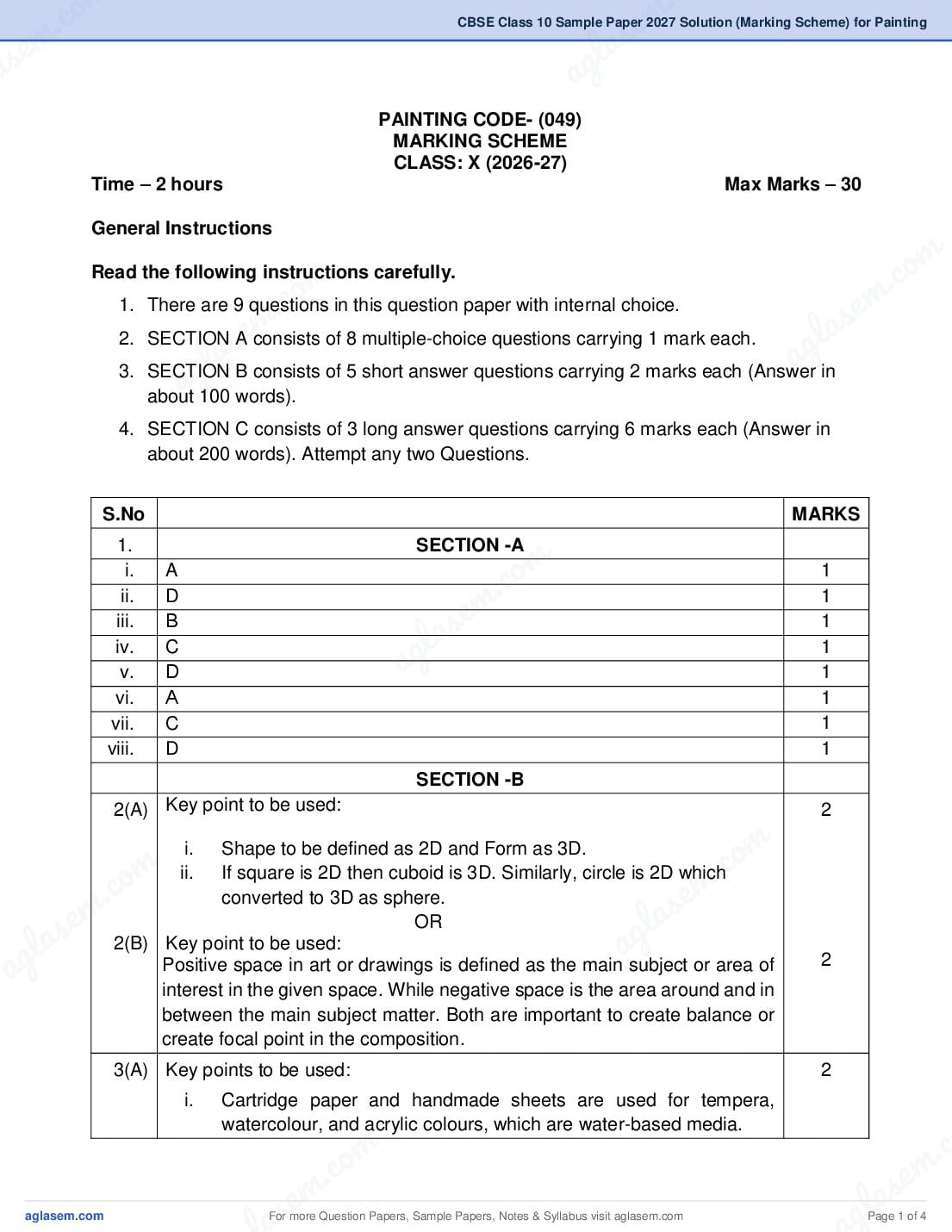
PAINTING CODE- (049)
MARKING SCHEME
CLASS: X (2026-27)
Time – 2 hours Max Marks – 30
General Instructions
m
om
Read the following instructions carefully.
. co
. c e m
1. There are 9 questions in this question paper with internal choice.
m
2. SECTION sAeconsists of 8 multiple-choice questions carrying 1 mark each. l as
a g
a in
l B consists of 5 short answer questions carrying 2 marks each (Answer
g
a 100 words).
3. SECTION
about
4. SECTION C consists of 3 long answer questions carrying 6 marks each (Answer in
about 200 words). Attempt any two Questions.
S.No MARKS
1. SECTION -A
m
.co
i. A 1
ii. D
e m 1
iii. B
l as 1
ag
iv. C 1
v. D 1
vi. A 1
vii. C 1
viii. D 1
SECTION -B
2(A) Key point to be used: 2
m
.co
i.
Shape to be defined as 2D and Form as 3D.
m
.co m
ii.
If square is 2D then cuboid is 3D. Similarly, circle is 2D which
m
converted to 3D as sphere.
s e
s e OR
g la
g la 2(B) Key point to be used: a
a Positive space in art or drawings is defined as the main subject or area of
interest in the given space. While negative space is the area around and in
2
between the main subject matter. Both are important to create balance or
create focal point in the composition.
3(A) Key points to be used: 2
i. Cartridge paper and handmade sheets are used for tempera,
watercolour, and acrylic colours, which are water-based media.
m . c
c. o s e m
s em
For more Question Papers, Sample Papers, Notes & Syllabus visit
gl aPage 1 of 4
Page 3
iii. Oil paper or canvas paper is used for oil painting and is thicker in
quality.
iv. Newsprint and thin cartridge paper are used for pencil work,
charcoal, dry colours, and oil pastels.
OR
3(B) VIBGYOR is also known as the rainbow spectrum. 2
It stands for Violet, Indigo, Blue, Green, Yellow, Orange, and Red.
4(A) Key points to be used: 2
i. Brushes are divided into two main types based on bristles:
hog-hair (hard-brushes) mostly oil paints.
sable-hair (soft- brushes) mostly water colour.
ii. Based on size and shape, brushes are classified as
round: for drawing and fine work.
flat: for flat background or surfaces and flat arears.
filbert, and mop brushes.
OR
4(B)
Pencils are mainly of three types: 2
i. Graphite pencils: Available from 2B to 12B. Softness and darkness
increase with higher numbers.
ii. Charcoal pencils: Darker, softer, and more fragile than graphite
pencils; used for deep tonal effects.
iii. Colour pencils: Available in various colours; some are water-based
and used for colouring.
5(A) Key points to be used: 2
Warli painting, the living tradition of Maharashtra are characterised by
simple geometric shapes depicting daily life, nature, and rituals. Simple
lines are used to form human figure.
Slanting lines for arms and legs in circular composition add movement
Togetherness, cooperation and joy of dancing around one musician brings
the spirit of community alive.
OR
5(B) Characteristic features of Madhubani (Mithila) Paintings 2
Madhubani paintings are characterized by bold outlines, flat bright colours,
and decorative patterns, traditionally made using natural colours.
For more Question Papers, Sample Papers, Notes & Syllabus visit Page 2 of 4
Page 4
.co s e m
s em l a
a ag
The themes mainly depict nature, mythology, religious rituals, animals,
birds, and floral motifs, with no empty space left in the composition.
6(A) Key points to be used: 2
Famous mural painting from the Ajanta Caves near Aurangabad,
Maharashtra. It is painted in Cave No. 1 during the late 5th century CE
m
om
and is considered a masterpiece of Gupta-period art. The Bodhisattva
. co
. c
is depicted as an embodiment of compassion and selflessness, holding
e m
e m
a blue lotus. The visual elements such as line, colour, posture, and
l as
l asexpression should be elaborated.
ag
ag OR
6(B) The Bodhisattva is made larger than life in comparison to the other human 2
figures to emphasize his spiritual importance and divine status. In
traditional Indian art, size is often used symbolically rather than realistically.
The larger scale of the Bodhisattva highlights his superiority, wisdom, and
compassion, and shows that he is the central focus of the composition.
By depicting him in a bigger form, the artist draws the viewer’s attention
m
.co
toward him and conveys his elevated position as an enlightened being
m
who guides and protects humanity.
e
l as
SECTION-C
ag
Attempt any two questions from the given options
7. Key points to be elaborated: 2+2+2
i. The Rashtrakuta king Krishna I commissioned the world’s largest
monolithic rock-cut chaityas, viharas, and Hindu temples at Ellora
during the 8th and 9th centuries CE.Ellora Cave No. 16, known as
the Kailashnath Temple, is dedicated to Lord Shiva.The temple is
carved from top to bottom in the Deccan style and is rich in
m
symbolism and narrative reliefs.
m ii. Sculptures of elephants appear to support parts of the structure,
.co
m .co em
creating a sense of movement and drama.The themes are based on
s
e la
the Shiva Purana, including the depiction of Ravana shaking Mount
las Kailash.
ag
ag iii. Kalash, Shikhar, Garbhagriha, Nandi Mandapa, Gopuram,
Parikrama sthal.
8. Line helps create movement, mood, and direction. Curved and flowing 2+2+2
lines often convey softness, grace, and calmness, while straight or vertical
lines suggest strength and stability. Diagonal lines create a sense of action
and tension, and rough or broken lines may express unrest or conflict.
m . c
c. o s e m
s em
For more Question Papers, Sample Papers, Notes & Syllabus visit
gl a
Page 3 of 4
Page 5
eye and sets the emotional tone of the artwork.
Colour strongly influences the emotional impact of a composition. Warm
colours like red, orange, and yellow create feelings of energy, passion, or
warmth, whereas cool colours such as blue and green evoke calmness,
peace, or sadness. Bright colours may suggest joy and celebration, while
dull or dark tones can express seriousness, mystery, or sorrow. The
contrast and harmony of colours also help communicate the overall idea
and mood.
Shapes and forms contribute to meaning and symbolism. Rounded
shapes often suggest comfort, harmony, and unity, while sharp or angular
shapes may express tension or aggression. Large forms can indicate
importance and dominance, whereas smaller forms may appear less
significant. The arrangement and balance of these shapes within the
composition help to convey the artist’s message clearly.
9. Point to be elaborated- 1+1+4
i. Title of the sculpture is the Lion Capital. Sculpture was commissioned
by Ashoka the grandson of Chandragupta Maurya. Carved out of
Chunar sand stone, very intricate carving method has been used.
ii. Wheel, Capital, Abacus, Bell shaped vase covered with inverted lotus,
Shaft
iii. Symbolic representation:
Four Asiatic Lions facing four cardinal direction spreading dharma
with courage.
Wheel with twenty-four spokes representing twenty-four virites of
life, that is 24 hours of the day
Elephant is divine knowledge.
Bull- Buddhas Zodiac sign knowledge.
Lion- Courage, royalty.
Horse-royalty wordly desire which Buddha left.
For more Question Papers, Sample Papers, Notes & Syllabus visit Page 4 of 4
Document Details
| Board / Org | CBSE |
| Exam | Class 10 |
| Type | Solution |
| Pages | 4 |
| Updated | 29 Oct 2026 |