Page 1
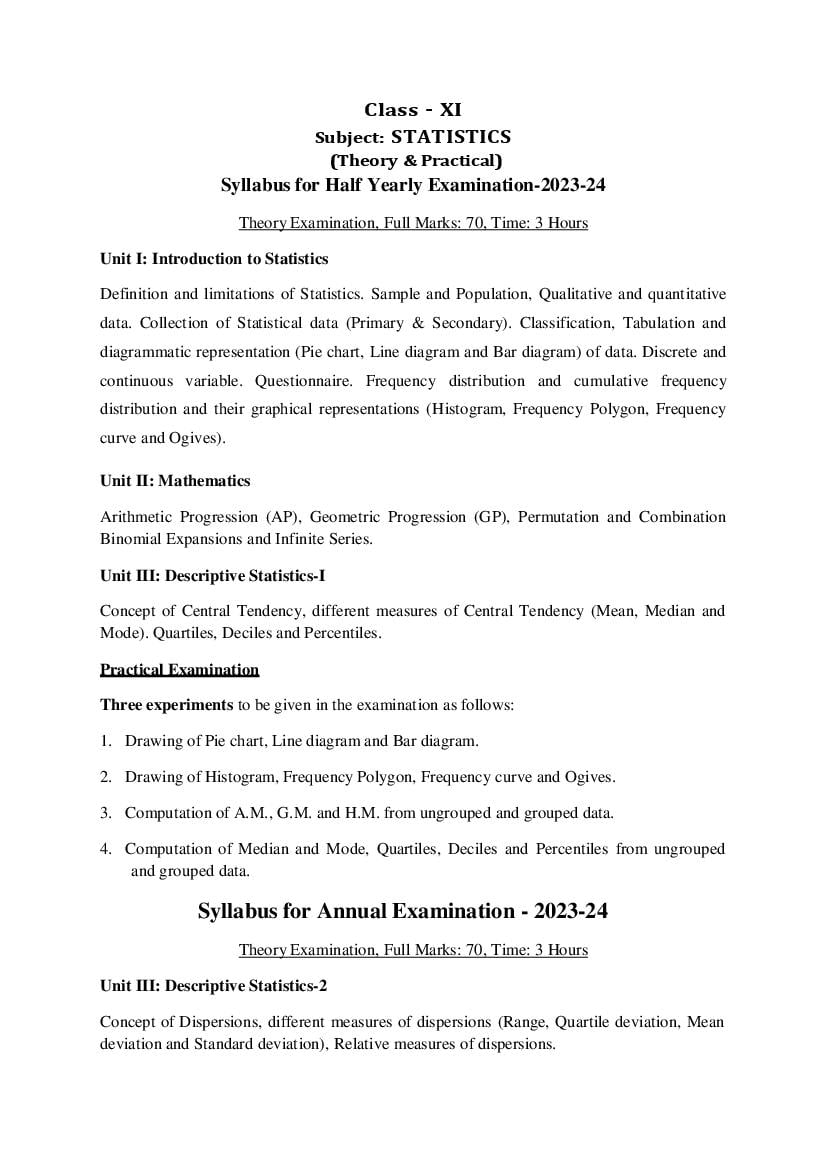
Class – XI Subject: STATISTICS (Theory & Practical) Syllabus for Half Yearly Examination-2023-24 Theory Examination, Full Marks: 70, Time: 3 Hours Unit I: Introduction to Statistics Definition and limitations of Statistics. Sample and Population, Qualitative and quantitative data. Collection of Statistical data (Primary & Secondary). Classification, Tabulation and diagrammatic representation (Pie chart, Line diagram and Bar diagram) of data. Discrete and continuous variable. Questionnaire. Frequency distribution and cumulative frequency distribution and their graphical representations (Histogram, Frequency Polygon, Frequency curve and Ogives). Unit II: Mathematics Arithmetic Progression (AP), Geometric Progression (GP), Permutation and Combination Binomial Expansions and Infinite Series. Unit III: Descriptive Statistics-I Concept of Central Tendency, different measures of Central Tendency (Mean, Median and Mode). Quartiles, Deciles and Percentiles. Practical Examination Three experiments to be given in the examination as follows: 1. Drawing of Pie chart, Line diagram and Bar diagram. 2. Drawing of Histogram, Frequency Polygon, Frequency curve and Ogives. 3. Computation of A.M., G.M. and H.M. from ungrouped and grouped data. 4. Computation of Median and Mode, Quartiles, Deciles and Percentiles from ungrouped and grouped data. Syllabus for Annual Examination - 2023-24 Theory Examination, Full Marks: 70, Time: 3 Hours Unit III: Descriptive Statistics-2 Concept of Dispersions, different measures of dispersions (Range, Quartile deviation, Mean deviation and Standard deviation), Relative measures of dispersions.
Page 2
Moments, Sheppard’s correction for moments (without proof), Skewness and Kurtosis and their measures based on moments and quartiles. Unit IV: Time Series Definition of Time Series, Different Components of Time Series, Different models involve in Time Series, Calculation of Trends by different methods (graphical method, method of semi average, method of moving average and method of least squares) with advantages and disadvantages. Calculation of seasonal components by different methods (method of simple average, ratio to trend and ratio to moving average) with advantages and disadvantages. Practical Examination Three experiments to be given in the examination as follows: 1. Computation of Range, Quartile deviation, Mean deviation, Standard deviation and coefficient of variation from ungrouped and grouped data. 2. Computation of different measures of Skewness and Kurtosis from ungrouped and grouped data. 3. Computation of trend by method of semi average, moving average and by method of least squares. 4. Computation of seasonal component by method of simple average, ratio to trend and ratio to moving average. Blue print of distribution of Marks (Theory) Half Yearly /Annual Examination - 2023-24 Very Short Answer (VSA): 15 Questions × 2 Marks 15 × 2 = 30 Short Answer (SA): 5 Questions × 3 Marks 5 × 3 = 15 Long Answer (LA): 5 Questions × 5 Marks 5 × 5 = 25 Total :- 70 Blue print of distribution of Marks (Practical) Half Yearly /Annual Examination - 2023-24 1. Experiments (5 + 5 + 10) 20 Marks 2. Practical Note Book (PNB) 3 Marks 3. Viva-Voce 2 Marks 4. Attendance 5 Marks Total: - 30 Marks