ISC Class 12 Syllabus 2022 English Elective – Text
Read the full text of this syllabus below — useful to quickly search, copy and reference the content online without downloading the PDF.
📄 View text version (2 pages)
Page 1
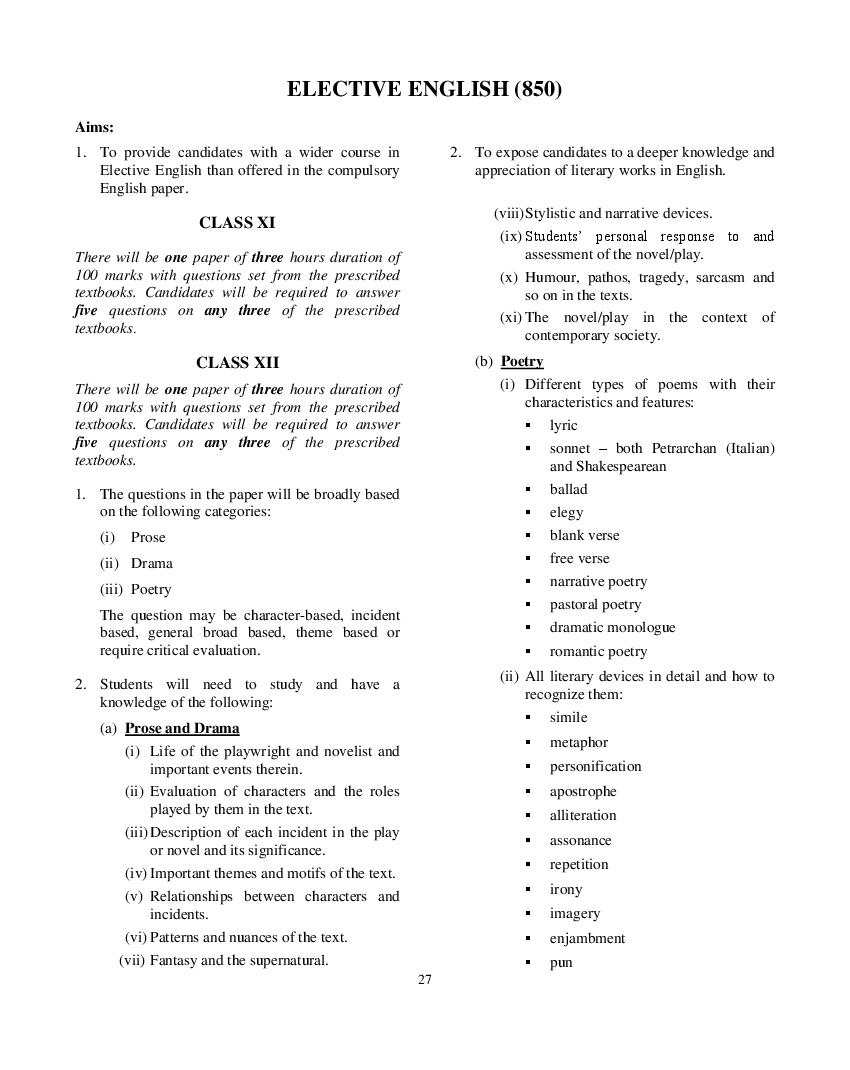
ELECTIVE ENGLISH (850) Aims: 1. To provide candidates with a wider course in 2. To expose candidates to a deeper knowledge and Elective English than offered in the compulsory appreciation of literary works in English. English paper. (viii) Stylistic and narrative devices. CLASS XI (ix) Students’ personal response to and There will be one paper of three hours duration of assessment of the novel/play. 100 marks with questions set from the prescribed (x) Humour, pathos, tragedy, sarcasm and textbooks. Candidates will be required to answer so on in the texts. five questions on any three of the prescribed (xi) The novel/play in the context of textbooks. contemporary society. CLASS XII (b) Poetry There will be one paper of three hours duration of (i) Different types of poems with their 100 marks with questions set from the prescribed characteristics and features: textbooks. Candidates will be required to answer ▪ lyric five questions on any three of the prescribed ▪ sonnet – both Petrarchan (Italian) textbooks. and Shakespearean 1. The questions in the paper will be broadly based ▪ ballad on the following categories: ▪ elegy (i) Prose ▪ blank verse (ii) Drama ▪ free verse ▪ narrative poetry (iii) Poetry ▪ pastoral poetry The question may be character-based, incident based, general broad based, theme based or ▪ dramatic monologue require critical evaluation. ▪ romantic poetry (ii) All literary devices in detail and how to 2. Students will need to study and have a recognize them: knowledge of the following: ▪ simile (a) Prose and Drama ▪ metaphor (i) Life of the playwright and novelist and important events therein. ▪ personification (ii) Evaluation of characters and the roles ▪ apostrophe played by them in the text. ▪ alliteration (iii) Description of each incident in the play ▪ assonance or novel and its significance. ▪ repetition (iv) Important themes and motifs of the text. (v) Relationships between characters and ▪ irony incidents. ▪ imagery (vi) Patterns and nuances of the text. ▪ enjambment (vii) Fantasy and the supernatural. ▪ pun 27
Page 2
▪ contrast ▪ Type of poem ▪ climax and anti-climax ▪ Setting ▪ onomatopoeia ▪ Theme ▪ hyperbole ▪ Mood and atmosphere ▪ oxymoron ▪ Different levels of meaning in the ▪ litotes poem, if any ▪ symbolism ▪ Rhyme scheme and its significance ▪ Symbolism (iii) A thorough knowledge of the poets’ lives and styles of writing. ▪ Imagery (iv) Important themes of the poems. ▪ Literary devices (v) Patterns and nuances of the poems. ▪ The student’s own personal response to the poem. (vi) Fantasy and the supernatural if present in any poem. Note: Credit is given for textual detail and for the (vii) Symbolism and Imagery. candidate’s own response. (viii) How to write a proper Critical Candidates are advised to exercise their options Evaluation / Appreciation, which must with great care, keeping in view their knowledge and contain the following components: understanding of the question(s) chosen. Candidates are also expected to be precise and to avoid ▪ Life of the poet and how it has unnecessary details. impacted his/her style of writing ▪ Autobiographical element in the For list of prescribed Textbooks, see Appendix I. poem 28