Finished viewing? Save it for later —
Download ISC Class 12 Syllabus 2022 Music (PDF · 12 pages)About ISC Class 12 Syllabus 2022 Music
ISC Class 12 Syllabus 2022 Music is available here for free download. Published by CISCE for Class 12, this syllabus can be viewed online or downloaded as a PDF (12 pages). Candidates preparing for Class 12 can use ISC Class 12 Syllabus 2022 Music to understand the exam pattern, the type of questions asked, and the overall difficulty level.
Frequently Asked Questions
How can I download ISC Class 12 Syllabus 2022 Music?
Open this page and click the Download button to save ISC Class 12 Syllabus 2022 Music as a PDF. It is completely free on AglaSem Docs.
Is ISC Class 12 Syllabus 2022 Music free to download?
Yes. ISC Class 12 Syllabus 2022 Music can be viewed online and downloaded as a PDF free of cost on AglaSem Docs.
How many pages does ISC Class 12 Syllabus 2022 Music have?
ISC Class 12 Syllabus 2022 Music contains 12 pages, which you can read online or download together as a single PDF.
Where can I find more Class 12 study material?
You can find more Class 12 question papers, sample papers, syllabus, and answer keys on AglaSem Docs.
ISC Class 12 Syllabus 2022 Music – Text
Read the full text of this syllabus below — useful to quickly search, copy and reference the content online without downloading the PDF.
📄 View text version (12 pages)
Page 1
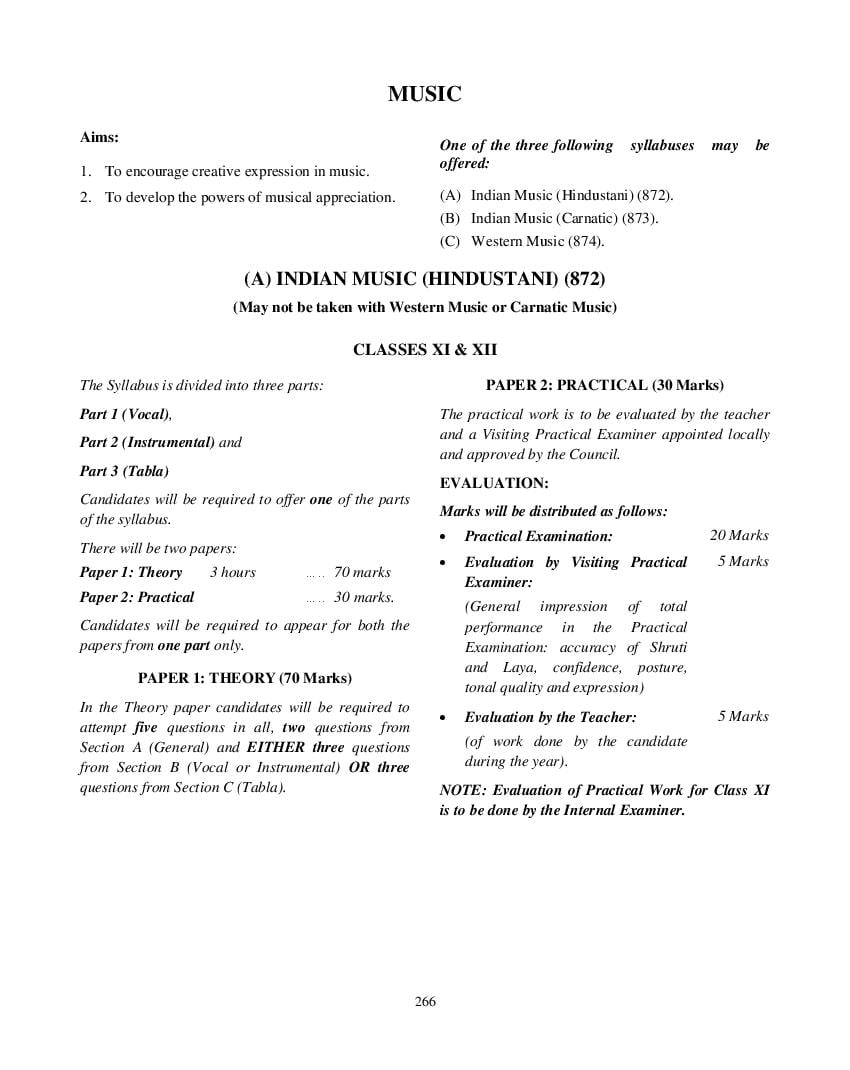
Aims:
One of the three following syllabuses may be
offered:
1. To encourage creative expression in music.
2. To develop the powers of musical appreciation. (A) Indian Music (Hindustani) (872).
(B) Indian Music (Carnatic) (873).
(C) Western Music (874).
(A) INDIAN MUSIC (HINDUSTANI) (872)
(May not be taken with Western Music or Carnatic Music)
CLASSES XI & XII
The Syllabus is divided into three parts: PAPER 2: PRACTICAL (30 Marks)
Part 1 (Vocal), The practical work is to be evaluated by the teacher
and a Visiting Practical Examiner appointed locally
Part 2 (Instrumental) and
and approved by the Council.
Part 3 (Tabla)
EVALUATION:
Candidates will be required to offer one of the parts
Marks will be distributed as follows:
of the syllabus.
• Practical Examination: 20 Marks
There will be two papers:
• Evaluation by Visiting Practical 5 Marks
Paper 1: Theory 3 hours ….. 70 marks
Examiner:
Paper 2: Practical ….. 30 marks.
(General impression of total
Candidates will be required to appear for both the performance in the Practical
papers from one part only. Examination: accuracy of Shruti
and Laya, confidence, posture,
PAPER 1: THEORY (70 Marks)
tonal quality and expression)
In the Theory paper candidates will be required to
• Evaluation by the Teacher: 5 Marks
attempt five questions in all, two questions from
Section A (General) and EITHER three questions (of work done by the candidate
from Section B (Vocal or Instrumental) OR three during the year).
questions from Section C (Tabla). NOTE: Evaluation of Practical Work for Class XI
is to be done by the Internal Examiner.
266
Page 2
PART 1: VOCAL MUSIC
PAPER 1: THEORY (70 Marks) The above Ragas with special reference to their
notes Thaat, Jaati, Aaroh, Avaroh, Pakad, Vadi,
1. Introduction to Musical Terms Samvadi, Anuvadi, Vivadi, Varjya, Vikrit,
(i) Dhwani Singing/Playing Time with examples.
Meaning, origin, types (Naad and
Kolahal/noise). 4. Taal and Taal-lipi
(ii) Shruti Notation of the following ‘Talas’: Teentaal,
Dadra, Kaharwa, Jhaptaal.
Meaning and origin.
The above Talas with their Thekas, Tali, Khali,
(iii) Swar
Vibhag in Thah, dugun and chaugun laya.
Meaning of Swar and types {Shudha,
Vikrit (Tivra, Komal) Vadi, Samvadi, 5. Swarlipi of Chota Khayal
Anuvadi, Vivadi, Varjya, Vakra, Grah, Ansh,
Nyas: Meaning with examples}. Notation of the following Ragas: Yaman,
Bhupali, Khamaj, Bhairav, Desh
(iv) Saptak
Sthai and antara with the mention of the name of
Meaning and types (Mandra, Madhya and
the Raga (with its Aaroh, Avaroh) and Taal with
Taar) with symbol.
clear indication of Swar and Taal signs.
(v) Thaat
Meaning, types, rules, number and names 6. Eminent Musicians of Hindustani Music
with examples in Bhatkhande system. The following musicians to be studied: Vishnu
(vi) Raga Narayan Bhatkhande, Vishnu Digambar
(a) Meaning of Raga; Types (Janak, Janya- Paluskar.
Meaning with examples). Life sketch, work and achievements.
(b) Jati of Raga (Odava, Shadava and
Sampoorna -Meaning and their nine 7. Topics of general interest related to Music
Upjatis).
Essay type questions of about 200 words will be
(vii) Varna asked on the above.
Meaning and types with examples (Sthayi,
Aarohi, Avarohi and Sanchari).
PAPER 2: PRACTICAL (30 Marks)
1. Demonstration of the following Ragas by singing
(viii) Alankar
Chota Khayal with five Taans:
Meaning and example in Shudh Swar.
(i)Yaman (ii) Bhupali (iii) Khamaj (iv) Bhairav
(ix) Taal (v) Desh
Meaning and examples of Matra, Tali, Khali,
Vibhag, Sam, Theka, Aavartan, Thah 2. Recitation of the following Talas in Thah, Dugun
(Ekgun), Dugun and Chaugun. and Chaugun. Laya showing various divisions by
Tali and Khali with hand gestures (Padhant):
2. Forms of Composition (i) Teentaal
(ii) Dadra
Khayal (Bada Khayal and Chhota Khayal)
(iii) Kaharwa
Origin, meaning, characteristics and (iv) Jhaptaal
comparative study.
3. Singing five Alankars.
3. Introduction to Ragas 4. Singing of a devotional or folk song of the
Yaman, Bhupali, Khamaj, Bhairav, Desh. candidate’s choice.
267
Page 3
PAPER 1: THEORY (70 Marks) 3. Introduction to Ragas
1. Introduction to Musical Terms Yaman, Bhupali, Khamaj, Bhairav, Desh.
(i) Dhwani The above Ragas with special reference to their
Meaning, origin, types (Naad and Kolahal/ notes Thaat, Jaati, Aaroh, Avaroh, Pakad, Vadi,
noise). Samvadi, Anuvadi, Vivadi, Varjya, Vikrit,
Singing/Playing Time with examples.
(ii) Shruti
Meaning and origin. 4. Taal and Taal-lipi
(iii) Swar Notation of the following ‘Talas’: Teentaal,
Meaning of Swar and types {Shudha, Vikrit Dadra, Kaharwa, Jhaptaal.
(Tivra, Komal) Vadi, Samvadi, Anuvadi,
Vivadi, Varjya, Vakra, Grah, Ansh, Nyas: The above Talas with their Thekas, Tali, Khali,
Meaning with examples}. Vibhag in Thah, dugun and chaugun laya.
(iv) Saptak 5. Swarlipi of Razakhani/Drut Gat
Meaning and types (Mandra, Madhya and
Tar) with symbol. Notation of the following Ragas: Yaman,
Bhupali, Khamaj, Bhairav, Desh.
(v) Thaat
Meaning, types, rules, number and name with Sthai and antara with the mention of the name of
example in Bhatkhande system. the Raga (with its Aaroh, Avaroh) and Taal with
clear indication of Swar and Taal signs and bols
(vi) Raga of Gat.
(a) Meaning of Raga; Types (Janak, Janya-
Meaning with examples). 6. Eminent Musicians of Hindustani Music
(b) Jati of Raga (Odava, Shadava and
The following musicians to be studied: Vishnu
Sampoorna - Meaning and their nine
Narayan Bhatkhande, Vishnu Digambar
Upjatis).
Paluskar.
(vii)Varna
Meaning and types with example (Sthayi, Life sketch, work and achievements of the above.
Aarohi, Avarohi and Sanchari).
7. Topics of general interest related to Music
(viii)Alankar
Meaning and example in Shudh Swar. Essay type questions of about 200 words will be
asked on the above.
(ix) Taal
Meaning and examples of Matra, Tali, Khali,
Vibhag, Sam, Theka, Aavartan, Thah
(Ekgun), Dugun and Chaugun.
2. Types and techniques of String Instruments
Types: Chal Thaat and Achal Thaat; Techniques:
Krintan, Zamzama, Murki, Khatka, Kampan.
Origin, meaning, characteristics and
comparative study.
268
Page 4
(iv) Jhaptaal
1. Demonstration of following Ragas by playing
Razakhani/ Drut Gat with Five Todas. 3. Playing five Alankars.
(i)Yaman (ii) Bhupali (iii) Khamaj (iv) Bhairav 4. One Dhun to be played on any Raga either from
(v) Desh the syllabus or any other Raga of the candidate’s
choice.
2. Recitation of the following Talas in Thah, Dugun
and Chaugun. Laya showing various divisions by
Tali and Khali with hand gestures (Padhant):
PART 3: INSTRUMENTAL MUSIC-PERCUSSION (TABLA)
PAPER 1: THEORY (70 Marks) 6. Topics of general interest related to Music
1. Eminent Musicians of Hindustani Music Essay type question of about 200 words will be
asked on the above.
The following musicians to be studied: Vishnu
Narayan Bhatkhande, Vishnu Digambar
PAPER 2: PRACTICAL (30 Marks)
Paluskar.
1. Playing the following Talas on Tabla in Thah
Life sketch, work and achievements of the above.
Dugun and Chaugun Layakari:
2. Terms related to Tabla (i) Teentaal
Theka, Avartan, Kism, Tukda, Mukhda, Mohra, (ii) Ektaal
Uthaan, Paran, Peshkara. (iii) Chaartaal
(iv) Rupak
Meaning and examples of the above.
(v) Tivra
3. Taal and Taal-lipi 2. Keeping the Wazan of the Taal intact,
Teentaal, Ektaal, Chaartaal, Rupak, Tivra. demonstration of the following:
Complete notation of the above Talas with their (i) One Peshkara, One Uthaan, One Kayada with
Thekas, Tali, Khali, Vibhag in Thah, Dugun and four Paltas and Tihai in Teentaal.
Chaugun Laya and their characteristics.
(ii) One Tihai in Teentaal.
4. Five Pranas of Taal (iii) One Paran in Chaartaal
Kaal, Marg, Kriya, Ang, Kala. (iv) One Tukda in Ektaal
Definition with examples. (v) One Kism each in Rupak and Tivra
5. Syllables of Tabla 3. Identification and production of syllables on
Technique of producing syllables of Tabla Tabla.
(Dahina and Bayan) individually and jointly. 4. Accompaniment of Tabla (only Thekas) with
music played or sung.
5. Knowledge of Lehra.
269
Page 5
PART I: VOCAL MUSIC
PAPER 1: THEORY (70 Marks) 7. Raga
(i) Bihag, Bageshwari, Kafi, Bhairavi, Malkauns
1. Musical Terms and Forms
(ii) Identification of Raga by written note-
(i) Naad combination
Meaning, origin, types (Aahat, Anahat) and
(iii) Comparison and contrast between above
qualities (Volume, Pitch, and Timbre). mentioned Raga.
(ii) Raga Complete theory of the above mentioned
Type of Raga: Poorva, Uttar, Sandi- Ragas with special reference to their Swar,
Prakash, Shudha, Chhayalag, Sankirna Thaat, Jaati, Aaroh, Avaroh, Pakad, Vadi,
(Meaning with examples). Samvadi, Anuvadi, Vivadi, Varjya, Vikrit,
Samprakriti Raga and singing/playing time.
(iii) Forms of composition: Dhrupad, Dhamar.
Origin, development and characteristics to 8. Notation of Taal
be done in detail.
Dhamar, Ektaal, Roopak, Chartaal.
(iv) Meend, Andolan, Gamak, Kan, Alaap, Taan.
Meaning, uses with examples wherever The above Talas with their Thekas, Tali, Khali,
applicable. Vibhag in Thah, Dugun, Tigun and Chaugun
Laya.
2. Systems of Indian Classical Music
9. Notation of Bandish (Chhota Khayal and Bada
The two systems of Indian Classical Music. Khayal)
Hindustani and Carnatic Music – comparative Sthai and antara with the mention of the name of
study with reference to technique of usage, Swar, the raga (with its aaroh, avaroh) and taal with
Taal, composition, instruments used and clear indication of Swar and Taal signs.
language. Note: Chhota Khayal in all Ragas and One Bada
Khayal of candidates choice from the Ragas
3. Placement of Swaras on twenty-two Shrutis (Bihag, Bageshwari, Kafi, Bhairavi, Malkauns).
Ancient and modern methods of placement of 10. Classification of Indian Musical Instruments
seven Swaras amongst Shrutis.
Tat -Vitat, Sushir, Avnada, Ghan.
4. “Thaats” of Bhatkhande Explanation with examples.
Ten Thaats with name, swar, signs and basic
rules. 11. Eminent Musicians of Hindustani Music
The following musicians to be studied: Pt. Ravi
5. Vadi Swar and time of Raga Shankar, Pt. Bhimsen Joshi.
Life sketch, work and achievements of the above.
Relationship between Vadi Swar and time of
raga, Purvang- Uttarang of day and Saptak. 12. Topics of general interest related to Music
6. Laya Essay type questions of about 200 words will be
asked on the above.
Definition of Laya and its types: Vilambit,
Madhya and Drut. 13. Brief History and knowledge of Tanpura
Drawing and labelling with description and
tuning.
270
Page 6
The practical work is to be assessed by the teacher Ragas in Point 1.
and a Visiting Examiner appointed locally and 3. Identification of all the Ragas by listening to their
approved by the Council. Alaap.
1. Demonstration of the following Raga by singing 4. Singing of Ten Alankars in Shudh Swar.
"Chota Khayal" with Alap, and five Taans:
5. Recitation of the following Talas in Dugun and
(i) Bihag (ii) Bageshwari (iii) Kafi (iv) Bhairvi. Chaugun Laya:
(v) Malkauns (i) Chaartaal (ii) Dhamar (iii) Ektaal (iv) Roopak
PART 2: INSTRUMENTAL MUSIC
PAPER 1: THEORY (70 Marks) 3. Placement of Swaras on twenty-two Shrutis
Ancient and modern methods of placement of
1. Musical Terms and Forms seven Swaras amongst Shrutis.
(i) Naad
4. “Thaats” of Bhatkhande
Meaning, origin, types (Aahat, Anahat) and
qualities (Volume, Pitch, and Timbre). Ten Thaats with name, swar, signs and basic
rules.
(ii) Raga
Type of Raga: Poorva, Uttar, Sandi 5. Vadi Swar and time of Raga
Prakash, Shudha, Chhayalag, Sankirna Relationship between Vadi Swar and time of
(Meaning with examples). raga; Purvang-Uttarang of day and Saptak.
(iii) Forms of composition: Razakhani/Dhrut Gat, 6. Laya
Maseetkhani/Vilambit Gat.
Definition of Laya and its types: Vilambit,
Origin, development and characteristics to Madhya and Drut.
be done in detail.
7. Raga
(iv)Meend, Ghaseet, Soot, Andolan, Gamak,
(i) Bihag, Bageshwari, Kafi, Bhairavi, Malkauns
Kan, Alaap, and Jod-Alap.
Meaning, uses with examples, wherever (ii) Identification of Raga by written note-
combination
applicable.
(iii)Comparison and contrast between above
2. Systems of Indian Classical Music mentioned Raga.
Complete theory of the above mentioned Ragas
The Two systems of Indian Classical Music.
with special reference to their Swar, Thaat, Jaati,
Hindustani and Carnatic Music – comparative
Aaroh, Avaroh, Pakad, Vadi, Samvadi, Anuvadi,
study with reference to technique of usage, Swar, Vivadi, Varjya, Vikrit, Samprakriti Raga and
Taal, composition, instruments used and singing/playing time.
language.
271
Page 7
Dhamar, Ektaal, Roopak, Chartaal Essay type questions of about 200 words will be
The above Taal with their Thekas, Tali, Khali, asked on the above.
Vibhag in Thah, Dugun, Tigun and Chaugun
Laya. 13. Brief History and knowledge of your
instrument
9. Notation of Bandish (Maseetkhani and Drawing and labelling with description and
Razakhani) tuning.
Sthai and antara with the mention of the name of
the raga (with its aaroh, avaroh) and taal with PAPER 2: PRACTICAL (30 Marks)
clear indication of Swar and Taal signs and bols The practical work is to be assessed by the teacher
of Gat. and a Visiting Examiner appointed locally and
Note: Razakhani in all Raga and One approved by the Council.
Maseetkhani of the candidate’s choice from the
1. Demonstration of the following Ragas by playing
Raga: Bihag, Bageshwari, Kafi, Bhairavi,
Razakhani/Drut Gat with five Todas and Jhala:
Malkauns.
(i) Bihag (ii) Bageshwari (iii) Kafi (iv) Bhairavi
10. Classification of Indian Musical Instruments (v) Malkauns
Tat -Vitat, Sushir, Avnada, Ghan. 2. Playing of one Maseetkhani Gat in any of the
Ragas in point 1.
Explanation of the above with examples.
3. Identification of all the Ragas by listening to their
11. Eminent Musicians of Hindustani Music Alaap.
The following musicians to be studied: 4. Playing of ten Alankars in Shudh Swar.
Pt. Ravi Shankar, Pt. Bhimsen Joshi. 5. Recitation of the following Taal in Dugun and
Life sketch, work and achievements of the above. Chaugun Laya:
(i) Chaartaal (ii) Dhamar (iii) Ektaal
(iv) Roopak
PART 3: INSTRUMENTAL MUSIC-PERCUSSION (TABLA)
PAPER 1: THEORY (70 Marks) 4. Compositions of Tabla
Tihai (Damdar/Bedam), Gat, Kayada, Palta, Rela,
1. History and knowledge of Tabla
Laggi, Ladi, Chakkardar Tukda, Paran.
Brief history of origin and evolution of tabla,
drawing and labelling with description and Definition and explanation with examples.
tuning.
5. Additional terms
2. Five Pranas of Taal Sam, Taali, Khali, Vibhag, Lehra (Nagma)
Grah, Jaati, Yati, Prastar, Laya Definition and explanation with examples.
Definition and explanation with sub divisions and
examples. 6. Talas
Jhaptaal, Dadra, Teental, Dhamar, Jhoomra,
3. Classification of Indian musical Instruments:
Kaharwa
Tat -Vitat, Sushir, Avanadh, Ghan
Complete notation of the above in Thah, Dugun,
Definition and explanation with examples. Tigun, and Chaugun Laya with characteristics.
272
Page 8
Solo (Ekal) and accompaniment (Sangat). 1. The practical work is to be assessed by the teacher
and a Visiting Examiner appointed locally and
Meaning, Solo presentation (order of
approved by the Council.
performance); Playing technique while
accompanying with vocal and instrumental music. Playing of the following Talas on Tabla in Thah,
Dugun and Chaugun Layakari:
8. Eminent Musicians of Hindustani Music
(i) Jhaptaal (ii) Dadra (iii)Teentaal (iv) Dhamar
The following musicians to be studied:
(v) Jhoomra (vi) Kaharwa
Pt. Kishan Maharaj, Ustad Ahmad Jaan Thirakwa
Life sketch, work and achievements 2. Keeping the Wazan of the Taal intact
demonstration of the following:
9. Topics of general interest related to Music (i) Four Kism in Kaharwa.
(ii) Four Kism in Dadra.
Essay type question of about 200 words will be
asked on the above. (iii) One Tukada, two Kism and one Kayada with
two paltas and Tihai in Jhaptal.
(iv) One Gat, One Laggi, One Ladi, one
Chakkardar Tukda and Paran, one Kayada
with two paltas and Tihai in Teentaal.
3. Accompaniment of Tabla (only Thekas) with
music played or sung.
(B) INDIAN MUSIC (CARNATIC) (873)
(May not be taken with Hindustani Music or Western Music)
CLASSES XI & XII
There will be two papers: 3. Raga classification in Carnatic Music. The
scheme of the 72 Melakartas. The names of the 12
Paper 1: Theory: 3 hours ..... 70 marks
chakras. Katapayadi Formula and its application.
Paper 2: Practical: ..... 30 marks
4. Lakshanas of the following 24 ragas:
PAPER 1: THEORY (70 Marks) 1. Todi 2. Saveri
Candidates will be required to answer five questions 3. Chakravakam 4. Bhairavi
in all. 5. Anandha Bhairavi 6. Karaharapriya
1. The fundamental technical terms and their 7. Shri Ranjani 8. Ritigoula
meanings (Ref. South Indian Music, Book 1 by P.
Sambamoorthy, Chap. III, pp. 38-48). 9. Mukhari 10. Harikambhoji
2. Principles of Sa, re, ga, ma, notations as laid down 11. Natakuranji 12. Kedaragoula
in K.V. Srinivasa Iyengar's Music Books and in P. 13. Sahana 14. Kambhoji
Sambamoorthy's "South Indian Music Series",
15. Yadukulakambhoji 16. Sankarabharana
Significance of symbols commonly used.
17. Hamsadhwani 18. Begada
19. Atana 20. Nata
273
Page 9
23. Kalyani 24. Saranga 19. Patnam Subramanya Iyar
5. Manodharma Sangita and its forms - Paddati in 20. Pallavi Seshayyar
developing rage alpana and Kapana Svaras. 10. Classification of musical instruments into
6. Dasavida gamakas (Ten gamakas). stringed, wind and percussion group. A general
knowledge of the structure of the vina, violin
7. The scheme of the 35 Talas. Chapu tala and its tampuro, gottuvadyam and flute. Tuning of the
varieties. Desadi and Madyadi talas, Kriya, Anga. human voice and the compass of the concert
Laya, Gati, Matra (a detailed knowledge of two/ instruments of South India.
five pranas) shadhangas.
11. Musical sound and voice. Pitch. Intensity and
8. Musical forms and their association. An advanced timbre. Sympathetic vibration. Resonance.
knowledge of the following musical forms: Echoes, Musical intervals. Modal shift of tonic.
1. Gita 2. Tana Verma (Grahabhedam).
3. Padavarna 4. Kriti
PAPER 2: PRACTICAL (about 20 minutes)
5. Ragamalika 6. Padam – 30 Marks
7. Javali 8. Tillana Two padas of Kshetrajna. One Ragamalika. Two
9. History of Carnatic Music with special reference Tillanas. Two Javalis and the following
to the following composers and theorists including compositions:
their biographies and their contributions to 1. Todi Kaddanna Variki
Carnatic Music. 10 out of 20 must be known. 2. Saveri Sankari Sankuru
1. Jayadeva 3. Chakravakam Etula Brotuvo
2. Purandaradas 4. Bhairavi Neepadamule
3. Ramamatya 5. Anandha Bhairavi Nimadi Challaga
4. Somanatha 6. Karaharapriya Pakkala Nilabadi
7. Sri Ranjani Marubalka
5. Narayana Tirtha
8. Harikambhoji Entharanidaya
6. Bhadrachala Ramadas
9. Natakuranji Manasuvishaya nata
7. Venkatamakhi
10. Shana Rama Ikananu
8. Kshetrajna
11. Kambhoji Koniyadina napai
9. Paidala Guruthy Sastri 12. Sankarabharana Saroja dala netri
10. Tyagaraja 13. Hamsadhwani Vatapi ganapatim
11. Muthuswami Dikshitar 14. Begada Nadopasana
12. Syama Sastri 15. Atana Ilalo pranatharthi hara
13. Arunachalam Kavirayar 16. Purvi Kalyani Ninnu Vina gamari
14. Gopalakrishna Gharat 17. Shanmukhapriya Mariveredikkevaraiya rama
15. Svati Tirunal 18. Kalyani Ninnu Vina gati
16. Subbaraya Shastri 19. Saranga Neevada negana
17. Veena Kuppayyar
274
Page 10
playing these pieces or other classical pieces of an vocal music or one of the following:
equal standard. Vina, Gottuvadyam, Violin, Balakokil, Flute or
Candidates shall be expected to know in outline the Nagasvaram. A vocal candidate shall sing to the
meaning of at least six songs of the classical sruti accompaniment of Tambura. A vocal
composers learnt by them. candidate may sing playing the Tambura
himself/herself or he/she may utilise the services
2. Alapana of the following ragas of another person to provide the Tambura
1. Todi 2. Saveri accompaniment for him/her, provided this other
person is not a candidate for this same
3. Bhairavi 4. Anandha Bhairavi examination.
5. Mohana 6. Kedaragoula
7. Kambhoji 8. Yadukula Kambhoji EVALUATION:
The practical work is to be evaluated by the teacher
9. Sankarabharana 10. Begada
and a Visiting Practical Examiner appointed locally
11. Kalyani and approved by the Council.
3. Ability (Note: For Class XI, Evaluation of Practical is to be
done by the Internal Examiner.)
(i) to sing Kalpada swara for the songs learnt in
Todi, Bhairavi, Kambhoji, Sankarabharana Marks will be distributed as follows:
and Kalyani ragas and in Adi and Rupaka • Practical Examination: 20 Marks
talas;
• Evaluation by Visiting Practical 5 Marks
(ii) to sing or play a given musical passage in sa,
Examiner:
re, ga, ma notation in any of the prescribed 24
(of candidate’s overall performance in
ragas.
the Practical Examination, based on
(iii) to give swaras for musical phrases sung or sruthy, laya, tonal quality, expression
played; and music performance)
(iv) to recognise ragas from alpanas heard or • Evaluation by the Teacher: 5 Marks
played; and (of work done by the candidate
(v) to recognise the talas of unfamiliar songs throughout the year.)
heard or played.
4. In addition to the individual tests there will also
be common ear tests, sight-singing tests and
musical dictation at the practical examination.
275
Page 11
(May not be taken with Hindustani Music or Carnatic Music)
CLASSES XI & XII
Pre-Requisite:
SECTION B
Candidates for the examination in Western Music
Prescribed Works:
will be required to have passed Grade 5 in Theory
and Grade 6 in Practicals of the Associated Board of Beethoven, Symphony No. 2 in major op 36 and one
the Royal School of Music or the Trinity College of of the following:
Music or the London College of Music.
(a) Bach, Prelude and Fugue No. 16 in G minor,
There will be two papers: Book I.
Paper 1: Theory: 3 hours ….. 70 marks
(b) Schubert "Erl Kenig" (The Erl King).
Paper 2: Practical: … 30 marks
(c) Caesar Frank: the last movement from the violin
PAPER 1: THEORY (70 Marks) and piano sonata.
Candidates will be required to answer five questions:
PAPER 2: PRACTICAL WORK (30 Marks)
two from Section A, two from Section B and
the remaining question from either Section A or Practical work will consist of six Aural Tests.
Section B. Candidates will be required to attempt all six Tests.
SECTION A 1. Candidates will be required to write on a
monotone, pre-fixing the necessary time
(i) Harmony, etc. signature, a short rhythmical passage beginning
on the first beat of a bar. Compound time will not
Four-parts chords formed on all degrees of major and be included. After indicating the speed at which
minor scales. First the second inversions, the the pulse of the music moves, the Examiner may
dominant seventh chord and its inversions, play the passage twice. After a short interval, he
modulation to related keys and the simple use of will play it a third and a fourth time.
unessential notes. The tests may take the form of 2. Candidates will be required to write from
harmonization of a melody in four vocal parts or in dictation a short melodic phrase, beginning on
simple pianoforte style, the working of a figured on the first beat of a bar, in either a major or a minor
unfigured bass, or the construction of a phrase on a key. Before playing the passage, the Examiner
given harmonic basis. will indicate the speed at which the pulse of the
music moves. The key will be named, and the
The addition of a melody, above or below a given keynote and tonic chord sounded. The phrase will
melody, the writing of a melody to given words, or then be played once throughout. It will then be
the completion of a melody of which the beginning is played twice in sections, at short intervals of
given. Analysis of the rhythmic structure of a time, and finally the phrase will be repeated in its
melody, phrasing, etc. Analysis of harmonic entirety.
progressions including modulations, in a 3. Candidates will be required to describe
straightforward passage. (e.g. 'perfect 5th') intervals which are diatonic in
major keys. Two such intervals will be given
without the sounding of the keynotes. Each
interval will be played twice.
276
Page 12
name any of the following cadences - perfect, candidate in the Practical
imperfect (half - close), plagal, interrupted -
Examination)
occurring in a musical example in a major or a
minor key played by the Examiner. After the • Evaluation by the Teacher: 5 Marks
tonic chord has been sounded, the whole musical (of work done by the candidate
sentence will be played through three times, with during the year)
due deliberation, at short intervals.
PAPER 2: PRACTICAL (30 Marks)
5. Candidates will be required to recognise the three
principal chords of a major or a minor key (in 1. The practical work is to be assessed by the
root position and in first and second inversion) as teacher and a Visiting Examiner appointed
played by the Examiner in a continuous musical locally and approved by the Council.
phrase in a definite key. The phrase containing
the given chords will begin with a chord in root Playing of the following Talas on Tabla in Thah,
position. It will be played four times at a Dugun and Chaugun Layakari:
reasonably slow pace, and, before each playing, (i) Jhaptaal (ii) Dadra (iii)Teentaal (iv) Dhamar
the tonic chord will be sounded.
(v) Jhoomra (vi) Kaharwa
6. Candidates will be required to recognise and
name simple changes of key. Three examples 2. Keeping the Wazan of the Taal intact
will be given, each starting from the same tonic demonstration of the following:
key. Three examples will be given, each starting (i) Four Kism in Kaharwa.
from the same tonic key, and containing one (ii) Four Kism in Dadra.
modulation only. Modulations will be limited to
the dominant, sub-dominant, and relative major (iii) One Tukada, two Kism and one Kayada with
or minor keys. After the key has been named and two paltas and Tihai in Jhaptal.
the tonic chord has been sounded, each of the (iv) One Gat, One Laggi, One Ladi, one
three examples will be played through twice. Chakkardar Tukda and Paran, one Kayada
with two paltas and Tihai in Teentaal.
The test will not necessarily contain examples of
modulations of three different keys; the same 4. Accompaniment of Tabla (only Thekas) with
keys recur. music played or sung.
A candidate will be at liberty to write down his
answers to a particular test at any stage.
EVALUATION:
The practical work is to be evaluated by the teacher
and a Visiting Practical Examiner appointed locally
and approved by the Council.
(Note: For Class XI, Evaluation of Practical is to be
done by the Internal Examiner.)
Marks will be distributed as follows:
• Practical Examination: 20 Marks
• Evaluation by Visiting Practical 5 Marks
Examiner:
(of candidate’s Aural skills,
presentation of written work and
277
Document Details
| Board / Org | CISCE |
| Exam | Class 12 |
| Type | Syllabus |
| Pages | 12 |
| Language | english |
| Updated | 09 Jun 2026 |