CBSE Class 10 Sample Paper 2027 Solution (Marking Scheme) for Science
Finished viewing? Save it for later —
Download CBSE Class 10 Sample Paper 2027 Solution (Marking Scheme) for Science (PDF · 12 pages)About CBSE Class 10 Sample Paper 2027 Solution (Marking Scheme) for Science
CBSE Class 10 Sample Paper 2027 Solution (Marking Scheme) for Science is available here for free download. Published by CBSE for Class 10, this solution can be viewed online or downloaded as a PDF (12 pages). Candidates preparing for Class 10 can use CBSE Class 10 Sample Paper 2027 Solution (Marking Scheme) for Science to understand the exam pattern, the type of questions asked, and the overall difficulty level.
Frequently Asked Questions
How can I download CBSE Class 10 Sample Paper 2027 Solution (Marking Scheme) for Science?
Open this page and click the Download button to save CBSE Class 10 Sample Paper 2027 Solution (Marking Scheme) for Science as a PDF. It is completely free on AglaSem Docs.
Is CBSE Class 10 Sample Paper 2027 Solution (Marking Scheme) for Science free to download?
Yes. CBSE Class 10 Sample Paper 2027 Solution (Marking Scheme) for Science can be viewed online and downloaded as a PDF free of cost on AglaSem Docs.
How many pages does CBSE Class 10 Sample Paper 2027 Solution (Marking Scheme) for Science have?
CBSE Class 10 Sample Paper 2027 Solution (Marking Scheme) for Science contains 12 pages, which you can read online or download together as a single PDF.
Where can I find more Class 10 study material?
You can find more Class 10 question papers, sample papers, syllabus, and answer keys on AglaSem Docs.
CBSE Class 10 Sample Paper 2027 Solution (Marking Scheme) for Science – Text
Read the full text of this solution below — useful to quickly search, copy and reference the content online without downloading the PDF.
📄 View text version (13 pages)
Page 1
CBSE Class 10 Sample
Paper 2027 Solution
(Marking Scheme) for
Science
EXAM YEAR TYPE SUBJECT
CBSE Class 10 2027 Solutions Science
Notes · Sample Papers · Previous Year Papers · Mock Tests
Page 2
m .co
m .co se
m
SCIENCE – Code no. 086la
se MARKING SCHEMEag
CLASS – X (2026-27)
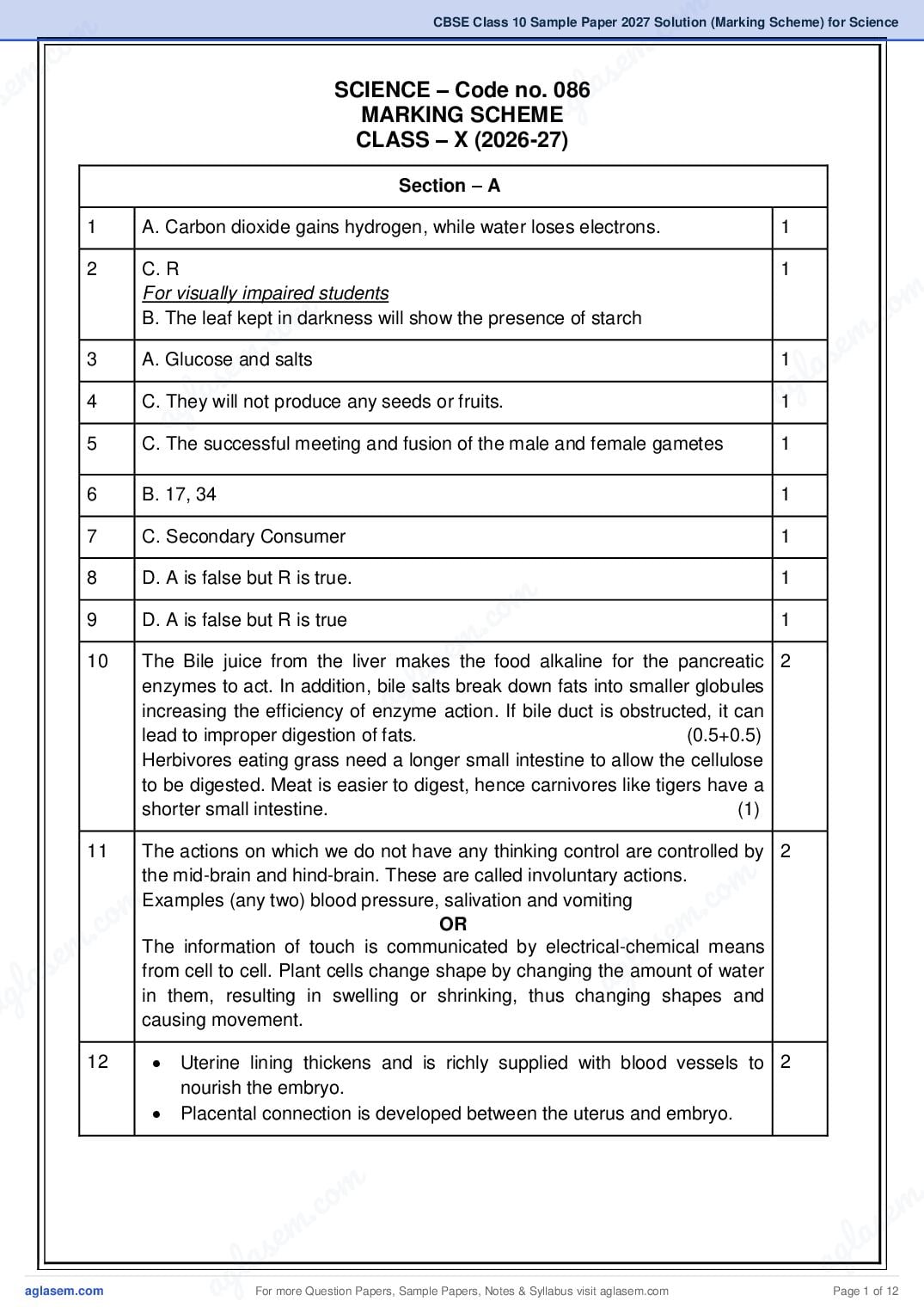
Section – A
1 A. Carbon dioxide gains hydrogen, while water loses electrons. 1
2 C. R 1
m
.co
o m
B. The leaf kept in darkness will show the presence of starch
m
c
. salts s e
3
e m
A. Glucose and 1
l a
a s
l will not produce any seeds or fruits. a1 g
4
g
C. They
a
5 C. The successful meeting and fusion of the male and female gametes 1
6 B. 17, 34 1
7 C. Secondary Consumer 1
8 D. A is false but R is true. 1
m
9 D. A is false but R is true
m .co 1
s e
la
10 The Bile juice from the liver makes the food alkaline for the pancreatic 2
ag
enzymes to act. In addition, bile salts break down fats into smaller globules
increasing the efficiency of enzyme action. If bile duct is obstructed, it can
lead to improper digestion of fats. (0.5+0.5)
Herbivores eating grass need a longer small intestine to allow the cellulose
to be digested. Meat is easier to digest, hence carnivores like tigers have a
shorter small intestine. (1)
11 The actions on which we do not have any thinking control are controlled by 2
the mid-brain and hind-brain. These are called involuntary actions.
m
mExamples (any two) blood pressure, salivation and vomiting
.co
m .co OR
s e m
s e The information of touch is communicated by electrical-chemical means
g l a
la a
from cell to cell. Plant cells change shape by changing the amount of water
ag in them, resulting in swelling or shrinking, thus changing shapes and
causing movement.
12 Uterine lining thickens and is richly supplied with blood vessels to 2
nourish the embryo.
Placental connection is developed between the uterus and embryo.
m .
.co s e m
s em l a
g la ag
a For more Question Papers, Sample Papers, Notes & Syllabus visit Page 1 of 12
Page 3
by changing their shape so that they shorten.
Muscle cells have special proteins that change both their shape and
their arrangement in the cell in response to nervous electrical
impulses.
When this happens, new arrangements of these proteins give the
muscle cells a shorter form.
14 A. 10000 KJ 3
B. No, the loss of energy at each step is so much that very little usable
energy will be left.
C. Large fish, due to biological magnification of pesticide.
15 A. In experiment one, in F1 all plants (100%) will have violet (Vv) flowers 4
and in F2, 75% (3/4) plants will have violet flowers (1/4 VV and 2/4Vv)
because violet colour of the flower is a dominant trait in pea plant. (1)
B. 3/16 or 18.75% pea plants will have tall height and white flowers
(vvTT/vvTt)– a combination of a dominant and a recessive trait. (1)
Attempt sub - part C or D.
C. In pea plants, no half way characteristics are produced because even
a single copy of T or V will produce the same result as two copies of T
or V. Thus, no plants with medium height and light violet flowers will be
produced in F1 or F2 generation (zero percent). (2)
OR
D. In F1 generation all plants will have only dominant traits so no plant
with short height and white flowers (recessive traits) will be produced
(zero percent). In F2 generation 1/16 or 6.25 % plants will have short
height with white flowers (vvtt) as both these traits are recessive. (2)
16 Student to attempt either option A or B. 5
A.
I. C – Four chambered heart. (1)
The separation of the right side and the left side of the heart is useful
to keep oxygenated and deoxygenated blood from mixing. Such
separation allows a highly efficient supply of oxygen to the body. This
is useful in animals that have high energy needs, such as birds and
mammals, which constantly use energy to maintain their body
temperature. (2)
II. A – Two chambered heart. (1)
The blood is pumped to the gills, is oxygenated there, and passes
directly to the rest of the body. Thus, blood goes only once through the
heart in the fish during one cycle of passage through the body. (1)
OR
For more Question Papers, Sample Papers, Notes & Syllabus visit Page 2 of 12
Page 4
m .co
m .co s e m
se B.
g l a
I. A depicts inhalation. a (1)
· Ribs get lifted (0.5)
· Diaphragm is flattened, (0.5)
· The chest cavity becomes larger (0.5)
· Air is sucked in. (0.5)
II. In human beings, the respiratory pigment haemoglobin has a very high
affinity for oxygen. This pigment is present in the red blood corpuscles.
m
.co
This oxygen-rich blood is then pumped by the heart to the rest of the
body.
o m (2)
m
. c s e
m
For visually impaired
echambers
students
l a
l a
I. Fours are present. (1)
separation of the right side and the left side of the heart is useful a
g
agto keep oxygenated and deoxygenated blood from mixing. Such
The
separation allows a highly efficient supply of oxygen to the body. This
is useful in animals that have high energy needs, such as birds and
mammals, which constantly use energy to maintain their body
temperature. (2)
II. Two chambered heart. (1)
The blood is pumped to the gills, is oxygenated there, and passes
m
.co
directly to the rest of the body. Thus, blood goes only once through
the heart in the fish during one cycle of passage through the body.(1)
e m
I.
las OR
· Ribs get lifted
ag (0.5)
· Diaphragm is flattened, (0.5)
· The chest cavity becomes larger (0.5)
· Air is sucked in. (0.5)
The exchange of gases can take place on the surface, which is
provided by the alveoli. The walls of the alveoli are supplied with an
extensive network of blood vessels. - So lungs maximize the area for
a gaseous exchange through the presence of large numbers of alveoli
m
m .co
which are richly supplied with blood. (1)
m .co II. In human beings, the respiratory pigment haemoglobin has a very
s e m
s e
high affinity for oxygen. This pigment is present in the red blood
g l a
la a
corpuscles. This oxygen-rich blood is then pumped by the heart to the
ag rest of the body. (2)
Section – B
17 C. physical change because the space between crystals is adjusted. 1
No new substance is formed in this process, only the spacing between
crystals changes that alters the wavelength of light reflected.
m .
.co s e m
s em l a
g la ag
a For more Question Papers, Sample Papers, Notes & Syllabus visit Page 3 of 12
Page 5
II & IV are incorrect as Chlorine is produced at the anode, but it is not
used to make margarine. And sodium hydroxide is deposited near
cathode.
19 A. Ca²⁺ and Mg²⁺ ions react with soap, forming insoluble compounds, 1
whereas detergents do not form such insoluble salts.
20 D. (i), (ii) and (iv) 1
Plaster of Paris is CaSO4.1/2 H2O,
Washing soda Na2CO3.10 H2O
Baking soda NaHCO3 and
Gypsum is CaSO4.2H2O
21 A. The compounds in this pair have same molecular formula but different 1
structural formula.
A. Propene
22 C. nitrogen, 1
In the label E304 and E307b are antioxidants. Nitrogen is also used as an
antioxidant.
C. antioxidant
23 C. do not corrode easily as aluminium oxide forms a protective layer. 1
24 B. Both A and R are true, and R is not the correct explanation of A. 1
25 Carbon forms millions of compounds because it has small atomic size, 2
therefore, it forms strong and stable C–C bonds, showing extensive
catenation. Silicon, being larger in size, forms weaker Si–Si bonds and
cannot show catenation to the same extent, so it forms fewer compounds.
26 Attempt either option A or B. 3
A.
(i)
(1)
For more Question Papers, Sample Papers, Notes & Syllabus visit Page 4 of 12
Page 6
m .co
m .co s em
se (ii) Propanol, C H OH
g la (0.5+0.5)
aH + H O
3 7
(iii) C H OH + CH COOH conc. H SO CH COOC
2 5 3 2 4 3 2 5 2 (1)
OR
B.
(i) Product A – Ethene, Product B – Ethane (0.5+0.5)
(ii) CH3CH2OH conc. H2SO4 CH2=CH2 + H2O (1)
CH2=CH2 + H2 Ni CH3CH3 (1)
m
.co
o m m
A.
. c s e
e
(i) Ethanolm (1)
l a
(ii) Cas (1) ag
g3
l 7H OH
a(iii) C H OH + CH COOH conc. H SO CH COOC H + H O
2 5 3 2 4 3 2 5 2 (1)
OR
B.
(i) Product A – Ethene, Product B – Ethane (0.5+0.5)
(ii) CH3CH2OH conc. H2SO4 CH2=CH2 + H2O (1)
CH2=CH2 + H2 Ni CH3CH3 (1)
m
27
.co
A. A sports drink contains ions (electrolytes) which help conduct 3
m
e
electricity. Coconut oil does not contain ions so it cannot conduct
s
la
electricity. (1)
ag
B. Limewater turns milky due to the formation of insoluble calcium
carbonate (CaCO₃). When excess CO₂ is passed, calcium carbonate
reacts further to form soluble calcium hydrogen carbonate, causing the
milkiness to disappear. (1)
C. Air near the sea contains high moisture (humidity), which speeds up
rusting. In a dry hilly region, moisture is low, so rusting occurs much
slowly. (1)
m
.co
28 A. Silver (1) 4
m
.co
B. (ii) 20 s (1)
e m
s
Attempt either sub-part C or D.
e m l a
s
C. Yes, the time required for candles to drop will increase for all the
la metals. The order of falling of candles will remain the same. Particles
ag
ag vibrate and transfer heat to one another in conduction. Conduction of
heat will take more time from one end to the other because heat has to
travel through a longer distance. (2)
OR
D. No, if the thickness of rods is changed the inference will not be correct.
The dimensions of the rods have to be the same. A thicker rod will take
more time to conduct heat. (2)
m .
.co s e m
s em l a
g la ag
a For more Question Papers, Sample Papers, Notes & Syllabus visit Page 5 of 12
Page 7
B. (ii) 20 s (1)
Attempt either sub-part C or D.
C. Yes, the time required for sensor to beep will increase for all the
metals.
The order of falling of pins will remain the same. Particles vibrate and
transfer heat to one another in conduction. Conduction of heat will take
more time to travel from one end to the other, as longer distance has
to be covered by heat energy. (2)
OR
D. No, if the thickness of rods is changed the inference will not be correct.
The dimensions of the rods have to be the same. A thicker rod will
take more time to conduct heat. (2)
29 Student to attempt either option A or B. 5
A.
I. Drishti.(Alisha and Bhushan are partially correct) (1)
Oxidation and reduction go hand in hand.
In case of formation of ammonia, nitrogen is getting reduced and
hydrogen is oxidised. In case of rusting of iron, iron is getting
oxidised while oxygen gets reduced. (2)
II. (i) MgCl2 + 2AgNO3 → 2AgCl + Mg(NO3)2 (1)
(ii) 2Al + 3H2SO4 → Al2(SO4)3 + 3H2 (1)
OR
B.
I. Both have understood decomposition partially.
Decomposition reaction is when a single substance breaks down into
simpler substances. The single substance undergoing decomposition
has to be a compound while the products formed can be either
elements or compounds.
MgCO3 decomposes on heating to magnesium oxide and carbon
dioxide even when both products formed are compounds, it is
decomposition. (2)
Water on electrolysis gives hydrogen and oxygen both are elements. It
is also a decomposition reaction. (1)
II.
(i) Incorrect observation, iron is less reactive than Mg so it cannot
displace magnesium. (1)
(ii) Hydrogen gas is formed, which produces few bubbles. Brisk
effervescence is formed when carbon dioxide is formed. (1)
For more Question Papers, Sample Papers, Notes & Syllabus visit Page 6 of 12
Page 8
m .co
m .co s e m
se Section – C
g l a
a
30 B. Hold the lens above a sheet of paper and adjust until the smallest, 1
brightest spot is formed.
31 C. 4.0 A 1
32 A. Both A and R are true, and R is the correct explanation of A. 1
m
m .co
33 A. The ratio of sine of angle of incidence to the sine of angle of refraction 2
.co
is a constant, for the light of a given colour and for the given pair of
m s e m
media.
s e (1)
l a
l a
B. Consider a ray of light travelling from medium 1 into medium 2.Let v1 be
g ag
a
the speed of light in medium 1 and v2 be the speed of light in medium 2.
The refractive index of medium 2 with respect to medium 1 is given by
𝑣
(𝑛21 ) 𝑛21 = 𝑣1 (1)
2
34 Student to attempt either A or B. 2
A.
I. Joule’s law of heating: The heat produced in a resistor is
m
.co
(i) directly proportional to the square of current for a given
m
resistance,
s e
(ii) directly proportional to resistance for a given current, and
g la
(iii) directly proportional to the time for which the current flows
through the resistor. a
H = I2Rt,
where ‘I’ is current and ‘R’ is resistance. (1)
II. If resistance is doubled: For the same current I, heat H becomes
H = I2(2R)t = 2I2Rt = 2H,
i.e. heat doubles. (1)
OR
m
m .co
.co
B.
m s em
I. Definition: The resistivity (ρ) of a material is defined as the resistance
s e g la unit length
la a
of a wire having unit cross-sectional area and
ag 𝑅=
𝐿
,where R is resistance of a wire of length L and cross-
𝐴
sectional area A (1)
II. Intrinsic property justification: Resistivity depends only on material
(not on dimensions). Example: Two copper wires of different lengths
and thick-nesses yield the same ρ when computed using R*A/L. (1)
m .
.co s e m
s em l a
g la ag
a For more Question Papers, Sample Papers, Notes & Syllabus visit Page 7 of 12
Page 9
Type of lens: Concave (diverging) lens (given). (1)
ℎi 𝑣
B. Image distance, 𝑣: Magnification 𝑚 = = . For a concave lens the
ℎo 𝑢
1
image is upright and diminished, so, 𝑚 = + .
3
Using sign convention 𝑚 = −24 𝑐𝑚,
1
𝑣 = 𝑚𝑢 = × (−24) = −8 𝑐𝑚. (1)
3
Thus, the image is located 8 cm on the same side of the lens as the
object (virtual image).
C. Focal length 𝑓 : Use lens formula
1 1 1
= +
𝑓 𝑣 𝑢
Substitute, 𝑣 = −8 𝑐𝑚, 𝑢 = −24 𝑐𝑚:
1 1 1 1 1 3+1 2 1
= + =− + = − = − = −
𝑓 −8 −24 8 24 24 24 12
So, 𝑓 = −12 𝑐𝑚 (1)
------------
If a student places an object 24 cm from a convex lens of focal length 12
cm, then
1 1 1
= −
𝑣 𝑓 𝑢
1 1 1
= −
12 𝑣 −24
1 1 2−1 1
= − = = = 𝑣 = 24 𝑐𝑚, (2)
12 24 24 24
And, the image is real (on the opposite side) at 24 cm. (1)
36 A. Right-hand thumb rule: Imagine that you are holding a current-carrying 3
straight conductor in your right hand such that the thumb points towards
the direction of current. Then your fingers will wrap around the
conductor in the direction of the field lines of the magnetic field. (1)
If the thumb of the right hand points in the direction of conventional
current, the curled fingers indicate the direction of the magnetic field
lines around the conductor. This helps determine the direction of the
magnetic field. (1)
B. Variation with distance: Magnetic field magnitude around a long straight
conductor at distance r falls as
i.e. it decreases inversely with distance from the conductor. (1)
For more Question Papers, Sample Papers, Notes & Syllabus visit Page 8 of 12
Page 10
m .co
m .co s e m
se 37 A.
g l a 3
a
m
m .co
.co s e m
s em l a
1Ω andla
g 1Ω are in series and the combination is in parallel with 2 Ω ag
a
1 1 1
= +
𝑅 2 2
m
RAB =1 Ω
m .co
s e
g la
a
1 1 1
= +
𝑅 3 3
R = 1.5 Ω
m
.co
5 Ω , 1 Ω and 1.5 Ω are in series: Rs = 5 + 1+1.5
m
.co
Rs = 7.5 Ω
e m
e m l as
las V=IR
ag
ag 15 V = I* 7.5
I = 2A (2)
B. RAB= 1 Ω, net current between points A and B is 2A
VAB = IAB *RAB
VAB = 2 *1 = 2V (1)
------------
m .
.co s e m
s em l a
g la ag
a For more Question Papers, Sample Papers, Notes & Syllabus visit Page 9 of 12
Page 11
𝑅total = 2 + 3 + 5 = 10 Ω (1)
B. Total current:
𝑉 15
𝐼= = = 1.5 𝐴. (1)
𝑅total 10
C. Voltage drop across the 3 Ω resistor:
𝑉3 Ω = 𝐼 × 3 = 1.5 × 3 = 4.5 𝑉 (1)
38 A. An iron core placed inside the solenoid concentrates and amplifies 4
the magnetic field, producing a stronger pulling force on the bolt. (1)
B. Using the right-hand thumb rule (Curl the fingers of your right hand in
the direction of current, then the direction of thumb will point towards
the direction of north pole of the solenoid)
Use a bar magnet with a known north pole towards one of the ends of
the solenoid, Repulsion will indicate North pole. (1)
Attempt either sub-part C or D.
C. If current increases then the magnetic field B inside a solenoid will
also increases as magnetic field is directly proportional to current. As
the magnetic field increases, a stronger magnetic pull unlocks the
door more effectively. (2)
OR
D. Increase the number of turns N of the coil, reduce coil length, or insert
a soft iron core. (any two points) (2)
A. The compass needle is influenced by the magnetic field developed by
the current carrying conductor. Hence it shows a deflection. (1)
B. It aligns itself with the Earth’s magnetic field in the north–south
direction. (1)
Attempt either sub-part C or D.
C. The deflection increases with the increase in the amount of current as
Magnetic Field in a current carrying conductor is directly proportional
to the current flowing through the conductor. (2)
OR
D. The Right-Hand Thumb Rule explains the reversed compass
deflection. When current direction reverses, the magnetic field's
direction reverses (fingers curl the opposite way), causing the
compass needle (a tiny magnet) to align with the new field, thus
deflecting oppositely, showing that the magnetic field is now in the
opposite direction. (2)
For more Question Papers, Sample Papers, Notes & Syllabus visit Page 10 of 12
Page 12
m .co
m .co s e m
se 39 Students to attempt either option A or B.
g l a5
A. a
I. Accommodation: Ability of the eye lens to change its focal length to
focus objects at different distances on the retina. (1)
II. Near point: The nearest point (about 25 cm for a normal eye) at
which an object can be seen distinctly; it signifies the closest
comfortable focus. (1)
III. Lens for defect (cannot see distant objects): A diverging (concave)
m
.co
lens is used to correct myopia (short-sightedness). (1)
m
.co
IV. Diagram:
e m
em l as
l as ag
ag
(2)
B.
I. Dispersion: Splitting of white light into its component colours due to
wavelength-dependent refraction. (1)
II. Colour deviating least in prism: Red deviates least (longest
wavelength). (1)
III. Sky dark in space: No atmosphere to scatter sunlight — space
m
.co
appears dark. (1)
IV. Diagram:
e m
las
ag
(2)
m
.co
------------
m
.co m
Students to attempt either option A or B.
m
s e
s e A.
g l a
g la I. Hypermetropia is a defect of vision in which a person can see distant a
a objects clearly but cannot see nearby objects clearly. (1)
II. The far point of a normal human eye is at infinity.
It signifies that a normal eye can see objects clearly even when they
are extremely far away. (1)
III. A convex (converging) lens is used to correct hypermetropia. (1)
IV. A hypermetropic eye cannot focus nearby objects on the retina
m .
.co s e m
s em l a
g la ag
a For more Question Papers, Sample Papers, Notes & Syllabus visit Page 11 of 12
Page 13
a) The eyeball is too short, or
b) The eye lens is not converging enough (insufficient curvature)
As a result, the image of a nearby object forms behind the retina,
instead of on it. A convex lens is used to increase the
convergence of light so that the image forms on the retina. (2)
OR
B.
I. The earth’s atmosphere is a heterogeneous mixture of minute
particles. These particles include smoke, tiny water droplets,
suspended particles of dust and molecules of air. When a beam of
light strikes such fine particles, the path of the beam becomes
visible. The phenomenon of scattering of light by the colloidal
particles gives rise to Tyndall effect. (2)
II. Violet light has the shortest wavelength. (1)
III. Red light is least scattered by air because it has the longest
wavelength. It remains visible over long distances even in fog,
smoke, or dust. Hence, red is chosen for alert and stop signals. (1)
IV. Sunlight is white but when it enters the atmosphere, the smaller
particles of air scatter shorter wavelengths (blue and violet) more
strongly than others. Our eyes are more sensitive to blue than violet,
so the sky appears blue. (1)
**********
For more Question Papers, Sample Papers, Notes & Syllabus visit Page 12 of 12
Document Details
| Board / Org | CBSE |
| Exam | Class 10 |
| Type | Solution |
| Pages | 12 |
| Updated | 29 Oct 2026 |