ISC Class 12 Syllabus 2022 Physical Education
Finished viewing? Save it for later —
Download ISC Class 12 Syllabus 2022 Physical Education (PDF · 24 pages)About ISC Class 12 Syllabus 2022 Physical Education
ISC Class 12 Syllabus 2022 Physical Education is available here for free download. Published by CISCE for Class 12, this syllabus can be viewed online or downloaded as a PDF (24 pages). Candidates preparing for Class 12 can use ISC Class 12 Syllabus 2022 Physical Education to understand the exam pattern, the type of questions asked, and the overall difficulty level.
Frequently Asked Questions
How can I download ISC Class 12 Syllabus 2022 Physical Education?
Open this page and click the Download button to save ISC Class 12 Syllabus 2022 Physical Education as a PDF. It is completely free on AglaSem Docs.
Is ISC Class 12 Syllabus 2022 Physical Education free to download?
Yes. ISC Class 12 Syllabus 2022 Physical Education can be viewed online and downloaded as a PDF free of cost on AglaSem Docs.
How many pages does ISC Class 12 Syllabus 2022 Physical Education have?
ISC Class 12 Syllabus 2022 Physical Education contains 24 pages, which you can read online or download together as a single PDF.
Where can I find more Class 12 study material?
You can find more Class 12 question papers, sample papers, syllabus, and answer keys on AglaSem Docs.
ISC Class 12 Syllabus 2022 Physical Education – Text
Read the full text of this syllabus below — useful to quickly search, copy and reference the content online without downloading the PDF.
📄 View text version (24 pages)
Page 1
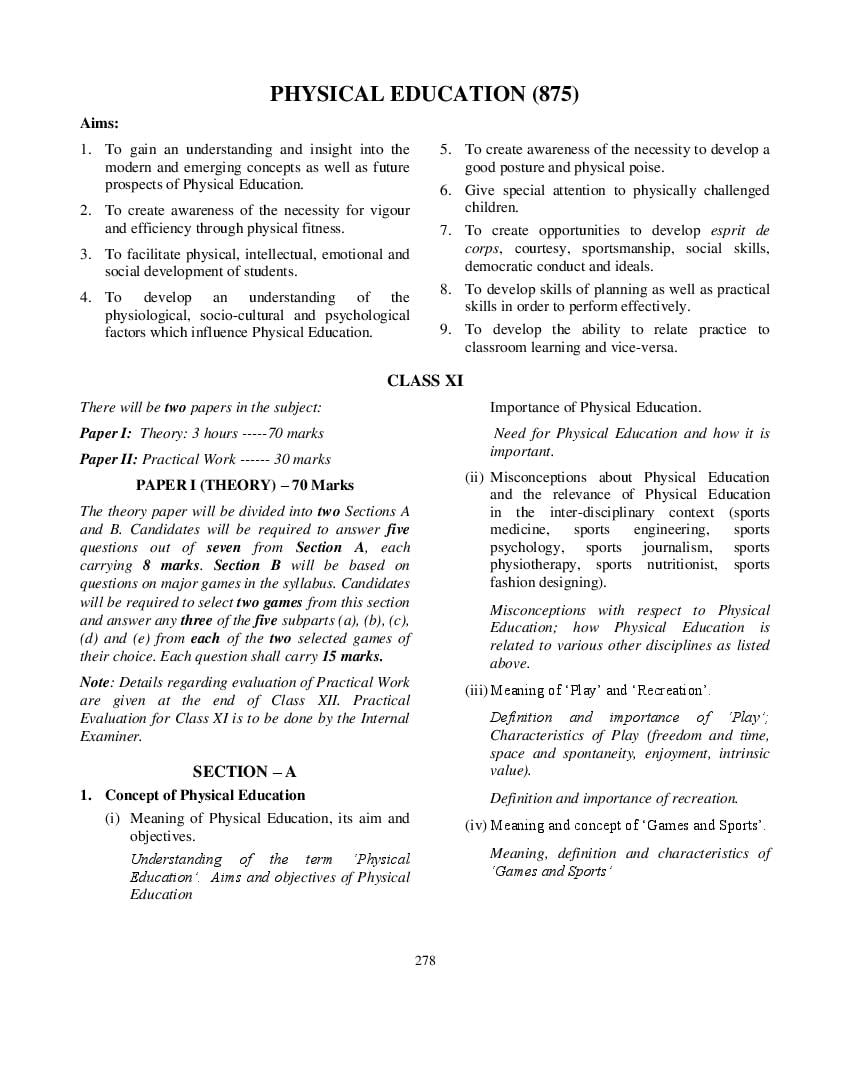
Aims:
1. To gain an understanding and insight into the 5. To create awareness of the necessity to develop a
modern and emerging concepts as well as future good posture and physical poise.
prospects of Physical Education. 6. Give special attention to physically challenged
2. To create awareness of the necessity for vigour children.
and efficiency through physical fitness. 7. To create opportunities to develop esprit de
3. To facilitate physical, intellectual, emotional and corps, courtesy, sportsmanship, social skills,
social development of students. democratic conduct and ideals.
8. To develop skills of planning as well as practical
4. To develop an understanding of the
skills in order to perform effectively.
physiological, socio-cultural and psychological
factors which influence Physical Education. 9. To develop the ability to relate practice to
classroom learning and vice-versa.
CLASS XI
There will be two papers in the subject: Importance of Physical Education.
Paper I: Theory: 3 hours -----70 marks Need for Physical Education and how it is
important.
Paper II: Practical Work ------ 30 marks
(ii) Misconceptions about Physical Education
PAPER I (THEORY) – 70 Marks
and the relevance of Physical Education
The theory paper will be divided into two Sections A in the inter-disciplinary context (sports
and B. Candidates will be required to answer five medicine, sports engineering, sports
questions out of seven from Section A, each psychology, sports journalism, sports
carrying 8 marks. Section B will be based on physiotherapy, sports nutritionist, sports
questions on major games in the syllabus. Candidates fashion designing).
will be required to select two games from this section
Misconceptions with respect to Physical
and answer any three of the five subparts (a), (b), (c), Education; how Physical Education is
(d) and (e) from each of the two selected games of related to various other disciplines as listed
their choice. Each question shall carry 15 marks. above.
Note: Details regarding evaluation of Practical Work
(iii) Meaning of ‘Play’ and ‘Recreation’.
are given at the end of Class XII. Practical
Evaluation for Class XI is to be done by the Internal Definition and importance of ‘Play’;
Examiner. Characteristics of Play (freedom and time,
space and spontaneity, enjoyment, intrinsic
SECTION – A value).
1. Concept of Physical Education Definition and importance of recreation.
(i) Meaning of Physical Education, its aim and (iv) Meaning and concept of ‘Games and Sports’.
objectives.
Understanding of the term ‘Physical Meaning, definition and characteristics of
Education’. Aims and objectives of Physical ‘Games and Sports’
Education
278
Page 2
diaphragm) and their functions.
(a) Interest and attitude.
(iii) Circulatory system: Meaning; Heart, its
− Meaning and definition of the term
structure and functions; control of the
Interest (inborn and acquired); Methods
heart rate; function and composition of
of developing interest (in Physical
blood, maintenance of blood supply.
Education activities and programmes).
(iv) Digestive System: Meaning, major organs
− Meaning and definition of the term
(mouth, oesophagus, stomach, pancreas,
Attitude (experience, derived, emotional
liver, gallbladder, small intestine, large
challenge, profession); methods of
intestine) and functions of each.
forming attitude: by means of
(v) Effect of exercise and benefits of regular
suggestions, by blindly accepting the
training on the above systems.
social norms, by means of some intense
emotional experiences, through 4. Nutrition, Weight Control & Exercise
participating in games and sports
(forming attitude to win, attitude towards (i) Nutrition Basics – Dietary Goals and basics
exercise, attitude towards physical of a Nutritious Diet.
fitness, fair play, obedience, discipline, Nutrition basics: Dietary Goals for various
etc.) stages of growth (childhood, adolescence,
(b) Motivation. adulthood, old age); Meaning of ‘Nutritious
− Introduction, meaning and definition of Diet’.
‘Motivation’.
(ii) Balanced Diet and role of balanced diet in
− Types of Motivation: intrinsic and
performance.
extrinsic.
− Methods of Motivation: praise or blame, Concept of a Balanced diet; elements and
competition, reward and punishment, sources of a balanced diet; factors affecting
setting clear goals, success and failure, balanced diet; Importance of Balanced diet
record of progress, scholarships, social in sports performance.
recognition, honour and glory. (iii) Obesity and weight control; Life time
(c) Leadership. concept of weight control.
− Meaning and definition of the word Meaning and definition of obesity; causes
‘Leader’. of Obesity, dangers of Obesity, prevention
− Desirable qualities of a Leader. of Obesity through exercise and weight
control.
3. Effects of Physical Exercise on Human Body
Systems Life-time concept of weight control – an
Various systems and the effects of exercise and understanding of how weight can be
training on the following: skeletal system, controlled through proper eating habits
muscular system, respiratory system, circulatory and exercise.
system and digestive systems.
5. Physical Fitness & Wellness
(i) The skeletal and muscular system: Types of
bones in the body, various types of joints (i) Physique, Physical Fitness and Wellness.
and major movements; structural Understanding of the term ‘Physique’;
classification of muscles, structure and A basic understanding of the three
function of muscle. body types (a) Endomorph (b) Mesomorph
(ii) Respiratory System: Meaning and types of (c) Ectomorph.
respiration, organs of the respiratory Meaning and importance of Physical Fitness
and Wellness.
279
Page 3
Components of physical fitness: place and where and when the upcoming
Health related fitness such as Cardio Asian Games will take place. Events held in
vascular endurance, muscular endurance, Asian Games; Countries participating in
strength; flexibility; body composition. Asian Games.
Skill related fitness: such as Cardio vascular
endurance, muscular endurance, strength; SECTION B
flexibility; body composition, balance; Any two of the following games are to be studied:
coordination; agility; power, reaction time
and speed (Candidates should be made to Cricket, Football, Hockey, Basketball, Volleyball,
understand that skill related fitness includes Badminton, Tennis, Swimming, Athletics.
all health related fitness components).
The following aspects should be studied for each of
Components of Wellness: social, spiritual,
the two games selected by the candidate.
physical, mental, emotional and intellectual
(a basic understanding of each). Rules and regulations of the game; Interpretation of
(iii) Factors affecting physical fitness and laws of the game; Duties and responsibilities of the
wellness. officials and players; Measurement and dimensions
Factors affecting physical fitness and related to the game; Terminologies related to the
wellness: Heredity, exercise (physical, game; Fundamental skills of the game; Strategies and
mental and social benefits), illness, physical formation of the game; Names and abbreviations of
deformity, age and gender, diet, stress, living
the National and Major International Tournaments
style, substance use (smoking, drugs,
alcohol) and environment. linked with the game; Diagrams and dimensions of
(iv) Tests and Measurements in Sports. play area; Diagrams and dimensions of equipment
related to the game.
Basic understanding, importance and
calculation of the following: Kraus Weber The details for each game are given below:
Test; Body Mass Index (BMI); Waist Hip
Ratio; Measurement of Heart Rate; Rockport CRICKET
one-mile test.
– Knowledge of the game, strategies and tactics,
6. Games and Sports – a global perspective and how to improve performance.
(i) Olympics as a Social force. – Detailed understanding of the rules and
An understanding of how the Olympic games regulations of the game. Diagrams of the field
promote international understanding and and pitch, and various fielding positions.
appreciation of cultural diversity by – Knowledge of the dimensions of the field,
providing a platform for athletes from all thickness of the lines, dimensions of pitch and
over the world to meet and compete, complete specifications and markings on it.
irrespective of their colour, race, creed and
Equipment of the game with their length, width
political beliefs.
weight, thickness and material. Score board,
(ii) History of Modern Olympics.
scorer, sightscreen. Flood light
Motto of the Olympic games; Events held in – Duties of the officials, before, during and after
modern Olympics; Where and when the first
the match. Umpires and third umpire,
modern Olympics took place and where and
when the upcoming Olympics will take place; requirements of the game, equipment needed,
significance of the colours used in the rings numbers of players, duty of coach, captain etc.
of the Olympic flag and what these rings – Laws governing the game. Suspensions,
signify. The founder of modern Olympics. penalisations, draws, match fixtures,
(iii) Asian Games. arrangements needed to conduct tournaments,
280
Page 4
fixing, duck worth rule, sledging, ball tampering. pass, ground lofted, chip, volley, angle of pass.
– Basic skills and techniques. Batting (different Control (use of various surfaces-head chest, foot
types of shots, footwork, body position and thigh). Dribbling (running with the ball, rhythm
actual bat movement. Bowling (run up, delivery and pace, feints, body swerves, screening,
stride, follow through, types of bowling beating an opponent. Heading the ball with
variations, good line and length, grip action. intention of (attacking, defending, jumping, to
Fielding positions, catching and throwing skills, head down, high, pass, score). Shooting skills
Wicket keeping techniques, skills of getting the with either foot, inside or outside, short and long
batsmen out. range shots, swerving shots, volleys, penalty
– Different types of signals, extra runs, extra kicks, power and accuracy. Tackling skills -
players, runner, substitute, provisions and interception, jockeying for the ball, trapping by
restrictions, players equipment, danger area, various body parts, position, tackle front, side,
various terms of cricket. slide, recovery. Goalkeeping skills - stopping,
– Knowledge of associations and federations linked watching, guiding the team, saving goal, dealing,
to the game. Important tournaments. catching, heading, kicking, punching, throwing,
Abbreviations of associations and federations diving, anticipation, speed and reflexes.
concerned with the game. – Principles of play-attack, depth, defence,
penetration, sweeper systems, 4-4-2, 4-3-3,
FOOTBALL
4-2-4. Kick-off, corner kick, throw-in, goal kick,
– Knowledge of the game, strategies and tactics, free kick, penalty kick. Importance of penalty
and how to improve performance. arc, center circle and lines on the field.
– Detailed understanding of the rules and – Knowledge of associations and federations linked
regulations of the game. Match time, extra time, to the game. Important tournaments.
tie breaker, sudden death, ball in play and out of Abbreviations of associations and federations
play, importance of lines on the field. Various concerned with the game.
methods of starting and restarting the game.
HOCKEY
Substitution procedure, penalty cards and their
importance. – Knowledge of the game, strategies and tactics,
– Knowledge of the dimensions of the field, and how to improve performance.
thickness of the lines, dimensions of center – Detailed understanding of the rules and
circle, quarter circle, goal and penalty area, regulations of the game. Match time, extra time,
penalty arc and complete specifications and tie breaker, sudden death, ball in play and out of
markings on it. Equipment of the game with their play, penalty stroke, short corner, long corner,
length, width, weight, thickness, material and free hits, hit or push back, 16 yard hit,
dimensions. Diagram of goal post and field. importance of lines on the field. Start and restart
– Duties of the officials, requirements of the game, of the match.
equipment needed, numbers of players, duty of – Knowledge of the dimensions and diagrams of
coach, captain, assistant referees, technical the field and goalpost, thickness of the lines,
officials, grounds men, ball boys, match dimensions and complete specifications and
organizers, technical area. markings on it. Equipment of the game with their
– Laws governing the game. Suspensions, length, width, weight, thickness, material and
penalisations, draws, match fixtures, dimensions. Protective equipment of the
arrangements needed to conduct tournaments, goalkeeper and players.
punishment on players, coaches.
281
Page 5
equipment needed, numbers of players, reserve penalisations, draws, match fixtures,
bench, running substitution duty of coach, arrangements needed to conduct tournaments.
captain, assistant referees, ball boys, doctor, – Basic skills and techniques, tactics and team
grounds men. skills Knowledge of basic skills, free throws
– Laws governing the game. Suspensions, stance (passing, dribble, shoot); Shooting (jump
penalisations, draws, match fixtures, shot, layup, hook shot); passing (pass, signal,
arrangements needed to conduct tournaments, receive feint footwork, chest-pass, bounce pass,
punishment on players, coaches. overhead pass, javelin pass. Footwork (pivot, 1
– Basic skills and techniques (Passing - types of count and 2 count stop). One to one defence, fake
pass, ground lofted, chip, volley, angle of pass, and drive, pass and cut defence, types of defence,
push, scoop, flick, aerial ball. Receiving the ball zone defence, and fast break.
– control, dribbling (running with the ball, – Knowledge of associations and federations linked
rhythm and pace, feints, body swerves, screening, to the game. Important tournaments.
beating an opponent from the right to the left, Abbreviations of associations and federations
right and behind. Shooting skills with Stick, concerned with the game.
inside or outside, short and long range shots,
VOLLEYBALL
swerving shots, volleys, penalty, power and
accuracy. Tackling skills - interception, – Knowledge of the game, strategies and tactics,
jockeying for position. Goalkeeping skills - and how to improve performance.
stopping, watching, guiding the team, saving – Detailed understanding of the rules and
goal, kicking, diving, anticipation, speed. regulations of the game.
reflexes. – Knowledge of the dimensions and diagram of the
– Principles of play-attack, depth, defence, court, thickness of the lines, dimensions within
penetration, team formations 1-2-3-5/1-1-3-4- the court, full specifications of the net, pole and
2/1-1-3-3. other equipment required for the game.
– Knowledge of associations and federations linked – Duties of the officials, table officials, referees,
to the game. Important tournaments. requirements of the game, equipment needed,
Abbreviations of associations and federations numbers of players, reserve bench, duty of coach,
concerned with the game. captain, etc.
– Laws governing the game. Suspensions,
BASKETBALL
penalisations, draws, match fixtures,
– Knowledge of the game, strategies and tactics, arrangements needed to conduct tournaments,
and how to improve performance. default by teams.
– Detailed understanding of the rules and – Basic skills and techniques, tactics and team
regulations of the game. skills, Knowledge of basic skills, volley-two
– Knowledge of the dimensions of the court, hand pass over the head forearm pass. The serve-
thickness of the lines, diagrams and dimensions underarm, over arm float, over arm jump, over
of the court, full specifications of the ring, pole, arm top spin, round house jump. The smash -
boards and ball. high set cross court, down the line, speed smash,
– Duties of the officials, table officials, referees, tip the ball over the block. The block-line of
scorers, requirements of the game, equipment defence, defence against smash, attack at set ball.
needed, numbers of players, reserve bench, duty Teamwork importance in both defence and
of coach, captain, technical equipment team and attack. Understanding rotation, blocking and
player foul markers. screening
282
Page 6
to the game. Important tournaments. dimensions. Types of courts.
Abbreviations of associations and federations – Duties and number of officials, requirements of
concerned with the game. the game, number of players, duty of coach,
match organisers.
BADMINTON
– Laws governing the game. Suspensions,
– Knowledge of the game, strategies and tactics, penalisations, draws, match fixtures,
and how to improve performance. arrangements needed to conduct tournaments,
– Detailed understanding of the rules and punishment on players, coaches, match points,
regulations of the game. Match time, extra time, etc.
tie, shuttle in play and out of play, importance of – Basic skills and techniques - forehand or
lines on the court, singles and doubles. backhand, chopper grip, correct grip, smash,
– Knowledge of the dimensions and diagram of the drop, drive, net play, return upshots and
court, thickness of the lines. Equipment required low/high/flick serves. Basic positioning for men
for the game with their length, width weight, and women rallies. The racket grip-shake hand.
thickness, material and dimensions. Strokes - backhand push, forehand drive, forward
– Duties of the officials, requirements of the game, push. Service - two bounce serve, high toss,
equipment needed, number of players, duty of forehand spin, backhand spin, long serve. Spin -
coach, match organisers. forehand topspin, backhand topspin chopping
– Laws governing the game. Suspensions, blocking lobbing, follow through, placement of
penalisations, draws, match fixtures, ball for each service.
arrangements needed to conduct tournaments, – Knowledge of associations and federations linked
punishment on players, coaches, match points, to the game. Important tournaments.
etc. Abbreviations of associations and federations
– Basic skills and techniques - forehand or concerned with the game.
backhand, correct grip, smash, drop, drive, net
SWIMMING
play, return upshots and low/high/flick serves.
Basic positioning for men and women rallies. – Knowledge of competitive swimming events,
– Knowledge of associations and federations linked activities, strategies and tactics, and how to
to the game. Important tournaments. improve performance (individual and team).
Abbreviations of associations and federations – Detailed understanding of the rules and
concerned with the game. regulations of various swimming events,
strategies and tactics in chosen events. Planning
TENNIS
performing and evaluating particular event.
– Knowledge of the game, strategies and tactics, – Knowledge of the dimension, depth and distance
and how to improve performance. of the pool. Importance of starters and judges for
– Detailed understanding of the rules and start and finish of individual and medley races.
regulations of the game. Match time, deuce, Various officials in charge of conducting the
advantage, tie foot fault. Ball in play and out of events. Types of races, types of strokes, diving
play. Dimensions and importance of lines on the competitions, false start, individual and medley
court, singles and doubles. events. Stances for different strokes.
– Knowledge of the dimensions and diagram of the – Duties of the officials, table officials, referees,
court net, racket, thickness of the lines. requirements of the game, equipment needed,
Equipment required for the game with their numbers of players, reserve bench, duty of coach,
283
Page 7
photo finish. of the track. Measurement of 400 and 200 meters,
– Laws governing the game. Suspensions, relay and solo races. Equipment of athletes in
penalisations, draws, fixtures, arrangements various events dimensions and requirements.
needed to conduct tournaments. Importance of starters and judges for start and
– Basic skills and techniques requiring control, finish. Importance of staggers.
balance, weight transfer, flow and clear body – Duties of the officials, table officials, referees,
positions, complex sequence of movements and requirements of the game, equipment needed,
ability to perform showing high standards of numbers of players, reserve bench, duty of coach,
precision control power speed and stamina, physiotherapist, wind gauge operator, photo
fitness and tactics to outwit the opponents. finish.
Warming up and cooling down safely, safety – Laws governing the game. Suspensions,
requirements for swimmers. penalisations, draws, match fixtures,
– Knowledge of associations and federations linked arrangements needed to conduct meets. Rules
to the game. Important tournaments. and distances and requirements of various events.
Abbreviations of associations and federations – Basic skills and techniques requiring control,
concerned with the game. balance, weight transfer, flow and clear body
positions, complex sequence of movements and
ATHLETICS
ability to perform showing high standards of
– Knowledge of track and field events, activities, precision control power speed and stamina,
strategies and tactics, and how to improve fitness and tactics to outwit the opponents.
performance (individual and team). Warming up and cooling down exercises.
– Detailed understanding of the rules and – Knowledge of associations and federations linked
regulation of various events, strategies and tactics to the game. Important tournaments.
in chosen events. Planning performing and Abbreviations of associations and federations
evaluating particular event. concerned with the game.
284
Page 8
There will be two papers in the subject: (b) Methods of training.
Paper I: Theory: 3 hours -----70 marks Methods of Training: Repetition, continuous
& fartlek, and interval - Definition, purpose,
Paper II: Practical Work ------ 30 marks advantages and procedure of each.
PAPER I (THEORY) – 70 Marks (c) Warming up, conditioning and
cooling/limbering exercises.
The theory paper will be divided into two Sections A − Meaning of the terms ‘warming up’,
and B. Candidates will be required to answer five ‘conditioning’ and ‘cooling/limbering’.
questions out of seven from Section A, each − Basic exercises related to warming up,
carrying 8 marks. Section B will be based on conditioning and cooling/limbering.
questions on major games in the syllabus. Candidates − Advantages of warming up, conditioning
will be required to select two games from this section and cooling/limbering.
and answer any three of the five subparts (a), (b), (c), (d) Isometric and Isotonic exercises.
(d) and (e) from each of the two selected games of
their choice. Each question shall carry 15 marks. Meaning, advantages and examples of each.
(e) Circuit Training.
SECTION A Meaning and advantages of circuit training;
1. Sociological Aspects of Physical Education procedure of conducting circuit training.
(i) Games and sports as man’s cultural (f) Weight Training.
heritage. Meaning and advantages of weight training.
An understanding that sports have been a An understanding of how the above training
part of our culture and tradition since time methods help an individual in different sports
immemorial. and help develop strength, speed, stamina,
(ii) Development of the individual through skill, endurance.
games and sports.
Understanding how games and sports 3. Career Aspects in Physical Education
contribute in various ways towards the
development of an individual. (i) Career options in Physical Education.
(iii) Role of Physical Education in promoting Professional sportsmen, sports manager,
national integration. teacher/lecturer, sports coach, gym
How Physical Education helps in instructor, sports officials, sports events
promoting National Integration. coordinators, sports journalist and
(iv) Physical Education and personality commentator, sports software engineer,
development. marketing and manufacturing of sports
The role of Physical education in equipment.
development of personal qualities like an (ii) Important institutions of Physical Education
individual attitude, discipline, helpfulness, in India.
team spirit, patience, unity, friendship, etc. Functions and objectives of Netaji Subhash
2. Training Methods National Institute of Sports (N.S.N.I.S.),
(a) Meaning and importance of Sports Training. Sports Authority of India (S.A.I),
Definition of Sports Training and its International Olympic Committee (I.O.C),
importance. Indian Olympic Association (IOA), YMCA
College of Physical Education (Chennai),
Lucknow Christian College of Physical
Education (LCCPE), Luxmibai National
University of Physical Education (LNUPE).
285
Page 9
systems, influence of media and sponsors, meaning and examples.
campaigns like Health runs in creating
awareness towards social evil causes and Note: Details of specific diseases not
promoting physical fitness. required.
4. Competitions and Tournaments (c) Disability and Rehabilitation.
(i) Tournaments and types of tournaments. Causes of disability. General principles for
prevention of disability;
Candidates should be fully aware of:
Meaning and scope of Rehabilitation;
− the definition of ‘tournament’. services available for rehabilitation; role of
− the types of tournaments: Fixtures, the community and government
Knock-out, league matches (seeding and organizations in rehabilitation programmes.
byes). (d) Posture.
Meaning of posture.
− merits and demerits of tournaments.
Correct posture – meaning, importance of
− objectives and importance of intramural correct posture (standing, sitting, walking).
and extramural competitions. Common postural deformities: kyphosis,
− Names of the National and International scoliosis, lordosis, flat foot, knock-knees,
Federations/Bodies controlling the bowlegged, hunch back, round shoulders –
various tournaments/competitions. meaning, causes and corrective measures for
(iii) Difference between Professional and each.
Amateur Players. (e) Personal hygiene and sleep requirements.
Self-explanatory. Personal hygiene: Meaning of personal
hygiene, importance of personal hygiene for
Note: Candidates should be aware of the a healthy life style. Care of eyes, ears, feet,
above, for the past five years, with respect to hair, skin, oral hygiene, nose and clothing.
the games included in the syllabus. Foot care: causes of corns, broken nails due
to tight footwear; Causes of diseases like
5. Health Education & Health Problems
ring worm, athletes foot due to walking in
(a) Meaning and definition of ‘Health’ and wet areas; proper care of feet.
‘Health Education’. Sleep requirements: Sleep requirements for
Meaning and definition of ‘Health’ (mental different age groups. Effects of insufficient
health and physical health) and ‘Health sleep on human body.
Education’. (f) Substance Abuse.
(b) Principles and importance of Health Effects of use of alcohol and smoking on the
Education. Health problems and role of individual and society.
Health Education in solving them. Drugs: Meaning of ‘drugs’ and ‘drug
abuse’; Stimulants and Narcotics –
Principles and objectives of Health Analgesics.
Education. Importance of Health Education
Awareness of the fact that use of certain
for adults and the younger generation
drugs has been banned by World
through formal and non-formal channels of Anti-Doping Agency (WADA) and National
education. Various prevalent Health Anti-Doping Agency (NADA) and reasons for
Problems: Communicable diseases – the same.
meaning, examples and common mode of
spread. Epidemics – meaning and examples;
Water, noise and air pollution – causes and
286
Page 10
(i) Sports related injuries.
– Knowledge of the game, strategies and tactics,
Types of sports related injuries: soft tissue and how to improve performance.
injuries (contusion, abrasion, strain and
sprain) bone injuries (fracture) and joint – Detailed understanding of the rules and
injuries (dislocation): causes and prevention regulations of the game. Diagrams of the field
of each. and pitch, and various fielding positions.
(ii) Role of a sportsperson in prevention of sports – Knowledge of the dimensions of the field,
related accidents. thickness of the lines, dimensions of pitch and
complete specifications and markings on it.
Types of injuries due to: sudden movement;
Equipment of the game with their length, width
environment (hot, cold, wet and dry); lack of
weight, thickness and material. Score board,
preparation (warm up, cool down);
scorer and sightscreen. Flood light.
inadequate clothing, body protection; not
following instructions; surface and facilities, – Duties of the officials, before, during and after
equipment being unsafe. Role of individual in the match. Umpires and third umpire,
prevention of sports related accidents. requirements of the game, equipment needed,
numbers of players, duty of coach, captain etc.
(iii) First Aid.
– Laws governing the game. Suspensions,
Meaning and importance of ‘First Aid’.
penalisations, draws, match fixtures,
First Aid for various sports related injuries.
arrangements needed to conduct tournaments,
First Aid for cuts, grazes, strains, sprains, forfeitures, follow on, tie, power play, match
cramps, blisters, bruises, injuries of bone fixing, duck worth rule, sledging, ball tampering.
(fracture and dislocation); application of
– Basic skills and techniques. Batting (different
splints and Thomas splint; First Aid in
types of shots, footwork, body position and
drowning; Cardio Pulmonary Resuscitation
actual bat movement. Bowling (run up, delivery
(CPR) and Rest, Ice, Compression and
stride, follow through, types of bowling
Elevation (RICE).
variations, good line and length, grip action.
Fielding positions, catching and throwing skills,
SECTION B Wicket keeping techniques, skills of getting the
Any two of the following games are to be studied: batsmen out.
Cricket, Football, Hockey, Basketball, Volleyball, – Different types of signals, extra runs, extra
Badminton, Tennis, Swimming, Athletics. players, runner, substitute, provisions and
restrictions, players equipment, danger area,
The following aspects should be studied for each of various terms of cricket.
the two games selected by the candidate.
– Knowledge of associations and federations linked
Rules and regulations of the game; Interpretation of to the game. Important tournaments.
laws of the game; Duties and responsibilities of the Abbreviations of associations and federations
officials and players; Measurement and dimensions concerned with the game.
related to the game; Terminologies related to the FOOTBALL
game; Fundamental skills of the game; Strategies and
formation of the game; Names and abbreviations of – Knowledge of the game, strategies and tactics,
the National and Major International Tournaments and how to improve performance.
linked with the game; Diagrams and dimensions of – Detailed understanding of the rules and
play area; Diagrams and dimensions of equipment regulations of the game. Match time, extra time,
related to the game. tie breaker, sudden death, ball in play and out of
play, importance of lines on the field. Various
The details for each game are given below: methods of starting and restarting the game.
287
Page 11
importance.
– Knowledge of the game, strategies and tactics,
– Knowledge of the dimensions of the field, and how to improve performance.
thickness of the lines, dimensions of center
circle, quarter circle, goal and penalty area, – Detailed understanding of the rules and
penalty arc and complete specifications and regulations of the game. Match time, extra time,
markings on it. Equipment of the game with their tie breaker, sudden death, ball in play and out of
length, width, weight, thickness, material and play, penalty stroke, short corner, long corner,
dimensions. Diagram of goal post and field. free hits, hit or push back, 16 yard hit,
importance of lines on the field. Start and restart
– Duties of the officials, requirements of the game, of the match.
equipment needed, numbers of players, duty of
coach, captain, assistant referees, technical – Knowledge of the dimensions and diagrams of
officials, grounds men, ball boys, match the field and goalpost, thickness of the lines,
organizers, technical area. dimensions and complete specifications and
markings on it. Equipment of the game with their
– Laws governing the game. Suspensions, length, width, weight, thickness, material and
penalisations, draws, match fixtures, dimensions. Protective equipment of the
arrangements needed to conduct tournaments, goalkeeper and players.
punishment on players, coaches.
– Duties of the officials, requirements of the game,
– Basic skills and techniques (Passing - types of equipment needed, numbers of players, reserve
pass, ground lofted, chip, volley, angle of pass. bench, running substitution duty of coach,
Control (use of various surfaces-head chest, foot captain, assistant referees, ball boys, doctor,
thigh). Dribbling (running with the ball, rhythm grounds men.
and pace, feints, body swerves, screening,
beating an opponent. Heading the ball with – Laws governing the game. Suspensions,
intention of (attacking, defending, jumping, to penalisations, draws, match fixtures,
head down, high, pass, score.) Shooting skills arrangements needed to conduct tournaments,
with either foot, inside or outside, short and long punishment on players, coaches.
range shots, swerving shots, volleys, penalty – Basic skills and techniques (Passing - types of
kicks, power and accuracy. Tackling skills - pass, ground lofted, chip, volley, angle of pass,
interception, jockeying for the ball, trapping by push, scoop, flick, aerial ball. Receiving the ball
various body parts, position, tackle front, side, – control, dribbling (running with the ball,
slide, recovery. Goalkeeping skills - stopping, rhythm and pace, feints, body swerves, screening,
watching, guiding the team, saving goal, dealing, beating an opponent from the right to the left,
catching, heading, kicking, punching, throwing, right and behind. Shooting skills with Stick,
diving, anticipation, speed and reflexes. inside or outside, short and long range shots,
– Principles of play-attack, depth, defence, swerving shots, volleys, penalty, power and
penetration, sweeper systems, 4-4-2, 4-3-3, accuracy. Tackling skills - interception,
4-2-4. Kick-off, corner kick, throw-in, goal kick, jockeying for position. Goalkeeping skills -
free kick, penalty kick. Importance of penalty stopping, watching, guiding the team, saving
arc, center circle and lines on the field. goal, kicking, diving, anticipation, speed.
Reflexes.
– Knowledge of associations and federations linked
to the game. Important tournaments. – Principles of play-attack, depth, defence,
Abbreviations of associations and federations penetration, team formations 1-2-3-5/1-1-3-4-
concerned with the game. 2/1-1-3-3.
– Knowledge of associations and federations linked
to the game. Important tournaments.
Abbreviations of associations and federations
concerned with the game.
288
Page 12
default by teams.
– Knowledge of the game, strategies and tactics,
and how to improve performance. – Basic skills and techniques, tactics and team
skills Knowledge of basic skills, volley-two hand
– Detailed understanding of the rules and
pass over the head forearm pass. The serve-
regulations of the game.
underarm, over arm float, over arm jump, over
– Knowledge of the dimensions of the court, arm top spin, round house jump. The smash -
thickness of the lines, diagrams and dimensions high set cross court, down the line, speed smash,
of the court, full specifications of the ring, pole, tip the ball over the block. The block-line of
boards and ball. defence, defence against smash, attack at set ball.
– Duties of the officials, table officials, referees, Teamwork importance in both defence and
scorers, requirements of the game, equipment attack. Understanding rotation, blocking and
needed, numbers of players, reserve bench, duty screening
of coach, captain .technical equipment team and – Knowledge of associations and federations linked
player foul markers. to the game. Important tournaments.
– Laws governing the game. Suspensions, Abbreviations of associations and federations
penalisations, draws, match fixtures, concerned with the game.
arrangements needed to conduct tournaments. BADMINTON
– Basic skills and techniques, tactics and team
– Knowledge of the game, strategies and tactics,
skills Knowledge of basic skills, free throws
and how to improve performance.
stance (passing, dribble, shoot). Shooting (jump
shot, layup, hook shot), passing (pass, signal, – Detailed understanding of the rules and
receive feint footwork, chest-pass, bounce pass, regulations of the game. Match time, extra time,
overhead pass, javelin pass. Footwork (pivot, 1 tie, shuttle in play and out of play, importance of
count and 2 count stop) One to one defence, fake lines on the court, singles and doubles.
and drive, pass and cut Defence, types of – Knowledge of the dimensions and diagram of the
defence, zone defence, and fast break. court, thickness of the lines. Equipment required
– Knowledge of associations and federations linked for the game with their length, width weight,
to the game. Important tournaments. thickness, material and dimensions.
Abbreviations of associations and federations – Duties of the officials, requirements of the game,
concerned with the game. equipment needed, number of players, duty of
VOLLEYBALL coach, match organisers.
– Laws governing the game. Suspensions,
– Knowledge of the game, strategies and tactics,
penalisations, draws, match fixtures,
and how to improve performance.
arrangements needed to conduct tournaments,
– Detailed understanding of the rules and punishment on players, coaches, match points,
regulations of the game. etc.
– Knowledge of the dimensions and diagram of the – Basic skills and techniques - forehand or
court, thickness of the lines, dimensions within backhand, correct grip, smash, drop, drive, net
the court, full specifications of the net, pole and play, return upshots and low/high/flick serves.
other equipment required for the game. Basic positioning for men and women rallies.
– Duties of the officials, table officials, referees, – Knowledge of associations and federations linked
requirements of the game, equipment needed, to the game. Important tournaments.
numbers of players, reserve bench, duty of coach, Abbreviations of associations and federations
captain, etc. concerned with the game.
– Laws governing the game. Suspensions,
penalisations, draws, match fixtures,
289
Page 13
competitions, false start, individual and medley
– Knowledge of the game, strategies and tactics,
events. Stances for different strokes.
and how to improve performance.
– Duties of the officials, table officials, referees,
– Detailed understanding of the rules and
requirements of the game, equipment needed,
regulations of the game. Match time, deuce,
numbers of players, reserve bench, duty of coach,
advantage, tie foot fault. Ball in play and out of
physiotherapist, wind gauge operator, lifeguard,
play. Dimensions and importance of lines on the
photo finish.
court, singles and doubles.
– Laws governing the game. Suspensions,
– Knowledge of the dimensions and diagram of the
penalisations, draws, fixtures, arrangements
court net, racket, thickness of the lines.
needed to conduct tournaments.
Equipment required for the game with their
length, width, weight, thickness, material and – Basic skills and techniques requiring control,
dimensions. Types of courts. balance, weight transfer, flow and clear body
positions, complex sequence of movements and
– Duties and number of officials, requirements of
ability to perform showing high standards of
the game, number of players, duty of coach,
precision control power speed and stamina,
match organisers.
fitness and tactics to outwit the opponents.
– Laws governing the game. Suspensions, Warming up and cooling down safely, safety
penalisations, draws, match fixtures, requirements for swimmers.
arrangements needed to conduct tournaments,
– Knowledge of associations and federations linked
punishment on players, coaches, match points,
to the game. Important tournaments.
etc.
Abbreviations of associations and federations
– Basic skills and techniques - forehand or concerned with the game.
backhand, chopper grip, correct grip, smash,
drop, drive, net play, return upshots and ATHLETICS
low/high/flick serves. Basic positioning for men – Knowledge of track and field events, activities,
and women rallies. The racket grip-shake hand. strategies and tactics, and how to improve
Strokes - backhand push, forehand drive, forward performance (individual and team).
push. Service - two bounce serve, high toss,
– Detailed understanding of the rules and
forehand spin, backhand spin, long serve. Spin -
regulation of various events, strategies and tactics
forehand topspin, backhand topspin chopping
in chosen events. Planning performing and
blocking lobbing, follow through, placement of
evaluating particular event.
ball for each service.
– Knowledge of the dimension of the track. Width
– Knowledge of associations and federations linked
of the track. Measurement of 400 and 200 meters,
to the game. Important tournaments.
relay and solo races. Equipment of athletes in
Abbreviations of associations and federations
various events dimensions and requirements.
concerned with the game.
Importance of starters and judges for start and
SWIMMING finish. Importance of staggers.
– Knowledge of competitive swimming events, – Duties of the officials, table officials, referees,
activities, strategies and tactics, and how to requirements of the game, equipment needed,
improve performance (individual and team). numbers of players, reserve bench, duty of coach,
physiotherapist, wind gauge operator, photo
– Detailed understanding of the rules and
finish.
regulations of various swimming events,
strategies and tactics in chosen events. Planning – Laws governing the game. Suspensions,
performing and evaluating particular event. penalisations, draws, match fixtures,
arrangements needed to conduct meets. Rules
– Knowledge of the dimension, depth and distance
and distances and requirements of various events.
of the pool. Importance of starters and judges for
start and finish of individual and medley races. – Basic skills and techniques requiring control,
Various officials in charge of conducting the balance, weight transfer, flow and clear body
290
Page 14
ability to perform showing high standards of B. Specialisation Tests 6 marks
precision control power speed and stamina, (The candidate is to be evaluated
fitness and tactics to outwit the opponents. on any two basic skills of the
Warming up and cooling down exercises. two games/activities chosen by
– Knowledge of associations and federations linked him/her for Continuous
to the game. Important tournaments. Evaluation)
Abbreviations of associations and federations C. Viva-voce (on the two 2 marks
concerned with the game. games/activities chosen by the
PRACTICAL WORK - 30 Marks candidate)
No question paper for practical work will be set
by the Council. A. PHYSICAL EFFICIENCY TESTS
The Practical Work will be evaluated in two parts as The following are the tests to evaluate the
follows: physical fitness of candidates. These tests are to
be used for Continuous Assessment by the
1. Continuous Evaluation (by the 10 marks
Teacher as well as for Practical Assessment by
Teacher)
the Visiting Examiner. Tests 1 to 3 should be
2. Practical Evaluation (by Visiting 20 marks conducted on one day and 4 to 6 on the next.
Examiner)
(a) Test 1
1. CONTINUOUS EVALUATION (by the 50 metre run, standing start: Timings to be
Teacher): 10 Marks taken to the nearest tenth of a second
Continuous evaluation will be done by the (weather should be relatively windless
teacher(s) responsible for preparing the candidate without extremes of temperature).
for the examination, in two of the following (b) Test 2
games and activities of the candidate’s choice: Standing long jump: A flat no slip surface
Athletics, Cricket, Hockey, Football, Volleyball, should be used. The candidate should stand
Softball, Basketball, Tennis, Badminton, with toes just behind the take-off line and
Swimming, Dancing, Gymnastics, Yoga. jump when ready. After making preliminary
Continuous Evaluation will include the swing with the arms the candidate swings
following: them forward vigorously, springing with both
feet simultaneously to land as far forward as
A. File Work done throughout the 4 marks possible. Distance jumped to be measured in
year on any two games/activities. centimetres.
B. Participation and performance of 3 marks
(c) Test 3
the candidate, throughout the
year, in at least any two Distance run - 1000 metres run for boys, 600
games/activities of his/her metres run for girls. Time to be taken to the
choice. nearest second.
C. Physical Efficiency Tests. 3 marks (d) Test 4
(i) Floor push-ups for boys: The boy takes
2. PRACTICAL EVALUATION (by the Visiting a front-leaning position with body
Examiner): 20 Marks supported on hands and balls of feet; the
Practical evaluation will be done by the Visiting arms are straight and at right angles to
Examiner in the presence of the teacher and will the body. He then dips or lowers the
consist of the following: body so that the chest touches or nearly
touches the floor, then pushes back to the
starting position by straightening the
291
Page 15
times as possible. Only the chest should
60-second sit-ups: The candidate lies with
touch the floor; the arms must be
his/her back on a mat or flat surface, feet
completely extended with each push-up;
about 30 cm apart and knees flexed at a right
the body must be held straight
throughout. Scoring consists of the angle. The candidate's hands with fingers
number of correct push-ups. interlocked are placed behind the back. A
partner holds the candidate's feet in contact
(ii) Push-ups for girls: This is executed from with the mat or floor. On the signal "Go" the
a stall bar bench or a stool 32 cm high by candidate sits up to touch the knees with
50 cm long and 35 cm wide. It should be his/her elbows. Without pause he/she returns
placed on the floor about 15 cm from a to his/her starting position and immediately
wall so that the subject will not take a sits up again. The number of sit-ups
position too far forward. The girl should completed in 60 seconds are to be counted.
grasp the outer edges of the bench, or
stool, at the nearest corners and assume B. SPECIALISATION TESTS
the front-leaning rest position, with the
Candidates are to be tested by a Visiting
balls of her feet on the floor and with her
Examiner in the presence of the teacher in two of
body and arms forming a right angle.
the games/activities that were selected by them
She should then lower her body so that for Continuous Assessment. Details of skill areas
the upper chest touches the near edge to are given below.
the bench or stool, then raise it to a
straight arm position as many times as ATHLETICS
possible. The girl's body should be held Candidates will choose two of the following
straight throughout. If the body sways or events in which they wish to be tested:
arches, or if the subject does not go (i) Track events - sprints, middle and long
completely down or does not push distance races:
completely up, half credit is given up to 4
half credits. Boys - 100 m, 200 m, 400 m, 800 m, 1500 m
and 3000 m.
(e) Test 5
Girls - 100 m, 200 m, 400 m, 800 m.
Shuttle run: A flat course of 10 metres is (ii) Track events – hurdles:
required to be measured between the two
Boys - 110 m and 400 m.
parallel base lines. Behind each base line, a
semicircle 50 cm radius with centre on the Girls - 100 m.
base line is required to be marked. (iii) Field events - jumps and throws:
In the far semicircle two wooden blocks Boys - Broad jump, high jump, triple jump,
(5x5x5 cm) are to be placed. The candidate pole vault, shot-put, discus throw, javelin
stands with feet behind the base line, and on throw, hammer throw.
a signal, runs to the far line, picks up one
block which the candidate places in the Girls - Broad jump, high jump, shot-put,
starting semicircle when he/she returns. The discus throw.
candidate then repeats the procedure with the The following fundamental skills are
second block. The time to the nearest tenth of required:
a second is to be taken till the second block is Sprints
grounded in the starting semicircle. Practice of starts with blocks using proper
command.
292
Page 16
clearance time, acceleration time, velocity (i) Stance.
maintenance time, finish time.
(ii) Glide.
Middle Distance and Long Distance Races
(iii) Release.
(i) Style of endurance running.
(iv) Reverse.
(ii) Methods of endurance development.
Discus Throw
Broad Jump
(i) Stance.
(i) Approach run.
(ii) Preliminary Swings.
(ii) Take off.
(iii) Throws with one and a half turn.
(iii) Flying Phase.
(iv) Reverse.
(iv) Landing.
CRICKET
Hop, Step and Jump (Triple Jump) 1. Batting : pull, cut, hook, glance,
(i) Approach run. stepping out to drive the flighted ball.
(ii) Take off. 2. Bowling : outswing, inswing, off
(iii) Performance of hop, step and jump. break, leg break and googly.
(iv) Performance of combination of hops 3. Fielding : Catching high and low and
and steps. ground balls.
High Jump HOCKEY
(i) Approach run. 1. Straight hitting and stopping:
(ii) Take off. (a) Reverse hitting and stopping
(iii) Flying phase: scissors, straddle, (b) Hitting on the wrong foot
western roll or "Fosbury flop". 2. Straight push and stopping:
Pole Vault (Boys only) (a) Reverse push and stopping
(i) Grip. (b) Pushing on the wrong foot
(ii) Pole carry. 3. Scooping:
(iii) Approach run. (a) Push scoop
(iv) Take off. (a) Shovelling
(v) Planting of pole. 4. Flick:
(a) Straight Flick
(vi) Clearance of bar.
(b) Reverse flick
(vii) Landing.
(c) Flick on the wrong foot
Javelin Throw
5. Dribbling and carrying the ball
(i) Grip. 6. Passing:
(ii) Javelin carry. (a) Through pass
(iii) Transition from approach to five (b) Return pass
stride rhythm.
(c) Deflection pass
(iv) Release. (d) Interchanging position
(v) Reverse.
293
Page 17
(a) Dodging to opponent's left. kicks.
(d) Tactics of defence and attachment.
(b) Dodging to opponent's right.
(c) Double dodging. VOLLEYBALL
8. Different Techniques of: 1. The Pass:
(a) Corner (a) Over-head pass: Two-handed pass
(b) Penalty stroke with back rolling.
(c) Push in (b) Two-handed pass with side rolling.
(d) Goal keeping (c) Jump and pass.
9. Tackling: (d) Under arm pass.
(a) Lunging
(e) Forward dive and pass.
(b) Feinting
FOOTBALL (f) One arm pass with side rolling.
1. Passing and Interpassing: 2. The Serve:
(a) Interpassing between two players. (a) Over head service (Tennis-type).
(b) Interpassing among three players. (b) Round arm service.
(c) Three men weave. (c) Floating service (overhead and arm).
(d) Interpassing among four players.
3. The Set-up:
(e) Related practices.
(a) Setting up for quick smash.
2. Kicking:
(b) Move and set up (from back zones).
(a) Revision of all kicking fundamentals.
(b) Lofted kick with either foot. (c) Setting up to different zones at
varying trajectories.
(c) Practice of corner kicks - lobbing
chip shots and penalty kicks. 4. The Net Recovery:
3. Tackling: Two-handed overhead pass without rolling,
(a) Interception and hasty tackles. one hand under arm with or without rolling.
(b) Sliding tackles. 5. The Attack:
(c) Related practices. (a) Smash with turn of body.
4. Heading: (b) Smash with turn of wrist.
(a) Related practices, front, right side
(c) Round arm smash.
and left side.
(b) Head-up drills. (d) Smash on short pass (ascending
balls).
5. Dribbling:
Practice of dribbling skills suited to actual (e) Simple attack combination.
playing situations. 6. The Block:
6. Tactics and coaching: (a) Double block against different types
(a) Two back system - three back of attack.
system.
(b) Double block in assigned zones.
(b) Principles of zone and man to man
defence. (c) Double block against quick attack.
294
Page 18
combination. Candidates will be tested in two of the following
(e) Triple block against attack from events of their choice.
zone. Boys: Free style – 50m, 100 m, 200 m, 400 m,
7. Patterns of play: 800 m.
4-2 system, 5-1 system. Breast stroke – 50m, 100 m and 200 m.
Back stroke - 50m and 100m
BASKETBALL Butterfly stroke - 50 m and 100 m
1. Ball handling: Diving - Forward dive, backward dive,
Holding position of fingers, body, position, reverse dive and inward dive.
stance of player with ball. Girls: Free style – 50m, 100 m, 200 m.
2. Catching the ball: Breast stroke - 50 m and 100 m.
(Receiving) skills involved.
Back stroke - 50 m and 100 m
3. Passing: Skills - (Drills in Pairs)
Butterfly stroke - 50 m and 100 m.
(a) Two-handed chest pass.
Diving - Forward dive, backward dive,
(b) Two-handed bounce pass.
reverse dive and inward dive.
(c) Two-handed underhand pass (Right /
Left side). DANCING
(d) Two-handed over head pass. The candidates will be required to give a
4. Dribbling: performance of any two of the following dances
Dribbling high with speed, using alternate of their choice, with suitable accompaniment:
hands, low dribble. (i) Indian dancing: Bharatanatyam, Kuchipudi,
5. Shooting: Kathakali, Kathak, Manipuri, Odissi,
(a) Two-handed set shot. Mohiniyattam, Bhangra and other folk
(b) Two-handed free throw. dances.
(c) Lay up shot following dribble using (ii) Western dancing: Ballet, ballroom dancing,
right hand (over the shoulder layup). waltz, fox trot, tango, samba, charleston,
6. Footwork: square dancing; pop-dancing - jitterbug,
Player stance, position of feet, position of twist, rock-and-roll.
hand, elementary shuffling and slicing GYMNASTICS
movements (drills). The candidates will be tested in four exercises
7. Pivoting, Stationary Pivot. using any two of the following bits of apparatus
8. Individual defence: of their choice.
Player stance: position of hands, position of (i) Floor Exercise
feet, defender's position in between
opponent and basket. Boys - handspring to front somersault
(tucked); two headsprings; cartwheel to
9. Team defence: Man to man defence.
arabesque; arab spring; side somersault;
10. Team offence: First break offence. back roll to handstand, cabriole jump throw;
11. Full Court: Half court game using defence, flic-flacs.
offence taught.
Girls - Leap and cabriole; step into ball of
SOFTBALL/TENNIS/BADMINTON either foot; flic-flacs; round off; handspring;
cat leap; legs split in air, cartwheel;
Candidates will be required to demonstrate
handstand.
competency in the rules, skills and fitness training
related to the game.
295
Page 19
Run 2-3 steps; leap to riding seat with turned over the former).
1
/2 turn; rise to squat stand; ballet stand with (xii) Navasana (Balancing on buttocks with the
1
/2 turn; leap on either foot; step forward legs and trunk flexed over each other).
leap changing legs to rear leap; lunge to (xiii) Vajrasana (Sitting with flexed legs feet on
side; stag leap; one-arm cartwheel.
the side of buttocks).
(iii) Parallel bars (Boys only) (xiv) Supta Vajrasana (Supine lying in the position
Swing forward and cast to upper arm hand; of Vajrasana).
forward roll; pirouette forward; lower to
(xv) Kukutasana (Balancing on hands inserted
upper arm hand; swing backward; straddle
forward to support (hold). through the thighs and legs in padmasana).
(xvi) Jannsirasana (Paschimattrawasana on one leg
(iv) Vaulting horse
with the other leg flexed sideways).
Boys - (long horse) Split vault; through
(xvii) Ardha Baddha Padma Paschimttanasana
vault; hand stand with cartwheel; cartwheel
and handspring. (Paschimattanasana on one leg with the other
in Padmasana position).
Girls - Astride vault; split vault, through
vault; handspring. (xviii) Triang Mahaikapada Paschimatanasana
(Paschimottanasana on one leg with the other
(v) Horizontal bar (Boys only) in Najrasana position).
Forward and backward giant swings; change (xix) Moridriasana (Long sit with one knee flexed
of grip; twists; the hip-circles. and kept up and trunk turned over the
YOGA stretched leg).
Candidates will be tested in any four of the following
(xx) Akanrava Dhannrasana (Long sit and pull
asanas:
one foot to the corresponding ear).
(i) Vrikshasana (Balancing on one leg with the
(xxi) Uparrshta Konasana (Long sit with feet
other flexed sidewards).
spread and bring the head to the ground).
(ii) Utitha Trikonasana (Feet apart stand, side
(xxii) Bakasana (Balancing on hands with thighs
bending).
over the arms above elbows).
(iii) Parivrtta Trikonasana (Feet apart stand, side
(xxiii) Chakrasana (Cartwheel position).
bend, with the trunk rotated backward).
(xxiv) Nowli (contracting rectii abdominant in
(iv) Utitha Parvakonasana (Feet apart stand
uddiyana position alternate relaxation and
lunging on one side).
contraction of left and right muscles in quick
(v) Purivrita Parvakonasana (Feet apart stand succession).
lunging on one side and rotate the trunk
(xxv) Kapalabathi (Quick succession of abdominal
backwards).
strokes in padmasana position).
(vi) Virabhadrasana (Balancing on one leg with
(xxvi) Bhastrika (Pranavam following the strokes of
stretched hands, trunk and leg in a horizontal
Kapalabathi).
position).
(vii) Uthitha Hasta Padangusthasana (Balancing NOTE:
on one leg and trunk bending over the other While testing the candidates in any two
stretched horizontally). games/activities of their choice, the following method
(viii) Parasuottansasen (Feet apart stand and should be adopted. Test of the skill as a whole with
turning one side and bend the trunk over the emphasis on:
knee on that side. (i) Approach
(ix) Ushtrarsan (kneel sit and flex back the trunk). (ii) Stance/Grip
(iii) Execution (degree of perfection) and
(x) Padakastasan (Attention position, flex and
(iv) Follow through.
trunk over the thighs).
296
Page 20
PHYSICAL EFFICIENCY TESTS
Marks Test No. 1 Test No. 2 Test No. 3 Test No. 4 Test No. 5 Test No. 6
50m dash Standing long jump Distance run Push-ups Shuttle run 60 s sit-ups
(Timing in seconds (Distance in cm) (Timing in minutes (Numbers) (Timing in seconds (Numbers)
and tenths) and seconds) and tenths)
Boys Girls Boys Girls Boys Girls Boys Girls Boys Girls Boys Girls
(1000m) (600m)
5 6.5 7.6 204 167 4 min 2 min 30 22 9.8 11.0 47 30
10 s 30 s
4 6.6 7.9 197 155 4 min 2 min 24 14 10.0 11.2 44 28
20 s 40 s
3 6.8 8.2 190 149 4 min 2 min 17 8 10.2 11.6 41 26
30s 50 s
2 7.1 8.4 183 142 4 min 3 min 10 6 10.6 11.9 37 24
40 s
1 7.5 8.9 175 132 4 min 3 min 6 3 11.1 12.1 32 20
50 s 10 s
297
Page 21
ATHLETICS - FIELD EVENTS
Marks Long jump High jump Hop step & jump Pole vault Shot put throw Discus Javelin throw
(m and cm) (m and cm) (m and cm) (m and cm) (m and cm) (m and cm) (m and cm)
Boys Girls Boys Girls Boys Boys Boys Girls Boys Boys
10 5.50 5.00 1.70 1.50 12.00 3.00 10.00 8.50 25.00 35.00
8 5.00 4.50 1.55 1.45 11.50 2.75 9.00 7.50 22.00 32.00
6 4.50 4.00 1.40 1.30 11.00 2.25 8.00 6.50 19.00 29.00
4 4.00 3.50 1.30 1.20 10.50 2.00 7.00 5.50 16.00 26.00
3 3.50 3.00 1.20 1.10 10.00 1.75 6.00 4.50 13.00 23.00
2 3.00 2.50 1.10 0.95 9.50 1.50 5.00 3.50 10.00 20.00
1 2.99 2.00 1.00 0.94 9.49 1.25 4.99 3.49 9.98 19.98
PERFORMANCE TABLE - PHYSICAL EDUCATION SPECIALISATION TESTS
ATHLETICS - TRACK EVENTS
Marks 100 m 200 m 400 m 800 m 1500 m
(s and tenths) (s and tenths) (s and tenths) (s and tenths) (min and s)
Boys Girls Boys Girls Boys Girls Boys Girls Boys
10 11.5 13.6 24.0 25.0 56.0 68.0 2.10 2.45 4.40
8 11.8 14.4 25.1 26.1 56.1 68.1 2.15 2.50 4.45
6 12.4 15.2 26.1 27.1 58.1 71.1 2.20 2.55 4.50
4 13.2 16.0 27.1 30.1 60.1 74.1 2.30 3.05 5.00
3 14.0 16.8 28.1 33.1 62.1 77.1 2.40 3.15 5.10
2 14.8 17.6 29.1 36.1 64.1 80.1 2.50 3.25 5.20
1 15.6 18.5 30.1 39.1 66.1 83.1 3.00 3.35 5.30
298
Page 22
SWIMMING
Marks 50m free 100m free 200m free style 400m 50m breast-stroke 100m breast-
style style (min and s) free style (min and s) stroke
(s and tenths) (min and s) (min and s) (min and s)
Boys Girls Boys Girls Boys Girls Boys Boys Girls Boys
10 45.0 55.0 1:30 1:50 3.00 3.40 6.00 1.05 1.20 2:15
9 46.3 56.3 1:32.5 1:53 3.05 3.46 6.10 1.07 1.22.5 2:17.5
8 47.5 57.5 1:35 1:55 3.10 3.50 6.20 1.10 1.25 2:20
7 50.0 60.0 1:40 2:00 3.20 4.00 6.40 1.12 1.27.5 2:25
6 52.5 62.5 1:45 2:05 3.30 4.10 7.00 1.15 1.30 2:30
5 55.0 65.0 1:50 2:10 3.40 4.20 7.20 1.17 1.32.5 2:35
4 57.5 67.5 1:55 2:15 3.50 4.30 7.40 1.20 1.35 2:40
3 58.7 68.7 1:57.5 2:17.5 3.55 4.35 7.50 1.22 1.37 2:42.5
2 60.0 70.0 2:00 2:20 4.00 4.40 8.00 1.24 1.39 2:45
1 61.2 71.2 2:02.5 2:22.5 4.00.5 4.45 8.10 1.26 1.41 2:47
Note: For timings in between or higher than those indicated in the table the lower mark should be given.
299
Page 23
SWIMMING (continued)
Marks 50m back stroke 100m back 50m butterfly 100m butterfly Diving
(min and s) stroke stroke stroke
(min and s) (min and s) (min and s)
Boys Girls Boys Boys Girls Boys Description of action
10 0.55 1:10 2:00 0:55 1:05 1:50 Vertical, erect
body, arms and
9 1:00 1:15 2:00.5 0:57 1:10 1:52.5 legs together
8 1:02.5 1:17.5 2:05 1:00 1:12.5 1:55 Poor angle (either
backward or
7 1:05 1:20 2:10 1:02.5 1:15 2:00 forward)
6 1:07.5 1:22.5 2:15 1:05 1:17.5 2:05 Poor angle
opening of arms in front,
5 1:10 1:25 2:20 1:07.5 1:20 2:10 side, etc.
4 1:12.5 1:27.5 2:25 1:10 1:22.5 2:15 Poor angle
opening of arms
3 1:14 1:29 2:27.5 1:12.5 1:24 2:17.5 and legs
2 1:15 1:30.5 2:30 1:14 1:25 2:20 Poor angle
opening of arms
1 1:16 1:31 2:32.5 1:16 1:26 2:25 and legs in flight.
Note: For timings in between or higher than those indicated in the table the lower mark should be given.
300
Page 24
CONTINUOUS ASSESSMENT PRACTICAL ASSESSMENT TOTAL MARKS
(TO BE DONE BY THE TEACHER) (TO BE DONE BY THE VISITING EXAMINER Continuous Assessment
ONLY) +
Practical Assessment
File Work done Participation Physical Physical Specialisation Viva (To be entered by the
Unique Identification throughout the & Efficiency Efficiency Tests (on any 2 Visiting Examiner)
S. No. Number (Unique ID) of year performance Tests Tests games/
the candidate of candidates activities
in two games chosen)
of their choice
4 Marks 3 Marks 3 Marks 12 Marks 6 Marks 2 Marks 30 Marks
1.
2.
3.
4.
5.
6.
7.
8.
9.
10.
Name of the Teacher:_______________________ Name of the Visiting Examiner:___________________________
Signature: __________________________ Signature: __________________________
Date:___________________________ Date:___________________________
301
Document Details
| Board / Org | CISCE |
| Exam | Class 12 |
| Type | Syllabus |
| Pages | 24 |
| Language | english |
| Updated | 22 Jul 2026 |