CBSE Class 10 Sample Paper 2027 Solution (Marking Scheme) for Social Science
Finished viewing? Save it for later —
Download CBSE Class 10 Sample Paper 2027 Solution (Marking Scheme) for Social Science (PDF · 8 pages)About CBSE Class 10 Sample Paper 2027 Solution (Marking Scheme) for Social Science
CBSE Class 10 Sample Paper 2027 Solution (Marking Scheme) for Social Science is available here for free download. Published by CBSE for Class 10, this solution can be viewed online or downloaded as a PDF (8 pages). Candidates preparing for Class 10 can use CBSE Class 10 Sample Paper 2027 Solution (Marking Scheme) for Social Science to understand the exam pattern, the type of questions asked, and the overall difficulty level.
Frequently Asked Questions
How can I download CBSE Class 10 Sample Paper 2027 Solution (Marking Scheme) for Social Science?
Open this page and click the Download button to save CBSE Class 10 Sample Paper 2027 Solution (Marking Scheme) for Social Science as a PDF. It is completely free on AglaSem Docs.
Is CBSE Class 10 Sample Paper 2027 Solution (Marking Scheme) for Social Science free to download?
Yes. CBSE Class 10 Sample Paper 2027 Solution (Marking Scheme) for Social Science can be viewed online and downloaded as a PDF free of cost on AglaSem Docs.
How many pages does CBSE Class 10 Sample Paper 2027 Solution (Marking Scheme) for Social Science have?
CBSE Class 10 Sample Paper 2027 Solution (Marking Scheme) for Social Science contains 8 pages, which you can read online or download together as a single PDF.
Where can I find more Class 10 study material?
You can find more Class 10 question papers, sample papers, syllabus, and answer keys on AglaSem Docs.
CBSE Class 10 Sample Paper 2027 Solution (Marking Scheme) for Social Science – Text
Read the full text of this solution below — useful to quickly search, copy and reference the content online without downloading the PDF.
📄 View text version (9 pages)
Page 1
CBSE Class 10 Sample
Paper 2027 Solution
(Marking Scheme) for
Social Science
EXAM YEAR TYPE SUBJECT
CBSE Class 10 2027 Solutions Social Science
Notes · Sample Papers · Previous Year Papers · Mock Tests
Page 2
.co s e m
s em SOCIAL SCIENCE (087) g l a
a MARKING SCHEME a
CLASS-X (2026-27)
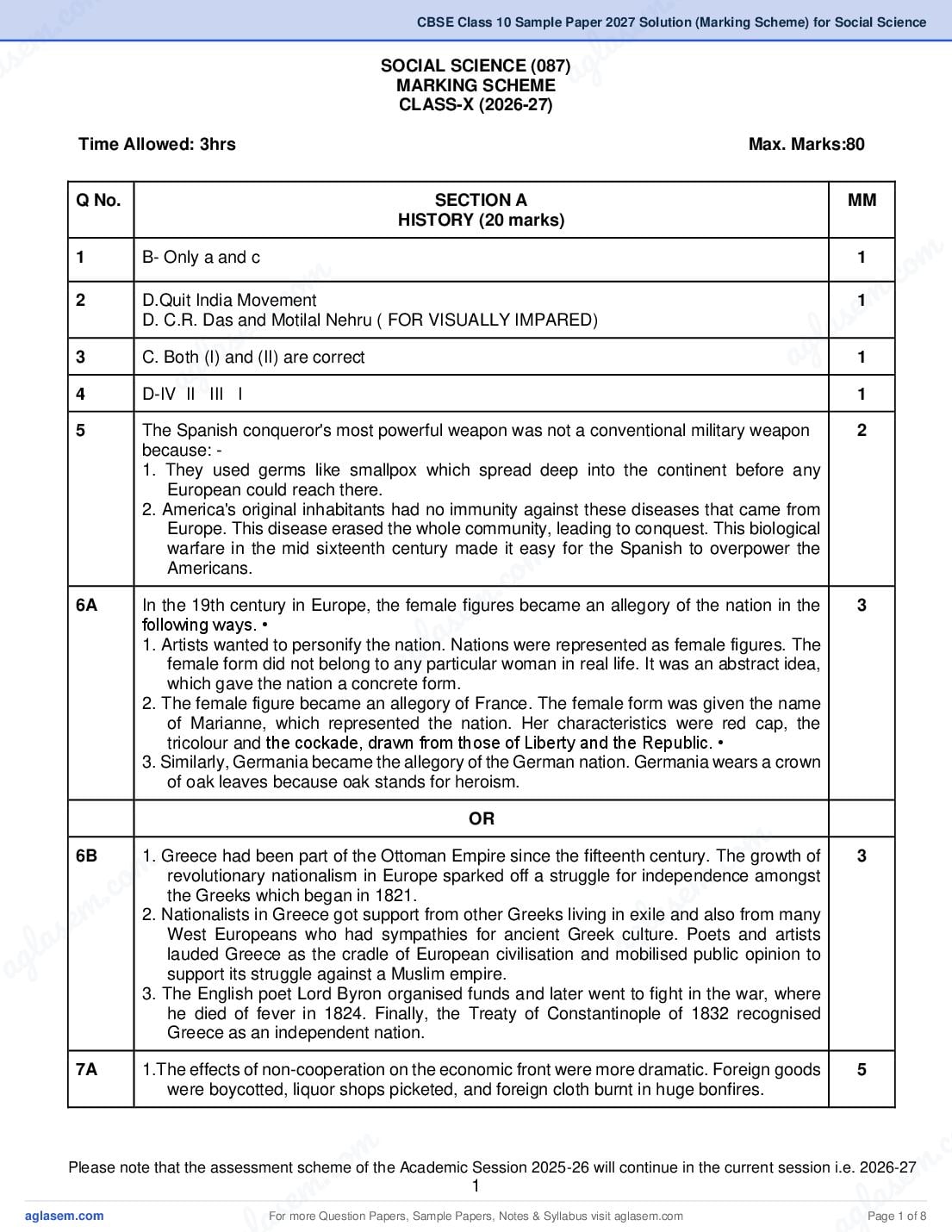
Time Allowed: 3hrs Max. Marks:80
Q No. SECTION A MM
HISTORY (20 marks)
m
co
1 B- Only a and c 1
o m .
2
.
D.Quit India Movement
m
c s e1 m
e la 1
D. C.R. Das and Motilal Nehru ( FOR VISUALLY IMPARED)
s
C. Both (I)aand (II) are correct
l ag
g
3
4 D-IV aII III I 1
5 The Spanish conqueror's most powerful weapon was not a conventional military weapon 2
because: -
1. They used germs like smallpox which spread deep into the continent before any
European could reach there.
2. America's original inhabitants had no immunity against these diseases that came from
Europe. This disease erased the whole community, leading to conquest. This biological
m
warfare in the mid sixteenth century made it easy for the Spanish to overpower the
Americans.
c o
. became an allegory of the nation in the
6A
e m
In the 19th century in Europe, the female figures 3
following ways. •
a s
l Nationswoman
a
female form did not belong to anyg
1. Artists wanted to personify the nation.
particular
were represented as female figures. The
in real life. It was an abstract idea,
which gave the nation a concrete form.
2. The female figure became an allegory of France. The female form was given the name
of Marianne, which represented the nation. Her characteristics were red cap, the
tricolour and the cockade, drawn from those of Liberty and the Republic. •
3. Similarly, Germania became the allegory of the German nation. Germania wears a crown
of oak leaves because oak stands for heroism.
OR
m
om .co
6B 1. Greece had been part of the Ottoman Empire since the fifteenth century. The growth of 3
. c revolutionary nationalism in Europe sparked off a struggle for independence amongst
e m
e m
the Greeks which began in 1821.
las
s
2. Nationalists in Greece got support from other Greeks living in exile and also from many
la a
West Europeans who had sympathies for ancient Greek culture. Poets and artistsg
ag lauded Greece as the cradle of European civilisation and mobilised public opinion to
support its struggle against a Muslim empire.
3. The English poet Lord Byron organised funds and later went to fight in the war, where
he died of fever in 1824. Finally, the Treaty of Constantinople of 1832 recognised
Greece as an independent nation.
7A 1.The effects of non-cooperation on the economic front were more dramatic. Foreign goods 5
were boycotted, liquor shops picketed, and foreign cloth burnt in huge bonfires.
m . c
c. o
s e m
em a
1
s
For more Question Papers, Sample Papers, Notes & Syllabus visit
gl Page 1 of 8
Page 3
102 crore to Rs 57 crore.
3. In many places merchants and traders refused to trade in foreign goods or finance
foreign trade.
4. As the boycott movement spread, people began discarding imported clothes and
wearing only Indian ones
5. Production of Indian textile mills and handlooms went up and making and wearing of
Khadi became very popular
OR
7B 1.During the First World War, Indian merchants and industrialists had made huge profits 5
and become powerful.Keen on expanding their business, they now reacted against
colonial policies that restricted business activities.
2.They wanted protection against imports of foreign goods, and a rupee-sterling foreign
exchange ratio that would discourage imports.
3.To organise business interests, they formed the Indian Industrial and Commercial
Congress in 1920 and the Federation of the Indian Chamber of Commerce and
Industries (FICCI) in 1927. Led by prominent industrialists like Purshottamdas
Thakurdas and G. D. Birla, the industrialists attacked colonial control over the Indian
economy, and supported the Civil Disobedience Movement when it was first
launched.
4.They gave financial assistance and refused to buy or sell imported goods. Most
businessmen came to see swaraj as a time when colonial restrictions on business
would no longer exist and trade and industry would flourish without constraints.
5. But after the failure of the Round Table Conference, business groups were no longer
uniformly enthusiastic. They were apprehensive of the spread of militant activities,
and worried about prolonged disruption of business, as well as of the growing
influence of socialism amongst the younger members of the Congress.
8 8.1. The Bengal Gazette was the first newspaper that marked the beginning of English 1+1+2
newspaper printing in India. =4
8.2. James Augustus Hickey demonstrated independence by publishing a private weekly
newspaper that claimed to be open to all and not influenced by colonial authorities.
8.3. Early printing activities helped spread knowledge by printing books and religious texts
in regional languages such as Konkani, Tamil, and Malayalam. This made written
material accessible to local people and encouraged the circulation of ideas much
before the rise of English newspapers.
9 A- Amritsar 1+1=2
B- Champaran
For Candidates with Visual Impairment
A-Dandi
B-Ahmedabad
SECTION B
GEOGRAPHY (20 marks)
10 C. Potential resource 1
11 A. 1-Y, 2-X, 3-Z 1
2
For more Question Papers, Sample Papers, Notes & Syllabus visit Page 2 of 8
Page 4
.co s e m
s em l a
a 12 D. (a), (c), (d) ag 1
13 C. Durg–Bastar–Chandrapur belt 1
14 B. Limited use of high-quality yarn due to decentralised weaving structure 1
15 C. A is true, but R is false 1
16 1. Rooftop rainwater harvesting: Rainwater collected from rooftops is stored in tanks for 2
domestic use, helping reduce dependence on surface and groundwater sources during
o m
dry periods.
m
o These structures store rainwater and allow it to seep into the ground, em . c
. c
2. Johads or khadins:
which helpsm s
s e recharge groundwater and supports irrigation in water-scarce areas.
l
g 5a
● Tea isla a
17A
a g which prefers seasonal rainfall.
coffee
more suitable in areas with high rainfall distributed throughout the year, unlike
● Tea requires a frost-free climate, making it ideal for tropical and sub-tropical regions.
● Coffee (Arabica) is suitable for regions with moderate temperatures and well-drained
slopes, such as the Western Ghats.
● Tea plantations demand large-scale labour availability, while coffee requires
comparatively less labour.
● Coffee cultivation is geographically more restricted, whereas tea can be grown in
several regions of India.
o m
c
OR
● Wheat is more suitable as it grows well in m
.
17B
s ewheat’s requirement of 50–75 cm.
cool temperatures during the growing season. 5
a
● The region’s moderate rainfall matches
● Wheat requires bright sunshine atl the time of ripening, which is common in winter
months. ag
● Availability of irrigation supports wheat cultivation in areas with limited rainfall.
● Wheat is traditionally grown in north and north-western regions, matching the given
conditions.
18 18.1 To ensure the protection and sustainable use of forest resources by involving local 4
communities. 1
m
.co
18.2 2
m
.co
● Local communities possess traditional knowledge of forests, which helps in their
e m
e m
sustainable management.
las
las ● People develop a sense of responsibility and ownership, preventing over-
exploitation of resources.
ag
ag Examples:
● Farmers and citizen’s groups like the Beej Bachao Andolan in Tehri and Navdanya
have shown that adequate levels of diversified crop production without the use of
synthetic chemicals are possible and economically viable.
● Joint Forest Management (JFM), where local communities and the government
jointly manage forest resources.
(Or any other relevant example(s)) – (any 2)
m . c
c. o
s e m
em a
3
s
For more Question Papers, Sample Papers, Notes & Syllabus visit
gl Page 3 of 8
Page 5
19 Marked on the map. (Answers to the questions for the V.I candidates are also the same- (1+2=
though only naming of the locations is required.) 3)
SECTION C
POLITICAL SCIENCE (20 marks)
20 A 1
21 C 1
22 B 1
23 C/B (Visually impaired) 1
24 1. Constitution prescribes that the number of Dutch and French-speaking ministers 2
shall be equal in the central government.
2. Many powers of the Central have been given to the State of the two regions of the
country. The State Governments are not subordinate to the Central Government.
3. Brussels has a separate government in which both the communities have equal
representation.
(Any 2 points)Or (Any other relevant point)
25. 1. People as the Source of Political Power- In a democracy, the people are the ultimate 2
source of all political power. They have the right and opportunity to participate in
governing themselves through various institutions of self-government.
2. Active Participation and Representation -: Democracy ensures that citizens actively
participate in political processes, have representation in government, and get
opportunities to take part in decision-making.
3. Accountability and Stability- Democracy encourages public debates and expression
of opinions, which influence policy making. It allows people to hold the government
accountable, ensures transparency, reduces conflicts between social groups, and
provides legitimacy to the elected government, thus contributing to political stability.
Any 2 points (Any other relevant answer)
26 1. No parliamentary constituency in the country has a clear majority of one single caste. 3
So, every candidate and party needs to win the confidence of more than one caste
and community to win elections.
2. No party wins the votes of all the voters of a caste or community. When people say
that a caste is a ‘vote bank’ of one party, it usually means that a large proportion of
the voters from that caste vote for that party.
3. Many political parties may put up candidates from the same caste (if that caste is
believed to dominate the electorate in a particular constituency). Some voters have
more than one candidate from their caste while many voters have no candidate from
their caste.
4. The ruling party and the sitting MP or MLA frequently lose elections in our country.
That could not have happened if all castes and communities were frozen in their
political preferences.
(Any 3 points)
27A 1. Now it is constitutionally mandatory to hold regular elections to local government 5
4
For more Question Papers, Sample Papers, Notes & Syllabus visit Page 4 of 8
Page 6
.co s e m
s em g l a
a bodies. a
2. Seats are reserved in the elected bodies and the executive heads of these institutions
for the Scheduled Castes, Scheduled Tribes and Other Backward Classes.
3. At least one-third of all positions are reserved for women.
4. An independent institution called the State Election Commission has been created in
each State to conduct panchayat and municipal elections.
5. The State governments are required to share some powers and revenue with local
government bodies. The nature of sharing varies from State to State.
OR
o m
m . c
27B
. co through three lists:
1. Division of Powers -The Constitution divides powers between the Union Government
s
5
e m
m
and State Governments
s e
a.Union List
g l a
la List
b.State List
g a
a ensures each level works independently within its jurisdiction.
c.Concurrent
This
2. Written and Supreme Constitution -India has a written Constitution, and all
governments must function within its limits.The Constitution is the supreme authority,
not the Parliament.
3. Rigidity of the Constitution -The division of powers cannot be changed easily.Any
amendment affecting federal structure requires approval of both Parliament and State
Legislatures.
4. Independent Judiciary-The Supreme Court acts as an impartial authority.It settles
disputes between the Centre and States and protects the Constitution.
m
.co
5. Dual Government System- There are two levels of government: Central Government
for the whole country and State Governments for their respective states
6.
e m
Financial Autonomy-States have their own sources of revenue, though some taxes
are shared with the Centre.
l as
ag
(Any 5 points)
28 28.1. 1+2+1
1. Every candidate in the elections will be independent. So no one will be able to make =4
any promises to the people about any major policy changes
2. The government may be formed but: it’s utility will remain uncertain. Elected
representatives will be accountable to their constituency for what they do in their
locality.
(Any one Point)
28.2
1. Contesting Elections: Parties select candidates and compete in elections, presenting
m
m different choices to voters.
.co
.co m
2. Formulating Policies & Programmes:They put forward their ideologies as policies and
m
programs for people to support.
s e
s e 3. Making Laws: Parties play a decisive role in debating and passing laws in the
g la
g la legislature.
a
a
4. Forming & Running Governments: The majority party forms the government and runs
it, implementing its agenda.
5. Playing the Role of Opposition: Defeated parties act as opposition, criticizing
government failures and holding it accountable.
6. Shaping Public Opinion: Parties highlight issues, raise public awareness, and
influence how people think.
7. Providing Access to Government: They act as a link, helping citizens access
government machinery and welfare schemes.
m . c
c. o
s e m
em a
5
s
For more Question Papers, Sample Papers, Notes & Syllabus visit
glPage 5 of 8
Page 7
28.3 -India adopted a multi-party system primarily due to its vast social and geographical
diversity, including different religions, cultures, languages, and regions, which couldn't
be adequately represented by just one or two parties, ensuring broader voice,
interests, and preventing power concentration in a single group, strengthening
democracy.
SECTION D
ECONOMICS (20 marks)
29 A. People living in different conditions may prioritise different needs and goals 1
30 C. 1: Farming/mining, 2: Relies on raw materials from primary sector 1
31 A. ₹200 crore, tertiary sector 1
32 B. People accept it in return for goods and services, making trade easier. 1
33 D. Inflation rate 1
34 A. Both A and R are true, and R is the correct explanation of A 1
35 This is called disguised unemployment. (1+2=3)
Causes of Disguised Unemployment in India
1. Excess labour in agriculture
2. Lack of alternative employment opportunities
3. Poverty and population pressure
4. Lack of skills and training required for other kinds of work
Or any other relevant point (any 1)
Solutions -
● Diversification of activities: Introduce other rural jobs like small-scale industries,
dairy, and poultry farming.
● Land reforms and consolidation: Combine small plots to make farming more
efficient, so fewer workers are underemployed.
● Skill development and education: Train people for non-agricultural jobs in towns or
industries to reduce surplus labour in farms.
● Or any other relevant point (any 2)
36 • SHG members are responsible collectively for repayment, so banks have 3
assurance of repayment.
• The group monitors individual members and follows up on non-repayment cases.
• Regular savings and organized meetings show discipline and reliability, making
banks confident to lend.
(Or any other relevant point) – (any 3)
37 1. Technology (transport, telecom, Internet) allows fast movement of goods, services, and 3
information across countries.
2. Liberalisation reduces trade barriers and allows foreign investments, making it easier
for businesses to operate globally.
3. Together, they increase interconnection between countries, integrate markets, and
expand opportunities for trade and investment.
6
For more Question Papers, Sample Papers, Notes & Syllabus visit Page 6 of 8
Page 8
.co s e m
s em l a
a agother relevant point) – (any 3)
(Or any
38A 1. Kerala clearly performs the best on both indicators (highest literacy and lowest infant (1+2+
mortality), whereas Bihar performs the weakest, and Haryana lies in between with 2=5)
moderate literacy but a high infant mortality rate.
Inferences that may be drawn:
1. Higher literacy seems linked with better health outcomes, since Kerala’s high literacy
(94%) coincides with a very low infant mortality rate (6).
States with lower literacy levels tend to face weaker health results, shown by Bihar’s
m
om
low literacy (62%) and high infant mortality rate (27), indicating limited access to quality
. co
. c
education and healthcare.
em
e m
2. Kerala’s performance suggests long-term social investment pays off, as consistent focus
l as
as
on education and public health has resulted in both high literacy and very low infant
l ag
ag
mortality.
3. The wide gaps among the three states show that development in India is uneven,
meaning different states progress at different speeds depending on their policies,
governance quality, and resource allocation. – (or any other relevant point)
(any 2)
Suggestions:
1. Haryana should improve maternal and child healthcare services to reduce its high
infant mortality rate while continuing to strengthen education quality.
2. Bihar needs to prioritise both expanding literacy and improving basic health facilities,
m
.co
whereas Kerala should aim to maintain and further strengthen its existing education and
healthcare systems.
e m (Or any other relevant point) – (any 2)
l as OR
ag
38B Kerala is likely to have a better human development standard than Haryana and Bihar. (1+2+
Justification – Two Reasons: 2=5)
1. Low Infant Mortality Rate (IMR 6): Kerala has the lowest number of children dying
before age one, showing strong healthcare and better life expectancy.
2. High Literacy Rate (94%) and Net Attendance Ratio (94%): A high percentage of
people can read and write, and most children attend secondary school, reflecting
good education and social development.
(Or any other relevant point) – (any 2)
m
m Importance of Paying Attention to These Indicators:
.co
.co e m
1. IMR: Reducing infant deaths ensures healthier children and contributes to a
e m stronger, more productive population.
las
las 2. Literacy Rate & Net Attendance Ratio: Education empowers people, improves
ag
awareness of health, employment, and civic responsibilities, leading to overall
ag development of the state.
(Or any other relevant point) – (any 2)
Map for Q. no. 9 (Section A) & Q. no. 19 (Section B)
m . c
c. o
s e m
em a
7
s
For more Question Papers, Sample Papers, Notes & Syllabus visit
gl
Page 7 of 8
Page 9
For more Question Papers, Sample Papers, Notes & Syllabus visit Page 8 of 8
Document Details
| Board / Org | CBSE |
| Exam | Class 10 |
| Type | Solution |
| Pages | 8 |
| Updated | 29 Oct 2026 |