CBSE Class 11 Applied Mathematics Syllabus 2021-22
Finished viewing? Save it for later —
Download CBSE Class 11 Applied Mathematics Syllabus 2021-22 (PDF · 13 pages)About CBSE Class 11 Applied Mathematics Syllabus 2021-22
CBSE Class 11 Applied Mathematics Syllabus 2021-22 is available here for free download. Published by CBSE for Class 11, this syllabus can be viewed online or downloaded as a PDF (13 pages). Candidates preparing for Class 11 can use CBSE Class 11 Applied Mathematics Syllabus 2021-22 to understand the exam pattern, the type of questions asked, and the overall difficulty level.
Frequently Asked Questions
How can I download CBSE Class 11 Applied Mathematics Syllabus 2021-22?
Open this page and click the Download button to save CBSE Class 11 Applied Mathematics Syllabus 2021-22 as a PDF. It is completely free on AglaSem Docs.
Is CBSE Class 11 Applied Mathematics Syllabus 2021-22 free to download?
Yes. CBSE Class 11 Applied Mathematics Syllabus 2021-22 can be viewed online and downloaded as a PDF free of cost on AglaSem Docs.
How many pages does CBSE Class 11 Applied Mathematics Syllabus 2021-22 have?
CBSE Class 11 Applied Mathematics Syllabus 2021-22 contains 13 pages, which you can read online or download together as a single PDF.
Where can I find more Class 11 study material?
You can find more Class 11 question papers, sample papers, syllabus, and answer keys on AglaSem Docs.
CBSE Class 11 Applied Mathematics Syllabus 2021-22 – Text
Read the full text of this syllabus below — useful to quickly search, copy and reference the content online without downloading the PDF.
📄 View text version (13 pages)
Page 1
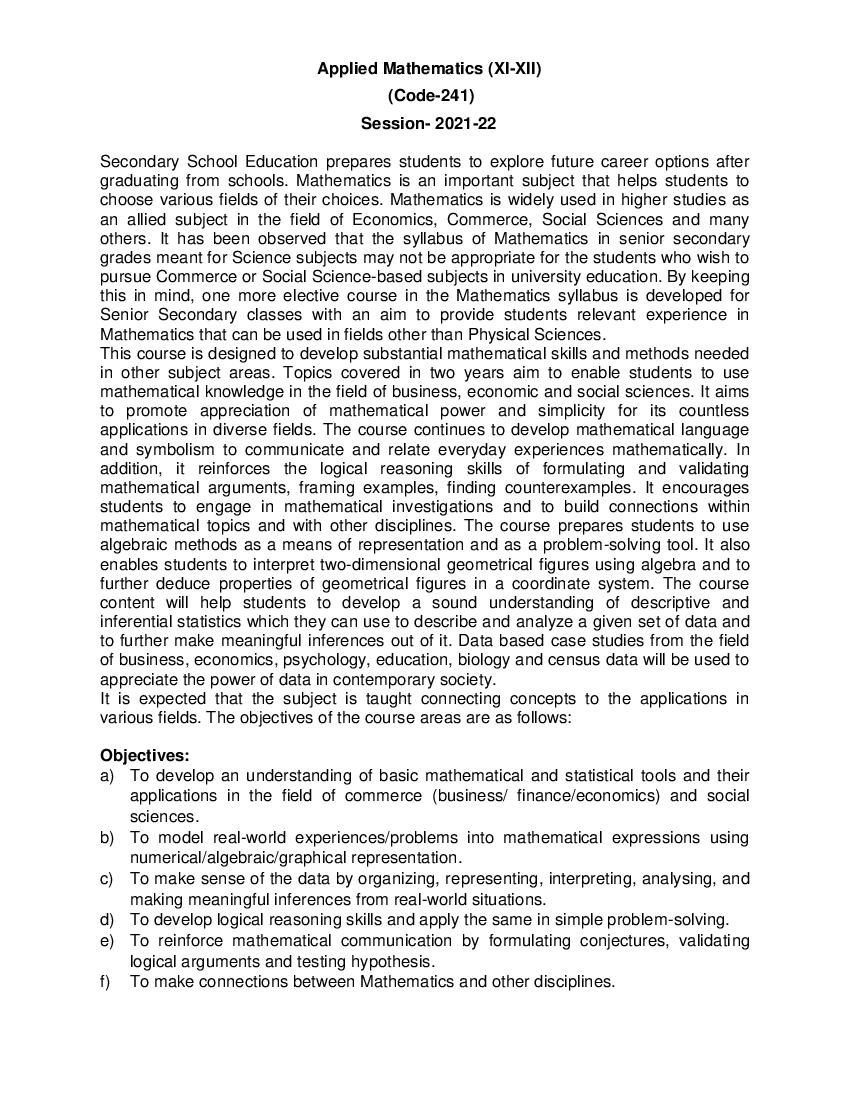
(Code-241)
Session- 2021-22
Secondary School Education prepares students to explore future career options after
graduating from schools. Mathematics is an important subject that helps students to
choose various fields of their choices. Mathematics is widely used in higher studies as
an allied subject in the field of Economics, Commerce, Social Sciences and many
others. It has been observed that the syllabus of Mathematics in senior secondary
grades meant for Science subjects may not be appropriate for the students who wish to
pursue Commerce or Social Science-based subjects in university education. By keeping
this in mind, one more elective course in the Mathematics syllabus is developed for
Senior Secondary classes with an aim to provide students relevant experience in
Mathematics that can be used in fields other than Physical Sciences.
This course is designed to develop substantial mathematical skills and methods needed
in other subject areas. Topics covered in two years aim to enable students to use
mathematical knowledge in the field of business, economic and social sciences. It aims
to promote appreciation of mathematical power and simplicity for its countless
applications in diverse fields. The course continues to develop mathematical language
and symbolism to communicate and relate everyday experiences mathematically. In
addition, it reinforces the logical reasoning skills of formulating and validating
mathematical arguments, framing examples, finding counterexamples. It encourages
students to engage in mathematical investigations and to build connections within
mathematical topics and with other disciplines. The course prepares students to use
algebraic methods as a means of representation and as a problem-solving tool. It also
enables students to interpret two-dimensional geometrical figures using algebra and to
further deduce properties of geometrical figures in a coordinate system. The course
content will help students to develop a sound understanding of descriptive and
inferential statistics which they can use to describe and analyze a given set of data and
to further make meaningful inferences out of it. Data based case studies from the field
of business, economics, psychology, education, biology and census data will be used to
appreciate the power of data in contemporary society.
It is expected that the subject is taught connecting concepts to the applications in
various fields. The objectives of the course areas are as follows:
Objectives:
a) To develop an understanding of basic mathematical and statistical tools and their
applications in the field of commerce (business/ finance/economics) and social
sciences.
b) To model real-world experiences/problems into mathematical expressions using
numerical/algebraic/graphical representation.
c) To make sense of the data by organizing, representing, interpreting, analysing, and
making meaningful inferences from real-world situations.
d) To develop logical reasoning skills and apply the same in simple problem-solving.
e) To reinforce mathematical communication by formulating conjectures, validating
logical arguments and testing hypothesis.
f) To make connections between Mathematics and other disciplines.
Page 2
Number of Paper: 1
Total number of Periods: 240 (35 Minutes Each)
Time: 3 Hours
Max Marks: 80
No. Units No. of Marks
Periods
I Numbers, Quantification and 25 09
Numerical Applications
II Algebra 45 15
III Mathematical Reasoning 15 06
IV Calculus 35 10
V Probability 25 08
VI Descriptive Statistics 35 12
VII Basics of Financial Mathematics 45 15
VIII Coordinate Geometry 15 05
Total 240 80
Internal Assessment 20
Page 3
Sl. Contents Learning Outcomes: Notes / Explanation
No. Students will be able to
UNIT – 1 NUMBERS, QUANTIFICATION AND NUMERICAL APPLICATIONS
Numbers & Quantification
1.1 Prime ● Identify prime numbers ● Definition and meaning
Numbers, ● Encrypt or Decrypt the ● Introduction to encryption
Encryptions message using prime /decryption using prime numbers
using Prime numbers by RSA algorithm
Numbers
1.2 Binary Numbers ● Express decimal ● Definition of number system
numbers in binary (decimal and binary)
system ● Conversion from decimal to binary
● Express binary numbers system and vice - versa
in decimal system
1.3 Complex ● Define complex Definition and representation of
Numbers numbers and explain Complex Numbers
(Preliminary basic notions of complex Basic operations (addition,
Idea Only) numbers subtraction, multiplication and
● Perform basic division) on two or more complex
operations on the numbers
complex numbers ● Properties of Conjugate and
● Find additive inverse Modulus of complex numbers
and multiplicative
inverse of a complex
number
● Find conjugate and
modulus of complex
numbers
1.4 Indices, ● Relate indices and ● Applications of rules of indices
Logarithm and logarithm /antilogarithm ● Introduction of logarithm and
Antilogarithm ● Find logarithm and antilogarithm
antilogarithms of given ● Common and Natural logarithm
number
1.5 Laws and ● Enlist the laws and ● Fundamental laws of logarithm
properties of properties of logarithms
logarithms ● Apply laws of logarithm
1.6 Simple ● Use logarithm in ● Express the problem in the form of
applications of different applications an equation and apply logarithm/
logarithm and antilogarithm
antilogarithm
Numerical Applications
1.7 Averages ● Determine average for a ● Definition and meaning
given data ● Problems on average, weighted
average
1.8 Clock ● Evaluate the angular ● Number of rotations of minute
value of a minute hand / hour hand of a clock in a
● Calculate the angle day
formed between two ● Number of times minute hand and
hands of clock at given hour hand coincides in a day
time
● Calculate the time for
which hands of clock
meet
Page 4
a month/ year/ century ● Odd days in a year/ century.
● Decode the day for the ● Day corresponding to a given date
given date
1.10 Time, Work and ● Establish the ● Basic concept of time and work
Distance relationship between ● Problems on time taken / distance
work and time covered / work done
● Compare the work done
by the individual / group
w.r.t. time
● Calculate the time taken/
distance covered/ Work
done from the given
data
1.11 Mensuration ● Solve problems based ● Comparison between 2D and 3D
on surface area and shapes
volume of 2D and 3D ● Combination of solids
shapes ● Transforming one solid shape to
● Calculate the volume/ another
surface area for solid
formed using two or
more shapes
1.12 Seating ● Create suitable seating ● Linear and circular seating
arrangement plan/ draft as per given arrangement
conditions ● Position of a person in a seating
(Linear/circular) arrangement
● Locate the position of a
person in a seating
arrangement
UNIT – 2 ALGEBRA
Sets
2.1 Introduction to ● Define set as well-defined ● Definition of a Set
sets – definition collection of objects ● Examples and Non-examples of
Set
2.2 Representation ● Represent a set in Roster ● Write elements of a set in Set
of sets form and Set builder form Builder form and Roster Form
● Convert a set given in Roster form
into Set builder form and vice-
versa
2.3 Types of sets Identify different types of Types of Sets: Finite Set, Infinite
and their sets on the basis of Set, Empty Set, Singleton Set
notations number of elements in
the set
Differentiate between
equal set and
equivalence set
2.4 Subsets Enlist all subsets of a set Subset of a given set
Find number of subsets Familiarity with terms like
of a given set Superset, Improper subset,
Find number of elements Universal set, Power set
of a power set
Page 5
numbers as intervals semi open interval and semi
closed interval
2.6 Venn diagrams Apply the concept of Venn diagrams as the pictorial
Venn diagram to representation of relationship
understand the between sets
relationship between Practical Problems based on Venn
sets Diagrams
Solve problems using
Venn diagram
2.7 Operations on Perform operations on Operations on sets include
sets sets to solve practical i) Union of sets
problems ii) Intersection of sets
iii) Difference of sets
iv) Complement of a set
v) De Morgan’s Laws
Relations
2.8 Ordered pairs Explain the significance Ordered pair, order of elements in
of specific arrangement an ordered pair and equality of
Cartesian of elements in a pair ordered pairs
product of two Write Cartesian product Cartesian product of two non-
sets of two sets empty sets
Find the number of
elements in a Cartesian
product of two sets
2.9 Relations Express relation as a Definition of Relation, examples
subset of Cartesian pertaining to relations in the real
product number system
Find domain and range
of a relation
2.10 Types of Define and illustrate Types of relations:
relations different types of Empty relation, universal relation,
relations: Empty relation reflexive relation, symmetric
and universal relation relation, transitive relation,
Examine whether the equivalence relation
relation is equivalence or Introducing a function as a special
not type of relation
Define function as a Examples and non-examples of
special type of relation functions
Categorize relations that
are functions and non-
functions
Sequences and Series
2.11 Sequence and ● Differentiate between ● Sequence:𝑎1 , 𝑎2 , 𝑎3, … , 𝑎𝑛
Series sequence and series ● Series: 𝑎1 + 𝑎2 + 𝑎3 + ⋯ + 𝑎𝑛
2.12 Arithmetic ● Identify Arithmetic ● General term of AP:
Progression Progression (AP) 𝑡 𝑛 = 𝑎 + (𝑛 − 1)𝑑
● Establish the formulae of ● Sum of n terms of AP :
𝑛
finding 𝑛𝑡ℎ term and sum Sn = 2 [2𝑎 + (𝑛 − 1)𝑑]
of n terms
Page 6
AM of 𝑎 𝑎𝑛𝑑 𝑏= 2
problems based on AP
● Find arithmetic mean
(AM) of two positive
numbers
2.13 Geometric Identify Geometric ● General term of GP:
Progression Progression (GP) 𝑡𝑛 = 𝑎𝑟 𝑛−1
● Sum of n terms of a GP:
● Derive the 𝑛𝑡ℎ term and 𝑎(𝑟 𝑛 −1)
Sn =
sum of n terms of a 𝑟−1
given GP
Sum of infinite term of GP =
𝑎
● Solve problems based , where −1 < 𝑟 < 1
1−𝑟
on applications of GP
● Geometric mean of a and b = √𝑎𝑏
● Find geometric mean ● For two positive numbers a and b,
(GM) of two positive 𝑎+𝑏
AM ≥GM i.e., 2
≥ √𝑎𝑏
numbers
● Solve problems based
on relation between AM
and GM
2.14 Applications of ● Apply appropriate Applications based on
AP and GP formulas of AP and GP ● Economy Stimulation
to solve application ● The Virus spread etc.
problems
Permutations and Combinations
2.15 Factorial ● Define factorial of a ● Definition of factorial:
number n! = n(n-1)(n-2)…3.2.1
● Calculate factorial of a Usage of factorial in counting
number principles
2.16 Fundamental ● Appreciate how to count ● Fundamental Principle of Addition
Principle of without counting ● Fundamental Principle of
Counting Multiplication
2.17 Permutations ● Define permutation ● Permutation as arrangement of
objects in a definite order taken
● Apply the concept of some or all at a time
permutation to solve ● Theorems under different conditions
simple problems 𝑛!
resulting in nPr=(𝑛−𝑟)! or 𝑛𝑟 or
𝑛!
𝑛1 !𝑛2 !…𝑛𝑘 !
arrangements
2.18 Circular ● Define circular ●(n-1)! as the number of
permutation permutation permutations of n distinct objects
● Solve problems based in a circle
on circular permutation Number of arrangements as
(𝑛−1)!
, when clockwise and
2
anticlockwise arrangement of
objects are indistinguishable
2.19 Permutations ● Solving problems based ● Permutations in which some
Page 7
restrictions at designated places.
● Permutations in which some
objects are always included or
excluded
2.20 Combinations ● Define combination -The number of combinations of
n different objects taken r at a
● Differentiate between 𝑛!
time is given by nCr= 𝑟!.(𝑛−𝑟)!
permutation and
combination Some results on combinations:
n
● C0 = 1 = nCn
● Apply the formula of ●
n
Ca = nCb ⇒ a=b or a+ b=n
combination to solve the ●
n
Cr = nCn-r
related problems ●
n
Cr + nCr-1 = n+1Cr
2.21 Combination ● Solve problems using ● Combination of n distinct objects
with repetition combination with taken r at a time if repetition is
repetitions allowed
UNIT -3 MATHEMATICAL REASONING
3.1 Mathematical ● Identify mathematically ● Meaning of mathematical
reasoning acceptable statements statements
● Express the implications ● Negation
of the compound ● Compound statements
statement ● Quantifiers
● Validate mathematical ● Converse and Contrapositive of
statements the statement
● Implications
● Validating statements
3.2 Logical ● Solve logical problems ● Odd man out
reasoning involving odd man out, ● Syllogism
syllogism, blood relation ● Blood relations
and coding decoding ● Coding Decoding
UNIT – 4 CALCULUS
4.1 Functions Identify dependent and ● Dependent variable and
independent variables independent variable
Define a function using ● Function as a rule or law that
dependent and defines a relationship between
independent variable one variable (the independent
variable) and another variable
(the dependent variable)
4.2 Domain and Define domain, range ● Domain as a set of all values of
Range of a and co-domain of a independent variable
function given function ● Co-domain as a set of all values
of dependent variable
● Range of a function as set of all
possible resulting values of
dependent variable
4.3 Types of Define various types of Following types of functions with
functions functions definitions and characteristics
Identify domain, co- Constant function, Identity
domain and range of the function, Polynomial function,
function Rational function, Composite
Page 8
Exponential function, Modulus
function, Greatest integer
function, Signum function,
Algebraic function
4.4 Graphical ● Representation of ● Graph of some polynomial
representation function graphically functions, Logarithm function,
of functions Exponential Function, Modulus
function, Greatest integer function,
Signum function
4.5 Concepts of ● Define limit of a function ● Left hand limit, Right hand limit,
limits and ● Solve problems based Limit of a function, Continuity of a
continuity of a on the algebra of limits function
function ● Define continuity of a
function
4.6 Instantaneous ● Define instantaneous ∆𝑦 𝑓(𝑥+∆𝑥)−𝑓(𝑥)
● The ratio = as
rate of change rate of change ∆𝑥 ∆𝑥
instantaneous rate of change,
where ∆𝑦 is change in 𝑦 and ∆𝑥 is
change in 𝑥 at any instant
4.7 Differentiation ● Find the derivative of ● Derivatives of functions (non-
as a process of the functions trigonometric only)
finding
derivative
4.8 Derivatives of ● Find the derivative of ● If 𝑦 = 𝑓(𝑢) where 𝑢 = 𝑔(𝑥) then
algebraic function of a function differential coefficient of 𝑦 w.r.t x is
functions using 𝑑𝑦 𝑑𝑦 𝑑𝑢
𝑑𝑥
= 𝑑𝑢 . 𝑑𝑥
Chain Rule
4.9 Tangent line ● Define tangent line ● The slope (gradient) of the tangent
and Equation of ● Find the gradient of a to the curve 𝑦 = 𝑓(𝑥) at the given
tangent tangent point
● Find equation of tangent ● The equation of the tangent to the
to the curve 𝑦 = 𝑓(𝑥) at curve at the given point
a given point
UNIT – 5 PROBABILITY
5.1 Introduction ● Appreciate the use of ● Probability as quantitative
probability in daily life measure of uncertainty
situations ● Use of probability in determining
the insurance premium, weather
forecasts etc.
5.2 Random ● Define random ● Sample space as set of all
experiment and experiment and sample possible outcomes
sample space space with suitable
examples
5.3 Event Define an event Types of Event:
Recognize and Impossible and sure event,
differentiate different Independent and dependent
types of events and find event, mutually exclusive and
their probabilities exhaustive event
Page 9
Probability conditional probability given that F has occurred is:
Apply reasoning skills to 𝑃(𝐸|𝐹) =
𝑃(𝐸∩𝐹)
, 𝑃(𝐹) ≠ 0
solve problems based 𝑃(𝐹)
on conditional
probability
5.5 Total Probability Interpret mathematical Total Probability:
information and identify Let 𝐸1, 𝐸2 , …,𝐸𝑛 be a partition of the
situations when to apply sample space S, then probability of
total probability an event A associated with S is:
Solve problems based 𝑃(𝐴) = ∑𝑛𝑗=1 𝑃(𝐸𝑗 )𝑃(𝐴|𝐸𝐽 )
on application of total
probability
5.6 Bayes’ State Bayes’ theorem ● Bayes’ Theorem:
Theorem Solve practical problems If 𝐸1 , 𝐸2 , … , 𝐸𝑛 be n non empty
based on Bayes’ events which constitute a partition
Theorem of a sample space 𝑆 and 𝐴 be any
event with non zero probability,
then:
𝑃(𝐸𝑖 )𝑃(𝐴|𝐸𝑖 )
𝑃(𝐸𝑖 |𝐴) = ∑𝑛
𝑗=1 𝑃(𝐸𝑗 )𝑃(𝐴|𝐸𝑗 )
UNIT- 6 DESCRIPTIVE STATISTICS
6.1 Types of data Identify real life situations Examples of raw data from
for collecting data different surveys, sports
Categorize data based Multi-variate data from not more
on nature of data than three variables
(Primary and Secondary Collection of data up to three
Data, Raw and variables from real life examples,
Organized Data) such as, data of students (age,
Identify and differentiate weight, height)
univariate, bivariate and
multi-variate data
Identify and differentiate
discrete data and
continuous data
Collect raw data from
practical examples
6.2 Data on various ● Describe nominal, ordinal, ● Examples and non-examples of
scales interval and ratio scale of data on different scales
data collection ● Benefit and limitations of collecting
● Collect and classify data data on various scales
on different scales of
measurement
6.3 Data ● Organize raw data in ● Data organization in
representation discrete and continuous increasing/decreasing order, using
and data form frequency table and in class
visualization ● Represent data on intervals of various length
nominal and ordinal ● Graphical representation of data
scales of measurement using pie-chart/bar
using pie chart and bar graphs/histogram using class
graphs interval of equal and unequal length
Page 10
interval and ratio scale Spreadsheet or any other computer
using histogram and assisted tool
frequency polygon
● Represent bivariate
continuous data using line
graph
● Choose appropriate graph
to represent data of
various kinds
6.4 Data Interpretation
Measure of ● Define central tendency of ● Mean using direct method, assumed
Central a data set mean method and step deviation
Tendency ● Differentiate between method
mean, median and mode ● Median and Mode
● Calculate mean, median ● Examples of different kinds of data
and mode for ungrouped helping students to choose and
and grouped data compare different measures of
● Choose appropriate central tendency
measure to calculate
central tendency
Measure of ● Understand meaning of ● Mean deviation around mean and
Dispersion dispersion in a data set median
● Differentiate between ● Standard deviation and variance
range, quartile deviation, ● Examples of different kinds of data
mean deviation and helping students to choose and
standard deviation compare different measures of
● Calculate range, quartile dispersion
deviation, mean deviation
and standard deviation for
ungrouped and grouped
data set
● Choose appropriate
measure of dispersion to
calculate spread of data
Skewness and ● Define Skewness and ● Examples of symmetrical and
Kurtosis Kurtosis using graphical asymmetrical data
representation of a data ● Visualization of graphical
set representation of data using Excel
● Interpret Skewness and Spreadsheet or any other computer
Kurtosis of a frequency assisted tool
distribution by plotting the
graph
● Calculate coefficient of
Skewness and interpret
the results
6.5 Percentile rank ● Define Percentile rank ● Emphasis on visualizing, analysing
and Quartile and Quartile rank and interpreting percentile and
rank ● Calculate and interpret quartile rank scores
Percentile and Quartile
rank of scores in a given
data set
6.6 Correlation ● Define correlation in ● Emphasis on application, analysis
Page 11
● Calculate Product coefficient of correlation using
moment correlation for practical examples
ungrouped and grouped
data
● Calculate Karl Pearson’s
coefficient of correlation
● Calculate Spearman’s
rank correlation
● Interpret the coefficient of
correlation
UNIT – 7 FINANCIAL MATHEMATICS
7.1 Interest and ● Define the concept of ● Impact of high interest rates and
Interest Rates Interest Rates low interest rates on the business
● Compare the difference
between Nominal
Interest Rate, Effective
Rate and Real Interest
Rate
● Solve Practical
applications of interest
rate
7.2 Accumulation ● Interpret the concept of ● Meaning and significance of
with simple and simple and compound simple and compound interest
compound interest ● Compound interest rates
interest ● Calculate Simple applications on various financial
Interest and Compound products
Interest
7.3 Simple and ● Explain the meaning, ● Concept of Equivalency
compound nature and concept of ● Annual Equivalency Rate
interest rates equivalency
with ● Analyze various
equivalency examples for
understanding annual
equivalency rate
7.4 Effective rate of ● Define with examples ● Effective Annual Interest Rate
interest the concept of effective = (1 + i/n)n – 1
rate of interest where:
i = Nominal Interest Rate
n = No. of Periods
7.5 Present value, Interpret the concept of Formula for Present Value:
net present compounding and
value and future discounting along with PV = CF/(1 + r)n
value practical applications Where:
Compute net present CF = Cash Flow in Future Period
value r = Periodic Rate of return or Interest
(also called the discount rate or the
Apply net present value required rate of return)
in capital budgeting n = no. of periods
decisions
Use of PVAF, FVAF tables for
practical purposes
Solve problems based on
Application of net present value
Page 12
Calculating Immediate Annuity, Examples
value of Annuity due and
Regular Annuity Deferred Annuity
● Calculate General
Annuity
7.7 Simple ● Calculate the future ● Examples of regular annuity:
applications of value of regular annuity, Mortgage Payment, Car Loan
regular annuity due Payments, Leases, Rent Payment,
annuities (upto ● Apply the concept of Insurance payouts etc.
3 period) Annuity in real life
situations
7.8 Tax, calculation Explain fundamentals of Computation of income tax
of tax, simple taxation Add Income from
applications of Differentiate between Salary, house property,
tax calculation Direct and indirect tax business or profession, capital
in Goods and Define and explain GST gain, other sources, etc.
service tax, Less deductions
Income Tax
Calculate GST
PF, PPF, LIC, Housing loan, FD,
Explain rules under NSC etc.
State Goods and
Services Tax (SGST) Assess the Individuals under
Central Goods and Income Tax Act
Services Tax (CGST) Formula for GST
and Union Territory Different Tax heads under GST
Goods and Services Tax
(UTGST)
7.9 Bills, tariff rates, Describe the meaning of Tariff rates- its basis of
fixed charge, bills and its various types determination
surcharge, Analyze the meaning Concept of fixed charge service
service charge and rules determining charge and their applications in
tariff rates various sectors of Indian economy
Explain the concept of
fixed charge
7.10 Calculation and To interpret and analyze Components of electricity bill/water
interpretation of electricity bills, water supply and other supply bills:
electricity bill, bills and other supply i) overcharging of electricity
water supply bill bills ii) water supply bills
and other Evaluate how to iii) units consumed in electricity
supply bills calculate units bills
consumed under
electricity bills/water bill
UNIT – 8 COORDINATE GEOMETRY
8.1 Straight line ● Find the slope and ● Gradient of a line
equation of line in ● Equation of line:
various form Parallel to axes, point-slope form,
● Find angle between the two-points form, slope intercept
two lines form, intercept form
● Find the perpendicular ● Application of the straight line in
from a given point on a demand curve related to
line economics problems
● Find the distance
between two parallel
Page 13
8.2 Circle ● Define a circle ● Circle as a locus of a point in a
● Find different form of plane
equations of a circle ● Equation of a circle in standard
● Solve problems based form, central form, diameter form
on applications of circle and general form
8.3 Parabola ● Define parabola and ● Parabola as a locus of a point in a
related terms plane.
● Define eccentricity of a ● Equation of a parabola in standard
parabola form:
● Derive the equation of ● Focus, Directrix, Axis, Latus
parabola rectum, Eccentricity
● Application in parabolic reflector,
beam supported by wires at the
end of the support, girder of a
railway bridge, etc.
Practical: Use of spreadsheet
Calculating average, interest (simple and compound), creating pictographs, drawing pie
chart, bar graphs, calculating central tendency visualizing graphs (straight line, circles
and parabola using real-time data)
Suggested practical using spreadsheet
1. Plot the graph of functions on excel study the nature of function at various points,
drawing lines of tangents
2. Create a budget of income and spending
3. Create and compare sheet of price & features to buy a product
4. Prepare the best option plan to buy a product by comparing cost, shipping charges,
tax and other hidden costs
5. Smart purchasing during sale season
6. Prepare a report card using scores of the last four exams and compare the
performance
7. Collect the data on weather, price, inflation, and pollution. Sketch different types of
graphs and analyze the results
Document Details
| Board / Org | CBSE |
| Exam | Class 11 |
| Type | Syllabus |
| Pages | 13 |
| Updated | 22 Jul 2026 |