TANCET 2027 Sample Paper MBA
Finished viewing? Save it for later —
Download TANCET 2027 Sample Paper MBA (PDF · 20 pages)About TANCET 2027 Sample Paper MBA
TANCET 2027 Sample Paper MBA is available here for free download. Published by Anna University for TANCET, this sample paper can be viewed online or downloaded as a PDF (20 pages). Candidates preparing for TANCET can use TANCET 2027 Sample Paper MBA to understand the exam pattern, the type of questions asked, and the overall difficulty level.
Frequently Asked Questions
How can I download TANCET 2027 Sample Paper MBA?
Open this page and click the Download button to save TANCET 2027 Sample Paper MBA as a PDF. It is completely free on AglaSem Docs.
Is TANCET 2027 Sample Paper MBA free to download?
Yes. TANCET 2027 Sample Paper MBA can be viewed online and downloaded as a PDF free of cost on AglaSem Docs.
How many pages does TANCET 2027 Sample Paper MBA have?
TANCET 2027 Sample Paper MBA contains 20 pages, which you can read online or download together as a single PDF.
Where can I find more TANCET study material?
You can find more TANCET question papers, sample papers, syllabus, and answer keys on AglaSem Docs.
TANCET 2027 Sample Paper MBA – Text
Read the full text of this sample paper below — useful to quickly search, copy and reference the content online without downloading the PDF.
📄 View text version (20 pages)
Page 1
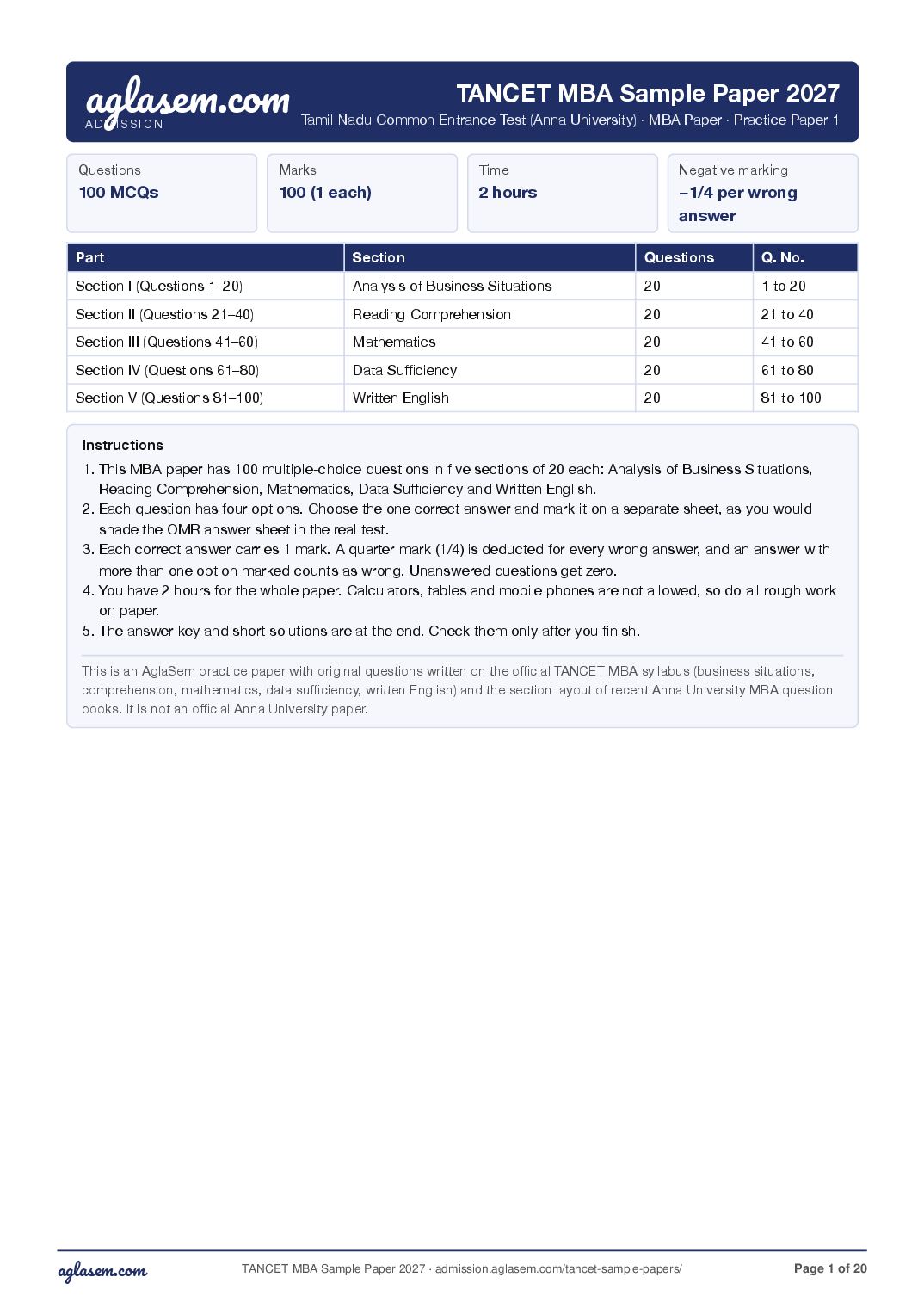
TANCET MBA Sample Paper 2027
Tamil Nadu Common Entrance Test (Anna University) · MBA Paper · Practice Paper 1
Questions Marks Time Negative marking
100 MCQs 100 (1 each) 2 hours −1/4 per wrong
answer
Part Section Questions Q. No.
Section I (Questions 1–20) Analysis of Business Situations 20 1 to 20
Section II (Questions 21–40) Reading Comprehension 20 21 to 40
Section III (Questions 41–60) Mathematics 20 41 to 60
Section IV (Questions 61–80) Data Sufficiency 20 61 to 80
Section V (Questions 81–100) Written English 20 81 to 100
Instructions
1. This MBA paper has 100 multiple-choice questions in five sections of 20 each: Analysis of Business Situations,
Reading Comprehension, Mathematics, Data Sufficiency and Written English.
2. Each question has four options. Choose the one correct answer and mark it on a separate sheet, as you would
shade the OMR answer sheet in the real test.
3. Each correct answer carries 1 mark. A quarter mark (1/4) is deducted for every wrong answer, and an answer with
more than one option marked counts as wrong. Unanswered questions get zero.
4. You have 2 hours for the whole paper. Calculators, tables and mobile phones are not allowed, so do all rough work
on paper.
5. The answer key and short solutions are at the end. Check them only after you finish.
This is an AglaSem practice paper with original questions written on the official TANCET MBA syllabus (business situations,
comprehension, mathematics, data sufficiency, written English) and the section layout of recent Anna University MBA question
books. It is not an official Anna University paper.
TANCET MBA Sample Paper 2027 · admission./tancet-sample-papers/ Page 1 of 20
Page 2
Analysis of Business Situations
Directions (Questions 1–10): Read the passage and classify each item that follows it.
Classify each item as:
Major Objective: one of the goals sought by the decision maker.
Major Factor: an aspect of the problem, specifically mentioned in the passage, that fundamentally affects
or determines the decision.
Minor Factor: a less important element that bears on a Major Factor, rather than on a Major Objective
directly.
Major Assumption: a projection or supposition made by the decision maker before considering the factors
and alternatives.
Kovai Pumps Ltd is a family-run company in Coimbatore that has made electric monoblock pump sets for
farms for more than forty years. Its pumps have a strong reputation for reliability, and they are sold
through about 600 dealers in Tamil Nadu and Karnataka. For the past five years, however, the company's
sales have not grown. Its dealers report that many farmers are turning to solar-powered pump sets, which
let them irrigate in the daytime without depending on an irregular three-phase power supply, and which
are partly paid for by a government subsidy scheme.
Revathi Sundaram, the managing director, called a meeting of her senior managers. She said the
company had two aims: to get back to steady growth in sales, and to protect the reputation for reliable
pumps that it had built over four decades. She was convinced that demand for solar pump sets among
farmers would keep rising for at least the next ten years, and she asked the team to examine whether
Kovai Pumps should launch its own solar range.
The production head said the existing motor lines could make the pump and motor with only small
changes. The real gap was the electronic controller that runs a pump directly from solar panels, a
technology in which the company had no expertise. It could develop the controller itself, which would take
about eighteen months and require hiring four electronics engineers at salaries well above the company's
usual scale, or buy controllers from an established supplier in Pune, which would allow a launch within six
months but at a lower margin.
The finance manager pointed out that only pump sets empanelled with the state energy agency could be
sold under the subsidy scheme. Empanelment required each model to pass tests at an approved
laboratory. The testing fees were modest, but without empanelment the range would have almost no
buyers.
The marketing manager warned that the dealers were used to selling electric pumps, while solar sets also
need panels and mounting structures to be installed and serviced on the farm. Dealers' mechanics would
have to be trained, at a cost the company would share. Two national brands already led the solar pump
market. Revathi, however, believed that farmers would pay a slightly higher price for a trusted local name.
After the discussion, the company decided to buy controllers from the Pune supplier for the first two years
and launch quickly, while building its own controller in parallel.
1. Getting the company back to steady growth in sales.
(A) Minor Factor (B) Major Objective
(C) Major Assumption (D) Major Factor
2. Demand for solar pump sets among farmers will keep rising for at least ten years.
(A) Major Factor (B) Minor Factor
(C) Major Assumption (D) Major Objective
TANCET MBA Sample Paper 2027 · admission./tancet-sample-papers/ Page 2 of 20
Page 3
(A) Minor Factor (B) Major Assumption
(C) Major Factor (D) Major Objective
4. Salaries of the four electronics engineers needed for in-house development.
(A) Major Assumption (B) Major Factor
(C) Major Objective (D) Minor Factor
5. Empanelment of the pump sets with the state energy agency.
(A) Major Objective (B) Minor Factor
(C) Major Assumption (D) Major Factor
6. Fees charged by the approved testing laboratory.
(A) Major Factor (B) Major Objective
(C) Minor Factor (D) Major Assumption
7. Farmers will pay a slightly higher price for a trusted local name.
(A) Major Assumption (B) Minor Factor
(C) Major Objective (D) Major Factor
8. Protecting the company's reputation for reliable pumps.
(A) Major Assumption (B) Minor Factor
(C) Major Objective (D) Major Factor
9. Ability of the dealer network to install and service solar pump sets.
(A) Major Objective (B) Major Factor
(C) Major Assumption (D) Minor Factor
10. Cost of training the dealers' mechanics.
(A) Minor Factor (B) Major Factor
(C) Major Objective (D) Major Assumption
TANCET MBA Sample Paper 2027 · admission./tancet-sample-papers/ Page 3 of 20
Page 4
Marina Bakes runs fourteen bakery-cafés across Chennai. Home delivery has grown to almost a third of
its sales, and nearly all delivery orders come through two food-delivery apps, which charge the bakery a
commission on every order. Arvind Prakash, the owner, wants to increase the share of sales that comes
from home delivery, but he also wants to protect the company's profit margins, which the commissions
have squeezed.
Arvind is considering a plan to launch Marina Bakes' own ordering app and to deliver orders with the
company's own riders. He takes it for granted that most delivery orders will continue to come from homes
and offices within five kilometres of a store, so that a small team of riders could cover each area. He also
believes that the bakery's regular customers will switch to ordering directly if they are offered a small
discount on the app.
The operations manager estimated the cost of building and running a delivery fleet: riders' salaries, two-
wheelers, insulated delivery bags and a fuel allowance for each rider. The bags and the fuel allowance
were small items, but salaries and vehicles made the fleet a major expense. An IT firm quoted a price for
developing the app, and the payment gateway would charge a small fee on every app order.
The marketing manager studied the bakery's order data. It showed that most first-time customers found
Marina Bakes through the delivery apps, where it appeared alongside many competitors. If the bakery left
the apps, it would lose this flow of new customers.
After weighing the commission saved against the cost of the fleet, Arvind chose a mixed approach: the
company would launch its own app for regular customers in three neighbourhoods as a trial, while staying
on the delivery apps to reach new customers.
11. Increasing the share of sales that comes from home delivery.
(A) Major Factor (B) Major Objective
(C) Major Assumption (D) Minor Factor
12. Commission charged by the delivery apps on each order.
(A) Major Factor (B) Major Objective
(C) Major Assumption (D) Minor Factor
13. Regular customers will switch to ordering directly if offered a small discount.
(A) Major Objective (B) Minor Factor
(C) Major Factor (D) Major Assumption
14. Fee charged by the payment gateway on each app order.
(A) Minor Factor (B) Major Factor
(C) Major Assumption (D) Major Objective
15. Cost of riders' salaries and two-wheelers for the delivery fleet.
(A) Minor Factor (B) Major Assumption
(C) Major Factor (D) Major Objective
16. Protecting the company's profit margins.
(A) Major Factor (B) Major Objective
(C) Major Assumption (D) Minor Factor
17. Fuel allowance paid to the delivery riders.
(A) Minor Factor (B) Major Objective
(C) Major Factor (D) Major Assumption
18. Most first-time customers find Marina Bakes through the delivery apps.
(A) Major Factor (B) Minor Factor
(C) Major Assumption (D) Major Objective
TANCET MBA Sample Paper 2027 · admission./tancet-sample-papers/ Page 4 of 20
Page 5
(A) Major Factor (B) Major Objective
(C) Major Assumption (D) Minor Factor
20. Most delivery orders will keep coming from within five kilometres of a store.
(A) Major Factor (B) Major Objective
(C) Major Assumption (D) Minor Factor
Section II (Questions 21–40)
Reading Comprehension
Directions (Questions 21–25): Read the passage and answer the questions that follow.
Until the middle of the twentieth century, loading a cargo ship was slow and costly work. Goods arrived at
the docks in sacks, barrels and crates of every size, and gangs of dock workers lifted them into the hold
one piece at a time. A ship could spend almost as long in port as at sea, and theft and breakage were
common. In 1956 an American trucking businessman, Malcolm McLean, sent a converted tanker from
New Jersey to Texas carrying fifty-eight metal boxes that could be lifted straight from a truck chassis onto
the deck. The idea of a box was not new; what was new was McLean's insistence on treating the ship, the
port and the truck as parts of a single transport system.
The real breakthrough came only when the boxes were standardised. As long as each shipping line used
containers of its own design, a box could not move easily from one company's ship to another company's
train. After years of negotiation, international standards fixed a few common sizes and the design of the
corner fittings by which cranes lift and lock the boxes. From then on, a container packed in a factory
could travel by truck, rail and sea without being opened.
The consequences went far beyond shipping. Cheaper and more predictable transport made it practical
for firms to spread production across several countries, sending parts to wherever they could be made
most efficiently. Port cities changed too: old docks in the centres of cities fell idle, while new container
terminals were built on open land beside deep water. Far fewer dock workers were needed, which led to
bitter disputes in many ports. The story of the container is a reminder that a technology often matters less
for its own sake than for the standards and systems that grow around it.
21. Which of the following best expresses the main idea of the passage?
(A) Standard container sizes mattered less than the speed of the new cargo ships
(B) Containers mainly helped dock workers by making their work safer and better paid
(C) Malcolm McLean invented the first metal shipping box in 1956 and so created modern world trade
(D) The container changed trade because it became part of a standard, linked transport system
22. According to the passage, before containers were standardised:
(A) a box could not move easily from one company's ship to another company's train
(B) converted tankers were the only ships able to carry containers
(C) goods could not be packed into boxes at the factory
(D) cranes at most ports were unable to lift loaded metal boxes onto the decks of cargo ships
23. It can be inferred from the passage that old docks in city centres fell idle mainly because:
(A) container terminals needed open land and deep water that these docks lacked
(B) dock workers refused to handle containers in city ports
(C) theft and breakage of goods at these crowded city-centre docks had become far too common
(D) shipping lines moved their offices away from the cities
TANCET MBA Sample Paper 2027 · admission./tancet-sample-papers/ Page 5 of 20
Page 6
(A) lazy (B) not in use
(C) crowded (D) slow-moving
25. The author's concluding point is that:
(A) transport costs no longer influence where firms locate production
(B) a technology's effects often come mostly from the standards and systems around it
(C) new technologies nearly always lead to bitter and lasting disputes with the workers they replace
(D) standards usually slow down the spread of a new technology
Directions (Questions 26–30): Read the passage and answer the questions that follow.
In many family-owned firms, the hardest decision is not about products or markets but about who will run
the business next. Founders often build their companies around their own judgement and their personal
relationships with suppliers, bankers and key customers. Much of what makes the firm work is never
written down. When the founder steps back, this knowledge can leave with him or her, and the firm may
stumble even if its products are sound.
Studies of family businesses suggest that succession goes best when it is treated as a process rather
than an event. Successors who join the firm early, work in several departments and earn the respect of
long-serving employees tend to do better than those who arrive at the top straight from outside. Some
families insist that the next generation first work in another company, so that they learn how a business is
run without the protection of the family name. Others prepare a written 'family constitution' that sets out
who may join the firm, how they will be paid and how disputes among relatives will be settled.
None of this guarantees success. A founder who announces a successor but continues to take every
major decision leaves the new leader with responsibility but no authority. Equally, a firm that promotes a
family member who lacks the ability or the interest to lead may lose its best professional managers, who
see no path to the top. For this reason a growing number of family firms separate ownership from
management: the family keeps its shares and sits on the board, while the day-to-day running of the
business is handed to professionals chosen on merit. Whether this suits a particular firm depends less on
any general rule than on the talents and wishes of the family itself.
26. The passage is mainly concerned with:
(A) the legal rules that govern shareholding in family companies
(B) why family-run businesses usually earn higher profits than professionally managed firms
(C) the reasons founders refuse to retire from their firms
(D) how family firms can hand over leadership without harming the business
27. According to the passage, a 'family constitution' is used to:
(A) register the family company, its shares and its board of directors under company law
(B) set rules on who may join the firm, how they are paid and how disputes are settled
(C) decide which new products and markets the firm should enter
(D) fix the salaries of the professional managers alone
28. The author mentions a founder who names a successor but still takes every major decision in order to
show that:
(A) successors should always work in another company first
(B) family members should not be allowed to sit on the board
(C) naming a successor is not enough unless real authority is also handed over
(D) founders are usually better leaders than their own sons and daughters can ever be
TANCET MBA Sample Paper 2027 · admission./tancet-sample-papers/ Page 6 of 20
Page 7
(A) A founder's knowledge of the business is easy to write down
(B) Family firms should always hand management to outside professionals
(C) Successors do best when they are appointed straight to the top
(D) No single succession model is right for every family firm
30. As used in the passage, the word 'stumble' most nearly means:
(A) fall to the ground (B) grow very quickly
(C) change its owners (D) face difficulties
Directions (Questions 31–35): Read the passage and answer the questions that follow.
For a long time sleep was seen as a period of rest in which the brain simply switched off. Research over
the past few decades has overturned this view. During sleep, and especially during the deep, slow-wave
stage that dominates the early part of the night, the brain appears to replay patterns of activity from the
day. Experiments with rats learning to find their way through a maze have shown that the same groups of
nerve cells that fired while the animal explored the maze fire again, in the same order, while it sleeps.
This replay is thought to help move new memories from short-term storage in a region called the
hippocampus to longer-term storage in the outer layers of the brain. In human studies, people who learn a
list of word pairs or a new motor skill and then sleep usually remember more the next day than people
who stay awake for the same number of hours. Sleep seems to do more than protect memories from
interference; it may also help the brain pick out the general rule hidden in a set of examples. In some
experiments, people who had slept were more likely to notice a shortcut in a problem they had practised
the day before.
These findings have practical consequences. Students who cut sleep to study late into the night may be
undermining the very learning they are trying to secure. Shift workers and people whose sleep is often
disturbed may find it harder to absorb new skills. At the same time, researchers caution against simple
slogans. The effect of sleep varies with the kind of material and the person, and a short nap is no
substitute for regular, sufficient sleep.
31. According to the passage, the older view of sleep held that:
(A) the hippocampus stored all long-term memories
(B) dreams were the main way in which people learned
(C) sleep weakened the memories formed during the day
(D) the brain was largely inactive during sleep
32. The maze experiments described in the passage show that:
(A) animals that sleep less learn new routes more quickly
(B) the hippocampus stops working during deep, slow-wave sleep
(C) rats learn their way through a maze faster at night than they do during the daytime
(D) nerve cells active during learning fire again in the same order during sleep
33. Which of the following is stated about slow-wave sleep?
(A) It is the stage in which the brain switches off
(B) It dominates the early part of the night
(C) It occurs mainly during short daytime naps
(D) It stops memories reaching the outer brain
34. What does the author suggest about students who study late into the night?
(A) Cutting sleep may weaken the very learning they are trying to secure
(B) They should replace their night-time sleep with several short naps during the day
(C) They remember word pairs better than new motor skills
(D) They are more likely than others to notice shortcuts in problems
TANCET MBA Sample Paper 2027 · admission./tancet-sample-papers/ Page 7 of 20
Page 8
(A) alarmist and urgent (B) informative and measured
(C) sarcastic and dismissive (D) nostalgic and personal
Directions (Questions 36–40): Read the passage and answer the questions that follow.
For several decades, manufacturers around the world tried to cut the stocks of parts and materials they
held. The approach, often called 'just-in-time', was made popular by Japanese car makers. Instead of
filling warehouses with components in case they were needed, a factory arranged for suppliers to deliver
small quantities often, just before they were used. Lower stocks freed cash that would otherwise be tied
up in inventory, reduced waste and made problems visible: if a faulty batch arrived, the line soon stopped
and the cause had to be fixed rather than hidden behind a pile of spare parts.
The weakness of the system lies in its dependence on everything going to plan. A fire at a single
supplier's plant, a flood that closes a port or a sudden jump in demand can halt production when there is
no buffer to draw on. Several industries have learned this lesson the hard way, as a shortage of one small
part has left otherwise finished products waiting in yards.
Some commentators have concluded that just-in-time is finished and that firms should go back to holding
large stocks. This is too simple. Stocks cost money, take up space and can become obsolete, especially
for products whose designs change quickly. The more sensible response is to ask which items are truly
critical and hard to replace, and to hold extra stock or develop a second supplier for those alone. Many
firms are also mapping their supply chains beyond their direct suppliers, since a disruption often begins
two or three steps further back. In practice, the choice is not between efficiency and resilience but about
how much of each a firm is willing to pay for.
36. According to the passage, just-in-time made production problems visible because:
(A) workers were paid a bonus for reporting faulty parts
(B) a faulty batch soon stopped the line, so the cause had to be fixed
(C) suppliers were required to inspect every part twice before each delivery to the factory
(D) warehouses kept detailed records of every defect found
37. The main weakness of just-in-time, as described in the passage, is that it:
(A) can be used only by car makers and their suppliers
(B) leaves little buffer when supply or demand is disrupted
(C) needs very large warehouses to be built close to every single factory
(D) ties up more cash in stock than the older method
38. The author regards the idea that firms should go back to holding large stocks as:
(A) the only sensible way to protect production
(B) suitable mainly for products whose designs change quickly
(C) too simple, because holding stock has real costs
(D) already adopted by most Japanese car makers
39. Why, according to the passage, are many firms mapping their supply chains beyond their direct
suppliers?
(A) Governments now require all firms to publish such maps
(B) Disruptions often begin two or three steps further back in the chain
(C) Mapping the chain lowers the price that they pay for parts
(D) Direct suppliers usually refuse to share any information about their own suppliers
TANCET MBA Sample Paper 2027 · admission./tancet-sample-papers/ Page 8 of 20
Page 9
(A) Efficiency and Resilience: Striking a Balance
(B) How Japanese Car Makers Built Their Global Brands
(C) The End of Just-in-Time Manufacturing
(D) Why Big Warehouses Are Coming Back
Section III (Questions 41–60)
Mathematics
41. A trader marks his goods 40% above cost price and allows a discount of 15% on the marked price. His
profit percentage is:
(A) 19% (B) 25%
(C) 17% (D) 21%
42. The difference between the compound interest (compounded annually) and the simple interest on
₹20,000 for 2 years at 10% per annum is:
(A) ₹100 (B) ₹200
(C) ₹210 (D) ₹400
43. The incomes of A and B are in the ratio 5 : 4 and their expenses are in the ratio 3 : 2. If each saves
₹4,000 a month, A's monthly income is:
(A) ₹15,000 (B) ₹12,000
(C) ₹10,000 (D) ₹8,000
44. A can finish a job in 12 days and B in 18 days. They work together for 4 days, after which A leaves and
B finishes the rest. In how many days in all is the job completed?
(A) 14 (B) 10
(C) 11 (D) 12
45. A train 240 m long passes a platform 360 m long in 30 seconds. The speed of the train is:
(A) 60 km/h (B) 72 km/h
(C) 80 km/h (D) 54 km/h
46. A 60-litre mixture contains milk and water in the ratio 7 : 3. How much water must be added to make
the ratio 3 : 2?
(A) 10 litres (B) 6 litres
(C) 12 litres (D) 8 litres
47. The average of 11 numbers is 50. The average of the first six is 49 and the average of the last six is 52.
The sixth number is:
(A) 58 (B) 50
(C) 56 (D) 52
48. In how many different ways can the letters of the word BANANA be arranged?
(A) 120 (B) 720
(C) 30 (D) 60
49. Two fair dice are thrown together. The probability that the sum of the numbers shown is 8 is:
(A) 7/36 (B) 5/36
(C) 1/9 (D) 1/6
TANCET MBA Sample Paper 2027 · admission./tancet-sample-papers/ Page 9 of 20
Page 10
that both are of the same colour is:
(A) 13/28 (B) 15/28
(C) 1/2 (D) 5/14
51. The sum of the first 20 terms of the arithmetic progression 3, 7, 11, 15, … is:
(A) 840 (B) 780
(C) 800 (D) 820
52. The sum to infinity of the series 6 + 2 + 2/3 + 2/9 + … is:
(A) 18 (B) 9
(C) 8 (D) 12
53. If log₂x + log₄x = 6, then x equals:
(A) 64 (B) 8
(C) 32 (D) 16
54. If α and β are the roots of x² − 5x + 3 = 0, the value of α² + β² is:
(A) 19 (B) 13
(C) 22 (D) 25
55. The value of the determinant
| 2 1 3 |
| 0 4 1 |
| 1 0 2 |
is:
(A) −5 (B) 3
(C) 7 (D) 5
56. A firm's profit (in ₹ thousand) from selling x hundred units is P(x) = −2x² + 120x − 1000. The maximum
profit the firm can earn is:
(A) ₹6,00,000 (B) ₹9,00,000
(C) ₹8,00,000 (D) ₹10,00,000
57. A closed cylindrical tank has radius 7 m and height 10 m. Its capacity (take π = 22/7) is:
(A) 770 kilolitres (B) 3,080 kilolitres
(C) 1,450 kilolitres (D) 1,540 kilolitres
58. A invests ₹60,000 for 12 months and B invests ₹80,000 for 6 months in a business. Out of a profit of
₹50,000, B's share is:
(A) ₹25,000 (B) ₹30,000
(C) ₹20,000 (D) ₹24,000
59. The price of sugar rises by 25%. By what percentage must a family reduce its consumption so that its
spending on sugar does not change?
(A) 15% (B) 22.5%
(C) 25% (D) 20%
60. A boat goes 18 km/h downstream and 12 km/h upstream. How long will it take to go 30 km upstream
and come back?
(A) 4 h (B) 4 h 10 min
(C) 5 h (D) 3 h 50 min
TANCET MBA Sample Paper 2027 · admission./tancet-sample-papers/ Page 10 of 20
Page 11
Data Sufficiency
Directions (Questions 61–80): Each question is followed by two statements, I and II.
Decide whether the data in the statements are sufficient to answer the question, using the data given plus
your knowledge of mathematics and everyday facts. Choose:
• Statement I alone is sufficient (but II alone is not);
• Statement II alone is sufficient (but I alone is not);
• Both statements together are needed (neither alone is sufficient); or
• Both together are still not sufficient.
61. What is the value of x?
I. 3x + 2y = 12
II. x − y = −1
(A) Both together are still not sufficient
(B) Statement I alone is sufficient
(C) Statement II alone is sufficient
(D) Both statements together are needed
62. Is the integer n even?
I. n² + n is even.
II. n² is divisible by 4.
(A) Both statements together are needed
(B) Statement I alone is sufficient
(C) Both together are still not sufficient
(D) Statement II alone is sufficient
63. What is the price of one pen?
I. 5 pens cost ₹60.
II. 3 pens and 2 pencils cost ₹50.
(A) Statement II alone is sufficient
(B) Statement I alone is sufficient
(C) Both together are still not sufficient
(D) Both statements together are needed
64. What is the area of rectangle ABCD?
I. Its perimeter is 34 cm.
II. Its diagonal is 13 cm.
(A) Both together are still not sufficient
(B) Statement I alone is sufficient
(C) Both statements together are needed
(D) Statement II alone is sufficient
65. What is the profit percentage on an article?
I. Its selling price is ₹1,200.
II. Its cost price is 80% of its selling price.
(A) Statement II alone is sufficient
(B) Statement I alone is sufficient
(C) Both together are still not sufficient
(D) Both statements together are needed
TANCET MBA Sample Paper 2027 · admission./tancet-sample-papers/ Page 11 of 20
Page 12
I. x − y = 3
II. x² > y²
(A) Both together are still not sufficient
(B) Statement I alone is sufficient
(C) Both statements together are needed
(D) Statement II alone is sufficient
67. How old is Ravi now?
I. Ravi is 4 years older than Sita.
II. Five years ago, Sita's age was three-fourths of Ravi's age.
(A) Both statements together are needed
(B) Statement II alone is sufficient
(C) Both together are still not sufficient
(D) Statement I alone is sufficient
68. In which direction is Mohan facing?
I. He walked 10 m and then turned left.
II. Just after sunrise, his shadow fell exactly to his right.
(A) Statement I alone is sufficient
(B) Statement II alone is sufficient
(C) Both statements together are needed
(D) Both together are still not sufficient
69. Who is the tallest among P, Q, R and S?
I. P is taller than Q, R and S.
II. Q is taller than R but shorter than S.
(A) Both statements together are needed
(B) Statement II alone is sufficient
(C) Statement I alone is sufficient
(D) Both together are still not sufficient
70. What was the population of town X in 2025?
I. Its population grew by 10% from 2024 to 2025.
II. Its population increased by 4,000 from 2024 to 2025.
(A) Both together are still not sufficient
(B) Statement II alone is sufficient
(C) Both statements together are needed
(D) Statement I alone is sufficient
71. What is Meena's monthly salary?
I. Meena earns ₹5,000 more than Kavya.
II. Kavya's salary is 80% of Leela's salary.
(A) Both statements together are needed
(B) Statement I alone is sufficient
(C) Both together are still not sufficient
(D) Statement II alone is sufficient
TANCET MBA Sample Paper 2027 · admission./tancet-sample-papers/ Page 12 of 20
Page 13
I. 22 March of that year was a Monday.
II. 1 February of that year was a Sunday.
(A) Statement I alone is sufficient
(B) Both statements together are needed
(C) Both together are still not sufficient
(D) Statement II alone is sufficient
73. How is A related to B?
I. A is the son of C.
II. B's father has only two children, A and B, and A is a boy.
(A) Both together are still not sufficient
(B) Statement I alone is sufficient
(C) Statement II alone is sufficient
(D) Both statements together are needed
74. Is x > y? (x and y are real numbers.)
I. x² > y²
II. xy > 0
(A) Statement II alone is sufficient
(B) Statement I alone is sufficient
(C) Both statements together are needed
(D) Both together are still not sufficient
75. In a certain code, 'pit na ro' means 'sell good products'. What is the code for 'good'?
I. 'ro ka' means 'products sale'.
II. 'pit lo' means 'sell now'.
(A) Statement I alone is sufficient
(B) Both together are still not sufficient
(C) Both statements together are needed
(D) Statement II alone is sufficient
76. On which date in May is Asha's birthday?
I. Her brother remembers that it is after 12 May but before 17 May.
II. Her mother remembers that it is after 13 May but before 18 May.
(A) Both together are still not sufficient
(B) Statement I alone is sufficient
(C) Both statements together are needed
(D) Statement II alone is sufficient
77. What is the value of the two-digit number N?
I. The sum of its digits is 9.
II. N is a multiple of 27 and is greater than 60.
(A) Statement I alone is sufficient
(B) Both together are still not sufficient
(C) Both statements together are needed
(D) Statement II alone is sufficient
TANCET MBA Sample Paper 2027 · admission./tancet-sample-papers/ Page 13 of 20
Page 14
I. There are 40 students in the class.
II. The average weight of the boys is 45 kg.
(A) Both together are still not sufficient
(B) Statement II alone is sufficient
(C) Both statements together are needed
(D) Statement I alone is sufficient
79. What is the speed of a train?
I. The train is 240 m long and passes a pole in 12 seconds.
II. The train passes a platform 300 m long in 27 seconds.
(A) Both together are still not sufficient
(B) Both statements together are needed
(C) Statement I alone is sufficient
(D) Statement II alone is sufficient
80. What is the value of k?
I. k is a prime number.
II. k is less than 10.
(A) Statement I alone is sufficient
(B) Both together are still not sufficient
(C) Both statements together are needed
(D) Statement II alone is sufficient
Section V (Questions 81–100)
Written English
Directions (Questions 81–86): Each sentence is split into three parts.
Find the part that contains a grammatical or usage error. If the sentence is correct, choose 'No error'.
81. Neither the manager nor his assistants | was present | at the review meeting yesterday.
(A) Neither the manager nor his assistants
(B) at the review meeting yesterday
(C) was present
(D) No error
82. Each of the new trainees | have been given | a laptop and an identity card.
(A) have been given (B) a laptop and an identity card
(C) Each of the new trainees (D) No error
83. She is senior than me | in the accounts department | by two years.
(A) in the accounts department (B) She is senior than me
(C) by two years (D) No error
84. If I would have known about the delay, | I would have taken | the earlier flight to Madurai.
(A) If I would have known about the delay
(B) I would have taken
(C) the earlier flight to Madurai
(D) No error
TANCET MBA Sample Paper 2027 · admission./tancet-sample-papers/ Page 14 of 20
Page 15
(A) since the last five years
(B) in every quarter
(C) The company has been making profits
(D) No error
86. The board approved the proposal | after a long discussion | that lasted nearly three hours.
(A) that lasted nearly three hours
(B) after a long discussion
(C) The board approved the proposal
(D) No error
87. Choose the word that best fills the blank:
The new manager was not averse ______ the idea of flexible working hours.
(A) to (B) with
(C) for (D) from
88. Choose the word that best fills the blank:
The auditors found several ______ in the accounts that the firm could not explain.
(A) delicacies (B) discrepancies
(C) dependencies (D) deliberations
89. Choose the word that best fills the blank:
Mr. Rao has been working in this branch ______ 2019.
(A) by (B) from
(C) for (D) since
90. Choose the word that best fills the blank:
Hardly had the meeting begun ______ the power went off.
(A) then (B) when
(C) as (D) than
91. Choose the correct passive form of: 'The committee will announce the results next week.'
(A) The results will announce by the committee next week.
(B) The results are being announced by the committee next week.
(C) The results will be announced by the committee next week.
(D) The results would be announced by the committee next week.
92. Choose the correct passive form of: 'Who wrote this letter?'
(A) By whom this letter was written?
(B) By whom is this letter written?
(C) Who was this letter wrote by?
(D) By whom was this letter written?
93. Arrange the parts in the correct order to complete the sentence:
When the new manager joined the branch,
(i) she first met every member of the staff
(ii) and then drew up a plan
(iii) to understand their problems
(iv) to deal with the most urgent ones.
(A) (iii) (i) (iv) (ii) (B) (ii) (iv) (i) (iii)
(C) (i) (ii) (iii) (iv) (D) (i) (iii) (ii) (iv)
TANCET MBA Sample Paper 2027 · admission./tancet-sample-papers/ Page 15 of 20
Page 16
P. As a result, many small shops now accept payments through mobile phones.
Q. Digital payments have spread quickly across India in the last decade.
R. This has made it easier for customers to pay even small amounts without cash.
S. Part of the reason is that smartphones and mobile data have become cheaper.
(A) SQRP (B) QPSR
(C) QSPR (D) QRSP
95. Choose the word closest in meaning to LUCRATIVE:
(A) fragile (B) ostentatious
(C) profitable (D) tedious
96. Choose the word closest in meaning to METICULOUS:
(A) talkative (B) generous
(C) painstaking (D) cheerful
97. Choose the word opposite in meaning to FRUGAL:
(A) modest (B) extravagant
(C) careful (D) thrifty
98. Choose the word opposite in meaning to TRANSPARENT:
(A) honest (B) clear
(C) opaque (D) visible
99. The idiom 'to cut corners' means:
(A) to take the shortest possible road when travelling to a place
(B) to do something cheaply or quickly by skipping steps
(C) to settle a dispute by compromise
(D) to reduce the size of a document
100. The idiom 'a blessing in disguise' means:
(A) something good that first seemed to be bad
(B) a reward given for a hidden talent
(C) a kind act done by an unknown person
(D) a gift that has been wrapped in plain brown paper
TANCET MBA Sample Paper 2027 · admission./tancet-sample-papers/ Page 16 of 20
Page 17
1 B 2 C 3 C 4 D 5 D 6 C 7 A 8 C 9 B 10 A
11 B 12 A 13 D 14 A 15 C 16 B 17 A 18 A 19 D 20 C
21 D 22 A 23 A 24 B 25 B 26 D 27 B 28 C 29 D 30 D
31 D 32 D 33 B 34 A 35 B 36 B 37 B 38 C 39 B 40 A
41 A 42 B 43 C 44 D 45 B 46 A 47 C 48 D 49 B 50 A
51 D 52 B 53 D 54 A 55 D 56 C 57 D 58 C 59 D 60 B
61 D 62 D 63 B 64 C 65 A 66 B 67 A 68 B 69 C 70 C
71 C 72 A 73 C 74 D 75 C 76 A 77 D 78 A 79 C 80 B
81 C 82 A 83 B 84 A 85 A 86 D 87 A 88 B 89 D 90 B
91 C 92 D 93 D 94 C 95 C 96 C 97 B 98 C 99 B 100 A
Solutions
Analysis of Business Situations
1. (B) Revathi names steady sales growth as one of the company's two aims.
2. (C) Revathi is 'convinced' of this before the options are examined; it is a projection, not a fact studied in the
meeting.
3. (C) The controller is called 'the real gap'; it shapes the choice between developing and buying, and so the whole
decision.
4. (D) The salaries bear on the cost of one way of filling the controller gap (a Major Factor), not on the aims directly.
5. (D) Without empanelment the range 'would have almost no buyers', so it fundamentally affects the decision.
6. (C) The fees are 'modest' and matter only as part of getting empanelment, which is the Major Factor.
7. (A) This is Revathi's belief about customers, not something the team tested.
8. (C) It is the second of the two aims Revathi states at the meeting.
9. (B) Solar sets need installation and service on the farm, and the dealers are not yet equipped for it; this directly
affects whether the launch can work.
10. (A) The training cost bears on the dealer network's readiness (a Major Factor) rather than on the objectives directly.
11. (B) Arvind 'wants to increase the share of sales that comes from home delivery': a goal.
12. (A) The commission squeezes margins and is what Arvind weighs against the cost of a fleet; it drives the decision.
13. (D) Arvind 'believes' this; it is a supposition made before the factors are studied.
14. (A) A small fee that adds to the cost of running the app, which is part of a Major Factor.
15. (C) Salaries and vehicles make the fleet 'a major expense', and the fleet cost is weighed directly in the decision.
16. (B) Arvind also 'wants to protect the company's profit margins': his second goal.
17. (A) Described as a small item within the fleet cost (a Major Factor).
18. (A) This finding from order data is why the bakery stays on the apps; it shapes the final mixed approach.
19. (D) Another small item within the fleet cost.
20. (C) Arvind 'takes it for granted'; it is a projection on which his fleet plan rests.
Reading Comprehension
21. (D) The passage stresses standardisation and the 'single transport system', and its last sentence states the general
point. It says the box itself was not new.
TANCET MBA Sample Paper 2027 · admission./tancet-sample-papers/ Page 17 of 20
Page 18
another's train.
23. (A) New terminals were built 'on open land beside deep water', which implies the old central docks could not
provide these.
24. (B) Docks that 'fell idle' stopped being used, while new terminals were built elsewhere.
25. (B) The last sentence says a technology often matters less for its own sake than for the standards and systems
that grow around it.
26. (D) Every paragraph deals with succession: what is at risk, what helps, and what can go wrong.
27. (B) Paragraph 2 lists exactly these three purposes.
28. (C) Such a successor has 'responsibility but no authority', so the handover fails.
29. (D) The final sentence says the right choice depends 'less on any general rule than on the talents and wishes of the
family'.
30. (D) A firm that 'may stumble even if its products are sound' is one that may run into trouble.
31. (D) The first sentence: sleep was seen as a time when the brain 'simply switched off'.
32. (D) The same groups of cells 'fire again, in the same order, while it sleeps'.
33. (B) Paragraph 1 describes 'the deep, slow-wave stage that dominates the early part of the night'.
34. (A) Paragraph 3 says they 'may be undermining the very learning they are trying to secure'; it adds that a nap is no
substitute for sleep.
35. (B) It reports research and adds cautions ('researchers caution against simple slogans'), without exaggeration.
36. (B) With no spare stock to hide behind, a faulty batch stopped the line and forced a fix.
37. (B) Paragraph 2: it depends on everything going to plan, and a disruption halts production when there is no buffer.
38. (C) The author calls it 'too simple' and lists the costs of stocks; it is worst for fast-changing designs, not best.
39. (B) The passage gives this reason directly in paragraph 3.
40. (A) The passage weighs the gains of just-in-time against its risks and ends by saying firms must choose how much
efficiency and resilience to buy.
Mathematics
41. (A) SP = 1.40 × 0.85 = 1.19 times the cost, so the profit is 19%.
42. (B) For 2 years the difference is P(r/100)² = 20,000 × 0.01 = ₹200.
43. (C) 5x − 3y = 4,000 and 4x − 2y = 4,000. From the second, y = 2x − 2,000; then 5x − 6x + 6,000 = 4,000, so x =
2,000 and A's income = 5x = ₹10,000.
44. (D) Together they do 1/12 + 1/18 = 5/36 per day, so 20/36 = 5/9 in 4 days. B does the remaining 4/9 in (4/9) × 18 =
8 days. Total 4 + 8 = 12 days.
45. (B) Distance = 240 + 360 = 600 m in 30 s = 20 m/s = 20 × 18/5 = 72 km/h.
46. (A) Milk = 42 L, water = 18 L. 42/(18 + w) = 3/2 gives 18 + w = 28, so w = 10 L.
47. (C) The sixth number is counted twice: 6 × 49 + 6 × 52 − 11 × 50 = 294 + 312 − 550 = 56.
48. (D) 6!/(3! × 2!) = 720/12 = 60, since A repeats 3 times and N twice.
49. (B) Favourable outcomes: (2,6), (3,5), (4,4), (5,3), (6,2), that is 5 of 36.
50. (A) [C(5,2) + C(3,2)]/C(8,2) = (10 + 3)/28 = 13/28.
51. (D) S = (n/2)[2a + (n − 1)d] = 10 × (6 + 76) = 820.
52. (B) A geometric series with a = 6 and r = 1/3: S = 6/(1 − 1/3) = 9.
53. (D) log₄x = ½ log₂x, so (3/2) log₂x = 6, log₂x = 4 and x = 16.
54. (A) α + β = 5 and αβ = 3, so α² + β² = 25 − 6 = 19.
55. (D) 2(8 − 0) − 1(0 − 1) + 3(0 − 4) = 16 + 1 − 12 = 5.
56. (C) P′(x) = −4x + 120 = 0 at x = 30. P(30) = −1800 + 3600 − 1000 = 800 thousand = ₹8,00,000.
57. (D) V = πr²h = (22/7) × 49 × 10 = 1,540 m³, and 1 m³ = 1 kilolitre.
TANCET MBA Sample Paper 2027 · admission./tancet-sample-papers/ Page 18 of 20
Page 19
59. (D) Required cut = 25/(100 + 25) × 100 = 20%.
60. (B) 30/12 + 30/18 = 2.5 h + 1 h 40 min = 4 h 10 min.
Data Sufficiency
61. (D) Each equation alone has two unknowns. Together: y = x + 1, so 5x + 2 = 12 and x = 2.
62. (D) n² + n = n(n + 1) is always even, so I tells nothing. If n² is divisible by 4, n cannot be odd (an odd square is odd),
so n is even.
63. (B) I gives ₹12 per pen. II has two unknown prices.
64. (C) Together l + w = 17 and l² + w² = 169, so 2lw = 289 − 169 and the area lw = 60 cm². Neither alone fixes it.
65. (A) II gives profit = 20% of SP on a cost of 80% of SP, i.e. 25%. I gives no cost.
66. (B) I gives x − y > 0. II fails: x = −3, y = 0 gives x² > y² but x < y.
67. (A) With R = S + 4 and S − 5 = ¾(R − 5): S − 5 = ¾(S − 1), so S = 17 and R = 21. Each statement alone has two
unknowns.
68. (B) At sunrise the Sun is in the east and shadows point west. If west is on his right, he faces south. I gives no fixed
direction.
69. (C) I answers directly: P. II says nothing about P.
70. (C) Together, 10% of the 2024 population is 4,000, so 2024 = 40,000 and 2025 = 44,000. Neither alone is enough.
71. (C) No statement gives any actual salary, so even together the value cannot be found.
72. (A) I: 1 March is 21 days (3 weeks) before 22 March, so also a Monday. II fails because February may have 28 or 29
days.
73. (C) II makes A and B children of the same father with A male, so A is B's brother. I says nothing about B.
74. (D) x = 3, y = 1 and x = −3, y = −1 both satisfy I and II, but give different answers.
75. (C) I gives ro = products; II gives pit = sell. Only together is na = good fixed.
76. (A) Together the date could be 14, 15 or 16 May, so it cannot be fixed.
77. (D) Two-digit multiples of 27 are 27, 54 and 81; only 81 is above 60. I allows 18, 27, …, 90.
78. (A) The number of boys and girls and the girls' average are unknown, so even together the class average cannot be
found.
79. (C) I gives 240/12 = 20 m/s. II alone has two unknowns (length and speed).
80. (B) Together k could be 2, 3, 5 or 7.
Written English
81. (C) With 'neither … nor', the verb agrees with the nearer subject, 'assistants': were present.
82. (A) 'Each' is singular, so the verb should be 'has been given'.
83. (B) 'Senior' takes 'to', not 'than': She is senior to me.
84. (A) In a past unreal condition the if-clause takes the past perfect: If I had known.
85. (A) A period of time takes 'for': for the last five years.
86. (D) The sentence is correct.
87. (A) 'Averse' is followed by 'to'.
88. (B) Unexplained differences between figures are discrepancies.
89. (D) A point of time with the present perfect continuous takes 'since'.
90. (B) 'Hardly … when' is the correct pair; 'than' goes with 'no sooner'.
91. (C) Future simple active 'will announce' becomes 'will be announced'.
92. (D) A question in the past simple: By whom was this letter written? The other forms have wrong word order, a
wrong verb form or the wrong tense.
TANCET MBA Sample Paper 2027 · admission./tancet-sample-papers/ Page 19 of 20
Page 20
ones (iv).
94. (C) Q introduces the topic, S gives a reason, P states the result and R adds its effect on customers.
95. (C) A lucrative business earns a lot of money: profitable.
96. (C) Meticulous means showing great care over detail.
97. (B) Frugal means sparing with money; its opposite is extravagant. 'Thrifty' is a synonym.
98. (C) Something that cannot be seen through is opaque.
99. (B) Cutting corners is saving time or money by leaving out what should be done, often lowering quality.
100. (A) It describes an apparent misfortune that turns out to be helpful.
TANCET MBA Sample Paper 2027 · admission./tancet-sample-papers/ Page 20 of 20
Document Details
| Board / Org | Anna University |
| Exam | TANCET |
| Type | Sample Paper |
| Pages | 20 |
| Language | english |
| Updated | 27 Oct 2026 |