TBSE Class 12 Syllabus 2024 Economics
Finished viewing? Save it for later —
Download TBSE Class 12 Syllabus 2024 Economics (PDF · 4 pages)About TBSE Class 12 Syllabus 2024 Economics
TBSE Class 12 Syllabus 2024 Economics is available here for free download. Published by Tripura Board for Class 12, this syllabus can be viewed online or downloaded as a PDF (4 pages). Candidates preparing for Class 12 can use TBSE Class 12 Syllabus 2024 Economics to understand the exam pattern, the type of questions asked, and the overall difficulty level.
Frequently Asked Questions
How can I download TBSE Class 12 Syllabus 2024 Economics?
Open this page and click the Download button to save TBSE Class 12 Syllabus 2024 Economics as a PDF. It is completely free on AglaSem Docs.
Is TBSE Class 12 Syllabus 2024 Economics free to download?
Yes. TBSE Class 12 Syllabus 2024 Economics can be viewed online and downloaded as a PDF free of cost on AglaSem Docs.
How many pages does TBSE Class 12 Syllabus 2024 Economics have?
TBSE Class 12 Syllabus 2024 Economics contains 4 pages, which you can read online or download together as a single PDF.
Where can I find more Class 12 study material?
You can find more Class 12 question papers, sample papers, syllabus, and answer keys on AglaSem Docs.
TBSE Class 12 Syllabus 2024 Economics – Text
Read the full text of this syllabus below — useful to quickly search, copy and reference the content online without downloading the PDF.
📄 View text version (4 pages)
Page 1
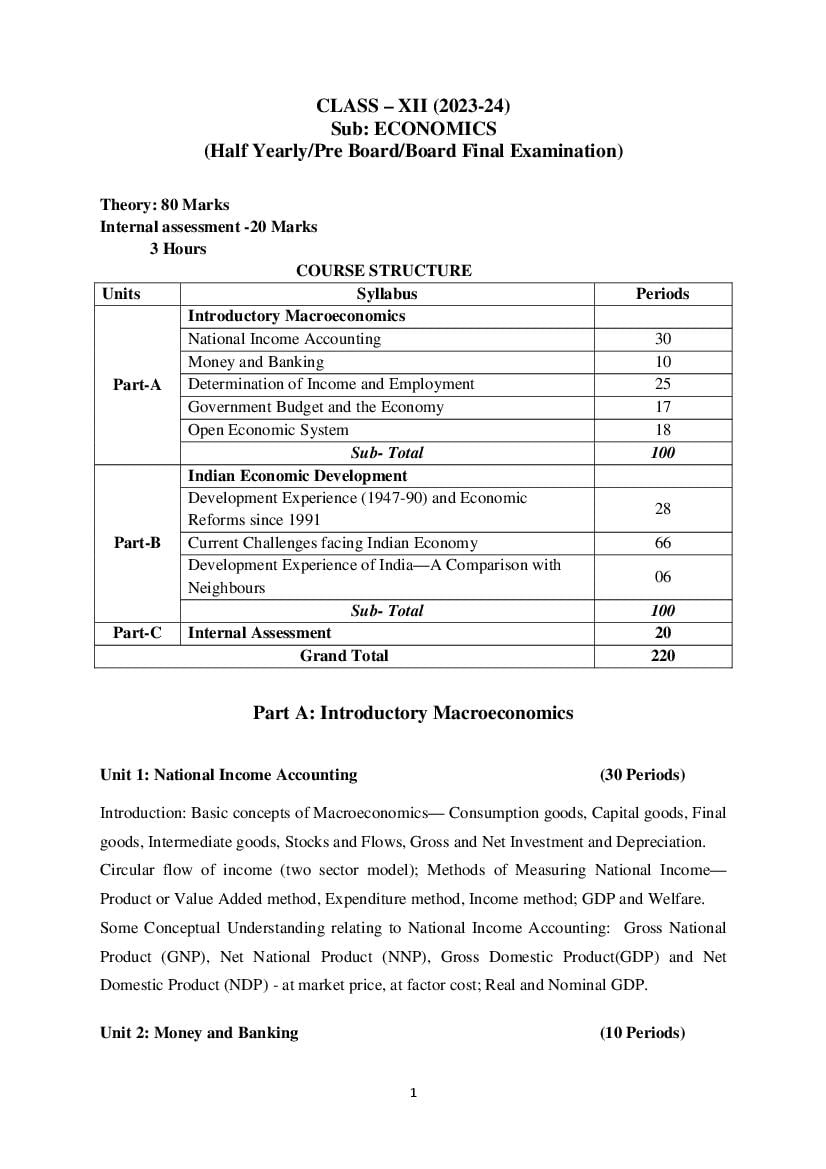
(Half Yearly/Pre Board/Board Final Examination)
Theory: 80 Marks
Internal assessment -20 Marks
3 Hours
COURSE STRUCTURE
Units Syllabus Periods
Introductory Macroeconomics
National Income Accounting 30
Money and Banking 10
Part-A Determination of Income and Employment 25
Government Budget and the Economy 17
Open Economic System 18
Sub- Total 100
Indian Economic Development
Development Experience (1947-90) and Economic
28
Reforms since 1991
Part-B Current Challenges facing Indian Economy 66
Development Experience of India—A Comparison with
06
Neighbours
Sub- Total 100
Part-C Internal Assessment 20
Grand Total 220
Part A: Introductory Macroeconomics
Unit 1: National Income Accounting (30 Periods)
Introduction: Basic concepts of Macroeconomics— Consumption goods, Capital goods, Final
goods, Intermediate goods, Stocks and Flows, Gross and Net Investment and Depreciation.
Circular flow of income (two sector model); Methods of Measuring National Income—
Product or Value Added method, Expenditure method, Income method; GDP and Welfare.
Some Conceptual Understanding relating to National Income Accounting: Gross National
Product (GNP), Net National Product (NNP), Gross Domestic Product(GDP) and Net
Domestic Product (NDP) - at market price, at factor cost; Real and Nominal GDP.
Unit 2: Money and Banking (10 Periods)
1
Page 2
M4; Demonetization.
Banking: Currency held by the public and net demand deposits held by commercial banks;
Credit control policy of Central Bank.
Unit 3: Determination of Income and Employment (25 Periods)
Aggregate demand and its components; Determination of Income in a two-sector model;
Investment Multiplier.
Unit 4: Government Budget and the Economy (17 Periods)
Government budget - meaning, objectives and components. Classification of receipts -
revenue receipts and capital receipts; classification of expenditure – revenue expenditure and
capital expenditure. Measures of government deficit - revenue deficit, fiscal deficit, primary
deficit their meaning.
Unit 5: Open Economic System (18 Periods)
Balance of Payment: Current Account and Capital Account; Balance of Trade; Deficit and
Surplus in Balance of Payment.
Foreign Currency Exchange Market: Foreign Exchange Rate, Determination of Exchange
Rate, Advantage and Disadvantage of Fixed and Flexible Exchange Rate System, Managed
Floating.
Part B: Indian Economic Development
Unit 6: Development Experience (1947-90) and Economic Reforms since 1991:
(28 Periods)
A brief introduction of the state of Indian economy on the eve of independence. Indian
economic system and common goals of Five Year Plans. Main features problems and
policies of agriculture (institutional aspects and new agricultural strategy), industry (IPR
1956; SSI – role & importance) and foreign trade.
Features and appraisals of liberalisation, globalisation and privatisation (LPG policy);
Concepts of demonetization and GST
Unit 7: Current challenges facing Indian Economy (66 Periods)
Poverty: Definition— Absolute and Relative; Measurement of Poverty; Trends of Poverty in
India; Reasons of Poverty; Poverty Alleviation Programmes: A Critical Assessment
2
Page 3
Human capital in India; Indian Education Sector; Future of Human Capital Formation
Rural development: Definition; Key issues - credit and marketing; Organic Farming
Employment: Growth and changes in work force participation rate in formal and informal
sectors; problems and policies
Infrastructure: Meaning; Infrastructure Development and Economic Development; various
types of Infrastructure
Sustainable Economic Development: Meaning, Effects of Economic Development on
Resources and Environment, including global warming
Unit 8: Development Experience of India (06 Periods)
A comparison with neighbours: India and Pakistan; India and China
Issues: Economic Growth, Population, Sectoral Development and other Human Development
Indicators
Part C: Internal Assessment- 20
Sub:Economics
Blue Print of Distribution of Marks
[A] Half- Yearly Examination Total Marks: 80 (40 + 40)
Short Short Long Long
Objective/ Answer-I
SL Answer-II Answer-II Answer Answer Total
Chapters MCQ (1 Marks)
No (2 Marks) (3 Marks) (4Marks) (5Marks) Marks
(1 Marks) (one word/
(20 words) (60 words) (80words) (120words)
1. National Income
2 1 - 1 1 1* 15
2. Money and
1 1 - - 2 - 10
3. Determination
of Income and 2 2 2 1 1* - 15
Sub- Total Marks (A) 05 04 04 06 16 5 40
1. Development
Economic - 2 2 2 - 1* 17
3
Page 4
Poverty 1 1 - - 1 - 06
Human Capital
1 1 - - 1 - 06
Formation
Rural
1 - - - 1 - 05
development
Employment 1 1 - - 1 - 06
Sub- Total Marks (B) 04 05 04 06 16 5 40
Grand Total Marks
10 08 08 12 32 10 80
(A+B)
* indicates that there is an option of extra one (01) question.
[B] Pre- Board/ Board Final Examination Total Marks: 80(40 +40)
Short Short Long Long
Objective/ Answer-I
SL Answer-II Answer-II Answer Answer Total
Chapters MCQ (1 Marks)
No (2 Marks) (3 Marks) (4Marks) (5Marks) Marks
(1 Marks) (one word/
(20 words) (60 words) (80words) (120 words)
National Income
1. 1 1 - 1 - 1* 10
Money and
2. 1 1 - - 1 - 06
Determination
3. of Income and 2 1 1 1 1* - 12
Government
4. Budget and the - - 1 - 1 - 06
Economy
Open Economic
5. 1 1 - - 1 - 06
System
Sub- Total Marks (A) 05 04 04 06 16 5 40
Development
1. Economic - 2 1 1 - 1* 12
2. Current challenges facing Indian Economy
Poverty
2.1 1 2 - - 1 - 07
&Employment
Human Capital
2.2 1 - - - 1 - 05
Formation
Rural
2.3 1 - - - 1 - 05
development
2.4 Infrastructure 1 - - - 1 - 05
Sustainable
2.5 Economic 1 - 1 - - - 03
Development
Development
3. Experience of - - - 1 - - 03
India
Sub- Total Marks (B) 05 04 04 06 16 5 40
Grand Total Marks
09 09 08 12 32 10 80
(A+B)
* indicates that there is an option of extra one (01) question.
Internal Assessment-20
4