TBSE Class 12 Syllabus 2025 Computer Science
Finished viewing? Save it for later —
Download TBSE Class 12 Syllabus 2025 Computer Science (PDF · 3 pages)About TBSE Class 12 Syllabus 2025 Computer Science
TBSE Class 12 Syllabus 2025 Computer Science is available here for free download. Published by Tripura Board for Class 12, this syllabus can be viewed online or downloaded as a PDF (3 pages). Candidates preparing for Class 12 can use TBSE Class 12 Syllabus 2025 Computer Science to understand the exam pattern, the type of questions asked, and the overall difficulty level.
Frequently Asked Questions
How can I download TBSE Class 12 Syllabus 2025 Computer Science?
Open this page and click the Download button to save TBSE Class 12 Syllabus 2025 Computer Science as a PDF. It is completely free on AglaSem Docs.
Is TBSE Class 12 Syllabus 2025 Computer Science free to download?
Yes. TBSE Class 12 Syllabus 2025 Computer Science can be viewed online and downloaded as a PDF free of cost on AglaSem Docs.
How many pages does TBSE Class 12 Syllabus 2025 Computer Science have?
TBSE Class 12 Syllabus 2025 Computer Science contains 3 pages, which you can read online or download together as a single PDF.
Where can I find more Class 12 study material?
You can find more Class 12 question papers, sample papers, syllabus, and answer keys on AglaSem Docs.
TBSE Class 12 Syllabus 2025 Computer Science – Text
Read the full text of this syllabus below — useful to quickly search, copy and reference the content online without downloading the PDF.
📄 View text version (3 pages)
Page 1
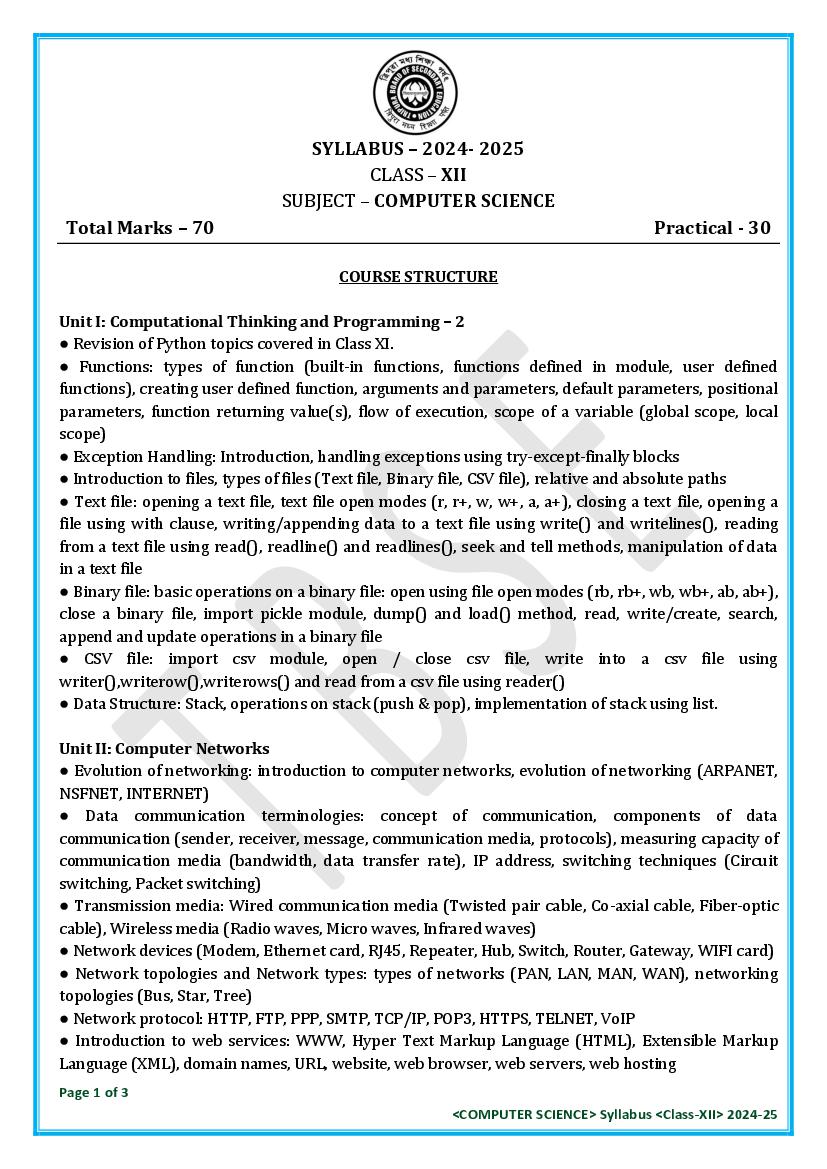
CLASS – XII
SUBJECT – COMPUTER SCIENCE
Total Marks – 70 Practical - 30
COURSE STRUCTURE
Unit I: Computational Thinking and Programming – 2
● Revision of Python topics covered in Class XI.
● Functions: types of function (built-in functions, functions defined in module, user defined
functions), creating user defined function, arguments and parameters, default parameters, positional
parameters, function returning value(s), flow of execution, scope of a variable (global scope, local
scope)
● Exception Handling: Introduction, handling exceptions using try-except-finally blocks
● Introduction to files, types of files (Text file, Binary file, CSV file), relative and absolute paths
● Text file: opening a text file, text file open modes (r, r+, w, w+, a, a+), closing a text file, opening a
file using with clause, writing/appending data to a text file using write() and writelines(), reading
from a text file using read(), readline() and readlines(), seek and tell methods, manipulation of data
in a text file
● Binary file: basic operations on a binary file: open using file open modes (rb, rb+, wb, wb+, ab, ab+),
close a binary file, import pickle module, dump() and load() method, read, write/create, search,
append and update operations in a binary file
● CSV file: import csv module, open / close csv file, write into a csv file using
writer(),writerow(),writerows() and read from a csv file using reader()
● Data Structure: Stack, operations on stack (push & pop), implementation of stack using list.
Unit II: Computer Networks
● Evolution of networking: introduction to computer networks, evolution of networking (ARPANET,
NSFNET, INTERNET)
● Data communication terminologies: concept of communication, components of data
communication (sender, receiver, message, communication media, protocols), measuring capacity of
communication media (bandwidth, data transfer rate), IP address, switching techniques (Circuit
switching, Packet switching)
● Transmission media: Wired communication media (Twisted pair cable, Co-axial cable, Fiber-optic
cable), Wireless media (Radio waves, Micro waves, Infrared waves)
● Network devices (Modem, Ethernet card, RJ45, Repeater, Hub, Switch, Router, Gateway, WIFI card)
● Network topologies and Network types: types of networks (PAN, LAN, MAN, WAN), networking
topologies (Bus, Star, Tree)
● Network protocol: HTTP, FTP, PPP, SMTP, TCP/IP, POP3, HTTPS, TELNET, VoIP
● Introduction to web services: WWW, Hyper Text Markup Language (HTML), Extensible Markup
Language (XML), domain names, URL, website, web browser, web servers, web hosting
Page 1 of 3
Page 2
● Database concepts: introduction to database concepts and its need
● Relational data model: relation, attribute, tuple, domain, degree, cardinality, keys (candidate key,
primary key, alternate key, foreign key)
● Structured Query Language: introduction, Data Definition Language and Data Manipulation
Language, data type (char(n), varchar(n), int, float, date), constraints (not null, unique, primary key),
create database, use database, show databases, drop database, show tables, create table, describe
table, alter table (add and remove an attribute, add and remove primary key), drop table, insert,
delete, select, operators (mathematical, relational and logical), aliasing, distinct clause, where clause,
in, between, order by, meaning of null, is null, is not null, like, update command, delete command,
aggregate functions (max, min, avg, sum, count), group by, having clause, joins: cartesian product on
two tables, equi-join and natural join
● Interface of python with an SQL database: connecting SQL with Python, performing insert, update,
delete queries using cursor, display data by using connect(), cursor(), execute(), commit(),
fetchone(), fetchall(), rowcount, creating database connectivity applications, use of %s format
specifier or format() to perform queries
SUGGESTED PRACTICAL LIST
Python Programming
●Read a text file line by line and display each word separated by a #.
● Read a text file and display the number of vowels/consonants/uppercase/lowercase characters in
the file.
● Remove all the lines that contain the character 'a' in a file and write it to another file.
● Create a binary file with name and roll number. Search for a given roll number and display the
name, if not found display appropriate message.
● Create a binary file with roll number, name and marks. Input a roll number and update the marks.
● Write a random number generator that generates random numbers between 1 and 6 (simulates a
dice).
● Write a Python program to implement a stack using list.
● Create a CSV file by entering user-id and password, read and search the password for given user id.
Database Management
● Create a student table and insert data. Implement the following SQL commands on the
student table:
● ALTER table to add new attributes / modify data type / drop attribute
● UPDATE table to modify data
● ORDER By to display data in ascending / descending order
● DELETE to remove tuple(s)
● GROUP BY and find the min, max, sum, count and average
● Similar exercise may be framed for other cases.
● Integrate SQL with Python by importing suitable module.
Page 2 of 3
Page 3
● NCERT Textbook for COMPUTER SCIENCE (Class XII)
HALF YEARLY/ PRE-BOARD/ BOARD FINAL EXAMINATION: 2024-2025
BLUE PRINT OF DISTRIBUTION OF MARKS
Sl MCQ VSA SA I SA II LA I LA II Total
Topic
No (1) (1) (2) (3) (4) (5) Marks
Computational Thinking &
I 1x6 1x5 2x2 3x1 4x3 5x2 40
Programming II
II Computer Networks 1x2 1x2 2x3 - - - 10
III Database Management 1x2 1x2 2x3 - - 5x2 20
Total Marks (Questions) 1x10 1x9 2x8 3x1 4x3 5x4 70
(10) (9) (8) (1) (3) (4) (35)
MARKS DISTRIBUTION FOR PRACTICAL EXAMINATION: 30 MARKS
1. Actual Experiment - 20 Marks
2. Viva voce - 02 Marks
3. Lab Note Book - 03 Marks
4. Attendance - 05 Marks
Total :- 30 Marks
Page 3 of 3