Tamil Nadu 12th Std Model Question Paper 2026 Mathematics
Finished viewing? Save it for later —
Download Tamil Nadu 12th Std Model Question Paper 2026 Mathematics (PDF · 12 pages)About Tamil Nadu 12th Std Model Question Paper 2026 Mathematics
Tamil Nadu 12th Std Model Question Paper 2026 Mathematics is available here for free download. Published by Tamil Nadu Board for Class 12, this sample paper can be viewed online or downloaded as a PDF (12 pages). Candidates preparing for Class 12 can use Tamil Nadu 12th Std Model Question Paper 2026 Mathematics to understand the exam pattern, the type of questions asked, and the overall difficulty level.
Frequently Asked Questions
How can I download Tamil Nadu 12th Std Model Question Paper 2026 Mathematics?
Open this page and click the Download button to save Tamil Nadu 12th Std Model Question Paper 2026 Mathematics as a PDF. It is completely free on AglaSem Docs.
Is Tamil Nadu 12th Std Model Question Paper 2026 Mathematics free to download?
Yes. Tamil Nadu 12th Std Model Question Paper 2026 Mathematics can be viewed online and downloaded as a PDF free of cost on AglaSem Docs.
How many pages does Tamil Nadu 12th Std Model Question Paper 2026 Mathematics have?
Tamil Nadu 12th Std Model Question Paper 2026 Mathematics contains 12 pages, which you can read online or download together as a single PDF.
Where can I find more Class 12 study material?
You can find more Class 12 question papers, sample papers, syllabus, and answer keys on AglaSem Docs.
Tamil Nadu 12th Std Model Question Paper 2026 Mathematics – Text
Read the full text of this sample paper below — useful to quickly search, copy and reference the content online without downloading the PDF.
📄 View text version (12 pages)
Page 1
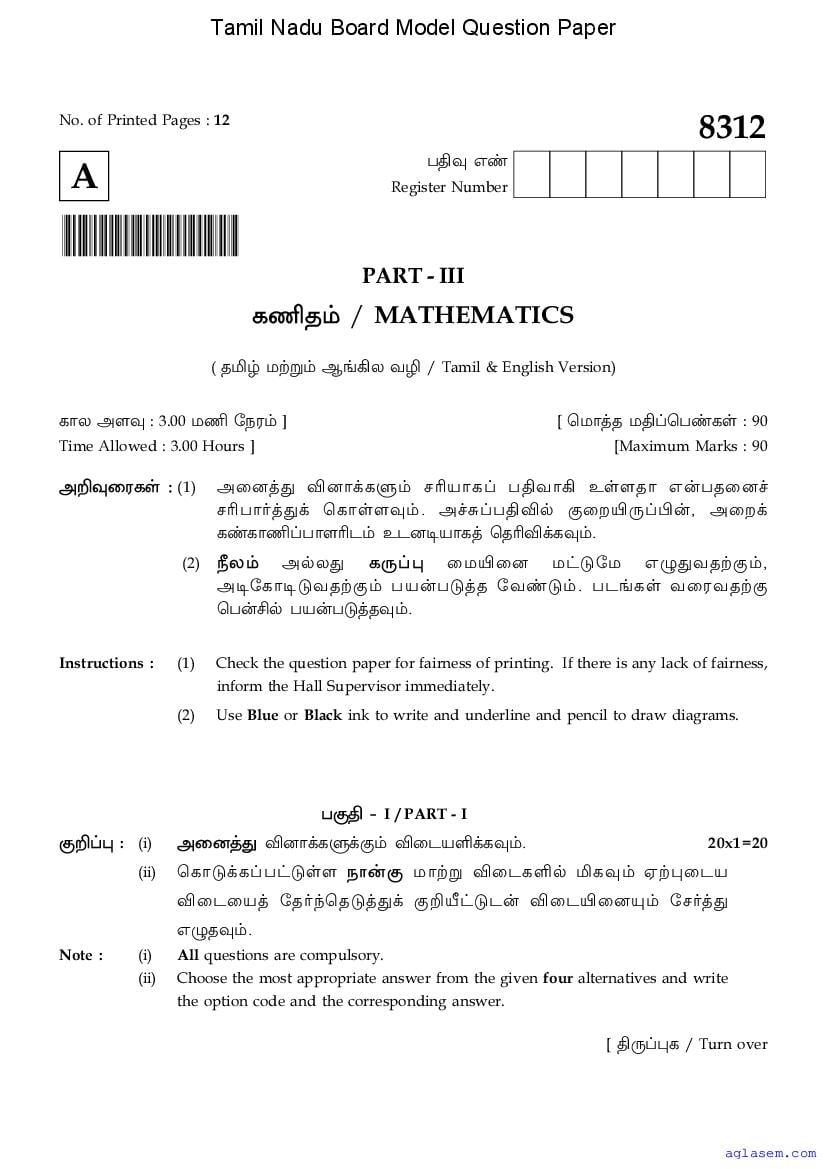
No. of Printed Pages : 12
8312
£vÄ Gs
A Register Number
!8312Mathematics!
PART - III
Pou® / MATHEMATICS
( uªÌ ©ØÖ® B[Q» ÁÈ / Tamil & English Version)
Põ» AÍÄ : 3.00 ©o ÷|µ® ] [ ö©õzu ©v¨ö£sPÒ : 90
Time Allowed : 3.00 Hours ] [Maximum Marks : 90
AÔÄøµPÒ : (1) AøÚzx ÂÚõUPЮ \›¯õP¨ £vÁõQ EÒÍuõ GߣuøÚa
\›£õºzxU öPõÒÍÄ®. Aa_¨£vÂÀ SøÓ°¸¨¤ß, AøÓU
PsPõo¨£õÍ›h® EhÚi¯õPz öu›ÂUPÄ®.
(2) }»® AÀ»x P¸¨¦ ø©°øÚ ©mk÷© GÊxÁuØS®,
Ai÷PõikÁuØS® £¯ß£kzu ÷Ásk®. £h[PÒ ÁøµÁuØS
ö£ß]À £¯ß£kzuÄ®.
Instructions : (1) Check the question paper for fairness of printing. If there is any lack of fairness,
inform the Hall Supervisor immediately.
(2) Use Blue or Black ink to write and underline and pencil to draw diagrams.
£Sv & I / PART - I
SÔ¨¦ : (i) AøÚzx ÂÚõUPÐUS® Âøh¯ÎUPÄ®. 20x1=20
(ii) öPõkUP¨£mkÒÍ |õßS ©õØÖ ÂøhPÎÀ ªPÄ® Hئøh¯
Âøhø¯z ÷uº¢öukzxU SÔ±mkhß Âøh°øÚ²® ÷\ºzx
GÊuÄ®.
Note : (i) All questions are compulsory.
(ii) Choose the most appropriate answer from the given four alternatives and write
the option code and the corresponding answer.
[ v¸¨¦P / Turn over
Page 2
1. PÈzu¼ß RÌ ¤ßÁ¸® Pn® AøhÄ ö£ÓÂÀø» :
(A) N (B) R (C) Q (D) Z
Subtraction is not a binary operation in :
(a) N (b) R (c) Q (d) Z
2. 0, 1 ©ØÖ® 2 BQ¯ ©v¨¦PÎÀ JßøÓ X öPõÒQÓx GßP. H÷uõ J¸ ©õÔ¼
1
k &ÂØS, P(X=i)=k P(X=i−1), i=1, 2 ©ØÖ® P(X = 0) = GÛÀ k &Cß ©v¨¦
7
PõsP.
(A) 3 (B) 1 (C) 4 (D) 2
Suppose that X takes on one of the values 0, 1 and 2. If for some constant k,
1
P(X=i)=k P(X=i−1) for i=1, 2 and P(X = 0) = , then the value of k is :
7
(a) 3 (b) 1 (c) 4 (d) 2
3. A Gߣx 3×3 Á›ø\²øh¯ §a]¯©ØÓU ÷PõøÁ Ao ÷©¾® ?A?=5 GÛÀ
?A−1?= :
1 1
(A) 5 2 (B) 5 (C) 2 (D) 5
5
If A is a non-singular matrix of order 3×3 and ?A?=5 then ?A−1? is :
1 1
(a) 52 (b) 5 (c) 2 (d)
5 5
4. J¸ PÀ»õÚx ö\[SzuõP ÷©À÷|õUQ GÔ¯¨£kQßÓx. t ÷|µzvÀ Ax Aøh¢u
E¯µ® x=80 t−16 t2. PÀ AvP£m\ E¯µzøu t ÂÚõi ÷|µzvÀ Aøh¢uõÀ t BÚx :
(A) 3 (B) 2 (C) 3.5 (D) 2.5
A stone is thrown up vertically. The height it reaches at time t seconds is given by
x=80 t−16 t2. The stone reaches the maximum height in time t seconds is given by :
(a) 3 (b) 2 (c) 3.5 (d) 2.5
dy dy
5. −4 − 7x = 0 GßÓ ÁøPUöPÊa \©ß£õmiß Á›ø\ ©ØÖ® £i •øÓ÷¯ :
dx dx
(A) 1, 2 (B) 2, 1 (C) 2, 2 (D) 1, 1
dy dy
The order and degree of the differential equation −4 − 7x = 0 are respectively :
dx dx
(a) 1, 2 (b) 2, 1 (c) 2, 2 (d) 1, 1
A
Page 3
2 3
©ØÖ® λA =A GÛÀ, λ &ß ©v¨¦ :
6. A= −1
5 −2
(A) 19 (B) 17 (C) 21 (D) 14
2 3 −1
If A = be such that λA =A, then λ is :
5 −2
(a) 19 (b) 17 (c) 21 (d) 14
dy
7. y=f(x) GÝ® ÁøÍÁøµ°ß H÷uÝ® J¸ ¦Òΰhzx \õ´Ä = 3x 2 GÚU
dx
öPõkUP¨£mkÒÍx. ÷©¾® ÁøÍÁøµ¯õÚx (−1, 1) ¦ÒÎ ÁȯõPa ö\ÀQÓx
GÛÀ, ÁøÍÁøµ°ß \©ß£õk :
(A) y=3x3+4 (B) y=x 3+2 (C) y=x 3+5 (D) y=3x2+4
dy
The slope at any point of a curve y=f(x) is given by = 3x 2 and it passes through (−1, 1).
dx
Then the equation of the curve is :
(a) y=3x 3 +4 (b) y=x 3+2 (c) y=x 3+5 (d) y=3x 2 +4
8. f ( x ) = sin−1 x − 1 GÚ Áøµ¯ÖUP¨£k® \õº¤ß \õº£P® :
(A) [0, 1] (B) [1, 2] (C) [−1, 0] (D) [−1, 1]
−1
The domain of the function defined by f ( x ) = sin x − 1 is :
(a) [0, 1] (b) [1, 2] (c) [−1, 0] (d) [−1, 1]
2 2 ∂u
9. u(x, y)=ex +y , GÛÀ &ß ©v¨¦ :
∂x
(A) x2u (B) ex2+y2 (C) y2u (D) 2xu
2 2 ∂u
If u(x, y)=ex +y , then is equal to :
∂x
2 2
(a) x 2u (b) ex +y (c) y 2u (d) 2xu
10. [0, 2π] &À sin4x−2sin2x+1 &I {øÓÄ ö\´²® ö©´ö¯sPÎß GsoUøP :
(A) 1 (B) 2 (C) ∞ (D) 4
The number of real numbers in [0, 2π] satisfying sin4x−2sin2x+1 is :
(a) 1 (b) 2 (c) ∞ (d) 4
A [ v¸¨¦P / Turn over
Page 4
11. i &ß ÁºUP ‰»[PÒ :
1 1 1 1
(A) ± 2 (1 + i) (B) ± 2 (1 + i) (C) ± 2 (1 − i) (D) ± 2 (1 − i)
The square root of i are :
1 1 1 1
(a) ± (1 + i) (b) ± (1 + i) (c) ± (1 − i) (d) ± (1 − i)
2 2 2 2
13
12. ∑ (in+in−1) &ß ©v¨¦ :
n=1
(A) 1 (B) 1+i (C) 0 (D) i
13
The value of ∑ (in+in−1) is :
n=1
(a) 1 (b) 1+i (c) 0 (d) i
13. D¸Ö¨¦ ©õÔ X BÖ •¯Ø]PÎÀ 9P(X=4)=P(X=2) GÝ® öuõhº¤øÚ
AÝ\›UQÓx GÛÀ öÁØÔ°ß {PÌuPÄ :
(A) 0.375 (B) 0.125 (C) 0.75 (D) 0.25
If in 6 trials, X is a binomial variable which follows the relation 9P(X=4)=P(X=2), then the
probability of success is :
(a) 0.375 (b) 0.125 (c) 0.75 (d) 0.25
x −2 y +1 x −1 2y + 3 z +5
14. = , z=2 ©ØÖ® = = GßÓ ÷PõkPÐUS
3 −2 1 3 2
Cøh¨£mh ÷Põn® :
π π π π
(A) 3 (B) 6 (C) 2
(D) 4
x −2 y +1 x −1 2y + 3 z +5
The angle between the lines = , z = 2 and = = is :
3 −2 1 3 2
π π π π
(a) (b) (c) (d)
3 6 2 4
15. y=(x−1)3 GßÓ ÁøÍÁøµ°ß ÁøÍÄ ©õØÓ¨ ¦ÒÎ :
(A) (1, 0) (B) (0, 0) (C) (1, 1) (D) (0, 1)
The point of inflection of the curve y=(x−1)3 is :
(a) (1, 0) (b) (0, 0) (c) (1, 1) (d) (0, 1)
A
Page 5
2
3
dx
16. ∫ Cß ©v¨¦ :
0 4 − 9x 2
π π π
(A) 4 (B) 6 (C) π (D) 2
2
3
dx
The value of ∫ is :
2
0 4 − 9x
π π π
(a) (b) (c) π (d)
4 6 2
17. y 2=x(a−x) GßÓ ÁøÍÁøµ°À Aøh£k® Aµ[Pzvß £µ¨ø£ x &Aaø\¨
ö£õ¸zx _ÇØÖÁuõÀ E¸ÁõS® vh¨ö£õ¸Îß PÚAÍÄ :
πa 3 πa 3 πa 3
(A) (B) πa 3 (C) (D)
5 6 4
2
The volume of solid of revolution of the region bounded by y =x(a−x) about x-axis is :
πa 3 πa 3 πa 3
(a) (b) πa 3 (c) (d)
5 6 4
18. }ÒÁmhzvß AøµUSØÓa_ OB, F ©ØÖ® F ' S¯[PÒ ©ØÖ® FBF ' J¸
ö\[÷Põn® GÛÀ A¢u }ÒÁmhzvß ø©¯zöuõø»z uPÄ PõsP.
1 1 1 1
(A) 4 (B)
2
(C) 3
(D) 2
An ellipse has OB as semi minor axes, F and F' its foci and the angle FBF' is a right angle.
Then the eccentricity of the ellipse is :
1 1 1 1
(a) (b) (c) (d)
4 2 3 2
∧ ∧ ∧ ∧ ∧ ∧ ∧
19. GßÓ öÁUhºPøÍ J¸ ¦ÒΰÀ
i + j , i +2 j , i + j +πk \¢vUS®
Âή¦PÍõPU öPõsh CønPµz vs©zvß PÚAÍÄ :
π π π
(A) π (B) 2 4
(C)(D) 3
The volume of the parallelepiped with its edges represented by the vectors
∧ ∧ ∧ ∧ ∧ ∧ ∧
i + j , i + 2 j , i + j + π k is :
π π π
(a) π (b) (c) (d)
2 4 3
A [ v¸¨¦P / Turn over
Page 6
20. x &ß AøÚzx ©v¨¤ØS® f (x) > 0 GßP, ÷©¾® g(x)=log(f (x)), GÛÀ dg= :
1 1 1 1
(A) f ( x ) dx (B) f ( x ) f '(x ) dx (C) x dx (D) x
f (x ) dx
If f (x) > 0 for all x and g(x)=log(f (x)), then dg is :
1 1 1 1
(a) dx (b) f '(x ) dx (c) dx (d) f (x ) dx
f (x) f (x) x x
£Sv & II / PART - II
SÔ¨¦ : GøÁ÷¯Ý® HÊ ÂÚõUPÐUS Âøh¯ÎUPÄ®. ÂÚõ Gs 30 &US
Pmhõ¯©õP Âøh¯ÎUPÄ®. 7x2=14
Note : Answer any seven questions. Question No. 30 is compulsory.
−1 2 2
21. adj A = 1 1 2 , GÛÀ A−1 &IU PõsP.
2 2 1
−1 2 2
If adj A = 1 1 2 , find A−1.
2 2 1
1
22. z=x+i y GÛÀ, Re &ß ö\ÆÁP ÁiÂøÚU PõsP.
z
1
If z=x+i y, then find Re in rectangular form.
z
23. tan−1 (− 3 ) &ß ©v¨¦U PõsP.
Find the value of tan
−1
(− 3 ) .
A
Page 7
24. y=4x+c GßÓ ÷|ºU÷Põk x2+y 2=9 GßÓ Ámhzvß öuõk÷Põk GÛÀ c &ß
©v¨¦U PõsP.
If y=4x+c is a tangent to the circle x2+y2=9, find c.
x 2 − 6x + 7
25. f (x) = GßÓ \õº¤ØS \õ´¢u öuõø»z öuõk÷PõmiøÚU PõsP.
x+5
Find the slant (oblique) asymptote for the function f ( x ) =
x 2 − 6x + 7 .
x+5
x 2 + 5xy − 10y 2
26. \õº¦ F(x , y ) = £i 1 Eøh¯ \©£izuõÚ \õº¦ GÚU PõmkP.
3x + 7y
x 2 + 5xy − 10y 2
Show that F(x , y ) = is a homogeneous function of degree 1.
3x + 7y
1 − y2
27. wºUP : dy =
dx 1 − x2
dy 1 − y2
Solve =
dx 1 − x2
Cx 2 1<x < 4
28. f (x) =
0
x & Cß ¤Ó ©v¨¦ PÐUS,
GÝ® \õº¦ J¸ Ahºzv \õº¦ GÛÀ ©õÔ¼ C &Cß ©v¨¦ PõsP.
Cx 2 1<x < 4
Find the constant C such that the function f (x) =
0 otherwise
is a density function of X.
29. i−2 &I ‰»©õPU öPõsh SøÓ¢u£m\ £i²hß ÂQu•Ö öPÊUPÐøh¯ Kº
£À¾Ö¨¦U÷PõøÁa \©ß£õmøhU PõsP.
Find a polynomial equation of minimum degree with rational coefficients having i−2 as a
root.
A [ v¸¨¦P / Turn over
Page 8
π
π 2
30. f (x)=sinx GÛÀ, ∫ f ( x ) dx = 2 ∫ f ( x ) dx GÚ {ÖÄP.
0 0
π
π 2
If f (x)=sinx, then prove that ∫ f ( x ) dx = 2 ∫ f ( x ) dx
0 0
£Sv & III / PART - III
SÔ¨¦ : GøÁ÷¯Ý® HÊ ÂÚõUPÐUS Âøh¯ÎUPÄ®. ÂÚõ Gs 40 &US
Pmhõ¯©õP Âøh¯ÎUPÄ®. 7x3=21
Note : Answer any seven questions. Question No. 40 is compulsory.
31. ¤ßÁ¸® ÷|›¯a \©ß£õmkz öuõS¨ø£ ÷|º©õÖ Ao PõnÀ •øÓ°À wºUP
2x+5y=−2, x+2y=−3
Solve the system of linear equations 2x+5y=−2, x+2y=−3 by matrix inversion method.
32. ?z?=2 GÛÀ, 8≤?z+6+8i?≤12 GÚU PõmkP.
If ?z?=2 show that 8≤?z+6+8i?≤12
33. 7x3−43x2=43x−7 GßÓ \©ß£õmøhz wºUP.
Solve the equation 7x3−43x2=43x−7
34. {¹¤UP : tan−1 2 + tan−1 7 = tan−1 1
11 24 2
2 7 1
Prove that tan−1 + tan−1 = tan−1
11 24 2
→ → → → → → → → → → → → →
35. Gß£Ú ‰ßÖ öÁUhºPÒ GÛÀ a + c , a + b , a + b + c = a , b , c
a, b, c
GÚ {¹¤UP.
→ → → → → → → → → → → → →
If a , b , c are three vectors, prove that a + c , a + b , a + b + c = a , b , c
A
Page 9
du
36. \õº¦ u(x, y)=x2y+3xy4, x=et ©ØÖ® y=sin t, GÛÀ &IU PõsP.
dt
du
If u(x, y)=x2y+3xy4, x=et and y=sin t, find
dt
π
2
dx
37. ©v¨¤kP : ∫ 2
0 1 + 5 cos x
π
2
dx
Evaluate ∫ 2
0 1 + 5 cos x
38. 600 iUöPmkPÒ öPõsh J¸ »õmh›°À J¸ £›_ ` 200 &US®, |õßS £›_PÒ
` 100&US®, BÖ £›_PÒ ` 50 &US® GÚU öPõkUP¨£kQÓx. iUöPm ö\»Ä
` 2 GßÓõÀ, J¸ iUöPmiß Gvº£õºUP¨£k® C»õ£z öuõøPø¯U PshԯĮ.
A lottery with 600 tickets gives one prize of ` 200, four prizes of ` 100 and six prizes of ` 50.
If the ticket cost is ` 2, find the expected profit amount of a ticket.
39. f (x)=x 3+2x+1, (−∞ < x < ∞) GßÓ \õº¤ß öh´»º öuõh›ß ›øÁ x=2 &I
ö£õ¸zx PõsP.
Find the Taylor’s series about x=2 for f (x)=x3+2x+1, (−∞ < x < ∞)
40. Q Gߣx ÂQu•Ö GsPÎß Pn® GßP. * GßÓ Kº D¸Ö¨¦a ö\¯¼ Q &ß «x
a * b=a+b−ab+7 GÝ©õÖ Áøµ¯ÖUP¨£kQÓx, ÷©¾® * m =
3 87
GÛÀ
2 10
m &ß ©v¨ø£U PõsP.
Let Q be the set of all Rational numbers. If * is a binary operation defined on Q as
a*b=a+b−ab+7 and * m =
3 87
, then find the value of m.
2 10
A [ v¸¨¦P / Turn over
Page 10
£Sv & IV / PART - IV
SÔ¨¦ : AøÚzx ÂÚõUPÐUS® Âøh¯ÎUPÄ®. 7x5=35
Note : Answer all the questions.
41. (A) ¤ßÁ¸® ÷|›¯a \©ß£õkPÎß öuõS¨ø£ Qµõ©›ß Âvø¯¨ £¯ß£kzvz
wºUP x1−x2=3, 2x1+3x2+4x3=17, x2+2x3=7
AÀ»x
(B) x=7 cos t ©ØÖ® y=2 sin t, t∈R GßÓ ÁøÍÁøµUS H÷uÝ® J¸ ¦ÒΰÀ
Áøµ¯¨£k® öuõk÷Põk ©ØÖ® ö\[÷Põmiß \©ß£õkPøÍU PõsP.
(a) Solve, by Cramer’s rule, the system of equations x 1 −x 2=3, 2x 1 +3x 2 +4x 3 =17,
x 2+2x 3=7
OR
(b) Find the equation of tangent and normal to the curve given by x=7 cos t and
y=2 sin t, t∈R at any point on the curve.
42. (A) ω≠1 Gߣx JßÔß •¨£i ‰»® GÛÀ (z−1)3+8=0 GßÓ \©ß£õmiß
‰»[PÒ −1, 1−2ω, 1−2ω2 GÚUPõmkP.
AÀ»x
(B) £µÁøͯ® y2=x ©ØÖ® ÷Põk y=x−2 BQ¯ÁØÓõÀ Aøh£k® Aµ[Pzvß
£µ¨ø£U PõsP.
(a) If ω ≠ 1 is a cube root of unity, show that the roots of the equation (z−1)3+8=0 are
−1, 1−2ω, 1−2ω2
OR
(b) Find the area of the region bounded by the parabola y2=x and the line y=x−2
1
43. (A) 6x4−5x3−38x2−5x+6=0 GÝ® \©ß£õmiß J¸ wºÄ 3 GÛÀ, \©ß£õmiß
wºÄ PõsP.
AÀ»x
(B) wºUP : (x2−3y2)dx+2xydy=0.
1
(a) Solve the equation 6x4−5x3−38x2−5x+6=0 if it is known that is a solution.
3
OR
(b) Solve (x2−3y2)dx+2xydy=0.
A
Page 11
44. (A) J¸ £õ»® £µÁøͯ ÁøÍÂÀ EÒÍx. ø©¯zvÀ 10 « E¯µ•®,
Ai¨£Sv°À 30 « AP»•® EÒÍx. ø©¯zv¼¸¢x C¸¦Ó•®
6 « yµzvÀ £õ»zvß E¯µzøuU PõsP.
AÀ»x
(B) öÁUhº •øÓ°À, {ÖÄP.
cos(α−β)=cosα cosβ+sinα sinβ
(a) A bridge has a parabolic arch that is 10 m high in the centre and 30 m wide at the
bottom. Find the height of the arch 6 m from the centre, on either sides.
OR
(b) Using vector method, prove that cos(α−β)=cosα cosβ+sinα sinβ.
45. (A) ÷£õºUPõ»zvÀ J¸ SÔ¨¤mh £¯nzvÀ £¯n® ö\´²® 9 P¨£ÀPÎÀ
\µõ\›¯õP 1 P¨£À ‰ÌSQÓx GÛÀ,
(i) 6 P¨£ÀPÒ öPõsh J¸ SÊÂÀ \›¯õP 3 P¨£ÀPÒ £õxPõ¨£õP Á¢x
÷\¸®.
(ii) 4 P¨£ÀPÒ öPõsh J¸ SÊÂÀ J¸ P¨£À Th \›¯õP Á¢x ÷\µõx.
BQ¯ÁØÖUPõÚ {PÌuPÄ PõsP.
AÀ»x
(B) S¯[PÒ (2, 1), (−2, 1) ©ØÖ® ö\ÆÁP»zvß }Í® 6 Eøh¯ }ÒÁmhzvß
\©ß£õk PõsP.
(a) During war, 1 ship out of 9 was sunk on an average in making a certain voyage. What
was the probability that :
(i) Exactly 3 out of a convoy of 6 ships would arrive safely ?
(ii) No ships arrive safely from a convoy of 4 ships.
OR
(b) Find the equation of the ellipse whose Foci are (2, 1), (−2, 1) and the length of the latus
rectum is 6
A [ v¸¨¦P / Turn over
Page 12
46.
→
(A) (0, 1, −5) GßÓ ¦ÒÎ ÁÈa ö\À¾® r = i + 2 j − 4 k +s 2 i +3 j +6 k ©ØÖ® ( ∧ ∧ ∧
) ( ∧ ∧ ∧
)
→
( ∧ ∧ ∧
) ( ∧
r = i −3 j + 5 k +t i + j − k
∧ ∧
) GßÓ ÷PõkPÐUS Cøn¯õP EÒÍx©õÚ
uÍzvß xøn¯»S AÀ»õu öÁUhº \©ß£õk ©ØÖ® Põºj]¯ß
\©ß£õkPøÍU PõsP.
AÀ»x
(B) ö£õ¸Îß C¸¨¤ß ö£¸UP©õÚx AvÀ Põn¨£k® ö£õ¸Îß C¸¨¤ß
GsoUøP°ß ÂQu©õP Aø©¢xÒÍx. ö£õ¸Îß C¸¨¦ 50 BskPÎÀ
C¸ ©h[PõQÓx GÛÀ, GzuøÚ BskPÎÀ ö£õ¸Îß C¸¨¦
•®©h[PõS® ?
(a) Find the non-parametric form of Vector equation, and the Cartesian equation of the
plane passing through the point (0, 1, −5) and parallel to the straight lines
→
( ∧ ∧ ∧
) ( ∧ ∧ ∧
) →
( ∧
r = i + 2 j − 4 k +s 2 i +3 j +6 k and r = i − 3 j + 5 k + t i + j − k
∧ ∧
) ( ∧ ∧ ∧
)
OR
(b) The growth of a population is proportional to the number present. If the population of
a colony doubles in 50 years, in how many years will the population become triple ?
47. (A) Bµ® a ö\.« ©ØÖ® E¯µ® b ö\.« öPõsh J¸ öÁØÖU T®¦ J¸ ÷©ø\°ß
«x øÁUP¨£kQÓx. Cuß Ai°À ©øÓzx øÁUPUTi¯ ªP¨ö£›¯
4
E¸øÍ°ß PÚAÍÄ, T®¤ß PÚ AÍøÁ¨ ÷£õÀ 9 ©h[S GߣøuU
PõmkP.
AÀ»x
(B) ö©´ø© AmhÁønø¯¨ £¯ß£kzv {ÖÄP p ∧ (q ∨ r) ≡ (p ∧ q) ∨ (p ∧ r)
(a) A hollow cone with base radius a cm and height b cm is placed on a table. Show that
4
the volume of the largest cylinder that can be hidden underneath is times volume of
9
the cone.
OR
(b) Using truth table, prove that p ∧ (q ∨ r) ≡(p ∧ q) ∨ (p ∧ r)
-oOo-
A
Document Details
| Board / Org | Tamil Nadu Board |
| Exam | Class 12 |
| Type | Sample Paper |
| Pages | 12 |
| Updated | 24 Sep 2026 |