Finished viewing? Save it for later —
Download ISC Class 12 Syllabus 2028 Biotechnology (PDF · 11 pages)About ISC Class 12 Syllabus 2028 Biotechnology
ISC Class 12 Syllabus 2028 Biotechnology is available here for free download. Published by CISCE for Class 12, this syllabus can be viewed online or downloaded as a PDF (11 pages). Candidates preparing for Class 12 can use ISC Class 12 Syllabus 2028 Biotechnology to understand the exam pattern, the type of questions asked, and the overall difficulty level.
Frequently Asked Questions
How can I download ISC Class 12 Syllabus 2028 Biotechnology?
Open this page and click the Download button to save ISC Class 12 Syllabus 2028 Biotechnology as a PDF. It is completely free on AglaSem Docs.
Is ISC Class 12 Syllabus 2028 Biotechnology free to download?
Yes. ISC Class 12 Syllabus 2028 Biotechnology can be viewed online and downloaded as a PDF free of cost on AglaSem Docs.
How many pages does ISC Class 12 Syllabus 2028 Biotechnology have?
ISC Class 12 Syllabus 2028 Biotechnology contains 11 pages, which you can read online or download together as a single PDF.
Where can I find more Class 12 study material?
You can find more Class 12 question papers, sample papers, syllabus, and answer keys on AglaSem Docs.
ISC Class 12 Syllabus 2028 Biotechnology – Text
Read the full text of this syllabus below — useful to quickly search, copy and reference the content online without downloading the PDF.
📄 View text version (11 pages)
Page 1
INDIAN SCHOOL CERTIFICATE
EXAMINATION
YEAR 2028
BIOTECHNOLOGY
(878)
Page 2
Research, Development and Curriculum Division (RDCD)
CISCE
January 2026
____________________________________________________________________________________________
© Copyright, Council for the Indian School Certificate Examinations
All rights reserved. The copyright to this publication and any part thereof solely vests in the Council for the Indian
School Certificate Examinations. This publication and no part thereof may be reproduced, transmitted, distributed or
stored in any manner whatsoever, without the prior written approval of the Council for the Indian School Certificate
Examinations.
Page 3
MISSION STATEMENT
The Council for the Indian School Certificate
Examinations is committed to serving the nation's
children, through high quality educational
endeavours, empowering them to contribute towards
a humane, just and pluralistic society, promoting
introspective living, by creating exciting learning
opportunities, with a commitment to excellence.
ETHOS OF CISCE
Trust and fair play.
Minimum monitoring.
Allowing schools to evolve their own niche.
Catering to the needs of the children.
Giving freedom to experiment with new ideas
and practices.
Diversity and plurality - the basic strength for
evolution of ideas.
Schools to motivate pupils towards the
cultivation of:
Excellence - The Indian and Global
experience.
Values - Spiritual and cultural - to be the bedrock
of the educational experience.
Schools to have an 'Indian Ethos', strong roots in
the national psyche and be sensitive to national
aspirations.
Page 4
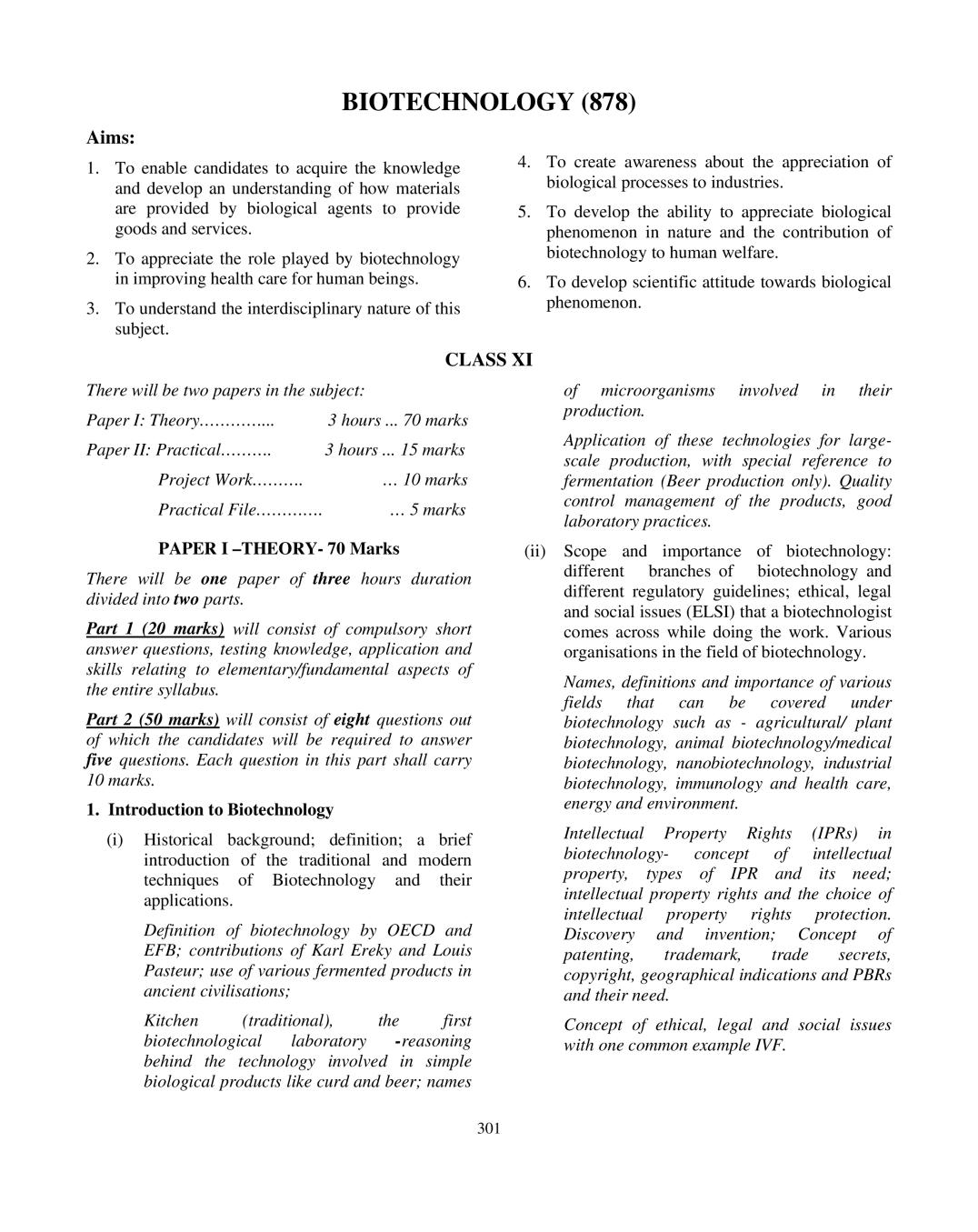
There will be two papers in the subject:
Paper I: Theory……………. 3 hours ... 70 marks
Paper II: Practical…………. 3 hours ... 15 marks
Project Work………. …10 marks
Practical File………… … 5 marks
PAPER I: THEORY- 70 Marks
S. NO. UNIT WEIGHTAGE
(Marks)
1. Molecular Biology 15
2. Genetic Engineering 23
3. Cell culture technology 20
4. Bioinformatics 12
Total 70
1. Molecular Biology
(i) Nucleic acids and their estimation: an understanding of nucleic acids and their biochemical structure.
Units of nucleic acids: Nucleotides. Difference between nucleosides and nucleotides.
DNA – its structure (as suggested by Watson and Crick), Chargaff’s Equivalence Rule, DNA as the genetic
material (Hershey and Chase experiment).
RNA and its types – structure and roles of mRNA-monocistronic and polycistronic types, tRNA, rRNA.
tRNA- an introduction to Clover leaf model and inverted L-shaped model.
Replication of DNA- Messelson-Stahl Experiment and Taylor et. al experiment, with reference to leading
and lagging strands, enzymes and proteins involved in replication in prokaryotes viz. Topoisomerase,
helicase, SSBPs, primase, DNA polymerase, DNA ligase.
DNA proofreading and repair by DNA Polymerase I and II.
Estimation methods for nucleic acids using UV-visible spectrophotometry and colorimetry.
(ii) Protein Synthesis: Central dogma, transcription and translation.
Concept of central dogma.
(a) Transcriptional Unit: promoter region, structural region and terminator region; Split genes – (exons
and introns); hnRNA.
(b) Process of transcription - Initiation, Elongation and termination including enzymes involved.
(c) Post-transcriptional changes their significance in eukaryotes – polyadenylation, capping and RNA
splicing; role of snRNA in splicing.
7
Page 5
(e) Translation process - Initiation, elongation and termination,
Post translational - modification in proteins (i.e. glycosylation, protein folding, proteolytic
degradation, intein splicing).
Reverse transcription - process (an exception to Central Dogma.
(iii) Gene regulation in prokaryotes
Types of Operons: Inducible and Repressible.
Lac operon and trp operons – their structure and working.
2. Genetic Engineering
(i) Introduction to gene cloning and genetic engineering: DNA extraction from the source cell, host selection.
Construction of recombinant DNA.
Tools: enzymes such as restriction endonucleases – (Type I, II and III), DNA ligase, alkaline phosphatase,
Taq Polymerase, RNase, S1 nuclease, polynucleotide kinase, alongside exonuclease, DNA polymerases I,
II and III. DNA isolation from bacterial cells, plant cells and animal cells and its purification using CTAB
method.
Vectors used in gene cloning ex. plasmids – (pBR322, pUC), Phages (M13 and λ), Phagemids, Cosmids,
cloning vectors, expression vectors, YACs, and BACs and their specific carrying capacities.
(a) Transformation of host cells:
• Vector-less: electroporation, liposome mediated, microinjection and biolistics.
• Vector mediated method: Agrobacterium mediated.
(b) Identification of recombinants-Direct selection by Green Fluorescent Protein (GFP), Insertional
inactivation (antibiotic resistance gene, Blue-white selection).
(c) Genomic DNA and cDNA libraries.
(ii) Innovations in Biotechnology:
(a) Development of Flavr Savr tomatoes, Bt-crops, Golden rice.
(b) Gene editing, Gene therapy using CRISPR-Cas9 technology to insert knockout genes for gene therapy
of sickle cell anaemia and cancer.
(c) Development of Humulin, recombinant interferons.
(d) Recombinant Hepatitis B vaccine, mRNA based vaccine against Covid-19, stem cell therapy.
(e) Transgenic animals ex. Dolly Sheep, Rosie cow, ATryn goat, development of artificial meat without
slaughter.
(f) Bioremediation using oil-eating bacteria (Super Bug). Mycoremediation (Pleurotus ostreatus to
digest diesel and motor oils), Phycoremediation (Chlamydomonas for heavy metals and crude oils).
(g) Industrial enzymes: Rennet, Subtilisin, Amylase, Papain – their sources and applications.
(iii) Gene analysis:
(a) DNA probes – definition and use.
(b) Process and applications of Gel electrophoresis, Southern blotting, Western and Northern blotting.
(c) DNA sequencing – Sanger’s Method of Chain termination and automated DNA sequencing method.
(d) Site directed mutagenesis with an example of human insulin.
(e) Process and application of Polymerase chain reaction (PCR), RT-PCR, DNA finger printing.
8
Page 6
Different cell culture technologies and their applications such as microbial, plant tissue and animal cell
cultures.
(i) Microbial culture:
Fermentation process and growth kinetics-batch, fed batch, continuous cultures -principles, products
obtained and graphs.
Process of turbidostat and chemostat- forms of open continuous culture.
Bioprocess engineering like bioreactor designing – its components, downstream processing with respect
to antibiotic production.
Subtilisin, Production of SCP - large scale production of mycoprotein (using Yeast) by fermentation.
(ii) Plant tissue culture:
Cell isolation, synchronisation of isolated cells using chemical methods.
Totipotency – definition and concept of cellular differentiation, de-differentiation, re-differentiation with
respect to callus formation.
(a) Process of Haploid production (androgenesis and gynogenesis) and Triploid production (endosperm
culture).
(b) Process of In-vitro pollination and Embryo rescue.
(c) Embryo culture, Somatic hybridisation - Pomato.
(d) Process of Micropropagation, Virus resistant plants by RNAi.
(e) Somatic embryogenesis and production of synthetic seeds, PHB (bioplastics).
(iii) Animal cell culture:
Primary culture, secondary culture or Sub-culture - suspension (with suspension cell line) and monolayer
(adherent cell line), cell-lines and its types: finite and continuous. Scale up using Roller bottle culture
technique.
Process of hybridoma technology, tissue engineering and CAR-T therapy by genetically engineered
T-cells to cure cancer.
4. Bioinformatics
(i) Introduction to bioinformatics, global bioinformatics databases and data retrieval tools; genomics,
different types of sequences, types of sequence analysis.
Definition and need.
Bioinformatics databases: EMBL, NCBI, DDBJ, SWISSPROT, GenBank.
Data retrieval tools- ENTREZ, Taxonomy Browser.
(ii) Genomics: Definition, introduction, tools used in Genomics and its applications.
Definition of genomics. Types: Structural, Functional, and Metagenomics. Sequences – cDNA, ESTs
STSs.
Tools: BLAST and FASTA; global, local, pair wise and multiple sequence alignments.
Rice Genome Project and Human Genome Project - objectives, achievements, countries involved, people
contributing in it.
DNA microarray: Definition and application.
Concept of SNPs.
9
Page 7
Types - Structural, functional and expression.
Databases: PDB, PIR, SWISSPROT.
Protein Engineering - definition, principle and application.
AI powered Drug Designing and Drug Targeting (AlphaFold2 as AI for vaccine against Covid-19 and
cancer therapy).
PAPER II
PRACTICAL WORK: 15 marks
Candidates are required to complete the following experiments.
1. Paper Chromatography – separation of photosynthetic pigments.
Take any leaf. Extract chlorophyll in 80% acetone. Take a strip of paper or prepare a thin layer of silica gel
on a slide. Load chlorophyll extract at one end of the paper/gel. Keep paper or gel in the rising medium in
test tube or jar for about 30 minutes. The rising medium should have methanol/ acetic acid, n-butanol or
benzene. The rising fluid should always be at the bottom below the point of loading of chlorophylls. After 30
minutes, three spots: yellow, bluish green and light green will be observed corresponding to carotenes,
chlorophyll A & chlorophyll B.
2. Preparation of buffers – phosphate, acetate and borate buffers.
This experiment should be done to make the basics clear to the students. Basic calculation for buffer
preparation should be known. The approach should be to utilize easily available chemicals at reasonable
costs. Phosphate, borate and acetate buffers can give the range of pH 4 - pH 9.2
3. Preparation of culture media (LB, MS) as slants and suspensions.
(i) Bacterial culture Media - Luria Bertani (L.B.) media - Peptone/ Tryptone, yeast extract and NaCl.
(ii) Plant Tissue culture medium (Sugars + Coconut milk + Agar Agar). MS.
Medium to be prepared, autoclaved and cooled to 60 degrees C. To prepare nutrient plates the media is
poured into pre-sterilized petri-dishes under a LAF. To prepare slants the media is poured into several
test tubes, plugged and kept in a tilted position (at an angle of 45o) until it sets.
4. Sterilization of culture medium and other materials.
(i) Dry Physical method – heat or radiation.
(ii) Wet Physical methods – steam sterilization.
(iii) Chemical Sterilization/ Surface sterilization Disinfection with 70% alcohol and Sodium hypochlorite
solution carbolic acid.
5. Inoculation and incubation of Lactobacillus on the culture medium in the Petri plate.
Use of inoculation loop or inoculation needle for the purpose.
6. Identification of bacteria by Gram +ve and Gram –ve (from curd /saliva and/or soil solution).
(i) Prepare a bacterial smear on a slide (ii) Stain with crystal violet stain. (iii) Rinse with water. (iv) Add a
few drops of iodine solution. (v) Add few drops of 90 % ethanol (vi) Counterstain with safranin solution (vii)
Observe the red and blue colonies under the microscope
7. Action of enzymes on starch under: (a) variable temperature (b) variable substrate concentration – plotting of
K m value by graph.
(i) To study the effect of variable temperature on the activity of the enzyme salivary amylase.
10
Page 8
of saliva to 10 ml of starch solution. Incubate for 15 minutes. Again test for presence of starch with
iodine. Also test for the presence of reducing sugars in solution. Repeat the same process at the variable
volumes of starch.
8. Isolation of DNA from plants.
Take half a ripe and peeled banana into a beaker and add 50 ml of extraction fluid (1.5gm table salt +10 ml
liquid detergent +90 ml distilled water). Place the beaker in a water bath set at 60 degrees C for 15 minutes.
Stir gently with a glass rod. Filter 5ml of cooled content into a clean test tube and add 5ml of cold 90%
ethanol. DNA molecules separate out and appear as white fibres. [DNA can also be extracted from pea seeds
and soaked wheat grains].
9. DNA estimation by colorimeter by DPA method.
10. Protein estimation by colour reaction – Bradford test.
Bradford’s Assay is a Dye binding assay based on the differential change of colour of a dye in response to
various concentrations of proteins. Bradford’s assay can be performed for qualitative as well as quantitative
assessment of proteins in a sample.
Dilute 1 volume of Bradford’s dye with 4 volumes of distilled water. Filter the dye through Whatman filter
paper and store at room temperature in a brown glass bottle. Take different aliquots of standard Bovine Serum
Albumin (BSA solution), for example (0.2, 0.4, 0.6, 0.8 and 1.0 ml) in different test tubes Make up the volume
to 1ml with distilled water. To each tube add 2ml of Bradford’s dye. Extent of colour development can be
made by rough estimate using + signs to show the concentration of protein in the sample. Alternatively, OD
can be read using colorimeter or spectrophotometer. Take the unknown sample to be estimated and perform
the experiment. Similarly read the OD and note the corresponding concentration of protein in it using the
graph.
11. Cell viability test by Trypan blue dye.
12. Isolation of milk protein – wet weight and dry weight.
Milk proteins are isolated by adding 0.4 N HCl into the milk sample. Casein start coagulating at its isoelectric
point (i.e. at pH 4.6). The precipitate is filtered and weighed to quantify the protein present.
13. Demonstration of cell counting by haemocytometer by using diluted blood.
14. Experiment to show the process of saponification.
15. Separation of amino acids by paper chromatography.
11
Page 9
Project Work – 10 Marks
The Project Work is to be assessed by a Visiting Examiner appointed locally and approved by CISCE.
Candidates are to creatively execute one project / assignment on an aspect of Biotechnology.
Teachers may assign or students may choose any one project of their choice. The report should be kept simple,
but neat and elegant.
LIST OF SUGGESTED PROJECTS:
1. Effluent analysis.
2. Role of biotechnology in brewing industries – viz. production of beer, wine etc.
3. Drug designing and drug targeting through AI and proteomics.
4. Vaccine/drug development.
5. Diagnosis of diseases by modern techniques like ELISA, RIA and Antibody targeting.
6. DNA Fingerprinting.
7. Methods of identifying microbes (various staining techniques and biochemical reactions).
8. Tissue Culture and its applications.
9. Stem Cell Technology.
10. Nanotechnology.
11. Bioinformatics.
12. Cloning – gene and animal.
13. Forensic Biotechnology.
14. Ethical, Legal and Social Issues (ELSI) related to Biotechnology/ GMOs.
15. Biopiracy- Case Studies.
Practical File – 5 Marks
The Visiting Examiner is required to assess students on the basis of the practical file maintained by them during
the academic year.
Suggested Evaluation Criteria for Project Work:
Format of the Project:
– Content
– Introduction
– Presentation (graphs, tables, charts, newspaper cuttings, diagrams, photographs, statistical analysis if relevant)
– Conclusion/ Summary
– Bibliography
12
Page 10
1. AI: Artificial Intelligence
2. BAC: Bacterial Artificial Chromosomes
3. BLAST: Basic Local Alignment Search Tool
4. CAR: Chimeric Antigen Receptor
5. COVID-19: Corona Virus Disease 2019
6. CRISPR: Clustered Regularly Interspaced Short Palindromic Repeats
7. Cas9: CRISPR-associated protein 9.
8. CTAB: Cetyl Trimethyl Ammonium Bromide
9. DDBJ: DNA Database/ Data Bank of Japan
10. ddNTP: Dideoxy Nucleoside triphosphate
11. DMEM: Dulbecco Modified Eagle Medium
12. EMBL: European Molecular Biology Laboratory
13. EST: Expressed Sequence Tag
14. FACS: Fluorescence Activated Cell Sorting
15. FASTA: Fast All
16. FBS: Foetal Bovine Serum
17. HEPA: High Energy Particulate Air
18. HGP: Human Genome Project
19. hnRNA: heterogeneous nuclear RNA
20. LAF: Laminar Air Flow
21. IFN: Interferon
22. LB medium: Luria and Bertani Medium
23. MS medium: Murashige and Skoog medium
24. NCBI: National Centre for Biotechnology Information
25. PAGE: Polyacrylamide Gel Electrophoresis
26. PCR: Polymerase Chain Reaction
27. PDB: Protein Database/ Data Bank
28. PHB: Poly 3–Hydroxyl Butyrate
29. PIR: Protein Information Resource
30. RFLP: Restriction Fragment Length Polymorphism
31. RNA: Ribonucleic acid
32. RNAi: RNA Interference
33. RPMI medium: Roswell Park Memorial Institute medium
34. RT PCR: Reverse Transcription Polymerase Chain Reaction
35. SCP: Single Cell Protein
36. SDS – PAGE: Sodium Dodecyl Sulphate–Polyacrylamide Gel Electrophoresis
37. SNP: Single Nucleotide Polymorphism
38. snRNA: Small Nuclear RNA
39. SSBs: Single Strand Binding Proteins
40. STS: Sequence Tagged Site
41. Taq: Thermus aquaticus
42. VNTR: Variable Number of Tandem Repeats
43. YAC: Yeast Artificial Chromosome
13
Page 11
1. Table-top Centrifuge
2. Vortex - Mixer
3. Thermostatic water-bath
4. Spectrophotometer (UV visible range)/ Colorimeter
5. Refrigerator
6. Lactometer
7. pH meter
8. Hot air oven
9. Autoclave
10. Desiccators
11. Micro-filtration unit
12. Incubator
13. Magnetic stirrer with hot plate
14. Laminar flow cabinet
15. Weighing Balance (Electrical)
16. Hot plate
17. Binocular Microscope
18. Haemocytometer
19. Colony counter
20. Antiserum
21. Electrophoresis chamber
22. Micropipettes
14
Document Details
| Board / Org | CISCE |
| Exam | Class 12 |
| Type | Syllabus |
| Pages | 11 |
| Updated | 04 Aug 2026 |