Finished viewing? Save it for later —
Download ISC Class 12 Syllabus 2028 Economics (PDF · 8 pages)About ISC Class 12 Syllabus 2028 Economics
ISC Class 12 Syllabus 2028 Economics is available here for free download. Published by CISCE for Class 12, this syllabus can be viewed online or downloaded as a PDF (8 pages). Candidates preparing for Class 12 can use ISC Class 12 Syllabus 2028 Economics to understand the exam pattern, the type of questions asked, and the overall difficulty level.
Frequently Asked Questions
How can I download ISC Class 12 Syllabus 2028 Economics?
Open this page and click the Download button to save ISC Class 12 Syllabus 2028 Economics as a PDF. It is completely free on AglaSem Docs.
Is ISC Class 12 Syllabus 2028 Economics free to download?
Yes. ISC Class 12 Syllabus 2028 Economics can be viewed online and downloaded as a PDF free of cost on AglaSem Docs.
How many pages does ISC Class 12 Syllabus 2028 Economics have?
ISC Class 12 Syllabus 2028 Economics contains 8 pages, which you can read online or download together as a single PDF.
Where can I find more Class 12 study material?
You can find more Class 12 question papers, sample papers, syllabus, and answer keys on AglaSem Docs.
ISC Class 12 Syllabus 2028 Economics – Text
Read the full text of this syllabus below — useful to quickly search, copy and reference the content online without downloading the PDF.
📄 View text version (8 pages)
Page 1
INDIAN SCHOOL CERTIFICATE
EXAMINATION
YEAR 2028
ECONOMICS
(856)
Page 2
Research, Development and Curriculum Division (RDCD)
CISCE
January 2026
____________________________________________________________________________________________
© Copyright, Council for the Indian School Certificate Examinations
All rights reserved. The copyright to this publication and any part thereof solely vests in the Council for the Indian
School Certificate Examinations. This publication and no part thereof may be reproduced, transmitted, distributed or
stored in any manner whatsoever, without the prior written approval of the Council for the Indian School Certificate
Examinations.
Page 3
MISSION STATEMENT
The Council for the Indian School Certificate
Examinations is committed to serving the nation's
children, through high quality educational
endeavours, empowering them to contribute towards
a humane, just and pluralistic society, promoting
introspective living, by creating exciting learning
opportunities, with a commitment to excellence.
ETHOS OF CISCE
Trust and fair play.
Minimum monitoring.
Allowing schools to evolve their own niche.
Catering to the needs of the children.
Giving freedom to experiment with new ideas
and practices.
Diversity and plurality - the basic strength for
evolution of ideas.
Schools to motivate pupils towards the
cultivation of:
Excellence - The Indian and Global
experience.
Values - Spiritual and cultural - to be the bedrock
of the educational experience.
Schools to have an 'Indian Ethos', strong roots in
the national psyche and be sensitive to national
aspirations.
Page 4
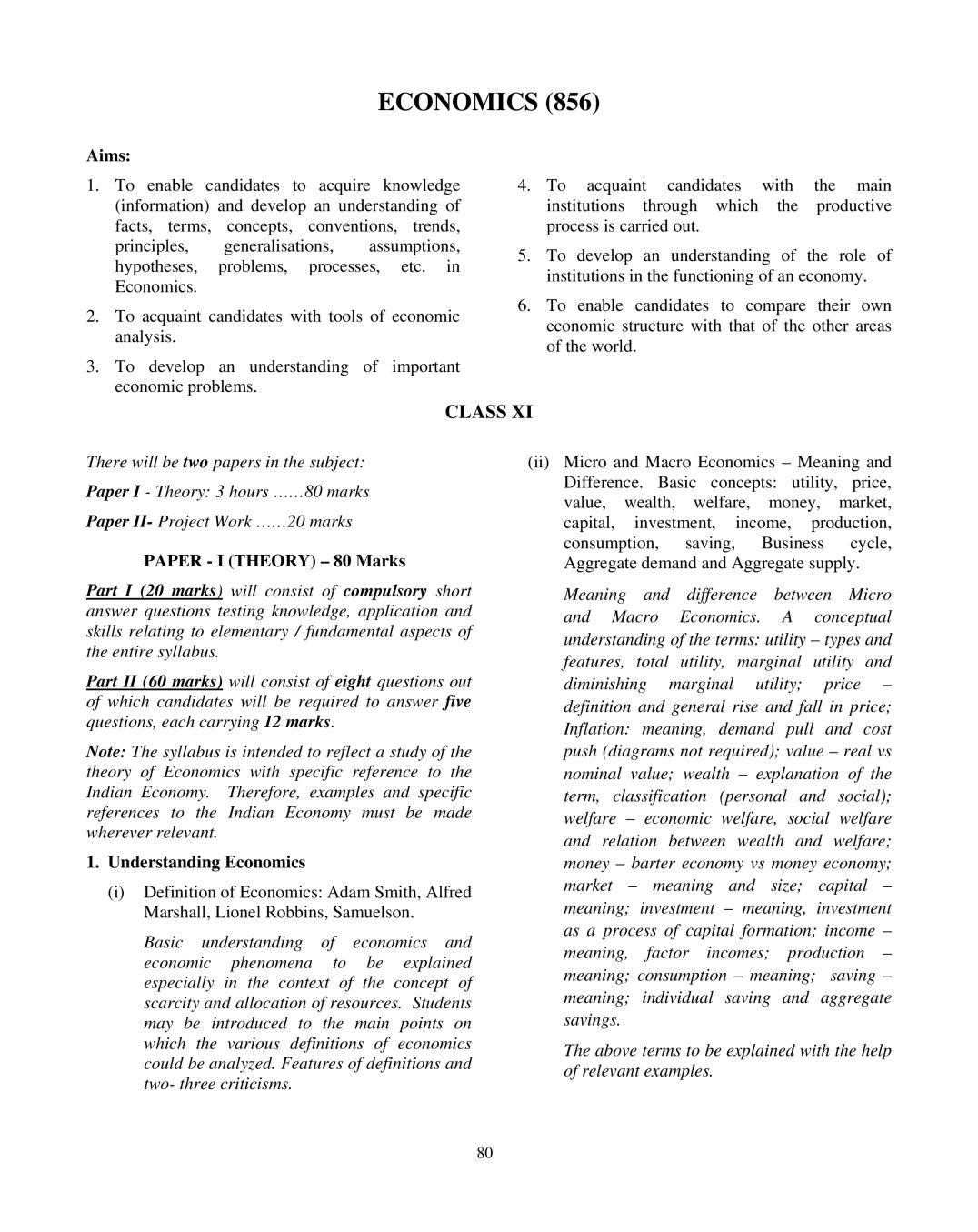
There will be two papers in the subject:
Paper I - Theory: 3 hours ……80 marks
Paper II- Project Work ……20 marks
Note: The syllabus is intended to reflect a study of the theory of Economics with specific reference to the Indian
Economy. Therefore, examples and specific references to the Indian Economy must be made wherever relevant.
PAPER I (THEORY) : 80 MARKS
S. No. UNIT TOTAL
WEIGHTAGE
1. MICROECONOMIC THEORY (40 Marks)
(i) Demand
(ii) Elasticity of Demand 16 Marks
(iii) Supply
(iv) Market Mechanism
(v) Concepts of Production 12 Marks
(vi) Cost and Revenue
(vii) Main Market Forms and Equilibrium of a Firm 12 Marks
MACROECONOMICS (40 Marks)
2. Theory of Income and Employment 8 Marks
3. Money and Banking 8 Marks
4. Balance of Payments and Exchange Rate 6 Marks
5. Public Finance 6 Marks
6. National Income 12 Marks
80 Marks
TOTAL
1. Micro Economic Theory
(i) Demand: meaning, factors affecting demand; Demand function; Law of Demand; derivation of
demand curve; movement and shift of the demand curve; exceptions to the Law of Demand.
Law of Diminishing Marginal Utility, Law of Equimarginal Utility, consumer’s equilibrium through
utility approach (Cardinal) and indifference curve analysis (Ordinal).
The concept of demand: meaning, types of demand. A demand function to be specified incorporating
the determinants of demand. Diagrams should be used in explaining the Law of Demand, reasons for
downward slope of demand curve, its derivation using demand schedule. Derivation of market
demand curve from individual demand curve.
(a) Cardinal Utility Analysis: meaning of utility, total utility, marginal utility, relationship of TU and
MU, Law of Diminishing Marginal Utility (schedule and diagram, Only assumptions to be taught,
criticisms not required), Consumer’s equilibrium – one commodity (schedule and diagram), Law of
5
Page 5
utility; (b) Ordinal Utility Analysis: Indifference Curve – its meaning and properties (including MRS
and DMRS), indifference map, consumer’s budget line, Consumer’s equilibrium – condition (to be
explained with the help of a diagram).
(ii) Elasticity of demand: meaning, types of elasticity of demand, measurement of elasticity of demand;
factors affecting elasticity of demand.
Various methods of measurement of the elasticity of demand: point method - percentage method,
expenditure method and geometric method. (Numericals required on percentage method only). The
cross and income elasticity of demand must be explained. Degrees of elasticity of demand to be
explained. Use diagrams wherever necessary.
(iii) Supply: meaning; difference between stock and supply; determinants of supply; Law of Supply;
movement and shift of the supply curve; elasticity of supply
Difference between stock (intended supply) and supply (actual supply) with the help of relevant
examples. A supply function should be specified and explained. Law of Supply: Meaning, supply
schedule and supply curve. Derivation of market supply curve from individual supply curve.
Movement and shift of the supply curve, exceptions to the Law of Supply. Elasticity of Supply:
Meaning, degrees of elasticity of supply and measurement of elasticity of supply by percentage
method and geometric method.
(iv) Market Mechanism: Equilibrium and disequilibrium; Equilibrium price and effect of changes in
demand and supply on the equilibrium price. Simple applications of tools of demand and supply.
A basic understanding of the concept of equilibrium. The effects of changes in demand and supply -
both along the curves and shift of the curves to be explained. Basic understanding of Price control,
rationing, Price ceiling and Floor price with the help of demand and supply curves.
(v) Concept of production and production function: (short run and long run production function), returns
to a factor, returns to scale (meaning only) total, average and marginal physical products; Law of
Variable Proportions and its three stages.
A production function (concept only). Law of Variable Proportions: statement, assumptions, schedule
(for the purpose of understanding and not for testing), diagram and explanation to the three stages.
(vi) Cost and revenue: Basic concepts of cost; fixed cost, variable cost, total cost, marginal cost and
average cost – their relationships; opportunity cost; short run and long run cost curves. Revenue:
meaning; average revenue, marginal revenue and total revenue and their relationships under perfect
competition and imperfect competition, Producer’s equilibrium.
Basic concepts – private cost, economic cost, social cost, money cost, real cost, explicit cost, implicit
cost.
Cost concepts – Fixed cost, variable cost, total cost, marginal cost, average cost with schedule and
diagram; relationship between average cost, marginal cost, total cost (only concepts of long run and
short run cost curves, derivations not required). Opportunity cost – meaning only. Difference between
accounting cost and opportunity cost.
Revenue – Average revenue, marginal revenue, total revenue – concepts and relationships under
perfect competition and imperfect competition. Producer’s equilibrium (Profit maximization goal) –
meaning; conditions: (a) TR and TC approach along with diagram (b) MR and MC approach along
with diagram.
(vii) Main market forms: perfect competition, monopolistic competition, oligopoly, monopoly,
monopsony; characteristics of the various market forms; equilibrium of a firm in perfect competition
under short run and long run.
Features of perfect competition, monopolistic competition, oligopoly, monopoly and monopsony
(meaning only). Equilibrium of a firm in perfect competition under short run (explanation and
diagram, shut down point and break-even point) and long run (diagram not required).
6
Page 6
Basic concepts and determination of Income and Employment
The concept of demand (exante) and effective (expost) demand. Aggregate demand and its components,
propensity to consume and propensity to save (average and marginal), equilibrium output; investment
multiplier (its meaning and mechanism with the help of a diagram). Simple numerical based on the above.
Meaning of full employment. Problems of excess demand and deficient demand; measures to correct them.
3. Money and Banking
(i) Money: meaning, functions of money, supply of money.
Meaning, kinds of money, functions of money (primary, secondary and contingent) to be explained;
supply of money (only meaning of M 0, M 1 , M 2 , M 3 & M 4 ). Inflation: meaning, demand pull and cost
push (diagrams not required)
(ii) Banks: functions of commercial bank; high powered money, credit creation by commercial banks;
Central Bank: functions.
Basic understanding of the functions of commercial banks, credit creation process with limitation.
The regulatory role of the Central Bank, its functions and the way it controls the flow of credit needs
to be explained. A brief mention may be made of quantitative CRR, SLR, Bank Rate policy (repo rate
and reverse repo rate and Open Market Operations) and qualitative methods.
4. Balance of Payment and Exchange Rate
Balance of Payment – meaning, components; foreign exchange – meaning, determination of exchange rate
(Flexible).
Balance of Payment - Meaning and components; Causes of disequilibrium and how the disequilibrium
can be corrected; Foreign Exchange Rate – meaning, meaning of fixed and flexible exchange rate,
determination of exchange rate in a free market. Concepts of depreciation, appreciation, devaluation and
revaluation (meaning only).
5. Public Finance
(i) Fiscal Policy: meaning and instruments of fiscal policy.
Meaning and instruments of fiscal policy – Public Revenue: Meaning, taxes (Meaning and types),
difference between direct and indirect taxes; Public Expenditure: Meaning and importance; Public
Debt: Meaning and redemption; Deficit Financing: meaning.
(ii) Government Budget: meaning, types and components.
Meaning and types of Government budget – union, state; components – revenue and capital. Concept
of deficit budget: revenue deficit, fiscal deficit, primary deficit – their meaning and implications.
6. National Income
(i) Circular flow of Income.
A simple model explaining the circular flow of income with two, three and four sector models with
leakages and injections.
(ii) Concepts and definition of NY, GNP, GDP, NNP, private income, personal income, personal
disposable income, National Disposable Income and per capita income; relationship between the
income concepts.
A brief understanding of the mentioned national income aggregates is needed. The concepts of GNP
and NNP should be explained both at factor cost and market prices, real GDP and nominal GDP,
National Disposable Income (Gross and Net), GDP and Welfare, GDP as an indicator of Economic
welfare.
(iii) Methods of measuring National Income: product or value-added method; income method and
expenditure method with simple numericals based on them.
Simple numericals based on all the methods to be covered for better understanding of the concept.
Precautions and difficulties of measuring National Income for each method.
7
Page 7
Candidates will be expected to have completed two projects from any topic covered in Theory.
The project work will be assessed by the teacher and a Visiting Examiner appointed locally and approved by
CISCE.
Mark allocation for each Project [10 marks]:
Overall format 1 mark
Content 4 marks
Findings 2 marks
Viva-voce based on the Project 3 marks
A list of suggested Projects is given below:
1. Study a Public Sector Enterprise with reference to its relevance to the Indian Economy and its future
prospects. Analyse the trend of its growth for the last ten years.
2. Conduct a Socio-Economic survey of a locality (minimum sample size should be 30 households) with
reference to:
(a) Demographic features.
(b) Consumption Pattern – Expenditure on necessities, comforts and luxuries.
(c) Occupational structure.
3. Compare the contribution made by different sectors of the economy towards GDP growth during the
planning period.
4. Prepare a report on the competition in the Aviation Sector in India with reference to:
(a) Performance of the Public Sector and Private Sector.
(b) Operational strategies adopted by budget/low cost carriers.
5. Make a comparative analysis of lending performance of five Commercial Banks in the past six years with
reference to the changing CRR and SLR.
6. Many thinkers believe that we are rapidly depleting our natural resources. Assume that there are only two
inputs (labour and natural resources) producing two goods (wheat and gasoline) with no improvement in
technology over time. Show what would happen to the Production Possibility Curve over time as natural
resources are exhausted. How would invention and technological improvement modify your answer? On
the basis of this example, explain why it is said “economic growth is a race between depletion and
invention.”
7. Make a comparative study of the allocation of financial resources of the Central Government Budget on
Agriculture, Defence, Industry and Education in the last ten years. Prepare a report on your observations.
8. Prepare a trend Analysis of Growth and Productivity of any one industry such as:
Textile / Automobiles / Electronic and Tele-communication, etc. in India for the past ten years.
NOTE: No question paper for Project Work will be set by CISCE.
8
Page 8
S. Unique PROJECT 1 PROJECT 2 TOTAL
No. Identification MARKS
Number A B C D E F G H I J
(Unique ID) of
the candidate Teacher Visiting Average Viva-Voce Total Teacher Visiting Average Viva-Voce Total (E + J)
Examiner Marks by Visiting Marks Examiner Marks by Visiting Marks
(A + B ÷ Examiner (C + D) (F + G ÷ Examiner (H + I)
2) 2)
7 Marks* 7 Marks* 7 Marks 3 Marks 10 Marks 7 Marks* 7 Marks* 7 Marks 3 Marks 10 Marks 20 Marks
1
2
3
4
5
6
7
8
9
10
*Breakup of 7 Marks to be awarded separately by the
Name of Teacher:
Teacher and the Visiting Examiner is as follows:
Signature: Date
Overall Format 1 Mark
Content 4 Marks Name of Visiting Examiner
Findings 2 Marks Signature: Date
NOTE: VIVA-VOCE (3 Marks) for each Project is to be conducted only by the Visiting Examiner, and should be based on the Project only.
9
Document Details
| Board / Org | CISCE |
| Exam | Class 12 |
| Type | Syllabus |
| Pages | 8 |
| Updated | 04 Aug 2026 |