Finished viewing? Save it for later —
Download ISC Class 12 Syllabus 2028 English (PDF · 12 pages)About ISC Class 12 Syllabus 2028 English
ISC Class 12 Syllabus 2028 English is available here for free download. Published by CISCE for Class 12, this syllabus can be viewed online or downloaded as a PDF (12 pages). Candidates preparing for Class 12 can use ISC Class 12 Syllabus 2028 English to understand the exam pattern, the type of questions asked, and the overall difficulty level.
Frequently Asked Questions
How can I download ISC Class 12 Syllabus 2028 English?
Open this page and click the Download button to save ISC Class 12 Syllabus 2028 English as a PDF. It is completely free on AglaSem Docs.
Is ISC Class 12 Syllabus 2028 English free to download?
Yes. ISC Class 12 Syllabus 2028 English can be viewed online and downloaded as a PDF free of cost on AglaSem Docs.
How many pages does ISC Class 12 Syllabus 2028 English have?
ISC Class 12 Syllabus 2028 English contains 12 pages, which you can read online or download together as a single PDF.
Where can I find more Class 12 study material?
You can find more Class 12 question papers, sample papers, syllabus, and answer keys on AglaSem Docs.
ISC Class 12 Syllabus 2028 English – Text
Read the full text of this syllabus below — useful to quickly search, copy and reference the content online without downloading the PDF.
📄 View text version (12 pages)
Page 1
INDIAN SCHOOL CERTIFICATE
EXAMINATION
YEAR 2028
ENGLISH
(801)
Page 2
Research, Development and Curriculum Division (RDCD)
CISCE
January 2026
____________________________________________________________________________________________
© Copyright, Council for the Indian School Certificate Examinations
All rights reserved. The copyright to this publication and any part thereof solely vests in the Council for the Indian
School Certificate Examinations. This publication and no part thereof may be reproduced, transmitted, distributed or
stored in any manner whatsoever, without the prior written approval of the Council for the Indian School Certificate
Examinations.
Page 3
MISSION STATEMENT
The Council for the Indian School Certificate
Examinations is committed to serving the nation's
children, through high quality educational
endeavours, empowering them to contribute towards
a humane, just and pluralistic society, promoting
introspective living, by creating exciting learning
opportunities, with a commitment to excellence.
ETHOS OF CISCE
Trust and fair play.
Minimum monitoring.
Allowing schools to evolve their own niche.
Catering to the needs of the children.
Giving freedom to experiment with new ideas
and practices.
Diversity and plurality - the basic strength for
evolution of ideas.
Schools to motivate pupils towards the
cultivation of:
Excellence - The Indian and Global
experience.
Values - Spiritual and cultural - to be the bedrock
of the educational experience.
Schools to have an 'Indian Ethos', strong roots in
the national psyche and be sensitive to national
aspirations.
Page 4
ENGLISH (801)
This subject may not be taken with Modern English.
Aims (English Language)
To develop the ability to:
1. derive, infer and critically assess information through listening.
2. express oneself by speaking individually, or in a discussion.
3. read with comprehension, drawing information directly or by inference from the text, through an
understanding of grammar and structure, vocabulary and idiom.
4. employ a variety of skills in writing within a framework using argument or imagination or summarizing.
5. use the English language for the purpose of study and social and cultural interaction.
6. speak and write clearly and to the purpose, using appropriate grammar, vocabulary and idiom.
Aims (Prescribed Texts)
1. To enjoy and appreciate literature through a critical study of selected literary works.
2. Through the study of literature:
• approach an understanding of humanity.
• develop an interest in the thought and culture of the peoples of the world.
• develop the power of expression and a sense of aesthetic values.
CLASSES XI & XII
The subject English has two components, English Language and Literature in English. Each of these components
will consist of a Theory Paper of 80 Marks and Project Work of 20 Marks.
ENGLISH LANGUAGE
There will be two papers in English Language:
Paper I: Theory (3 hours): 80 Marks
Paper II: Project Work: 20 Marks
PAPER I (THEORY) : 80 Marks
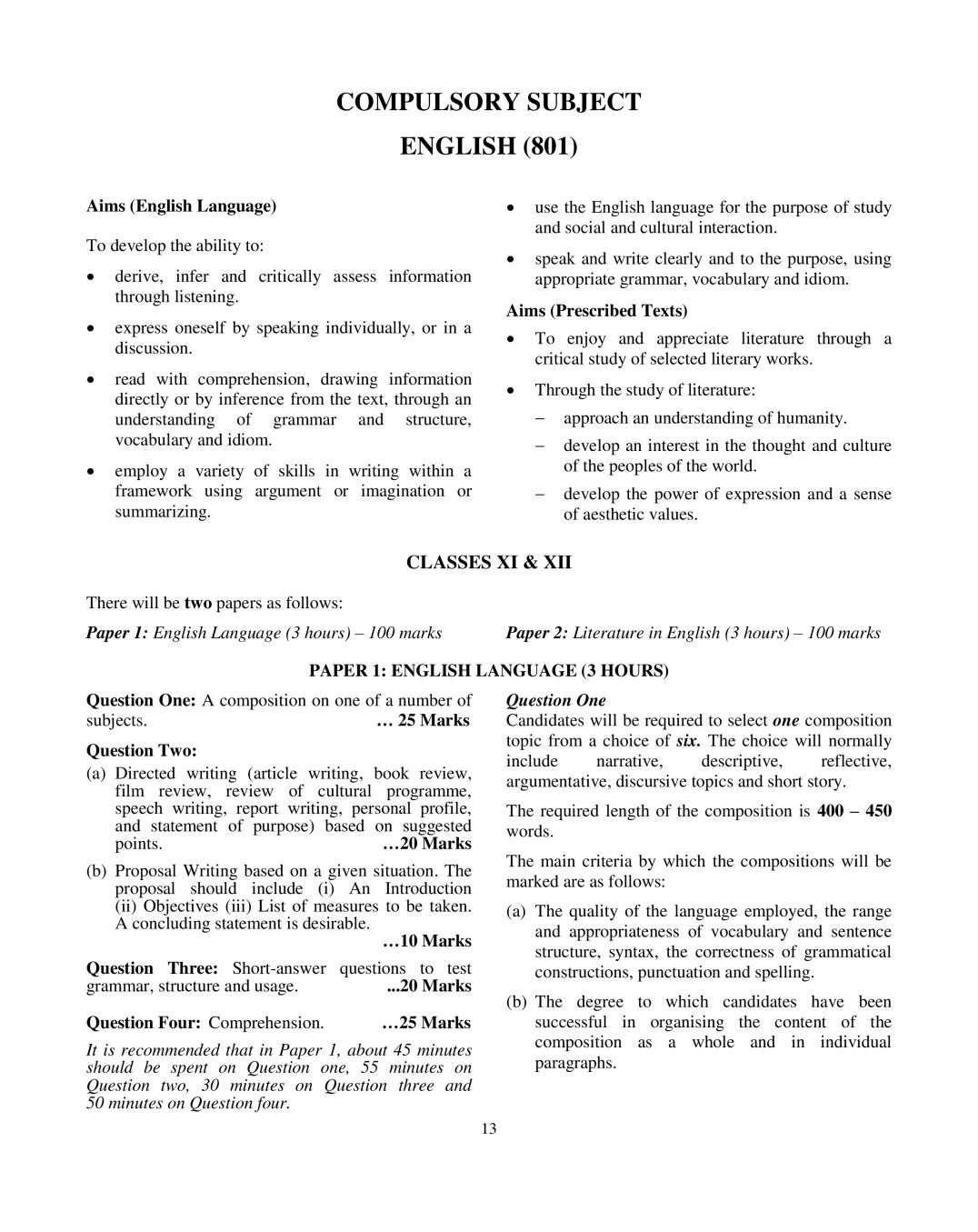
All questions will be compulsory.
Question One:
A composition on one of a number of subjects.
Question Two:
(a) Directed writing.
(b) Proposal Writing based on a given situation.
1
Page 5
Short-answer questions to test grammar, structure and usage.
Question Four:
Comprehension.
Question One
Candidates will be required to select one composition topic from a choice of six. The choice will normally include
narrative, descriptive, reflective, argumentative/ persuasive, expository topics and original short story.
The required length of the composition is 400 – 450 words.
The main criteria by which the compositions will be marked are as follows:
(a) The quality of the language employed, the range and appropriateness of vocabulary and sentence structure,
syntax, the correctness of grammatical constructions, punctuation, and spelling.
(b) The degree to which candidates have been successful in organising the content of the composition as a whole
and in individual paragraphs.
Question Two
There are two parts to this question and both parts are compulsory.
(a) Directed Writing
The piece of directed writing must be based on the information and all the points provided. The required
length is 250-300 words. The range of subjects includes feature article, book review, blogs, newspaper report,
and statement of purpose.
Skills such as amplifying, describing and re-stating are involved. The candidates’ ability in the above skills,
including format, will be taken into account as well as their ability to handle language appropriately in the
context of the given situation.
(b) Proposal Writing
Candidates will be required to write a proposal based on a given situation.
The proposal should include (i) An Introduction/Heading (ii) Objectives (iii) List of measures to be taken. A
concluding statement is necessary.
The format prescribed by the CISCE must be followed. The candidates will also be marked on linguistic
ability.
Question Three
All the items in this question are compulsory and their number and type/ pattern may vary from year to year. They
will consist of the transformation of sentences, phrasal verbs, and verbs/tenses, which will test the candidates’
knowledge of the essentials of functional English grammar and structure.
Question Four
A passage of about 700 words will be provided.
Questions based on the passage will be as follows:
• Questions that test the candidates’ analytical skills, knowledge of vocabulary, ability to understand the
content, infer information and meanings from the text.
• A question that elicits the main ideas of all or part of the passage, where the candidate will be required to
frame a summary (keeping to a word limit), in a coherent manner. Marks will be awarded for expression and
the candidate’s ability to summarise clearly in complete sentences. Marks will be deducted for linguistic
errors.
NOTE: This part must be done in the grid form. The use of abbreviations and contractions will not be
accepted.
2
Page 6
In addition to the syllabus prescribed above for Classes XI and XII, candidates are also required to be assessed in
Project Work.
PROJECT WORK FOR CLASS XI
Project Work in Class XI consists of assessment of candidates in Listening and Speaking Skills which are to be
assessed internally, by the school, during English course work and shown in the student’s report and school record.
Candidates are to be assessed in two projects, one on Listening Skills and one on Speaking Skills.
Details of assignments for Project Work on Listening and Speaking Skills are given below:
Listening Skills
An unseen passage of about 500 words is to be read aloud, twice, the first time at normal reading speed (about
110 words a minute) and the next time at a slower speed. The passage may be taken from any novel, newspaper,
magazine article, journal and so on but not from an ICSE or ISC textbook. Students may make brief notes
during the readings followed by answering objective type questions based on the passage, on the paper provided.
Speaking Skills
Students are to be assessed through an individual presentation of about three minutes followed by a discussion
with the subject teacher, for another two or three minutes.
Some of the themes which may be addressed are:
1. Narrating an experience
2. Giving directions or instructions on how to make or operate something
3. Providing a description
4. Giving a report
5. Expressing an opinion or a theme-based conversation
Internal Evaluation by the Teacher (20 Marks):
Assessment Criteria Description Marks
Listening Skills Response to questions based on listening comprehension 10
(Aural)
Speaking Skills (Oral) Content 2
Fluency 2
Vocabulary 2
Sentence structure 2
Confidence 2
TOTAL 20
3
Page 7
Project Work in Class XII consists of assessment of candidates in three projects, one each on Listening, Speaking
and Writing skills.
Listening and Speaking skills are to be assessed internally, by the School, during English course work in Class
XII.
Writing Skills are to be assessed externally by the Visiting Examiner, appointed locally and approved by CISCE.
Details of assignments for Project Work are given below:
Listening Skills (to be internally assessed by the subject teacher)
An unseen passage of about 500 words may be read aloud, twice, the first time at normal reading speed (about
110 words a minute) and the next time at a slower speed. The passage may be taken from any novel, newspaper,
magazine article, journal and so on but not from an ICSE or ISC textbook. Students may make brief notes
during the readings followed by answering objective type questions based on the passage, on the paper provided.
Speaking Skills (to be internally assessed by the subject teacher)
Students are to be assessed through an individual presentation of about three minutes followed by a discussion
with the subject teacher, for another two or three minutes.
Some of the themes which may be addressed are:
1. Narrating an experience
2. Giving directions or instructions on how to make or operate something
3. Providing a description
4. Giving a report
5. Expressing an opinion or a theme-based conversation
Writing Skills (to be externally assessed by the Visiting Examiner)
A piece of written work of about 500 words must be produced.
List of suggested assignments for Project Work:
1. The text of a brochure
2. A product description
3. A process description (e.g. instruction to operate a device, a recipe, a scientific experiment)
4. Description of a sporting event
5. An autobiographical experience
6. Review of a television serial
EVALUATION
Marks (out of a total of 20) should be distributed as given below:
1. Internal Evaluation by Teacher*
Listening Skills (Aural) 5 Marks
Speaking Skills (Oral) 5 Marks
2. Evaluation by Visiting Examiner of Writing Skills** 10 Marks
TOTAL 20 Marks
4
Page 8
Assessment Criteria Description Marks
Listening Skills Response to questions based on listening comprehension 5
(Aural)
Speaking Skills (Oral) Content 1
Fluency 1
Vocabulary 1
Sentence structure 1
Confidence 1
TOTAL 10
**Criteria for Evaluation by the Visiting Examiner (10 Marks):
Assessment Criteria Description Marks
1. Presentation Overall formatting (headings, sub-headings, paragraphing) 2
within a word limit of 500 words and a separate title page.
2. Originality No plagiarism 2
3. Use of appropriate Use of suitable terminology, vocabulary and illustrations 2
language for the specific task chosen.
4. Structure Must read as a unified whole. 2
5. Style Lucid style, which communicates the message effectively 2
TOTAL 10
LITERATURE IN ENGLISH (PRESCRIBED TEXTS)
There will be two papers in Literature in English:
Paper I: Theory (3 hours): 80 Marks
Paper II: Project Work: 20 Marks
PAPER I (THEORY) : 80 Marks
Candidates will be required to answer questions based on the prescribed textbooks, which include Drama, Prose
(Short Stories) and Poetry.
Drama and Prose (Short Stories)
Questions set will be central to the text. Candidates will be required to show that they have understood the
questions asked and are able to clearly respond in their own words. Questions will test understanding, appreciation
and ability to analyse and synthesise.
Poetry
Questions on a poem or a group of poems will be set to test the candidates’ response. The questions will focus on
the content, understanding and the personal response of candidates to the entire poem. Candidates’ ability to
appreciate content, stylistic and literary features of the poem(s) in question will also be tested.
5
Page 9
CLASS XI
I. DRAMA: Macbeth - William Shakespeare
(Acts I & II)
II. PRISM: A Collection of ISC Short Stories (Evergreen Publications (India) Ltd. New Delhi)
1. A Living God – Lafcadio Hearn
2. Advice to Youth – Mark Twain
3. The Paper Menagerie – Ken Liu
4. The Great Automatic Grammatizator – Roald Dahl
5. Thank You, Ma’am – Langston Hughes
III. RHAPSODY: A Collection of ISC Poems (Evergreen Publications (India) Ltd. New Delhi)
1. Abhisara: The Tryst – Rabindranath Tagore
2. Why I Like the Hospital – Tony Hoagland
3. Sonnet 116 – William Shakespeare
4. Death of a Naturalist – Seamus Heaney
5. Strange Meeting – Wilfred Owen
NOTE: The Class XI Examination is to be conducted on the portion of the syllabus that is prescribed for
Class XI.
CLASS XII
I. DRAMA: Macbeth: William Shakespeare
(Acts III, IV & V)
II. PRISM: A Collection of ISC Short Stories (Evergreen Publications (India) Ltd. New Delhi)
1. Atithi / Guest – Rabindranath Tagore
2. The Cookie Lady – Philip K. Dick
3. There Will Come Soft Rains – Ray Bradbury
4. Indigo – Satyajit Ray
5. The Medicine Bag – Virginia Driving Hawk Sneve
III. RHAPSODY: A Collection of ISC Poems (Evergreen Publications (India) Ltd. New Delhi)
1. Telephone Conversation – Wole Soyinka
2. Tithonus – Alfred, Lord Tennyson
3. Beethoven – Shane Koyczan
4. Small Towns and the River – Mamang Dai
5. Death be not Proud – John Donne
NOTE: The ISC (Class XII) Examination paper will be set ONLY on the portion of the syllabus that is
prescribed for Class XII.
6
Page 10
In addition to the syllabus prescribed above for Classes XI and XII, candidates are also required to be assessed in
Project Work. Project Work consists of assessment of Writing Skills in Classes XI and XII. The objective is to
produce original, creative and insightful perspectives on the drama/short stories/poems.
PROJECT WORK FOR CLASS XI
Project Work in Class XI consists of assessment of Writing Skills (only from the syllabus to be covered in Class
XI) which are to be assessed internally by the School.
Candidates will be required to undertake one written assignment of 1000-1500 words, which should be structured
as given below:
A. The written assignment must be given a title in the form of a question which should allow the candidate to
explore the drama or the chosen short stories/poems in depth.
B. The written assignment must follow the structure given below:
• Introduction:
- Explanation of the question that has been framed
- Reason for choosing the text
- Brief explanation of how the candidate intends to interpret the chosen text and literary materials used
in the process
• Main Body – organised and well-structured treatment of the question using appropriate sub-headings.
• Conclusion – comprehensive summary of the points made in the main body.
Internal Evaluation by the Teacher (20 Marks):
Assessment Criteria Candidates should be able to: Marks
1. Process • Identify the topic. 6
• Plan a detailed written assignment.
• Produce a written outline.
2. Understanding, Application of Use a range of literary aspects such as plot, 8
Knowledge and Analysis setting, characters, action, style and ideas in
order to present an organised and well-
structured complete assignment.
3. Presentation Prepare the document (overall format: 6
headings, sub-headings, paragraphing)
writing within a limit of 1000-1500 words
and provide a separate title page.
TOTAL 20
List of suggested assignments for Project Work:
1. Analysis of a theme from any short story/ poem in the syllabus (prescribed texts).
2. Analysis of a character from the drama or any short story/poem in the syllabus (prescribed texts).
3. Background – historical, cultural, literary context and relevance of the writer/poet chosen.
4. Summary / paraphrase of the chosen text.
5. Appreciation of literary qualities of the chosen text.
6. Identifying with a character in the chosen text and presenting his/her personal perspective.
7
Page 11
plot/setting/characters/mood and tone.
8. Comparing and contrasting two characters/themes from different short stories/poems of the prescribed texts.
PROJECT WORK FOR CLASS XII
Project Work in Class XII consists of assessment of Writing Skills which are to be assessed internally by the
subject teacher and externally by the Visiting Examiner appointed locally and approved by CISCE.
Candidates will be required to undertake one written assignment of 1000-1500 words, which should be structured
as given below:
A. The written assignment must be given a title in the form of a question which should allow the candidate to
explore the drama or the chosen short stories/poems in depth.
B. The written assignment must follow the structure given below:
• Introduction:
- Explanation of the question that has been framed
- Reason for choosing the text
- Brief explanation of how the candidate intends to interpret the chosen text and literary materials used
in the process
• Main Body – organised and well-structured treatment of the question using appropriate sub-headings.
• Conclusion – comprehensive summary of the points made in the main body.
Note: The text/texts analysed in the Class XI Project Work must not be repeated in Class XII.
EVALUATION
Marks (out of a total of 20) should be distributed as given below:
1. Internal Evaluation by Teacher* 10 marks
2. Evaluation by Visiting Examiner** 10 marks
TOTAL 20 marks
* Internal Evaluation by the Teacher (10 Marks):
Assessment Criteria Candidates should be able to: Marks
1. Process Identify the topic. Plan a detailed written assignment. Produce a written 3
outline.
2. Understanding, Use a range of literary aspects such as plot, setting, characters, action, style 4
Application of and ideas in order to present an organised and well-structured complete
Knowledge and assignment.
Analysis
3. Presentation Prepare the document (overall format: headings, sub-headings, 3
paragraphing) writing within a limit of 1000-1500 words and provide a
separate title page.
TOTAL 10
8
Page 12
Assessment Criteria Candidates should be able to: Marks
1. Presentation Prepare the document (overall format: headings, 4
sub-headings, paragraphing) writing within a word
limit of 1000-1500 words and provide a separate
title page.
2. Understanding, Application of Use a range of literary aspects such as plot, setting, 6
Knowledge and Analysis characters, action, style and ideas in order to
present an organised and well-structured complete
assignment.
TOTAL 10
List of suggested assignments for project work:
1. Analysis of a theme from any short story/poem in the syllabus (prescribed texts).
2. Analysis of a character from the drama or any short story/poem in the syllabus (prescribed texts).
3. Background – historical, cultural, literary context and relevance of the writer/poet chosen.
4. Summary / paraphrase of the chosen text.
5. Appreciation of literary qualities of the chosen text.
6. Identifying with a character in the chosen text and presenting his/her personal perspective.
7. Imagining an alternate outcome or ending or extension of the chosen text and its impact on the
plot/setting/characters/mood and tone.
8. A script for dramatization, based on the short story/poem chosen.
9. Writing a short story based on a poem.
10. Comparing and contrasting two characters/themes from different short stories/poems of the prescribed texts.
Note: No Question Paper for Project Work will be set by CISCE.
9
Document Details
| Board / Org | CISCE |
| Exam | Class 12 |
| Type | Syllabus |
| Pages | 12 |
| Updated | 04 Aug 2026 |