Finished viewing? Save it for later —
Download ISC Class 12 Syllabus 2028 Modern Foreign Languages (PDF · 49 pages)About ISC Class 12 Syllabus 2028 Modern Foreign Languages
ISC Class 12 Syllabus 2028 Modern Foreign Languages is available here for free download. Published by CISCE for Class 12, this syllabus can be viewed online or downloaded as a PDF (49 pages). Candidates preparing for Class 12 can use ISC Class 12 Syllabus 2028 Modern Foreign Languages to understand the exam pattern, the type of questions asked, and the overall difficulty level.
Frequently Asked Questions
How can I download ISC Class 12 Syllabus 2028 Modern Foreign Languages?
Open this page and click the Download button to save ISC Class 12 Syllabus 2028 Modern Foreign Languages as a PDF. It is completely free on AglaSem Docs.
Is ISC Class 12 Syllabus 2028 Modern Foreign Languages free to download?
Yes. ISC Class 12 Syllabus 2028 Modern Foreign Languages can be viewed online and downloaded as a PDF free of cost on AglaSem Docs.
How many pages does ISC Class 12 Syllabus 2028 Modern Foreign Languages have?
ISC Class 12 Syllabus 2028 Modern Foreign Languages contains 49 pages, which you can read online or download together as a single PDF.
Where can I find more Class 12 study material?
You can find more Class 12 question papers, sample papers, syllabus, and answer keys on AglaSem Docs.
ISC Class 12 Syllabus 2028 Modern Foreign Languages – Text
Read the full text of this syllabus below — useful to quickly search, copy and reference the content online without downloading the PDF.
📄 View text version (49 pages)
Page 1
INDIAN SCHOOL CERTIFICATE
EXAMINATION
YEAR 2028
MODERN FOREIGN
LANGUAGES
Page 2
Research, Development and Curriculum Division (RDCD)
CISCE
January 2026
____________________________________________________________________________________________
© Copyright, Council for the Indian School Certificate Examinations
All rights reserved. The copyright to this publication and any part thereof solely vests in the Council for the Indian
School Certificate Examinations. This publication and no part thereof may be reproduced, transmitted, distributed or
stored in any manner whatsoever, without the prior written approval of the Council for the Indian School Certificate
Examinations.
Page 3
MISSION STATEMENT
The Council for the Indian School Certificate
Examinations is committed to serving the nation's
children, through high quality educational
endeavours, empowering them to contribute towards
a humane, just and pluralistic society, promoting
introspective living, by creating exciting learning
opportunities, with a commitment to excellence.
ETHOS OF CISCE
Trust and fair play.
Minimum monitoring.
Allowing schools to evolve their own niche.
Catering to the needs of the children.
Giving freedom to experiment with new ideas
and practices.
Diversity and plurality - the basic strength for
evolution of ideas.
Schools to motivate pupils towards the
cultivation of:
Excellence - The Indian and Global
experience.
Values - Spiritual and cultural - to be the bedrock
of the educational experience.
Schools to have an 'Indian Ethos', strong roots in
the national psyche and be sensitive to national
aspirations.
Page 4
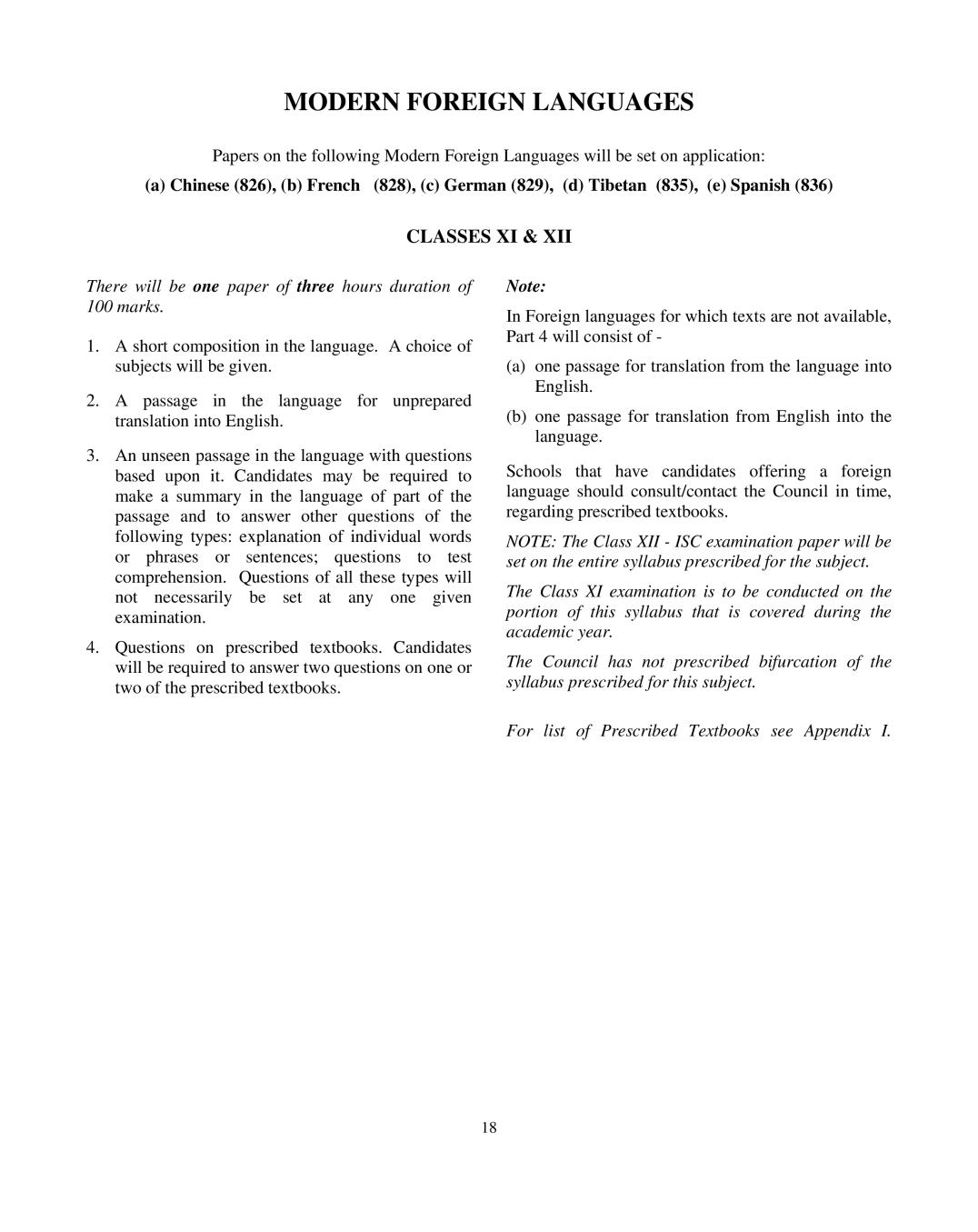
Papers on the following Modern Foreign Languages will be set on this syllabus:
(a) Chinese (826), (b) Tibetan (835), (c) Modern Armenian (833) (d) Thai (830) (e) Portuguese (840)
CLASSES XI & XII
There will be two papers in the subject:
Paper I - Theory: 3 hours…… 80 Marks
Paper II - Project Work ……. 20 Marks
PAPER I (THEORY): 80 Marks
There will be one paper of three hours duration of 80 marks.
1. A short composition in the language. A choice of subjects will be given.
2. A passage in the language for unprepared translation into English.
3. An unseen passage in the language with questions based upon it. Candidates may be required to make a
summary in the language of part of the passage and to answer other questions of the following types:
explanation of individual words or phrases or sentences; questions to test comprehension. Questions of all
these types will not necessarily be set at any one given examination.
4. Questions on prescribed textbooks for the given language. Candidates will be required to answer two
questions on one or two of the prescribed textbooks.
In Foreign languages for which texts are not available, Part 4 will consist of -
(a) one passage for translation from the language into English.
(b) one passage for translation from English into the language.
Schools that have candidates offering a foreign language should consult/contact the CISCE in time, regarding
prescribed textbooks.
NOTE: The Class XII - ISC examination paper will be set on the entire syllabus prescribed for the subject.
The Class XI examination is to be conducted on the portion of this syllabus that is covered during the academic
year.
The CISCE has not prescribed bifurcation of the syllabus prescribed for this subject.
1
Page 5
In addition to the syllabus prescribed above, candidates are also required to be assessed in Project Work.
Details of the same are given below:
PROJECT WORK FOR CLASS XI
Project Work in Class XI comprises of assessment of candidates in Listening, Speaking and Writing skills.
These are to be assessed internally by the school, during course work and shown in the candidate’s report and
school record.
Candidates are to be assessed in three projects, one each on Listening, Speaking and Writing Skills.
Details of Projects in Listening, Speaking and Writing Skills are given below:
Listening Skills
An unseen passage of about 500 words or a poem (of appropriate length) may be read aloud, twice, the first time
at normal reading speed and the next time at a slower speed. The passage/poem may be taken from any book,
newspaper, magazine, journal and so on but not from an ICSE or ISC textbook. A suitable audio clip may also
be used.
Candidates may make brief notes during the readings/playing of the audio clip, followed by answering objective
type questions based on the passage/poem/audio clip, on the paper provided.
Speaking Skills
Candidates are to be assessed through an individual presentation, e.g. extempore speaking, declamation,
recitation, debate, of about three minutes followed by a discussion with the subject teacher, for another two or
three minutes.
List of suggested assignments for Project Work:
1. Narrating an experience
2. Giving directions or instructions on how to make or operate something
3. Providing a description
4. Giving a report
5. Expressing an opinion or a theme-based conversation
6. Giving a speech on a selected topic.
Writing Skills (Language/Literature)
Candidates will be required to undertake one written assignment of about 200 words on any aspect of Language
/Literature syllabus covered in Class XI.
List of suggested assignments for Project Work:
1. Product/process description
2. Description of an event
3. Summary or paraphrase of a chosen text from the syllabus
4. Providing an alternate title to a given text and giving a justification for the same.
5. Selecting another story/poem on a theme studied in the syllabus and writing a summary of it.
6. Giving an alternative title to a story or poem and justifying the same.
2
Page 6
Internal Evaluation by the Teacher (20 Marks):
Assessment Criteria Description Marks
Listening Skills (Aural) Response to questions based on listening comprehension 6
Speaking Skills (Oral) Content, Fluency, Vocabulary, Sentence structure, Confidence level 6
Writing Skills Process, Content, Presentation, Originality 8
TOTAL 20
PROJECT WORK FOR CLASS XII
Project Work in Class XII comprises of assessment of candidates in three projects, one each on Listening,
Speaking and Writing Skills.
Listening and Speaking skills are to be assessed internally, by the School in Class XII.
Writing Skills are to be assessed externally by the Visiting Examiner, appointed locally and approved by
the CISCE.
Details of assignments for Project Work are given below:
Listening Skills (to be internally assessed by the subject teacher)
An unseen passage of about 500 words or a poem (of appropriate length) may be read aloud, twice, the first time
at normal reading speed and the next time at a slower speed. The passage/poem may be taken from any book,
newspaper, magazine, journal and so on but not from an ICSE or ISC textbook. A suitable audio clip may also
be used.
Candidates may make brief notes during the readings/playing of the audio clip, followed by answering objective
type questions based on the passage/poem/audio clip, on the paper provided.
Speaking Skills (to be internally assessed by the subject teacher)
Candidates are to be assessed through an individual presentation, e.g. extempore speaking, declamation,
recitation, debate, of about three minutes followed by a discussion with the subject teacher, for another two or
three minutes.
List of suggested assignments for Project Work:
1. Narrating an experience
2. Giving directions or instructions on how to make or operate something
3. Providing a description
4. Giving a report
5. Expressing an opinion or a theme-based conversation
6. Giving a speech on a selected topic.
3
Page 7
Candidates will be required to undertake one written assignment of about 250 words on any aspect of Language
/Literature syllabus covered in Class XII.
List of suggested assignments for Project Work:
1. Summarising / paraphrasing of the chosen text.
2. An autobiographical experience.
3. Review of a book/serial/play/performance.
4. Writing a short story based on a poem.
5. Writing a poem based on a story.
6. Analysing the relevance of a selected story/couplets in the present-day context.
7. Imagining an alternate outcome or ending or extension of the chosen text and its impact on the
plot/setting/characters/mood and tone.
8. Imagining oneself as one of the main characters of the story/novel/drama and describing what one would
like to change in the story/novel/drama, giving reasons for the same.
9. Analysing the theme of the story/poem/novel and expressing one’s opinion on the same.
EVALUATION
Marks (out of a total of 20) should be distributed as given below:
1. Internal Evaluation by the Teacher*
Listening Skills (Aural) 5 Marks
Speaking Skills (Oral) 5 Marks
2. External Evaluation by the Visiting Examiner of Writing Skills** 10 Marks
TOTAL 20 Marks
*Internal Evaluation by the Teacher (10 Marks)
S. No. Assessment Criteria Description Marks
1. Listening Skills (Aural) Response to questions based on 5
listening comprehension
2. Speaking Skills (Oral) Content, Fluency, Vocabulary, 5
Sentence structure, Confidence
TOTAL 10
4
Page 8
(10 Marks)
Assessment Criteria and Description Marks
1. Title and introduction 1
2. Presentation 3
(Overall formatting: headings/ sub-headings, paragraphing, writing within the word
limit and providing a separate title page)
3. Content 5
(Present an organised and well-structured complete assignment with proper
introduction, main body and conclusion/comments)
4. Originality 1
TOTAL 10
NOTE: No question paper for Project Work will be set by CISCE.
5
Page 9
Aims:
1. To equip learners with intermediate competencies in the four language skills – reading, writing, listening
and speaking.
2. To use the language effectively and appropriately in various contexts that learners are likely to encounter in
school contexts or during travel abroad.
3. To support learners in expressing their opinions by developing simple argumentation and by effectively
communicating in personal and social contexts.
4. To deepen intercultural awareness and appreciation of the global diversity of languages.
Overview of Language Competencies Acquired Upon Completion of the
Course
At the end of this course, language learners will demonstrate intermediate proficiency in all core areas of
communication. The following outlines the overview of competencies in reading, writing, listening and speaking
as defined by the CEFRL (Common European Framework of Reference for Languages) for B1+ level.
Reading Comprehension Written Expression Listening Skills Oral/Speaking Skills
• Can read and • Can write detailed and • Can understand • Gives straightforward
comprehend with a well-organised texts on straightforward descriptions and
reasonable degree of a range of familiar information and short presentations on a range
independence. subjects within the narratives about routine of subjects related to
• Has a relatively broad learner's field of or work/school/leisure- their field of interest,
active reading interest, by linking a related topics, explaining the main
vocabulary, with a series of shorter discrete identifying both general points in an idea or
limited understanding of elements into a linear messages and specific problem with reasonable
idioms. sequence. details, provided speech precision and clarity.
is clearly articulated in a • Can handle
generally familiar conversations
accent. independently and
• Can understand the key participate in
points of clear standard discussions on familiar
speech by a native subjects
speaker.
6
Page 10
There will be two papers in the subject:
Paper I - Theory: 3 hours…… 80 Marks
Paper II - Project Work ……. 20 Marks
PAPER I (THEORY): 80 MARKS
There will be one paper of three hours duration of 80 marks.
1. Composition (20 Marks)
Candidates will be required to write, in French, one composition of 180-200 words. Possible types of
compositions include a narrative text recounting a past event, a descriptive text, an argumentative text or
a critique of a book or film. A choice of topics will be offered.
2. Email and Letter Writing (20 Marks)
Candidates will be required to write an email or a letter of around 120-150 words from a choice of either a
formal (candidature, plainte/mécontentement, réclamation) or a semi-formal (demande de renseignement,
correspondance avec un responsable, organisation pratique) format. Suggestions may be given. The
layout of the email or letter with an appropriate subject line, introduction, conclusion, etc., will form part of
the assessment.
3. Comprehension (30 Marks)
Candidates will be required to complete two to three reading tasks based on informative texts in French.
One of the tasks can involve one or more practical documents such as brochures, leaflets, or prospectuses.
Candidates may be asked to extract and compare information and interpret content accurately in realistic,
everyday contexts.
The second or third tasks will each be based on simplified articles taken from general-interest media,
approximately 300 to 350 words in length. Questions will include multiple-choice, true/false, or short
written responses.
4. Grammar (10 Marks)
Candidates will complete short, focused tasks to assess grammatical accuracy and range. These may
include fill-in-the-blank exercises, multiple-choice questions, and sentence transformations (e.g., into
reported speech or using a given connector). Tasks will be situation-based, requiring application of
grammar in everyday contexts. For example, completing a dialogue with the correct verb forms or
rewriting direct speech as indirect, grammar concepts are assessed through a text with fill-in-the-blank
questions, with the relevant
The focus will be on functional use of grammar rather than on detailed knowledge of grammatical
definitions.
7
Page 11
A. Tenses & Moods
• Plus-que-parfait passé composé and imparfait
• Using past tenses in narrative
• Dependant clauses in future and past tenses
• The conditionnel présent (present conditional)
• Expressing feelings, wishes, obligations, will, hypotheses, and imaginary situations using the
conditional
• Subjonctif présent (present subjunctive) to express feelings and obligations
• Difference between subjonctif and indicatif (e.g., j’aime que, j’espère que, je crois que)
• Subjunctive with expressions like il faut que / il ne faut pas que
• Verbs/conjunction + subjunctive or infinitive
B. Verbs & Verbal Structures
• Propositions with “what if…” (si + imparfait)
• Indirect speech in the present (discours indirect au présent : que, si)
• Prepositional verbs & Prepositional Adjectives
• Expressing hypotheses:
• si + présent → présent / futur (certain)
• si + imparfait → conditionnel présent (uncertain)
• Nominalising verbs (la nominalisation des verbes)
• Gerund (le gérondif), passive voice (la voix passive)
C. Pronouns
• Double pronominalisation (placement of COD and COI)
• Indefinite pronouns (plusieurs, quelques, certains...)
• Pronouns en (for quantity) and y (for place with verbe + à / verbe + de)
• Relative pronouns and compound relative pronouns (auxquelles, desquels, etc.)
D. Sentence Structures & Style
• Past participle and its agreement (le participe passé et son accord)
• Using emphasis/focus structures (la mise en relief) – ce qui, ce que, ce dont (e.g. Ce que je veux dire,
c’est que...)
E. Connectors & Cohesion
• Cause: car, comme, puisque, grâce à, en effet
• Conséquence: c’est pourquoi, voilà pourquoi, par conséquent
• Purpose: pour que (subj.), afin de (inf.), afin que (subj.)
• Opposition: alors que, au contraire
• Concession: bien que, cependant, malgré, pourtant, néanmoins, quand même, tout de même
• Other connectors: également, aussi
• Chronological / conclusion connectors: finalement, à la fin
8
Page 12
• Adverbs of quantity: environ, presque, autant...
• Adverbs of manner: finalement, prudemment, brièvement...
• Time adverbs: autrefois, aussitôt, récemment
• Time indicators: la veille, le lendemain, dès que, d’ici, dans, vers
• Prepositions of place: par, en…
NOTE: The suggested topics for the Reading and Writing components are listed in the 'Annexe' section at
the end of this syllabus.
Suggested books:
• Imagine 3, Didier Publications
• Edito B1, Didier Publications
• Décibel, Goyal Publications
• Explore, Goyal Publications
NOTE: The Class XII - ISC examination paper will be set on the entire syllabus prescribed for the subject.
The Class XI examination is to be conducted on the portion of this syllabus that is covered during the
academic year.
The CISCE has not prescribed bifurcation of the syllabus for this subject.
9
Page 13
TASKS IN WRITTEN PRODUCTION AND INTERACTION
Composition (20 Marks)
Pragmatic competences (8 M ) Linguistic competences (8 M)
Creativity and Engagement
Grade Coherence &
Content (4M) Vocabulary Grammar
cohesion
(4M) (4M) (4M)
(4M)
I The candidate can develop a The candidate can The candidate shows originality The candidate has a The candidate has a good
(Expectations well-structured produce clear, in approach and content, offering relatively broad grammatical grasp of
fully met) reasoning/text, providing coherent, and well- a personal perspective or vocabulary range, common, complex, and
(16 M - 20M) justifications, for or against. structured text using inventive angle. Ideas are allowing them to grammatical structures,
appropriate thoughtful and engaging, with communicate on common producing frequently
Can illustrate his arguments connectors. The clear signs of imagination and social topics. extended sentences, well
with concrete and varied punctuation and initiative. The text reflects the Spelling errors are linked together.
examples. format are logical and candidate’s voice and intent, occasional and occur Occasional errors may still
enhance the reader's avoiding overused or memorised mainly when using occur, but they in no way
comprehension. expressions. complex vocabulary. hinder comprehension.
II The candidate can express The candidate can The candidate shows some The candidate possesses a The candidate can properly
(Expectations their opinion through a produce continuous attempt at originality or personal common vocabulary in use simple syntactic
partially met) continuous text relying on a text, using a few expression, but ideas may remain connection with familiar structures and tries to use
(11M - 15M) few concrete examples. connectors. somewhat predictable or subjects and everyday common complex structures.
Format and underdeveloped. There is limited situations, but the range is Errors are frequent when
punctuation are not creativity or variation in content, too limited to respond expressing more complex
always appropriate. and the text may rely on familiar fully to the task. ideas.
or rehearsed patterns. Spelling errors still occur,
but do not hinder
comprehension.
III The candidate can The candidate can The response lacks originality or The candidate possesses The candidate struggles even
(Expectations communicate their point of write a sequence of personal input. Ideas are generic, very simple vocabulary, with simple syntactic
not met) view via a sequence of sentences, but not a repetitive, or mechanical, with which is inadequate to structures.
(3 M - 10 M) simple sentences, but the coherent text. little to no evidence of creative respond to the task.
10
Page 14
hinders comprehension. punctuation may The task may appear overly frequent.
hinder understanding. formulaic or derivative.
IV The task is not attempted
(Not (copie blanche), or the
Attempted or content is off-topic or too
Insufficient minimal to assess
Response)
(0 - 2M)
Letter and Email Writing (20 marks)
Pragmatic competences (8marks) Sociolinguistic Linguistic competences (8marks)
Grade competence
Coherence & (4 marks)
Content (4) Vocabulary (4) Grammar (4)
cohesion (4)
I The candidate can develop The candidate can The candidate can adapt The candidate has a relatively The candidate has a good
(Expectations well-structured reasoning, produce clear, coherent, their style and tone broad vocabulary range, grammatical grasp of common
fully met) providing justifications for and well-structured text (formal/semi-formal) of allowing them to and complex grammatical
(16 M - 20M) or against and can illustrate using appropriate writing to suit the communicate on common structures.
their arguments with connectors. The situation. Confusions of social topics. Occasional errors may still
concrete and varied punctuation and format tone are rare. Spelling errors are occasional occur, but they in no way
examples. are logical and enhance and occur mainly when using hinder comprehension.
the reader's complex vocabulary.
comprehension.
II The candidate can express The candidate can Can express himself The candidate possesses a The candidate can properly use
(Expectations their opinions through a produce a coherent text, using appropriate common vocabulary in simple syntactic structures and
partially met) continuous text relying on a using limited expressions to suit the connection with familiar tries to use common complex
(11M - 15M) few concrete examples. connectors. situation, but confusions subjects and everyday structures.
Format and punctuation in tone (formal/semi- situations, but the range is too Errors are frequent when
are not always formal) remain. limited to respond fully to the expressing more complex
appropriate. task. ideas..
Spelling errors still occur, but
do not hinder comprehension.
11
Page 15
(Expectations in communicating their a sequence of sentences, limited usage of simple vocabulary, which is with simple syntactic
hardly met) point of view via a sequence but not a coherent text. expressions and is unable inadequate to respond to the structures.
(3M - 10M) of simple sentences, and the Format and punctuation to adapt the tone task.
lack of clarity and examples may hinder (formal/semi-formal) to Spelling errors are frequent.
hinders comprehension. understanding. the situation.
IV The task is not attempted
(Insufficient (copie blanche) or the
Response) content is off-topic or too
(0 - 2M) minimal to assess
12
Page 16
In addition to the syllabus prescribed above, candidates are also required to be assessed in Project Work.
Details of the same are given below:
Project Work for Class XI
Project Work in Class XI comprises the assessment of candidates in Listening and Speaking skills. These are to
be assessed internally by the school, during coursework and shown in the candidate’s report and school record.
Class XI: Four assessments (of both listening and speaking skills) in the course of the year.
Class XI Examiner
Assessment 1 Subject Teacher
Assessment 2 Subject Teacher
Assessment 3 Subject Teacher
Assessment 4 (Internal Final Examinations) Subject Teacher
Project Work for Class XII
Project Work in Class XII comprises an assessment of candidates in Listening and Speaking Skills.
Class XII: Four assessments (of both listening and speaking skills) in the course of the year, with the
fourth one assessed by a Visiting Examiner*.
Class XII Examiner
Assessment 1 Subject Teacher
Assessment 2 Subject Teacher
Assessment 3 Subject Teacher
Assessment 4 – Final ISC Board Visiting
Examinations Examiner*
Note*:The Visiting Examiner will be appointed locally and approved by CISCE.
Details and patterns of listening and speaking assessments are given below:
Pattern of Assessment
A. Listening Skills
2-3 short audio clips by a native speaker of 2 -3 min duration may be used. Each audio clip is to be
played twice at a moderately slow pace. The questions can be objective-type questions based on the audio
clip, on the paper provided.
13
Page 17
• Dialogue on everyday life situations
• Radio broadcast on contemporary or professional topics.
NOTE: The listening files or audio clips are to be played on a school-provided device or gadget and should
not be read out.
B. Speaking Skills
Candidates will be assessed through a test divided into three tasks, with a total duration of 12 to 15 minutes
per candidate. Preparation time (of a total of 20 minutes per candidate) will be provided for Task 3.
Task 1: Interaction (1–2 minutes)
The examiner asks questions in French about the candidate's daily life.
Topics can include work, studies, family, hobbies, future plans, learning French, etc., from the prescribed
topics under the annexe.
Example Questions:
- Can you introduce yourself?
- Tell me about your family.
- What are your hobbies?
- What are your plans for the future?
- Where did you spend your last holidays?
- Tell me about your favourite book/movie/singer
Task 2: Problem-solving (3–4 minutes)
The candidate is given a situation in which they must resolve a problem. The candidate will need to actively
engage with the examiner, propose solutions, argue, and negotiate.
Example Situations:
− You are on vacation in France. You get out of the bus and realise that you no longer have your wallet
(identity document, passport, money). You go to the police station to explain your situation and ask how
to get your identity documents back. The examiner plays the role of the French police officer.
− You ask your French teacher if it is possible to organise a “French-speaking” weekend with your class.
He refuses. You ask him the reasons for his refusal, then you explain to him the interest of the project
and offer to participate in the organisation. The examiner plays the role of the French teacher.
Task 3: Expression of a Point of View (3–5 minutes)
The candidate will deliver an individual presentation of discourse on a contemporary issue for about 3–5
minutes.
Candidates are to be assessed through a prepared individual oral presentation of 3-5 minutes, in the form
of a personal reflection based on a short article (max 10 lines) on a contemporary issue. The examiner
may ask a few follow-up questions afterwards.
The presentation must have 3 parts – introduction, development (with arguments and personal opinions)
and conclusion.
NOTE: The suggested topics for the Listening and Speaking components are listed in the 'Annexe' section at
the end of this syllabus.
14
Page 18
The Subject Teacher and the Visiting Examiner, as appointed by the school and approved by CISCE, will
evaluate the Candidates on their listening and speaking skills by marking as follows.
Award of Marks (20 Marks)
Listening Skills 10 marks
Speaking Skills 10 marks
The total marks obtained out of 20 are to be sent to CISCE by the Head of the School. The Head of the School
will be responsible for the online entry of marks on CISCE’s CAREERS portal by the due date.
Schools are required to maintain a record of all assessments conducted in Listening and Speaking Skills for
candidates of Classes XI and XII. These include copies of the listening assessment tests, topics for presentation
and marks awarded. This record will be maintained for a period of up to two months after the declaration of the
results of ICSE (Class XII) examinations of the candidates concerned.
INTERNAL ASSESSMENT - GUIDELINES FOR MARKING WITH GRADES
LISTENING ASSESSMENT (CLASS XI & XII)
The Listening Assessment may include the following question formats:
• Multiple Choice Questions (MCQs) – to assess understanding of key details and overall meaning.
• True or False Statements (with justification) – candidates may be asked to justify their answers by
quoting or paraphrasing from the audio.
• Matching tasks
NOTE:
The above section is designed to assess only the candidate’s listening comprehension skills. Their responses
will not be evaluated for writing accuracy. That is, spelling, grammar, and sentence structure will not be taken
into account while grading this component. The goal is to assess how well candidates can extract key
information, understand tone and speaker intent, and interpret meaning in real-world communicative situations.
15
Page 19
SPEAKING ASSESSMENT (CLASS XI & XII)
Grade Pragmatic and sociolinguistic competences Linguistic competences Marks per
(6M) (4M) competence
Task 1 Task 2 Task 3 Grammar & Vocabulary Phonetics
Directed interview Role play Monologue of 4 to 6 min
(with 20 min preparation)
I The candidate can The candidate can The candidate can present the The candidate has a The candidate has 2
(Expectations communicate with successfully complete the issue raised by the task using a sufficiently large vocabulary acquired generally
fully met) assurance on familiar task in a spontaneous and brief introduction. to be able to communicate correct pronunciation,
or unfamiliar efficient manner. Can give their point of view based without much restrictions on intonation and
subjects, in relation to Can deal with unforeseen on specific arguments and provide subjects relating to their field accentuation.
their field of interests. situations and defend his relevant examples to support his of interest and current social Any pronunciation
point of view remarks. subjects, as well as to manage difficulties does not
convincingly. Can produce generally well- in unpredictable daily hinder comprehension.
Consistently uses a tone organised speech, using situations.
(formal/informal) connectors. Has a good grammatical grasp
appropriate to the of the most frequent syntactic
situation. structures and complex
grammatical forms.
II The candidate can The candidate can The candidate can identify the The candidate correctly uses The pronunciation is 1
(Expectations introduce themself complete the task using theme raised in the topic. simple vocabulary, but its generally
partially met) clearly and carry out a simple and adequate Can give their opinion in a simple scope is still too limited to comprehensible, but
simple description of speech functions. way and rely on some personal deal with common social there are some
various subjects in Can exchange, verify and examples. topics. hesitation in the
their familiar field or confirm information and Some passages in the production Can use common syntactic intonation and the
area of interest. explain why there is a may lack organisation and/or and simple structures, but has accentuation.
Can interact with the difficulty. clarity. difficulty maintaining this
examiner by The tone accuracy when expressing a
providing details, but (formal/informal) is more elaborate idea.
still lacks confidence.. adapted, despite
occasional confusions.
III The candidate can The candidate struggles to The candidate is unable to The candidate has an The candidate can 0.5
16
Page 20
met) the form of short, functions are limited or the document. Struggles to state too limited to address tasks. of basic words and
simple, unconnected redundant. their point of view. Repetitions Makes errors even while using expressions correctly,
statements. Can use basic polite are frequent and the examiner simple grammatical forms. but the examiner may
Hesitations are forms, but confuses tone needs to help by asking questions sometimes need to ask
frequent. (formal/informal). and rephrasing answers to pursue the candidate to repeat
the discussion. for clearer
understanding.
IV The task is not The task is not attempted The task is not attempted Vocabulary is extremely Pronunciation and 0
(Not Attempted attempted (candidate (candidate remains silent (candidate remains silent or gives limited or inappropriate. intonation are unclear.
or Insufficient remains silent or or gives unrelated unrelated responses), or the Frequent and major The examiner
Response) gives unrelated responses), or the spoken spoken production is too limited grammatical errors prevent struggles to
responses), or the production is too limited to be evaluated. communication. understand, even with
spoken production is to be evaluated. repetition or
too limited to be prompting.
evaluated.
17
Page 21
The following topics and themes are to be integrated into reading, writing, listening and speaking exercises
and assessments for French language learning. These have been selected based on the expected intermediate
language proficiency at the ISC level, broadening exposure to French culture and society, while developing
functional language skills for everyday contexts.
1. Topic A: Culture
Entertainment
• Types of popular entertainment: cinema, TV/streaming, gaming, internet
• The role of entertainment in our lives
• Celebrity culture: role models, idols, responsibilities.
Identity and culture
• Expressing identity through style and appearance, language, association with particular groups, and
fashion.
• Preserving/respecting cultural heritage, sites /monuments, festivals, traditions.
The arts
• Theatre, music, visual arts, dance, literature, and film
• Access to the arts, funding (commercial /governmental), awards/prizes, representation/diversity.
2. Topic B: Health & well‑being
Health and fitness
• The role of sport in society, fair play, individual versus team sports, and national sports events.
• Physical health, the importance of exercise/diet.
• Mental health and happiness, sleep, mental health awareness, and self-esteem.
• Healthcare provision
Nutrition
• Different types of diet/eating habits
• Environmental impact of food production, organic foods, food waste and shortage.
• Ethics of food production, fair trade, food labelling, and government intervention.
Managing well-being
• Work–life balance
• Importance of leisure activities
• Relaxation
3: Topic C: Education and future plans
Life at school
• Different education systems
• Student issues: discipline, workload, time management, organisation of the school day/year
• School as preparation for future life.
Further/higher education
• Access and barriers to further/higher education
• Costs versus benefits of further/higher education
• Alternatives to further/higher education: vocational education, apprenticeships, gap years.
Career/work choices
• Different career options
• The world of work, different workplaces and working practices, employment and unemployment
18
Page 22
4: Topic C- Community and society
Equality and diversity
• Inclusivity, diversity, gender equality, and social mobility.
• Prejudices within society: racism, etc.
• Immigration, refugees, integration.
Lifestyle
• Friends, family and relationships, generation gap, changing patterns of family life.
• Quality of life: where we live, differences between urban/rural/coastal life, changing patterns in where
people live, overcrowding and its consequences, social isolation.
• Lifestyle choices: relationships, diet, fashion, self-expression, values, goals.
Society
• Social organisation, law and order, local and national governance, communities
• National and global citizenship
• Rights and responsibilities of individuals, governments.
5: Topic D - Our responsibility for the planet
The environment
• Global warming, climate change and pollution, possible solutions, governmental intervention, impact on
the economy.
• Preserving biodiversity/ecosystems, treatment of animals.
• Impact of growing population
Sustainable living
• Use of natural resources and recycling, waste disposal, consumerism/overconsumption
• Sources and use of energy: fossil fuels, renewable energy, energy and geopolitics, impact of energy
production on local environment and landscape
• Reducing environmental impact, individual choices in housing, food, and travel.
Protecting our world:
• Travel and tourism: sustainable tourism, benefits of travel
• Global cooperation versus national agendas
• The role of individuals versus the role of industry/governments, and environmental movements.
6: Topic E - Science and technology
Scientific and technological innovation
• Medical Advances, ethics of research
• Smart technology, privacy and security
• Artificial Intelligence
Social media
• Digital media, benefits and dangers
• Communication technology
• Online communities
Technology
• Access to technology
• Technology in education and in the workplace
19
Page 23
Aims:
1. To equip learners with intermediate competencies in the four language skills – reading, writing, listening
and speaking.
2. To use the language effectively and appropriately in various contexts that learners are likely to encounter in
school contexts or during travel abroad.
3. To support learners in expressing their opinions by developing simple argumentation and by effectively
communicating in personal and social contexts.
4. To deepen intercultural awareness and appreciation of the global diversity of languages.
Overview of Language Competencies Acquired Upon Completion of the
Course
At the end of this course, language learners will demonstrate intermediate proficiency in all core areas of
communication. The following outlines the overview of competencies in reading, writing, listening and speaking
as defined by the CEFRL (Common European Framework of Reference for Languages) for B1+ level.
Reading Comprehension Written Expression Listening Skills Oral/Speaking Skills
• Can read and • Can write detailed and • Can understand • Gives straightforward
comprehend with a well-organised texts on straightforward descriptions and
reasonable degree of a range of familiar information and short presentations on a range
independence. subjects within the narratives about routine of subjects related to
• Has a relatively broad learner's field of or work/school/leisure- their field of interest,
active reading interest, by linking a related topics, explaining the main
vocabulary, with a series of shorter discrete identifying both general points in an idea or
limited understanding of elements into a linear messages and specific problem with reasonable
idioms. sequence. details, provided speech precision and clarity.
is clearly articulated in a • Can handle
generally familiar conversations
accent. independently and
• Can understand the key participate in
points of clear standard discussions on familiar
speech by a native subjects
speaker.
20
Page 24
There will be two papers in the subject:
Paper I - Theory: 3 hours…… 80 Marks
Paper II - Project Work ……. 20 Marks
PAPER I (THEORY): 80 MARKS
There will be one paper of three hours duration of 80 marks.
1. Composition (20 Marks)
Candidates will be required to write, in German, one composition of 180-200 words Possible types of
compositions include a narrative text (Erzählungstext) recounting a past event, a descriptive text
(Beschreibungstext) and critique of a book or film. A choice of topics will be offered.
2. Email and Letter Writing (20 Marks)
Candidates will be required to write a letter or an email of 120 - 150 words from a choice of either a formal
(formell) or a semi-formal (halb formell) format. Suggestions may be given. The layout of the letter and
email with an appropriate subject line, introduction, conclusion, etc., will form part of the assessment.
3. Comprehension (30 Marks)
Candidates will be required to complete two to three reading tasks based on informative texts in German.
One of the tasks can involve one or more practical documents such as brochures, leaflets, or prospectuses.
Candidates may be asked to extract and compare information and interpret content accurately in realistic,
everyday contexts.
The second or third tasks will each be based on simplified articles taken from general-interest media,
approximately 300 to 350 words in length. Questions will include multiple-choice, true/false, or short
written responses.
4. Grammar (10 Marks)
Candidates will complete short, focused tasks to assess grammatical accuracy and range. These may include
fill-in-the-blank exercises, multiple-choice questions, and sentence transformations (e.g., into reported
speech or using a given connector). Tasks will be situation-based, requiring application of grammar in
everyday contexts. For example, completing a dialogue with the correct verb forms or rewriting direct
speech as indirect speech, grammar concepts are assessed through a text with fill-in-the-blank questions.
The focus will be on functional use of grammar rather than on detailed knowledge of grammatical
definitions.
The questions on grammar will include the following:
A. TENSES & MOODS
Präteritum von regelmäßigen und unregelmäßigen Verben
Plusquamperfekt - using past tenses in narrative
21
Page 25
Expressing feelings, wishes, obligations, will, hypotheses, and imaginary situations using the conditional
Präsens (present subjunctive) to express feelings and obligations
Partizip I - ein lachendes Baby- das lachende Baby , ein bellender Hund,- der bellende Hund, eine aktive
Frau- die aktive Frau
Konjunktiv II -Könntest du mir bitte den Kuli geben? Was würdest du machen, wenn du ein Vogel wärst?
Wenn ich Millionär wäre, …….
Passiv in allen 4 Fällen - Die Studenten werden/ wurden/ informiert . /sind …..informiert worden
Passiv Präsens mit Modalverben
Genitiv Präpositionen - während, außerhalb, wegen
Indirekte Fragen (Kannst du mir sagen, ob du morgen kommst?)
Nominalisierung der Verben (lesen - das Lesen)
N- Deklination (der Junge - ohne den Jungen - mit dem Jungen)
Zweiteilige Konjunktion - nicht nur….sondern auch , weder ….. noch
Modale Nebensätze - anstatt, statt ,statt dass,
Temporale Nebensätze - Konjunktionen- seit /seitdem
NOTE: The suggested topics for the Reading and Writing components are listed in the 'Annexe' section at
the end of this syllabus.
Suggested books:
(i) Beste Freunde B1.2 (For both years), Hueber Publications, Published in India by Goyal Publishers.
(ii) Optional Reference Material: Deutsch im Einsatz (Coursebook with Cambridge Elevate Edition),
Cambridge University Press
NOTE: The Class XII - ISC examination paper will be set on the entire syllabus prescribed for the subject.
The Class XI examination is to be conducted on the portion of this syllabus that is covered during the
academic year.
The CISCE has not prescribed bifurcation of the syllabus for this subject.
22
Page 26
TASKS IN WRITTEN PRODUCTION AND INTERACTION
Composition (20 Marks)
Pragmatic competences (8 M ) Linguistic competences (8 M)
Creativity and Engagement
Grade Coherence &
Content (4M) Vocabulary Grammar
cohesion
(4M) (4M) (4M)
(4M)
I The candidate can The candidate can The candidate shows originality The candidate has a The candidate has a good
(Expectations develop a well-structured produce a clear, in approach and content, offering relatively broad grammatical grasp of
fully met) reasoning/text, providing coherent, and well- a personal perspective or vocabulary range, common, complex, and
(16M - 20M) justifications, for or structured text using inventive angle. Ideas are allowing them to grammatical structures,
against. appropriate thoughtful and engaging, with communicate on producing frequently
Can illustrate his arguments connectors. The clear signs of imagination and common social topics. extended sentences, well-
with concrete and varied punctuation and initiative. The text reflects the Spelling errors are linked together.
examples. format are logical and candidate’s voice and intent, occasional and occur Occasional errors may still
enhance the reader's avoiding overused or memorised mainly when using occur, but they in no way
comprehension. expressions. complex vocabulary. hinder comprehension.
II The candidate can express The candidate can The candidate shows some The candidate possesses a The candidate can properly
(Expectations their opinion through a produce continuous attempt at originality or personal common vocabulary in use simple syntactic
partially met) continuous text relying on a text, using a few expression, but ideas may connection with familiar structures and tries to use
(11M - 15M) few concrete examples. connectors. remain somewhat predictable or subjects and everyday common complex
Format and underdeveloped. There is limited situations, but the range is structures.
punctuation are not creativity or variation in content, too limited to respond Errors are frequent when
always appropriate. and the text may rely on familiar fully to the task. expressing more complex
or rehearsed patterns. Spelling errors still occur, ideas.
but do not hinder
comprehension.
III The candidate can The candidate can The response lacks originality or The candidate possesses The candidate struggles even
(Expectations communicate their point of write a sequence of personal input. Ideas are generic, a very simple with simple syntactic
not met) view via a sequence of sentences, but not a repetitive, or mechanical, with vocabulary, which is structures.
(3M - 10M) simple sentences, but the coherent text. little to no evidence of creative inadequate to respond to
lack of clarity and examples Format and engagement or individual voice. the task.
23
Page 27
hinder understanding. formulaic or derivative. frequent.
IV The task is not attempted
(Not (copie blanche) or the
Attempted or content is off-topic or too
Insufficient minimal to assess
Response)
(0M - 2M)
Letter and Email Writing (20 marks)
Pragmatic competences (8marks) Linguistic competences (8marks)
Sociolinguistic
Grade competence
Coherence & cohesion (4 marks)
Content (4) Vocabulary (4) Grammar (4)
(4)
I The candidate can develop The candidate can The candidate can adapt The candidate has a relatively The candidate has a good
(Expectations well-structured reasoning, produce clear, coherent, their style and tone broad vocabulary range, grammatical grasp of common
fully met) providing justifications for and well-structured text (formal/semi-formal) of allowing them to and complex grammatical
(16 M - 20M) or against and can illustrate using appropriate writing to suit the communicate on common structures.
their arguments with connectors. The situation. Confusions of social topics. Occasional errors may still
concrete and varied punctuation and format tone are rare. Spelling errors are occasional occur, but they in no way
examples. are logical and enhance and occur mainly when using hinder comprehension.
the reader's complex vocabulary.
comprehension.
II The candidate can express The candidate can Can express himself The candidate possesses a The candidate can properly use
(Expectations their opinions through a produce a coherent text, using appropriate common vocabulary in simple syntactic structures and
partially met) continuous text relying on a using limited expressions to suit the connection with familiar tries to use common complex
(11M - 15M) few concrete examples. connectors. situation, but confusion subjects and everyday structures.
Format and punctuation in tone (formal/semi- situations, but the range is too Errors are frequent when
are not always formal) remains. limited to respond fully to the expressing more complex
appropriate. task. ideas.
Spelling errors still occur, but
do not hinder comprehension.
III The candidate has difficulty The candidate can write The candidate has very The candidate possesses very The candidate struggles even
24
Page 28
hardly met) point of view via a sequence but not a coherent text. expressions and is unable inadequate to respond to the structures.
(3M - 10M) of simple sentences, and the Format and punctuation to adapt the tone task.
lack of clarity and examples may hinder (formal/semi-formal) to Spelling errors are frequent.
hinders comprehension. understanding. the situation.
IV The task is not attempted
(Insufficient (copie blanche) or the
Response) content is off-topic or too
(0 - 2M) minimal to assess
25
Page 29
In addition to the syllabus prescribed above, candidates are also required to be assessed in Project Work.
Details of the same are given below:
Project Work for Class XI
Project Work in Class XI comprises the assessment of candidates in Listening and Speaking skills. These are to
be assessed internally by the school, during coursework and shown in the candidate’s report and school record.
Class XI: Four assessments (of both listening and speaking skills) in the course of the year.
Class XI Examiner
Assessment 1 Subject Teacher
Assessment 2 Subject Teacher
Assessment 3 Subject Teacher
Assessment 4 (Internal Final Examinations) Subject Teacher
Project Work for Class XII
Project Work in Class XII comprises an assessment of candidates in Listening and Speaking Skills.
Class XII: Four assessments (of both listening and speaking skills) in the course of the year, with the
fourth one assessed by a Visiting Examiner*.
Class XII Examiner
Assessment 1 Subject Teacher
Assessment 2 Subject Teacher
Assessment 3 Subject Teacher
Assessment 4 – Final ISC Board Visiting
Examinations Examiner*
Note*: The Visiting Examiner will be appointed locally and approved by CISCE.
Details and patterns of listening and speaking assessments are given in the following section.
Pattern of Assessment
A. Listening Skills
2-3 short audio clips by a native speaker of 2 -3 min duration may be used. Each audio clip is to be
played twice at a moderately slow pace. The questions can be objective-type questions based on the audio
clip, on the paper provided.
26
Page 30
• Dialogue on everyday life situations
• Radio broadcast on contemporary or professional topics.
NOTE: The listening files or audio clips are to be played on a school-provided device or gadget and
should not be read out.
B. Speaking Skills
Candidates will be assessed through a test divided into three tasks, with a total duration of 12 to 15
minutes per candidate. Preparation time (of a total of 20 minutes per candidate) will be provided for Task 3.
Task 1: Interaction (1–2 minutes)
The examiner asks questions in German about the candidate's daily life.
Topics can include work, studies, family, hobbies, future plans, learning German, etc., from the prescribed
topics under the annexe.
Example Questions:
- Can you introduce yourself?
- Tell me about your family.
- What are your hobbies?
- What are your plans for the future?
- Where did you spend your last holidays?
- Tell me about your favourite book/movie/singer
Task 2: Problem-solving (3–4 minutes)
The candidate is given a situation in which they must resolve a problem. The candidate will need to actively
engage with the examiner, propose solutions, argue, and negotiate.
Example Situations:
- You are on vacation in Germany. You get out of the bus and realise that you no longer have your wallet
(identity document, passport, money). You go to the police station to explain your situation and ask how to
get your identity documents back. The examiner plays the role of the local police officer.
- You ask your German teacher if it is possible to organise a “German-speaking” weekend with your class.
He refuses. You ask him the reasons for his refusal, then you explain to him the interest of the project and
offer to participate in the organisation. The examiner plays the role of the German teacher.
Task 3: Expression of a Point of View (3–5 minutes)
The candidate will deliver an individual presentation of discourse on a contemporary issue for about 3–5
minutes.
Candidates are to be assessed through a prepared individual oral presentation of 3-5 minutes, in the form of
a personal reflection based on a short article (max 10 lines) on a contemporary issue. The examiner may
ask a few follow-up questions afterwards.
The presentation must have 3 parts – introduction, development (with arguments and personal opinions)
and conclusion.
NOTE: The suggested topics for the Listening and Speaking components are listed in the 'Annexe' section at
the end of this syllabus.
27
Page 31
The Subject Teacher and the Visiting Examiner, as appointed by the school and approved by CISCE, will
evaluate the candidates on their listening and speaking skills by marking as follows.
Award of Marks (20 Marks)
Listening Skills 10 marks
Speaking Skills 10 marks
The total marks obtained out of 20 are to be sent to CISCE by the Head of the School. The Head of the School
will be responsible for the online entry of marks on CISCE’s CAREERS portal by the due date.
Schools are required to maintain a record of all assessments conducted in Listening and Speaking Skills for
candidates of Classes XI and XII. These include copies of the listening assessment tests, topics for presentation
and marks awarded. This record will be maintained for a period of up to two months after the declaration of
the results of ICSE (Class XII) examinations of the candidates concerned.
INTERNAL ASSESSMENT - GUIDELINES FOR MARKING WITH GRADES
LISTENING ASSESSMENT (CLASS XI & XII)
The Listening Assessment may include the following question formats:
• Multiple Choice Questions (MCQs) – to assess understanding of key details and overall meaning.
• True or False Statements (with justification) – candidates may be asked to justify their answers by
quoting or paraphrasing from the audio.
• Matching tasks
NOTE:
The above section is designed to assess only the candidate’s listening comprehension skills. Their responses
will not be evaluated for writing accuracy. That is, spelling, grammar, and sentence structure will not be taken
into account while grading this component. The goal is to assess how well Candidates can extract key
information, understand tone and speaker intent, and interpret meaning in real-world communicative situations.
28
Page 32
SPEAKING ASSESSMENT (CLASS XI & XII)
Grade Pragmatic and sociolinguistic competences Linguistic competences Marks per
(6M) (4M) competence
Task 1 Task 2 Task 3 Grammar & Vocabulary Phonetics
Directed interview Role play Monologue of 4 to 6 min
(with 20mins preparation)
I The candidate can The candidate can The candidate can present The candidate has a The candidate has 2
(Expectations communicate with successfully the issue raised by the sufficiently large acquired
fully met) assurance on complete the task in task using a brief vocabulary to be able to generally correct
familiar or a spontaneous and introduction. communicate without pronunciation,
unfamiliar subjects, efficient manner. Can give their point of many restrictions on intonation and
in relation to their Can deal with view based on specific subjects relating to their accentuation.
field of interest. unforeseen arguments and provide field of interest and current Any
situations and relevant examples to social subjects, as well as pronunciation
defend his point of support their remarks. to manage in unpredictable difficulties do not
view convincingly. Can produce generally daily situations. hinder
Consistently uses a well-organised speech, Has a good grammatical comprehension.
tone using connectors. grasp of the most frequent
(formal/informal) syntactic structures and
appropriate to the complex grammatical
situation. forms.
II The candidate can The candidate can The candidate can The candidate correctly The 1
(Expectations introduce themself complete the task identify the theme raised uses simple vocabulary, pronunciation is
partially met) clearly and carry using simple and in the topic. but its scope is still too generally
out a simple adequate speech Can give their opinion in limited to deal with comprehensible,
description of functions. a simple way and rely on common social topics. but there are
various subjects in Can exchange, some personal examples. Can use common syntactic some hesitation in
their familiar field verify and confirm Some passages in the and simple structures, but the intonation and
or area of interest. information and production may lack has difficulty maintaining the accentuation.
Can interact with explain why there is organisation and/or this accuracy when
the examiner by a difficulty. clarity. expressing a more
providing details, The tone elaborate idea.
but still lacks (formal/informal) is
confidence. adapted, despite
occasional
29
Page 33
III The candidate can The candidate The candidate is unable to The candidate has an The candidate 0.5
(Expectations introduce struggles to correctly identify the elementary vocabulary that can pronounce a
not met) themselves in the complete the task. theme of the document. is too limited to address repertoire of
form of short, Speech functions Struggles to state their tasks. basic words and
simple, are limited or point of view. Repetitions Makes errors even while expressions
unconnected redundant. are frequent, and the using simple grammatical correctly, but the
statements. Can use basic polite examiner needs to help by forms. examiner may
Hesitations are forms, but confuses asking questions and sometimes need
frequent. tone rephrasing answers to to ask the
(formal/informal). pursue the discussion. candidate to
repeat for clearer
understanding.
IV The task is not The task is not The task is not attempted Vocabulary is extremely Pronunciation 0
(Not attempted attempted (candidate remains silent limited or inappropriate. and intonation are
Attempted or (candidate remains (candidate remains or gives unrelated Frequent and major unclear. The
Insufficient silent or gives silent or gives responses), or the spoken grammatical errors prevent examiner
Response) unrelated unrelated production is too limited communication. struggles to
responses), or the responses), or the to be evaluated. understand, even
spoken production spoken production with repetition or
is too limited to be is too limited to be prompting.
evaluated. evaluated.
30
Page 34
The following topics and themes are to be integrated into reading, writing, listening and speaking
exercises and assessments for German language learning. These have been selected based on the expected
intermediate language proficiency at the ISC level, broadening exposure to German culture and society,
while developing functional language skills for everyday contexts.
1. Topic A: Culture
Entertainment
• Types of popular entertainment: cinema, TV/streaming, gaming, internet
• The role of entertainment in our lives
• Celebrity culture: role models, idols, responsibilities.
Identity and Culture
• Expressing identity through style and appearance, language, association with particular groups, and
fashion.
• Preserving and respecting cultural heritage, sites and monuments, festivals, traditions.
The Arts
• Theatre, music, visual arts, dance, literature, and films.
• Access to the arts, funding (commercial /governmental), awards and prizes, representation and
diversity
2. Topic B: Health & Well‑being
Health and Fitness
• The role of sport in society, fair play, individual versus team sports, and national sports events
• Physical health, the importance of exercise and diet.
• Mental health and happiness, sleep, mental health awareness, and self-esteem
• Healthcare provision
Nutrition
• Different types of diet and eating habits
• Environmental impact of food production, organic foods, food waste and shortage.
• Ethics of food production, fair trade, food labelling, and government intervention.
Managing Well-being
• Work–life balance
• Importance of leisure activities
• Relaxation and recreation
3: Topic C: Education and Future Plans
Life at School
• Different education systems
• Student issues: discipline, workload, time management, organisation of the school day and year
• School as preparation for future life.
Further/Higher Education
• Access and barriers to further/higher education
• Costs versus benefits of further/higher education
• Alternatives to further/higher education: vocational education, apprenticeships, gap years.
Career and Work Choices
• Different career options
• The world of work, different workplaces and working practices, employment and unemployment
• Money versus job satisfaction, volunteering, working for charities
31
Page 35
Equality and Diversity
• Inclusivity, diversity, gender equality, and social mobility.
• Prejudices within society: racism, etc.
• Immigration, refugees, integration.
Lifestyle
• Friends, family and relationships, generation gap, changing patterns of family life.
• Quality of life: where we live, differences between urban/rural/coastal life, changing patterns in
where people live, overcrowding and its consequences, and social isolation.
• Lifestyle choices: relationships, diet, fashion, self-expression, values, goals.
Society
• Social organisation, law and order, local and national governance, communities
• National and global citizenship
• Rights and responsibilities of individuals, governments.
5: Topic D - Our Responsibility for the Planet
The Environment
• Global warming, climate change and pollution, possible solutions, governmental intervention, impact
on the economy.
• Preserving biodiversity/ecosystems, treatment of animals.
• Impact of growing population
Sustainable Living
• Use of natural resources and recycling, waste disposal, consumerism/overconsumption
• Sources and use of energy: fossil fuels, renewable energy, energy and geopolitics, impact of energy
production on local environment and landscape
• Reducing environmental impact, individual choices in housing, food, and travel.
Protecting our World:
• Travel and tourism: sustainable tourism, benefits of travel
• Global cooperation versus national agendas
• The role of individuals versus the role of industry/governments, and environmental movements.
6: Topic E - Science and Technology
Scientific and Technological Innovation
• Medical advances, ethics of research
• Smart technology, privacy and security
• Artificial Intelligence
Social Media
• Digital media, benefits and dangers
• Communication technology
• Online communities
Technology
• Access to technology
• Technology in education and in the workplace
32
Page 36
Aims:
1. To equip learners with intermediate competencies in the four language skills – reading, writing, listening
and speaking.
2. To use the language effectively and appropriately in various contexts that learners are likely to
encounter in school contexts or during travel abroad.
3. To support learners in expressing their opinions by developing simple argumentation and by effectively
communicating in personal and social contexts.
4. To deepen intercultural awareness and appreciation of the global diversity of languages.
Overview of Language Competencies Acquired Upon Completion of the
Course
At the end of this course, language learners will demonstrate intermediate proficiency in all core areas of
communication. The following outlines the overview of competencies in reading, writing, listening and
speaking as defined by the CEFRL (Common European Framework of Reference for Languages) for B1+
level.
Reading Comprehension Written Expression Listening Skills Oral/Speaking Skills
• Can read and • Can write detailed and • Can understand • Gives straightforward
comprehend with a well-organised texts on straightforward descriptions and
reasonable degree of a range of familiar information and short presentations on a range
independence. subjects within the narratives about routine of subjects related to
• Has a relatively broad learner's field of or work/school/leisure- their field of interest,
active reading interest, by linking a related topics, explaining the main
vocabulary, with a series of shorter discrete identifying both general points in an idea or
limited understanding of elements into a linear messages and specific problem with reasonable
idioms. sequence. details, provided speech precision and clarity.
is clearly articulated in a • Can handle
generally familiar conversations
accent. independently and
• Can understand the key participate in
points of clear standard discussions on familiar
speech by a native subjects
speaker.
33
Page 37
There will be two papers in the subject:
Paper I - Theory: 3 hours…… 80 Marks
Paper II - Project Work ……. 20 Marks
PAPER I (THEORY): 80 MARKS
There will be one paper of three hours duration of 80 marks.
1. Composition (20 Marks)
Candidates will be required to write, in Spanish, one composition of 180-200 words. Possible types of
compositions include a narrative text recounting a past event, a descriptive text describing a picture and
an opinion essay, like a critique of a book or film, giving viewpoint, discussing plans or giving advice. A
choice of topics will be offered.
2. Email and Letter Writing (20 Marks)
Candidates will be required to write a letter or an email of 120 - 150 words from a choice of either a
formal or a semi-formal format. Suggestions may be given. The layout of the letter and email with an
appropriate subject line, introduction, conclusion, etc., will form part of the assessment.
3. Comprehension (30 Marks)
Candidates will be required to complete two to three reading tasks based on informative texts in
Spanish. One of the tasks can involve one or more practical documents such as brochures, leaflets, or
prospectuses. Candidates may be asked to extract and compare information and interpret content
accurately in realistic, everyday contexts.
The second or third tasks will each be based on simplified articles taken from general-interest media,
approximately 300 to 350 words in length. Questions will include multiple-choice, true/false, or short
written responses.
4. Grammar (10 Marks)
Candidates will complete short, focused tasks to assess grammatical accuracy and range. These may
include fill-in-the-blank exercises, multiple-choice questions, and sentence transformations (e.g., into
reported speech or using a given connector). Tasks will be situation-based, requiring application of
grammar in everyday contexts. For example, completing a dialogue with the correct verb forms or
rewriting direct speech as indirect, grammar concepts assessed through a text with fill in the blank
questions.
The focus will be on functional use of grammar rather than on detailed knowledge of grammatical
definitions.
The questions on grammar will assess the following
1. Nouns and Articles
• Gender and number: review of irregular forms and exceptions (el problema, la mano)
• Nominalisation of adjectives and adverbs (Lo importante es participar / Lo bueno de viajar es
conocer gente)
2. Adjectives and Adverbs
• Review of concordance in gender and number (Una chica simpática / Unos chicos simpáticos)
• Position and change of meaning (Un gran hombre −admirable− / Un hombre grande −tamaño−)
• Review of comparative and superlative forms (regular and irregular) (Este libro es mejor que el otro
/ Es el más interesante de todos)
34
Page 38
3. Pronouns
• Review of OD and OI pronouns (Lo veo todos los días / Le di un regalo)
• Combination of pronouns (Me lo dijo / Te la envié)
• Relative pronoun (El libro que leí es interesante / La persona que vino es mi amiga)
• Relative pronoun with prepositions (La casa en la que vivo es antigua)
4. Determiners
• Review of possessive, demonstrative, numeral and indefinite determiners (mi coche, esta casa,
varios libros, ningún problema)
5. Verbs – Indicative Tenses
• Review of past tenses of Indicative in contrast (pretérito indefinido vs pretérito perfecto vs pretérito
imperfecto)
• Pretérito pluscuamperfecto (había hablado)
• Condicional simple (hablaría): courtesy, hypothesis, advice.
6. Verbs – Subjunctive Tenses
• The Present of subjunctive:
a. To express wishes (Ojalá que tengas un buen día)
b. To express emotions (Me alegra que estés aquí)
c. To express doubts and probability (Dudo que sea verdad / Es probable que no llueva)
d. To express recomendations/advices (Te recomiendo que estudies más)
• The Pretérito perfecto of Subjuntive (Espero que no le haya passado nada)
• Introduction to pretérito imperfecto of Subjuntive with type II conditional sentences
7. Verbal Periphrases
• B1.1: Review of ir a + infinitivo, estar + gerundio, acabar de + infinitivo, dejar de + infinitivo,
volver a + infinitivo (Estoy estudiando español / Acabo de llegar)
• B1.2: seguir + gerundio, llevar + gerundio, estar a punto de + infinitivo, tener + participio, ir +
gerundio (Llevo viviendo aquí cinco años / Estoy a punto de salir)
8. Passive and Impersonal Constructions
• Periphrastic passive (El edificio fue construido en 1900)
9. Reported Speech
• Verbs of communication: decir, contar, preguntar, explicar.
• Tense shifts in indirect speech:
a. Presente → imperfecto: “Voy al cine” → Dijo que iba al cine.
b. Pretérito perfecto → pluscuamperfecto: “He comido” → Dijo que había comido.
c. Futuro → condicional: “Iré” → Dijo que iría.
• Changes in pronouns and temporal expressions ( “Te llamaré mañana” → Me dijo que me llamaría
al día siguiente)
10. Conditional Sentences
• Type I (real / possible): si + presente + futuro / presente (Si estudias, aprobarás / Si llueve, no
salimos)
• Type II (hypothetical / unlikely): si + imperfecto de subjuntivo + condicional simple (Si tuviera
tiempo, viajaría más)
11. Sentence Structure
• Coordinated sentences: y, o, pero, sino, sin embargo (quiero café, pero no tengo azúcar)
• Subordinate clauses:
a. Causales: porque, ya que, puesto que (No salí porque llovía)
b. Finales: para que + subjuntivo (Estudio español para que me entiendan en España)
c. Temporales: cuando, mientras, antes de que, después de que (Cuando llegues, llámame)
d. Concesivas: aunque, a pesar de que, si bien (Aunque llueva, iremos)
e. Consecutivas: tan… que, tanto… que (Estudió tanto que aprobó con nota)
f. Cause (A causa de la lluvia no salimos / Con el fin de mejorar, estudio más)
g. Consecuence (Estudió mucho, por eso aprobó el examen)
35
Page 39
• Review of prepositions (a, de, en, entre, con, sin, etc.)
• Por vs Para (Lo hizo por la justicia / La escribe para ellos)
• Some fixed prepositional expressions (soñar con, depender de, insistir en, pensar en)
• Phrases of cause, purpose and condition.
13. Connectors
• Addition: y, además, también, incluso (Es simpática y además muy trabajadora)
• Contrast: pero, sin embargo, aunque, no obstante (Me gusta el campo, pero vivo en la ciudad)
• Cause: porque, ya que, debido a que (No vino porque estaba enfermo)
• Consequence: por eso, por lo tanto, así que (No tenía dinero, por eso no viajó)
• Time: antes de, después de, cuando, mientras (Después de comer, salimos)
• Condition: si, en caso de que, siempre que (Iremos si hace buen tiempo)
• Summary: en resumen, en conclusión, para terminar (En resumen, fue una buena experiencia)
14. Review of adverbs and adverbial phrases
• Place: aquí, allí, cerca, lejos.
• Time: ayer, hoy, mañana, ya, todavía, nunca, siempre.
• Manner: bien, mal, de repente, poco a poco.
• Quantity: muy, poco, bastante, demasiado, casi.
• Doubt and probability: quizás, tal vez, probablemente, seguramente.
15. Communicative Functions (B1.1 / B1.2)
• Expressing agreement and disagreement (Estoy de acuerdo contigo / No lo creo así)
• Expressing opinions and evaluations (Creo que es una buena idea / Es importante que participes)
• Expressing hypotheses and possibility (Puede que venga más tarde / Es posible que no tenga
tiempo)
• Giving advice and suggestions (Te recomiendo que descanses / Deberías estudiar más)
• Expressing wishes and emotions (Ojalá que apruebes / Me alegra que estés aquí)
• Expressing complaints (quejas y reclamaciones) (Me gustaría presentar una queja / Le ruego me
haga una nueva factura / Esto no funciona como esperaba)
*NOTE: The suggested topics for the Reading and Writing components are listed in the 'Annexe' section
at the end of this syllabus.
Suggested Books
• Nuevo Español Sin Fronteras 2 & 3, Student´s Book + Workbook, Goyal, SGEL
• Aula Internacional 3 (B1) Student’s Book + Workbook, Goyal, Difusión
• ELE Actual B1, B2 Student´s Book + Workbook, SM
• Nuevo Ven 2 & 3: Student´s Book + Workbook, Goyal, Edelsa
• Nuevo Sueña B1, B2: Student´s Book + Workbook, Goyal, Anaya
• Metodo de Español 3 + 4, Student´s Book + Workbook, Goyal, Anaya
• Nuevo Prisma B1, B2, Student´s Book + Workbook, Goyal, Edinumen
NOTE: The Class XII - ISC examination paper will be set on the entire syllabus prescribed for the
subject.
The Class XI examination is to be conducted on the portion of this syllabus that is covered during the
academic year.
The CISCE has not prescribed bifurcation of the syllabus for this subject.
36
Page 40
TASKS IN WRITTEN PRODUCTION AND INTERACTION
Composition (20 Marks)
Pragmatic competences (8 M ) Linguistic competences (8 M)
Creativity and Engagement
Grade
Content Coherence & cohesion (4M) Vocabulary Grammar
(4M) (4M) (4M) (4M)
I The candidate can develop a The candidate can The candidate shows originality in The candidate has a The candidate has a good
(Expectations well-structured produce a clear, approach and content, offering a relatively broad vocabulary grammatical grasp of
fully met) reasoning/text, providing coherent, and well- personal perspective or inventive range, allowing them to common, complex, and
(16M - 20M) justifications, for or against. structured text using angle. Ideas are thoughtful and communicate on common grammatical structures,
Can illustrate his arguments appropriate connectors. engaging, with clear signs of social topics.
producing frequently
with concrete and varied The punctuation and imagination and initiative. The text Spelling errors are
examples. format are logical and reflects the candidate’s voice and occasional and occur mainly extended sentences, well-
enhance the reader's intent, avoiding overused or when using complex linked together.
comprehension. memorised expressions. vocabulary. Occasional errors may still
occur, but they in no way
hinder comprehension.
II The candidate can express their The candidate can The candidate shows some attempt The candidate possesses a The candidate can properly
(Expectations opinion through a continuous produce continuous at originality or personal expression, common vocabulary in use simple syntactic
partially met) text relying on a few concrete text, using a few but ideas may remain somewhat connection with familiar structures and tries to use
(11M - 15M) examples. connectors. predictable or underdeveloped. subjects and everyday common complex
Format and punctuation There is limited creativity or situations, but the range is
structures.
are not always variation in content, and the text too limited to respond fully
appropriate. may rely on familiar or rehearsed to the task. Errors are frequent when
patterns. Spelling errors still occur, expressing more complex
but do not hinder ideas.
comprehension.
III The candidate can The candidate can The response lacks originality or The candidate possesses a The candidate struggles even
(Expectations communicate their point of write a sequence of personal input. Ideas are generic, very simple vocabulary, with simple syntactic
not met) view via a sequence of simple sentences, but not a repetitive, or mechanical, with little which is inadequate to structures.
37
Page 41
clarity and examples hinders Format and punctuation engagement or individual voice. The Spelling errors are frequent.
comprehension. may hinder task may appear overly formulaic or
understanding. derivative.
IV The task is not attempted
(Not Attempted (copie blanche) or the content
or Insufficient is off-topic or too minimal to
Response) assess
(0M - 2M)
Letter and Email Writing (20 marks)
Pragmatic competences (8marks) Linguistic competences (8marks)
Sociolinguistic competence
Grade
(4 marks)
Content (4) Coherence & cohesion (4) Vocabulary (4) Grammar (4)
I The candidate can develop The candidate can produce The candidate can adapt The candidate has a relatively The candidate has a good
(Expectations well-structured reasoning, clear, coherent, and well- their style and tone broad vocabulary range, grammatical grasp of common and
fully met) providing justifications for or structured text using (formal/semi-formal) of allowing them to communicate complex grammatical structures.
(16 M - 20M) against and can illustrate appropriate connectors. writing to suit the situation. on common social topics. Occasional errors may still occur,
their arguments with concrete The punctuation and Confusions of tone are rare. Spelling errors are occasional but they in no way hinder
and varied examples. format are logical and and occur mainly when using comprehension.
enhance the reader's complex vocabulary.
comprehension.
II The candidate can express their The candidate can produce Can express himself using The candidate possesses a The candidate can properly use
(Expectations opinions through a continuous a coherent text, using appropriate expressions to common vocabulary in simple syntactic structures and
partially met) text relying on a few concrete limited connectors. suit the situation, but connection with familiar subjects tries to use common complex
(11M - 15M) examples. Format and punctuation are confusion in tone and everyday situations, but the structures.
not always appropriate. (formal/semi-formal) range is too limited to respond Errors are frequent when
remains. fully to the task. expressing more complex ideas..
Spelling errors still occur, but do
not hinder comprehension.
III The candidate has difficulty in The candidate can write a The candidate has very The candidate possesses very The candidate struggles even with
38
Page 42
hardly met) view via a sequence of simple not a coherent text. and is unable to adapt the inadequate to respond to the
(3M - 10M) sentences, and the lack of Format and punctuation tone (formal/semi-formal) task.
clarity and examples hinders may hinder understanding. to the situation. Spelling errors are frequent.
comprehension.
IV The task is not attempted (copie
(Insufficient blanche) or the content is off-
Response) topic or too minimal to assess
(0 - 2M)
39
Page 43
In addition to the syllabus prescribed above, candidates are also required to be assessed in Project Work.
Details of the same are given below:
Project Work for Class XI
Project Work in Class XI comprises the assessment of candidates in Listening and Speaking skills. These are
to be assessed internally by the school, during coursework and shown in the candidate’s report and school
record.
Class XI: Four assessments (of both listening and speaking skills) in the course of the year.
Class XI Examiner
Assessment 1 Subject Teacher
Assessment 2 Subject Teacher
Assessment 3 Subject Teacher
Assessment 4 (Internal Final Examinations) Subject Teacher
Project Work for Class XII
Project Work in Class XII comprises an assessment of candidates in Listening and Speaking Skills.
Class XII: Four assessments (of both listening and speaking skills) in the course of the year, with the
fourth one assessed by a Visiting Examiner*.
Class XII Examiner
Assessment 1 Subject Teacher
Assessment 2 Subject Teacher
Assessment 3 Subject Teacher
Assessment 4 – Final ISC Board Visiting
Examinations Examiner*
Note*: The Visiting Examiner will be appointed locally and approved by CISCE.
Details and patterns of listening and speaking assessments are given in the following section.
Pattern of Assessment
A. Listening Skills
2-3 short audio clips by a native speaker of 2 -3 min duration may be used. Each audio clip is to be
played twice at a moderately slow pace. The questions can be objective-type questions based on the
audio clip, on the paper provided.
Examples of the nature of Audio Clip:
• Dialogue on everyday life situations.
• Radio broadcast on contemporary or professional topics.
NOTE: The listening files or audio clips are to be played on a school-provided device or gadget and
should not be read out.
40
Page 44
Candidates will be assessed through a test divided into three tasks, with a total duration of 12 to 15
minutes per candidate. Preparation time (of a total of 20 minutes per candidate) will be provided for
Task 3.
Task 1: Interaction (1–2 minutes)
The examiner asks questions in Spanish about the candidate's daily life.
Topics can include work, studies, family, hobbies, future plans, learning Spanish, etc., from the
prescribed topics under the annexe.
Example Questions:
- Can you introduce yourself?
- Tell me about your family.
- What are your hobbies?
- What are your plans for the future?
- Where did you spend your last holidays?
- Tell me about your favourite book/movie/singer
Task 2: Problem-solving (3–4 minutes)
The candidate is given a situation in which they must resolve a problem. The candidate will need to
actively engage with the examiner, propose solutions, argue, and negotiate.
Example Situations:
− You are on vacation in Spain. You get out of the bus and realise that you no longer have your wallet
(identity document, passport, money). You go to the police station to explain your situation and ask
how to get your identity documents back. The examiner plays the role of the local police officer.
− You ask your Spanish teacher if it is possible to organise a “Spanish-speaking” weekend with your
class. He refuses. You ask him the reasons for his refusal, then you explain to him the interest of the
project and offer to participate in the organisation. The examiner plays the role of the Spanish
teacher.
Task 3: Expression of a Point of View (3–5 minutes)
The candidate will deliver an individual presentation of discourse on a contemporary issue for about 3–5
minutes.
Candidates are to be assessed through a prepared individual oral presentation of 3-5 minutes, in the
form of a personal reflection based on a short article (max 10 lines) on a contemporary issue. The
examiner may ask a few follow-up questions afterwards.
The presentation must have 3 parts – introduction, development (with arguments and personal opinions)
and conclusion.
NOTE: The suggested topics for the Listening and Speaking components are listed in the 'Annexe'
section at the end of this syllabus.
41
Page 45
The Subject Teacher and the Visiting Examiner, as appointed by the school and approved by CISCE, will
evaluate the candidates on their listening and speaking skills by marking as follows.
Award of Marks (20 Marks)
Listening Skills 10 marks
Speaking Skills 10 marks
The total marks obtained out of 20 are to be sent to CISCE by the Head of the School. The Head of the
School will be responsible for the online entry of marks on CISCE’s CAREERS portal by the due date.
Schools are required to maintain a record of all assessments conducted in Listening and Speaking Skills for
candidates of Classes XI and XII. These include copies of the listening assessment tests, topics for
presentation and marks awarded. This record will be maintained for a period of up to two months after the
declaration of the results of ICSE (Class XII) examinations of the candidates concerned.
INTERNAL ASSESSMENT - GUIDELINES FOR MARKING WITH GRADES
LISTENING ASSESSMENT (CLASS XI & XII)
The Listening Assessment may include the following question formats:
• Multiple Choice Questions (MCQs) – to assess understanding of key details and overall meaning.
• True or False Statements (with justification) – candidates may be asked to justify their answers by
quoting or paraphrasing from the audio.
• Matching tasks
NOTE:
The above section is designed to assess only the candidate’s listening comprehension skills. Their
responses will not be evaluated for writing accuracy. That is, spelling, grammar, and sentence structure will
not be taken into account while grading this component. The goal is to assess how well candidates can
extract key information, understand tone and speaker intent, and interpret meaning in real-world
communicative situations.
42
Page 46
SPEAKING ASSESSMENT (CLASS XI & XII)
Grade Pragmatic and sociolinguistic competences Linguistic competences Marks per
(6M) (4M) competence
Task 1 Task 2 Task 3 Grammar & Vocabulary Phonetics
Directed Role play Monologue of 4 to 6 min
interview (with 20mins preparation)
I The candidate The candidate can The candidate can present the The candidate has a The candidate has 2
(Expectations can successfully issue raised by the task using a sufficiently large acquired generally
fully met) communicate complete the task in brief introduction. vocabulary to be able to correct pronunciation,
with assurance a spontaneous and Can give their point of view communicate without intonation and
on familiar or efficient manner. based on specific arguments many restrictions on accentuation.
unfamiliar Can deal with and provide relevant examples subjects relating to their Any pronunciation
subjects, in unforeseen to support their remarks. field of interest and current difficulties do not hinder
relation to their situations and Can produce generally well- social subjects, as well as comprehension.
field of interest. defend his point of organised speech, using to manage in unpredictable
view convincingly. connectors. daily situations.
Consistently uses a Has a good grammatical
tone grasp of the most frequent
(formal/informal) syntactic structures and
appropriate to the complex grammatical
situation. forms.
II The candidate The candidate can The candidate can identify the The candidate correctly The pronunciation is 1
(Expectations can introduce complete the task theme raised in the topic. uses simple vocabulary, generally
partially met) themself clearly using simple and Can give their opinion in a but its scope is still too comprehensible, but
and carry out a adequate speech simple way and rely on some limited to deal with there are some hesitation
simple functions. personal examples. common social topics. in the intonation and the
description of Can exchange, Some passages in the Can use common syntactic accentuation.
various subjects verify and confirm production may lack and simple structures, but
in their familiar information and organisation and/or clarity. has difficulty maintaining
field or area of explain why there is this accuracy when
interest. a difficulty. expressing a more
Can interact The tone elaborate idea.
with the (formal/informal) is
examiner by adapted, despite
43
Page 47
details, but still confusion.
lacks
confidence.
III The candidate The candidate The candidate is unable to The candidate has an The candidate can 0.5
(Expectations can introduce struggles to correctly identify the theme of elementary vocabulary that pronounce a repertoire of
not met) themselves in complete the task. the document. Struggles to is too limited to address basic words and
the form of Speech functions state their point of view. tasks. expressions correctly, but
short, simple, are limited or Repetitions are frequent, and Makes errors even while the examiner may
unconnected redundant. the examiner needs to help by using simple grammatical sometimes need to ask
statements. Can use basic polite asking questions and forms. the candidate to repeat
Hesitations are forms, but confuses rephrasing answers to pursue for clearer
frequent. tone the discussion. understanding.
(formal/informal).
IV The task is not The task is not The task is not attempted Vocabulary is extremely Pronunciation and 0
(Not Attempted attempted attempted (candidate remains silent or limited or inappropriate. intonation are unclear.
or Insufficient (candidate (candidate remains gives unrelated responses), or Frequent and major The examiner struggles
Response) remains silent or silent or gives the spoken production is too grammatical errors prevent to understand, even with
gives unrelated unrelated limited to be evaluated. communication. repetition or prompting.
responses), or responses), or the
the spoken spoken production
production is too is too limited to be
limited to be evaluated.
evaluated.
44
Page 48
The following topics and themes are to be integrated into reading, writing, listening and speaking exercises
and assessments for Spanish language learning. These have been selected based on the expected intermediate
language proficiency at the ISC level, broadening exposure to Spanish culture and society, while developing
functional language skills for everyday contexts.
1. Topic A: Culture
Entertainment
• Types of popular entertainment: cinema, TV/streaming, gaming, internet
• The role of entertainment in our lives
• Celebrity culture: role models, idols, responsibilities.
Identity and Culture
• Expressing identity through style and appearance, language, association with particular groups, and
fashion.
• Preserving and respecting cultural heritage, sites and monuments, festivals, traditions.
The Arts
• Theatre, music, visual arts, dance, literature, and films.
• Access to the arts, funding (commercial /governmental), awards and prizes, representation and diversity
2. Topic B: Health & Well‑being
Health and Fitness
• The role of sport in society, fair play, individual versus team sports, and national sports events
• Physical health, the importance of exercise and diet.
• Mental health and happiness, sleep, mental health awareness, and self-esteem
• Healthcare provision
Nutrition
• Different types of diet and eating habits
• Environmental impact of food production, organic foods, food waste and shortage.
• Ethics of food production, fair trade, food labelling, and government intervention.
Managing Well-being
• Work–life balance
• Importance of leisure activities
• Relaxation and recreation
3: Topic C: Education and Future Plans
Life at School
• Different education systems
• Student issues: discipline, workload, time management, organisation of the school day and year
• School as preparation for future life.
Further/Higher Education
• Access and barriers to further/higher education
• Costs versus benefits of further/higher education
• Alternatives to further/higher education: vocational education, apprenticeships, gap years.
Career and Work Choices
• Different career options
45
Page 49
• Money versus job satisfaction, volunteering, working for charities
4: Topic C- Community and Society
Equality and Diversity
• Inclusivity, diversity, gender equality, and social mobility.
• Prejudices within society: racism, etc.
• Immigration, refugees, integration.
Lifestyle
• Friends, family and relationships, generation gap, changing patterns of family life.
• Quality of life: where we live, differences between urban/rural/coastal life, changing patterns in where
people live, overcrowding and its consequences, and social isolation.
• Lifestyle choices: relationships, diet, fashion, self-expression, values, goals.
Society
• Social organisation, law and order, local and national governance, communities
• National and global citizenship
• Rights and responsibilities of individuals, governments.
5: Topic D - Our Responsibility for the Planet
The Environment
• Global warming, climate change and pollution, possible solutions, governmental intervention, impact on
the economy.
• Preserving biodiversity/ecosystems, treatment of animals.
• Impact of growing population
Sustainable Living
• Use of natural resources and recycling, waste disposal, consumerism/overconsumption
• Sources and use of energy: fossil fuels, renewable energy, energy and geopolitics, impact of energy
production on local environment and landscape
• Reducing environmental impact, individual choices in housing, food, and travel.
Protecting our World:
• Travel and tourism: sustainable tourism, benefits of travel
• Global cooperation versus national agendas
• The role of individuals versus the role of industry/governments, and environmental movements.
6: Topic E - Science and Technology
Scientific and Technological Innovation
• Medical Advances, ethics of research
• Smart technology, privacy and security
• Artificial Intelligence
Social Media
• Digital media, benefits and dangers
• Communication technology
• Online communities
Technology
• Access to technology
• Technology in education and in the workplace
46
Document Details
| Board / Org | CISCE |
| Exam | Class 12 |
| Type | Syllabus |
| Pages | 49 |
| Updated | 04 Aug 2026 |