Finished viewing? Save it for later —
Download ISC Class 12 Syllabus 2028 SUPW (PDF · 15 pages)About ISC Class 12 Syllabus 2028 SUPW
ISC Class 12 Syllabus 2028 SUPW is available here for free download. Published by CISCE for Class 12, this syllabus can be viewed online or downloaded as a PDF (15 pages). Candidates preparing for Class 12 can use ISC Class 12 Syllabus 2028 SUPW to understand the exam pattern, the type of questions asked, and the overall difficulty level.
Frequently Asked Questions
How can I download ISC Class 12 Syllabus 2028 SUPW?
Open this page and click the Download button to save ISC Class 12 Syllabus 2028 SUPW as a PDF. It is completely free on AglaSem Docs.
Is ISC Class 12 Syllabus 2028 SUPW free to download?
Yes. ISC Class 12 Syllabus 2028 SUPW can be viewed online and downloaded as a PDF free of cost on AglaSem Docs.
How many pages does ISC Class 12 Syllabus 2028 SUPW have?
ISC Class 12 Syllabus 2028 SUPW contains 15 pages, which you can read online or download together as a single PDF.
Where can I find more Class 12 study material?
You can find more Class 12 question papers, sample papers, syllabus, and answer keys on AglaSem Docs.
ISC Class 12 Syllabus 2028 SUPW – Text
Read the full text of this syllabus below — useful to quickly search, copy and reference the content online without downloading the PDF.
📄 View text version (15 pages)
Page 1
INDIAN SCHOOL CERTIFICATE
EXAMINATION
YEAR 2028
SOCIALLY USEFUL
PRODUCTIVE WORK
Page 2
Research, Development and Curriculum Division (RDCD)
CISCE
January 2026
____________________________________________________________________________________________
© Copyright, Council for the Indian School Certificate Examinations
All rights reserved. The copyright to this publication and any part thereof solely vests in the Council for the Indian
School Certificate Examinations. This publication and no part thereof may be reproduced, transmitted, distributed or
stored in any manner whatsoever, without the prior written approval of the Council for the Indian School Certificate
Examinations.
Page 3
MISSION STATEMENT
The Council for the Indian School Certificate
Examinations is committed to serving the nation's
children, through high quality educational
endeavours, empowering them to contribute towards
a humane, just and pluralistic society, promoting
introspective living, by creating exciting learning
opportunities, with a commitment to excellence.
ETHOS OF CISCE
Trust and fair play.
Minimum monitoring.
Allowing schools to evolve their own niche.
Catering to the needs of the children.
Giving freedom to experiment with new ideas
and practices.
Diversity and plurality - the basic strength for
evolution of ideas.
Schools to motivate pupils towards the
cultivation of:
Excellence - The Indian and Global
experience.
Values - Spiritual and cultural - to be the bedrock
of the educational experience.
Schools to have an 'Indian Ethos', strong roots in
the national psyche and be sensitive to national
aspirations.
Page 4
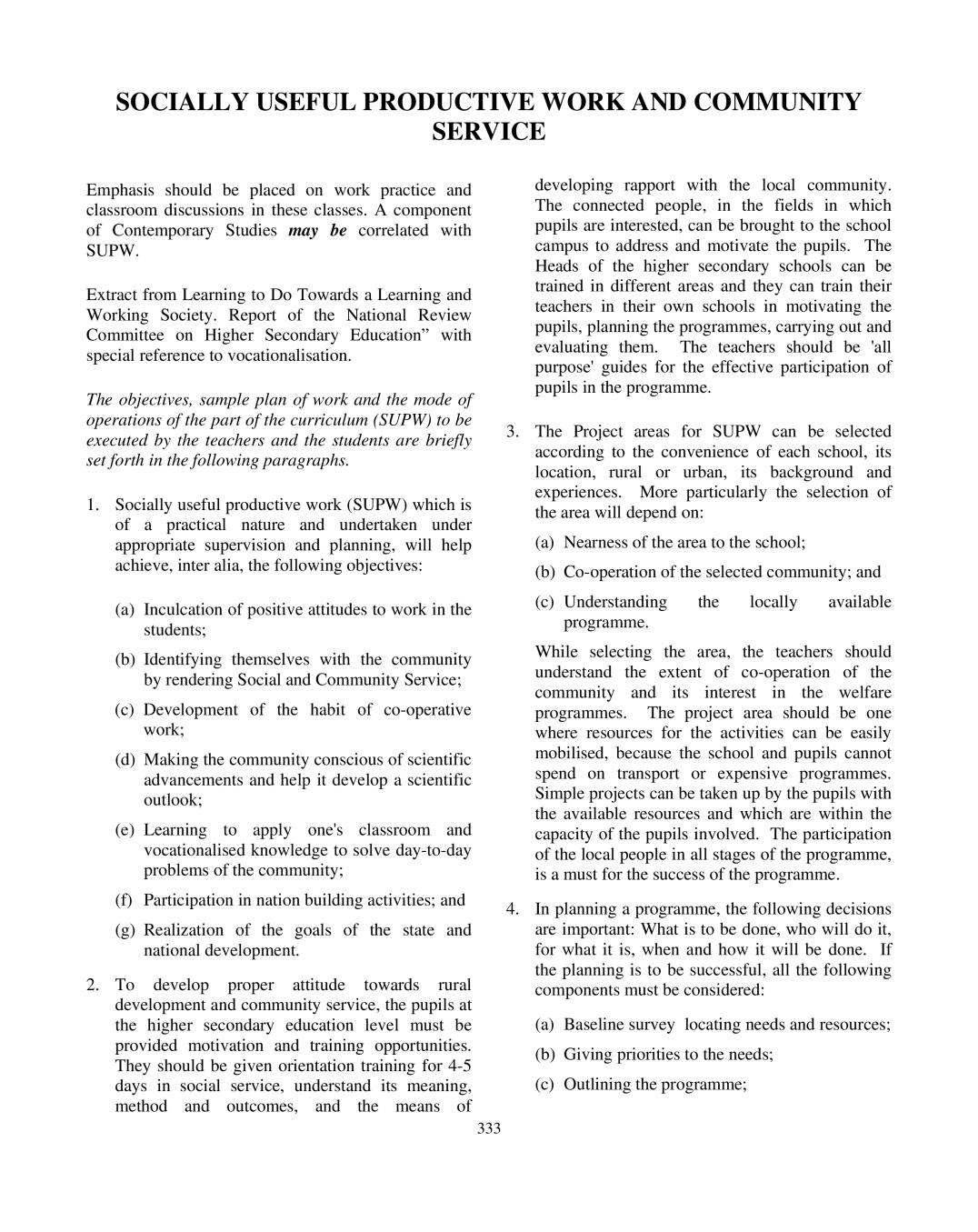
Emphasis should be placed on work practice and classroom discussions in these classes. A component of
Contemporary Studies may be correlated with SUPW.
Extract from “Learning to Do Towards a Learning and Working Society: Report of the National Review
Committee on Higher Secondary Education” with special reference to vocationalisation.
The objectives, sample plan of work and the mode of operations of the part of the curriculum (SUPW) to be
executed by the teachers and the students are briefly set forth in the following paragraphs.
1. Socially useful productive work (SUPW) which is of a practical nature and undertaken under appropriate
supervision and planning, will help achieve, inter alia, the following objectives:
(a) Inculcation of positive attitudes to work in the students;
(b) Identifying themselves with the community by rendering Social and Community Service;
(c) Development of the habit of co-operative work;
(d) Making the community conscious of scientific advancements and help it develop a scientific outlook;
(e) Learning to apply one's classroom and vocationalised knowledge to solve day-to-day problems of the
community;
(f) Participation in nation building activities; and
(g) Realisation of the goals of the state and national development.
2. To develop proper attitude towards rural development and community service, the pupils at the higher
secondary education level must be provided motivation and training opportunities. They should be given
orientation training for 4-5 days in social service, understand its meaning, method and outcomes, and the
means of developing rapport with the local community. The connected people, in the fields in which pupils
are interested, can be brought to the school campus to address and motivate the pupils. The Heads of the
higher secondary schools can be trained in different areas and they can train their teachers in their own schools
in motivating the pupils, planning the programmes, carrying out and evaluating them. The teachers should be
'all purpose' guides for the effective participation of pupils in the programme.
3. The Project areas for SUPW can be selected according to the convenience of each school, its location, rural
or urban, its background and experiences. More particularly the selection of the area will depend on:
(a) Nearness of the area to the school;
(b) Co-operation of the selected community; and
(c) Understanding the locally available programme.
While selecting the area, the teachers should understand the extent of co-operation of the community and its
interest in the welfare programmes. The project area should be one where resources for the activities can be
easily mobilised, because the school and pupils cannot spend on transport or expensive programmes. Simple
projects can be taken up by the pupils with the available resources and which are within the capacity of the
pupils involved. The participation of the local people in all stages of the programme, is a must for the success
of the programme.
4. In planning a programme, the following decisions are important: What is to be done, who will do it, for what
it is, when and how it will be done. If the planning is to be successful, all the following components must be
considered:
(a) Baseline survey locating needs and resources;
(b) Giving priorities to the needs;
1
Page 5
(d) Conducting the programme;
(e) Concluding the programme.
A simple survey should be conducted by the pupils in their selected project areas, to help them to understand
the needs of the people, the resources available in the area, and decide what could be done by them. With the
help of all the teachers in the school, and based on the needs of the people, programmes can be outlined for
the specified period of work (two years) in the community. Annual work plans can be prepared by the teachers
as a guidepost for both the teachers and the students. A sample plan on a savings campaign is given below.
A Sample Plan of Work (Savings Campaign)
Week Purpose Methods Persons to be Involved Place to be adopted
I Contacting the village Home Visits. Pupils, teachers and local Individual houses.
leaders and people. leaders.
II Baseline survey to learn Interview. Homemakers, teachers Individual houses.
the income and and pupils.
&
expenditure and savings
III pattern in the area.
IV Introduce the need and Group meetings, People, District, Savings Community hall or
method of savings. charts, posters and Officer, Pupils and School .
exhibits. teachers.
V Explaining various Home visits, Group Pupils and teachers Gram Individual houses.
methods of savings. discussion with Sevikas and Gram Sevaks.
charts and pamphlets.
VI Helping them to reach the Field visits, Postmaster, leaders in the Post Office.
Post office. Discussions, community, pupils and
Demonstrations. teachers.
VII Educating the people on Lecture-cum- Representative from School.
Bank Saving. Discussion. nearby bank, pupils and
teachers
VIII Helping people to go to Field Visits, Interested people, Bank Bank.
the bank and open Discussion. Manager, Pupils and
savings accounts. teachers..
IX Educating the people in Lecture-cum- Small Scale Industries Community Hall.
economic improvement. Discussion. Officer, Pupils and
Teachers.
X Starting simple income- Demonstration. Pupils, Teachers. Community Hall and
generating programmes. Concerned People. individual houses.
XI Follow-up (continued). All methods and Concerned people. Appropriate places.
techniques.
2
Page 6
important in order also to minimise the expenditure and effort. The teachers should know the infrastructure
available and be aware as to how to make use of them for the success of the programme. The infrastructure
available for the welfare of the community is:
(a) District Collectorate
(b) Panchayat Union
(c) Village Panchayat
(d) Elementary School
(e) Primary Health Centre
(f) Municipality
(g) Small Savings Organisation
(h) Field Publicity Office
(i) Sarvodaya Sangh
(j) Local Organisations, such as, Parent Teachers' Association and Service Clubs - such as, Rotary, Lions,
Jaycees and others.
To get the assistance and co-operation of those who make up this infrastructure, they should be apprised and
involved at all the stages of the programme development - from the planning, through execution to evaluation.
6. The programmes selected must be suitable to the age level and competencies of the pupils and the needs of
the community. Both general types of productive programmes and specific productive projects related to the
subject matter of each student can be undertaken. The following general programmes can be undertaken by
all the pupils irrespective of their subjects (electives) of study:
(a) Fact finding;
(b) Tree Planting;
(c) Cleanliness and Sanitation;
(d) Deepening ponds, construction of contour-bounds, community halls, road laying;
(e) Small Savings Drive;
(f) Health and Nutrition Education;
(g) Celebration of National Days and festivals;
(h) Organising film shows;
(i) Organising libraries/book banks and mobile laboratories;
(j) Hospital work;
(k) Conducting programmes in Balwari (games and music);
(l) Coaching children;
(m) Adult literacy;
(n) Camps in the adopted area.
Students who are pursuing language studies should take up Adult Education under Socially Useful Productive
Work.
3
Page 7
students, allowing also for any other kind of work depending upon the facilities available in the
neighbourhood. The students who are studying Home Science may, for instance, work with the community
for improvement of the nutritional status of the population, utilising the local products for developing cheap
and wholesome diets. The students of Chemistry may undertake useful work of soil fertilisers and water,
removal of pollution, utilisation of wastes, etc. Those of Physics may similarly work on rural electrification,
improvement of small scale and cottage industries, etc. Biology students may serve in primary health centres
and promote other health measures or help farmers, horticulturists, etc., for improving productivity. Political
Science students may work with Panchayat Administration, local bodies, etc., for purposes of improving
various services to the community.
The above are illustrations of the kind of Socially Useful Productive Work which the students, pursuing
academic studies, may undertake. Obviously, there are many more areas that can be tackled in one's own
environment. A list of certain subject matter related activities is set forth:
(1) Indian Languages
(i) Writing short stories and skits.
(ii) Developing leadership qualities and through education debates.
(iii) Developing artistic tendency - painting, drawing and other fine arts.
(iv) Promoting national integration.
(v) Encouraging them to read newspapers - knowledge about current affairs.
(vi) Adult literacy and adult education.
(vii) Coaching school children.
(2) History
(i) Dramatisation programmes.
(ii) Screening historical films.
(iii) Publication of historical leaflets and booklets.
(iv) Organisation of exhibitions of historical value.
(v) Debates and oratorical competitions regarding the political set up of the country.
(vi) Discussions and utilisation of local resources.
(vii) Encouraging the pupils to adopt such hobbies as are of educational value.
(3) Geography
(i) Radio broadcasts on weather conditions.
(ii) Making the villagers to understand the radio broadcasts.
(iii) Working models of volcanoes and earthquakes.
(iv) Survey work of the lands and roads.
(v) Attending the Panchayat Union Meetings and discussions.
(4) Mathematics
(i) Encouraging the pupils to learn mathematics by pointing out its use in the world at present.
(ii) Helping the adults and unemployed to run a co-operative store selling goods at controlled price.
(iii) Teaching them to make toys with simple models like triangles, spheres etc.
(iv) Helping them to discriminate between British units, and the metric system.
4
Page 8
can be done by actually showing the weights, scales and meter scale.
(5) Physics
(i) Giving basic knowledge about how to prevent electric shock accidents.
(ii) Giving knowledge about how lightning and thunder occur and what are the uses of lightning and thunder
and the thunder arrester.
(iii) Teaching how we receive sound from the radio which is relayed from the Radio Station.
(iv) Preparing hot water with the help of solar heat or energy.
(v) Giving knowledge about how to produce artificial rain.
(vi) Teaching how to get electricity from water and steam.
(vii) Giving basic knowledge about how to operate the machines like washing machine, grinding-machine,
electric cookers, etc.
(viii) Giving knowledge about how sound is produced from various sound instruments.
(6) Chemistry
(i) Preparation of soap and washing soda.
(ii) Explaining the uses of Dettol and Phenyl for cleanliness.
(iii) Preparation of tincture and simple ointments for wounds.
(iv) Preparation of dyes.
(v) Explaining the preparation of bleaching powder.
(vi) Explaining the equipping techniques and use of gobar gas plant in the houses making use of animal
waste.
(vii) Explaining the uses and preparation of ammonium nitrate.
(viii) Explaining the fixation of nitrogen.
(ix) Explaining the uses of insecticides.
(x) Demonstrating the method of purifying water.
(7) Biology
(i) Helping the farmers to get rid of insect pests.
(ii) Learning methods of vegetative propagation.
(iii) Introducing modern techniques of incubation in poultry.
(iv) Practicing the way of getting uniform fruiting and blossoming through simple techniques using
chemicals (Hormones).
(v) Leathering of economically important animals.
(vi) Making students aware of economic Zoology.
(vii) Providing knowledge on crop rotation.
(viii) Making students aware of the various sources of nitrogen manure in the form of nitrogen yielding plants
(legumes) and easily available cultures to increase the yield.
(ix) Making students aware of contamination.
5
Page 9
(i) Raising a kitchen garden.
(ii) Helping the rural people to have poultry units and to do bee keeping.
(iii) Organising rural Balwari.
(iv) Low-cost nutritious food-demonstration.
(v) Improving arts and crafts.
(vi) Make use of compost pits.
(vii) Pest control measures.
(viii) Nutrition education through various games.
8. Fifteen per cent of the working time is to be spent for Socially Useful Productive Work. It amounts to about
150 hours a year. The 150 hours can be distributed throughout the year according to the convenience of
schools. Sometimes, if it is impossible to give them every week, a stretch of several hours could be given
during the year, for a camp. But continuity should be assured in the work. Many adjustments have to be made
in the school timetable to give the students and teachers free time to go to the work spot. The timings suitable
for the students must also fit in with the timings of the people in the programme area. After the two-year's
programme, even when a particular batch of students completes its courses and leaves, the school should plan
for follow-up programmes in the areas, by subsequent batches of students.
9. The Heads of the institutions should nominate a senior teacher to be in charge and co-ordinate the entire
programme for the school and guide the teacher-in-charge. All teachers in the school would be guiding the
students of their own class in all aspects of the programme – planning, execution and evaluation. The Heads
of the institutions should scrutinize the records and registers maintained by the students, teachers and teacher-
in-charge (coordinator) of the programme. The work of the coordinator should be counted in the workload of
the teacher.
ASSESSMENT (CLASSES XI AND XII)
Evaluation is an important aspect of planning and execution of the Socially Useful Productive Work (including
Community Services and an optional component of Contemporary Studies) programme in schools. From the
beginning of the programme each step needs evaluation. An illustrative guide to the areas of assessment and
weightage to be given is contained in the following paragraphs.
1. Selection of Socially Useful Productive Work (including Community Service and an optional
component of Contemporary Studies)
Candidates will be required to select one craft and one service per year of preparation for the Examination,
i.e. Classes XI and XII. In addition, candidates may also select topics under Contemporary Studies per year
of preparation for the Examination.
2. Internal Assessment
The Internal Assessment will consist of assessment in (a) Socially Useful Productive Work (b) Community
Service (c) Contemporary Studies (if opted by candidates). The work undertaken by the candidates during
the two-year preparation period in each year will be assessed and marked out of 100.
6
Page 10
(i) This will be taken to mean work practice in craft. In contrast to community service, it implies the making
of articles of social use or practice of a skill.
(ii) The areas of assessment of Socially Useful Productive Work may be classified as follows:
Marks
(1) Preparation 10
(2) Organisation 20
(3) Skills 40
(4) Research 20
(5) Interest 10
(iii) Preparation: It is important to select a craft which is socially useful and within the candidates'
capabilities. It may be necessary to visit localities where certain crafts are practiced and note details of
the processes or methods involved.
(iv) Organisation: The candidates should be able to explain in writing the tools, materials and processes
required as well as draw up a timetable/programme of work.
(v) Skills: The manipulative skills of the candidates should be assessed regularly from the finished product(s)
and should include the candidates' abilities to follow the processes or methods of the craft.
(vi) Research: This is the candidate’s ability to analyse a process or method and suggest/implement
improvements and also improvise wherever necessary.
(vii) Interest: This is an assessment of the candidate’s industriousness, constancy and conscientiousness with
regard to the work undertaken. The candidates should be able to adhere to the timetable/programme of
work drawn up by them.
(viii) Record card: This should be kept for each candidate and the assessment of Socially Useful Productive
Work entered in it. A specimen of the record card is given below for guidance.
NAME OF THE SCHOOL
Internal Assessment Card for Socially Useful Productive Work
Name of Candidate:__________________________________________________________________________
Craft/Skill:_________________________________________________________________________________
ASSESSMENT RECORD
Date of Assessment Areas of Assessment
Preparation Organisation Skills Research Interest
Grade Points Grade Points Grade Points Grade Points Grade Points
7
Page 11
Grade Standard
A Very Good
B Good
C Satisfactory
D Fair
E Unsatisfactory (Fail)
4. Community Service
(i) This will be taken to mean work done in the home, school and outside, which is beneficial to the
community.
(ii) The areas of assessment of Community Service may be as under:
Marks
(1) Preparation 10
(2) Organisation 20
(3) Skills 40
(4) Resourcefulness 20
(5) Interest 10
(iii) Preparation: It is important to select a service that will be beneficial to the community. It may be
necessary to form teams or squads and to select a leader.
(iv) Organisation is the knowledge of the tools, materials and methods/processes by which the work can be
done, and the ability to draw up a timetable, or programme of work.
(v) Skills are the manipulative skills of doing the work. The quality of the candidate’s work should be
assessed.
(vi) Resourcefulness is the ability to complete the work in spite of problems and difficulties and to improvise
wherever necessary.
(vii) Interest is the assessment of the candidate’s constancy, industriousness and conscientiousness in doing
the work and their abilities to adhere to the timetable, or programme of work drawn up by them.
(viii) A record card on the lines suggested for Socially Useful Productive Work should be kept.
(ix) A practical scheme for day schools is given below:
(a) In the case of day-schools, parents should be involved in making their children aware of their
responsibilities in the home and to persons in the area in which they live. They should be encouraged
to render service in the home and to their neighbours. Such service may take the form of helping
parents in cleaning the house, making the beds, assisting in the kitchen, cleaning the backyard, helping
in the garden, visiting the sick, teaching a child, or children in the neighbourhood, and so on.
Experiments should be tried in every school in which there are day scholars.
Parents should be asked to give each child a job of work to do, which will last between 20 minutes to
half an hour each day.
(b) A diary should be kept for each child in which the parents enter this every day:
(i) Nature of work;
(ii) Time allotted;
(iii) Remark of the parent;
(iv) Signature of the parent.
Thus, it will be possible for the school to ensure that children do at least three and half-hours of
Socially Useful Productive Work and Community Service, per week.
8
Page 12
within the home and the neighbourhood and may rightly be termed 'Homework'.
The remarks to be entered by the parent should be specified so that they may be converted into grades.
(d) A suggested five points "remarks" scale is given below:
A -Very Good
B -Good
C -Satisfactory
D -Fair
E - Unsatisfactory (Fail)
(e) The class teacher should be required to enter the "grades" in a special register against each child.
5. Contemporary Studies
Pupils are to be provided a general appreciation of the topics given with a view to cultivate and inculcate
values promoting sustainable societal practices. Assessment will be done on the basis of participation in class
discussions. Grades may be awarded as for SUPW.
6. Submission of SUPW and Community Service Grades
Heads of schools will be responsible for correct entry of the SUPW (including Community Service) and
Contemporary Studies (optional) result of each candidate in terms of the Grades A, B, C, D or E.
The grades must be submitted online through the CISCE’s CAREERS portal within the stipulated due date.
9
Page 13
(Recommended to form a component of SUPW)
The aim of this section is to provide to all students the ability to comprehend social transformations and develop
in them the ability to utilise knowledge and skills to effectively address emerging opportunities. The student
should learn:
(i) To analyse concepts and practices within socio-economic, political contexts in the society.
(ii) To critically examine and evaluate various development strategies and experiences so as to be able to
generate a viewpoint of their own.
(iii) To understand the inter-relationships of development in the country, in the region and at the international
levels in commerce, trade and socio-political areas.
(iv) To develop a challenging attitude to act on the social and environmental matters in order to introduce change
for a sustainable social order.
(v) To appreciate the conflicts of interests between social and political organisations at the national and
international levels and develop a comprehensive appraisal of their impact on the individual.
CLASS XI
1. Emergence of new Society
• 'Greens' and ‘Culture Creatives’.
• Emerging trends in modern society:
− Organic Foods
− Vegetarianism
− Feminism
− Decline of the industrial age practices
− Netizens
2. Atmosphere and Climate Change
• What is the “greenhouse gas effect” and which are the “greenhouse gases”?
• Is global warming man-made?
• What are the likely consequences of global warming?
• What other climate changes are taking place?
• What measures can we take to mitigate or combat these changes?
3. Equity, Equality, Social Justice
• Constitutional provisions.
• Present political aspirations.
• Social imbalances.
• Perspectives promoting sustainable society.
10
Page 14
• Impact of burning fossil fuel on environment.
• Future of nuclear energy.
• Scope of fuel conservation.
5. Reaching Out
Types of communication networks and their utility – e-mail, facsimile, video conferencing; understanding of
the Internet as a global knowledge base and communication network.
CLASS XII
1. Understanding the New World Order
• Spirituality, Science and Society:
(i) The co-relation and need for balanced appreciation for sustainable social order.
(ii) The emergence of higher consciousness and higher spiritual commitments for meaningful living.
(iii) Scientific dimensions of spirituality.
(iv) Emerging society promoting contradictions and paradoxes.
• North-South dialogue:
(i) Unequal distribution of economic wealth.
(ii) Exploitation of world governance; instruments for enhancing the North-South divide.
(iii) Labour practices in the creation of wealth. Child labour, women labour, bonded labour. Low wages
and economic activity in India and a selected western country.
(iv) Towards practices enhancing sustainability of world trade practices.
• United Nation’s declaration for the rights of women, minorities and the child.
A critical understanding of the enshrined articles related to child, women and minorities rights.
2. Building People
• Privatisation vs Nationalisation.
• The need for governments to govern and leave economic activities to the people; role of NGOs.
• Generation of financial resources to meet governmental expenses.
• Impact of privatisation on economic development with specific reference to Insurance,
Telecommunications, Railways and Electricity.
3. Science and Technology
• Animal and human aggression:
(i) Human and non-human signals of aggression.
(ii) Weapons devised by man for offence and defence.
(iii) Nuclear weapons, control on weapons manufacture, sale to foreign powers.
(iv) Technology - does it make war more or less likely?
11
Page 15
(i) Effect of scientific developments on our lives - at work and at home.
(ii) Business on net – e-commerce, its feasibility and implications.
• Cosmology and space research:
(i) Current theories about the origins of the universe.
(ii) Probability of existence of Extra Terrestrial Intelligence.
• Emergence of new technologies and their appreciation:
(i) Non-Digital and Digital technology.
(ii) Communication technology.
(iii) Information technology.
• Biodiversity, Genetic Engineering and Cloning.
• Ecology, exploitation of natural resources.
• Interdependence of species and ecosystem and consequences of disturbing this equilibrium.
4. Dilemmas
• Patent Laws and their implications.
• Intellectual copyrights - ethical and moral dimensions.
12
Document Details
| Board / Org | CISCE |
| Exam | Class 12 |
| Type | Syllabus |
| Pages | 15 |
| Updated | 04 Aug 2026 |