TALLENTEX 2026 Sample Paper Class 7
Finished viewing? Save it for later —
Download TALLENTEX 2026 Sample Paper Class 7 (PDF · 14 pages)About TALLENTEX 2026 Sample Paper Class 7
TALLENTEX 2026 Sample Paper Class 7 is available here for free download. Published by Default for TALLENTEX, this sample paper can be viewed online or downloaded as a PDF (14 pages). Candidates preparing for TALLENTEX can use TALLENTEX 2026 Sample Paper Class 7 to understand the exam pattern, the type of questions asked, and the overall difficulty level.
Frequently Asked Questions
How can I download TALLENTEX 2026 Sample Paper Class 7?
Open this page and click the Download button to save TALLENTEX 2026 Sample Paper Class 7 as a PDF. It is completely free on AglaSem Docs.
Is TALLENTEX 2026 Sample Paper Class 7 free to download?
Yes. TALLENTEX 2026 Sample Paper Class 7 can be viewed online and downloaded as a PDF free of cost on AglaSem Docs.
How many pages does TALLENTEX 2026 Sample Paper Class 7 have?
TALLENTEX 2026 Sample Paper Class 7 contains 14 pages, which you can read online or download together as a single PDF.
Where can I find more TALLENTEX study material?
You can find more TALLENTEX question papers, sample papers, syllabus, and answer keys on AglaSem Docs.
TALLENTEX 2026 Sample Paper Class 7 – Text
Read the full text of this sample paper below — useful to quickly search, copy and reference the content online without downloading the PDF.
📄 View text version (14 pages)
Page 1
This section contains 11 Multiple Choice Questions. Each question has four choices (1), (2), (3) and (4) out of
which ONLY ONE is correct.
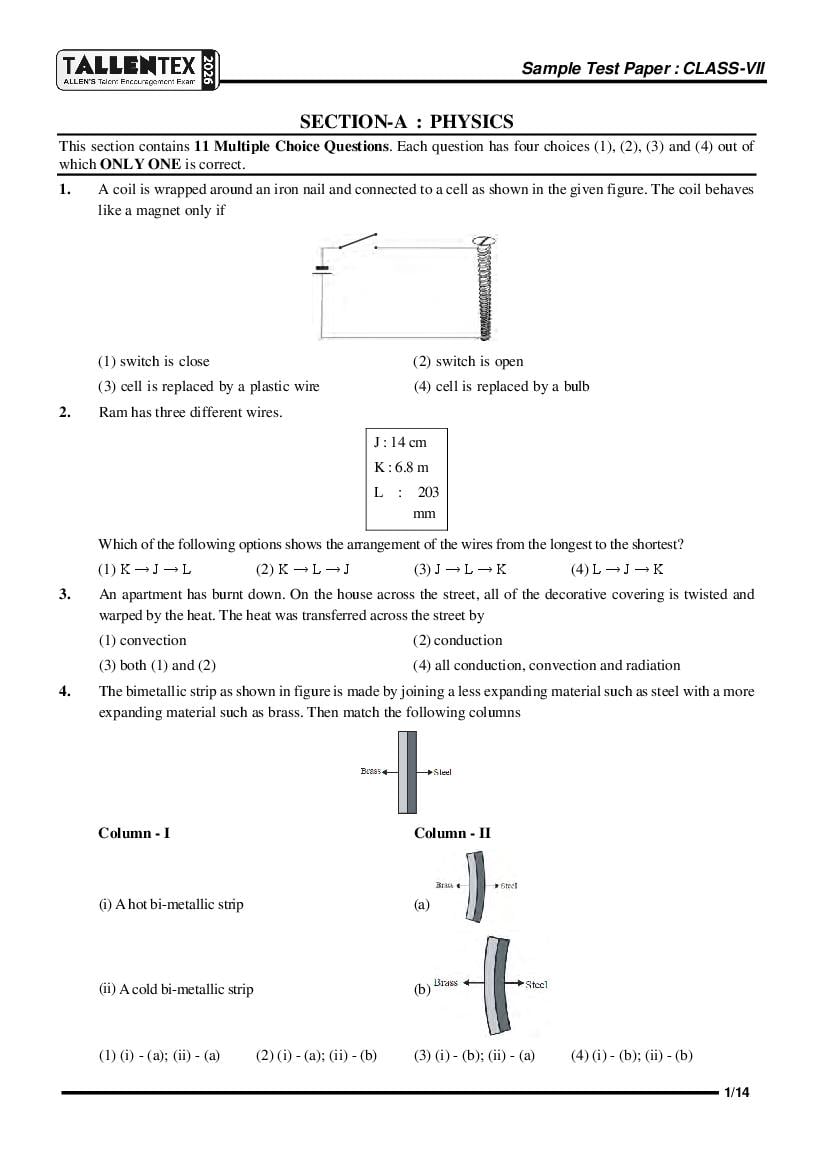
1. A coil is wrapped around an iron nail and connected to a cell as shown in the given figure. The coil behaves
like a magnet only if
(1) switch is close (2) switch is open
(3) cell is replaced by a plastic wire (4) cell is replaced by a bulb
2. Ram has three different wires.
J : 14 cm
K : 6.8 m
L : 203
mm
Which of the following options shows the arrangement of the wires from the longest to the shortest?
(1) K → J → L (2) K → L → J (3) J → L → K (4) L → J → K
3. An apartment has burnt down. On the house across the street, all of the decorative covering is twisted and
warped by the heat. The heat was transferred across the street by
(1) convection (2) conduction
(3) both (1) and (2) (4) all conduction, convection and radiation
4. The bimetallic strip as shown in figure is made by joining a less expanding material such as steel with a more
expanding material such as brass. Then match the following columns
Column - I Column - II
(i) A hot bi-metallic strip (a)
(ii) A cold bi-metallic strip (b)
(1) (i) - (a); (ii) - (a) (2) (i) - (a); (ii) - (b) (3) (i) - (b); (ii) - (a) (4) (i) - (b); (ii) - (b)
1/14
Page 2
it?
(1) nh + nb (2) h + nb (3) nh + b (4) None of these
6. Which of the following figure shows the strongest magnet?
(1) (2) (3) (4)
7. We can increase the strength of an Electromagnet by:-
(1) Increasing the magnitude of current through it. (2) Increasing the number of turns of coil around it.
(3) Both (1) and (2) (4) None of the above
8. The circuit diagram below shows D-cells connected to four light bulbs and four different materials labelled 1,
2, 3, and 4.
Which one of the materials is not a conductor of electric current?
(1) 1 (2) 2 (3) 3 (4) 4
9. 15 cm is equal to
(1) 150 mm (2) 15 mm (3) 1.5 mm (4) 0.15 mm
10. Match the following columns :
Column - I Column - II
(i) Absolute zero temperature (a) 212 °F
(ii) Boiling point of water (b) –273 °C
(iii) Freezing point of water (c) 273 K
(iv) Normal body temperature (d) 310 K
(1) (i) - (b); (ii) - (a); (iii) - (c); (iv) - (d) (2) (i) - (b); (ii) - (a); (iii) - (d); (iv) - (c)
(3) (i) - (b); (ii) - (c); (iii) - (a); (iv) - (d) (4) (i) - (c); (ii) - (a); (iii) - (b); (iv) - (d)
11. When a plastic comb is rubbed on dry hair, then plastic comb acquires
(1) Positive charge (2) Negative charge
(3) May be positive or negative (4) Neutrality
2/14
Page 3
This section contains 11 Multiple Choice Questions. Each question has four choices (1), (2), (3) and (4) out of
which ONLY ONE is correct.
12. Which of the following statements are incorrect?
(a) China Rose turns green in detergent solution. (b) The acid found in apple is oxalic acid.
(c) All alkalis are bases. (d) Acids are bitter in taste.
(1) (a), (b), (c) and (d) (2) (b) and (c) (3) (b) and (d) (4) (b), (c) and (d)
13. Mr. Mark was teaching the students about the solubility of substances. He brought three conical flasks
filled with water and labelled them as A, B and C. He then asked one of his students to add any three
substances to the conical flask such that the substance 1 and 3 are soluble and substance 2 is insoluble.
Identify the substances 1, 2 and 3 from the options given below.
14. Observe the given figure carefully and select the correct option.
Hydrochloric
acid
Sodium
hydroxide
(1) It is a neutralisation reaction. (2) It will produce common salt and water.
(3) pH of solution will be 7. (4) All of these
15. Study the table given below.
Identify X and Y :
(1) (2)
(3) (4)
16. Which of the following are neutralisation reactions ?
A. 2NaOH + H2SO4 → Na2SO4 + 2H2O B. H2SO4 + 2NH4OH →(NH4)2SO4 + 2H2O
C. Ca(OH)2 + 2HCl → CaCl2 + 2H2O D. NaOH + HNO3 → NaNO3 + H2O
(1) A & B (2) A, B & D (3) C & D (4) All of these
17. Abraham and Manju were discussing about petrol and diesel.
Abraham - Where do we get petrol and diesel?
Manju - From deep under the earth crust.
Abraham - Then we don’t need to buy it. We can get it using borewell like we pump out water.
Manju - It is not found everywhere. We need big machine to pump it out and clean it.
Abraham - How will vehicles run if the petrol and diesel finish?
Manju - ______
What would have been correct reply?
(1) On coal as it gives less smoke. (2) On kerosene as it gives less smoke.
(3) On CNG as it gives less smoke. (4) On petroleum as it gives less smoke.
3/14
Page 4
(1) I - Hand picking, II - Decantation, III - Sieving , IV - Evaporation
(2) I - Sieving, II - Filtration, III - Hand picking, IV - Evaporation
(3) I - Sieving, II - Filtration, III - Hand picking, IV - Churning
(4) I - Hand picking, II - Sieving, III - Filtration, IV - Churning
19. A gas that is colourless, odourless and extinguishes fire is
(1) Hydrogen (2) Carbon dioxide (3) Helium (4) Oxygen
20. Study the flow chart given below. Which of the following materials can P, Q and R be ?
21. Which of the following can be placed in the area marked ‘P’ in given venn diagram?
(1) Nitrogen (2) Water (3) Clay (4) Paper
22. Seema took orange juice in one glass and soap solution in another glass. Then she took strips of blue litmus
and red litmus and dipped those into both glasses one by one. What changes will she observe?
(1) Red litmus paper turns blue in orange juice. (2) Red litmus paper turns blue in soap solution.
(3) Blue litmus paper remains same in orange juice. (4) Blue litmus paper turns red in soap solution.
4/14
Page 5
This section contains 11 Multiple Choice Questions. Each question has four choices (1), (2), (3) and (4) out of
which ONLY ONE is correct.
23. Which of the following is an organism having green coloured part which can photosynthesize but still it
eats the other organism to obtain specific nutrients?
(1) Pea plant (2) Pitcher plant (3) Grapevine (4) Sunflower plant
24. Given below are six statements (a –f). Select the option which correctly fills up the blanks in any four of
these statement.
(a) The movement of leaf in response to touch is called ______.
(b) Earthworm breathes through its moist _______.
(c) Whales and dolphins have ______ as their respiratory organ.
(d) The removal of metabolic waste products from the body of living organisms is called______.
(e) Potato can vegetatively reproduce by _____.
(f) Movement of plant in response to gravity is called _____.
(1) b – skin, c – lungs, d – egestion, e – bulb
(2) a – thigmotropism, b – skin, e – tuber, f – chemotropism
(3) a – thigmotropism, b – skin, c – lungs, f – geotropism
(4) c – lungs, d – excretion, e – bulb, f – geotropism
25. Read the following statements carefully and select the option which correctly identifies the True (T) and
False (F) statements.
(I) Cuscuta forms specialized structures called haustoria to draw nutrition from host plants.
(II) Azotobacter lives in the roots of legumes and converts gaseous nitrogen into usable form.
(III) Mycorrhiza is the symbiotic association of mycelium of a fungus with an algae.
(IV) Insectivorous plants can’t synthesize their own food and obtain nutrition from insects.
(V) Indian pipe and coral roots are parasitic plants.
(VI) Fungi releases digestive juices that converts dead and decaying matter into simpler form.
I II III IV V VI
(1) T T F F F T
(2) T F F F T F
(3) T F F F F F
(4) T F F F F T
26. The diagram represents the respiratory structure in insects. Identify A, B & C –
(1) A – Tracheal tube, B – Spiracle, C – Air sac (2) A – Spiracle, B – Tracheal tube, C – Air sac
(3) A – Air sac, B – Tracheal tube, C – Spiracle (4) A – Tracheal tube, B – Air sac, C – Spiracle
5/14
Page 6
‘P’ secretes enzyme which helps in digestion of starch. ‘Q’ produces a juice which helps in fat digestion.
Identify the correct labelled diagram.
P
28. Forests are called green lungs. They help in maintaining the balance of O2 and CO2 in the atmosphere with
the help of processes A & B.
Select the option that are not correct regarding A & B.
(1) A is the process that takes place in green plants to synthesize their own food.
(2) Process B provides energy to perform different activities.
(3) Process B is performed by almost all the living organisms.
(4) Plants are called producers because of the process B.
29. Match the following and choose the correctly matched option.
(1) A-i-P, B-iii-S, C-iv-Q, D-ii-R (2) A-iii-P, B-i-Q, C-ii-R, D-iv-S
(3) A-i-R, B-iii-Q, C-ii-S, D-iv-P (4) A-iii-P, B-i-Q, C-iv-S, D-ii-R
30. Choose the incorrect statement from the given options.
(1) Part labeled ‘C’ is not true stomach.
(2) Part labeled ‘A’ is the region where complete digestion occur.
(3) Part labeled ‘D’ is the region where cud is formed.
(4) Part labeled ‘B’ is Abomasum
6/14
Page 7
Read the following passage to answer.
Food supplies an organism with many, energy-rich molecules. These molecules after digestion are taken in
by the organism's cells. Inside cells, the molecules from food are broken down to release energy that cells
can use. This energy powers cell processes that allow the entire organism to grow and live.
A. Molecules from food can provide energy to the cells.
B. Breakdown of molecules release energy.
C. Cells use energy to promote the organism's growth.
D. Conversion of small food molecules to large food molecules releases energy.
Which of the above statements are true?
(1) A and B
(2) B and C
(3) C and D
(4) A, B and C
32. In a survey of a village, some doctors found out that the children living there have very thin arm & legs
and a pot belly. From the following options, choose the irrelevant statements with reference to the
condition of the children.
(1) Such children can play and prepare for state level competitions.
(2) Such children do not even get a roti to eat in the whole day.
(3) Such children if provided with proper food would grow & develop properly.
(4) Both (1) & (2)
33. From the given pie chart it could be inferred that bread, cereals and potatoes occupy the maximum portion
of the diet of an individual. These food items are a rich source of _________?
(1) Carbohydrates
(2) Proteins
(3) Fats
(4) Minerals
7/14
Page 8
This section contains 25 Multiple Choice Questions. Each question has four choices (1), (2), (3) and (4) out of
which ONLY ONE is correct.
34. The following pictograph shows the number of mangoes purchased for a home during first four months
of an year. Read the table and answer the question given below :
Find the number of mangoes purchased for a home during January to March is
(1) 60 (2) 25 (3) 30 (4) 80
35. Seven times a number added to five times the same number gives the result 192. The number is ...................
(1) 12 (2) 96 (3) 32 (4) 16
36. Find the distance covered by an insect in crawling along the edges of top of the rectangular table as shown
in the figure.
80 cm
80 cm
(1) 220 cm (2) 200 cm (3) 280 cm (4) 240 cm
37. In a magic square each row, column and diagonal have the same sum, then the values of A and B are
respectively.
3 –4 1
–2 A 2
–1 B –3
(1) 4, 1 (2) 4, 0 (3) 1, 1 (4) 0, 4
38. 4 (x − 3) − 2 (x + 3) = 6 (x + 5)− 8 , then the value of x is
(1) 10 (2) –12 (3) –10 (4) 44
39. If ||m then find the value of x in the following figure.
(1) 43º (2) 72° (3) 115° (4) 66°
40. Absolute value of 2 × 3 – 4 × 5 is
(1) 10 (2) –14 (3) 14 (4) –11
8/14
Page 9
41. The value of 1 is
1
2
1
3
4
4 5 43 43
(1) (2) (3) (4)
29 39 4 30
42. The perimeter of the right angled isosceles triangle is 8 4 2 cm , then area of triangle is
(1) 8 cm2 (2) 16 cm2 (3) 2 2 cm2 (4) 32 2 cm2
43. The sale of electric bulbs on different days of a month is shown below and answer the following question.
Number of Electric Bulbs = 5 bulbs
Find the total number of electric bulbs sold in all the months.
(1) 80 (2) 100 (3) 20 (4) 20
14 3 1 2
44. What is the value of the expression 2 3 1 ?
3 7 6 3
1 1 1 1
(1) 1 (2) 2 (3) 3 (4) 4
2 2 2 3
1 1 1
45. On dividing Rs. 7200 among A, B and C in the ratio : : then B’s share is
3 6 4
(1) Rs. 1600 (2) Rs. 2400 (3) Rs. 3200 (4) Rs. 1200
6 5
46. Which is smaller among and
7 9
5 6
(1) (2) (3) both are equal (4) None of these
9 7
47. In the given figure, if AB||CD and BC||ED then the value of x is
(1) 75° (2) 125° (3) 105° (4) 85°
48. 7 steps to the left of 4 on number line gives
(1) 3 (2) 11 (3) –11 (4) –3
9/14
Page 10
49. The speed of a train is 75 km / hr What is the distance travelled by train in 1
3 5
8 8 8 1
(1) 12 km (2) 1200 km (3) 120 km (4) 47
15 15 15 2
50. The difference of one fifth of a number and 4 is 3. Which of the following can be the number ?
(1) 7 (2) 35 (3) 21 (4) 14
51. A pair of lines which do not intersect at any point are called lines.
(1) Perpendicular (2) Parallel (3) Concurrent (4) Intersecting
52. Which number to be added to 2, 3, 5 and 7 to be in proportion?
(1) 5 (2) 1 (3) 2 (4) 3
−51x 5 y12 − 34x12 y5 120x 7 y8 54x 2 y 4
53. Simplify the following expression × ÷
−17x 5 y5 4 3
40x y 9xy
3y 6 + 2x 6 3y 7 + 2x 7
(1) − (
× x y
2 2
) (2) (
× x y
2 2
)
1 2
3y 6 + 2x 6 3y 7 + 2x 7
(3) (
× x y
2 2
) (4) − (
× x y
2 2
)
3 2
54. Find the cost of polishing a circular table top of diameter 1.6 m, if the rate of polishing is Rs. 15 per m2.
(Take π = 3.14)
(1) Rs. 14.25 (2) Rs. 100 (3) Rs. 30.14 (4) Rs. 50.14
1 1
55. If x + 11 , then the value of x − is =
= .
x x
(1) 117 (2) 110 (3) 119 (4) 10
56. In the figure given below, O is the centre of the circle and OPQR is a rectangle. A is a point on PO such
1
that AO = PO and B is the mid point of OR. Find the area of the shaded region, if PA = 8cm and BR =
3
4cm. (Use π = 3.14)
(1) 132.68 cm2 (2) 121.11 cm2 (3) 108.56 cm2 (4) 146.24 cm2
57. Factors of (5x − 20y )is
4 4
(1) 5 (2) x2 − 2y2 (3) x2 + 2y2 (4) All of these
58. The decimals 0.919, 9.19, 0.0919, 91.96 and 0.9919 can be arranged in descending order as
(1) 91.96 > 0.9919 > 0.0919 > 9.19 > 0.919 (2) 91.96 > 9.19 > 0.9919 > 0.919 > 0.0919
(3) 91.96 > 0.9919 > 9.19 > 0.0919 > 0.919 (4) 91.96 > 9.19 > 0.919 > 0.0919 > 0.9919
10/14
Page 11
This section contains 22 Multiple Choice Questions. Each question has four choices (1), (2), (3) and (4) out of
which ONLY ONE is correct.
59. Answer the given question based on the following English alphabet: A B C D E F G H I J K L M N O
P QR S TUV WXYZ
Which letter is 5th to the right of letter P?
(1) V (2) T (3) U (4) K
60. A man is facing North–East. He turns 90° in the clockwise direction and then 45° in the anti
clockwise direction. Which direction is he facing now ?
(1) North (2) South–West (3) West (4) East
61. In a certain code, “BAGGINS” is written as “#$ααφ3%@”. How is AGING written in that code?
(1) $αφ3%# (2) $αφ3%α (3) $@φ3%# (4) $αφ3#@
62. Regina wants to go to eat pizza in Dominos. She starts from Woodland shop which is in the East and
comes to the crossing.The pathway to her Left ends in PVR cinemas, straight ahead is the MacDonald’s. In
which direction is the Dominos?
(1) East (2) North (3) South (4) West
63. Choose the missing term out of the given alternatives 3C, 6F, 10J, 15O, ?
(1) 21T (2) 20T (3) 21U (4) 20S
64. If the following four words are arranged in alphabetical order, which word will come in third?
(1) Peacock (2) Pencil (3) Pear (4) Past
65. If the code for HORSE is SLIHV, what is the code for DONKEY in the same code language?
(1) WLPMVB (2) WLMPVB (3) WLPMBV (4) WLMPBV
66. Donald ranks 23rd from the bottom and 13th from the top in a class. How many students are there in the
class?
(1) 34 (2) 35 (3) 32 (4) 36
67. In the following question, you are given a fig. (X) followed by four alternative figures such that one of
the answer figures is embedded in fig. (X). Trace out the alternative figure which is embedded in
fig. (X) as its part.
(X)
(1) (2) (3) (4)
11/14
Page 12
turned left. In which direction he is walking now?
(1) North (2) South
(3) East (4) West
69. Arrange the given words in the alphabetical order and tick the one that comes at the second place.
(1) Batting (2) Banking
(3) Backing (4) Banishing
70. Choose the water image of the following combination.
SARVATR75
(1) (2)
(3) (4)
71. Choose the mirror image of the following figure (X).
(X)
(1) (2) (3) (4)
72. Complete the following series 1, 1, 3, 9, 6, 36, 10, 100, ?, ?
(1) 14, 196 (2) 15, 225
(3) 15, 255 (4) 225, 15
73. Which one of the four interchanges in signs and numbers would make the given equation correct? 6
× 4 + 2 = 16
(1) + and ×, 2 and 4 (2) + and ×, 2 and 6
(3) + and ×, 4 and 6 (4) None of these
74. Choose the venn-diagram which best illustrates the three given classes : Yak, Zebra, Deer.
(1) (2) (3) (4)
75. Find the mirror image of ‘MOWGLI’.
(1) (2)
(3) (4)
76. If ‘X’ stands for add, ‘Y’ stands for subtract and ‘Z’ stands for multiply, then what is the value of
given equation.
(7 Z 3) Y 6 X 5 = ?
(1) 5 (2) 10 (3) 15 (4) 20
12/14
Page 13
(1) (2) (3) (4)
78. Two different positions of the same dice are shown. Find the number on the face opposite to the face
showing '2'.
(1) 5 (2) 4 (3) 3 (4) 1
79. In a row of girls Aditi is 10th from right and 18th from left. How many girls are there in the row?
(1) 27 (2) 25 (3) 28 (4) 29
80. Which one of the following correctly represents the relation among Mango, fruit and vegetables?
(1) (2) (3) (4)
13/14
Page 14
Que. 1 2 3 4 5 6 7 8 9 10 11 12 13 14 15
Ans. 1 2 2 3 2 4 3 4 1 1 2 3 3 4 1
Que. 16 17 18 19 20 21 22 23 24 25 26 27 28 29 30
Ans. 4 3 3 2 4 2 2 2 3 4 3 3 4 4 2
Que. 31 32 33 34 35 36 37 38 39 40 41 42 43 44 45
Ans. 4 1 1 1 4 3 4 3 1 3 4 1 2 4 1
Que. 46 47 48 49 50 51 52 53 54 55 56 57 58 59 60
Ans. 2 3 4 3 2 2 2 2 3 1 2 4 2 3 4
Que. 61 62 63 64 65 66 67 68 69 70 71 72 73 74 75
Ans. 2 2 3 3 2 2 2 2 4 4 3 2 3 3 2
Que. 76 77 78 79 80
Ans. 4 2 4 1 4
14/14
Document Details
| Board / Org | Default |
| Exam | TALLENTEX |
| Type | Sample Paper |
| Pages | 14 |
| Updated | 24 Sep 2026 |