NCERT Book Class 9 Science Chapter 8 Force and laws of motion
Finished viewing? Save it for later —
Download NCERT Book Class 9 Science Chapter 8 Force and laws of motion (PDF · 16 pages)About NCERT Book Class 9 Science Chapter 8 Force and laws of motion
NCERT Book Class 9 Science Chapter 8 Force and laws of motion is available here for free download. Published by NCERT for Class 9, this books can be viewed online or downloaded as a PDF (16 pages). Candidates preparing for Class 9 can use NCERT Book Class 9 Science Chapter 8 Force and laws of motion to understand the exam pattern, the type of questions asked, and the overall difficulty level.
Frequently Asked Questions
How can I download NCERT Book Class 9 Science Chapter 8 Force and laws of motion?
Open this page and click the Download button to save NCERT Book Class 9 Science Chapter 8 Force and laws of motion as a PDF. It is completely free on AglaSem Docs.
Is NCERT Book Class 9 Science Chapter 8 Force and laws of motion free to download?
Yes. NCERT Book Class 9 Science Chapter 8 Force and laws of motion can be viewed online and downloaded as a PDF free of cost on AglaSem Docs.
How many pages does NCERT Book Class 9 Science Chapter 8 Force and laws of motion have?
NCERT Book Class 9 Science Chapter 8 Force and laws of motion contains 16 pages, which you can read online or download together as a single PDF.
Where can I find more Class 9 study material?
You can find more Class 9 question papers, sample papers, syllabus, and answer keys on AglaSem Docs.
NCERT Book Class 9 Science Chapter 8 Force and laws of motion – Text
Read the full text of this books below — useful to quickly search, copy and reference the content online without downloading the PDF.
📄 View text version (1 page)
Page 1
FORCE AND LAWS OF MOTION
In the previous chapter, we described the In our everyday life we observe that some
motion of an object along a straight line in effort is required to put a stationary object
terms of its position, velocity and acceleration. into motion or to stop a moving object. We
We saw that such a motion can be uniform ordinarily experience this as a muscular effort
or non-uniform. We have not yet discovered and say that we must push or hit or pull on
what causes the motion. Why does the speed an object to change its state of motion. The
of an object change with time? Do all motions concept of force is based on this push, hit or
require a cause? If so, what is the nature of pull. Let us now ponder about a ‘force’. What
this cause? In this chapter we shall make an is it? In fact, no one has seen, tasted or felt a
attempt to quench all such curiosities. force. However, we always see or feel the effect
For many centuries, the problem of of a force. It can only be explained by
motion and its causes had puzzled scientists describing what happens when a force is
and philosophers. A ball on the ground, when applied to an object. Pushing, hitting and
given a small hit, does not move forever. Such pulling of objects are all ways of bringing
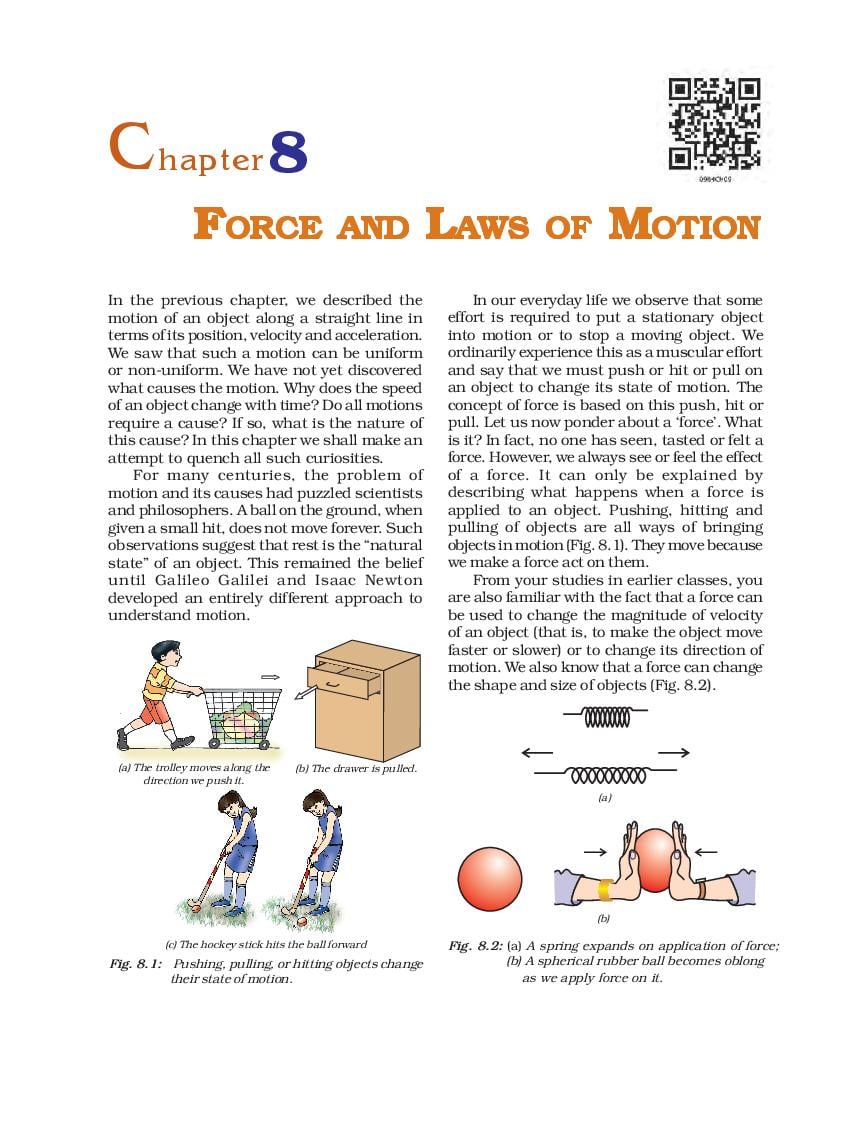
observations suggest that rest is the “natural objects in motion (Fig. 8.1). They move because
state” of an object. This remained the belief we make a force act on them.
until Galileo Galilei and Isaac Newton From your studies in earlier classes, you
developed an entirely different approach to are also familiar with the fact that a force can
understand motion. be used to change the magnitude of velocity
of an object (that is, to make the object move
faster or slower) or to change its direction of
motion. We also know that a force can change
the shape and size of objects (Fig. 8.2).
(a) The trolley moves along the (b) The drawer is pulled.
direction we push it.
(a)
(b)
(c) The hockey stick hits the ball forward Fig. 8.2: (a) A spring expands on application of force;
Fig. 8.1: Pushing, pulling, or hitting objects change (b) A spherical rubber ball becomes oblong
their state of motion. as we apply force on it.
Showing the first page only. Download the PDF above for the complete document.
Document Details
| Board / Org | NCERT |
| Exam | Class 9 |
| Type | Books |
| Pages | 16 |
| Updated | 22 Jul 2026 |